Self-care deficit theory of nursing
Violeta A. Berbiglia and Barbara Banfield
“Nursing is practical endeavor, but it is practical endeavor engaged in by persons who have specialized theoretic nursing knowledge with developed capabilities to put this knowledge to work in concrete situations of nursing practice”
(Orem, 2001, p. 161).
Dorothea E. Orem
1914 to 2007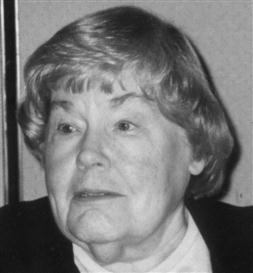
Credentials and background of the theorist
Dorothea Elizabeth Orem, one of America’s foremost nursing theorists, was born in Baltimore, Maryland, in 1914. She began her nursing career at Providence Hospital School of Nursing in Washington, DC, where she received a diploma of nursing in the early 1930s. Orem received a BS in Nursing Education from Catholic University of America (CUA) in 1939, and she received an MS in Nursing Education from the same university in 1946.
Photo credit: Gerd Bekel Archives, Cloppenburg, Germany.
Previous authors: Susan G. Taylor, Angela Compton, Jeanne Donohue Eben, Sarah Emerson, Nergess N. Gashti, Ann Marriner Tomey, Margaret J. Nation, and Sherry B. Nordmeyer. Sang-arun Isaramalai is acknowledged for research and editorial assistance in a previous edition.
Orem’s early nursing experiences included operating room nursing, private duty nursing (home and hospital), hospital staff nursing on pediatric and adult medical and surgical units, evening supervisor in the emergency room, and biological science teaching. Orem held the directorship of both the nursing school and the Department of Nursing at Providence Hospital, Detroit, from 1940 to 1949. After leaving Detroit, she spent 8 years (1949 to 1957) in Indiana working at the Division of Hospital and Institutional Services of the Indiana State Board of Health. Her goal was to upgrade the quality of nursing in general hospitals throughout the state. During this time, Orem developed her definition of nursing practice (Orem, 1956).
In 1957, Orem moved to Washington, DC, to take a position at the Office of Education, U.S. Department of Health, Education, and Welfare, as a curriculum consultant. From 1958 to 1960, she worked on a project to upgrade practical nurse training. That project stimulated a need to address the question: What is the subject matter of nursing? As a result, Guides for Developing Curricula for the Education of Practical Nurses was developed (Orem, 1959). Later that year, Orem became an assistant professor of nursing education at CUA. She subsequently served as acting dean of the School of Nursing and as associate professor of nursing education. She continued to develop her concepts of nursing and self-care at CUA. Formalization of concepts sometimes was accomplished alone and sometimes with others. Members of the Nursing Models Committee at CUA and the Improvement in Nursing Group, which later became the Nursing Development Conference Group (NDCG), all contributed to the development of the theory. Orem provided intellectual leadership throughout these collaborative endeavors.
In 1970, Orem left CUA and began her own consulting firm. Orem’s first published book was Nursing: Concepts of Practice (Orem, 1971). She was editor for the NDCG as they prepared and later revised Concept Formalization in Nursing: Process and Product (NDCG, 1973, 1979). In 2004, a reprint of the second edition was produced and distributed by the International Orem Society for Nursing Science and Scholarship (IOS). Subsequent editions of Nursing: Concepts of Practice were published in 1980, 1985, 1991, 1995, and 2001. Orem retired in 1984 and continued working, alone and with colleagues, on the development of the Self-Care Deficit Nursing Theory (SCDNT).
Georgetown University conferred on Orem the honorary degree of Doctor of Science in 1976. She received the CUA Alumni Association Award for Nursing Theory in 1980. Other honors received included Honorary Doctor of Science, Incarnate Word College, 1980; Doctor of Humane Letters, Illinois Wesleyan University, 1988; Linda Richards Award, National League for Nursing, 1991; and Honorary Fellow of the American Academy of Nursing, 1992. She was awarded the Doctor of Nursing Honoris Causae from the University of Missouri in 1998.
At age 92, Dorothea Orem’s life ended after a period of being bedridden. She died Friday, June 22, 2007, at her residence on Skidaway Island, Georgia. Survivors were her lifelong friend, Walene Shields of Savannah, and her cousin Martin Conover of Minneapolis, Minnesota. Tributes by Orem’s close colleagues were featured in the IOS official journal, Self-Care, Dependent-Care & Nursing (SCDCN).
Orem’s many papers and presentations provide insight into her views on nursing practice, nursing education, and nursing science. Some of these papers are now available to nursing scholars in a compilation edited by Renpenning and Taylor (2003). Other papers of Orem and scholars who worked with her in the development of the theory can be found in the Orem Archives at The Alan Mason Chesney Medical Archives of the Johns Hopkins Medical Institutions.
Theoretical sources
Orem (2001) stated, “Nursing belongs to the family of health services that are organized to provide direct care to persons who have legitimate needs for different forms of direct care because of their health states or the nature of their health care requirements” (p. 3). Like other direct health services, nursing has social features and interpersonal features that characterize the helping relations between those who need care and those who provide the required care. What distinguishes these health services from one another is the helping service that each provides. Orem’s SCDNT provides a conceptualization of the distinct helping service that nursing provides.
Early on, Orem recognized that if nursing was to advance as a field of knowledge and as a field of practice, a structured, organized body of nursing knowledge was needed. From the mid-1950s, when she first put forth a definition of nursing, until shortly before her death in 2007, Orem pursued the development of a theoretical structure that would serve as an organizing framework for such a body of knowledge.
The primary source for Orem’s ideas about nursing was her experiences in nursing. Through reflection on nursing practice situations, she was able to identify the proper object, or focus, of nursing. The question that directed Orem’s (2001) thinking was, “What condition exists in a person when judgments are made that a nurse(s) should be brought into the situation?” (p. 20). The condition that indicates the need for nursing assistance is “the inability of persons to provide continuously for themselves the amount and quality of required self-care because of situations of personal health” (Orem, 2001, p. 20). It is the proper object or focus that determines the domain and boundaries of nursing, both as a field of knowledge and as a field of practice. The specification of the proper object of nursing marks the beginning of Orem’s theoretical work. The efforts of Orem, working independently as well as with colleagues, resulted in the development and refinement of the SCDNT. Consisting of a number of conceptual elements and theories that specify the relationships among these concepts, the SCDNT is a general theory, “one that is descriptively explanatory of nursing in all types of practice situations” (Orem, 2001, p. 22). Originally, three specific theories were articulated, the theory of nursing systems, the theory of self-care deficits, and the theory of self-care. An additional theory, the theory of dependent care, has been articulated. This theory is regarded as being parallel with the theory of self-care and serves to illustrate the ongoing development of the SCDNT.
In addition to her experiences in nursing practice situations, Orem was well versed in contemporary nursing literature and thought. Her association with nurses over the years provided many learning experiences, and she viewed her work with graduate students and her collaborative work with colleagues as valuable endeavors. Orem cited many other nurses’ works in terms of their contributions to nursing, including, but not limited to, Abdellah, Henderson, Johnson, King, Levine, Nightingale, Orlando, Peplau, Riehl, Rogers, Roy, Travelbee, and Wiedenbach.
Orem’s familiarity with literature was not limited to nursing literature. In her discussion of various topics related to nursing, Orem cited authors from a number of other disciplines. The influence of scholars such as Allport (1955), Arnold (1960a, 1960b), Barnard (1962), Fromm (1962), Harre (1970), Macmurray (1957, 1961), Maritain (1959), Parsons (1949, 1951), Plattel (1965), and Wallace (1979, 1996) can be seen in Orem’s ideas and positions. Familiarity with these sources helps to promote a comprehensive understanding of Orem’s work.
Foundational to Orem’s SCDNT is the philosophical system of moderate realism. Banfield (1998, 2008, 2011) conducted philosophical inquiries to explicate the metaphysical and epistemological underpinnings of Orem’s work. These inquiries revealed consistency between Orem’s views regarding the nature of reality, human beings, the environment and nursing as a science; ideas and positions associated with the philosophy of moderate realism. Taylor, Geden, Isaramalai, and Wongvatunyu (2000) have also explored the philosophical foundations of the SCDNT.
According to the moderate realist position, there is a world that exists independent of the thoughts of the knower. Although the nature of the world is not determined by the thoughts of the knower, it is possible to obtain knowledge about the world.
Orem did not specifically address the nature of reality; however, statements and phrases that she uses reflect a moderate realist position. Four categories of postulated entities are identified as establishing the ontology of the SCDNT (Orem, 2001, p. 141). These four categories are (1) persons in space-time localizations, (2) attributes or properties of these persons, (3) motion or change, and (4) products brought into being.
With regard to the nature of human beings, “the view of human beings as dynamic, unitary beings who exist in their environments, who are in the process of becoming, and who possess free-will as well as other essential human qualities” is foundational to the SCDNT (Banfield, 1998, p. 204). This position, which reflects the philosophy of moderate realism, can be seen throughout Orem’s work.
Orem (1997) identified “five broad views of human beings that are necessary for developing understanding of the conceptual constructs of the SCDNT and for understanding the interpersonal and societal aspects of nursing systems” (p. 28). These are the view of person, agent, user of symbols, organism,and object. The view of human beings as person reflects the philosophical position of moderate realism; it is this position regarding the nature of human beings that is foundational to Orem’s work. She made the point that taking a particular view for some practical purpose does not negate the position that human beings are unitary beings (Orem, 1997, p. 31).
The view of person-as-agent is central to the SCDNT. Self-care, which refers to those actions in which a person engages for the purpose of promoting and maintaining life, health, and well-being, is conceptualized as a form of deliberate action. “Deliberate action refers to actions performed by individual human beings who have intentions and are conscious of their intentions to bring about, through their actions, conditions or states of affairs that do not at present exist” (Orem, 2001, pp. 62–63). When engaging in deliberate action, the person acts as an agent. The view of person-as-agent is also reflected in the SCDNT’s conceptual elements of the nursing care and dependent care. In relation to the view of person-as-agent and the idea of deliberate action, Orem cited a number of scholars, including Arnold, Parsons, and Wallace. She identified seven assumptions regarding human beings that pertain to deliberate action (Orem, 2001, p. 65). These explicit assumptions, while addressing deliberate action, rest upon the implicit assumption that human beings have free will.
The SCDNT represents Orem’s work regarding the substance of nursing as a field of knowledge and as a field of practice. She also put forth a position regarding the form of nursing as a science, identifying it as a practical science. In relation to her ideas about the form of nursing science, Orem cites the work of Maritain (1959) and Wallace (1979), philosophers who were associated with the moderate realist tradition, . In practical sciences, knowledge is developed for the sake of the work to be done. In the case of nursing, knowledge is developed for the sake of nursing practice. Two components make up the practical science: the speculative and the practical. The speculatively practical component is theoretical in nature, while the practically practical component is directive of action. The SCDNT represents speculatively practical knowledge. Practically practical nursing science is made up of models of practice, standards of practice, and technologies.
Orem (2001) identified two sets of speculatively practical nursing science: nursing practice sciences and foundational nursing sciences. The set of nursing practice sciences includes (1) wholly compensatory nursing science, (2) partly compensatory nursing science, and (3) supportive developmental nursing science. The foundational nursing sciences are (1) the science of self-care, (2) the science of the development and exercise of the self-care agency in the absence or presence of limitations for deliberate action, and (3) the science of human assistance for persons with health-associated self-care deficits. In relation to this proposed structure of nursing sciences, Orem stated, “the isolation, naming, and description of the two sets of sciences are based on my understanding of the nature of the practical sciences, on my knowledge of the organization of subject matter in other practice fields, and on my understanding of components of curricula for education for the professions” (pp. 174–175).
In addition to the two components or types of practical science, scientific knowledge necessary for nursing practice includes sets of applied sciences and basic non-nursing sciences. In the development of applied sciences, theories from other fields are used to solve problems in the practice field. These applied nursing sciences have yet to be identified and developed. Box 14–1 depicts the structure of nursing science.
Orem’s articulation of the form of nursing science provided the framework for the development of a body of knowledge for the education of nurses and for the provision of nursing care in concrete situations of nursing practice. The SCDNT with its conceptual elements and four theories identifies the substance or content of nursing science.
MAJOR CONCEPTS & DEFINITIONS
The self-care deficit nursing theory is a general theory composed of the following four related theories:
1. The theory of self-care, which describes why and how people care for themselves.
2. The theory of dependent-care, which explains how family members and/or friends provide dependent-care for a person who is socially dependent.
3. The theory of self-care deficit, which describes and explains why people can be helped through nursing
4. The theory of nursing systems, which describes and explains relationships that must be brought about and maintained for nursing to be produced
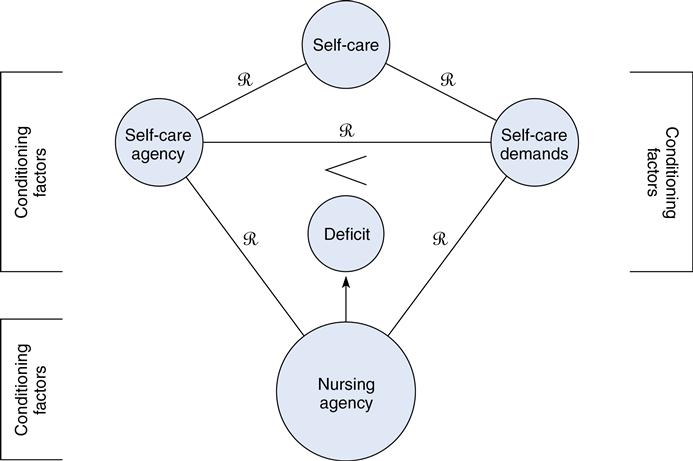
The major concepts of these theories are identified here and discussed more fully in Orem (2001), Nursing: Concepts of Practice (see Figure 14–1).

Self-care
Self-care comprises the practice of activities that maturing and mature persons initiate and perform, within time frames, on their own behalf in the interest of maintaining life, healthful functioning, continuing personal development, and well-being by meeting known requisites for functional and developmental regulations (Orem, 2001, p. 522).
Dependent care
Dependent care refers to the care that is provided to a person who, because of age or related factors, is unable to perform the self-care needed to maintain life, healthful functioning, continuing personal development, and well-being.
Self-care requisites
A self-care requisite is a formulated and expressed insight about actions to be performed that are known or hypothesized to be necessary in the regulation of an aspect(s) of human functioning and development, continuously or under specified conditions and circumstances. A formulated self-care requisite names the following two elements:
1. The factor to be controlled or managed to keep an aspect(s) of human functioning and development within the norms compatible with life, health, and personal well-being
Formulated and expressed self-care requisites constitute the formalized purposes of self-care. They are the reasons for which self-care is undertaken; they express the intended or desired result—the goal of self-care (Orem, 2001, p. 522).
Universal self-care requisites
Universally required goals are to be met through self-care or dependent care, and they have their origins in what is known and what is validated, or what is in the process of being validated, about human structural and functional integrity at various stages of the life cycle. The following eight self-care requisites common to men, women, and children are suggested:
1. Maintenance of a sufficient intake of air
2. Maintenance of a sufficient intake of food
3. Maintenance of a sufficient intake of water
4. Provision of care associated with elimination processes and excrements
5. Maintenance of balance between activity and rest
6. Maintenance of balance between solitude and social interaction
7. Prevention of hazards to human life, human functioning, and human well-being
8. Promotion of human functioning and development within social groups in accordance with human potential, known human limitations, and the human desire to be normal. Normalcy is used in the sense of that which is essentially human and that which is in accordance with the genetic and constitutional characteristics and talents of individuals (Orem, 2001, p. 225).
Developmental self-care requisites
Developmental self-care requisites (DSCRs) were separated from universal self-care requisites in the second edition of Nursing: Concepts of Practice (Orem, 1980). Three sets of DSCRs have been identified, as follows:
1. Provision of conditions that promote development
2. Engagement in self-development
3. Prevention of or overcoming effects of human conditions and life situations that can adversely affect human development (Orem, 1980, p. 231)
Health deviation self-care requisites
These self-care requisites exist for persons who are ill or injured, who have specific forms of pathological conditions or disorders, including defects and disabilities, and who are under medical diagnosis and treatment. The characteristics of health deviation as conditions extending over time determine the types of care demands that individuals experience as they live with the effects of pathological conditions and live through their durations.
Disease or injury affects not only specific structures and physiological or psychological mechanisms, but also integrated human functioning. When integrated functioning is affected seriously (severe mental retardation and comatose states), the individual’s developing or developed powers of agency are seriously impaired, either permanently or temporarily. In abnormal states of health, self-care requisites arise from both the disease state and the measures used in its diagnosis or treatment.
Care measures to meet existent health deviation self-care requisites must be made action components of an individual’s systems of self-care or dependent care. The complexity of self-care or dependent care systems is increased by the number of health deviation requisites that must be met within specific time frames.
Therapeutic self-care demand
Therapeutic self-care demand consists of the summation of care measures necessary at specific times or over a duration of time to meet all of an individual’s known self-care requisites, particularized for existent conditions and circumstances by methods appropriate for the following:
■ Controlling or managing factors identified in the requisites, the values of which are regulatory of human functioning (sufficiency of air, water, and food)
■ Fulfilling the activity element of the requisites (maintenance, promotion, prevention, and provision) (Orem, 2001, p. 523)
Therapeutic self-care demand at any time (1) describes factors in the patient or the environment that must be held steady within a range of values or brought within and held within such a range for the sake of the patient’s life, health, or well-being, and (2) has a known degree of instrumental effectiveness derived from the choice of technologies and specific techniques for using, changing, or in some way controlling patient or environmental factors.
Dependent-care demand
The summation of care measures at a specific point in time or over a duration of time for meeting the dependent’s therapeutic self-care demand when his or her self-care agency is not adequate or operational. (Taylor, Renpenning, Geden, et al, 2001, p. 40).
Self-care agency
The self-care agency is a complex acquired ability of mature and maturing persons to know and meet their continuing requirements for deliberate, purposive action to regulate their own human functioning and development (Orem, 2001, p. 522).
Dependent-care agency
Dependent-care agency refers to the acquired ability of a person to know and meet the therapeutic self-care demand of the dependent person and/or regulate the development and exercise of the dependent’s self-care agency.
Self-care deficit
Self-care deficit is the relation between an individual’s therapeutic self-care demands and his or her powers of self-care agency in which the constituent-developed self-care capabilities within self-care agency are inoperable or inadequate for knowing and meeting some or all components of the existent or projected therapeutic self-care demand (Orem, 2001, p. 522).
Dependent-care deficit
Dependent-care deficit is a relationship that exists when the dependent care provider’s agency is not adequate to meet the therapeutic self-care demand of the person receiving dependent care.
Nursing agency
Nursing agency comprises developed capabilities of persons educated as nurses that empower them to represent themselves as nurses and within the frame of a legitimate interpersonal relationship to act, to know, and to help persons in such relationships to meet their therapeutic self-care demands and to regulate the development or exercise of their self-care agency (Orem, 2001, p. 518). Nursing agency also incorporates the capabilities of nurses to assist persons who provide dependent care to regulate the development or exercise of their dependent-care agency.
Nursing design
Nursing design, a professional function performed both before and after nursing diagnosis and prescription, allows nurses, on the basis of reflective practical judgments about existent conditions, to synthesize concrete situational elements into orderly relations to structure operational units. The purpose of nursing design is to provide guides for achieving needed and foreseen results in the production of nursing toward the achievement of nursing goals; these units taken together constitute the pattern that guides the production of nursing (Orem, 2001, p. 519).
Nursing systems
Nursing systems are series and sequences of deliberate practical actions of nurses performed at times in coordination with the actions of their patients to know and meet components of patients’ therapeutic self-care demands and to protect and regulate the exercise or development of patients’ self-care agency (Orem, 2001, p. 519).
Helping methods
A helping method from a nursing perspective is a sequential series of actions that, if performed, will overcome or compensate for the health-associated limitations of individuals to engage in actions to regulate their own functioning and development or that of their dependents. Nurses use all methods, selecting and combining them in relation to the action demands on individuals under nursing care and their health-associated action limitations, as follows:
■ Acting for or doing for another
■ Providing physical or psychological support
■ Providing and maintaining an environment that supports personal development
■ Teaching (Orem, 2001, pp. 55–56)
Basic conditioning factors
Basic conditioning factors condition or affect the value of the therapeutic self-care demand and/or the self-care agency of an individual at particular times and under specific circumstances. The following ten factors have been identified:
Use of empirical evidence
As a practical science, nursing knowledge is developed to inform nursing practice. Orem (2001) stated that, “nursing is practical endeavor, but it is practical endeavor engaged in by persons who have specialized theoretic nursing knowledge with developed capabilities to put this knowledge to work in concrete situations of nursing practice” (p. 161). The provision of nursing care occurs in concrete situations. As nurses enter into nursing practice situations, they use their knowledge of nursing science to assign meaning to the features of the situation, to make judgments about what can and should be done, and to design and implement systems of nursing care. From the perspective of the SCDNT, desired nursing outcomes include meeting the patient’s therapeutic self-care demand and/or regulating and developing the patient’s self-care agency.
The conceptual elements and the specific theories of the SCDNT are abstractions about the features common to all nursing practice situations. The SCDNT was developed and refined through the use of intellectual processes that focused on nursing practice situations. For example, Orem reflected on her nursing practice experiences to identify the proper object of nursing. In their work related to the SCDNT, the Nursing Development Conference Group (1979) engaged in analysis of nursing cases and in processes of analogical reasoning. In a tribute to Orem, Allison (2008) talks about the Nursing Development Conference Group, saying that “these nurses came together because they were interested in and willing to commit themselves to examining nursing situations in order to formalize ways of thinking about nursing that they felt were descriptive of nursing and would contribute to nursing knowledge” (p. 50). Since the SCDNT was first published, extensive empirical evidence has contributed to the development of theoretical knowledge. Much of this is incorporated into continuing refinement of the theory; however, the basics of the theory remain unchanged. The theory of dependent care represents a major advancement in terms of the development of the SCDNT. “The increased need in societies for dependent-care indicates the importance for nurses of understanding dependent-care and their relationships to dependent-care agents” (Orem, 2001, p. 286).
Major assumptions
Assumptions basic to the general theory were formalized during the early 1970s and were first presented at Marquette University School of Nursing in 1973. Orem (2001) identifies the following five premises underlying the general theory of nursing:
1. Human beings require continuous, deliberate inputs to themselves and their environments to remain alive and function in accordance with natural human endowments.
2. Human agency, the power to act deliberately, is exercised in the form of care for self and others in identifying needs and making needed inputs.
3. Mature human beings experience privations in the form of limitations for action in care for self and others involving making of life-sustaining and function-regulating inputs.
4. Human agency is exercised in discovering, developing, and transmitting ways and means to identify needs and make inputs to self and others.
5. Groups of human beings with structured relationships cluster tasks and allocate responsibilities for providing care to group members who experience privations for making required, deliberate input to self and others (p. 140).
Orem stated pre-suppositions and propositions for the theory of nursing systems, the theory of self-care deficit, and the theory of self care. These constitute the expression of the theories and are summarized below.
Theoretical assertions
Presented as a general theory of nursing, one that represents a complete picture of nursing, the SCDNT is expressed in the following three theories:
The three constituent theories, taken together in relationship, constitute the SCDNT. The theory of nursing systems is the unifying theory and includes all the essential elements. It subsumes the theory of self-care deficit and the theory of self-care. The theory of self-care deficit develops the reason why a person may benefit from nursing. The theory of self-care, foundational to the others, expresses the purpose, method, and outcome of taking care of self.
Theory of nursing systems
The theory of nursing systems proposes that nursing is human action; nursing systems are action systems formed (designed and produced) by nurses through the exercise of their nursing agency for persons with health-derived or health-associated limitations in self-care or dependent care. Nursing agency includes concepts of deliberate action, including intentionality, and the operations of diagnosis, prescription, and regulation. Figure 14–1 shows the basic nursing systems categorized according to the relationship between patient and nurse actions. Nursing systems may be produced for individuals, for persons who constitute a dependent-care unit, for groups whose members have therapeutic self-care demands with similar components or who have similar limitations for engagement in self-care or dependent care, and for families or other multi-person units.
Theory of self-care deficit
The central idea of the theory of self-care deficit is that the requirements of persons for nursing are associated with the subjectivity of mature and maturing persons to health-related or health care–related action limitations. These limitations render them completely or partially unable to know existent and emerging requisites for regulatory care for themselves or their dependents. They also limit the ability to engage in the continuing performance of care measures to control or in some way manage factors that are regulatory of their own or their dependent’s functioning and development.
Self-care deficit is a term that expresses the relationship between the action capabilities of individuals and their demands for care. Self-care deficit is an abstract concept that, when expressed in terms of action limitations, provides guides for the selection of methods for helping and understanding patient roles in self-care.
Theory of self-care
Self-care is a human regulatory function that individuals must, with deliberation, perform themselves or must have performed for them to maintain life, health, development, and well-being. Self-care is an action system. Elaboration of the concepts of self-care, self-care demand, and self-care agency provides the foundation for understanding the action requirements and action limitations of persons who may benefit from nursing. Self-care, as a human regulatory function, is distinct from other types of regulation of human functioning and development, such as neuro-endocrine regulation. Self-care must be learned, and it must be performed deliberately and continuously in time and in conformity with the regulatory requirements of individuals. These requirements are associated with their stages of growth and development, states of health, specific features of health or developmental states, levels of energy expenditure, and environmental factors.
Theory of dependent-care
The theory of dependent care “explains how the self-care system is modified when it is directed toward a person who is socially dependent and needs assistance in meeting his or her self-care requisites” (Taylor & Renpenning, 2011, p. 24). For persons who are socially dependent and unable to meet their therapeutic self-care demand, assistance from other persons is necessary. In many ways self-care and dependent care are parallel, with the main difference that when providing dependent-care, the person is meeting the self-care needs of another person. For the dependent-care agent, the demands of providing dependent care can influence or condition the agent’s therapeutic self-care demand and self-care agency. The need for dependent-care is expected to grow with the increasing age of the population and the number of persons living with chronic and/or disabling conditions.
Logical form
Orem’s insight led to her initial formalization and subsequent expression of a general concept of nursing. This generalization then made possible inductive and deductive thinking about nursing. The form of the theory is shown in the many models that Orem and others have developed, such as those shown in Figure 14–1 and Figure 14–2. Orem described the models and their importance to the development and understanding of the reality of the entities. These models are “.... directed toward knowing the structure of the processes that are operational or become operational in the production of nursing systems, systems of care for individuals or for dependent-care units or multi-person units served by nurses” (Orem, 1997, p. 31). The overall theory is logically congruent.
Acceptance by the nursing community
Orem’s SCDNT has achieved a significant level of acceptance by the international nursing community, as evidenced by the magnitude of published material and presentations at the International Orem Society World Congresses (2008, 2011, and 2012). In research using the SCDNT or components, Biggs (2008) found more than 800 references. Berbiglia identified selected practice settings and SCDNT conceptual foci from a review of more than 3 decades of use of the SCDNT in practice and research and publicized selected international SCDNT practice models for the twenty-first century (in press).
The SCDNT was introduced as the basic structure for nursing management in German hospital DRG (diagnosis-related group) implementation. The movement toward SCDNT-based nursing management in Germany is credited to Bekel. Although it is difficult to fully assess the international application of the SCDNT, it is clear that, over time, Germany and Thailand have been landmark examples of the more recent utilization of the SCDNT (Bekel, 2002; Harnucharunkul, 2012). The Luxembourg Ministry of Social Security and Health co-sponsorship of the 12th IOS World Congress marked the recognition of the SCDNT as one of the frameworks for health care for Luxembourg.
The following U.S. schools are among those with SCDNT curriculum frameworks (Berbiglia, 2011, 2012):
The influence of Orem’s SCDNT has continued at the international level through the translation of Nursing Concepts of Practice into several languages (Spanish in 1993, German in 2002, and Japanese in 2005) and the proliferation of SCDNT-based practice, education, and research worldwide.
Further development
From the time of publication of the first edition of Nursing: Concepts of Practice in 1971, Orem was engaged in continual development of her conceptualizations. She worked by herself and with colleagues. The sixth and final edition was completed and published in 2001. Her work with a group of scholars, known as the Orem Study Group, further developed the various conceptualizations and structured nursing knowledge using elements of the theory. This work led to the expression of a Theory of Dependent Care (Taylor, Renpenning, Geden, et al., 2001) and the foundational Science of Self-Care (Denyes, Orem, & Bekel, 2001).
Nursing: Concepts of Practice (Orem, 2001) is organized with two foci: nursing as a unique field of knowledge and nursing as practical science. The text includes an expansion, from earlier editions, of content on nursing science and the theory of nursing systems. Important work has been done on the nature of person and interpersonal features of nursing. Orem identified many areas for further development in her descriptions of the stages of theory development. She also described the development of the Science of Self-Care, which could include concepts such as elaboration of operational functions of self-care agency with the elements of sensation and perception, appraisal, and motivation, and determining the relevance of foundational capabilities and dispositions to discreet acts. There is a need to focus on the person in the situation and on capabilities for action and self-management. This content has been expanded in the description of the foundational nursing Science of Self-Care (Denyes, Orem, & Bekel, 2001).
The IOS was established in 1993. The purpose of the IOS is to advance nursing science and scholarship through the use of Orem’s nursing conceptualizations in nursing education, practice, and research. The IOS publishes Self-Care, Dependent-Care & Nursing, an open access online journal found on the IOS website (http://www.orem-society.com/). Since its inception, the IOS has sponsored international conferences and maintains a record of the content of these conferences.
Critique
Clarity
The terms Orem used are defined precisely. The language of the theory is consistent with the twenty-first century language used in action theory and philosophy. The terminology of the theory is congruent throughout. The term self-care has multiple meanings across disciplines; Orem defined the term and elaborated the substantive structure of the concept in a way that is unique while also congruent with other interpretations. Reference has been made to the difficulty of Orem’s language; however, the limitation generally resides in the reader’s lack of familiarity with practical science and with the field of action science. Once a basic familiarity with the terminology of the SCDNT is achieved, further reading and studying of Orem’s work fosters a comprehensive understanding of her view of nursing as a field of knowledge and as a field of practice.
Simplicity
Orem’s theory is expressed in a limited number of terms. These terms are defined and used consistently in the expression of the theory. Orem’s general theory, the SCDNT, comprises the following four constituent theories: self-care, dependent-care, self-care deficit,and nursing systems. The SCDNT is a synthesis of knowledge about eight entities, which include self-care (and dependent care), self-care agency (and dependent-care agency), therapeutic self-care demand, self-care deficit, nursing agency, and nursing system. Development of the theory using these entities is parsimonious. The relationship between and among these entities can be presented in a simple diagram. The substantive structure of the theory is seen in the development of these entities. The depth of development of the concepts gives the theory the complexity necessary to describe and understand a human practice discipline.
Generality
Orem (1995) commented on the generality, or universality, of the theory as follows:
The self-care deficit theory of nursing is not an explanation of the individuality of a particular concrete nursing practice situation, but rather the expression of a singular combination of conceptualized properties or features common to all instances of nursing. As a general theory, it serves nurses engaged in nursing practice, in development and validation of nursing knowledge, and in teaching and learning nursing (pp. 166–167).
A review of the research and other literature attests to the generality of the theory.
Accessibility
As a general theory, the SCDNT provides a descriptive explanation of why persons require nursing and what processes are needed for the production of required nursing care. The concepts of the theory are abstractions of the entities that represent the proper object of nurses in concrete nursing practice situations. Self-care, dependent care, and nursing care all are forms of deliberate action engaged in to achieve a particular purpose. The concepts of therapeutic self-care demand, self-care agency, dependent-care agency, and nursing agency refer to properties of persons. Self-care deficitand dependent-care deficit refer to relationships between properties of persons. Self-care system, dependent-care system,and nursing system are systems of care that are designed and implemented to achieve desired outcomes. Basic conditioning factors refer to factors that condition or influence the variables of persons. These factors may be internal to the person, such as developmental level, or external, such as available resources. In nursing practice situations, the data collected by nurses can be categorized readily according to the concepts of the SCDNT.
For research purposes, both quantitative and qualitative research methods are appropriate for the development of knowledge related to the SCDNT. Specific research methods to be used in any investigation are selected on the basis of the questions being asked. Examples of various approaches can be found in this publication’s companion text summary of recent SCDNT-based research (Berbiglia, in press). Although the concepts of the SCDNT refer to real entities, they are complex in nature. Operationalization of these concepts requires a comprehensive understanding of Orem’s work. Instruments to measure some of these concepts have been developed.
The current emphasis in the SCDNT is on building a body of knowledge-related nursing practice, rather than engaging in theory-testing research. Instrument development has an important role in building nursing knowledge as well as other types of scholarly work. A great deal of work is needed with regard to the structuring of existent knowledge around the practice sciences and the foundational nursing sciences identified by Orem. Therefore, comprehensive descriptive studies of various populations in terms of their self-care requisites and self-care practices are needed. The structuring of existent knowledge and the findings from descriptive studies will provide a solid base for the development of instruments to measure the concepts of the SCDNT.
Importance
The SCDNT differentiates the focus of nursing from other disciplines. Although other disciplines find the theory of self-care helpful and contribute to its development, the theory of nursing systems provides a unique focus for nursing. The significance of Orem’s work extends far beyond the development of the SCDNT. In her works, she provided expression of the form of nursing science as practical science, along with a structure for ongoing development of nursing knowledge in the stages of theory development. Orem presented a visionary view of contemporary nursing practice, education, and knowledge development expressed through the general theory.
Summary
The critical question—What is the condition that indicates that a person needs nursing care?—was the starting point for the development of the SCDNT. Orem noted that it was the inability of persons to maintain on a continuous basis their own care or the care of dependents. From this observation, she began the process of formalizing knowledge about what persons need to do or have done for themselves to maintain health and well-being. When a person needs assistance, what are the appropriate nursing assistive actions? The theory of self-care describes what a person requires and what actions need to be taken to meet those requirements. The theory of dependent-care is complex. It parallels Orem’s theory of self-care. The theory of self-care deficits describes the limitations involved in meeting requirements for ongoing care and the effects they have on the health and well-being of the person or dependent. The theory of nursing systems provides the structure for examining the actions and antecedent knowledge required to assist the person. These theories also are descriptive of situations involving families and communities.
Orem’s work related to nursing as a practical science and the identification of three practice sciences and three foundational nursing sciences provides direction for the development of nursing science. This work offers a structure for the organization of existing nursing knowledge, as well as for the generation of new knowledge.
In an interview with Jacqueline Fawcett (2001), Orem identified factors essential for the development of nursing science. They included the following: (1) a model of practice science, (2) a valid, reliable, general theory of nursing, (3) models of the operations of nursing practice, (4) development of the conceptual structure of the general theory, and (5) integration of the conceptual elements of the theory with the practice operations (p. 36). Orem’s work related to the SCDNT and the form of nursing science as a practical science provides a foundation for the development of a body of knowledge. The efforts of nurse scholars and nurse researchers to build on this foundation will result in a body of knowledge that serves nurses in their provision of care to persons requiring nursing.
Critical thinking activities
Case study analysis
We will use two conceptual models to analyze this case.
The Dependency Cycle (see Figure 14–3) presents the way dependency occurs. The outer arrows show how an independent person can become dependent, progress to interdependency, and even become independent again.
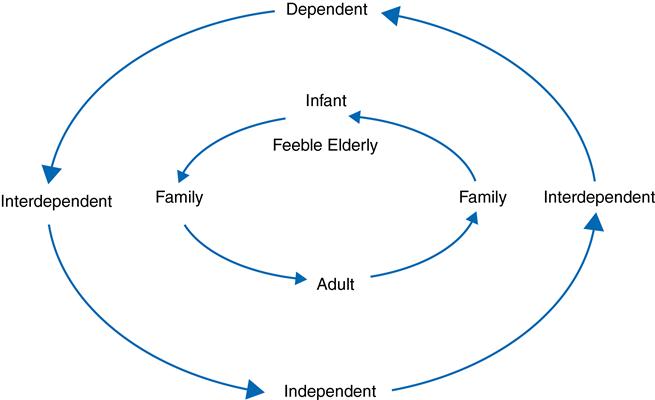
Figure 14–4 displays the Basic Dependent-Care System in which Dan and Jane are interacting.
1. Let’s examine this case through the Dependency Cycle model (see Figure 14–3). The outer arrows show a progression through varying stages of dependency. The inner circle represents who can be involved in the dependency cycle. Indicate where Jane and Dan are in this cycle.
2. Now, using the Basic Dependent-Care System model (Figure 14–4), assess Dan and Jane. Identify the basic conditioning factors (BCFs) for each. Ask “What is the effect of Dan’s BCFs on his self-care agency (SCA)?” Is he able to meet his therapeutic self-care demands (TSCDs)? Continue on to diagnose Dan’s self-care deficit (SCD) and resulting dependent-care deficit (DCD). Next, assess Jane’s self-care system (SCS).
3. Design a nursing system that addresses Jane’s SCS while she increases her role as dependent-care agent (DCA).

Points for further study
■ Fawcett, J. (1988). The nurse theorists. Portraits of excellence: Dorothea Orem (Video/DVD). Athens, (OH): Fitne, Inc.
■ Fawcett, J. (1992). Excellence in Action: Dorothea Orem (Video/DVD). Athens, (OH): FITNE, Inc.
■ The companion text for Nursing Theorists and Their Work includes Berbiglia, V. A. (in press). Orem’s self-care deficit nursing theory in practice. In M. R. Alligood (Ed.). Nursing theory: Utilization & application (5th ed., Ch. 12). St. Louis: Mosby Elsevier.
■ The International Orem Society (IOS) website at: http://scdnt.com/.
■ The Johns Hopkins Archives house the Dorothea Orem Collection at: http://www.medicalarchives.jhmi.edu.
■ The official online IOS journal, Self-Care, Dependent-Care & Nursing, is archived on the IOS website.