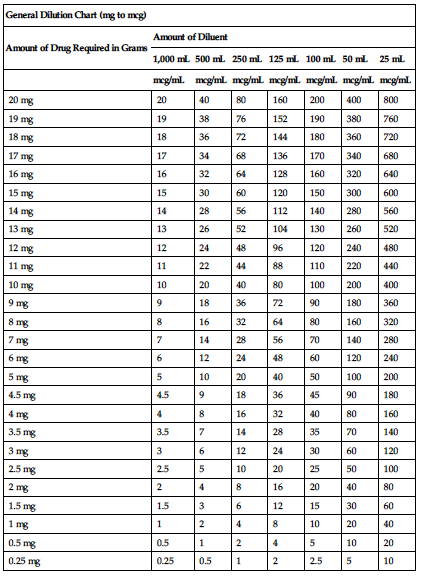
1. Find mcg/mL desired, track to amount of diluent desired and amount of drug in mg required.
2. Find amount of drug in mg required, track to diluent desired and/or mcg/mL desired.
3. Find amount of diluent required, track to amount of drug in mg and/or mcg/mL desired.
| X mg diluted in 1,000 mL = X mcg/mL (1 mg in 1,000 mL = 1 mcg/mL) |
| X mg diluted in 500 mL = 2 X mcg/mL (1 mg in 500 mL = 2 mcg/mL) |
| X mg diluted in 250 mL = 4 X mcg/mL (1 mg in 250 mL = 4 mcg/mL) |
| X mg diluted in 125 mL = 8 X mcg/mL (1 mg in 125 ml = 8 mcg/mL) |
| X mg diluted in 100 mL = 10 X mcg/mL (1 mg in 100 mL = 10 mcg/mL) |
| X mg diluted in 50 mL = 20 X mcg/mL (1 mg in 50 mL = 20 mcg/mL) |
| X mg diluted in 25 mL = 40 X mcg/mL (1 mg in 25 mL = 40 mcg/mL) |
Some variation occurs from manufacturer’s overfill or if the drug is in liquid form. If absolute accuracy is required, these variations can be avoided by withdrawing an amount in mL from the diluent equal to manufacturer’s overfill and/or an amount equal to the amount in mL of the drug. Consult the pharmacist for specific information on manufacturer’s overfill of infusion fluids used in your facility.
HOW TO USE THIS BOOK
STEP 1
Refer to the index at the back of the book. You can find any drug by any name in less than 5 seconds. All drugs are cross-indexed by generic and all known trade names. The index is easily distinguished by a printed blue bar at the edge of the pages. Drugs are also indexed by pharmacologic action. With one turn of the page, all drugs included in the text with similar pharmacologic actions and their page numbers are available to you. Everything is strictly alphabetized; you will never be required to refer to additional pages to locate a drug.
STEP 2
Turn to the single page number given after the name of the drug. All information about the drug is included as continuous reading. You will rarely be required to turn to another section of the book to be completely informed. Specific breakdowns of each drug (Usual Dose, Pediatric Dose, Dose Adjustments, Dilution, Compatibility, Rate of Administration, Actions, Indications and Uses, Precautions, Contraindications, Drug/Lab Interactions, Side Effects, and Antidote) are consistent in format and printed in boldface type. Subheadings under these categories are in boldface. Scan quickly for a Usual Dose check, Dose Adjustment, Drug/Lab Interaction, Side Effect, or Antidote or carefully read all included information. The choice is yours. A quick scan will take 5 to 10 seconds. Even the most complicated drugs will take less than 2 minutes to read completely. Read each monograph carefully and completely before administering a drug to a specific patient for the first time and review it any time a new drug is added to the patient’s drug profile.
That’s it!
A fast, complete, and accurate reference for anyone administering intravenous medications. The spiral binding is specifically designed to lie flat, leaving your hands free to secure needed supplies, prepare your medication, or even ventilate a patient while you read the needed information.
Develop the “look it up” habit.
Clear, concise language and simplicity of form contribute to quick, easy use of this handbook. Before your first use, read the preface; it contains lots of helpful information.
Check out the Intravenous Medications website for monographs no longer included in this text and for other useful IV medication information:
http://evolve.elsevier.com/IVMeds