14
Muscle Length Testing of the Lower Extremity
Tests for Muscle Length: Iliopsoas
Developed in 1876 as a method of measuring hip flexion contractures in children with tuberculosis, the Thomas test for determining iliopsoas muscle length has become “probably the most widely known and performed test for detecting decreased hip extension.”1 The original Thomas test was defined by Kendall et al2 as follows:
“The Thomas flexion test is founded upon our inability to extend a diseased hip without producing a lordosis. If there is flexion deformity, the patient is unable to extend the thigh on the diseased side, and it remains at an angle.”
The original Thomas test has undergone modifications over the years. Today the most frequent variation in the original technique is to use a goniometer to measure the amount of hip flexion while the subject holds the contralateral knee toward the chest.3,4,5
A second technique that can be used to measure iliopsoas muscle length is a modification of the technique used by the American Academy of Orthopaedic Surgeons (AAOS) to measure hip extension.6 This technique is performed with the patient in the prone position with the knee flexed to 90 degrees.
Tests for Muscle Length: Rectus Femoris
The Thomas test position also can be used to measure the length of the rectus femoris muscle. Kendall et al3 suggested that the Thomas test technique could be used not only to examine the iliopsoas muscle by taking measurements at the hip but also to examine the length of the rectus femoris muscle (a two-joint muscle) by taking measurements at the knee.
The length of the rectus femoris muscle also can be examined in the prone position. The knee is fully flexed through the full available range of motion (ROM), ensuring that the ipsilateral hip is not allowed to flex.
Tests for Muscle Length: Hamstrings
According to Gajdosik et al,7 the straight leg raise is the most common clinical test for measuring hamstring muscle length. A second type of test used for measuring hamstring muscle length is the knee extension test, which is described in the literature as performed in two ways, active8 and passive.9,10 Magee4 refers to these tests as the “90/90 test.” Measurements similar to the 90/90 knee extension test have been described in the pediatric medical literature for examination of infants; these tests are referred to as measurement of the “popliteal angle.”11,12
Sit-and-Reach Test
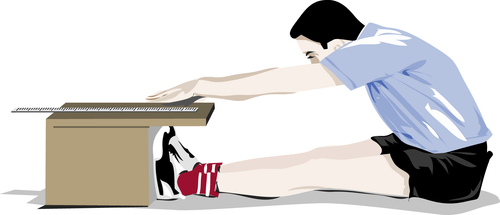
The sit-and-reach test, a field test used to measure hamstring flexibility, is a part of most health-related physical fitness test batteries.13 The test is performed by having the subject assume the long sitting posture and reach forward with both hands as far as possible, not allowing the knees to flex. A score is given based on the most distant point on a standardized box reached by both hands (Fig. 14-1).14,15
Although the sit-and-reach test has been shown to be reliable,16,17 some authors suggest that the ability to reach is influenced by hamstring flexibility, range of motion of the lumbar and thoracic spine, anthropometric factors such as legs short or arms long relative to the length of the trunk, and the amount of scapular abduction, allowing a greater reach with the arms.15,16 Jackson and Langford13 suggest that “the sit and reach test does not possess criterion-related validity as a field test for hamstring and low back flexibility.”
Chapter 1 includes information defining composite tests (tests that measure more than one motion or muscle), along with a rationale for avoiding these types of tests when examining muscle length. Given that the sit-and-reach test is influenced by so many factors, including muscle length of the upper and lower extremities and range of motion of the spine, a detailed description of this technique is not included in this chapter.
Tests for Muscle Length: Iliotibial Band and Tensor Fasciae Latae
Description of Tests
In 1935, Ober18 described a test to examine the relationship between tightness in the tensor fasciae latae and the iliotibial band and low back pain and sciatica. This test, known today as the Ober test, was used originally to examine the length of the iliotibial band and of the tensor fasciae latae in individuals with low back pain, but now it is used to examine muscle length in anyone. In addition, use of the Ober test in patients with anterior knee pain and iliotibial band friction syndrome has been documented.19,20
In 1952, Kendall et al21 presented a modification of the original Ober test, suggesting that the examiner should keep the knee extended in the extremity to be tested (as opposed to flexing the knee to 90 degrees, as originally described by Ober) while performing the examination. The test is referred to as the modified Ober test. The following reasons have been offered for modifying the original Ober test: less stress to the medial knee joint, less tension on the patella, less potential interference by a tight rectus femoris muscle,3 and a more functional test position.22 Based on a review of the literature, the Ober test and the modified Ober test appear to be used with equal frequency; neither test has been shown to be more popular, more accurate, or easier to perform than the other.
Expressing concern that the Ober test was too difficult to be used “satisfactorily,” Gautam and Anand23 suggested the use of an alternative test for examining iliotibial band and tensor fasciae latae muscle length. These authors suggested that the problem with the Ober test arose from difficulty in maintaining the hip in 0 degrees extension while at the same time attempting to examine the amount of hip adduction. They suggested that the Ober test is, therefore, a “two-plane” test (i.e., extension, abduction). Gautam and Anand23 proposed an alternate test for estimating iliotibial band contracture to be performed with the patient prone, thus eliminating the need to control hip extension. In this way, the two-plane Ober test is converted into a one-plane test of abduction. This “new test” for iliotibial band and tensor fasciae latae length is referred to in this text as the prone technique.
Quantification
Methods of quantifying the results of the Ober test and of modifications of the Ober test range from observation23,16,18 to use of the goniometer,24,25,12 the tape measure,26 and the inclinometer.22,27 Ober18 relied on observation to quantify the results, stating that “if there is no contracture present, the thigh will adduct beyond the median line.” Hoppenfeld16 suggested that when the Ober test is performed, if the iliotibial tract is “normal” the thigh should drop to the adducted position, and if “contracture” is present in the tensor fasciae latae or the iliotibial band, the thigh remains abducted. Gose and Schweizer28 presented a slightly more sophisticated classification system, which describes the position of the lower extremity relative to the horizontal body plane:
“If the leg can be passively stretched to a position horizontal but not completely adducted to the table, it constitutes ‘minimal’ tightness, especially in the proximal fascia. If the leg can be passively adducted to horizontal at best, it constitutes ‘moderate’ tightness of the iliotibial band and proximal fascia. . . . If the leg cannot passively be adducted to horizontal, this constitutes a maximal contracture of the iliotibial band throughout its expanse.”
Gajdosik et al24 suggested the use of a goniometer to quantify length of the iliotibial band and tensor fasciae latae muscles during performance of the Ober test. The stationary arm of the goniometer was aligned with both anterior superior iliac spines and the movable arm aligned with a line drawn on the midline of the thigh. (The location of the axis of the goniometer was not provided.) A value of 0 degrees was documented when the thigh was horizontal, positive values were recorded if the thigh was adducted past horizontal, and negative values were recorded if the thigh did not adduct to horizontal.
The use of a tape measure to quantify muscle length was described by Doucette and Goble.26 Subjects were placed in the Ober test position, and the distance between the medial border of the patella and the support surface was measured. Melchione and Sullivan22 and Reese and Bandy27 described use of an inclinometer placed at the distal lateral thigh of the extremity on which the modified Ober test was performed.
Tests for Muscle Length: Gastrocnemius and Soleus
The key to differentiating between muscle length testing of the gastrocnemius and soleus muscles is realizing that because of its origin on the femur and insertion on the calcaneus, the gastrocnemius crosses two joints (the knee and the ankle joints). The soleus originates from the posterior surface of the fibula and tibia and crosses only the ankle joint as it inserts into the posterior surface of the calcaneus.
Therefore, flexing the knee during muscle length testing causes the gastrocnemius to become slack across the knee, and the amount of dorsiflexion is limited only by the soleus muscle. In testing the muscle length of the gastrocnemius, the knee is extended, which elongates the muscle across the knee and the ankle.3,29
Iliopsoas Muscle Length: Thomas Test

Patient position
Patient is supine, with hip of lower extremity to be measured extended. Buttock should be toward edge of support surface so knees extend just past the edge (Fig. 14-2).
Examiner action
After instructing patient in motion desired, flex contralateral hip, bringing knee toward chest. Knee is allowed to flex fully. The contralateral hip should be flexed only enough to flatten lumbar spine against support surface (Fig. 14-3). (Note: Extremity not being flexed is extremity to be measured with goniometer and is referred to as the “tested” extremity.)
Patient action
Patient is instructed to grasp knee to chest, only enough to flatten lumbar spine against support surface (Fig. 14-4).


Goniometer alignment
Stationary arm
Lateral midline of trunk.
Axis
Greater trochanter of femur.
Moving arm
Lateral epicondyle of femur.
If muscle length of iliopsoas is within normal limits, thigh of lower extremity being measured remains on examining table. No measurement is needed. If decreased muscle length of iliopsoas is present, patient’s thigh being measured will rise off examining table. Maintaining proper goniometer alignment, read scale of goniometer for amount of hip flexion (see Fig. 14-5). (Note: If flexion of contralateral lower extremity to chest causes tested extremity to abduct rather than lift off support surface, patient may have a tight iliotibial band.)
Documentation
Record amount of hip flexion in tested extremity.
Precaution
Contralateral hip should be flexed by patient only enough to flatten lumbar spine against support surface. Pulling hip to chest and allowing inappropriate rotation of pelvis causes inaccurate measurement and should be avoided.

Iliopsoas Muscle Length: Prone Hip Extension Test

An assistant is needed to perform this measurement correctly.
Patient position
Patient is prone, knee flexed to 90 degrees (Fig. 14-6).
Examiner action (Examiner #1)
After instructing the patient in motion desired, stabilize pelvis by placing one hand on ipsilateral side; with other hand, extend patient’s hip maximally (indicated by pelvis beginning to rise), keeping knee flexed to 90 degrees (Fig. 14-7).


Goniometer alignment (Examiner #2)
Stationary arm
Lateral midline of trunk.
Axis
Greater trochanter of femur.
Moving arm
Lateral epicondyle of femur. Maintaining goniometer alignment, examiner #2 reads scale of goniometer (see Fig. 14-8).
Documentation
Record patient’s hip extension measurement.
Rectus Femoris Muscle Length: Thomas Test

Patient position
Patient is supine, with hip of lower extremity to be measured extended. Buttock should be toward edge of support surface so knees extend just past the edge (Fig. 14-9).
Examiner action
After instructing patient in motion desired, flex contralateral hip, bringing knee toward chest. Knee is allowed to flex fully. The contralateral hip should be flexed only enough to flatten lumbar spine against support surface (Fig. 14-10). (Note: Extremity not being flexed is extremity to be measured with the goniometer and is referred to as the “tested” extremity.)
Patient action
Patient is instructed to grasp knee to chest, only enough to flatten lumbar spine against support surface (Fig. 14-11).


Goniometer alignment
Palpate following bony landmarks on tested lower extremity (shown in Fig. 14-9) and align goniometer accordingly (Fig. 14-12).
Stationary arm
Greater trochanter of femur.
Axis
Lateral epicondyle of femur.
Moving arm
Lateral malleolus. If muscle length of rectus femoris is within normal limits, knee being measured remains at 90 degrees of flexion. No measurement is needed. If decreased muscle length of rectus femoris is present, patient’s knee being measured will extend slightly.
Maintaining proper goniometer alignment, read scale of goniometer for amount of knee flexion (see Fig. 14-12).
Documentation
Record knee flexion in tested extremity.
Precaution
Contralateral hip should be flexed by patient only enough to flatten lumbar spine against support surface. Pulling hip to chest and allowing inappropriate rotation of pelvis causes inaccurate measurement and should be avoided.

Rectus Femoris Muscle Length: Prone Technique

Patient position
Patient is prone, knee flexed to 90 degrees (Fig. 14-13).
Examiner action
After instructing patient in motion desired, flex patient’s knee through full available ROM while maintaining the ipsilateral hip in full extension (Fig. 14-14).
Goniometer alignment
Palpate following bony landmarks (shown in Fig. 14-13) and align goniometer accordingly (Fig. 14-15).


Stationary arm
Greater trochanter of femur.
Axis
Lateral epicondyle of femur.
Moving arm
Lateral malleolus.
Maintaining proper goniometer alignment, read scale of goniometer (see Fig. 14-15).
Documentation
Record patient’s maximum amount of knee flexion.
Note
The point at which the ipsilateral hip begins to flex during knee flexion marks the limit of rectus femoris muscle length. No further knee flexion should be attempted, and goniometric measurement of knee flexion should occur at that point. Fig. 14-16 illustrates inaccurate positioning for measurement caused by hip flexion of ipsilateral limb.

Hamstring Muscle Length: Straight Leg Raise Test

An assistant is needed to perform this measurement correctly.
Patient position
Patient is supine, with hip and knee extended (Fig. 14-17).
Examiner action (Examiner #1)
After instructing patient in motion desired, flex patient’s hip through full available ROM while maintaining knee in full extension. One hand is placed over anterior thigh to ensure knee is maintained in full extension during movement, and hip is flexed until firm muscular resistance to further motion is felt (Fig. 14-18).
Goniometer alignment (Examiner 2)
Examiner #2 palpates following bony landmarks (shown in Fig. 14-17) and aligns goniometer accordingly (Fig. 14-19).
Stationary arm
Lateral midline of trunk.
Axis
Greater trochanter of femur.


Moving arm
Lateral epicondyle of femur.
Maintaining proper goniometer alignment, examiner #2 reads scale of goniometer (see Fig. 14-19).
Documentation
Record patient’s maximum amount of hip flexion.
Precaution
Contralateral lower extremity should be maintained on support surface with knee fully extended to avoid inaccurate measurement caused by pelvic motion. Fig. 14-20 illustrates inaccurate positioning for measurement caused by hip flexion of contralateral limb.

Hamstring Muscle Length: Knee Extension Test

An assistant is needed to perform Option #2 of this measurement correctly.
Patient position
Patient is supine with hip flexed to 90 degrees. Contralateral lower extremity should be placed on support surface with knee fully extended. It is imperative that contralateral lower extremity be maintained in this position throughout testing (Fig. 14-21).
Examiner action
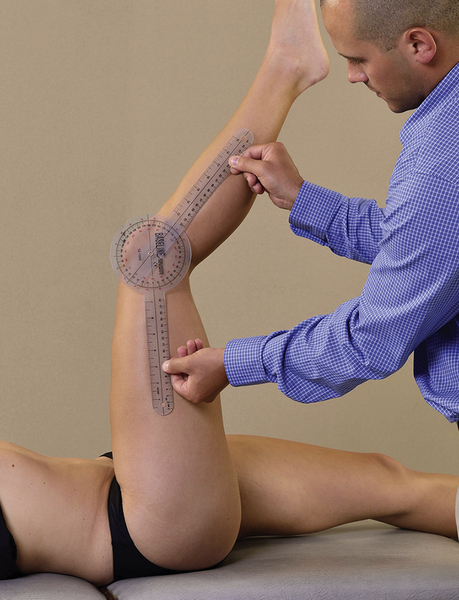
After instructing patient in motion desired, extend patient’s knee through full available ROM while maintaining hip in 90 degrees of flexion. This passive movement allows an estimate of ROM available and demonstrates to patient exact movement desired (Fig. 14-22).
Patient/Examiner action
Option #1 (Fig. 14-23)—Have patient perform active extension of knee until myoclonus is observed in hamstring muscles.
Option #2 (Fig. 14-24)—Examiner #1 passively extends knee until firm muscular resistance to further motion is felt.
Goniometer alignment
Palpate following bony landmarks (shown in Fig. 14-21) and align goniometer accordingly (see Figs. 14-23 and 14-24).

Stationary arm
Greater trochanter of femur.
Axis
Lateral epicondyle of femur.
Moving arm
Lateral malleolus.
Maintaining proper goniometer alignment, read scale of goniometer (see Figs. 14-23 and 14-24). For Option #2, a second examiner is needed to align goniometer and read scale.
Documentation
Record patient’s maximum amount of knee extension and which option was used.
Precaution
Contralateral lower extremity should be maintained on support surface with knee fully extended to avoid inaccurate measurement due to pelvic motion.

Iliotibial Band and Tensor Fasciae Latae Muscle Length: Ober Test and Modified Ober Test

Patient position
Side-lying, with hip and knee of lowermost extremity flexed to 45 degrees to stabilize pelvis (Fig. 14-25).
Examiner action
After instructing patient in movement required, examiner places one hand on ipsilateral pelvis to stabilize it and maintain neutral pelvic alignment. Examiner uses other hand first to passively abduct hip and second to extend patient’s hip on upper side in line with trunk, thereby bringing tensor fasciae latae over greater trochanter (Figs. 14-26 and 14-27).
Patient/Examiner action
Examiner asks patient to relax muscles of lower extremity while allowing uppermost limb to drop into adduction toward table through available ROM. As limb drops toward table, examiner prevents flexion and internal rotation of hip. If hip is allowed to internally rotate and flex, tensor fasciae latae and iliotibial band are no longer in lengthened position and are not accurately tested (see Figs. 14-26 and 14-27).
Ober test
During performance of test, examiner maintains patient’s knee in 90 degrees of flexion (see Fig. 14-26).


Modified Ober test
During performance of test, examiner maintains patient’s knee in full extension (see Fig. 14-27).
Measurement
Review of literature yields very few reports of using goniometers, tape measures, or any other device for measurement when Ober and modified Ober tests are performed. Traditionally, this test is performed in an “all or none” fashion. Either test is positive and patient has tight tensor fasciae latae and iliotibial band, or test is negative and patient has ideal muscle length.
Positive test
For both Ober and modified Ober, the test is considered positive for tight tensor fasciae latae and iliotibial band if relaxed hip remains abducted and does not fall below horizontal. Test is considered negative for tight tensor fasciae latae and iliotibial band if relaxed and extended hip falls below horizontal.
Precaution
Extremity being measured should not be allowed to flex and internally rotate at the hip. Fig. 14-28 illustrates incorrect positioning for Ober test.

Iliotibial Band and Tensor Fasciae Latae Muscle Length: Ober Test and Modified Ober Test—Inclinometer

An assistant is needed to perform this measurement correctly.
Patient position
Side-lying, with hip and knee of lowermost extremity flexed to 45 degrees to stabilize pelvis (Fig. 14-29).
Examiner action (Examiner #1)
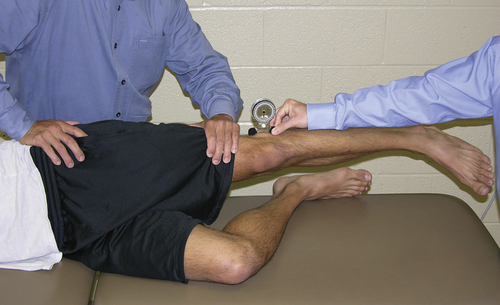
After instructing patient in movement required, examiner places one hand on ipsilateral pelvis to stabilize it and maintain neutral pelvic alignment. Examiner uses other hand first to passively abduct hip and second to extend patient’s hip on upper side in line with trunk, thereby bringing tensor fasciae latae over greater trochanter (Figs. 14-30 and 14-31).
Patient/Examiner action
Examiner asks patient to relax muscles of lower extremity while allowing uppermost limb to drop into adduction toward table through available ROM. As limb drops toward table, examiner prevents flexion and internal rotation of hip. If hip is allowed to internally rotate and flex, tensor fasciae latae and iliotibial band are no longer in lengthened position and are not tested accurately (see Figs. 14-30 and 14-31).

Ober test
During performance of test, examiner #1 maintains patient’s knee in 90 degrees of flexion while examiner #2 places the inclinometer on the lateral epicondyle of the femur (see Fig. 14-30).
Modified Ober test
During performance of test, examiner #1 maintains patient’s knee in full extension while examiner #2 places the inclinometer on the lateral epicondyle of the femur (see Fig. 14-31).
Documentation
Read the inclinometer and record the amount of hip abduction. If during the test the limb remains horizontal, 0 degrees is recorded; if the limb falls below the horizontal (adducted), a positive number is recorded; and if the limb remains above the horizontal (abducted), a negative number is recorded.
Precaution
Extremity being measured should not be allowed to flex and internally rotate at the hip. Fig. 14-28 illustrates incorrect positioning for the Ober test.
Iliotibial Band and Tensor Fasciae Latae Muscle Length: Prone Technique

Patient position
Patient is prone, hip abducted and knee flexed to 90 degrees (Fig. 14-32).
Examiner action
After instructing patient in movement required, examiner stabilizes pelvis with one hand and adducts hip (maintaining 90-degree knee flexion) until movement of the pelvis is palpated. End point is defined as point at which initial pelvic movement is detected (Fig. 14-33).


Goniometer alignment
Palpate following bony landmarks (shown in Fig. 14-32), and align goniometer accordingly (Fig. 14-34).
Stationary arm
Contralateral posterior superior iliac spine (PSIS).
Axis
Ipsilateral PSIS.
Moving arm
Posterior midline of ipsilateral femur.
Maintaining goniometer alignment, read scale of goniometer (see Fig. 14-34).
Documentation
Record patient’s hip abduction/adduction measurement.
Gastrocnemius Muscle Length Test
Patient position
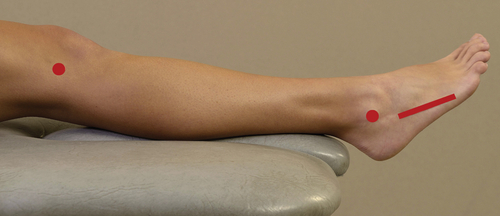
Patient is supine with hip and knee extended (Fig. 14-35).
Examiner action
After instructing patient in motion desired, dorsiflex patient’s ankle through full available ROM while maintaining knee in full extension. This passive movement allows an estimate of ROM available and demonstrates to patient exact movement desired (Fig. 14-36).
Patient/Examiner action
Maintaining full knee extension, perform passive, or have patient perform active, dorsiflexion of ankle (see Fig. 14-36).
Goniometer alignment
Palpate following bony landmarks (shown in Fig. 14-36) and align goniometer accordingly (Fig. 14-37).
Stationary arm
Head of fibula.
Axis
Lateral malleolus.

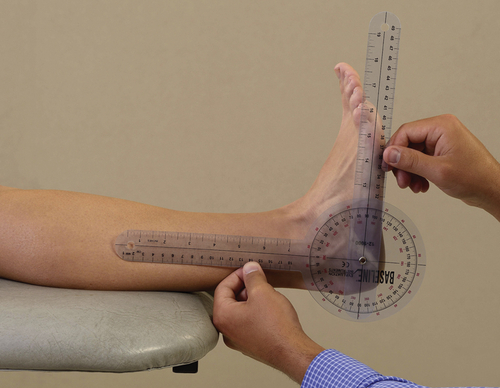
Moving arm
Parallel to fifth metatarsal.
Maintaining proper goniometer alignment, read scale of goniometer (see Fig. 14-37).
Documentation
Record patient’s maximum amount of dorsiflexion.
Precaution
Examiner must ensure that knee remains in full extension during dorsiflexion movement.
Note
A suggested procedure for measuring dorsiflexion involves maintaining the subtalar joint in neutral position while dorsiflexing the patient’s ankle. It is thought that in this way pronation and supination are avoided and pure dorsiflexion is measured. The procedure for maintaining neutral position of the subtalar joint is described in Chapter 13 (see Fig. 13-16).
Soleus Muscle Length Test: Supine

Patient position
Patient is supine with hip and knee flexed to 45 degrees. Placing knee in flexion relaxes gastrocnemius muscle and allows measurement of soleus muscle. Opposite lower extremity should be placed on support surface with knee fully extended (Fig. 14-38).
Examiner action
After instructing patient in motion desired, dorsiflex patient’s ankle through full available ROM while maintaining hip and knee in 45 degrees of flexion. This passive movement allows an estimate of available ROM and demonstrates to patient exact movement desired (Fig. 14-39).
Patient/Examiner action
Maintaining hip and knee in 45 degrees of flexion, perform passive, or have patient perform active, dorsiflexion of ankle (see Fig. 14-39).
Goniometer alignment
Palpate following bony landmarks (shown in Fig. 14-38) and align goniometer accordingly (Fig. 14-40).
Stationary arm
Head of fibula.


Axis
Lateral malleolus.
Moving arm
Parallel to fifth metatarsal.
Maintaining proper goniometer alignment, read scale of goniometer (see Fig. 14-40).
Documentation
Record patient’s maximum amount of dorsiflexion.
Note
A suggested procedure for measuring dorsiflexion involves maintaining the subtalar joint in neutral position while dorsiflexing the patient’s ankle. It is thought that in this way pronation and supination are avoided and pure dorsiflexion is measured. The procedure for maintaining neutral position of the subtalar joint is described in Chapter 13 (see Fig. 13-16).
Soleus Muscle Length Test: Prone

Patient position
Patient is prone with knee flexed to 90 degrees. Placing knee in flexion relaxes gastrocnemius muscle and allows measurement of soleus muscle. Opposite lower extremity should be placed on support surface with knee fully extended (Fig. 14-41).
Examiner action
After instructing patient in motion desired, dorsiflex patient’s ankle through full available ROM while maintaining knee in 90 degrees of flexion. This passive movement allows an estimate of available ROM and demonstrates to patient exact movement desired (Fig. 14-42).
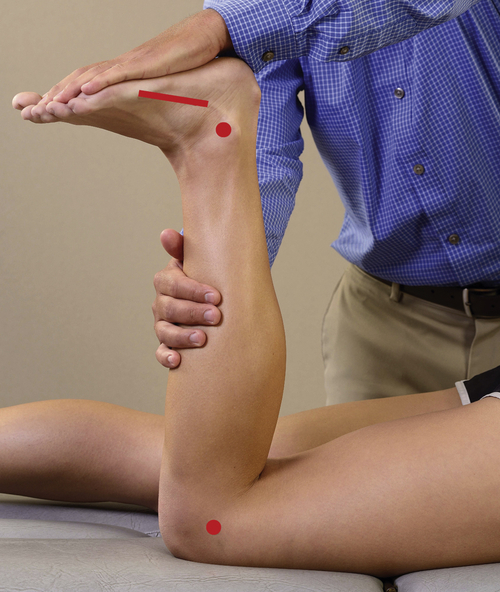

Patient/Examiner action
Maintaining hip and knee in 90 degrees of flexion, perform passive, or have patient perform active, dorsiflexion of ankle (see Fig. 14-42).
Goniometer alignment
Palpate following bony landmarks (shown in Fig. 14-41) and align goniometer accordingly (Fig. 14-43).
Stationary arm
Head of fibula.
Axis
Lateral malleolus.
Moving arm
Parallel to fifth metatarsal.
Maintaining proper goniometer alignment, read scale of goniometer (see Fig. 14-43).
Documentation
Record patient’s maximum amount of dorsiflexion.
Note
A suggested procedure for measuring dorsiflexion involves maintaining the subtalar joint in neutral position while dorsiflexing the patient’s ankle. It is thought that in this way pronation and supination are avoided and pure dorsiflexion is measured. The procedure for maintaining neutral position of the subtalar joint is described in Chapter 13 (see Fig. 13-16).