What Are Critical Thinking, Clinical Reasoning, and Clinical Judgment?
Learning outcomes
After completing this chapter, you should be able to:
1. Describe critical thinking, clinical reasoning, and clinical judgment in your own words, based on the descriptions in this chapter.
2. Give at least three reasons why critical thinking skills are essential for students and nurses.
3. Explain (or map) how the following terms are related to one another: critical thinking, clinical reasoning, clinical judgment, decision-making, problem-solving, and nursing process.
4. Identify four principles of the scientific method that are evident in critical thinking.
5. Compare and contrast the terms problem-focused thinking and outcome-focused thinking.
6. Clarify the term critical thinking indicator (CTI).
7. Use CTIs, together with the 4-Circle CT model, to identify five critical thinking characteristics you’d like to improve.
8. Explain why knowing the nursing process is needed for clinical reasoning and passing the NCLEX® and other standard tests.
9. Identify the relationships among healthy workplaces, learning cultures, safety cultures, and critical thinking.
10. Compare and contrast the terms thinking ahead, thinking-in-action, and thinking back.
Key concepts
Critical thinking, clinical reasoning, clinical judgment, critical thinking indicator (CTI), nursing process, healthy workplace, learning culture, safety culture, thinking ahead, thinking-in-action, thinking back.
Critical thinking: behind every healed patient
A powerful quote from an online blog sets the stage for this chapter: “Behind every healed patient is a critical thinking nurse.”1 Critical thinking—your ability to focus your thinking to get the results you need—makes the difference between whether you succeed or fail. It makes the difference between keeping you and your patients safe and being in harm’s way. Whether you’re trying to set priorities, collaborate with a difficult person, or develop a plan of care, critical thinking—deliberate, informed thought—is the key.
Developing critical thinking starts with having a good understanding of what it IS. As a colleague of mine says, too many nurses believe that critical thinking is like an “amorphous blob” that you can’t describe—something that you’re “just supposed to do.” To improve thinking, you must be specific about exactly what’s involved when thinking critically in various situations. Thinking is a skill, just like music or tennis. It flows and changes depending on current conditions, and it requires gaining specific knowledge, skills, and experience.
This chapter helps you start the journey to improving your ability to think critically in two steps: (1) First, you learn why health care organizations and nursing schools stress the need for critical thinking. (2) Second, you examine exactly what it is and how it relates to clinical reasoning, clinical judgment, and nursing process.
Critical thinking: not simply being critical
Critical thinking doesn’t mean simply being negative or full of criticism. It means not accepting information at face value without carefully evaluating it. When you think critically, you examine assumptions, evaluate evidence, and uncover underlying values and reasons.2
There are many positive uses for critical thinking—for example, developing workable solutions to complex problems, deliberating about courses of action to take, or determining ways to improve consumer satisfaction.
In critical thinking, the term critical may be replaced with important. In other words, critical thinking is “important thinking” you need to do to answer questions or assess, prevent, or manage problems. Nurses often use critical thinking to imply thinking that’s crucial must be done to manage specific problems. For example, “We’re working with our nurses to develop the critical thinking needed to identify people at risk for infection early.”
Rewards of learning to think critically
Learning what critical thinking is—what it “looks like” and how you “do it” when circumstances change—helps you:
• Gain confidence, a trait that’s crucial for success; lack of confidence is a “brain drain” that impedes thinking and performance.
• Be safe and autonomous; it helps you decide when to take initiative and act independently, and when to get help.
• Improve patient outcomes and your own job satisfaction (nothing’s more rewarding than seeing patients and families thrive because you made a difference).
Yet thinking isn’t “like it always was.” Health care delivery is increasingly complex and dynamic, requiring very specific thinking and workplace skills (Box 1-1). Consider how the following points relate to the importance of developing sound critical thinking skills:
• Critical thinking is the key to preventing and solving problems. If you can’t think critically, you become a part of the problems.
• Critical thinking is crucial to passing tests that demonstrate that you’re qualified to practice nursing—for example, the National Council Licensure Examination (NCLEX®), the Canadian Nurse Registered Examination (CNRE), and other certification exams.
• In all settings, nurses are expected to take on new responsibilities, collaborate with diverse individuals, and make more independent decisions. High-performance organizations need workers with solid thinking skills and personal qualities such as reliability and integrity.3
• Nurses’ roles within the context of the entire workforce, the nursing shortage, social issues, and technology continue to evolve. As a nurse, you must be a key player in designing and implementing more effective and efficient health care systems.4,5
• The complexity of care today requires knowledgeable individuals who are thought-oriented rather than task-oriented. For the public to value the need for nurses, we must change our image from being simply “a caring, helpful hand” to one that shows that we have specific knowledge that’s vital to keeping patients safe and helping them get and stay well. We must “wear not only our hearts, but also our brains on our sleeves.”6
• Patients and families must be active participants in making decisions; as the saying goes, “Nothing about me, without me.” Knowing how to lead, advocate, and teach and empower patients and families to manage their own care requires highly developed critical thinking and interpersonal skills.
• Critical thinking skills are key to establishing the foundation for lifelong learning, a healthy workplace, and an organizational culture that’s more concerned with reporting errors and promoting safety than “pointing fingers” and “blaming” (Box 1-2).
How this book helps you improve thinking
To keep your interest and help you understand and remember what you read, this book is designed based on principles of brain-based learning.7,8 Let’s look at what brain-based learning is and how this book is organized to help you improve, regardless of your skill level.
Brain-Based Learning
Brain-based learning uses strategies that help your brain get “plugged in to learning.” For example:
1. You learn best when there’s logical progression of content and you’re engaged by a conversational style that gives lots of examples, strategies, and exercises to help you apply content to the “real world.”
2. Gaining deep understanding requires intensive analysis, which means thinking about the same topics in various ways.
3. Understanding and retaining what you read requires that you make learning meaningful by using your own unique way of processing how content relates to you personally, rather than trying to memorize a bunch of facts.
4. Humor reduces stress, keeps your interest, and helps you learn.
5. Thinking is like any skill (e.g., music, art, and athletics). We each have our own styles and innate or learned capabilities. We all can improve by gaining insight, acquiring instruction and feedback, and deliberately working on the skills in real and simulated situations.
Organized for Novices and Experts
Whether you’re a novice or an expert, the following organization helps you connect with what you already know and move on to developing the complex skills you need to succeed today.
• Chapters 1 to 3 give the foundation for developing critical thinking, clinical reasoning, and clinical judgment. Here, you learn the “what and how” of critical thinking. You gain insight into how personality, upbringing, and culture affect thinking and get strategies to help you overcome personal challenges. Chapter 3 explores critical thinking and learning cultures, in which “everyone teaches and everyone learns.” It gives you strategies to help you make the most out of clinical learning experiences and pass high-stakes tests such as NCLEX® and other certification exams.
• Chapters 4 to 6 focus on reasoning in the clinical setting. Here, you gain the knowledge and skills needed to develop sound nursing judgment and make safe and effective clinical decisions. You gain a foundation for moral and ethical reasoning, research, evidence-based practice, and quality improvement. In Chapter 6, you apply what you learned in Chapters 4 and 5 by working with case scenarios that are based on real incidents. You practice key nursing process skills such as assessing systematically, drawing valid conclusions, and setting priorities.
• Chapter 7 helps you develop the interpersonal, teamwork, and self-management skills you need to lead and succeed (e.g., managing your time). Today, every nurse must be a leader. Advocating for your patients, yourself, your peers, and your community requires highly developed interpersonal and communication abilities. In Skill 7.0, How to Prevent and Deal with Mistakes Constructively, you learn how to meet quality and safety standards and keep patients, caregivers, and yourself safe.
Describing critical thinking
When trying to get an in-depth understanding of something, we sometimes call this “peeling the onion.” When you peel an onion you go through many layers to get to the core. Let’s “peel the critical thinking onion” by looking at various descriptions of what it entails.
Thinking Versus Critical Thinking
You may be wondering what’s the difference between thinking and critical thinking. The main differences are purpose and control. Thinking refers to any mental activity. It can be “mindless,” like when you’re daydreaming or doing routine tasks like brushing your teeth. Critical thinking is controlled and purposeful, using well-reasoned strategies to get the results you need.
The Best Description
Critical thinking is a complex process that changes depending on context (circumstances). For this reason, there is no one right definition. Many authors develop their own descriptions to complement and clarify someone else’s (which is, by the way, a good example of thinking critically: critical thinking requires you to “personalize” information—to analyze it and decide what it means to you rather than simply memorizing someone else’s words). In fact, the description that you put in your own words may be the best one because it’s most likely to have an impact on your reasoning abilities. Keep this in mind as you think about the following synonym and commonly seen descriptions.
A Synonym: Reasoning
A good synonym for critical thinking is reasoning because it implies careful, deliberate thought. Today, students learn “four Rs”: reading, ’riting, r’ithmetic, and reasoning.
Common Critical Thinking Descriptions
Consider the following critical thinking descriptions that complement and clarify one another:
• “Knowing how to learn, reason, think creatively, generate and evaluate ideas, see things in the mind’s eye, make decisions, and solve problems”3
• “Reasonable, reflective thinking that focuses on what to believe or do”9
• “The ability to solve problems by making sense of information using creative, intuitive, logical, and analytical mental processes… and the process is continual”10
• “Knowing how to focus your thinking to get the results you need (includes using logic, intuition, standards, and evidence-based practice)”11
Clinical Reasoning, Critical Thinking, and Clinical Judgment
The terms clinical reasoning, critical thinking, and clinical judgment are often used interchangeably. But there is a slight difference in how nurses use these terms:
• Clinical reasoning—a specific term—is the process you use to think about issues at the point of care—for example, deciding how to prevent and manage patient problems. For reasoning about other clinical issues (e.g., teamwork, collaboration, and streamlining work flow), nurses usually use the term critical thinking.
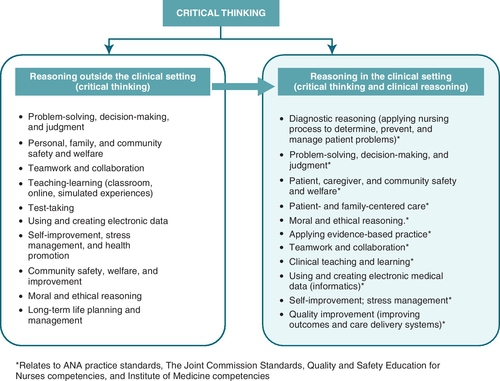
• Critical thinking—a broad term—includes reasoning both outside and inside of the clinical setting. Clinical reasoning and clinical judgment are key pieces of critical thinking in nursing.
• Clinical judgment refers to the result (outcome) of critical thinking or clinical reasoning—the conclusion, decision, or opinion you make after thinking about the issues.
• To clarify the relationships among critical thinking, clinical reasoning, and clinical judgment, study Figure 1-1.

Critical Thinking Versus Nursing Process
American Nurses Association (ANA) standards state that the nursing process—assessment, diagnosis, outcome identification, planning, implementation, and evaluation—serves as a critical thinking model that promotes a competent level of care.12 This means that the nursing process—Assess, Diagnose, Plan, Implement, and Evaluate—is the major tool for clinical reasoning. It’s the first tool you need to know to think like a nurse and pass NCLEX® and other exams. In Chapter 6 you will practice using the nursing process as a tool for clinical reasoning.
Applied Definition: Thinking in the Clinical Setting
To understand important points about thinking in the clinical setting—a setting that’s challenging, complex, and regulated by laws and standards—study the following applied definition.
Critical thinking in nursing—which includes clinical reasoning and clinical judgment—is purposeful, informed, outcome-focused thinking that:13
• Is guided by standards, policies, ethics codes, and laws (individual state practice acts and state boards of nursing).
• Is driven by patient, family, and community needs, as well as nurses’ needs to give competent and efficient care (e.g., streamlining charting to free nurses for patient care).
• Is based on principles of nursing process, problem-solving, and the scientific method (requires forming opinions and making decisions based on evidence).
• Focuses on safety and quality, constantly re-evaluating, self-correcting, and striving to improve.
• Carefully identifies the key problems, issues, and risks involved, including patients, families, and key stakeholders in decision-making early in the process. Stakeholders are the people who will be most affected (patients and families) or from whom requirements will be drawn (e.g., caregivers, insurance companies, third-party payers, and health care organizations).
• Uses logic, intuition, and creativity and is grounded in specific knowledge, skills, and experience.
• Calls for strategies that make the most of human potential and compensate for problems created by human nature (e.g., finding ways to prevent errors, using technology, and overcoming the powerful influence of personal views).
Figure 1-2 clarifies the relationships of many aspects of critical thinking in nursing. It also highlights important Quality and Safety Education for Nurses (QSEN) and Institute of Medicine (IOM) competencies.
Problem-focused versus outcome-focused thinking
Problem-focused thinking and outcome-focused thinking are closely related. You need excellent problem-solving skills to achieve desired outcomes (results). But, consider the following:
• There are many ways to solve a problem. There are quick fixes, “one-size-fits-all” solutions, temporary and long-term solutions, and solutions that are satisfactory but could be better. Outcome-focused thinking aims to fix problems in ways that get you the best results.
• Sometimes there are so many problems that the best approach may be to focus on outcomes rather than problems. For example, if you work on a team with many interpersonal problems, your manager might say, “We have a long history of problems, and it will take forever to fix them. I want to see us all working as a team. I’m asking you to put the problems aside and get agreement on roles, responsibilities, and behavior, so that our patients get good care and we enjoy coming to work.”
What about common sense?
Is critical thinking simply common sense, something that can’t be taught? The answer is “No.” Some people are born with the gift of common sense, but a lot of it is learned from experience. You can put someone with great common sense in a new or stressful situation, and you’re likely to see behaviors that don’t seem at all sensible. Think about the following scenario, a true story.
Common sense may be innate, but it also comes from knowledge and experience. What may be common sense to you, based on your upbringing, schooling, or experience, may not be so to someone else. If you encounter someone who seems to have no common sense, don’t jump to conclusions. Dig a little deeper to determine the real issues: Is there a knowledge, confidence, communication, or organizational skills problem? Is the person simply inexperienced or stressed by a new environment? Has the person become complacent? Could a learning disability be contributing to the problem? Like critical thinking, common sense often can be taught if you determine the underlying problems and do something about them.
What do critical thinkers look like?
Research shows that most critical thinkers have high foreheads and furrowed brows, probably because of all the thinking they do. If you’re not questioning this statement, then you’re not thinking critically about what you’re reading. When I ask, “What do critical thinkers look like?” I mean, “What characteristics do we see in someone who thinks critically?” Consider the following description:
The ideal critical thinker is habitually inquisitive, self-informed, trustful of reason, open-minded, flexible, fair-minded in evaluation, honest in facing personal biases, prudent in making judgments, willing to reconsider, clear about issues, orderly in complex matters, diligent in seeking relevant information, reasonable in selecting criteria, focused in inquiry, and persistent in seeking results that are as precise as the subject and the circumstances of inquiry permit.14
Critical thinking indicators
Studying behavior—what good thinkers do and say—helps you get a picture of what critical thinkers “look like.” Box 1-3 describes personal critical thinking indicators (CTIs). Personal CTIs are brief descriptions of behaviors and characteristics often seen in individuals who are critical thinkers. These behaviors are called critical thinking indicators because they indicate characteristics of critical thinkers. A survey of 65 expert nurses from various backgrounds showed agreement that the CTIs were behaviors often seen in nurses who are critical thinkers.15 Review Box 1-3 and rate where you stand in relation to each indicator, using the following 0 to 10 scale:
As you evaluate yourself, keep in mind that some of you, because of your nature, will be harder on yourselves than others (and vice versa). If you have some trusted friends, peers, or family members, ask them how they see your behavior. Ask them to focus on usual patterns of behaviors (not single incidents) and to give you specific examples. The results of this exercise may reaffirm or surprise you.
Table 1-1 gives examples of what critical thinking is and what it’s not. Box 1-4 shows how other authors describe critical thinking traits. These traits were incorporated into the CTIs using simpler terms.
Table 1-1
Critical Thinking: What It Is and What It Is Not
| Critical Thinking | Not Critical Thinking | Critical Thinking Example |
| Organized and clearly explained by using words, examples, maps, pictures, or graphs | Disorganized and vague | Persisting until you find a way to make your ideas easy to understand; using examples and illustrations to facilitate understanding |
| Critical for the sake of improvement, new ideas, and doing things in the best interest of the key players involved | Critical for the sake of defending your viewpoint or being able to suggest new ideas and alternatives; critical for the sake of having it your way | Determining key players’ best interest; then looking for flaws in ways something is done and figuring out ways to achieve the same outcomes more easily or better |
| Inquisitive about intent, facts, and reasons behind ideas or actions; thought- and knowledge-oriented | Unconcerned about motives, facts, and reasons behind ideas or actions; task-oriented, rather than thought-oriented | Raising questions to deeply understand the main goals, what happened, why it happened, and what was the process in place to achieve the goals |
| Sensitive to the powerful influence of emotions, but focused on making decisions based on what’s morally and ethically the right thing to do | Emotion-driven; often unclear about what these emotions are; unable to focus on logic | Finding out how someone feels about something, then moving on to discuss what’s morally and ethically right |
| Communicative and collaborative with others when dealing with complex issues | Isolated, competitive, or unable to communicate with others when dealing with complex issues | Seeking multidisciplinary approaches to plan care as needed |
What’s familiar and what’s new?
We understand something best by comparing it with things we already know: How is it the same, and how is it different? Let’s examine what’s familiar and what’s new about critical thinking.
What’s Familiar
Problem-Solving
Knowing specific problem-solving strategies is a key part of critical thinking. For example, if you’re caring for someone after heart surgery, you must know strategies to prevent and treat complications. Be aware, however, that using problem-solving interchangeably with critical thinking can be a “sore subject.” Problem-solving is missing the important concepts of prevention, creativity, improvement, and aiming for the best results. Even if there are no problems, you should be thinking creatively, asking, “What could we do better?” and “How can we prevent problems before they happen?”
Analyzing
Although being analytical is important, critical thinking requires more than analyzing. It requires coming up with new ideas (right-brain thinking) and judging the worth of those ideas (left-brain thinking). Some overly analytical people suffer from “analysis paralysis,” overthinking problems when they should be taking action.
Decision-Making
Decision-making and critical thinking are sometimes used interchangeably. Making decisions is an important part of critical thinking.
Scientific Method
This is an excellent critical thinking tool. It has been well studied and applies the following principles of scientific investigation:
• Observing: Continuously observing and examining to collect data, check for changes, and gain understanding
• Classifying data: Grouping related information so that patterns and relationships emerge
• Drawing conclusions that follow logically: “If this is so, then….”
• Conducting experiments: Performing studies to examine hypotheses (hunches or suspicions) and identify ways to improve
• Testing hypotheses (hunches): Determining whether we have factual evidence to support our hunches, assumptions, or suspicions
What’s New
Emotional Quotient
Emotional quotient (EQ)—the ability to recognize and manage your own emotions and help others do the same—is as important to critical thinking as the intelligence quotient (IQ).
So-Called “Soft Skills” Aren’t Soft
For years, we called communication and interpersonal skills the “soft skills” of nursing, implying that clinical skills such as managing intravenous lines are the most important skills. We now know that communication and interpersonal skills such as engaging patients, dealing with difficult people, and resolving conflicts are crucial to critical thinking. These types of skills take considerable knowledge and practice and must be as good as clinical skills.16
Right-Brain and Left-Brain Thinking
Critical thinking requires right-brain thinking (generating new ideas) and left-brain thinking (analyzing and judging the worth of those ideas).
Maximizing Human Potential
We’re only just beginning to identify ways to maximize the human potential to think critically. For example, new brain imaging techniques show us what parts of the brain are being used in various thinking and tasks, helping us learn how we use our brains. People survive brain injuries that used to be fatal, and we continue to learn from their rehabilitation. For example, some people who have had strokes can’t speak, but they can sing words. We’re learning how to use brain techniques not only to learn but also to promote healing, stress reduction, and wellness.
Mapping as a Strategy to Teach and Learn
Maps and decision trees created by experts guide seasoned and new nurses. Maps created by learners promote deep personal understanding. They help learners make connections between concepts and information in their own unique way. You can find the “how to’s” of concept mapping in Appendix B.
Changing How We View Mistakes
Experts agree that “to err is human” and that most errors happen because of multiple factors and system problems (e.g., look-alike drugs or inadequate staffing or staff preparation). Humans are vulnerable to making mistakes because of “human factors” (e.g., stress, fatigue, and information overload). Reducing errors related to human factors (e.g., using computers and decision support systems) is now a priority.17–19 We also know that being allowed to make mistakes in safe situations (e.g., simulations) is a powerful way to learn.
Preparing for “What-If” Scenarios
There’s now greater emphasis on developing detailed policies and procedures to be prepared for “what-if” scenarios (e.g., bioterrorism).
Evidence-Based Thinking
Clinicians are expected to provide evidence that supports opinions, solutions, and courses of action. We must be confident when we’re asked questions like, “What evidence do you have that this will work?” or “What data are you using to support that this is the problem or that this is a good solution?”
Measuring Outcomes (Results)
Critical thinking makes it necessary to develop very specific ways to measure progress and results. For example, in the case of pain management, you don’t ask a general question like, “Are you more comfortable?” You ask, “Can you rate your pain on a scale of 0 to 10, with 0 meaning pain-free, and 10 meaning the worst possible pain?”
Collaborative Thinking
Collaborative approaches are the norm today. The workforce is diverse, and we need to facilitate “meetings of the minds” to achieve the best outcomes.
Relating on a “Human Level” Matters
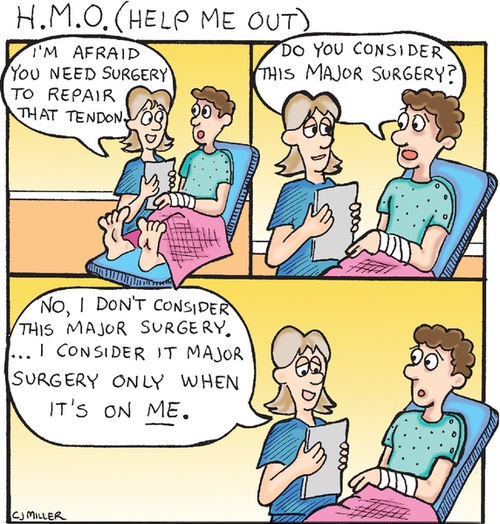
Understanding personal interests and passions and showing your “human side” help build the relationships needed for critical thinking (Figure 1-3).
4-Circle ct model: get the picture?
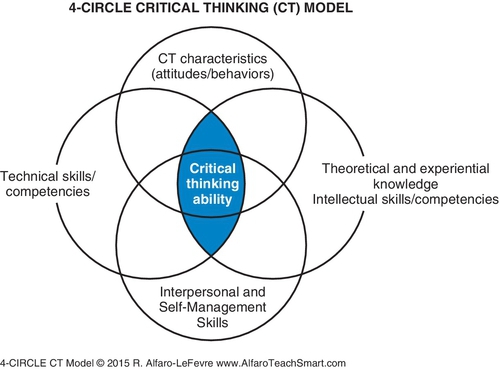
Whereas CTIs give verbal descriptions of behaviors that promote critical thinking, the 4-Circle CT Model (Figure 1-4) gives you “a picture” of what critical thinking involves. Study the four circles. Note that critical thinking (CT) requires a blend of critical thinking characteristics, theoretical and experiential knowledge, interpersonal skills, and technical skills. Realize that the top circle—critical thinking characteristics—corresponds with the personal CTIs listed in Box 1-3. In the next chapters, we’ll address the other circles in more depth. For now, remember that if you develop the critical thinking characteristics and attitudes in the top circle (e.g., confidence, resilience, and being proactive), developing the skills in the other three circles of the model will be easier.
Thinking ahead, thinking-in-action, and thinking back
Critical thinking is contextual, which means it changes depending on circumstances. The saying “one size doesn’t fit all” applies. Let’s finish this chapter by addressing the importance of looking at critical thinking from three perspectives: thinking ahead, thinking-in-action, and thinking back (reflective thinking).
Consider the following descriptions and think about the differences in each circumstance.
1. Thinking Ahead: Anticipating what might happen and being proactive by identifying what you can do to be prepared. For novices, thinking ahead is difficult and sometimes restricted to reading procedure manuals and textbooks. An important part of being proactive is asking questions like “What can I bring with me to help jog my memory and stay focused and organized?”
2. Thinking-in-Action: Often, this is called “thinking on your feet.” It’s rapid, dynamic reasoning that considers several things at once, making it difficult to describe. For example, suppose you find your stove on fire. As you spring into action, your mind races, thinking about many things at once (“How can I put this out?” “Where’s the fire extinguisher?” “Should I call the fire department?”). Thinking-in-action is highly influenced by previous knowledge and hands-on experience. To keep safety first, in all important situations, keep experts nearby who have extensive experiential knowledge stored in their brains. If you encountered a fire, wouldn’t you like to have a fireman standing at your side? Thinking-in-action is prone to “knee-jerk” responses and decisions. To use the fire example again, an untrained person may throw water on a grease fire, which can make it worse.
3. Thinking Back (Reflective Thinking): Analyzing the reasoning you used to look for flaws, gain more understanding, and correct and improve it. Experienced nurses double-check their thinking in dynamic ways during thinking-in-action. However, this doesn’t replace reflective thinking that happens after the fact. Deliberate, methodical reflective thinking that happens after the fact, using specific strategies and tools (e.g., writing in a journal, chart reviews, and honest dialogue with others) brings new insights, more depth, and greater accuracy; you can more objectively identify “lessons learned” from experience.
Considering all three of these phases of thinking helps you examine thinking in a holistic way. If you look only at one phase, you’ll miss important parts of thinking.
Putting it all together
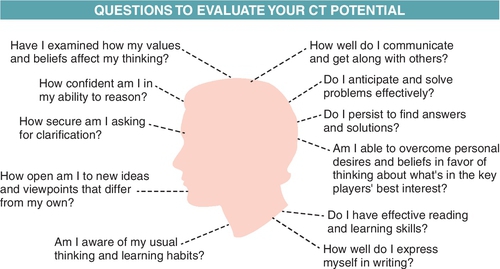
By now, you should have an idea of what critical thinking, clinical reasoning, and clinical judgment entail. To solidify your understanding of this chapter, take a few moments to decide where you stand in relation to Questions to Evaluate Your Critical Thinking Potential (Figure 1-5). Next, study Box 1-5, which tells you how to make the most of the exercises throughout this book and complete the end-of-chapter exercises.
 Critical thinking exercises
Example responses are in Appendix A.
1. When you form an opinion, you draw a conclusion from facts (evidence).
a. What’s the difference between facts and opinions?
b. How can you determine if an opinion is valid?
2. What is the relationship between achieving outcomes (desired results) and identifying problems, issues, and risks involved?
3. What is the relationship between critical thinking indicators (Box 1-3) and behavior?
4. What is the relationship between knowledge of your state nurse practice act and critical thinking?
5. If you are in a new or uncomfortable situation, what is likely to happen to your ability to demonstrate critical thinking indicators?
6. What do the following “five Cs” (context, confident, courage, curious, committed) have to do with critical thinking?
7. Why is it important to consider thinking from three perspectives: thinking ahead, thinking-in-action, and thinking back (reflecting)?
 Think, pair, share
With a partner, in a group, or in a journal entry:
1. Complete the following sentences, and then compare your responses with those of others:
a. If I were to explain to someone else what critical thinking is, I would say that….
b. I do my best thinking when….
c. I do my worst thinking when…
2. Discuss times when you’ve experienced some of the descriptions listed under “Not Critical Thinking” in Table 1-1 (page 11). How did it affect your thinking?
3. Discuss how having a healthy workplace, learning culture, and safety culture affects critical thinking skill development.
4. Think about the Personal CTIs in Box 1-3 and identify five indicators (behaviors) that are especially challenging for beginning nurses.
5. Draw a map of the relationships among the key concepts listed in the chapter opener.
6. Decide where you stand in relation to achieving the outcomes in the chapter opener (page 1).
7. Discuss your thoughts on the following Other Perspectives and Critical Moments.
 Critical moments
Good Question!
Socrates learned more from questioning others than he did from reading books. Learn to be confident asking questions. Seek other opinions, and question deeply to gain understanding. Don’t think you have to know all the answers. Simply saying “Good question!” often sparks great critical thinking.
Aha!
We say “Aha!” when we suddenly realize something or have our suspicions confirmed. We say “Aha!” when we connect with something that was in the back of our minds but never put into words. As you read this book, share your “Ahas.” These moments of “light bulbs going off in your head” are energizing. They bring new ideas and stimulate you to learn more.
 Other perspectives
How to Think Like Einstein
It’s not that I’m smart, it’s just that I stick with problems longer.
—Albert Einstein
Playing Lullabies: Creative Way to Improve Satisfaction

Courtesy Nola Lanham and Lenka Kaslasi, http://www.lenkaphotography.com
In some hospitals, when a baby is born, everyone shares in the celebration. With each birth, the public address system plays Brahms’ Lullaby. Patients love it—even oncology patients, who say it lifts their spirits and allows them to share someone else’s joy. Parents who have just lost their baby are given the option of playing the lullaby or not. Many of them choose to have it played for their baby.
Playing the music is a simple thing that can be done for patients and families. It costs nothing and brings a great deal of pleasure.
—Jean Young, Patient Care Manager
Key points/summary
• To improve critical thinking you must be clear about what it entails in each unique situation.
• Critical thinking doesn’t mean simply being critical. It means not accepting information at face value without evaluating whether it is factual and reliable.
• Critical thinking is an “umbrella term” that includes the terms clinical reasoning and clinical judgment. Figure 1-2 maps the relationships among key aspects of reasoning inside and outside of the clinical setting.
• This book applies brain-based learning, using strategies that help you get your brain “plugged in” to learning.
• Because critical thinking changes with context and is a complex process, there’s no one right definition—there are several that complement and clarify one another.
• The term critical thinking is often used interchangeably with clinical reasoning, clinical judgment, problem-solving, and decision-making.
• Reasoning in the clinical setting is challenging, complex, and regulated by standards, policies, procedures, and individual state practice acts (you must know what you’re allowed to do and how you should do it).
• The applied definition on page 6 summarizes the major points of critical thinking, clinical reasoning, and clinical judgment in nursing.
• Critical thinking requires right-brain thinking (generating new ideas) and left-brain thinking (analyzing and judging the worth of those ideas).
• Communication and interpersonal skills such as engaging patients, knowing how to collaborate, and resolving conflicts are crucial to critical thinking.
• Box 1-3 (page 9) shows personal CTIs—behaviors that demonstrate characteristics that promote critical thinking. Ability to demonstrate these behaviors varies, depending on circumstances such as familiarity with the people and situations at hand. These are the behaviors that you should work to develop.
• The 4-Circle CT model (Figure 1-4) gives you “a picture” of what it takes to think critically. If you develop critical thinking characteristics (top circle), you will easily develop skills related to the other circles.
• Critical thinking is like any skill (e.g., music, art, and athletics). We each have our own styles and innate or learned capabilities. We can improve by gaining self-awareness, acquiring instruction, and consciously practicing to improve.
• Because critical thinking is contextual (it changes with circumstances), consider it from three different perspectives: thinking ahead, thinking-in-action, and thinking back (reflective thinking).
• Scan this chapter to review the illustrations and highlighted Guiding Principles.