Role of the limited X-ray machine operator
Learning objectives
At the conclusion of this chapter, you will be able to:
• Compare the role of the limited x-ray machine operator with that of the registered radiologic technologist
• Identify the discoverer of x-rays and the date of the discovery
• Explain the primary purposes of the American Registry of Radiologic Technologists, American Society of Radiologic Technologists, and Joint Review Committee on Education in Radiologic Technology
• Determine the legal requirements for the practice of radiography in your state
• Describe the typical work environment of the limited x-ray machine operator
• Describe in a general way the duties of a limited x-ray machine operator
Key terms
American Registry of Radiologic Technologists (ARRT)
American Society of Radiologic Technologists (ASRT)
back office
front office
Joint Review Committee on Education in Radiologic Technology (JRCERT)
limited operator
limited x-ray
limited x-ray machine operator (LXMO)
medical assistant (MA)
radiograph
radiographer
radiologist
reciprocity
Welcome to the fascinating field of radiography! You are beginning a study of the art and science needed to create images of the internal structures of the human body. The images you create will aid physicians in diagnosis and will help patients receive treatment needed to promote or regain health. This is a vital role in the health care delivery system, one that requires knowledge, skill, judgment, integrity, and dedication.
Radiography
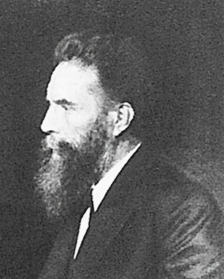
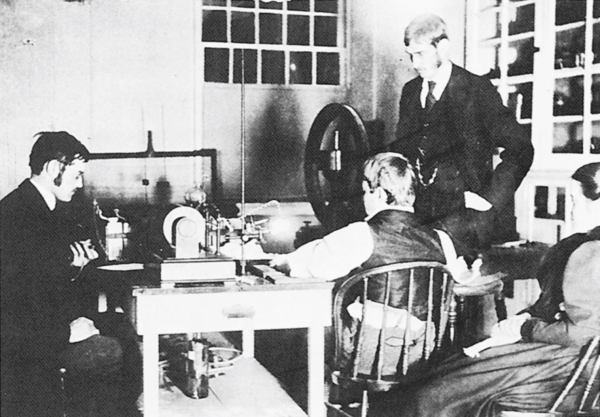
X-rays were discovered on November 8, 1895, by Wilhelm Conrad Roentgen (Fig. 1-1) at the University of Würzburg in Germany. Roentgen was a teacher and researcher with a special interest in the conduction of high-voltage electricity through low-vacuum tubes. His discovery of the x-ray during his regularly planned experiments was accidental. The first x-ray image by Roentgen was of his wife Bertha’s hand using a 15-minute exposure (Fig. 1-2). The first radiographers were scientists and physicians who experimented with primitive x-ray apparatus to make x-ray images of the human body (Fig. 1-3). Soon these pioneers trained their assistants to make these “x-ray pictures,” now called radiographs, and the profession of radiography was born.

American Society of Radiologic Technologists
Early radiographers soon began meeting to share their knowledge. The organization, now called the American Society of Radiologic Technologists (ASRT), was founded in Chicago in 1920. It is the world’s oldest and largest professional radiologic science organization. The ASRT provides many services to its members, including continuing education, a professional journal, a newsletter, guidelines and assistance for radiography educators, and an annual national meeting. The ASRT publishes a Code of Ethics that can be found at www.asrt.org.
American Registry of Radiologic Technologists
Through the efforts of this organization, the American Registry of Radiologic Technologists (ARRT) was formed in 1922 to establish standards and examinations necessary to certify radiologic technologists. Radiologic technologists certified by ARRT use the initials RT(R) after their names. This abbreviation means registered technologist (radiography). Registered technologists who have passed the ARRT examination in radiography are referred to as radiographers. Do not get radiographer mixed up with radiologist. A radiologist is a physician who specializes in radiography. Radiographers and radiologists work together in radiology departments. The ARRT publishes a Code of Ethics, which are aspirational statements. This can be found in Chapter 20 or at www.arrt.org. It also publishes an important document called the Rules of Ethics, which are mandatory and enforceable statements. This document, found in Appendix B, discusses the minimally acceptable professional conduct that those in radiology should adhere to. An important document, the Task Inventory for Limited Scope of Practice in Radiography, is also published by the ARRT. This document, which identifies for the limited operator all the tasks that are tested on the certification examination, can be found in Appendix M.
The profession of radiography has expanded to include a variety of imaging and treatment modalities, including those listed in Box 1-1. Many of these modalities require specialized training beyond that needed for certification by the ARRT in radiography. The newest role for the radiographer is that of radiologist assistant (RA). These radiographers obtain additional schooling, usually at the graduate level, and perform limited duties that a radiologist typically carries out, such as fluoroscopy and initial readings of radiographs.
 Box 1-1
Imaging and Treatment Modalities in Radiology
Angiography: imaging of blood vessels with the injection of special compounds called contrast media
Bone densitometry (BD): art and science of measuring the bone mineral content and density of specific skeletal sites or the whole body
Computed tomography (CT): computerized x-ray system that provides axial images (transverse “slices”) of all parts of the body
Fluoroscopy: real-time viewing of x-ray images in motion
Magnetic resonance imaging (MRI): computerized imaging system that uses a powerful magnetic field and radiofrequency pulses to produce images of all parts of the body
Mammography: x-ray imaging of the breast using a special x-ray machine
Nuclear medicine (NM): injection or ingestion of radioactive materials and recording of their uptake in the body using a gamma camera
Positron emission tomography (PET): highly sophisticated computerized form of nuclear medicine imaging
Radiation therapy: treatment of malignant diseases using radiation
Sonography: imaging of soft tissue structures using sound echoes. This modality is also referred to as “ultrasound”
Joint review committee on education in radiologic technology
The Joint Review Committee on Education in Radiologic Technology (JRCERT) is the national organization that formally conducts the accreditation of schools of radiologic technology. The JRCERT was formed in 1969 and accredits, as of this printing, 637 radiography programs in the United States. The JRCERT publishes the Standards for an Accreditation Program in Radiography document, which tells colleges what standards are required to be accredited. Certification in radiography requires at least 2 years of education (six college semesters) in an accredited program that includes comprehensive academic coursework in the sciences. These programs are affiliated with acute care general hospitals to provide extensive clinical experience in the care of patients who are severely ill or injured. A growing number of programs are changing to a 4-year bachelor’s degree curriculum.
Effective January 1, 2012, the JRCERT began to accredit limited scope x-ray machine operator educational programs. This accreditation is designed to promote academic excellence, patient safety, and quality health care. Many states currently have limited x-ray machine operator programs of anywhere from 10 weeks to 9 months. Many of these programs are expected to apply for this national accreditation and recognition. Documents from the JRCERT can be obtained at www.jrcert.org.
To understand how these three organizations work together to develop a professional radiographer, the following scenario is provided. Individuals interested in becoming a radiographer must qualify and enter a JRCERT-accredited radiography program. While in the program they complete a comprehensive curriculum developed by the ASRT. On graduation, these students take the certification examination in radiography given by the ARRT. ARRT-registered technologists can perform all diagnostic x-ray examinations and operate complex radiography equipment in all 50 states. The titles registered technologist and radiographer are used throughout this text to denote these professionals.
Limited X-ray machine operator
The ASRT recently published the Limited X-ray Machine Operator Curriculum to support the education of limited operators of x-ray equipment. The curriculum allows states and faculty flexibility in the development of limited curricula to meet the needs of individuals performing diagnostic x-ray procedures within a limited scope. The ASRT officially terms the limited operator, a limited x-ray machine operator (LXMO). The titles limited operator and LXMO are used throughout this text to denote limited operators of x-ray equipment. The ARRT and JRCERT also use these titles in their publications. LXMOs are encouraged to join the ASRT to support the profession and to obtain continuing education.
Limited x-ray work is regulated within the offices of each state’s Department of Health. The majority of states that have regulations for those who operate x-ray equipment use the above titles for individuals who perform limited x-rays. However, a few states use other terms such as basic x-ray machine operator, practical x-ray machine operator, limited radiologic technologist, or limited radiographer.
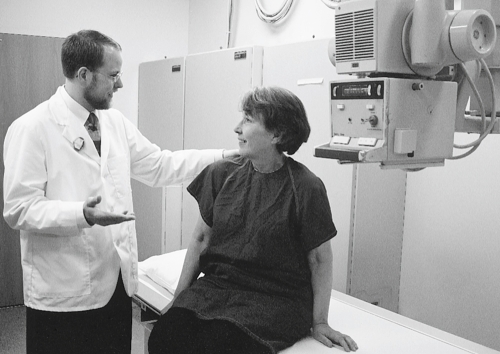
Limited x-ray is practiced primarily in clinics and physicians’ offices (Fig. 1-4). In some areas, however, limited operators are employed in hospitals, a practice that is expanding.
Limited x-ray developed as nurses, medical assistants, chiropractic assistants, laboratory technologists, and health care office personnel were trained to perform limited aspects of radiography in addition to their primary duties. It is called limited because the scope of practice is restricted compared with that of registered technologists. Limited x-ray practice does not involve the use of contrast media for the imaging of blood vessels and abdominal organs or the operation of complex radiographic equipment such as computed tomography (CT) and magnetic resonance imaging (MRI) scanners and angiography equipment.a
Additional restrictions may be applied because the scope of practice varies among the states. In contrast to registered technologists, limited operators are often educated as certified medical assistants (MA) and perform a variety of office procedures that do not involve imaging, such as drawing blood samples, performing diagnostic tests, and assisting the physician with treatments and patient care procedures. Information about some of these duties is included in the final chapters.
Certification
Certification in radiography by the ARRT has been accepted as the minimum credential for radiographers for many years. No legal requirements were applied to the practice of radiography until the early 1970s, when licensure laws for radiologic technologists were passed in New York and New Jersey. California passed licensing legislation shortly thereafter. Today, most states have laws requiring some type of licensure to practice radiography, and at least half of these include provision for limited x-ray practice. State licensure is not ARRT credentialing. Currently, depending on the state, limited x-ray may be prohibited, permitted without restriction, or regulated quite specifically. For example, New York prohibits limited x-ray, whereas Missouri has no requirements for certification and Wisconsin restricts limited x-ray to only the limbs, chest, and spine. Oregon issues eight different categories of limited permits based on the specific procedures for which the radiographer is qualified.
Legal requirements are subject to change, so it will be necessary for you to inquire directly of the appropriate agency in your state to determine whether limited x-ray is permitted, whether its practice is regulated, and how to obtain the necessary certification. Appendix A provides additional information on where to obtain information.
Most states that regulate limited x-ray also regulate the education necessary to qualify. The student who plans to obtain a limited license or permit must be certain that the planned education meets state requirements. These requirements may include the need for clinical experience and clinical supervision. Some states also have continuing education requirements for renewal of licenses or permits. Reciprocity is common in many states. This means that the education and credential issued in one state is approved in another state.
Each state that regulates limited x-ray has established standards for the scope of practice allowed. There are serious sanctions for practicing radiography outside the boundaries defined by state laws and regulations. Practicing without a valid license or permit or practicing outside the scope of one’s credentials may result in fines, imprisonment, or both. In addition, a license or permit may be suspended or permanently revoked. Employers may also be penalized if their employees practice radiography in violation of regulations. All radiographers and limited operators must be aware of the legal standards that apply to them and take care that their practice conforms to these standards. This information also is available from the agencies listed in Appendix A.
The practice of radiography involves a variety of knowledge and skills. Although the scope of practice may be limited, there is no restriction on the knowledge and skill necessary for the practice. In other words, the limited operator is held to the same high standards as a registered radiologic technologist in performing procedures within the permitted scope of practice.
American registry of radiologic technologists limited scope examination
The ARRT provides the examination for all the states that require limited x-ray operators to be certified. Thirty-five states utilize the ARRT limited scope examination for state licensing purposes. The examination, entitled “Limited Scope of Practice in Radiography,” is completed on a computer at an ARRT-approved testing site. The ARRT’s detailed Content Specifications document for this examination can be found in the Workbook and Licensure Prep for this text. The document identifies the various areas of limited practice that are tested, along with an outline of what is contained in each area. The limited scope examination contains a core module of 100 questions. The questions for this section come from Chapters 1 through 11. The limited scope examination also contains the following procedure modules: chest, skull/sinus, spine, and extremities, which contain 90 questions total. The questions for these sections come from Chapters 12 through 22. Individuals do not have to write each procedure module, only those that contain the x-ray procedures they perform. There is also a specialty podiatry module specifically for those who work in that area. The podiatry module contains 20 questions. The ARRT also provides a Limited Scope Exam Handbook that explains the process and contains the application. The Handbook can be found at www.arrt.org.
The ARRT’s limited scope examination is the same for all states that require licensure for limited operators. An important aspect of this examination is that all x-ray projections of the abdomen, pelvis, hips, ribs, and sternum are not tested. X-ray projections using contrast media, such as the stomach, colon, and kidneys, are also not tested.
Bone densitometry
Bone densitometry (BD) is a specialized area of radiography. A separate x-ray machine is used to measure the bone mineral content and density of various bones in the body. Many diseases affecting the bones, especially osteoporosis, are diagnosed using this machine (Fig. 1-5). Each state will have its own regulations regarding the operation of BD x-ray machines. Many states allow limited x-ray operators to perform BD examinations. However, separate ARRT certification may be required. The ARRT provides states with the “Bone Densitometry Equipment Operators Examination.” This examination contains 60 questions covering the equipment and procedures performed. The ARRT’s Content Specifications document for this examination is also found in the Workbook and Licensure Prep for this text. Chapter 26 provides the introductory information needed to understand BD and prepare for the examination.

Work environment
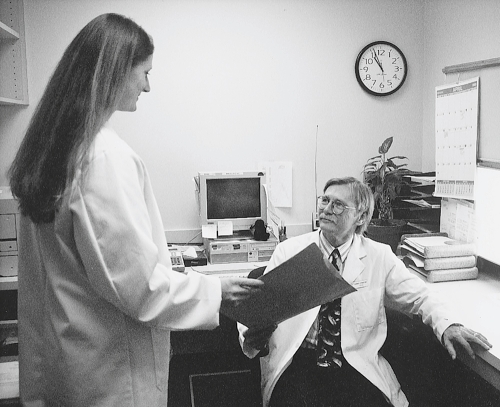
As a limited operator, your direct supervisor may be a physician, a nurse, a registered technologist, an office manager, or a radiology administrator. In most instances your supervisor will be a radiologic technologist. Work environments vary greatly, depending on the type of organization, its size, and its organizational structure. You will often work directly with one or more physicians (Fig. 1-6). These physicians may be primary-care physicians whose specialty is general practice and who see both adults and children for a wide variety of complaints. On the other hand, you may work for a specialist, a physician who has completed extensive additional training to qualify as an expert in a particular aspect of medical or chiropractic care. Box 1-2 lists health care specialists and describes their areas of clinical interest. It will be helpful to understand these terms because you will encounter them frequently in various aspects of your work.
Box 1-2
Abbreviated Listing of Health Care Specialists
Anesthesiologist: administers anesthetics and monitors patient during surgery
Dermatologist: diagnoses and treats conditions and diseases of the skin
Emergency department physician: specializes in treating trauma and emergency situations; a triage expert in disaster situations
Family practice physician: treats individuals and families in the context of daily life
Gastroenterologist: diagnoses and treats diseases of the gastrointestinal tract
Geriatrician: specializes in problems and diseases of elderly persons
Gynecologist: treats problems and diseases of the female reproductive system
Internist: specializes in diseases of the internal organs
Neurologist: specializes in functions and disorders of the nervous system
Obstetrician: specializes in pregnancy, labor, delivery, and immediate postpartum care
Oncologist: specializes in tumor identification and treatment
Ophthalmologist: diagnoses and treats problems and diseases of the eye
Pathologist: specializes in the scientific study of body alterations caused by disease and death
Pediatrician: treats and diagnoses disorders and diseases in children
Podiatrist: diagnoses and treats disorders and diseases of the feet
Psychiatrist: specializes in diagnosis, treatment, and prevention of mental illness
Radiologist: specializes in diagnosis by means of medical imaging
Abdominal: specializes in surgery of the abdominal cavity
Neurologic: specializes in surgery of the brain, spinal cord, and peripheral nervous system
Orthopedic: diagnoses and treats problems of the musculoskeletal system
Plastic: restores or improves the appearance and function of body parts
Thoracic: specializes in problems of the chest
Urologic: diagnoses and treats problems of the urinary tract and the male reproductive system
Chiropractic specialties: specialty certification is available to chiropractic physicians in the fields of radiology, orthopedics (nonsurgical), neurology, nutrition, sports medicine, and other fields
Both medical and chiropractic physicians may limit their practices to specific areas of interest with or without certification. Those with certification may have a general practice outside the scope of their specialty.
Modified from Ehrlich RA, Coakes D: Patient care in radiography, ed 9, St Louis, 2016, Mosby.
The work of outpatient clinic facilities is divided into two general areas, often referred to as the front office and the back office. The front office (Fig. 1-7) is a public area and includes the reception desk, the patient waiting area, and the desks or offices of those who deal with medical records, billing, and insurance claims. The back office (Fig. 1-8), the area where patients are examined and treated, includes consulting rooms, examination rooms, treatment rooms, laboratory facilities, and the x-ray department. Utility and storage areas are also found there.


The radiography suite will include one or more x-ray rooms, a computer room or station to view and process digital images and access electronic records, a desk or countertop with various computers, a film viewing area for looking at older film x-rays, and a film storage area. Dressing rooms and restrooms are usually convenient to x-ray rooms. The limited operator is a back office employee and may be assigned other back office duties in addition to radiography.
Limited operators employed by hospitals will work in a much different environment. The radiology department is supervised by a director, usually a registered radiologic technologist. Limited operators, like radiographers, work directly with radiologists, the physician specialists who interpret the radiographs and perform special imaging procedures. There will be less contact with the patients’ primary care physicians, although some will visit the radiology department. The duties are likely to be limited to radiographic procedures, with other personnel handling paperwork, patient transportation, and much of the communication with physicians’ offices and other hospital departments. On the other hand, limited radiographers who also have medical assisting skills may also be employed in ways that use these skills.
The hospital radiology staff may also include a number of limited operators with assignments involving specific procedures or work areas and some with responsibility for supervision or quality control. The staff may be scheduled in three shifts around the clock. In small institutions, the department may be closed during late night hours and on Sundays and holidays. When the department is closed, limited operators may take turns being “on call,” that is, available by telephone or pager to come to the hospital when necessary.
Hospitals are complex, highly structured institutions. Each has many rules and procedures that must be mastered for the safety of patients and the efficient performance of the health care team. It is beyond the scope of this text to prepare limited operators to cope with all the situations and judgments they might face in an acute care hospital setting. A thorough orientation to the institution is necessary, and the use of additional texts and references is highly recommended.
Typical duties of a limited X-ray machine operator
The limited operator encounters the patient after he or she has been admitted to the clinic or radiology department. A physician will have examined the patient, and one or more specific x-ray procedures will have been ordered. The physician may give the order directly to the limited operator or may instruct a nurse or medical assistant to communicate the order. The order may be verbal or in the form of a written requisition. The necessary x-ray paperwork may be completed by a clerical employee but is often the radiographer’s responsibility.
Once the paperwork is completed, the limited operator greets the patient and determines whether the patient will need to undress and don a gown before radiography. A dressing room or examining room is usually used for this purpose. The exact clothing to be removed is determined according to the examination. Generally, patients must remove outer clothing from the body area to be examined. Specific instructions for patient preparation are included in the appropriate sections of the text.
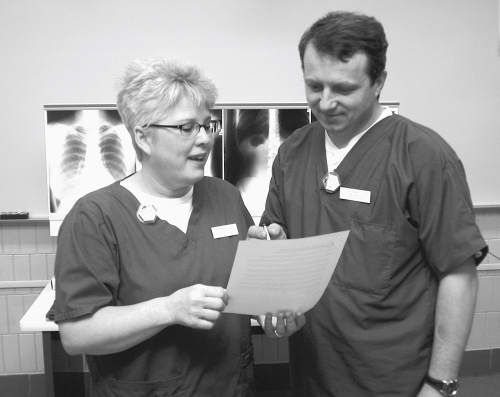
The patient is then taken into the x-ray room. At this point, the limited operator provides a brief explanation and answers any questions about the procedure. When you have completed this text, you should be prepared to respond appropriately to most patient questions and concerns. Very often the limited operator will have to discuss the examination with a radiographer or work directly with the radiographer to ensure that the appropriate x-ray projections are done and the correct exposure techniques used (Fig. 1-9).
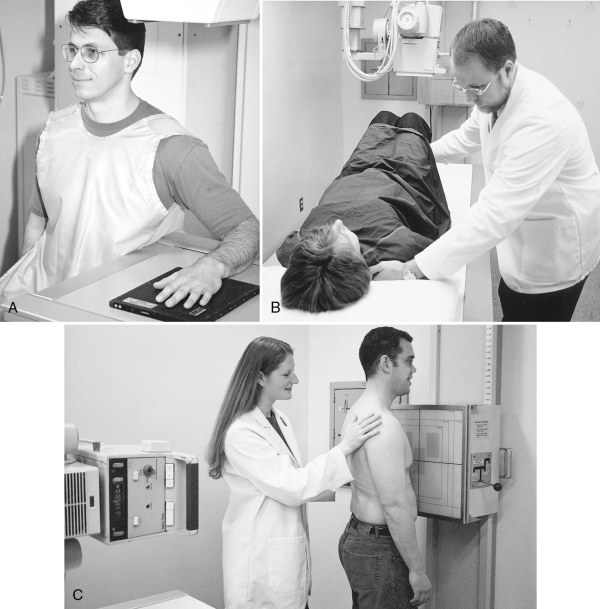
The next step is to assist the patient into the general position required for the x-ray examination (Fig. 1-10). For example, if a hand is to be x-rayed, the patient can be seated at the end of the x-ray table. For a spine examination, the patient may need to lie on the table. If a chest examination is ordered, the patient will stand at an upright cassette holder. The limited operator then selects the correct cassette and places it in position. Next, the patient is positioned precisely, and the x-ray tube is aligned with the body part and the film at a specific distance. The body part must be measured to determine the proper exposure factors from a technique chart. At this point, lead shields are positioned for radiation protection. The limited operator then goes to the control booth, consults the technique chart, and sets the x-ray control panel to the desired exposure. Final instructions are given to the patient, and the exposure is made. If more than one exposure is needed, the cassette is changed, the patient repositioned, and the steps repeated until the examination is complete.
After ensuring that the patient is safe and comfortable, the limited operator takes the cassette to the processing and reader device. Once the image is viewed on the computer monitor and approved, it can be sent for reading by the radiologist or stored. The processing and management of digital images are detailed in Chapter 8. If the image is satisfactory and no further exposures are needed, the patient is returned to an examining room or dressing room. The limited operator then readies the x-ray room for the next examination and prepares the films for reading.
The exact nature of a limited operator’s duties will vary with the place of employment, the size of the staff, and the equipment available.
Summary
Limited x-ray is a relatively new professional role in the field of health care. Similar to radiographers, limited x-ray operators work closely with general physicians and work directly with radiologists, and their duties involve direct patient contact. Most limited operators are employed in outpatient facilities such as clinics, but some are employed by hospitals, and their work may vary considerably, depending on their place of employment. Many limited operators enjoy their work and later enter JRCERT programs to become radiologic technologists.
Requirements and credentials for limited operators differ greatly from state to state, and limited operators are responsible for knowing and following the regulations that apply to them.