Appendix A
APPENDIX A-1: Recommended Immunization Schedule for Persons Aged 0 Through 6 Years—United States • 2010
For those who fall behind or start late, see the catch-up schedule
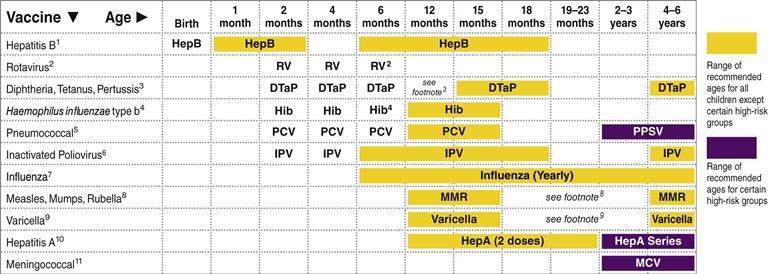
This schedule includes recommendations in effect as of December 15, 2009. Any dose not administered at the recommended age should be administered at a subsequent visit, when indicated and feasible. The use of a combination vaccine generally is preferred over separate injections of its equivalent component vaccines. Considerations should include provider assessment, patient preference, and the potential for adverse events. Providers should consult the relevant Advisory Committee on Immunization Practices statement for detailed recommendations: http://www.cdc.gov/vaccines/pubs/acip-list.htm. Clinically significant adverse events that follow immunization should be reported to the Vaccine Adverse Event Reporting System (VAERS) at http://www.vaers.hhs.gov or by telephone, 800-822-7967.
1. Hepatitis B vaccine (HepB). (Minimum age: birth)
At birth:
• Administer monovalent HepB to all newborns before hospital discharge.
• If mother is hepatitis B surface antigen (HBsAg)-positive, administer HepB and 0.5 mL of hepatitis B immune globulin (HBIG) within 12 hours of birth.
• If mother’s HBsAg status is unknown, administer HepB within 12 hours of birth. Determine mother’s HBsAg status as soon as possible and, if HBsAg-positive, administer HBIG (no later than age 1 week).
• The HepB series should be completed with either monovalent HepB or a combination vaccine containing HepB. The second dose should be administered at age 1 or 2 months. Monovalent HepB vaccine should be used for doses administered before age 6 weeks. The final dose should be administered no earlier than age 24 weeks.
• Infants born to HBsAg-positive mothers should be tested for HBsAg and antibody to HBsAg 1 to 2 months after completion of at least 3 doses of the HepB series, at age 9 through 18 months (generally at the next well-child visit).
• Administration of 4 doses of HepB to infants is permissible when a combina- tion vaccine containing HepB is administered after the birth dose. The fourth dose should be administered no earlier than age 24 weeks.
2. Rotavirus vaccine (RV). (Minimum age: 6 weeks)
• Administer the first dose at age 6 through 14 weeks (maximum age: 14 weeks 6 days). Vaccination should not be initiated for infants aged 15 weeks 0 days or older.
• The maximum age for the final dose in the series is 8 months 0 days
• If Rotarix is administered at ages 2 and 4 months, a dose at 6 months is not indicated.
3. Diphtheria and tetanus toxoids and acellular pertussis vaccine (DTaP). (Minimum age: 6 weeks)
• The fourth dose may be administered as early as age 12 months, provided at least 6 months have elapsed since the third dose.
• Administer the final dose in the series at age 4 through 6 years.
4. Haemophilus influenzae type b conjugate vaccine (Hib). (Minimum age: 6 weeks)
• If PRP-OMP (PedvaxHIB or Comvax [HepB-Hib]) is administered at ages 2 and 4 months, a dose at age 6 months is not indicated.
• TriHiBit (DTaP/Hib) and Hiberix (PRP-T) should not be used for doses at ages 2, 4, or 6 months for the primary series but can be used as the final dose in children aged 12 months through 4 years.
5. Pneumococcal vaccine. (Minimum age: 6 weeks for pneumococcal conjugate vaccine [PCV]; 2 years for pneumococcal polysaccharide vaccine [PPSV])
• PCV is recommended for all children aged younger than 5 years. Administer 1 dose of PCV to all healthy children aged 24 through 59 months who are not completely vaccinated for their age.
• Administer PPSV 2 or more months after last dose of PCV to children aged 2 years or older with certain underlying medical conditions, including a cochlear implant. See MMWR 1997;46(No. RR-8).
6. Inactivated poliovirus vaccine (IPV) (Minimum age: 6 weeks)
• The final dose in the series should be administered on or after the fourth birthday and at least 6 months following the previous dose.
• If 4 doses are administered prior to age 4 years a fifth dose should be administered at age 4 through 6 years. See MMWR 2009;58(30):829–30.
7. Influenza vaccine (seasonal). (Minimum age: 6 months for trivalent inacti-vated influenza vaccine [TIV]; 2 years for live, attenuated influenza vaccine [LAIV])
• Administer annually to children aged 6 months through 18 years.
• For healthy children aged 2 through 6 years (i.e., those who do not have underlying medical conditions that predispose them to influenza complications), either LAIV or TIV may be used, except LAIV should not be given to children aged 2 through 4 years who have had wheezing in the past 12 months.
• Children receiving TIV should receive 0.25 mL if aged 6 through 35 months or 0.5 mL if aged 3 years or older.
• Administer 2 doses (separated by at least 4 weeks) to children aged younger than 9 years who are receiving influenza vaccine for the first time or who were vaccinated for the first time during the previous influenza season but only received 1 dose. For recommendations for use of influenza A (H1N1) 2009 monovalent vaccine
• see MMWR 2009;58(No. RR-10).
8. Measles, mumps, and rubella vaccine (MMR). (Minimum age: 12 months)
• Administer the second dose routinely at age 4 through 6 years. However, the second dose may be administered before age 4, provided at least 28 days have elapsed since the first dose.
9. Varicella vaccine. (Minimum age: 12 months)
• Administer the second dose routinely at age 4 through 6 years. However, the second dose may be administered before age 4, provided at least 3 months have elapsed since the first dose.
• For children aged 12 months through 12 years the minimum interval between doses is 3 months. However, if the second dose was administered at least 28 days after the first dose, it can be accepted as valid.
10. Hepatitis A vaccine (HepA). (Minimum age: 12 months)
• Administer to all children aged 1 year (i.e., aged 12 through 23 months).
• Administer 2 doses at least 6 months apart.
• Children not fully vaccinated by age 2 years can be vaccinated at subsequent visits
• HepA also is recommended for older children who live in areas where vac- cination programs target older children, who are at increased risk for infection, or for whom immunity against hepatitis A is desired.
11. Meningococcal vaccine. (Minimum age: 2 years for meningococcal conjugate vaccine [MCV4] and for meningococcal polysaccharide vaccine [MPSV4])
• Administer MCV4 to children aged 2 through 10 years with persistent complement component deficiency, anatomic or functional asplenia, and certain other conditions placing tham at high risk.
• Administer MCV4 to children previously vaccinated with MCV4 or MPSV4 after 3 years if first dose administered at age 2 through 6 years. See MMWR 2009;58:1042–3.
The Recommended Immunization Schedules for Persons Aged 0 through 18 Years are approved by the Advisory Committee on Immunization Practices (http://www.cdc.gov/vaccines/recs/acip), the American Academy of Pediatrics (http://www.aap.org), and the American Academy of Family Physicians (http://www.aafp.org). Department of Health and Human Services • Centers for Disease Control and Prevention
APPENDIX A-2: Recommended Immunization Schedule for Persons Aged 7 Through 18 Years—United States • 2010
For those who fall behind or start late, see the schedule below and the catch-up schedule
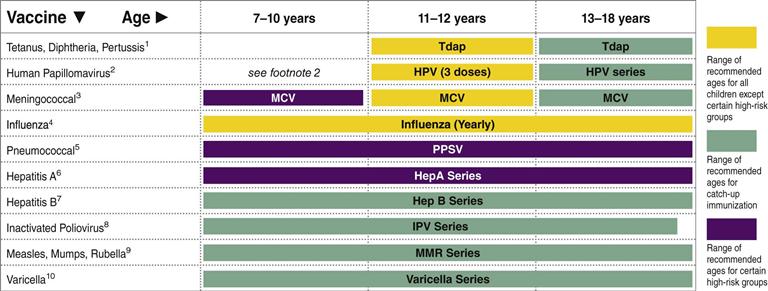
This schedule includes recommendations in effect as of December 15, 2009. Any dose not administered at the recommended age should be administered at a subsequent visit, when indicated and feasible. The use of a combination vaccine generally is preferred over separate injections of its equivalent component vaccines. Considerations should include provider assessment, patient preference, and the potential for adverse events. Providers should consult the relevant Advisory Committee on Immunization Practices statement for detailed recommendations: http://www.cdc.gov/vaccines/pubs/acip-list.htm. Clinically significant adverse events that follow immunization should be reported to the Vaccine Adverse Event Reporting System (VAERS) at http://www.vaers.hhs.gov or by telephone, 800-822-7967.
1. Tetanus and diphtheria toxoids and acellular pertussis vaccine (Tdap). (Minimum age: 10 years for Boostrix and 11 years for Adacel)
• Administer at age 11 or 12 years for those who have completed the recom- mended childhood DTP/DTaP vaccination series and have not received a tetanus and diphtheria toxoid (Td) booster dose.
• Persons aged 13 through 18 years who have not received Tdap should receive a dose.
• A 5-year interval from the last Td dose is encouraged when Tdap is used as a booster dose; however, a shorter interval may be used if pertussis immunity is needed.
2. Human papillomavirus vaccine (HPV). (Minimum age: 9 years)
• Two HPV vaccines are licensed: a quadrivalent vaccine (HPV4) for the pre- vention of cervical, vaginal and vulvar cancers (in females) and genital warts (in females and males), and a bivalent vaccine (HPV2) for the prevention of cervical cancers in females.
• HPV vaccines are most effective for both males and females when given before exposure to HPV through sexual contact.
• HPV4 or HPV2 is recommended for the prevention of cervical precancers and cancers in females.
• HPV4 is recommended for the prevention of cervical, vaginal and vulvar precancers and cancers and genital warts in females.
• Administer the first dose to females at age 11 or 12 years.
• Administer the second dose 1 to 2 months after the first dose and the third dose 6 months after the first dose (at least 24 weeks after the first dose).
• Administer the series to females at age 13 through 18 years if not previously vaccinated.
• HPV4 may be administered in a 3-dose series to males aged 9 through 18 years to reduce their likelihood of acquiring genital warts.
3. Meningococcal conjugate vaccine (MCV4).
• Administer at age 11 or 12 years, or at age 13 through 18 years if not previously vaccinated.
• Administer to previously unvaccinated college freshmen living in a dormitory.
• Administer MCV4 to children aged 2 through 10 years with persistent complement component deficiency, anatomic or functional asplenia, or certain other conditions placing them at high risk.
• Administer to children previously vaccinated with MCV4 or MPSV4 who remain at increased risk after 3 years (if first dose administered at age 2 through 6 years) or after 5 years (if first dose administered at age 7 years or older). Persons whose only risk factor is living in on-campus housing are not recommended to receive an additional dose. See MMWR 2009;58:1042–3.
4. Influenza vaccine (seasonal).
• Administer annually to children aged 6 months through 18 years.
• For healthy nonpregnant persons aged 7 through 18 years (i.e., those who do not have underlying medical conditions that predispose them to influenza complications), either LAIV or TIV may be used.
• Administer 2 doses (separated by at least 4 weeks) to children aged younger than 9 years who are receiving influenza vaccine for the first time or who were vaccinated for the first time during the previous influenza season but only received 1 dose.
• For recommendations for use of influenza A (H1N1) 2009 monovalent vaccine. See MMWR 2009;58(No. RR-10).
5. Pneumococcal polysaccharide vaccine (PPSV).
• Administer to children with certain underlying medical conditions, including a cochlear implant. A single revaccination should be administered after 5 years to children with functional or anatomic asplenia or an immunocompromising condition. See MMWR 1997;46(No. RR-8).
6. Hepatitis A vaccine (HepA).
• Administer 2 doses at least 6 months apart.
• HepA is recommended for children aged older than 23 months who live in areas where vaccination programs target older children, who are at increased risk for infection, or for whom immunity against hepatitis A is desired.
7. Hepatitis B vaccine (HepB).
• Administer the 3-dose series to those not previously vaccinated.
• A 2-dose series (separated by at least 4 months) of adult formulation Recombivax HB is licensed for children aged 11 through 15 years.
8. Inactivated poliovirus vaccine (IPV).
• The final dose in the series should be administered on or after the fourth birthday and at least 6 months following the previous dose.
• If both OPV and IPV were administered as part of a series, a total of 4 doses should be administered, regardless of the child’s current age.
9. Measles, mumps, and rubella vaccine (MMR).
• If not previously vaccinated, administer 2 doses or the second dose for those who have received only 1 dose, with at least 28 days between doses.
• For persons aged 7 through 18 years without evidence of immunity (see MMWR 2007;56[No. RR-4]), administer 2 doses if not previously vaccinated or the second dose if only 1 dose has been administered.
• For persons aged 7 through 12 years, the minimum interval between doses is 3 months. However, if the second dose was administered at least 28 days after the first dose, it can be accepted as valid.
• For persons aged 13 years and older, the minimum interval between doses is 28 days.
The Recommended Immunization Schedules for Persons Aged 0 through 18 Years are approved by the Advisory Committee on Immunization Practices (http://www.cdc.gov/vaccines/recs/acip), the American Academy of Pediatrics (http://www.aap.org), and the American Academy of Family Physicians (http://www.aafp.org). Department of Health and Human Services • Centers for Disease Control and Prevention
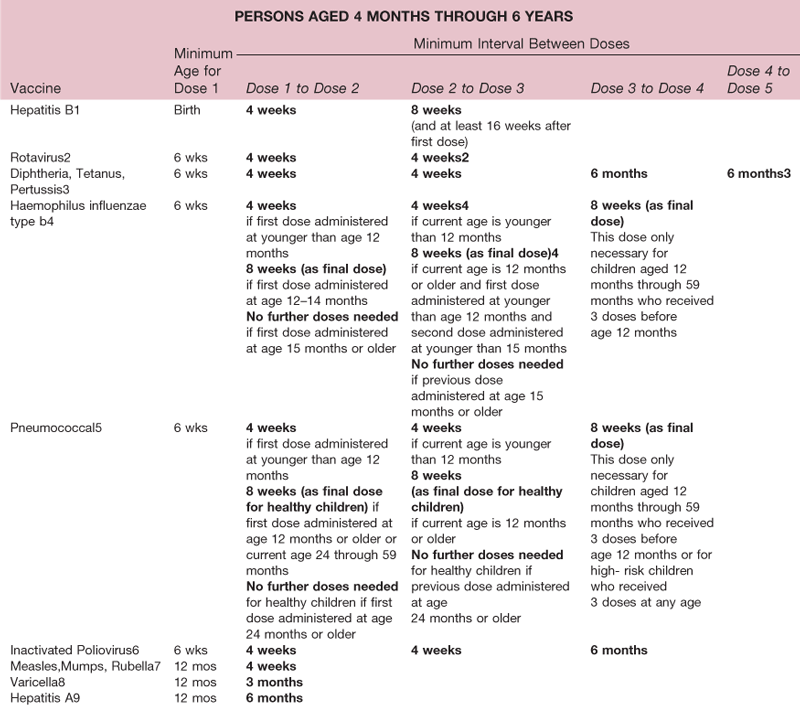
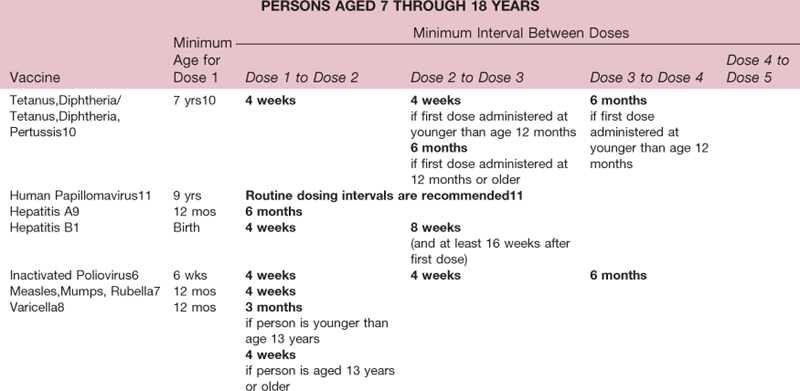
APPENDIX A-3: Catch-up Immunization Schedule for Persons Aged 4 Months Through 18 Years Who Start Late or Who Are More Than 1 Month Behind—United States • 2010
The table below provides catch-up schedules and minimum intervals between doses for children whose vaccinations have been delayed. A vaccine series does not need to be restarted, regardless of the time that has elapsed between doses. Use the section appropriate for the child’s age.
1. Hepatitis B vaccine (HepB).
• Administer the 3-dose series to those not previously vaccinated.
• A 2-dose series (separated by at least 4 months) of adult formulation Recombivax HB is licensed for children aged 11 through 15 years.
• The maximum age for the first dose is 14 weeks 6 days. Vaccination should not be initiated for infants aged 15 weeks 0 days or older.
• The maximum age for the final dose in the series is 8 months 0 days.
• If Rotarix was administered for the first and second doses, a third dose is not indicated.
3. Diphtheria and tetanus toxoids and acellular pertussis vaccine (DTaP).
• The fifth dose is not necessary if the fourth dose was administered at age 4 years or older.
4. Haemophilus influenzae type b conjugate vaccine (Hib).
• Hib vaccine is not generally recommended for persons aged 5 years or older. No efficacy data are available on which to base a recommendation concerning use of Hib vaccine for older children and adults. However, studies suggest good immu- nogenicity in persons who have sickle cell disease, leukemia, or HIV infection, or who have had a splenectomy; administering 1 dose of Hib vaccine to these persons who have not previously received Hib vaccine is not contraindicated.
• If the first 2 doses were PRP-OMP (PedvaxHIB or Comvax), and administered at age 11 months or younger, the third (and final) dose should be administered at age 12 through 15 months and at least 8 weeks after the second dose.
• If the first dose was administered at age 7 through 11 months, administer the second dose at least 4 weeks later and a final dose at age 12 through 15 months.
• Administer 1 dose of pneumococcal conjugate vaccine (PCV) to all healthy children aged 24 through 59 months who have not received at least 1 dose of PCV on or after age 12 months.
• For children aged 24 through 59 months with underlying medical conditions, admin- ister 1 dose of PCV if 3 doses were received previously or administer 2 doses of PCV at least 8 weeks apart if fewer than 3 doses were received previously.
• Administer pneumococcal polysaccharide vaccine (PPSV) to children aged 2 years or older with certain underlying medical conditions, including a cochlear implant, at least 8 weeks after the last dose of PCV. See MMWR 1997;46(No. RR-8).
6. Inactivated poliovirus vaccine (IPV).
• The final dose in the series should be administered on or after the fourth birthday and at least 6 months following the previous dose.
• A fourth dose is not necessary if the third dose was administered at age 4 years or older and at least 6 months following the previous dose.
• In the first 6 months of life, minimum age and minimum intervals are only recommended if the person is at risk for imminent exposure to circulating poliovirus (i.e., travel to a polio-endemic region or during an outbreak).
7. Measles, mumps, and rubella vaccine (MMR).
• Administer the second dose routinely at age 4 through 6 years. However, the second dose may be administered before age 4, provided at least 28 days have elapsed since the first dose.
• If not previously vaccinated, administer 2 doses with at least 28 days between doses.
• Administer the second dose routinely at age 4 through 6 years. However, the second dose may be administered before age 4, provided at least 3 months have elapsed since the first dose.
• For persons aged 12 months through 12 years, the minimum interval between doses is 3 months. However, if the second dose was administered at least 28 days after the first dose, it can be accepted as valid.
• For persons aged 13 years and older, the minimum interval between doses is 28 days.
9. Hepatitis A vaccine (HepA).
• HepA is recommended for children aged older than 23 months who live in areas where vaccination programs target older children, who are at increased risk for infection, or for whom immunity against hepatitis A is desired.
10. Tetanus and diphtheria toxoids vaccine (Td) and tetanus and diphtheria toxoids and acellular pertussis vaccine (Tdap).
• Doses of DTaP are counted as part of the Td/Tdap series
• Tdap should be substituted for a single dose of Td in the catch-up series or as a booster for children aged 10 through 18 years; use Td for other doses.
11. Human papillomavirus vaccine (HPV).
• Administer the series to females at age 13 through 18 years if not previously vaccinated.
• Use recommended routine dosing intervals for series catch-up (i.e., the second and third doses should be administered at 1 to 2 and 6 months after the first dose). The minimum interval between the first and second doses is 4 weeks. The minimum interval between the second and third doses is 12 weeks, and the third dose should be administered at least 24 weeks after the first dose.
Information about reporting reactions after immunization is available online at http://www.vaers.hhs.gov or by telephone, 800-822-7967. Suspected cases of vaccine-preventable diseases should be reported to the state or local health department. Additional information, including precautions and contraindications for immunization, is available from the National Center for Immunization and Respiratory Diseases at http://www.cdc.gov/vaccines or telephone, 800-CDC-INFO (800-232-4636). Department of Health and Human Services • Centers for Disease Control and Prevention