Appendix F: Dietary Reference Intakes (DRIs): Estimated Average Requirements
Food and Nutrition Board, Institute of Medicine, National Academies
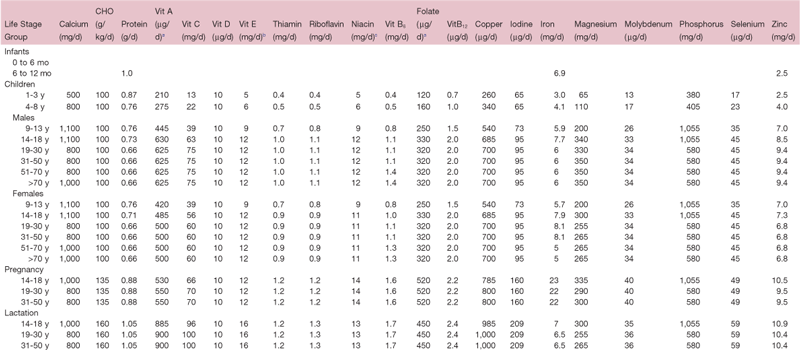
NOTE: An Estimated Average Requirement (EAR) is the average daily nutrient intake level estimated to meet the requirements of half of the healthy individuals in a group. EARs have not been established for vitamin K, pantothenic acid, biotin, choline, chromium, fluoride, manganese, or other nutrients not yet evaluated via the DRI process.
dAs dietary folate equivalents (DFE). 1 DFE = 1 µg food folate = 0.6 µg of folic acid from fortified food or as a supplement consumed with food = 0.5 µg of a supplement taken on an empty stomach.
aAs retinol activity equivalents (RAEs). 1 RAE = 1 µg retinol, 12 µg β-carotene, 24 µg α-carotene, or 24 µg β-cryptoxanthin. The RAE for dietary provitamin A carotenoids is two-fold greater than retinol equivalents (RE), whereas the RAE for preformed vitamin A is the same as RE.
bAs α-tocopherol. α-Tocopherol includes RRR-α-tocopherol, the only form of α-tocopherol that occurs naturally in foods, and the 2R-stereoisomeric forms of α-tocopherol (RRR-, RSR-, RRS-, and RSS-α-tocopherol) that occur in fortified foods and supplements. It does not include the 2S-stereoisomeric forms of α-tocopherol (SRR-, SSR-, SRS-, and SSS-α-tocopherol), also found in fortified foods and supplements.
cAs niacin equivalents (NE). 1 mg of niacin = 60 mg of tryptophan.
SOURCES: Dietary Reference Intakes for Calcium, Phosphorous, Magnesium, Vitamin D, and Fluoride (1997); Dietary Reference Intakes for Thiamin, Riboflavin, Niacin, Vitamin B6, Folate, Vitamin B12, Pantothenic Acid, Biotin, and Choline (1998); Dietary Reference Intakes for Vitamin C, Vitamin E, Selenium, and Carotenoids (2000); Dietary Reference Intakes for Vitamin A, Vitamin K, Arsenic, Boron, Chromium, Copper, Iodine, Iron, Manganese, Molybdenum, Nickel, Silicon, Vanadium, and Zinc (2001); Dietary Reference Intakes for Energy, Carbohydrate, Fiber, Fat, Fatty Acids, Cholesterol, Protein, and Amino Acids (2002/2005); and Dietary Reference Intakes for Calcium and Vitamin D (2011). These reports may be accessed via www.nap.edu.
Copyright National Academies Press, Washington, DC.