Chapter 10
Anemia
• Examination for pallor focuses on those parts of the body that present large numbers of superficial blood vessels with minimal natural skin pigments, such as the conjunctiva, tongue, oral mucosa, and palmar creases.
• The most compelling argument for anemia is conjunctival rim pallor.
• No single physical finding convincingly excludes the diagnosis of anemia.
I. Introduction
Anemia refers to an abnormally low number of circulating red cells, caused by blood loss, hemolysis, or underproduction of cells by the bone marrow. In patients with acute blood loss, the abnormal vital signs of hypovolemia are the most prominent physical findings (see Chapter 17), but in chronic anemia (the subject of this chapter), physical findings reflect instead changes in color of the skin and conjunctiva.
II. The Findings
Chronic anemia causes the skin and conjunctiva to appear abnormally pale because of reduced amounts of red-colored oxyhemoglobin that circulate in the dermal and subconjunctival capillaries and venules.1 Nonetheless, pallor does not always indicate anemia, because skin color also depends on the diameter of these minute vessels, the amount of circulating deoxyhemoglobin, and the patient’s natural skin pigments.1 Vasoconstriction from cold exposure or sympathetic stimulation also may cause pallor, and the pallor of anemia may be obscured by the red color of vasodilation (inflammation or permanent vascular injury from ischemia, cold, or radiation), the blue color of cyanosis (see Chapter 9), or the brown pigments of dark-skinned persons. Theoretically, examination of the conjunctiva, nailbeds, and palms avoids the effects of the patient’s natural skin pigments.
Most clinicians assess for pallor subjectively by comparing the patient’s skin color with their own color or their recollection of normal skin color. One definition of pallor, however, is more objective: conjunctival rim pallor is present if examination of the inferior conjunctiva reveals the color of the anterior rim to have the same pale fleshy color of the deeper posterior aspect of the palpebral conjunctiva (Fig. 10.1).2 In persons without anemia, the normal bright red color of the anterior rim contrasts markedly with the fleshy color of the posterior portion.
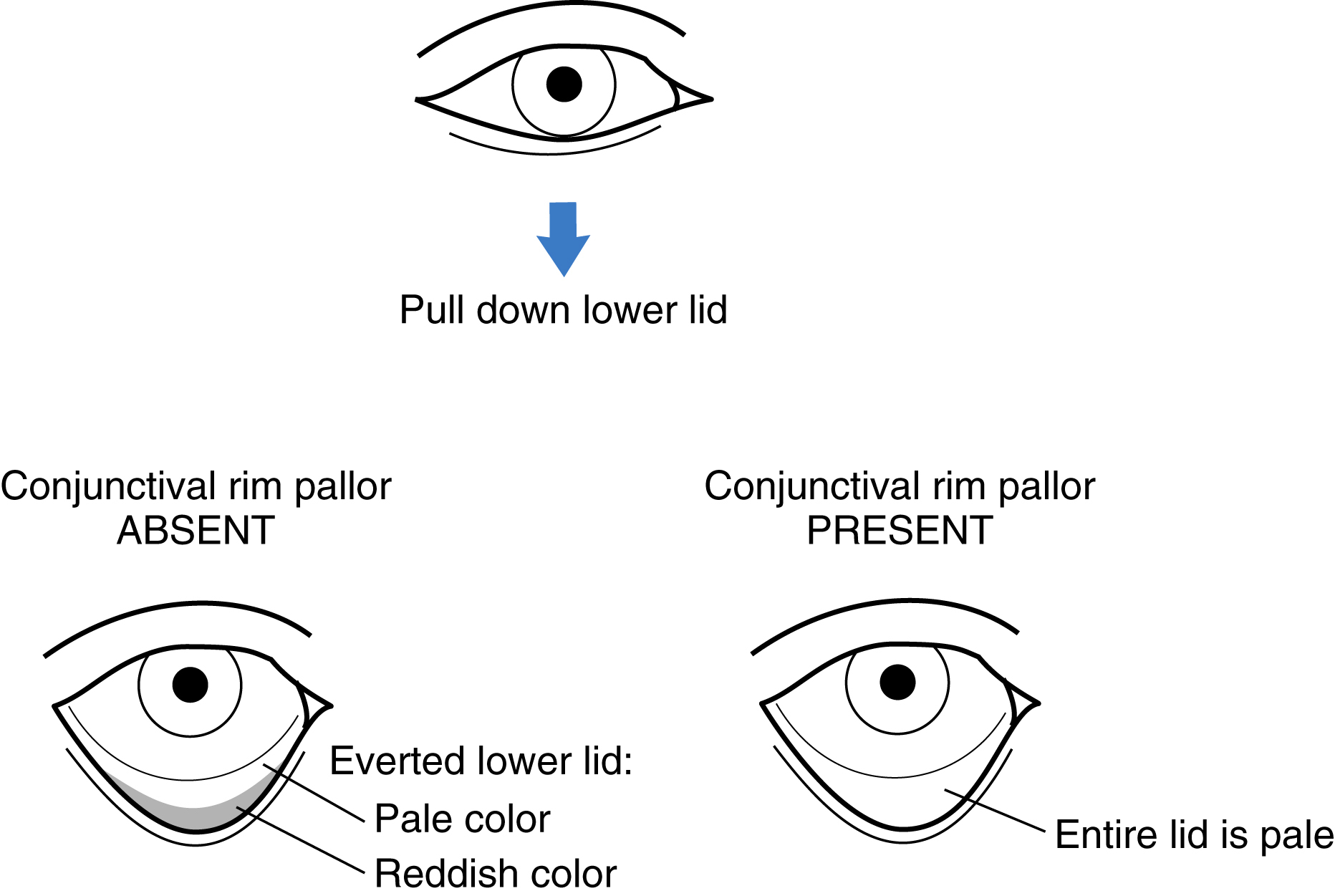
FIG. 10.1 Conjunctival rim pallor.
After gently pulling down the patient’s lower lid (top), the clinician observes the lid’s inner surface, comparing the color of the lid margin (its rim) with the conjunctival surface nearer to the globe. In patients without anemia (bottom left), there are two zones of color: a reddish color at the rim (due to its prominent vascular supply) and a contrasting paler color nearer to the globe (from prominent lymphoid tissue). In patients with anemia (bottom right), the entire inner surface of the lower lid has a pale color (conjunctival rim pallor).
III. Clinical Significance
EBM Box 10.1 presents the diagnostic accuracy of physical signs for chronic anemia as applied to hundreds of patients. These studies excluded patients with acute bleeding or those who had recently received transfusions. As much as possible, the color of skin and conjunctiva was determined using natural lighting.
According to EBM Box 10.1, the finding of conjunctival rim pallor (likelihood ratio [LR] = 16.7) increases the probability of anemia the most, followed by palmar crease pallor (LR = 7.9), palmar pallor (LR = 5.6), conjunctival pallor (i.e., not specifically conjunctival rim pallor, LR = 4.7), pallor at any site (LR = 3.8), facial pallor (light-skinned persons only, LR = 3.8), and tongue pallor (LR = 3.7). Nailbed pallor lacks diagnostic value (LR not significant). Importantly, no physical sign convincingly decreases the probability of anemia (i.e., no LR <0.4).

Finding (Reference)† | Sensitivity (%) | Specificity (%) | Likelihood Ratio‡ if Finding Is | |
| Present | Absent | |||
| Pallor at any site3-7 | 22-77 | 66-92 | 3.8 | 0.5 |
| Facial pallor4 | 46 | 88 | 3.8 | 0.6 |
| Nailbed pallor4,5 | 59-60 | 66-93 | NS | 0.5 |
| Palmar pallor4,5 | 58-64 | 74-96 | 5.6 | 0.4 |
| Palmar crease pallor4 | 8 | 99 | 7.9 | NS |
| Conjunctival pallor4,5,8,9 | 31-62 | 82-97 | 4.7 | 0.6 |
| Tongue pallor10 | 48 | 87 | 3.7 | 0.6 |
| Conjunctival Rim Pallor2 | ||||
| Pallor present | 10 | 99 | 16.7 | — |
| Pallor borderline | 36 | — | 2.3 | — |
| Pallor absent | 53 | 16 | 0.6 | — |
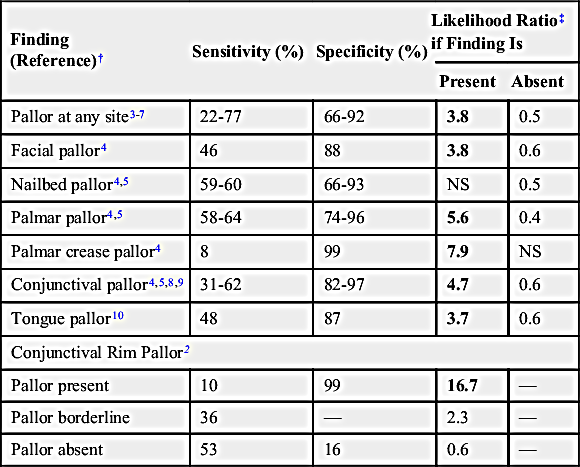
NS, Not significant.
