Chapter 35

Atrial Fibrillation

Michael E. Field
1. What is the difference between atrial fibrillation and atrial flutter?
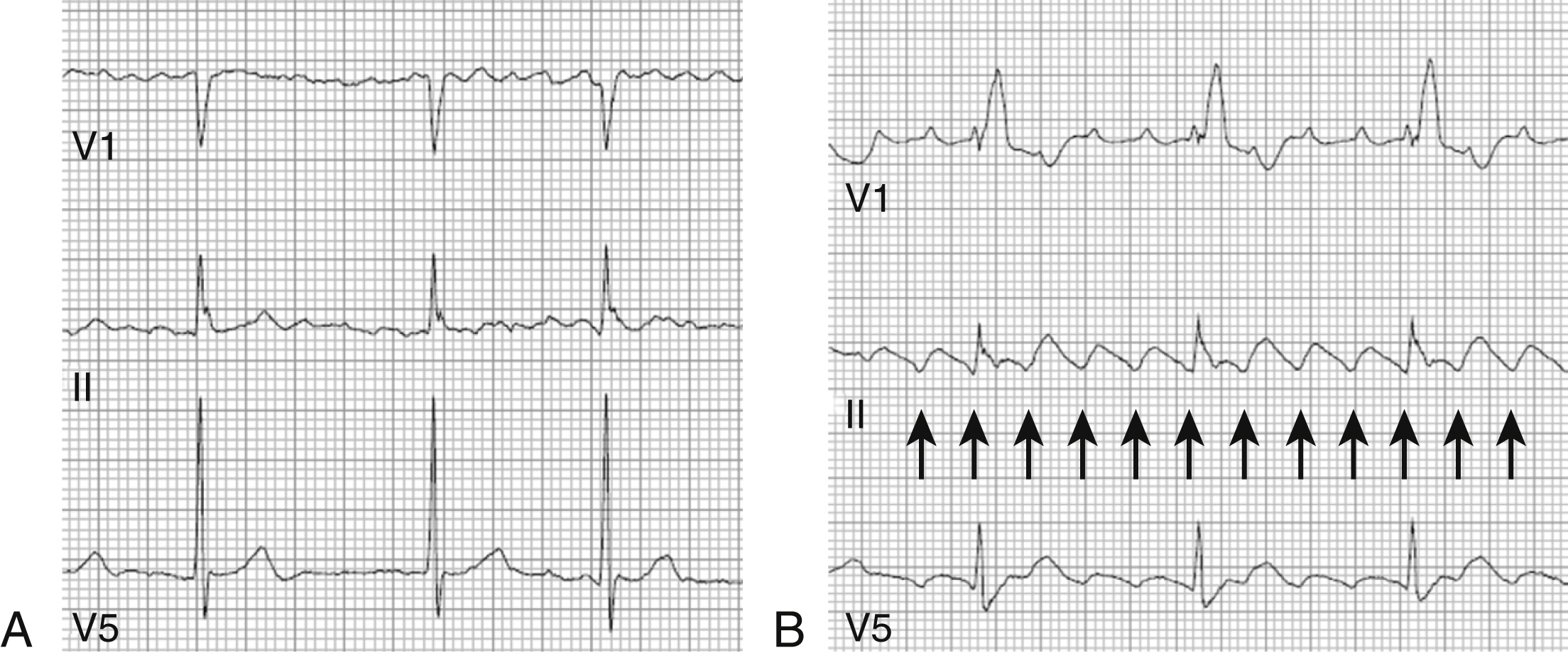
Atrial fibrillation (AF) is a supraventricular tachyarrhythmia with uncoordinated atrial activation and consequently ineffective atrial contraction with ECG characteristics of (1) irregular R-R intervals (when atrioventricular conduction is present), (2) absence of distinct repeating P waves, and (3) irregular atrial activity (Fig. 35.1). In contrast, atrial flutter is characterized by the presence of discrete P waves and atrial activation sequences. An important characteristic of atrial flutter is that the atrial activation is the same from beat to beat. Often times, patients with coarse AF with large-amplitude fibrillatory waves are mistaken for atrial flutter.
2. How common is atrial fibrillation?
The prevalence is 1% in the general population and increases with age (>10% in octogenarians). The number of patients with AF is likely to increase due to the aging population, improved survival for conditions predisposing to AF (such as myocardial infarction and heart failure), and improved detection strategies.
3. What are the primary goals of atrial fibrillation management?
The primary goals of AF management consist of
• Prevention of thromboembolism, including stroke
• Control of ventricular rate in AF and prevention of tachycardia-mediated cardiomyopathy (rate control)
• Alleviation of symptoms by restoring and/or maintaining sinus rhythm (rhythm control)
4. What is the current classification of atrial fibrillation?
Paroxysmal AF—AF that terminates spontaneously or with intervention within 7 days of onset
Persistent AF—Continuous AF that is sustained more than 7 days
Long-standing persistent AF—Continuous AF more than 12 months in duration
Permanent AF—This term is used when the patient and clinician make a joint decision to stop further attempts to restore or maintain sinus rhythm
5. What are the most common etiologic factors contributing to atrial fibrillation?
Although AF can present in the absence of any risk factors, the most common associated risk factors are hypertension and advanced age. AF is also associated with ischemic heart disease, heart failure, and valvular heart disease. It is also important to consider sleep apnea and obesity, which are important modifiable risk factors for AF that may be underrecognized. There is also an association with high-intensity endurance exercise and hereditary components.
In the inpatient setting the majority of cases of new-onset AF occur after noncardiac surgery or in patients with infections and, to a much lesser extent, associated with pulmonary embolism, thyrotoxicosis, or pericarditis.
6. What is the CHA2DS2-VASc score, and how is it used?
Several scoring systems have been developed for stratification of stroke risk with AF to identify who is likely to benefit from anticoagulation. The most commonly used tool is the CHA2DS2-VASc score, which takes into account several clinical risk factors and is summarized in Tables 35.1 and 35.2. Oral anticoagulation is preferred to aspirin in AF patients with one or more stroke risk factors. The recommendations from the 2014 AHA/ACC/HRS Guideline for the Management of AF for anticoagulation according to CHA2DS2-VASc score are summarized in Table 35.3. Aspirin has a limited role in AF and may not be any safer than oral anticoagulation.
7. What can be used to assess a patient’s bleeding risk on anticoagulation?
8. What are the different medication alternatives to warfarin?
9. What are the alternatives to anticoagulation for the prevention of stroke and systemic embolism with atrial fibrillation?
The left atrial appendage (LAA) is thought to be the primary source of stroke in patients with nonvalvular AF (Fig. 35.2). Several nonpharmacologic approaches to LAA occlusion exist and represent potential alternatives to anticoagulation. The WATCHMAN device (Boston Scientific, Marlborough, MA) is a self-expanding nitinol frame covered with a membrane that can be placed percutaneously in the LAA and appears to be an effective therapy for stroke prevention. Surgical occlusion of the LAA can also be performed at the time of concomitant cardiac surgery or as a stand-alone procedure using a minimally invasive approach with a specialized device, such as the AtriClip (AtriCure, Inc., Mason, OH).
10. What options exist for rate control of atrial fibrillation?
11. What is the optimal target heart rate for rate control in atrial fibrillation?
Most patients with AF will require some degree of ventricular rate control, which can be used to reduce symptoms and prevent tachycardia-mediated cardiomyopathy. The RACE ((Rate Control Efficacy in Permanent Atrial Fibrillation: a Comparison between Lenient versus Strict Rate Control)) II trial formally assessed the optimal target by randomizing patients to a “lenient” (resting heart rate <110 bpm) versus “strict” (resting heart rate <80 bpm) strategy. At 3 years the primary composite endpoint of cardiovascular death, hospitalization for heart failure, stroke, embolism, bleeding, or life-threatening arrhythmic events was similar between the two groups (12.9% lenient rate control vs. 14.9% strict rate control), suggesting that a strict rate control strategy did not improve outcomes. Although there are a number of caveats to this trial, it is reasonable in clinical practice to use a more permissive ventricular target rate as long as symptoms are controlled and the left ventricular function is preserved.
12. What are the reasons to pursue maintenance of sinus rhythm in patients with atrial fibrillation?
The main goal of strategies to maintain sinus rhythm (termed rhythm control strategies) is to reduce symptoms by decreasing the frequency and duration of AF episodes. However, data from rate versus rhythm control trials, such as AFFIRM (Atrial Fibrillation Follow-up Investigation of Rhythm Management) and RACE, do not support any mortality benefit of a rhythm control strategy. An important reason to consider a rhythm control approach is inability to achieve adequate rate control, especially when associated with a tachycardia-mediated cardiomyopathy. Other factors that might favor trying to maintain sinus rhythm include patient preference and young patient age. In theory, leaving a patient in AF may eliminate for them new rhythm control options that might arise in the future.
13. Are anticoagulation recommendations different for patients with paroxysmal versus persistent atrial fibrillation?
No, the assessment of stroke risk is based on the individual patient’s stroke risk based on other clinical risk factors using scoring systems, such as the CHA2DS2-VASc score. It is not based on whether the AF is paroxysmal or persistent, whether the patient has short duration or longer duration AF episodes, or whether the AF is apparently well controlled on antiarrhythmics or after AF ablation.
14. When is anticoagulation indicated around the time of cardioversion?
For AF that is less than 48 hours in duration, cardioversion may be performed without prior anticoagulation. If the duration is more than 48 hours or unknown (regardless of the baseline CHA2DS2-VASc score), the patient should be treated with anticoagulation therapy for 3 weeks before and at least 4 weeks after cardioversion. Alternatively, for AF of more than a 48-hour duration or unknown duration, a transesophageal echocardiogram (TEE) may be performed in patients recently initiated on anticoagulation to assess for thrombus prior to cardioversion. If no thrombus is seen, it is reasonable to proceed with cardioversion and then continue anticoagulation for at least 4 weeks afterward. In each of these scenarios, longer term anticoagulation may be indicated based on the patient’s stroke risk assessment (CHA2DS2-VASc score).
15. What can be done if cardioversion for atrial fibrillation is unsuccessful?
It is important to differentiate between a cardioversion in which no sinus rhythm occurred from one in which sinus rhythm was transiently seen but then AF recurred. In the former scenario, in which no beats of sinus rhythm are seen, the issue is energy delivery. Things that can improve energy delivery include increasing shock strength (joules), using a biphasic rather than monophasic waveform, changing the shock vector by altering the electrode pad position, pressing on the anterior electrode pad during shock delivery with a gloved hand, or using a drug such as ibutilide prior to energy delivery. Patients in whom sinus rhythm is transiently seen but then AF recurs can be pretreated with an antiarrhythmic drug prior to cardioversion. A baseline eye exam is also recommended.
16. What are some common side effects with amiodarone?
17. Why do some patients taking propafenone have a pronounced beta-blocking effect?
The cytochrome P450 enzyme activity CYP2D6 metabolizes propafenone to 5-hydroxypropafenone, a metabolite that has less beta-blocking activity than the parent compound. Approximately 6% of white people in the US population are naturally deficient in CYP2D6 activity. In patients lacking the CYP2D6 enzyme, propafenone levels are markedly higher (and levels of 5-hydroxy propafenone are lower), resulting in an exaggerated beta-blocking effect.
18. What are some risk factors for torsades de pointes associated with antiarrhythmic drug therapy?
The common pathway for drug-induced torsades de pointes is inhibition of the IKr (rapidly activating potassium current.) Sotalol and dofetilide (and rarely amiodarone or dronedarone) can be associated with torsades de pointes. Risk factors include hypokalemia, hypomagnesemia, female gender, concomitant use of other QT-prolonging drugs, baseline QT prolongation, or ventricular hypertrophy.
19. What is the target of atrial fibrillation catheter ablation?
The electrical triggers associated with AF originate from the region where the pulmonary veins join the left atrium and represent the common targets for AF catheter ablation. Ablation, using energy, such as radiofrequency or cryoablation, results in isolation of the electrically active sleeves of myocardium at the pulmonary vein junctions in what is termed pulmonary vein isolation.
20. What are the indications for atrial fibrillation catheter ablation?
Ablation is reserved primarily for symptomatic patients refractory to antiarrhythmic medication, although in select patients it may be appropriate as first-line treatment.
21. When is it appropriate to stop anticoagulation after atrial fibrillation catheter ablation?
The decision to discontinue anticoagulation more than 2 to 3 months after AF catheter ablation should be based on the patient’s CHA2DS2-VASc score rather than the apparent success of the procedure. This conservative approach reflects that recurrences of AF following ablation are not uncommon, can be asymptomatic, and escape detection with intermittent monitoring.
22. What are some complications of atrial fibrillation catheter ablation?
A worldwide survey on AF catheter ablation showed an overall incidence of major complications around 5% to 6%. Potential complications include access site complications, cardiac tamponade, stroke, pericarditis, phrenic nerve paralysis, pulmonary vein stenosis, and esophageal fistula. Reentrant and focal left atrial tachycardias, which in some cases can be more symptomatic than the initial AF due to difficult-to-control heart rate, may be seen after the procedure and may be transient or require repeat ablation.
23. What is “pre-excited” atrial fibrillation?
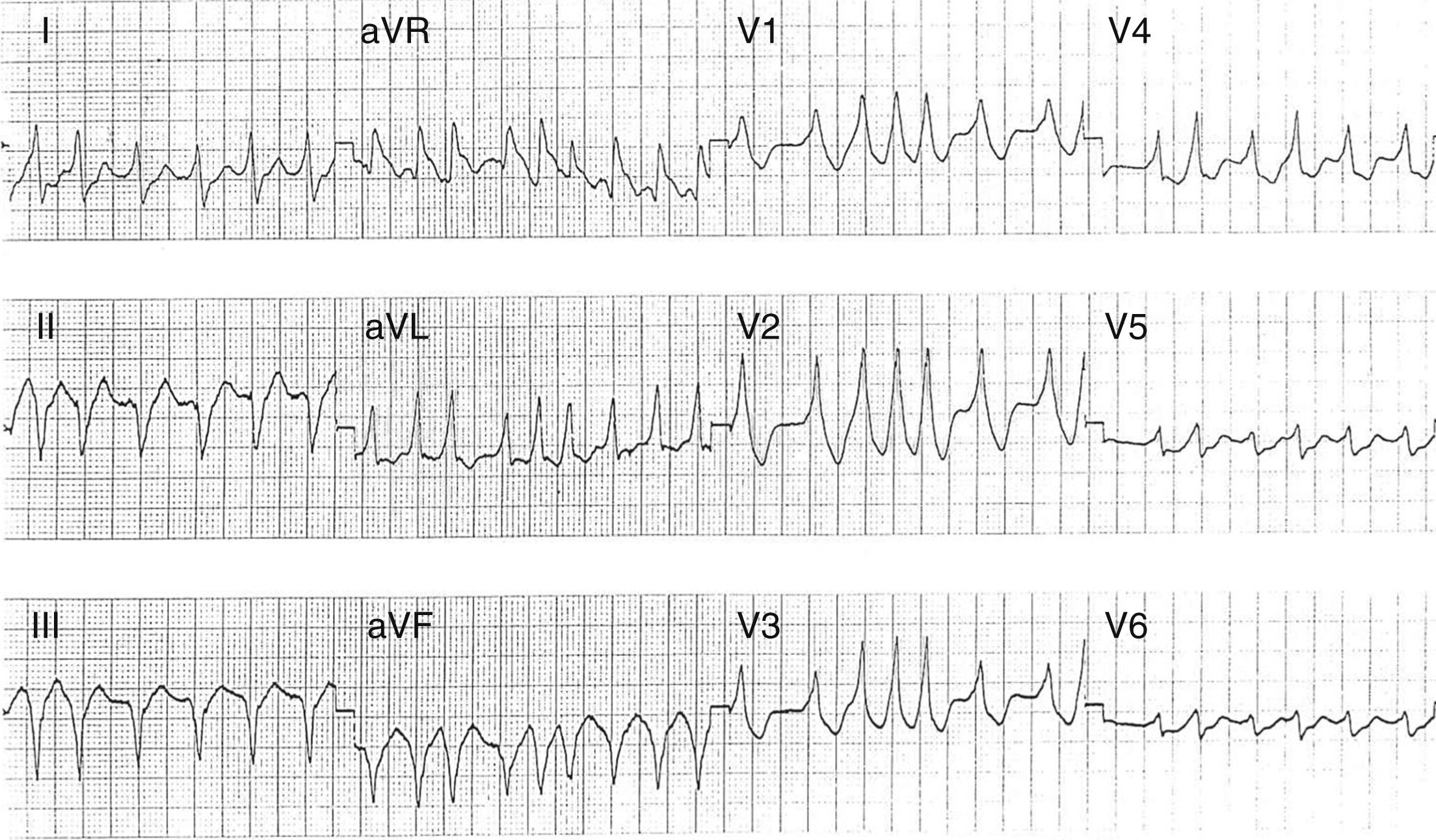
Pre-excited AF occurs in a patient with Wolff-Parkinson-White (WPW) syndrome who develops AF. There is anterograde conduction to varying degrees over the AV node and the accessory pathway. This results in a wide complex tachycardia characterized by irregular ventricular response and varying QRS complexes. (See fig. 35.3) If the accessory pathway is capable of rapid conduction, the ventricular response can be very rapid and potentially degenerate to ventricular fibrillation and subsequent sudden death. Treatment of these patients includes synchronized cardioversion if the patient is unstable or intravenous (IV) procainamide infusion.