Chapter 314 Hiatal Hernia
Herniation of the stomach through the esophageal hiatus can occur as a common sliding hernia (type 1), in which the gastroesophageal junction slides into the thorax, or it can be paraesophageal (type 2), in which a portion of the stomach (usually the fundus) is insinuated next to the esophagus inside the gastroesophageal junction in the hiatus (Figs. 314-1 and 314-2). A combination of sliding and paraesophageal types (type 3) is present in some patients. Sliding hernias are often associated with gastroesophageal reflux, especially in developmentally delayed children. The relationship to hiatal hernias in adults is unclear. Medical treatment is not directed at the hernia but at the gastroesophageal reflux, unless failure of medical therapy prompts correction of the hernia at the time of fundoplication.
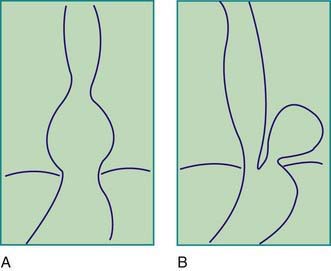
Figure 314-1 Types of esophageal hiatal hernia. A, Sliding hiatal hernia, the most common type. B, Paraesophageal hiatal hernia.
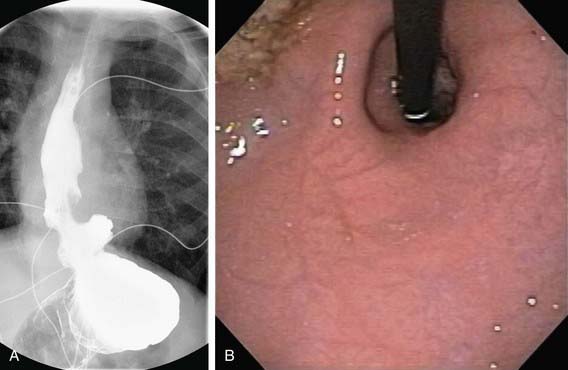
Figure 314-2 A, An upper gastrointestinal series shows a large hiatal hernia that extends above the diaphragm and impedes the exit of contrast from the esophagus into the stomach. Contrast is also noted to reflux to the upper esophagus. B, A retroflexed view of the hernia from the stomach during an upper endoscopy.
A paraesophageal hernia can be an isolated congenital anomaly or associated with gastric volvulus, or it may be encountered after fundoplication for gastroesophageal reflux, especially if the edges of a dilated esophageal diaphragmatic hiatus have not been approximated. Fullness after eating and upper abdominal pain are the usual symptoms. Infarction of the herniated stomach is rare.