Chapter 689 Disorders Involving Transcription Factors
There are three disorders involving transcription factors that result in bone dysplasias. One, campomelic dysplasia, is historically considered a chondrodysplasia. The other two, cleidocranial dysplasia and nail-patella syndrome, have been regarded as dysostoses, or abnormalities of single bones. The mutant genes that encode these transcription factors are SOX9, RUNX2 (CBFA1), and LMX1B, respectively, and are members of much larger gene families. For instance, SOX9 is a member of the SOX family of genes related to the SRY (sex-determining region of the Y chromosome) gene; RUNX2 (CBFA1) belongs to the runt family of transcription factor genes, and LMX1B is one of the LIM homeodomain gene family. All three disorders are due to haploinsufficiency of the respective gene products; the disorders are dominant traits. For familial cases of cleidocranial dysplasia and nail-patella syndrome, prenatal diagnosis is possible if the mutations are identified. Campomelic dysplasia results from new mutational events and has a low risk of recurrence in subsequent pregnancies.
Campomelic Dysplasia
Apparent in newborn infants, campomelic dysplasia (OMIM 114290) is characterized by bowing of long bones (especially in the lower legs), short bones, respiratory distress, and other anomalies that include defects of the cervical spine, central nervous system, heart, and kidneys. Several cases of sex reversal of XY males have been reported. Radiographs confirm the bowing and often show hypoplasia of the scapulae and pelvic bones (Fig. 689-1). Affected infants usually die of respiratory distress in the neonatal period. Complications in children and adolescents who survive include short stature with progressive kyphoscoliosis, recurrent apnea and respiratory infections, and learning difficulties.
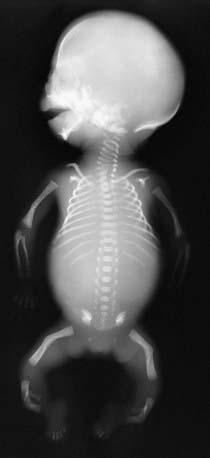
Figure 689-1 Radiograph in a fetus of 21 weeks’ gestation with campomelic dysplasia. Findings include a large skull with a small face; hypoplastic/absent scapular bodies; 11 ribs; poorly ossified thoracic pedicles; tall, narrow iliac wings; and short extremities with proportionately long, bowed femurs.
(From Slovis TL, editor: Caffey’s pediatric diagnostic imaging, ed 11, vol 2, Philadelphia, 2008, Mosby.)
Cleidocranial Dysplasia
Cleidocranial dysplasia (OMIM 114290) is recognized in infants because of drooping shoulders, open fontanelles, prominent forehead, mild short stature, and dental abnormalities (Fig. 689-2). Radiographs reveal hypoplastic or absent clavicles, delayed ossification of the cranial bones with multiple ossification centers (wormian bones), and delayed ossification of pelvic bones. The course is usually uncomplicated except for dislocations, especially of the shoulders, and dental anomalies (numerous teeth) that require therapy.

Nail-Patella Syndrome
Dysplasia of the nails, absence or hypoplasia of the patella, abnormalities of the elbow, and spurs or “horns” extending from the iliac bones characterize the nail-patella syndrome (OMIM 119600), which is also called osteo-onychodysostosis. Some patients have nephritis that resembles chronic glomerulonephritis. There is a wide spectrum of severity; some patients present in early childhood, whereas others are asymptomatic as adults.
Dreyer SD, Zhou G, Baldini A, et al. Mutations in LMX1B cause abnormal skeletal patterning and renal dysplasia in nail patella syndrome. Nat Genet. 1998;19:47-50.
Gimovsky M, Rosa E, Tolbert T, et al. Campomelic dysplasia: case report and review. J Perinatol. 2008;28:71-73.
Granata A, Nori G, Ravazzolo R, et al. Nail-patella syndrome and renal involvement. Description of three cases and literature review. Clin Nephrol. 2008;69:377-382.
Mansour S, Offiah AC, McDowall S, et al. The phenotype of survivors of campomelic dysplasia. J Med Genet. 2002;39:597-602.
Meyer J, Sudbeck P, Held M, et al. Mutational analysis of the sox9 gene in campomelic dysplasia and autosomal sex reversal: lack of genotype/phenotype correlations. Hum Mol Genet. 1997;6:91-98.
Mundlos S, Otto F, Mundlos C, et al. Mutations involving the transcription factor CBFA1 cause cleidocranial dysplasia. Cell. 1997;89:773-779.