Clinical Judgment and the NCLEX-RN® Examination
http://evolve.elsevier.com/Silvestri/comprehensiveRN/
The Pyramid to Success
Saunders Comprehensive Review for the NCLEX-RN® Examination
About This Resource and the NCLEX-RN® Examination
Welcome to the Pyramid to Success and Saunders Comprehensive Review for the NCLEX-RN® Examination. This resource is specially designed to help you begin your successful journey to the peak of the pyramid, becoming a registered nurse. As you begin your journey, you will be introduced to all of the important points regarding the NCLEX-RN examination and the process of testing, and to unique and special tips regarding how to prepare yourself for this important examination. You will read what a nursing graduate who recently passed the NCLEX-RN examination has to say about the test. Important test-taking strategies are detailed. These details will guide you in selecting the correct option or assist you in making an educated guess if you are not entirely sure about the correct answer. Each unit in this book begins with the Pyramid to Success. The Pyramid to Success addresses specific points related to the NCLEX-RN examination. Client Needs as identified in the test plan framework for the examination are listed, as are learning objectives for the unit. Pyramid Terms are key words that are defined in the glossary located in Evolve and set in color throughout each chapter to direct your attention to significant points for the examination.
This resource provides you with nursing content review, including the content identified in the current NCLEX test plan, and practice questions. Throughout each chapter, you will find Pyramid Point bullets that identify areas most likely to be tested on the NCLEX-RN examination. Read each chapter, and identify your strengths and areas that are in need of further review.
The book contains 945 NCLEX-style questions. The Evolve site accompanying this book contains all of the questions from the book plus additional Evolve questions for a total of more than 5200 practice questions. The types of practice questions include multiple choice; fill-in-the-blank; multiple-response; ordered-response (also known as drag and drop); questions that contain a figure, chart/exhibit, or graphic option item; audio or video item formats; and case studies. In addition, the new Next Generation NCLEX® (NGN) question types are also provided on the accompanying Evolve site. Examples of question types can be located throughout this chapter.
Test your strengths and abilities by taking all practice tests provided in this book and on the accompanying Evolve site. Be sure to read all rationales and test-taking strategies. The rationale provides you with significant information regarding the correct and incorrect options. The test-taking strategy provides you with the logical path to selecting the correct option. reference source and page number are provided so that you can easily find information you need to review in another Elsevier text. You may also review in the content review sections of this book. Each question in the book and on the accompanying Evolve site is coded on the basis of the Level of Cognitive Ability, the Client Needs category, the Integrated Process, Content Area being tested, and a Health Problem, if applicable. The Health Problem code allows you to filter and select questions based on a disease process. For example, if heart failure is the area of interest, you can select “Adult Health, Cardiovascular, Heart Failure” on the Evolve site. In addition, two Priority Concepts that relate to the content of the question are identified. This code is helpful for students specifically whose curriculum is concept-based. Additionally, information about all of the special features of this resource and the question types is located in the preface of this book.
Other Resources in the Saunders Pyramid to Success
There are several other resources in the Saunders Pyramid to Success program. These include the following: The Saunders Q&A Review for the NCLEX-RN® Examination, The HESI/Saunders Online Review for the NCLEX-RN® Examination, Saunders Strategies for Test Success: Passing Nursing School and the NCLEX® Exam, Saunders Q&A Review Cards for the NCLEX-RN® Exam, and Saunders RNtertainment for the NCLEX-RN® Exam.
All of these resources in the Saunders Pyramid to Success are described in the preface of this book and can be obtained online by visiting http://elsevierhealth.com or by calling 800-545-2522.
Let’s begin our journey through the Pyramid to Success.
Examination Process
An important step in the Pyramid to Success is to become as familiar as possible with the examination process. Candidates facing the challenge of this examination can experience significant anxiety. Knowing what the examination is all about and knowing what you will encounter during the process of testing will assist in alleviating fear and anxiety. The information contained in this chapter was obtained from the NCSBN Web site (www.ncsbn.org) and from the NCSBN 2019 test plan for the NCLEX-RN and includes some procedures related to registering for the exam, testing procedures, and the answers to the questions most commonly asked by nursing students and graduates preparing to take the NCLEX. You can obtain additional information regarding the test and its development by accessing the NCSBN Web site and clicking on the NCLEX Exam tab or by writing to the National Council of State Boards of Nursing, 111 East Wacker Drive, Suite 2900, Chicago, IL 60601. You are encouraged to access the NCSBN Web site, because this site provides you with the most up-to-date and valuable information about the NCLEX and other resources available to an NCLEX candidate. You are also encouraged to access the most up-to-date Candidate Bulletin. This document provides you with everything you need to know about registration procedures and scheduling a test date.
Computer Adaptive Testing
The acronym CAT stands for computer adaptive test, which means that the examination is created as the test-taker answers each question. All the test questions are categorized on the basis of the test plan structure and the level of difficulty of the question. As you answer a question, the computer determines your competency based on the answer you selected. If you selected a correct answer, the computer scans the question bank and selects a more difficult question. If you selected an incorrect answer, the computer scans the question bank and selects an easier question. This process continues until all test plan requirements are met and a reliable pass-or-fail decision is made.
When taking a CAT, once an answer is recorded, all subsequent questions administered depend, to an extent, on the answer selected for that question. Skipping and returning to earlier questions are not compatible with the logical methodology of a CAT. The inability to skip questions or go back to change previous answers will not be a disadvantage to you; you will not fall into that “trap” of changing a correct answer to an incorrect one with the CAT system.
If you are faced with a question that contains unfamiliar content, you may need to guess at the answer. There is no penalty for guessing, but you need to make an educated guess. With most of the questions, the answer will be right there in front of you. If you need to guess, use your nursing knowledge and clinical experiences to their fullest extent and all of the test-taking strategies you have practiced in this review program.
You do not need any computer experience to take this examination. A keyboard tutorial is provided and administered to all test-takers at the start of the examination. The tutorial will instruct you on the use of the on-screen optional calculator, the use of the mouse, and how to record an answer. The tutorial provides instructions on how to respond to all question types on this examination. This tutorial is also provided on the NCSBN Web site, and you are encouraged to view the tutorial when you are preparing for the NCLEX examination. In addition, at the testing site, a test administrator is present to assist in explaining the use of the computer to ensure your full understanding of how to proceed.
Development of the Test Plan
The test plan for the NCLEX-RN examination is developed by the NCSBN. The examination is a national examination; the NCSBN considers the legal scope of nursing practice as governed by state laws and regulations, including the Nurse Practice Act, and uses these laws to define the areas on the examination that will assess the competence of the test-taker for licensure.
The NCSBN also conducts an important study every 3 years, known as a practice analysis study, that is conducted to link the examination to nursing practice. The results of this study determine the framework for the test plan for the examination. The participants in this study include newly licensed registered nurses from all types of generalist nursing education programs. From a list of nursing care activities (activity statements) provided, the participants are asked about the applicability, frequency, and importance of performing these activities in relation to client safety. A panel of content experts at the NCSBN analyzes the results of the study and makes decisions regarding the test plan framework. The results of this recently conducted study provided the structure for the test plan implemented in April 2019.
Test Plan
The content of the NCLEX-RN examination reflects the activities identified in the practice analysis study conducted by the NCSBN. The questions are written to address Level of Cognitive Ability, Client Needs, and Integrated Processes as identified in the test plan developed by the NCSBN.
Level of Cognitive Ability
Levels of cognitive ability include knowledge, understanding, applying, analyzing, synthesizing, evaluating, and creating. The practice of nursing requires complex thought processing and critical thinking in decision making. Therefore, you will not encounter any knowledge or understanding questions on the NCLEX. Questions on this examination are written at the applying level or at higher levels of cognitive ability. Table 1-1 provides descriptions and examples of each level of cognitive ability. Box 1-1 presents an example of a question that requires you to apply data.
Table 1-1
| Level | Description and Example |
|---|---|
| Knowledge | Recalling information from memorizing. Example: A normal blood glucose level is 70 to 99 mg/dL (3.9 to 5.5 mmol/L). |
| Understanding | Recognizing the meaning of information. Example: A blood glucose level of 60 mg/dL (3.34 mmol/L) is lower than the normal reference range. |
| Applying | Carrying out an appropriate action based on information. Example: Administering 10 to 15 g of carbohydrate such as a 1⁄2 glass of fruit juice to treat mild hypoglycemia. |
| Analyzing | Examining a broad concept and breaking it down into smaller parts. Example: The broad concept is mild hypoglycemia and the smaller concepts are the signs and symptoms of mild hypoglycemia, such as hunger, irritability, weakness, headache, or blood glucose level lower than 70 mg/dL (3.9 mmol/L). So, for example, the question may present information that you need to interpret as mild hypoglycemia. Then, the question asks you to select the option(s) that identify the appropriate nursing action(s) to correct hypoglycemia. |
| Synthesizing | Examining smaller parts or information and determining the broad concept. Example: The smaller concepts are manifestations such as polyuria, polydipsia, polyphagia, vomiting, abdominal pain, weakness, confusion, and Kussmaul respirations. The broad concept is diabetic ketoacidosis (DKA). So, for example, the question may provide specific information about the manifestations of DKA. You need to interpret these manifestations as DKA. Then, the question asks you to select the option(s) that identify the appropriate nursing action(s), based on your interpretation that the client is experiencing DKA. |
| Evaluating | Making judgments, conclusions, or validations based on evidence. Example: Determining that treatment for mild hypoglycemia was effective if the blood glucose level returned to a normal level between 70 to 99 mg/dL (3.9 to 5.5 mmol/L) after a specified time period. |
| Creating | Generating or producing a new outcome or plan by putting parts of information together. Example: Designing a safe and individualized plan of care with the interprofessional health care team for a client with diabetes mellitus that meets the client’s physiological, psychosocial, and health maintenance needs. |
Reference: Ignatavicius, Workman (2018), pp. 1331-1333.
Adapted from Understanding Bloom’s (and Anderson and Krathwohl’s) taxonomy, 2015, ProEdit, Inc. http://www.proedit.com/understanding-blooms-and-anderson-and-krathwohls-taxonomy/
Client Needs
The NCSBN identifies a test plan framework based on Client Needs, which includes 4 major categories. Some of these categories are divided further into subcategories. The Client Needs categories are Safe and Effective Care Environment, Health Promotion and Maintenance, Psychosocial Integrity, and Physiological Integrity (Table 1-2).
Table 1-2
| Client Needs Category and Subcategory | Percentage of Questions |
|---|---|
| Safe and Effective Care Environment | |
| Management of Care | 17-23 |
| Safety and Infection Control | 9-15 |
| Health Promotion and Maintenance | 6-12 |
| Psychosocial Integrity | 6-12 |
| Physiological Integrity | |
| Basic Care and Comfort | 6-12 |
| Pharmacological and Parenteral Therapies | 12-18 |
| Reduction of Risk Potential | 9-15 |
| Physiological Adaptation | 11-17 |
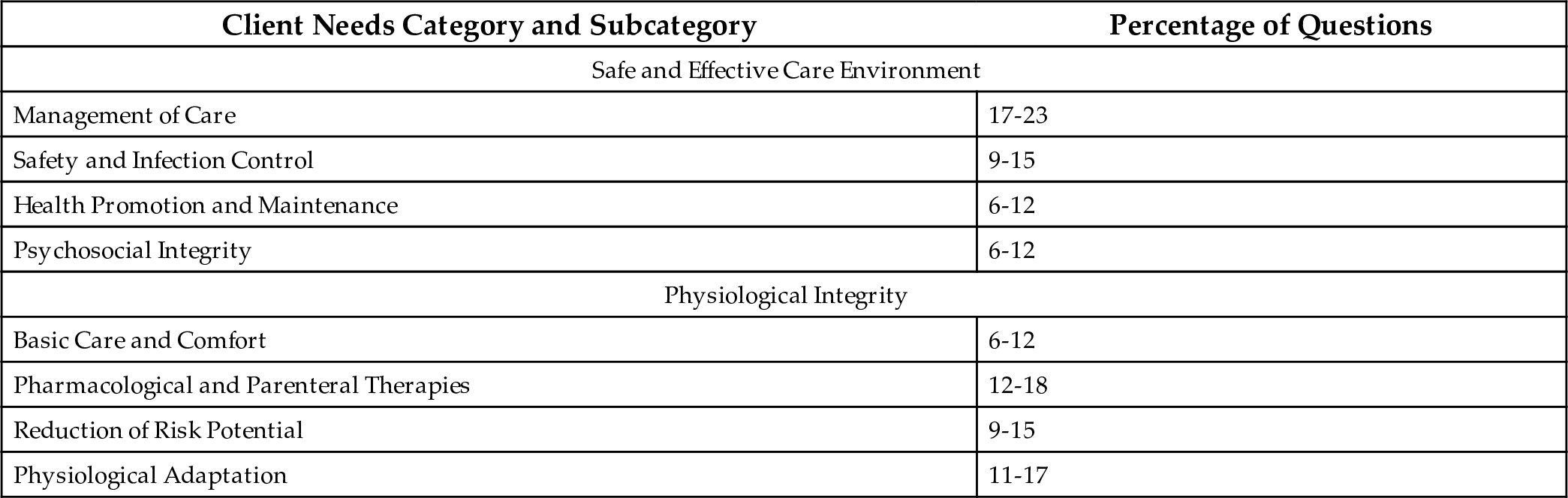
From National Council of State Boards of Nursing: 2019 NCLEX-RN® examination: Test plan for the National Council Licensure Examination for Registered NursesChicago, 2018, National Council of State Boards of Nursing.
Safe and Effective Care Environment
The Safe and Effective Care Environment category includes 2 subcategories: Management of Care, and Safety and Infection Control. According to the NCSBN, Management of Care addresses prioritizing care and providing and directing nursing care that will ensure a safe care delivery setting to protect clients and health care personnel. The NCSBN indicates that Safety and Infection Control addresses content that will protect clients and health care personnel from health and environmental hazards within health care facilities and in community settings. Box 1-2 presents examples of questions that address these 2 subcategories.
Health Promotion and Maintenance
The Health Promotion and Maintenance category addresses the principles related to growth and development. According to the NCSBN, this Client Needs category also addresses content required to assist the individual to prevent health problems; to recognize alterations in health; and to develop health practices that promote and support optimal wellness. See Box 1-3 for an example of a question in this Client Needs category.
Psychosocial Integrity
The Psychosocial Integrity category addresses content required to promote and support the ability of the client to cope, adapt, and problem-solve during stressful events. The NCSBN also indicates that this Client Needs category addresses the emotional, mental, and social well-being of the client experiencing stressful events and care for the client with an acute or chronic mental illness. See Box 1-4 for an example of a question in this Client Needs category.
Physiological Integrity
The Physiological Integrity category includes 4 subcategories: Basic Care and Comfort, Pharmacological and Parenteral Therapies, Reduction of Risk Potential, and Physiological Adaptation. The NCSBN describes these subcategories as follows. Basic Care and Comfort addresses content for providing comfort and assistance to the client in the performance of activities of daily living. Pharmacological and Parenteral Therapies addresses content for administering medications and parenteral therapies, such as intravenous therapies and parenteral nutrition, and administering blood and blood products. Reduction of Risk Potential addresses content for preventing complications or health problems related to the client’s condition or any prescribed treatments or procedures. Physiological Adaptation addresses content for managing and providing care to clients with acute, chronic, or life-threatening conditions. See Box 1-5 for examples of questions in this Client Needs category.
Integrated Processes
The NCSBN identifies five processes in the test plan that are fundamental to the practice of nursing. These processes are incorporated throughout the major categories of Client Needs. The Integrated Process subcategories are Caring, Communication and Documentation, Nursing Process (Assessment, Analysis, Planning, Implementation, and Evaluation), Culture and Spirituality, and Teaching and Learning. See Box 1-6 for an example of a question that incorporates the Integrated Process of Caring.
Types of Questions on the Examination
The types of questions that may be administered on the examination include multiple-choice; fill-in-the-blank; multiple-response; ordered-response (also known as drag and drop); image (hot spot) questions; figure, chart/exhibit, or graphic option items; and audio formats. You may also be administered some Next Generation NCLEX® (NGN) questions, which may be a part of the NCSBN research study. A pilot study on NGN questions is being conducted by the NCSBN, and results demonstrate that there is an asymmetrical relationship between knowledge and clinical judgment; thus, recall of learned material is not translating to safety and efficacy in practice. This is the impetus behind these new item types. Research on these new item types is still being conducted. The candidate will be informed if the questions are research items and will be given the option to answer them or to decline. Regardless, you need to focus and use critical thinking and clinical judgment skills to answer these correctly. These NGN question types will be accompanied by a single episode or unfolding case study and include extended multiple response, extended drag and drop, cloze (drop-down) enhanced hot spot (highlighting), and matrix/grid. These new item types are intended to evaluate a candidate’s ability to utilize the dynamic skill of clinical judgment, rather than knowledge or recall alone.
Some questions may require you to use the mouse and cursor on the computer. For example, you may be presented with a picture that displays the arterial vessels of an adult client. In this picture, you may be asked to “point and click” (using the mouse) on the area (hot spot) where the dorsalis pedis pulse could be felt.
In all types of questions, the answer is scored as either right or wrong. Credit is not given for a partially correct answer. In addition, all question types may include pictures, graphics, tables, charts, or sound. The NCSBN provides specific directions for you to follow with all question types to guide you in your process of testing. Be sure to read these directions as they appear on the computer screen. Examples of some of these types of questions are noted in this chapter. All question types are provided in this book and on the accompanying Evolve site.
Multiple-Choice Questions
Many of the questions that you will be asked to answer will be in the multiple-choice format. These questions provide you with data about a client situation and four answers, or options.
Fill-in-the-Blank Questions
Fill-in-the-blank questions may ask you to perform a medication calculation, determine an intravenous flow rate, or calculate an intake or output record on a client. You will need to type only a number (your answer) in the answer box. If the question requires rounding the answer, this needs to be performed at the end of the calculation. The rules for rounding an answer are described in the tutorial provided by the NCSBN and are also provided in the specific question on the computer screen. In addition, you must type in a decimal point if necessary. See Box 1-7 for an example.
Box 1-7
Fill-in-the-Blank Question
A prescription reads: acetaminophen liquid, 650 mg orally every 4 hours PRN for pain. The medication label reads: 500 mg/15 mL. The nurse prepares how many milliliters to administer one dose? Fill in the blank. Record your answer using one decimal place.
Formula:


In this question, you need to focus on the subject, mL per dose, and use the formula for calculating a medication dose. When the dose is determined, you will need to type your numeric answer in the answer box. Always follow the specific directions noted on the computer screen. Also, remember that there will be an on-screen calculator on the computer for your use.
Multiple-Response Questions
For a multiple-response question, you will be asked to select or check all of the options, such as nursing interventions, that relate to the information in the question. In these question types, there may be 1 correct answer, there may be more than 1 correct answer, or all answers could be correct. No partial credit is given for correct selections. You need to do exactly as the question asks, which will be to select all of the options that apply. See Box 1-8 for an example.
Box 1-8
Multiple-Response Question
The emergency department nurse is caring for a child suspected of acute epiglottitis. Which interventions apply in the care of the child? Select all that apply.
 1. Obtain a throat culture.
 2. Auscultate lung sounds.
- 3. Prepare the child for a chest x-ray.
- 4. Maintain the child in a supine position.
- 5. Obtain a pediatric-size tracheostomy tray.
- 6. Place the child on an oxygen saturation monitor.
In a multiple-response question, you will be asked to select or check all of the options, such as interventions, that relate to the information in the question. Focus on the subject, interventions for the child with suspected acute epiglottitis. To answer this question, recall that acute epiglottitis is a serious obstructive inflammatory process that requires immediate intervention and that airway patency is a priority. Auscultating lung sounds allows the nurse to obtain information about airway patency without causing further airway compromise by examining the throat. Examination of the throat with a tongue depressor or attempting to obtain a throat culture is contraindicated because the examination can precipitate further obstruction. A lateral neck and chest x-ray is obtained to determine the degree of obstruction, if present. To reduce respiratory distress, the child should sit upright. The child is placed on an oxygen saturation monitor to monitor oxygenation status. Tracheostomy and intubation may be necessary if respiratory distress is severe. Remember to follow the specific directions given on the computer screen.
Ordered-Response Questions
In this type of question, you will be asked to use the computer mouse to drag and drop your nursing actions in order of priority. Information will be presented in a question and, based on the data, you need to determine what you will do first, second, third, and so forth. The unordered options will be located in boxes on the left side of the screen, and you need to move all options in order of priority to ordered-response boxes to the right side of the screen. Specific directions for moving the options are provided with the question. See Figure 1-1 for an example. These type of practice questions are located on the accompanying Evolve site.

Figure or Hot Spot Questions
A question with a picture or graphic will ask you to answer the question based on the picture or graphic. The question could contain a chart, a table, or a figure or illustration. You also may be asked to use the computer mouse to point and click on a specific area in the visual. A chart, table, figure, or illustration may appear in any type of question, including a multiple-choice question. See Box 1-9 for an example.
Box 1-9
Figure Question
A client who experienced a myocardial infarction is being monitored via cardiac telemetry. The nurse notes the sudden onset of this cardiac rhythm on the monitor (refer to figure) and immediately takes which action?

- 1. Takes the client’s blood pressure
- 2. Initiates cardiopulmonary resuscitation (CPR)
- 3. Places a nitroglycerin tablet under the client’s tongue
- 4. Continues to monitor the client and then contacts the cardiologist
This question requires you to identify the cardiac rhythm, and then determine the priority nursing action. Note the strategic word, immediately. This cardiac rhythm identifies a coarse ventricular fibrillation (VF). The goals of treatment are to terminate VF promptly and to convert it to an organized rhythm. The primary health care provider, cardiologist, or an Advanced Cardiac Life Support (ACLS)–qualified nurse must immediately defibrillate the client. If a defibrillator is not readily available, CPR is initiated until the defibrillator arrives. Options 1, 3, and 4 are incorrect actions and delay lifesaving treatment.
Chart/Exhibit Questions
In this type of question, you will be presented with a problem and a chart or exhibit. You will be provided with tabs or buttons that you need to click to obtain the information needed to answer the question. A prompt or message will appear that will indicate the need to click on a tab or button. See Box 1-10 for an example.
Box 1-10
Chart/Exhibit Question
The nurse reviews the history and physical examination documented in the medical record of a client requesting a prescription for oral contraceptives. The nurse determines that oral contraceptives are contraindicated because of which documented items? Refer to chart. Select all that apply.
| Client’s Chart | ||
|---|---|---|
| History and Physical | Medications | Diagnostic Results |
| Item 1: Has admitting diagnosis of renal calculi Item 2: Past medical history: deep vein thrombosis with associated thrombophlebitis Item 3: Hypertension Item 4: Hyperlipidemia Item 5: Prediabetes | Item 6: Multivitamin orally daily Item 7: Lisinopril 40 mg orally daily Item 8: Atorvastatin 10 mg orally daily Item 9: Metformin 500 mg orally twice daily | Item 10: Renal ultrasound shows no hydronephrosis, low probability of renal artery stenosis Item 11: Complete blood cell (CBC) shows white blood cells (WBC) 13,000 mm3 (13 × 109/L), hemoglobin (Hgb) 16 g/dL ( 60 mmol/L), hematocrit (Hct) 47% (0.47), platelets 490,000 mm3 (490 × 109/L) |

This chart/exhibit question provides you with data from the client’s medical record. Focus on the subject, the item(s) that are a contraindication to the use of oral contraceptives. Oral contraceptives are contraindicated in women with a history of any of the following: thrombophlebitis and thromboembolic disorders, cardiovascular or cerebrovascular diseases (including stroke), any estrogen-dependent cancer or breast cancer, benign or malignant liver tumors, impaired liver function, hypertension, and diabetes mellitus with vascular involvement. Adverse effects of oral contraceptives include increased risk of superficial and deep venous thrombosis, pulmonary embolism, thrombotic stroke (or other types of strokes), myocardial infarction, and accelerations of preexisting breast tumors. Item 2 is a thromboembolic disorder with associated thrombophlebitis. Items 3 and 4 are cardiovascular diseases. The medications the client is taking are not specific contraindications to oral contraceptives. The normal WBC is 5000-10,000 mm3 (5-10 × 109/L). The normal Hgb for a male is 14-18 g/dL (140-180 mmol/L) and 12-16 g/dL (120-160 mmol/L) for a female. The normal Hct for a male is 42-52% (0.42-0.52) and 37-47% (0.37-0.47) for a female. The normal platelet count is 150,000-400,000 mm3 (150-400 × 109/L). Item 11 has components that present contraindications; of note is that this client has polycythemia, which is a thromboembolic disorder and therefore is contraindicated for the use of oral contraceptives.
Graphic Item Option Questions
In this type of question, the option selections will be pictures rather than text. You will need to use the computer mouse to click on the option that represents your answer choice. See Box 1-11 for an example.
Box 1-11
Graphic Item Option Question
The nurse would place the client in which position to administer an enema? (Refer to the figures in 1 to 4.)


This question requires you to select the picture that represents your answer choice. Focus on the subject, the position for administering an enema. To administer an enema, the nurse assists the client into the modified left lateral recumbent position with the right knee flexed. This position allows the enema solution to flow downward by gravity along the natural curve of the sigmoid colon and rectum, improving the retention of solution. Option 1 is a prone position. Option 3 is a dorsal recumbent position. Option 4 is a supine position.
Audio Questions
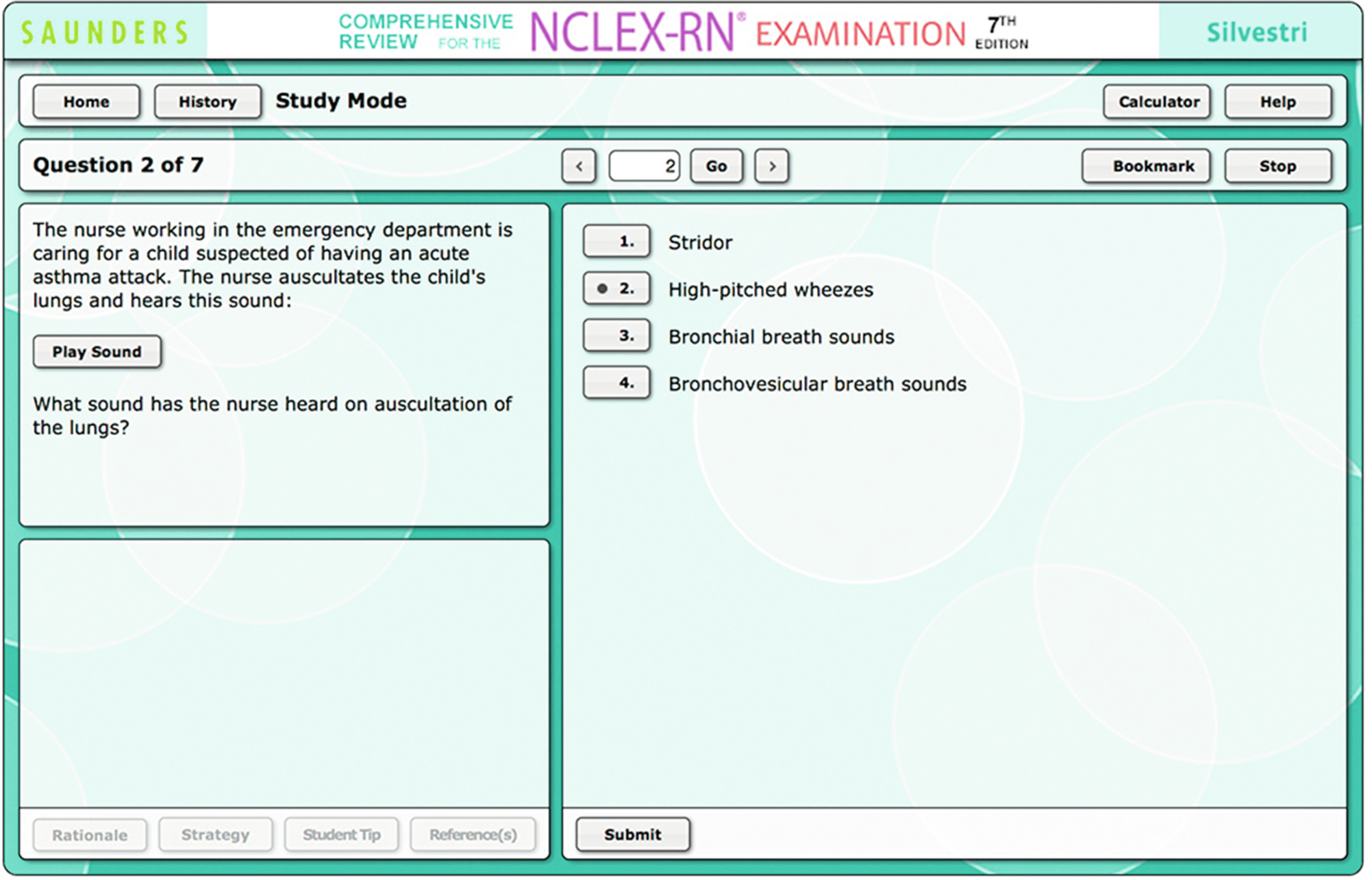
Audio questions will require listening to a sound to answer the question. These questions will prompt you to use the headset provided and to click on the sound icon. You will be able to click on the volume button to adjust the volume to your comfort level, and you will be able to listen to the sound as many times as necessary. Content examples include, but are not limited to, various lung sounds, heart sounds, or bowel sounds. Examples of this question type are located on the accompanying Evolve site (Fig. 1-2).
Clinical Judgment and Next Generation NCLEX (NGN) Item Types
Clinical judgment is the observed outcome of critical thinking and decision-making (Dickison, Haerling, & Lasater, 2019). There is heightened attention being paid to clinical judgment as a means of teaching, learning, assessment, and testing. The NCLEX-RN examination requires candidates to demonstrate the ability to use clinical judgment in the delivery of client care. Clinical judgment would also be used as a test-taking strategy to answer test questions (Refer to Chapter 4). The National Council of State Boards of Nursing (NCSBN) has created a Clinical Judgment Measurement Model (CJMM) that consists of applying 6 cognitive skills or processes. These include: (1) recognizing cues; (2) analyzing cues; (3) prioritizing hypotheses; (4) generating solutions; (5) taking action; and (6) evaluating outcomes (Dickison et al., 2019). See Table 1-3. This model also serves as a guide for the NCSBN to create Next Generation NCLEX (NGN) questions. The CJMM continues to evolve as may the NGN item types that will be presented in the exam. Currently, the test items that will be used are extended multiple response, extended drag and drop, cloze (drop-down), enhanced hot spot (highlighting), and matrix/grid. It is expected that the NGN test items will be scored items in the new test plan implemented in 2023. Some of these NGN item types can be found on the Evolve site accompanying this book. We highly encourage you to frequently access the NCSBN website at HYPERLINK "http://www.ncsbn.org" www.ncsbn.org for updates.
Table 1-3
| Cognitive Skill/Process | Description |
|---|---|
| Recognize cues | Identifying significant data; data can be from many sources (assessment) |
| Analyze cues | Connecting data to the client's clinical presentation—determining is the data is expected? Unexpected? (analysis) |
| Prioritize hypotheses | Ranking hypotheses; what are the concerns or client needs/problems and their priority? (analysis) |
| Generate solutions | Using hypotheses to determine interventions for an expected outcome (planning) |
| Take action | Implementing the generated solutions addressing the highest priorities or hypotheses (implementation) |
| Evaluate outcomes | Comparing observed outcomes with expected ones (evaluation) |
From Dickison, P., Haerling, K. A., & Lasater, K. (2019). Integrating the National Council of State Boards of Nursing Clinical Judgment Model into Nursing Educational Frameworks. Journal of Nursing Education, 58(2), 72–78.
Extended Multiple Response
This type is similar to a multiple response question in that it allows more than one option to be chosen. The difference is that an extended multiple-response question presents more options, from 7 to 10 options. An example of one way they may be presented can be located in Box 1-12.
Box 1-12
NGN Items: Case Study With Extended Multiple Response and CLOZE Item
Victoria Machane, 76 years old, is brought to the emergency department by her son, Michael. Michael tells the nurse that Victoria has not been able to tolerate any physical activity and that when she tries to do something she tires very easily. Victoria began to experience shortness of breath and a cough that started this morning, and Michael states that his mother’s skin looked pale and gray. On assessment, the nurse notes that Victoria exhibits shortness of breath on exertion; she is coughing and expectorating frothy white mucus. Her pulse rate is 102 beats/min, and her blood pressure is 164/98 mm Hg. The nurse auscultates Victoria’s lung sounds and notes the presence of bilateral crackles in the lower lobes. Victoria is hospitalized. Her current home medications include betaxolol hydrochloride for glaucoma and glimepiride for type 2 diabetes mellitus. She also takes over-the-counter hydroxyaluminum sodium carbonate to help prevent acid indigestion. Heart failure is diagnosed. In addition to the medication that Victoria takes at home, the following medications are prescribed: captopril, furosemide, metoprolol, and digoxin.
Item Type: Extended Multiple Response
Cognitive Skill: Prioritize Hypotheses
The nurse reviews Victoria’s admission data and prepares to collaborate with the interprofessional health care team about Victoria’s plan of care. What would the nurse discuss with the team? Select all that apply.
- 1. Victoria’s age as a risk for falls.
- 2. The need for respiratory treatments.
- 3. Victoria’s inability to tolerate activity.
- 4. That the antacid could affect the absorption of digoxin.
- 5. That metoprolol may mask symptoms of hypoglycemia.
- 6. That the antacid must be used with caution in clients with glaucoma.
- 7. That potential systemic side effects of betaxolol hydrochloride include heart failure.
- 8. That betaxolol hydrochloride may contribute to hypertension when taken with the newly prescribed medications.
Victoria is 76 years of age. In addition to her age, her poor respiratory status and inability to tolerate activity place her at risk for falls. These factors require implementing a plan of care that will meet her needs. Antacids decrease the digoxin level by increasing digoxin absorption or bioavailability. Antacids also decrease the absorption of captopril. However, antacids are not a concern in clients with glaucoma. Ophthalmic beta blockers can have additive therapeutic or adverse effects when given with systemically administered beta blockers or other cardiovascular medications. Toxic reactions to beta blockers are rare but primarily involve the cardiovascular system. Symptoms include bradycardia, cardiac failure, hypotension, and bronchospasm. Treatment involves discontinuation of the medication and supportive care (e.g., administration of adrenergic and anticholinergic medications). In addition, the nonselective beta blockers can interfere with the normal responses to hypoglycemia, such as tremor, tachycardia, and nervousness, in essence masking the signs and symptoms of hypoglycemia. Hypotension is more likely than hypertension in clients taking beta-blocker medications.
On the following morning (day 2 of hospitalization), the nurse checks Victoria’s vital signs and notes a blood pressure (BP) of 98/64 mm Hg and a heart rate of 62 beats per minute. On review of the laboratory data, the nurse notes the following:
- Hemoglobin 14 g/dL (140 g/L)
- Hematocrit 41% (0.41)
- White blood cell count 7,000 mm3 (7 × 10⁹/L)
- Sodium 145 mEq/L (145 mmol/L)
- Potassium 3.6 mEq/L (3.6 mmol/L)
- Blood urea nitrogen 20 mg/dL (7.1 mmol/L)
- Creatinine 1.1 mg/dL (97 mcmol/L)
- Blood glucose 99 mg/dL (5.5 mmol/L)
Which medication would be of most concern and require clarification prior to administration? Complete the following sentences by choosing from the dropdown lists.
- The nurse should not administer the (Select one)

Because (Select one)

Captopril is an angiotensin-converting enzyme (ACE) inhibitor. The main side/adverse effects of this medication are cough, hypotension, hyperkalemia, and tachycardia. Other side effects associated with ACE inhibitors include headache, dizziness, fatigue, insomnia, and weight loss. Victoria’s BP is low at 98/64 mm Hg. Digoxin is a cardiac glycoside and would require clarification about administration if the pulse were below 60 beats per minute or if she were showing signs of toxicity. Victoria’s pulse rate is 62 beats per minute. Glimepiride is used to manage blood glucose levels and would require clarification about administration if the blood glucose was low. Victoria’s blood glucose is normal (normal level is 70 - 99 mg/dL [3.9 - 5.5 mmol/L]). Furosemide is a diuretic. Although the nurse would monitor for a drop in BP in the client receiving furosemide, the primary concern is hypokalemia. Victoria’s potassium level is normal (normal level is 3.5-5.0 mEq/L [3.5-5.0 mmol/L]).
CLOZE Item
The CLOZE item type is similar to a short-answer type question. In this type of question, you will need to select a response from a drop-down menu. See Box 1-12 for an example.
Extended Drag and Drop
There are various ways in which extended drag and drop question types will be presented. An extended drag and drop question will provide you with several pieces of specific information and will ask you to order that information into the correct order of action or placement. See Box 1-13 for an example.
Box 1-13
NGN Item: Extended Drag and Drop; Cognitive Skill: Generate Solutions
The nurse is preparing assignments for the day for the eight clients below and needs to assign clients to a registered nurse (RN), a licensed practical nurse (LPN), and an assistive personnel (AP). Drag each client to the most appropriate health care provider.
| Clients |
| A client requiring a platelet transfusion. |
| A client requiring a colostomy irrigation. |
| A client receiving continuous tube feedings. |
| A client with respiratory failure on a mechanical ventilator. |
| A client who requires frequent ambulation and has a steady gait. |
| A client who requires a bed bath and range of motion exercises. |
| A client who requires hourly pulse and blood pressure measurements. |
| A client requiring abdominal wound irrigations and dressing changes every 3 hours. |

| RN Assignment | LPN Assignment | AP Assignment |
|---|---|---|
| A client requiring a platelet transfusion. | A client requiring a colostomy irrigation. | A client who requires frequent ambulation and has a steady gait. |
| A client with respiratory failure on a mechanical ventilator. | A client receiving continuous tube feedings. | A client who requires a bed bath and range-of-motion exercises. |
| A client requiring abdominal wound irrigations and dressing changes every 3 hours. | A client who requires hourly pulse and blood pressure measurements. |
The nurse must determine the most appropriate assignment based on the education and skills of the health care provider and the needs of the client. In general, noninvasive interventions, such as skin care, range-of-motion exercises, ambulation, grooming, and hygiene measures, can be assigned to the AP. In general, a LPN or vocational nurse (VN) can perform not only the tasks that a AP can perform but also certain invasive tasks, such as dressing changes, wound irrigations, tube feedings, colostomy irrigations, suctioning, urinary catheterization, and medication administration (oral, subcutaneous, intramuscular, and selected piggyback medications), according to the education and job description of the LPN or VN. The LPN or VN can also review with the client teaching plans that were initiated by the registered nurse. A registered nurse can perform the tasks that an LPN or VN can perform and is responsible for assessment and planning care, initiating teaching, and administering medications intravenously.
Enhanced Hot Spot (Highlighting)
These items present data pertinent to a client case, and asks the student to highlight the information that requires follow-up. See Box 1-14 for an example.
Box 1-14
NGN Item: Enhanced Hot Spot (Highlighting); Cognitive Skill: Recognize Cues
The nurse is assessing a male client admitted 1 day ago for newly diagnosed type 2 diabetes mellitus. Clinical findings are noted below.
| blank cell | Current | 12 hours ago | 24 hours ago |
|---|---|---|---|
| Blood pressure | 122/68 mmHg | 128/70 mmHg | 130/70 mmHg |
| Pulse | 122 beats per minute (bpm) | 110 bpm | 108 bpm |
| Respirations | 24 breaths per minute (bpm) | 22 bpm | 22 bpm |
| Oral temperature | 36.2C (97.1F) | 36.4C (97.5F) | 36.2C (97.1F) |
| Capillary glucose | 410 mg/dL (23.4 mmol/L) | 360 mg/dL (20.57 mmol/L) | 400 mg/dL (22.85 mmol/L) |
| Serum glucose | 425 mg/dL(25.2 mmol/L) | 360 mg/dL (20.57 mmol/L) | 410 mg/dL(23.4 mmol/L) |
| Serum potassium | 2.8 mEq/L (2.8 mmol/L) | 3.2 mEq/L (3.2 mmol/L) | 3.6 mEq/L (3.6 mmol/L) |
| Urine output | 23 mL/hr | 30 mL/hr | 40 mL/hr |

Which of the current findings requires immediate follow-up?
Click on the current findings that require immediate follow-up to highlight it. Highlight only findings that require follow-up. To deselect, click the finding again.
| blank cell | Current | 12 hours ago | 24 hours ago |
|---|---|---|---|
| Blood pressure | 122/68 mmHg | 128/70 mmHg | 130/70 mmHg |
| Pulse | 122 bpm | 110 bpm | 108 bpm |
| Respirations | 24 bpm | 22 bpm | 22 bpm |
| Oral temperature | 36.2C (97.1F) | 36.4C (97.5F) | 36.2C (97.1F) |
| Capillary glucose | 410 mg/dL(22.8 mmol/L) | 360 mg/dL(20.0 mmol/L) | 400 mg/dL (22.3 mmol/L) |
| Serum glucose | 425 mg/dL(23.7 mmol/L) | 360 mg/dL(20.0 mmol/L) | 410 mg/dL(22.8 mmol/L) |
| Serum potassium | 2.8mEq/L(2.8 mmol/L) | 3.2mEq/L(3.2 mmol/L) | 3.6mEq/L(3.6 mmol/L) |
| Urine output | 23mL/hr | 36mL/hr | 40mL/hr |

With newly diagnosed type 2 diabetes mellitus, the client is at risk for diabetic ketoacidosis or hyperglycemic hyperosmolar non-ketotic syndrome, both of which can lead to hypovolemia and shock. The blood pressure has remained stable for this client but is declining. At this time, it does not require further follow-up. The pulse rate has increased significantly since admission, and is a sign of hypovolemia, which is a finding that should be addressed. The respiratory rate is slightly elevated and should be addressed early on because this is a sensitive indicator of fluid status. The capillary glucose and serum glucose levels at each of the timepoints has been elevated, and an intervention is required to address this abnormality. The serum potassium level was within the normal range initially but has decreased since admission and is now at a critical level. This could be due to the client’s treatment, which likely involves insulin. This requires follow-up because of the risks associated with hypokalemia. The urine output has steadily decreased and could be an indicator of hypovolemia, and therefore requires follow-up. The temperature is normal and does not require follow-up.
Matrix Items
These items present data regarding a client, and may ask the student to select actions that are essential, nonessential, and contraindicated. See Box 1-15 for an example.
Box 1-15
NGN Item: Matrix Item; Cognitive Skill: Take Action
The nurse notes that there has been an increase in the number of central-line–associated blood stream infections (CLABSIs) that developed in the clients being cared for on the nursing unit. How would the nurse proceed to implement a quality improvement program? For each action below, click or mark with an X to specify whether the action would be:
Indicated: An action that the nurse would take to resolve the problem
Nonessential: An action that the nurse could take without harming the client, but the action would not be likely to address the problem
Contraindicated: An action that could harm the client and would not be taken

Quality improvement, also known as performance improvement, focuses on processes or systems that significantly contribute to client safety and effective client care outcomes; criteria are used to monitor outcomes of care and to determine the need for change to improve the quality of care. If the nurse notes a particular problem, such as an increase in the CLABSIs, the nurse should collect data about the problem. This should include information such as the primary and secondary diagnoses of the clients developing the infection, the type and location of IV catheters being used, the site of the catheter, IV site dressings being used, frequency of assessment and methods of care to the IV site, and length of time that the IV catheter was inserted. Once these data are collected and analyzed, the nurse should examine evidence-based practice protocols to identify the best practices for care to IV sites to prevent infection. These practices can then be implemented and followed by evaluation of results based on the evidence-based practice protocols used. Collecting identifying client information is contraindicated because of client confidentiality and is unnecessary in this quality improvement effort. Noting the mental status of the client can be done but is not likely to address the problem. Noting the types of medications being infused can also be done but will not address the problem of IV site infection. Although it is helpful to know the expected duration of the IV site, this information does not change infection control practices in managing the IV site and is therefore considered a nonessential action.
Case Studies (Testlets) and NGN Items
Case Studies and NGN Item Types are included in this resource and can be located in the Evolve site accompanying this book. These are specially designed to simulate the NCLEX experience of testing for these Next Generation NCLEX (NGN) Item Types. Refer to the Evolve site for practice with these question types.
The NCSBN Practice Test Questions for the NCLEX
The NCSBN provides a practice test for candidates that is composed of previously used NCLEX questions that are no longer a part of the NCLEX. This exam simulates the look of the real exam and provides the candidate with practice for the NCLEX. This practice test can be purchased through the NCSBN at www.ncsbn.org
Registering to Take the Examination
It is important to obtain an NCLEX Examination Candidate Bulletin from the NCSBN Web site at www.ncsbn.org, because this bulletin provides all of the information you need to register for and schedule your examination. It also provides you with Web site and telephone information for NCLEX examination contacts. The initial step in the registration process is to submit an application to the state board of nursing in the state in which you intend to obtain licensure. You need to obtain information from the board of nursing regarding the specific registration process, because the process may vary from state to state. Then, use the NCLEX Examination Candidate Bulletin as your guide to complete the registration process.
Following the registration instructions and completing the registration forms precisely and accurately are important. Registration forms not properly completed or not accompanied by the proper fees in the required method of payment will be returned to you and will delay testing. You must pay a fee for taking the examination; you also may have to pay additional fees to the board of nursing in the state in which you are applying.
Authorization to Test Form and Scheduling an Appointment
Once you are eligible to test, you will receive an Authorization to Test (ATT) form. You cannot make an appointment until you receive an ATT form. Note the validity dates on the ATT form, and schedule a testing date and time before the expiration date on the ATT form. The NCLEX Examination Candidate Bulletin provides you with the directions for scheduling an appointment; you do not have to take the examination in the same state in which you are seeking licensure.
The ATT form contains important information, including your test authorization number, candidate identification number, and validity date. You need to take your ATT form to the testing center on the day of your examination. You will not be admitted to the examination if you do not have it.
Changing Your Appointment
If for any reason you need to change your appointment to test, you can make the change on the candidate Web site or by calling candidate services. Refer to the NCLEX Examination Candidate Bulletin for this contact information and other important procedures for canceling and changing an appointment. If you fail to arrive for the examination or fail to cancel your appointment to test without providing appropriate notice, you will forfeit your examination fee and your ATT form will be invalidated. This information will be reported to the board of nursing in the state in which you have applied for licensure, and you will be required to register and pay the testing fees again.
Day of the Examination
It is important that you arrive at the testing center at least 30 minutes before the test is scheduled. If you arrive late for the scheduled testing appointment, you may be required to forfeit your examination appointment. If it is necessary to forfeit your appointment, you will need to reregister for the examination and pay an additional fee. The board of nursing will be notified that you did not take the test. A few days before your scheduled date of testing, take the time to drive to the testing center to determine its exact location, the length of time required to arrive at that destination, and any potential obstacles that might delay you, such as road construction, traffic, or parking sites.
In addition to the ATT form, you must have proper identification (ID) such as a U.S. driver’s license, passport, U.S. state ID, or U.S. military ID to be admitted to take the examination. All acceptable identification must be valid and not expired and contain a photograph and signature (in English). In addition, the first and last names on the ID must match the ATT form. According to the NCSBN guidelines, any name discrepancies require legal documentation, such as a marriage license, divorce decree, or court action legal name change. Refer to the NCLEX Examination Candidate Bulletin for acceptable forms of identification.
Testing Accommodations
If you require testing accommodations, you should contact the board of nursing before submitting a registration form. The board of nursing will provide the procedures for the request. The board of nursing must authorize testing accommodations. Following board of nursing approval, the NCSBN reviews the requested accommodations and must approve the request. If the request is approved, the candidate will be notified and provided the procedure for registering for and scheduling the examination.
Testing Center
The testing center is designed to ensure complete security of the testing process. Strict candidate identification requirements have been established. You may be required to wear a mask and follow other safety and social distancing guidelines and will also be asked to read the rules related to testing. A digital fingerprint and palm vein print will be taken. A digital signature and photograph will also be taken at the testing center. These identity confirmations will accompany the NCLEX exam results. In addition, if you leave the testing room for any reason, you may be required to perform these identity confirmation procedures again to be readmitted to the room.
Personal belongings are not allowed in the testing room; all electronic devices must be placed in a sealable bag provided by the test administrator and kept in a locker. Any evidence of tampering with the bag could result in the need to report the incident and test cancellation. A locker and locker key will be provided for you; however, storage space is limited, so you must plan accordingly. In addition, the testing center will not assume responsibility for your personal belongings. The testing waiting areas are generally small; friends or family members who accompany you are not permitted to wait in the testing center while you are taking the examination.
Once you have completed the admission process, the test administrator will escort you to the assigned computer. You will be seated at an individual workspace area that includes computer equipment, appropriate lighting, an erasable note board, and a marker. No items, including unauthorized scratch paper, are allowed into the testing room. Eating, drinking, or the use of tobacco is not allowed in the testing room. You will be observed at all times by the test administrator while taking the examination. In addition, video and audio recordings of all test sessions are made. The testing center has no control over the sounds made by typing on the computer by others. If these sounds are distracting, raise your hand to summon the test administrator. Earplugs are available on request.
You must follow the directions given by the testing center staff and must remain seated during the test except when authorized to leave. If you think that you have a problem with the computer, need a clean note board, need to take a break, or need the test administrator for any reason, you must raise your hand. You are also encouraged to access the NCSBN candidate Web site to obtain additional information about the physical environment of the testing center and to view a virtual tour of the testing center.
Testing Time
The maximum testing time is 6 hours; this period includes the tutorial, the sample items, all breaks, and the examination. All breaks are optional. The first optional break will be offered after 2 hours of testing. The second optional break is offered after 3.5 hours of testing. Remember that all breaks count against testing time. If you take a break, you must leave the testing room, and when you return you may be required to perform identity confirmation procedures to be readmitted. Note that modifications in testing time may be made due to the COVID-19 pandemic.
Length of the Examination
The minimum number of questions that you will need to answer is 75. Of these 75 questions, 60 will be operational (scored) questions and 15 will be pretest (unscored) questions. The maximum number of questions in the test is 265.
The pretest questions are questions that may be presented as scored questions on future examinations. These pretest questions are not identified as such. In other words, you do not know which questions are the pretest (unscored) questions; however, these pretest (unscored) questions will be administered among the first 75 questions in the test. Note that modifications in the exam length may be made due to the COVID-19 pandemic; modifications do not make the test harder or affect reliability or validity in determining your competence.
Pass-or-Fail Decisions
All examination questions are categorized by test plan area and level of difficulty. This is an important point to keep in mind when you consider how the computer makes a pass-or-fail decision, because a pass-or-fail decision is not based on a percentage of correctly answered questions.
The NCSBN indicates that a pass-or-fail decision is governed by three different scenarios. The first scenario is the 95% Confidence Interval Rule, in which the computer stops administering test questions when it is 95% certain that the test-taker’s ability is clearly above the passing standard or clearly below the passing standard. The second scenario is known as the Maximum-Length Exam, in which the final ability estimate of the test-taker is considered. If the final ability estimate is above the passing standard, the test-taker passes; if it is below the passing standard, the test-taker fails.
The third scenario is the Run-Out-Of-Time (R.O.O.T) Rule. If the examination ends because the test-taker ran out of time, the computer may not have enough information with 95% certainty to make a clear pass-or-fail decision. If this is the case, the computer will review the test-taker’s performance during testing. If the test-taker has not answered the minimum number of required questions, the test-taker fails. If the test-taker’s ability estimate was consistently above the passing standard on the last 60 questions, the test-taker passes. If the test-taker’s ability estimate falls below the passing standard, even once, the test-taker fails. Additional information about pass-or-fail decisions can be found in the NCLEX Examination Candidate Bulletin located at www.ncsbn.org.
Completing the Examination
When the examination has ended, you will complete a brief computer-delivered questionnaire about your testing experience. After you complete this questionnaire, you need to raise your hand to summon the test administrator. The test administrator will collect and inventory all note boards and then permit you to leave.
Processing Results
Every computerized examination is scored twice, once by the computer at the testing center and again after the examination is transmitted to the test scoring center. No results are released at the testing center; testing center staff do not have access to examination results. The board of nursing receives your result, and your result will be mailed to you approximately 6 weeks after you take the examination. In some states, an unofficial result can be obtained via the Quick Results Service 2 business days after taking the examination. There is a fee for this service, and information about obtaining your NCLEX result by this method can be obtained on the NCSBN Web site under candidate services.
Candidate Performance Report
A candidate performance report is provided to a test-taker who failed the examination. This report provides the test-taker with information about her or his strengths and weaknesses in relation to the test plan framework and provides a guide for studying and retaking the examination. If a retake is necessary, the candidate must wait 45 days between examination administration, depending on state procedures. Test-takers should refer to the state board of nursing in the state in which licensure is sought for procedures regarding when the examination can be taken again.
Interstate Endorsement and Nurse Licensure Compact
Because the NCLEX-RN examination is a national examination, you can apply to take the examination in any state. When licensure is received, you can apply for interstate endorsement, which is obtaining another license in another state to practice nursing in that state. The procedures and requirements for interstate endorsement may vary from state to state, and these procedures can be obtained from the state board of nursing in the state in which endorsement is sought. It may be possible to practice nursing in another state under the mutual recognition model of nursing licensure if the state has enacted a Nurse Licensure Compact. To obtain information about the Nurse Licensure Compact and the states that are part of this interstate compact, access the NCSBN Web site at www.ncsbn.org.
The Foreign-Educated Nurse
An important first step in the process of obtaining information about becoming a registered nurse in the United States is to access the NCSBN Web site at www.ncsbn.org and obtain information provided for international nurses in the NCLEX Web site link. The NCSBN provides information about some of the documents you need to obtain as an international nurse seeking licensure in the United States and about credentialing agencies. Refer to Box 1-16 for a listing of some of these documents. The NCSBN also provides information regarding the requirements for education and English proficiency, and immigration requirements such as visas and VisaScreen. You are encouraged to access the NCSBN Web site to obtain the most current information about seeking licensure as a registered nurse in the United States.
An important factor to consider as you pursue this process is that some requirements may vary from state to state. You need to contact the board of nursing in the state in which you are planning to obtain licensure to determine the specific requirements and documents that you need to submit.
Boards of nursing can decide either to use a credentialing agency to evaluate your documents or to review your documents at the specific state board, known as in-house evaluation. When you contact the board of nursing in the state in which you intend to work as a nurse, inform them that you were educated outside of the United States and ask that they send you an application to apply for licensure by examination. Be sure to specify that you are applying for registered nurse (RN) licensure. You should also ask about the specific documents needed to become eligible to take the NCLEX exam. You can obtain contact information for each state board of nursing through the NCSBN Web site at www.ncsbn.org. In addition, you can write to the NCSBN regarding the NCLEX exam. The address is 111 East Wacker Drive, Suite 2900, Chicago, IL 60601. The telephone number for the NCSBN is 1-866-293-9600; international telephone is 011 1 312 525 3600; the fax number is 1-312-279-1032.