Page 59 

Chapter 3 The ankle joint

ANATOMY 59
Bony landmarks to be palpated 59
Ligaments 60
Muscles 61
Plantarflexors 61
Dorsiflexors 62
Invertors 63
Evertors 64
MEASUREMENT 65
Range of movement 65
Dorsiflexion 65
Plantarflexion 66
Inversion 67
Eversion 69
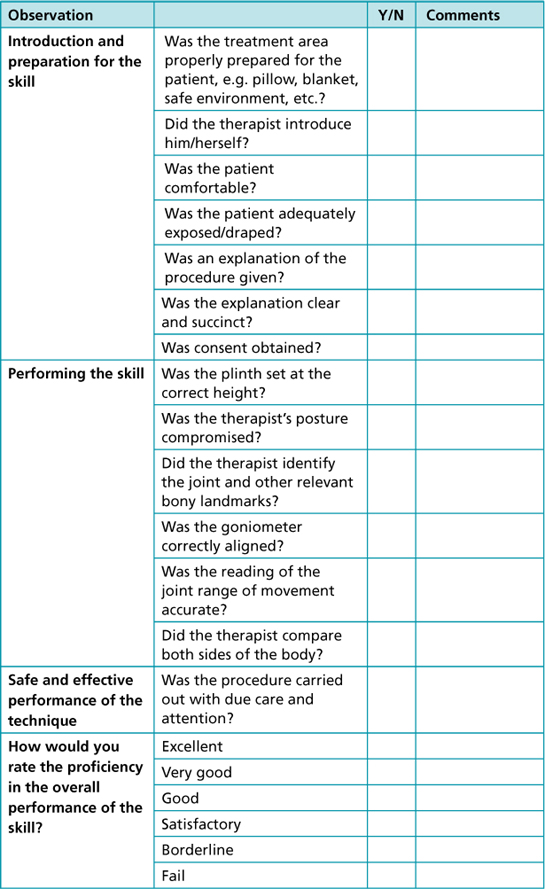
Observational/reflective checklist 71
Joint girth 72
Limb girth 75
Calf 75
Muscle strength: Oxford muscle grading 77
Plantarflexors 77
Dorsiflexors 79
Evertors 82
Invertors 84

Anatomy

1. The ankle joint is a synovial hinge joint.
2. It is an articulation between the distal end of the tibia and fibula with the body of the talus.
3. A fibrous capsule completely surrounds the joint, attaching to the articular margins.
4. It is supported by strong lateral and medial ligaments.
5. The ankle is most stable in dorsiflexion, which is the joint’s closed packed position.
6. The anterior talofibular ligament appears to be the ligament most prone to injury.
7. The movements that take place at the ankle joint are plantarflexion (flexion) and dorsiflexion (extension).

Bony Landmarks to be Palpated

The tibia – anterior border, medial surface, and the medial malleolus.
  Page 60 
The fibula – lateral malleolus.
The foot – the head of the talus, the sustentaculum tali of the calcaneus, the tuberosity of the navicular and the base of the 5th metatarsal.

Ligaments

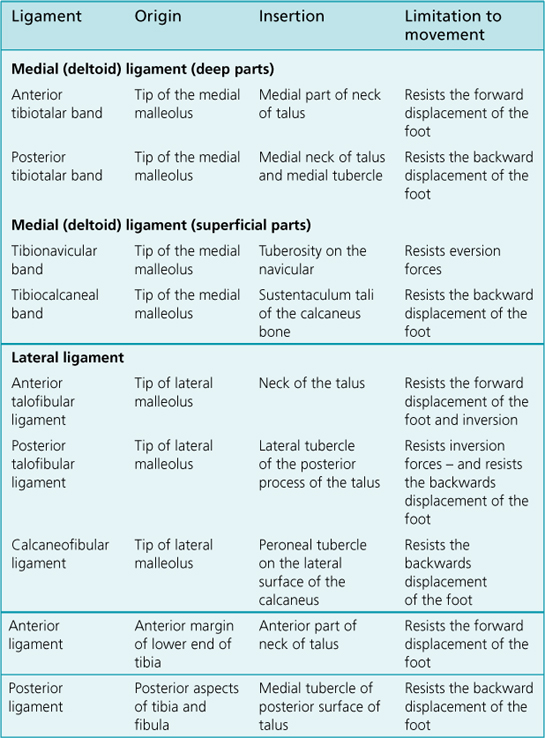
Table 3.1Ankle ligaments

image

  Page 61 

Muscles

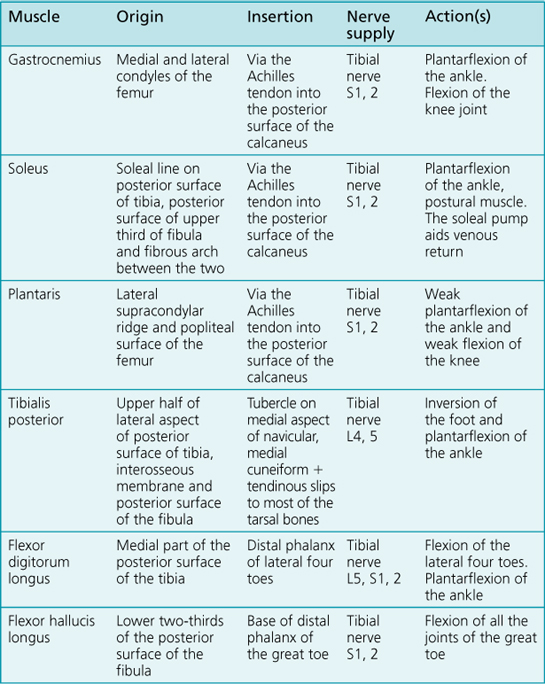
Plantarflexors

Table 3.2The plantarflexors of the ankle

image

  Page 62 

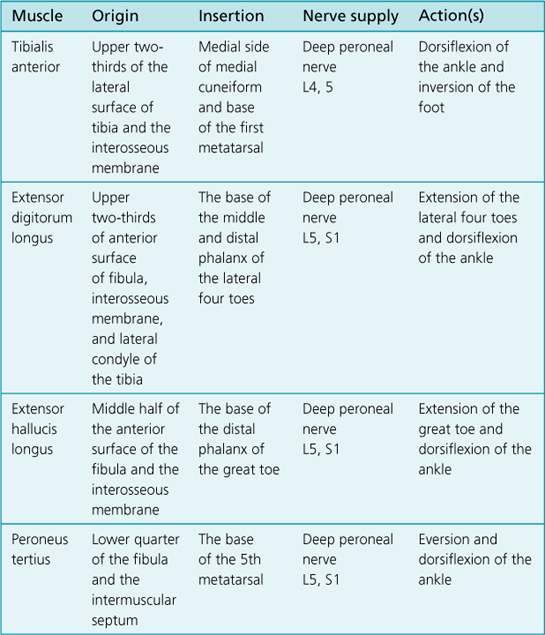
Dorsiflexors

Table 3.3The dorsiflexors of the ankle

image

  Page 63 

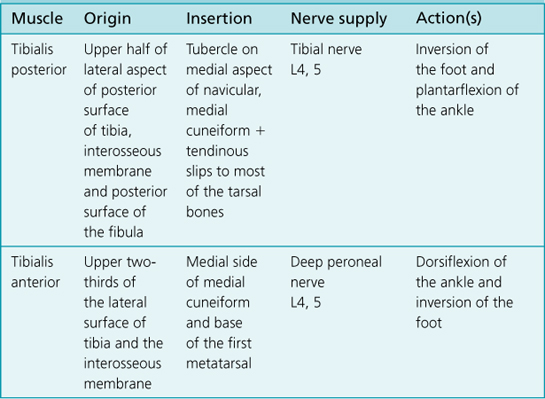
Invertors

Table 3.4The invertors of the ankle

image

  Page 64 

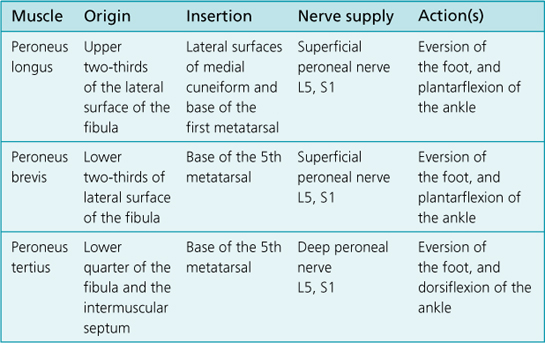
Evertors

Table 3.5The evertors of the ankle

image

  Page 65 

Measurement

Range of Movement

Dorsiflexion

image

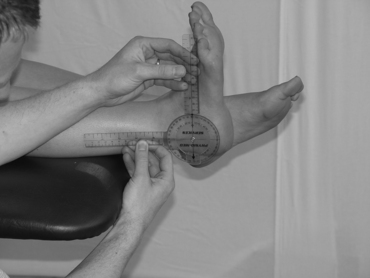
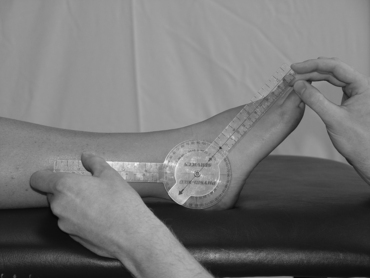
Fig 3.1 Goniometric measurement of ankle dorsiflexion.

Starting position:

The patient is positioned in supine lying on the plinth, their knee is slightly flexed and their foot is in neutral – 0°.

Goniometer axis:

The axis of the goniometer is placed 1.5 cm below the lateral malleolus of the fibula.

Stationary arm:

This is parallel to the longitudinal axis of the fibula, in line with the head of the fibula.

Moveable arm:

This is parallel to the longitudinal axis of the 5th metatarsal.

Command to patient:

‘Bend your foot up as far as you can’ (dorsiflexion).

End position:

The ankle is dorsiflexed to the limit of motion.

NB: It may be necessary to reposition the stationary and moveable arms of the goniometer prior to taking the reading, as they may have moved when the patient dorsiflexed their ankle.

  Page 66 

Plantarflexion

image

Fig 3.2 Goniometric measurement of ankle plantarflexion.

Starting position:

The patient is positioned in supine lying on the plinth, their knee is slightly flexed and their foot is in neutral – 0°.

Goniometer axis:

The axis of the goniometer is placed 1.5 cm below the lateral malleolus of the fibula.

Stationary arm:

This is parallel to the longitudinal axis of the fibula, in line with the head of the fibula.

Moveable arm:

This is parallel to the longitudinal axis of the 5th metatarsal.

Command to patient:

‘Push your foot down as far as you can’ (plantarflexion).

End position:

The ankle is plantarflexed to the limit of motion.

  Page 67 

Inversion

image

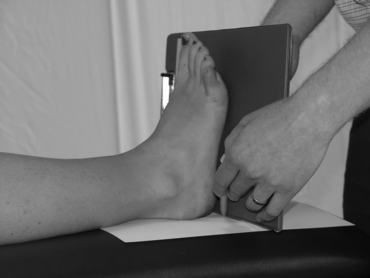
Fig 3.3 Measurement of the foot in neutral.

Starting position:

The patient is positioned in supine lying on the plinth; a roll is placed under the knee. The ankle is in neutral – 0°.

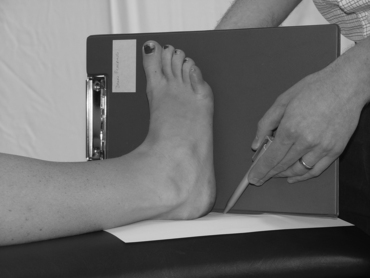
A piece of paper is placed under the foot, a book is placed against the sole of the foot, and a line is drawn parallel to the book.

Command to patient:

‘Turn your foot in as far as you can’ (inversion).

End position:

The foot has moved into inversion.

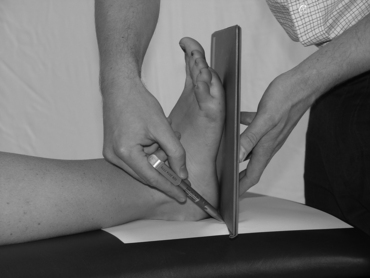
The book is placed against the full sole of the foot and a line is drawn parallel to the book. This line should bisect the original line, making an angle. This angle relates to the degree of inversion at the foot.

image

Fig 3.4 Measurement of foot inversion.

  Page 68 
  Page 69 

Eversion

image

Fig 3.5 Measurement of foot eversion.

Starting position:

The patient is positioned in supine lying on the plinth; a roll is placed under the knee. The ankle is in neutral – 0°.

A piece of paper is placed under the foot, a book is placed against the sole of the foot, and a line is drawn parallel to the book.

Command to patient:

‘Turn your foot out as far as you can’ (eversion).

End position:

The foot has moved into eversion.

The book is placed against the full sole of the foot and a line is drawn parallel to the book. This line should bisect the original line, making an angle. This angle relates to the degree of eversion at the foot.

  Page 70 

Notes

Treatment record

  Page 71 

Observational/reflective checklist

image

  Page 72 

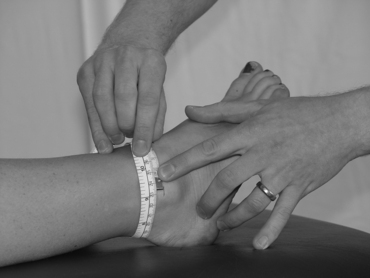
Joint Girth

image

Fig 3.6 Measurement of the girth of the ankle joint.

Patient’s position:

The patient is positioned in half lying or supine lying on the plinth.

Method:

The ankle joint girth can be measured by taking a circumferential measurement with a tape measure around the ankle joint line.

The ankle joint line can be recognized by identifying three points around the ankle. Firstly, mark 1.5 cm above the medial malleolus of the tibia. Secondly, mark 2 cm above the lateral malleolus of the fibula.

Owing to the possibility of a different length or bony changes to the tips of either malleoli, a third point to aid in the triangulation of all the points is identified. The clinician runs their thumb down the anterior border of the tibia until they feel their thumb fall into the dip of the ankle, the anterior joint line.

To confirm this position the clinician can move the ankle joint through plantarflexion and dorsiflexion and feel the talus move against the thumb. This enables confirmation of the anterior joint line of the ankle.

  Page 73 

The joint is encircled with a tape measure around the joint line. The circumferential measurement is then recorded.

Repeat the procedure three times and produce an average reading.

Repeat the procedure on the other limb to compare the joint girth.

Points to note:

The state of the tape measure – is it stretched?
The muscles must be relaxed.
Keep the tape measure straight (not twisted).
Measure consistently – at the top/bottom of the tape, and either in centimetres or in inches.
  Page 74 

Notes

Treatment record

  Page 75 

Limb Girth

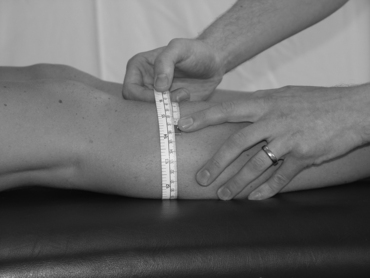
Calf

image

Fig 3.7 Measurement of the girth of the calf.

Patient’s position:

The patient is positioned in long sitting or half lying on the plinth, well supported. The knees are in passive extension so that the calf and thigh muscles are relaxed.

Method:

Mark two or three points – 5 cm (2 inches), 10 cm (4 inches) and 15 cm (6 inches) below the distal end of the tibial tuberosity. (If the patient is small in stature, the measure at 15 cm (6 inches) may not be necessary.)

The limb is encircled with a tape measure at each marked point. The circumferential measurements are then recorded. Repeat the procedure three times and produce an average reading. Repeat the procedure on the other limb to compare the measurements.

Points to note:

The state of the tape measure – is it stretched?
The muscles must be relaxed.
Keep the tape measure straight (not twisted).
Measure consistently – at the top/bottom of the tape, and either in centimetres or in inches.
  Page 76 

Notes

Treatment record

  Page 77 

Muscle Strength: Oxford Muscle Grading

Plantarflexors
Grade 0 – ‘No contraction’ and Grade 1 – ‘Flicker of a contraction’

Patient’s position:

The patient is positioned in prone lying on the plinth, their feet resting over the end of the plinth.

Clinician’s position:

The clinician is standing at the foot of the plinth with both hands palpating the gastrocnemius muscle for a contraction.

Command to patient:

‘Try and tighten your calf muscles/try and move your foot up towards the ceiling.’

Clinical tip:

Closely observing and feeling the muscle is essential in enabling the clinician to pick up on even the smallest flicker of a contraction.

image

Fig 3.8 Oxford muscle grading for the ankle plantarflexors – Grades 0 and 1.

Grade 2 – ‘Full ROM with the effects of gravity eliminated’

Patient’s position:

The patient is positioned in side lying on the plinth. Their foot is supported in full dorsiflexion.

Clinician’s position:

The clinician is standing by the patient, supporting the limb with one hand just below the knee and the other supporting the foot.

Command to patient:

‘Try and push your foot away from your leg as far as you can.’

The ankle has to move through its full range of movement – full dorsiflexion to full plantarflexion.

Clinical tip:

The limb can be heavy, so the safe positioning of the clinician is an essential part of this measurement technique.

image

Fig 3.9 Oxford muscle grading for the ankle plantarflexors – Grade 2. The ankle is moving from full dorsiflexion to full plantarflexion.

Grade 3 – ‘Full ROM against the effects of gravity’

Patient’s position:

The patient is positioned in prone lying, with their feet over the end of the plinth. The foot is in full dorsiflexion.

Clinician’s position:

The clinician is standing at the foot of the plinth to observe the movement.

Command to patient:

‘Move your foot upwards towards the ceiling as far as you can.’

The ankle has to move through its full range of movement – full dorsiflexion to full plantarflexion.

Clinical tip:

Make sure the patient is in a fully plantarflexed position with the anterior tibial muscles (tibialis anterior, extensor digitorum longus, extensor hallucis longus) relaxed. This can be achieved by palpating the anterior tibial muscles to assess muscle activity.

image

Fig 3.10 Oxford muscle grading for the ankle plantarflexors – Grade 3. The ankle is moving from full dorsiflexion to full plantarflexion (the sole of the foot is moving upwards).

Grade 4 – ‘Full ROM against minimal resistance’

Patient’s position:

The patient is positioned in prone lying, with their feet over the end of the plinth. Their foot is in full dorsiflexion.

Clinician’s position:

The clinician is standing at the foot of the plinth, applying a minimal resistance to the patient’s foot.

Command to patient:

‘Push your foot up as far as you can against the minimal resistance.’

The ankle has to move through its full range of movement – full dorsiflexion to full plantarflexion.

Clinical tip:

Use the length of lever arm principle to make sure you can apply a consistent resistance to the limb. Ask the patient to start slowly so they can appreciate the amount of resistance.

Grade 5 – ‘Full ROM against maximal resistance’

Patient’s position:

The patient is positioned in prone lying, with their feet over the end of the plinth (see Fig. 3.11).

image

Fig 3.11 Oxford muscle grading for the ankle plantarflexors – Grades 4 and 5. The ankle is moving from full dorsiflexion to full plantarflexion (the sole of the foot is moving upwards).

Clinician’s position:

The clinician is standing at the foot of the plinth, applying a maximal resistance to the patient’s lower leg.

Command to patient:

‘Push your foot up as far as you can against the maximal resistance.’

The ankle has to move through its full range of movement – full dorsiflexion to full plantarflexion.

Clinical tip:

Use the length of lever arm principle to make sure you can apply a consistent resistance to the limb. Ask the patient to start slowly so they can appreciate the amount of resistance. Remember, the patient’s calf muscles may be stronger than your applied resistance; use a safe and mechanically advantageous position to enable you to perform this technique safely and effectively.

Dorsiflexors
Grade 0 – ‘No contraction’ and Grade 1 – ‘Flicker of a contraction’

Patient’s position:

The patient is positioned in prone lying or long sitting on the plinth, their feet over the end of the plinth.

Clinician’s position:

The clinician is standing at the foot of the plinth, with both hands palpating the tibialis anterior muscle for a contraction

Command to patient:

‘Try and tighten the muscles on the front of your leg/pull your foot up towards you.’

Clinical tip:

Closely observing and feeling the muscle is essential in enabling the clinician to pick up on even the smallest flicker of a contraction.

Tibialis anterior is a prominent muscle on the anterior aspect of the leg. The tendon is the most medial of the tendons at the front of the ankle joint.

image

Fig 3.12 Oxford muscle grading for the ankle dorsiflexors – Grades 0 and 1.

Grade 2 – ‘Full ROM with the effects of gravity eliminated’

Patient’s position:

The patient is positioned in side lying on the plinth. The foot is supported in full plantarflexion.

Clinician’s position:

The clinician is standing by the patient, supporting the right limb with one hand under the knee area and the other supporting the foot.

Command to patient:

‘Try and pull your foot up as far as you can.’

The ankle has to move through its full range of movement – full plantarflexion to full dorsiflexion.

Clinical tip:

The limb can be heavy, so the safe positioning of the clinician is an essential part of this measurement technique.

image

Fig 3.13 Oxford muscle grading for the ankle dorsiflexors – Grade 2. The ankle is moving from full plantarflexion to full dorsiflexion (the dorsum of the foot is moving towards the shin).

Grade 3 – ‘Full ROM against the effects of gravity’

Patient’s position:

The patient is positioned in supine lying or long sitting on the plinth. Their foot is hanging over the end of the plinth in full plantarflexion.

Clinician’s position:

The clinician is standing at the foot of the plinth to observe the movement.

Command to patient:

‘Pull your foot upwards as far as you can.’

The ankle has to move through its full range of movement – full plantarflexion to full dorsiflexion.

image

Fig 3.14 Oxford muscle grading for the ankle dorsiflexors – Grade 3. The ankle is moving from full plantarflexion to full dorsiflexion (the dorsum of the foot is moving up towards the shin).

Grade 4 – ‘Full ROM against minimal resistance’

Patient’s position:

The patient is positioned in supine lying or long sitting on the plinth. Their foot is hanging over the end of the plinth in full plantarflexion.

Clinician’s position:

The clinician is standing at the foot of the plinth, applying a minimal resistance to the top of the patient’s foot.

Command to patient:

‘Push your foot up as far as you can against the minimal resistance.’

The ankle has to move through its full range of movement – full plantarflexion to full dorsiflexion.

Clinical tip:

Use the length of lever arm principle to make sure you can apply a consistent resistance to the limb. Ask the patient to start slowly so they can appreciate the amount of resistance.

Grade 5 – ‘Full ROM against maximal resistance’

Patient’s position:

The patient is positioned in supine lying or long sitting on the plinth. Their foot is hanging over the end of the plinth in full plantarflexion (see Fig. 3.15).

image

Fig 3.15 Oxford muscle grading for the ankle dorsiflexors – Grades 4 and 5. The ankle is moving from full plantarflexion to full dorsiflexion (the dorsum of the foot is moving up towards the shin).

Clinician’s position:

The clinician is standing at the foot of the plinth, applying a maximal resistance to the patient’s lower leg.

Command to patient:

‘Push your foot up as far as you can against the maximal resistance.’

The ankle has to move through its full range of movement – full plantarflexion to full dorsiflexion.

Clinical tip:

Use the length of lever arm principle to make sure you can apply a consistent resistance to the limb. Ask the patient to start slowly so they can appreciate the amount of resistance. Remember, the patient’s anterior tibial muscles may be stronger than your applied resistance. You must use a safe and mechanically advantageous position to enable you to perform this technique safely and effectively.

  Page 82 
Evertors
Grade 0 – ‘No contraction’ and Grade 1 – ‘Flicker of a contraction’

Patient’s position:

The patient is positioned in long sitting on the plinth, with their foot over the end of the plinth.

Clinician’s position:

The clinician is standing at the foot of the plinth with both hands palpating the lateral aspect of the leg, over the peroneal muscles (peroneus longus and brevis).

Command to patient:

‘Try and turn your foot outwards (by using the muscles on the side of your leg).’

Clinical tip:

Closely observing and feeling the muscles is essential in enabling the clinician to pick up on even the smallest flicker of a contraction.

Peroneus longus and brevis can be felt to contract on the lateral side of the leg, below the head of the fibula. The tendons can be palpated as they pass behind the lateral malleolus of the fibula.

image

Fig 3.16 Oxford muscle grading for the ankle evertors – Grades 0 and 1.

Grade 2 – ‘Full ROM with the effects of gravity eliminated’

Patient’s position:

The patient is positioned in supine lying or long sitting on the plinth, their inverted foot over the end of the plinth.

Clinician’s position:

The clinician is standing at the foot of the plinth, supporting the calcaneus and the foot.

Command to patient:

‘Try and turn your foot outwards as far as you can.’

The ankle has to move through its full range of movement – full inversion to full eversion.

Clinical tip:

The leg and foot can be heavy, so the safe positioning of the clinician is an essential part of this measurement technique. This has to be balanced against being able to take the weight of the foot, but not actually assisting the patient’s efforts to evert the foot.

image

Fig 3.17 Oxford muscle grading for the ankle evertors – Grade 2. The ankle is moving from full inversion to full eversion (the foot is moving from being fully turned in to being fully turned out).

Grade 3 – ‘Full ROM against the effects of gravity’

Patient’s position:

The patient is positioned in side lying on the plinth, their inverted foot over the end of the plinth.

Clinician’s position:

The clinician is standing at the foot of the plinth to observe the movement.

Command to patient:

‘Try and turn the sole of your foot so that it is facing towards the ceiling.’

The ankle has to move through its full range of movement – full inversion to full eversion.

image

Fig 3.18 Oxford muscle grading for the ankle evertors – Grade 3. The ankle is moving from full inversion to full eversion (the sole of the foot is turning up towards the ceiling).

Grade 4 – ‘Full ROM against minimal resistance’

Patient’s position:

The patient is positioned in side lying on the plinth, their inverted foot over the end of the plinth.

Clinician’s position:

The clinician is standing at the foot of the plinth, applying a minimal resistance to the lateral border of the foot.

Command to patient:

‘Try and turn the sole of your foot so that it is facing towards the ceiling against the minimal resistance.’

The ankle has to move through its full range of movement – full inversion to full eversion.

Grade 5 – ‘Full ROM against maximal resistance’

Patient’s position:

The patient is positioned in side lying on the plinth, their inverted foot over the end of the plinth (see Fig. 3.19).

image

Fig 3.19 Oxford muscle grading for the ankle evertors – Grades 4 and 5. The ankle is moving from full inversion to full eversion (the sole of the foot is turning up towards the ceiling).

Clinician’s position:

The clinician is standing at the foot of the plinth, applying a maximal resistance to the lateral border of the foot.

Command to patient:

‘Try and turn the sole of your foot so that it is facing towards the ceiling against the maximal resistance.’

The ankle has to move through its full range of movement – full inversion to full eversion.

  Page 84 
Invertors
Grade 0 – ‘No contraction’ and Grade 1 – ‘Flicker of a contraction’

Patient’s position:

The patient is positioned in long sitting on the plinth, their everted foot over the end of the plinth.

Clinician’s position:

The clinician is standing at the foot of the plinth with their hand palpating the tendon of tibialis posterior on the medial aspect of the ankle joint.

Command to patient:

‘Try and turn your foot inwards by using the muscles on the inside of your leg.’

Clinical tip:

Closely observing and feeling the tendon is essential in enabling the clinician to pick up on even the smallest flicker of a contraction. Tibialis posterior is a deep calf muscle, but it can be palpated behind the medial malleolus of the tibia.

image

Fig 3.20 Oxford muscle grading for the ankle invertors – Grades 0 and 1.

Grade 2 – ‘Full ROM with the effects of gravity eliminated’

Patient’s position:

The patient is positioned in supine lying or long sitting on the plinth, their everted foot over the end of the plinth.

Clinician’s position:

The clinician is standing at the foot of the plinth, supporting the calcaneus and the foot.

Command to patient:

‘Try and turn your foot inwards as far as you can.’

The ankle has to move through its full range of movement – full eversion to full inversion.

Clinical tip:

The foot can be heavy, so the safe positioning of the clinician is an essential part of this measurement technique. This has to be balanced against being able to take the weight of the foot, but not actually assisting the patient’s efforts to invert the foot.

image

Fig 3.21 Oxford muscle grading for the ankle invertors – Grade 2. The ankle has moved from full inversion to full eversion (the foot has moved from being fully turned out to being fully turned in).

Grade 3 – ‘Full ROM against the effects of gravity’

Patient’s position:

The patient is positioned in side lying on the plinth, their everted foot over the end of the plinth.

Clinician’s position:

The clinician is standing at the foot of the plinth observing the movement.

Command to patient:

‘Try and turn the sole of your foot so that it is facing towards the ceiling.’

The ankle has to move through its full range of movement – full eversion to full inversion.

image

Fig 3.22 Oxford muscle grading for the ankle invertors – Grade 3. The ankle has moved from full eversion to full inversion (the foot has moved from being fully turned out to being fully turned in).

Grade 4 – ‘Full ROM against minimal resistance’

Patient’s position:

The patient is positioned in side lying on the plinth, their everted foot over the end of the plinth.

Clinician’s position:

The clinician is standing at the foot of the plinth, applying a minimal resistance to the medial border of the foot.

Command to patient:

‘Try and turn the sole of your foot so that it is facing towards the ceiling against the minimal resistance.’

The ankle has to move through its full range of movement – full eversion to full inversion.

Grade 5 – ‘Full ROM against maximal resistance’

Patient’s position:

The patient is positioned in side lying on the plinth, their everted foot over the end of the plinth (see Fig. 3.23).
image

Fig 3.23 Oxford muscle grading for the ankle invertors – Grades 4 and 5. The ankle has moved from full eversion to full inversion (the foot has moved from being fully turned out to being fully turned in).

Clinician’s position:

The clinician is standing at the foot of the plinth, applying a maximal resistance to the medial border of the foot.

Command to patient:

‘Try and turn the sole of your foot so that it is facing towards the ceiling against the maximal resistance.’

The ankle has to move through its full range of movement – full eversion to full inversion.

  Page 87 

Notes

Treatment record

  Page 88 

Notes

Treatment record