Page 9 

Chapter 1 Taping Suppliesimage

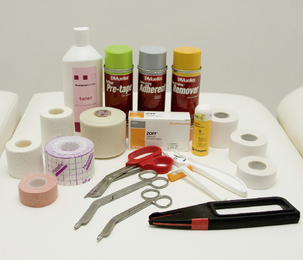
Essential taping supplies

disposable razor and soap

skin toughener spray

quick-drying adhesive spray

lubricating ointment/petroleum jelly (Vaseline™)

heel and lace pads

underwrap

Comfeel™

non-elastic (zinc oxide) tape 2.5 cm (1 in) and 5 cm (2 in) width. Wider tape useful in reinforcing vertical support strips

elastic adhesive bandage 2.5 cm (1 in), 5 cm (2 in) and 7.5 cm (3 in) width

fixation tape (Fixamol™, Sanipore™, Hyperfix™)

bandage scissors

padding: felt, foam or gel pad

cohesive bandages 2.5 cm (1 in), 5 cm (2 in) and 7.5 cm (3 in) width

Additional items for field kit

surgical gloves

wound wash

antiseptic solution

Kaltostat™ (fibrous blood coagulant dressing)

Tuff-cut shears

cotton gauze squares: sterile and non-sterile

plastic Band-Aid strips

triangular bandages

collar and cuff

ice and towels

pen, pencil and paper

cellular/mobile phone

Optional supplies

instant cold packs

antifungal spray or powder

blister protectors

cotton-tipped applicators

tongue depressors

waterproof tape

white zinc oxide tape 1.2 cm (½ in) width

adhesive remover

tape cutters

nail clippers, nail scissors

Any successful taping job begins with choosing quality materials. Top-quality tape is more reliable and consistent than poor-quality tape and is essential if optimal protection is to be achieved. Tape quality affects the degree of compression, stability and support necessary for a properly executed taping technique.

Included in this chapter are descriptions of and uses for various tapes and supplies. These have been divided into two lists. The recommended essentials for taping are included in the first list. The optional supplies in the second list should also be available but are not mandatory. Many more items could be added to a well-equipped taping kit but we have covered only what we deem to be the most important supplies.

RECOMMENDED SUPPLIES
image
  Page 10 

ELASTIC ADHESIVE BANDAGE (EAB)

This tape offers elasticity as well as adhesion. Useful for a wide range of purposes:

maintaining localized compression over a contusion

keeping maximal pressure over an injury without compromising circulation
forming an ‘anchor’ around a muscle area

keeping a brace in place.

Quality characteristics

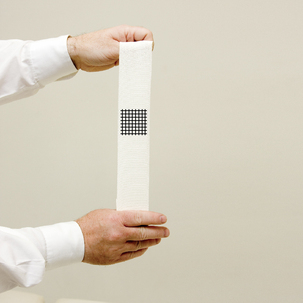
strong recoil. To test, stretch an 80 cm (32 in) strip to maximum length. Hold for 30 seconds, then release. Tape should return to 125% of original length (100 cm; 40 in)

ideally the roll should be encased in airtight wrapping to maintain freshness

Inferior

little, ineffective or no recoil

tendency to unravel at the edges

does not adhere well; tends to peel off easily

image
image
image

ANTISEPTIC LOTION; ANTIFUNGAL SPRAY OR POWDER

Useful as a secondary precaution in treating minor abrasions, blisters, lacerations and tape cuts.

apply to cleaned wounds prior to taping

use sparingly so as not to interfere with the adhesive properties of the overall tape job

NON-ELASTIC (ZINC OXIDE) TAPE

The basic all-purpose tape essential to any taping kit used in any sport. Adhesive, non-elastic and available in rolls of various lengths, zinc oxide tape is indispensable for the athletic taper.

Quality characteristics

slightly porous to permit some lateral glide or stretch (shearing) across the bias of the tape

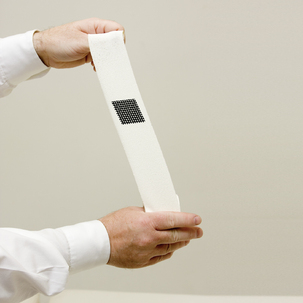
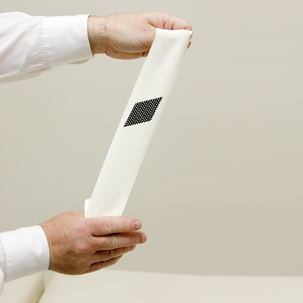
to test: grasp a 5 cm (2 in) piece of tape between your two hands and pull laterally. The tape should shear about 20 ° in either direction without creasing (as in the photographs below)

  Page 11 

Inferior

when tested as described above, a poor grade of tape will start to crease and to stick together almost as soon as any sideways stress is induced. Other types of inexpensive tape may have two or more lengths stitched end to end. Although the quality may not be inferior, it will not give a smooth, uniform finish to the taping job (important when the athlete is wearing footwear). Any seams must be removed before applying the tape

imageNOTE:

All types of tape should be kept in a cool, dry place. Rotate supplies to ensure freshness: old tape gets too sticky and difficult to use.

FIXATION TAPE (FIXAMOL™, SANIPORE™, HYPERFIX™)

This tape is primarily promoted for holding dressings in place. However, it also makes an excellent anchor when combined with adhesive spray, especially when encircling the whole limb is impractical or contraindicated; in such cases it can be used instead of non-elastic zinc oxide tape or elastic adhesive bandage. For many tapers, it is the tape of choice as an anchor in unloading (of neural/fascial elements for pain relief) techniques.

Quality characteristics

strong

hypoallergenic adhesive

highly adhesive

highly porous (allows skin to breathe)

Inferior

can be awkward to use in long strips

if it adheres to itself you cannot separate it

SKIN TOUGHENER SPRAY

Fast-drying aerosol spray that forms a thin adhesive layer protecting skin from contact with tape irritants and provides additional adhesive potency.

Quality characteristics

dries quickly

adheres well

Inferior

can irritate sensitive skin

difficult to remove

imageTIP:

Some brands are less apt to cause irritation in specific chemical-sensitive athletes. Having several brands on hand will enable the taper to try alternatives with different chemical ingredients.

  Page 12 

ADHESIVE SPRAY

Quick-drying adhesive sprays applied directly to the skin help to keep tape from slipping.

Quality characteristics

dries quickly

adheres well

Inferior

irritates skin

difficult to remove

imageTIP:

Essential in difficult taping situations of high humidity or where immersion in water makes adhesiveness a problem, i.e. a swimmer returning to action.

imageNOTE:

May be interchanged with skin toughener spray in situations where adherence is the primary concern.

UNDERWRAP

Applied to the taping area between ‘anchors’, this thin foam material reduces the area of direct skin contact, protects skin from traction burns and tape irritation (zinc oxide and adhesive elements in tape are frequently the cause of skin irritations or allergic reactions).

The use of underwrap can be helpful when taping bony areas which are particularly susceptible to skin blisters and tape cuts.

Quality characteristics

very fine-grained, thin foam roll that is slightly stretchy but non-adhesive. Normal width 5 cm (2 in)

available in a wide range of colours as well as skintone

Inferior

too thin – tears easily, tends to roll at edges producing irritating ridges if pulled over contours

too thick – reduces efficacy of tape, not cost efficient since length of roll is significantly less as width increases

imageTIP:

When choosing underwrap, thinness is preferable. However, if the material is too thin, the edges tend to roll more easily, causing ridges.

COMFEEL™ (COLOPLAST™)

A fast-drying liquid that forms a protective film (‘second skin’). This product can be expensive if you are working to a budget.

Quality characteristics

very easy to apply

protects the skin from irritation

waterproof, elastic and semi-permeable

Inferior

pungent aroma on application, should be used only in a well-ventilated space

can be expensive

  Page 13 

LUBRICATING OINTMENT/PETROLIUM JELLY

Viscous lubricating ointments used to decrease friction between tape and skin. These can be used instead of heel and lace pads if necessary.

Quality characteristics

maintains viscosity at body temperature

petroleum based

Inferior

thin, water based

will not maintain viscosity at body temperature

imageTIP:

Care must be taken to apply only a minimal amount so that the stability and support of the entire tape job are not jeopardized.

imageNOTE:

Lubrication is essential when taping high-friction areas, e.g. the tendo Achilles insertion, and sensitive skin areas (e.g. the front of the ankle, which is underlaid with superficial tendons, making the skin prone to blisters and/or tape cuts).

HEEL AND LACE PADS

Thin foam squares used in areas where there is a likelihood of friction under the taping, such as at the laces of the anterior ankle and the heel (used with a layer of skin lubricant).

Quality characteristics

thin but sturdy

does not flake or break when bent

smooth finish

Inferior

rough surface

easily torn or broken

imageTIP:

For economy, thin sheets of aerated plastic packing can be cut into 7 cm (2 ¾ in) squares. Gauze squares may also be used.

STERILE GAUZE PADS

Pads with a non-stick surface are useful for open wounds. They are used to:

cleanse abrasions and lacerations with antiseptic solution

protect open areas after cleaning blisters, lacerations, minor cuts and abrasions.

Quality characteristics

firmly woven

individually wrapped

Inferior

poorly packaged: unlikely to offer reliable sterility

imageNOTE:

Be careful when opening these pads: they must be sterile when applied to a wound.

  Page 14 

NON-STERILE GAUZE PADS

These are used:

to cleanse around abrasions and lacerations

to apply pressure near a wound in order to arrest bleeding

for splinting and protecting small areas such as a fractured toe.

Quality characteristics

firmly woven

Inferior

flimsy weave

ELASTIC BANDAGE/COHESIVE BANDAGE/ELASTIC WRAP

One of the most versatile components of a taping kit. It sticks to itself without sticking to skin or hair which means there is no need to shave the area and the taper may do away with underwrap for that reason. It is breathable, very durable and provides consistent compression.

A variety of different widths are available and the sizes most commonly used are:

15 cm (6 in): support for thigh and groin strains, splint supports, holding ice packs in place, compression on soft tissue injuries, temporarily wrapping other tape jobs while adhesive ‘sets’

10 cm (4 in): support for ankle sprains, devising a makeshift sling, holding ice packs in place, compression on soft tissue injuries, temporarily wrapping other tape jobs while adhesive ‘sets’

8 cm (3 in): small ankles, large wrists, compression on soft tissue injuries

5 cm (2 in): wrist sprains, children’s injuries, compression on soft tissue injuries.

imageTIP:

There are a number of other applications where elastic bandages will prove useful. The well-appointed taping kit should have these bandages in a range of sizes and in sufficient quantity to handle diverse situations.

Quality characteristics

firm weave

good elasticity: should have a wide stretch with gradually increasing resistance

good recoil: should return to within 10% of original length after use

‘clingy’ surface: reduces slippage between layers and holds position on limb

Inferior

looser weave

poor elasticity: stretches too easily and stops suddenly at limit of expansion

poor recoil: tends to stay stretched after use; does not return to within 20% of original length after use

too smooth a surface: tends to slip between layers and slides down limb

  Page 15 

FOAM PADDING

Thin sheets made of dense foam, useful when taping a bruised area; for example, when taping a bruised tibia (shinbone), a layer of padding can help protect the injured area.

Quality characteristics

‘closed cell’ foam: offers good protection as it is firm in construction and waterproof

Inferior

thick, spongy appearance

SURGICAL FELT PADDING

Sheets of densely compressed fibres, used as protection and support when taping a damaged acromio-clavicular joint shoulder, for example, or as temporary heel lifts supporting full body weight.

imageNOTE:

When effective taping requires local pressure and firm protection such as a separated shoulder, felt padding is preferable as it gives a more solid, cushioning effect than foam. Light and tightly compacted felt is used to make heel lifts.

imageTIP:

A thick sheet of quality felt can be split to make thinner layers.

Quality characteristics

firm, even texture

soft to the touch

equal thickness throughout sheet

Inferior

too loosely woven to protect adequately or to provide support when subjected to continuous weight bearing

if fibres are too tightly compressed, cutting is difficult and splitting impossible

uneven thickness over the sheet

GEL PADDING

Gel pads come in many forms: as a sock, sleeve or pad. Used for anti-shock, to reduce friction and to reduce problems caused by pressure and shearing forces.

Quality characteristics

does not tear

conforms to the body, especially around bony prominences

washable and reusable

Inferior

can be uncomfortable if too thick

can be difficult to cut and shape if too thick

  Page 16 

PLASTERS (COMPEED™, BAND-AID™ )

Available in a variety of widths and lengths, useful for simple cuts and grazes. Some brands are waterproof.

Quality characteristics

wrapped singly

adheres well

Inferior

may be non-sterile

poor adherence

Inferior (fabric strips)

poor adherence

often stretch to the point of forming creases which may cause secondary blisters

TAPE CUTTERS

Often referred to as ‘sharks’ because of their shape.

plastic handle encasing a replaceable razor sharp blade (take care when using or changing this blade as it is very sharp)

flattened tip helps protect the skin when removing tape

particularly helpful in removing ankle or wrist taping when scissoring action is awkward or impossible

imageTIP:

Tape cutters are useful when handling large numbers of ankle tapings and speed is critical.

BANDAGE SCISSORS

Special-purpose scissors with a flattened tip that protects the underlying skin from the cutting surface during tape removal.

CASE HISTORY FORMS

Keep an accurate record of past and present medical complaints (including musculo-skeletal) as well as current procedures.

Essential information includes:

the patient’s name, address, date of birth and contact phone numbers

family physician’s details

site of injury (body part)

date of injury

full details of injury (consequence)

current health and medical information

past health and medical information

medication

full examination of injury and associated areas

treatment administered (if any) and subsequent care suggested or implemented.

Additional information for athletes

sports participated in

level of participation

how often do they train/compete

intensity and amount of training

type of training

club details

who else has input on this injury (coach, trainer, manager, surgeon, etc. so that you can liaise with them)

This information is vital for statistical records and it can also be crucial should medico-legal complications arise or if the treatment provided were to be challenged. The importance of keeping detailed records cannot be stressed too strongly.

SURGICAL GLOVES

Non-sterile, thin, disposable rubber gloves.

mandatory when attending to any wound oozing blood or serum. Even though an abrasion or laceration may seem insignificant, blood carries transmissible infections

for maximum protection, surgical gloves should be used when treating even minor injuries

change gloves between patients to prevent cross-infection

dispose of soiled gloves correctly

imageNOTE:

When there is any doubt as to the reliability of a pair of surgical gloves, two pairs of gloves should be worn.

imageNOTE:

Thick, clumsy gloves hinder the dexterity necessary to produce an effective taping application.

Quality characteristics

thin yet strong

stretch without tearing

Inferior

prone to tearing and puncture easily

when ultra-thin, afford little protection in instances where the skin is broken

CELLULAR/MOBILE PHONE

When a major injury requires ambulance transport or supplementary medical personnel, reaction time is critical. Having a cell/mobile phone or exact change for a payphone PLUS a list of emergency telephone numbers for the area will facilitate summoning emergency assistance.

  Page 18 

OPTIONAL SUPPLIES

WHITE NON-ELASTIC ZINC OXIDE TAPE

Narrow tape 1.2 cm (½ in) useful in taping small joints such as toes, fingers and thumbs.

ADHESIVE REMOVER

Dissolves adhesive and removes adhesive residue.

helpful when tape has been left on for longer than 24 hours

skin must be washed thoroughly after using tape remover to avoid irritation

TONGUE DEPRESSOR/FLAT WOODEN STICKS

Apart from the obvious use, these are useful when applying lubricants or ointments to stop hands becoming oily or greasy.

COTTON BUDS

Preferable to cotton pads for precise application of gels, creams, oil or when applying skin toughener or adhesive spray near eyes or open wounds.

imageNOTE:

Avoid spraying chemicals near eyes or open wounds as this can be dangerous.

BLISTER PROTECTION (SECOND SKIN™ OR COMPEED™)

essential in the treatment of blisters

allows patients to remain active while protecting the area from exacerbation

imageTIP:

If blister protection is applied to vulnerable areas prior to participation, blisters are less likely to develop.

TRIANGULAR BANDAGE, COLLAR AND CUFF, MUSLIN SQUARES

Useful as a binding or as a strap for splints.

can be used as a sling for arm/shoulder injuries

provide padding and/or compression

WATERPROOF TAPE

essential in humid weather or water-related events

effective as a waterproof covering for other tape applications

NAIL CLIPPERS, NAIL SCISSORS

Useful for removing ripped nails or for trimming prior to taping.