Chapter 5

Femur and Pelvic Girdle

Femur and Pelvic Girdle

Radiation Protection

Male:

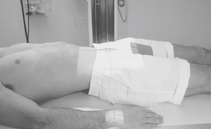
Gonadal shields should be used on pelvis and hip procedures for all male children and adults of childbearing age. Contact shields should be placed over the testes with the upper edge of the shield placed at the inferior margin of the symphysis pubis.
image

Fig. 5-1 Male gonadal shielding.

image

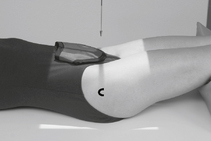
Fig. 5-2 Female ovarian shielding (superior borders at or slightly above level of ASISs and lower border just above pubis).

Female:

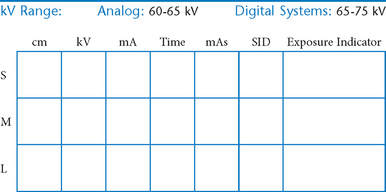
For AP and “frog-leg” laterals of the hips, specially shaped ovarian shields can be carefully placed over the area of the ovaries without obscuring essential anatomy as shown. This should be done on all female children and adults of childbearing age. These ovarian shields, however, may obscure essential anatomy on certain pelvic examinations. Departmental policy regarding shielding and kV range to be used should be determined.

kV Range:

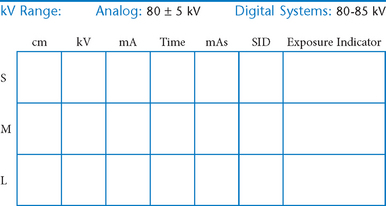
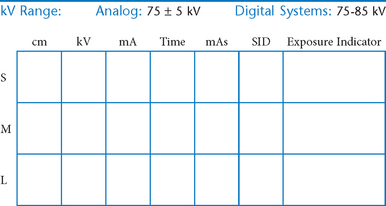
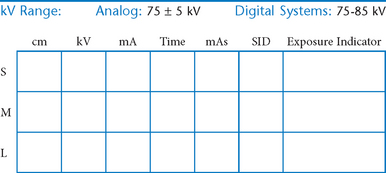
A higher kV range (90 ± 5) with lower mAs may be used for examinations of the hips and pelvis of adults to reduce the total radiation dose to the patient.

Close collimation to the area of interest is important for all procedures, including the hips and pelvis, even with gonadal shields. (See Appendix A for further explanation.)

Location of Femoral Head and Neck

First Method:

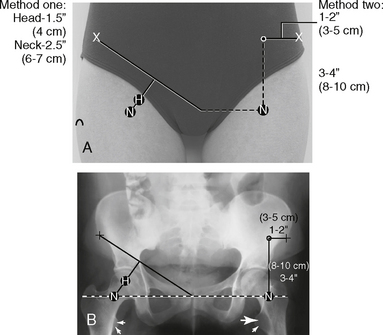
Location of the femoral head and neck regions can be accurately determined by first drawing an imaginary line between two landmarks, the ASIS and the symphysis pubis. The midpoint of this line is determined, from which a perpendicular imaginary line is drawn to locate the head and/or neck. The femoral head (A) is approximately 1.5″ (4 cm) down on this line. The midfemoral neck (B) is approximately 2.5″ (6-7 cm) down, as shown in the photo below.
Second Method:

A second method for locating the femoral neck (B) is ≈1-2″ (3-5 cm) medial to the ASIS at the level of the proximal or upper margin of the symphysis pubis, which is 3-4″ (8-10 cm) distal to the ASIS.

image

Fig. 5-3 A, Femoral head. B, Femoral neck.

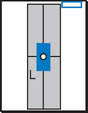
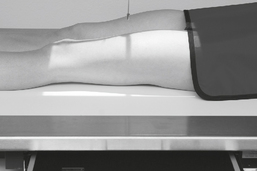
AP Femur*

image

image

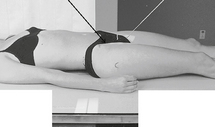
Fig. 5-4 AP, midfemur and distal femur.

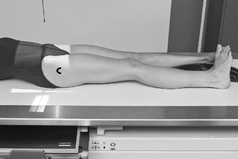
• 35 × 43 cm L.W. (14 × 17″)

• Grid

• Hip at cathode end (anode heel effect)

Note: For adults, a second smaller IR of either the hip or the knee should be taken on trauma patients to demonstrate both knee and hip joints to rule out possible fractures.

Position

• Supine, femur centered to midline of table or grid IR

• Rotate entire lower limb internally ≈5° for AP of midfemur and distal femur, and 15° internally for true AP to include hip.

• Lower border of IR ≈5 cm (2″) below knee to include knee joint adequately (see AP Unilateral Hip for proximal femur, p. 156).
• Shield gonads for both male and female

Central Ray:

CR ⊥, to mid-IR

SID:

40-44″ (102-113 cm)

Collimation:

Long, narrow collimation to femur area

image

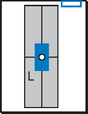
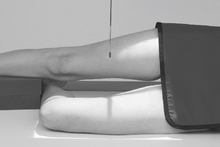
Lateral Femur*

image

image

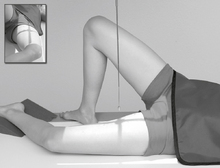
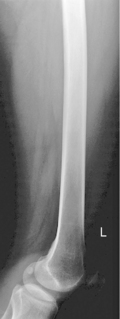
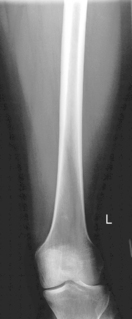
Fig. 5-5 Lateral, midfemur, and distal femur.

image

Fig. 5-6 Lateral, midfemur, and proximal femur.

Warning: Take horizontal beam lateral if fracture is suspected.

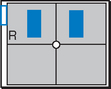
• 35 × 43 cm L.W. (14 × 17″)

• Grid

• Hip at cathode end (anode heel effect)

Note: For adults, take a second smaller IR of lateral hip or lateral knee if both joints are areas of interest.
Position

• Lateral recumbent, with unaffected leg placed behind to prevent over-rotation

• Include sufficient amount of either knee or hip at one end of IR.

• Shield gonads as possible.

Central Ray:

CR ⊥, to mid-IR

SID:

40-44″ (102-113 cm)

Collimation:

Long, narrow collimation to femur area

image

AP and Lateral Midfemur and Distal Femur

image

Fig. 5-7 AP.
image

image

Fig. 5-8 Lateral.
image

Evaluation Criteria

Anatomy Demonstrated:

AP and Lateral:

• Distal ⅔ of femur, including knee joint

Position:

AP:

• No rotation, femoral and tibial condyles appear symmetric in size and shape

Lateral:

• True lateral, femoral condyles appear superimposed

Exposure:

AP and Lateral:

• Optimal density and contrast

• Sharp borders and trabecular markings; no motion

Horizontal Beam Lateral Femur*

(Trauma Midfemur and Distal Femur)
image

image

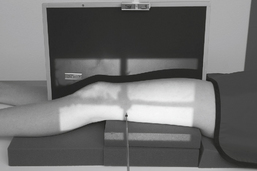
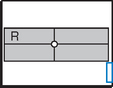
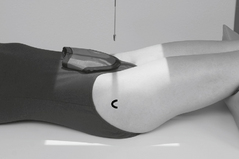
Fig. 5-9 Horizontal beam trauma projection (midfemur and distal femur).

• 35 × 43 cm L.W. (14 × 17″)

• Portable grid

Note: For proximal femur injuries, take axiolateral (Danelius-Miller method) hip.
Position

• Without moving trauma patient from the supine position, gently lift injured leg and place support under knee and leg.

• Place vertical IR between legs, as far superiorly as possible, but include knee distally. Use tape to hold grid IR in position.

• Shield gonads for both male and female.

Central Ray:

CR horizontal beam, ⊥ to mid-IR

SID:

40-44″ (102-113 cm)

Collimation:

Four sides to area of interest

image

AP Bilateral Hips*

image

Warning: Do not attempt to rotate leg if fracture is suspected. Take “as is” bilateral hips for comparison purposes.

Note: For AP pelvis centering, see p. 291 in text.
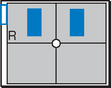
• 35 × 43 cm C.W. (14 × 17″)

• Grid

image

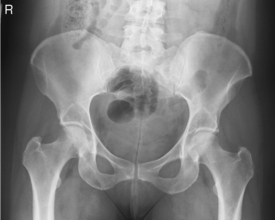
Fig. 5-10 AP bilateral hips.

Position

• Supine, aligned and centered to CR and IR, both legs extended and equally rotated internally 15°-20° (see warning above)

• Ensure no rotation of pelvis (bilateral ASISs the same distances from tabletop). Support under knees for patient comfort.
• Center IR to CR. Shield gonads (males and females).

Central Ray:

CR ⊥, to midpoint between femoral heads (which is about 2 cm or 1″ superior to symphysis pubis)

SID:

40-44″ (102-113 cm)

Collimation:

To pelvic and hip borders

Respiration:

Suspend during exposure.

image

AP Unilateral Hip*

image

Warning: For possible fractured hip, take AP bilateral hips (preceding page) for comparison purposes.
• 24 × 30 cm L.W. (10 × 12″)

• Grid

image

Fig. 5-11 AP hip—CR to femoral neck.

Position

• Supine, leg extended and rotated internally 15°–20° (nontrauma)

• Center femoral neck to CR. Support may be placed under knees for patient comfort.

• Center IR to CR. Shield gonads (males and females).

Central Ray:

CR ⊥, to femoral neck. (Center slightly lower as needed to include all of orthopedic appliance if present.)

SID:

40-44″ (102-113 cm)

Collimation:

Four sides to area of interest

Respiration:

Suspend during exposure.

image

AP Unilateral Hip

Evaluation Criteria

Anatomy Demonstrated:

• Proximal ⅓ of femur and adjacent parts of pelvic girdle

• Orthopedic appliance in entirety

Position:

• Greater trochanter, femoral head and neck in profile

• Lesser trochanter not visible or minimally only

Exposure:

• Optimal density and contrast

• Sharp trabecular markings clearly demonstrated; no motion

image

Fig. 5-12 AP hip.
image

Lateral Hip (Nontrauma)*

(Unilateral “Frog-Leg”)

image

image

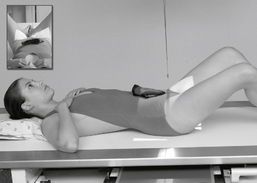
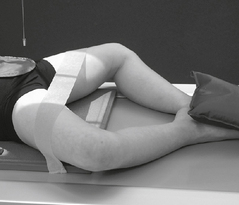
Fig. 5-13 Right hip “frog-leg” lateral (for femoral neck).

image

Fig. 5-14 For femoral head and acetabulum and proximal femoral shaft.

Warning: Do not attempt with possible fracture of hip area.

• 24 × 30 cm C.W. (10 × 12″)

• Grid

Position

• Patient supine

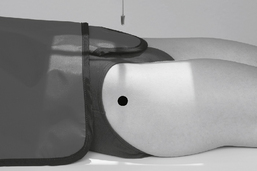
• For femoral neck, flex affected knee and hip, and abduct femur 45° from vertical (places femoral neck near parallel to IR).

• For femoral head, acetabulum, and proximal femoral shaft, oblique patient 35°–45° toward affected side and abduct leg to tabletop if possible. Center hip and neck area to CR.
• Center IR to CR. Shield gonads (male and female).

Central Ray:

CR ⊥, to midfemoral neck or head

SID:

40-44″ (102-113 cm)

Collimation:

To proximal femur and hip

Respiration:

Suspend during exposure.

image

Lateral Hips (Nontrauma)*

(Bilateral “Frog-Leg”)

image

Warning: Do not attempt with possible fracture of hip areas.

• 35 × 43 cm C.W. (14 × 17″)

• Grid

image

Fig. 5-15 Bilateral “frog-leg” (for comparison).

Position

• Supine, centered to CR and IR, flex hips and knees and abduct both thighs equally to 45° from vertical* if possible, with feet together

• Ensure no rotation of pelvis (ASISs equal distance from table)

• Center IR to CR, shield gonads (male and female).

Central Ray:

CR ⊥, to level of femoral heads (≈7-8 cm or 3″ inferior to level of ASISs)

SID:

40-44″ (102-113 cm)

Collimation:

To IR borders

Respiration:

Suspend during exposure.

image

AP Bilateral “Frog-Leg”

Evaluation Criteria

Anatomy Demonstrated:

• Femoral heads and necks, acetabulum, and trochanteric anatomy

image

Fig. 5-16 AP bilateral “frog-leg.”
image

Position:

• No rotation evident by symmetry of pelvic bones

• Lesser trochanters equal in size

• Greater trochanters superimposed over femoral necks

Exposure:

• Optimal density and contrast

• Sharp trabecular markings clearly demonstrated; no motion

Lateral Hip (Trauma Method)*

(Axiolateral Inferosuperior Projection [Danelius-Miller Method])

image

image

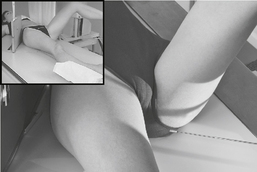
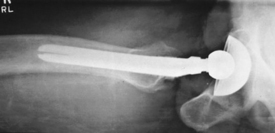
Fig. 5-17 Axiolateral trauma hip (pad under foot).

• 24 × 30 cm C.W. (IR parallel to femur) (10 × 12″)

• Portable grid

Position

• Supine, no rotation of pelvis

• Flex unaffected knee and hip and provide support such as the x-ray tube (use pad or towels for possible hot collimator).

• Rotate affected leg internally 15° unless possible hip fracture.

• Place vertical grid IR against side just superior to iliac crest with plane of IR perpendicular to CR.
Central Ray:

CR horizontal, perpendicular to femoral neck area and IR

SID:

40-44″ (102-113 cm)

Collimation:

On four sides to proximal femur area

Respiration:

Suspend during exposure.

image

Axiolateral Inferosuperior Hip

(Danelius-Miller Method)

Evaluation Criteria

Anatomy Demonstrated:

• Entire femoral head and neck, trochanters, and acetabulum

• Orthopedic appliance in entirety

image

Fig. 5-18 Axiolateral hip.
image

Position:

• Femoral head, neck, and acetabulum demonstrated with little superimposition of opposite hip

• No excessive grid lines present on radiograph.

• Minimal distortion of femoral neck

Exposure:

• Optimal density and contrast

• Use of compensation filter recommended.

• Sharp trabecular markings clearly seen; no motion

AP Pelvis*

image

image

Fig. 5-19 AP pelvis (entire pelvis centered to IR).

To include proximal femora, pelvic girdle, sacrum, and coccyx

Warning: Do not attempt to rotate legs if fractures involving hips are suspected.

Note: For bilateral hips centering, see p. 291.

• 35 × 43 cm C.W. (14 × 17″)

• Grid

Position

• Supine, pelvis centered to centerline, legs extended

• Both feet, knees, and legs equally rotated internally 15° (secure with tape if necessary). Support under knees for comfort.

• Ensure no rotation of pelvis (ASISs equal distance from TT).

• Center IR to CR. (Include entire pelvis.) Shield gonads (if it doesn’t compromise study).
Central Ray:

CR ⊥, midway between ASISs and symphysis pubis (which is about 5 cm or 2″ distal to level of ASISs)

SID:

40-44″ (102-113 cm)

Collimation:

On four sides to include entire pelvis

Respiration:

Suspend during exposure.

image

AP Pelvis

Evaluation Criteria

Anatomy Demonstrated:

• Pelvic girdle, L5, sacrum, coccyx, and proximal femora

• Orthopedic appliance in entirety (if present)

image

Fig. 5-20 AP pelvis.
image

Position:

• Lesser trochanters generally not visible (nontrauma)

• No rotation evident by symmetry of ilia and obturator foramina.

Exposure:

• Optimal density and contrast

• Soft tissue and sharp trabecular markings clearly demonstrated; no motion

AP Axial Pelvis*

(“Inlet” and “Outlet” Projections)

image

image

Fig. 5-21 AP axial pelvis.

image

Fig. 5-22 CR 40° caudal for inlet.

image

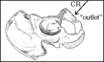
Fig. 5-23 CR cephalad 20° to 35° for males and 30° to 45° for females—outlet.

• 35 × 43 cm C.W. (14 × 17″)

• Grid

Position

• Supine, patient centered to centerline

• No rotation of pelvis (ASISs the same distance from tabletop)

• Center IR to projected CR. Gonadal shielding may not be possible without obscuring essential anatomy.

Central Ray:

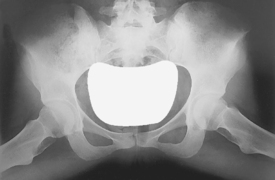
• Inlet—CR 40° caudal to level of ASISs, male and female

• Outlet—CR: male, 20°–35° cephalad; female, 30°–45° cephalad centered 1-2″ (3-5 cm) inferior to symphysis pubis or greater trochanter

SID:

40-44″ (102-113 cm)

Collimation:

Four sides to area of interest

Respiration:

Suspend during exposure.

image

AP Axial Pelvis

(“Inlet” and “Outlet” Projections)

Evaluation Criteria

Anatomy Demonstrated:

• Inlet: Pelvic ring or inlet in its entirety

• Outlet: Superior/inferior rami of pubes and ramus of ischium

image

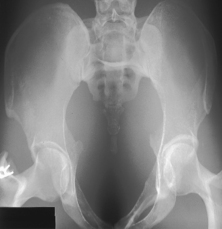
Fig. 5-24 AP axial inlet projection.
image

image

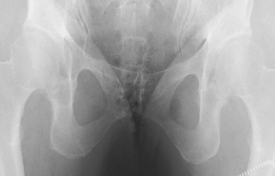
Fig. 5-25 AP axial outlet projection.
image

Position:

• Inlet: Ischial spines are demonstrated and equal in size; no rotation

• Outlet: Obturator foramina are equal in size

Exposure:

• Optimal density and contrast; no motion

• Pelvic ring is not overexposed

Acetabulum—Posterior Oblique Pelvis*

(Judet Method)

image

image

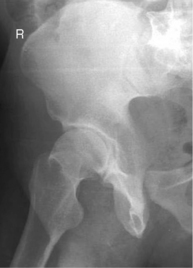
Fig. 5-26 Downside acetabulum.

image

Fig. 5-27 Upside acetabulum.

Note: Both sides generally are taken for comparison, either both for upside or both for downside.

• 24 × 30 cm L.W. (10 × 12″) or 35 × 43 cm C.W. (14 × 17″) if both hips must be seen on each projection.
• Grid

Position

• Patient in 45° posterior oblique position, centered for either upside or downside hip joint (dependent on anatomy of interest)

• Place 45° support under elevated side, position arms and legs as shown to maintain this position.

Central Ray:

• Downside—CR ⊥, to 2″ (5 cm) distal and 2″ (5 cm) medial to downside ASIS

• Upside—CR ⊥ to 2″ (5 cm) distal to upside ASIS

SID:

40-44″ (102-113 cm)

Collimation:

Four sides to area of interest

Respiration:

Suspend during exposure.

image

Acetabulum

(Posterior Oblique [Judet Method])

Evaluation Criteria

Anatomy Demonstrated:

• Downside: Anterior rim of acetabulum and posterior ilioischial column

• Upside: Posterior rim of acetabulum and anterior iliopubic column

Position:

• Downside: Iliac wing elongated and obturator foramina narrowed

• Upside: Iliac wing foreshortened and obturator foramina open

Exposure:

• Optimal density and contrast

• Bony margins and trabecular markings are sharp; no motion

image

Fig. 5-28 RPO downside visualized.
image

image

Fig. 5-29 LPO upside visualized.
image

Acetabulum*

(PA Axial Oblique Projection [Teufel Method])

image

image

Fig. 5-30 PA axial oblique.

Both sides generally are taken for comparison.

• 24 × 30 cm (10 × 12″), L.W.

• Grid

Position

• Patient semiprone; affected side down

• Rotate body 35°–40° anterior oblique

Central Ray:

• CR 12° cephalad

• 1″ (2.5 cm) superior to level of greater trochanter. Approximately 2″ (5 cm) lateral to the midsagittal plane.

SID:

40-44″ (102-113 cm)

Collimation:

Region of acetabulum and proximal femur

image

Acetabulum

(PA Axial Oblique Projection [Teufel Method])

Evaluation Criteria

Anatomy Demonstrated:

• Superoposterior wall of the acetabulum

Position:

• Fovea capitis with the femoral head in profile

• Obturator foramen open

Exposure:

• Optimal density and contrast; no motion

• Sharp trabecular markings clearly seen

image

Fig. 5-31 PA axial oblique.
image

Pediatric AP and Lateral Hips*

image

Warning: Do not attempt “frog-leg” lat. with possible hip pathology unless so indicated by a physician after review of AP pelvis radiograph.
image

Fig. 5-32 “Frog-leg” lateral hips.

• Size determined by patient size; IR C.W.

• Grid >10 cm

Position (AP and Lateral)

• Supine, pelvis centered to CR and to IR; use gonadal shields on both male and female. (Use ovarian shield of appropriate size for female, ensuring that it does not cover hip areas.)

• Immobilize arms and upper body with sandbags, tape, or compression band as needed.
AP:

Extend legs and internally rotate 15°.

Frog-Leg Lateral:

Flex knees and hips, place feet together and abduct both legs, secure with tape and sandbags.

Central Ray:

CR ⊥, centered to level of hips

SID:

40-44″ (102-113 cm)

Collimation:

To pelvic margins

Respiration:

Full inspiration if crying

image


*Bontrager Textbook, 8th ed, p. 274.

*Bontrager Textbook, 8th ed, p. 276.

*Bontrager Textbook, 8th ed, p. 275.

*Bontrager Textbook, 8th ed, p. 277.

*Bontrager Textbook, 8th ed, p. 283.

*Bontrager Textbook, 8th ed, p. 285.

*Bontrager Textbook, 8th ed, p. 278.

*Bontrager Textbook, 8th ed, p. 284.

*Bontrager Textbook, 8th ed, p. 277.

*Bontrager Textbook, 8th ed, pp. 279 and 280.

*Bontrager Textbook, 8th ed, p. 281.

*Bontrager Textbook, 8th ed, p. 282.

*Bontrager Textbook, 8th ed, p. 639.