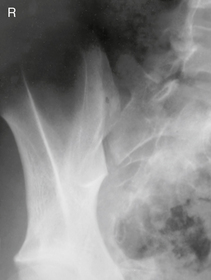
Chapter 6

Vertebral Column

Intervertebral Foramina and Zygapophyseal Joints

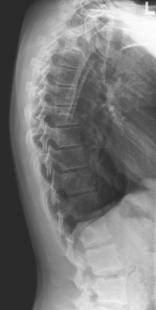
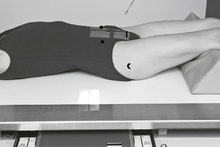
Certain lateral and oblique projections best demonstrate these important foramina and joints of the spine as follows:

  Zygapophyseal Joints Intervertebral Foramina
Cervical spine Lateral position 45° anterior oblique (side closest to IR)
Thoracic spine 70° anterior oblique (side closest to IR) Lateral position
Lumbar spine 45° posterior oblique (side closest to IR) Lateral position

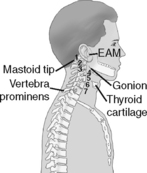
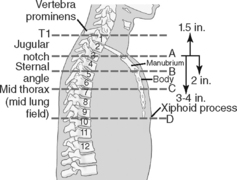
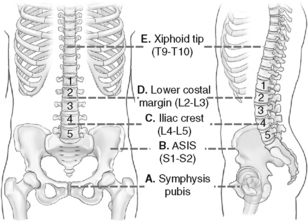
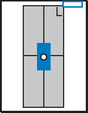
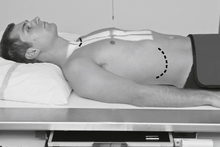
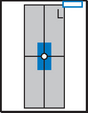
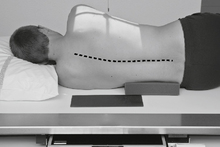
Topographic Landmarks

image

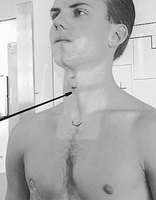
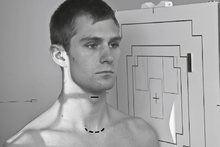
Fig. 6-1 Cervical spine landmarks.

image

Fig. 6-2 Sternum and thoracic spine landmarks.

image

Fig. 6-3 Lower spine landmarks.

AP for C1-C2*

(Atlas and Axis)

image

image

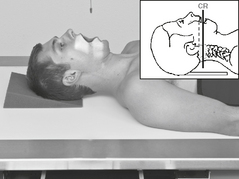
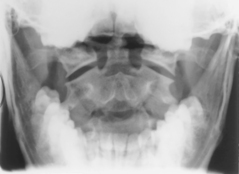
Fig. 6-4 AP open mouth for C1-C2.

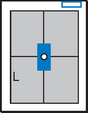
• 18 × 24 cm L.W. (8 × 10″)

• Grid

• AEC not recommended because of small field

Position

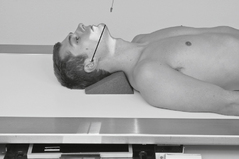
• Supine, patient centered to CR and centerline

• Adjust head without opening mouth—biting surface of upper incisors (junction of lips) aligned with base of skull (mastoid tips).

• Center IR to CR

• As a last step before making exposure—open mouth wide without moving head (make final check for head alignment).

Central Ray:

CR ⊥ through midportion of open mouth (to C1-C2)

SID:

40-44″ (102-113 cm)

Collimation:

Close collimation to C1-C2 region

Respiration:

Suspend during exposure.

image

AP for Dens (Odontoid Process)*

(AP Fuchs Method [and PA Judd Method])

Warning: Do not attempt on possible cervical trauma.

image

image

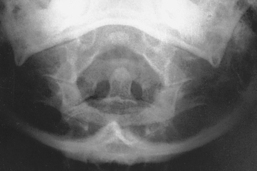
Fig. 6-5 AP Fuchs for dens (within foramen magnum outline).

image

Fig. 6-6 PA Judd method.

• 18 × 24 cm L.W. (8 × 10″)

• Grid

• AEC not recommended

Position

• Supine or erect, MSP aligned to centerline, no rotation

• Elevate chin until MML is near ⊥ to IR (may require some cephalic CR angle if chin cannot be elevated sufficiently)

Note:

May also be taken PA (Judd method) with chin against tabletop, with same CR alignment.

• Center IR to exiting CR.

Central Ray:

CR parallel to MML directed to tip of mandible (AP)

SID:

40-44″ (102-113 cm)

Collimation:

Close collimation to C1-C2 region

Respiration:

Suspend during exposure.

image

AP Open Mouth and AP (PA) Dens

Evaluation Criteria

Anatomy Demonstrated:

• Open mouth: Dens, lateral masses of C1, and C1-C2 zygapophyseal joints

• AP Fuchs: Dens within foramen magnum (odontoid process)

image

Fig. 6-7 AP open mouth—dens.
image

image

Fig. 6-8 AP (AP Fuchs—dens).
image

Position:

• Open mouth: Upper incisors and base of the skull superimposed. Entire dens demonstrated within foramen magnum

• AP Fuchs: Tip of mandible not superimposed over dens. Symmetric appearance of mandible

Exposure

• Optimal density (brightness) and contrast

• Sharp outline of dens; no motion

AP Axial Cervical Spine*

image

• 18 × 24 cm L.W. (8 × 10″)

• Grid

image

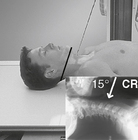
Fig. 6-9 Erect (CR 15°–20° cephalad).

Position

• Supine or erect, center midsagittal plane to CR (and to centerline of IR)

• Raise chin slightly as needed so the CR angle superimposes the mentum of the mandible over the base of the skull (to prevent mandible from superimposing more than C1-C2).

• Center IR to projected CR.

Central Ray:

CR 15°–20° cephalad, to enter at C4 (inferior border of thyroid cartilage)

SID:

40-44″ (102-113 cm)

Collimation:

On four sides to C spine region

Respiration:

Suspend during exposure.

image

Fig. 6-10 Supine (CR 15°–20° cephalad).

image

Oblique Projections, Cervical Spine*

image

Right and left obliques taken for comparison (as either posterior or anterior obli’s); anterior obli’s result in less thyroid dose.
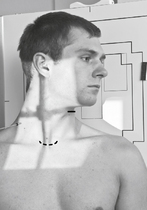
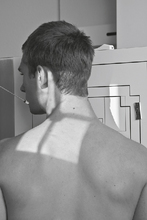
• 18 × 24 cm (8 × 10″) or 24 × 30 cm (10 × 12″), L.W.

• Grid (screen optional for small patient or pediatrics)

image

Fig. 6-11 LPO; CR 15° cephalad.

image

Fig. 6-12 RAO; CR 15° caudad.

Position

• Erect preferred (sitting or standing), entire torso and head turned 45° to IR, C spine aligned to CR (and centerline of IR)

• Raise chin slightly, looking straight ahead (or turn head slightly toward IR to prevent superimposing C1 by mandible).
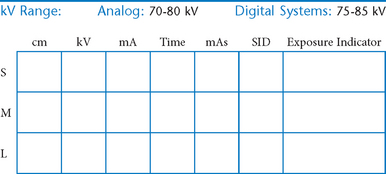
• Center IR to projected CR.

Central Ray (Posterior Obliques):

CR 15°–20° cephalad, to enter at C4. Caudal angle required for anterior obliques.

SID:

60-72″ (153-183 cm)

Collimation:

To C spine region

Respiration:

Suspend during exposure.

image

AP Axial and Oblique Cervical Spine

image

Fig. 6-13 AP axial.
image

image

Fig. 6-14 RPO.
image

Evaluation Criteria

Anatomy Demonstrated:

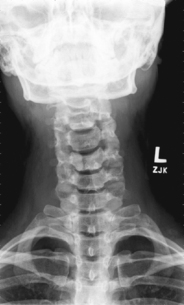
• AP axial: C3 to T2 vertebral bodies and intervertebral joints

• Oblique: Intervertebral foramina open and pedicles

• LPO/RPO projections: Demonstrate upside intervertebral foramina

• LAO/RAO projections: Demonstrate downside intervertebral foramina

Position:

• AP axial: Intervertebral joints open and spinous processes equidistant to midline

• Oblique: 45° (AP or PA): Intervertebral foramina uniformly open and pedicles in profile

Exposure:

• Optimal density (brightness) and contrast; no motion

• Soft tissue and bony margins and trabecular markings sharp

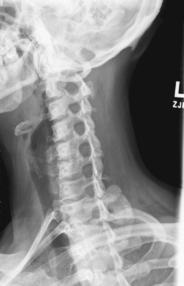
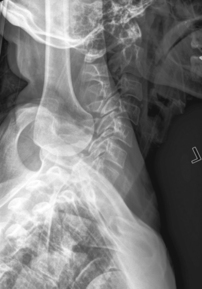
Lateral Cervical Spine*

image

image

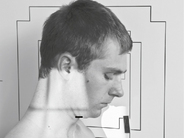
Fig. 6-15 Erect lateral, 183 cm (72″) SID.

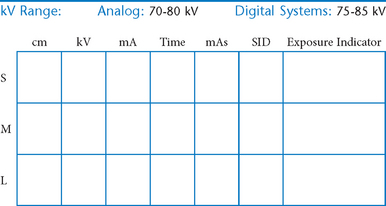
• 24 × 30 cm L.W. (10 × 12″)

• Grid (screen optional for small patient or pediatrics)

Position

• Erect (sitting or standing) in lateral position, C spine aligned and centered to CR (and centerline of IR)

• Top of IR ≈1-2″ (3-5 cm) above level of EAM

• Raise chin slightly (to remove mandible angles from spine).

• Relax and depress both shoulders evenly (weights in each hand may be necessary to visualize C7).
Note:

See following page for swimmer’s lateral if C7 is still not visualized.

Central Ray:

CR ⊥, to level of C4 (upper thyroid cartilage)

SID:

60-72″ (153-183 cm) (Longer SID provides for better visualization of C7 because of less divergent rays.)

Collimation:

On four sides to C spine region

Respiration:

Expose on complete expiration.

image

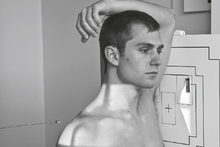
Lateral Cervicothoracic Spine*

Swimmer’s (Twining Method) C5-T3 Region

image

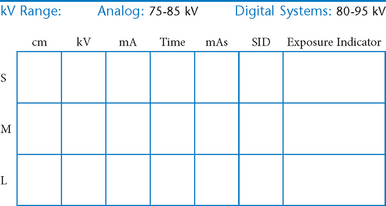
• 24 × 30 cm L.W. (10 × 12″)

• Grid

image

Fig. 6-16 Cervicothoracic (swimmer’s) lateral.

Position

• Erect preferred, align C-spine to CR (and centerline of IR).

• Elevate arm and shoulder closest to IR and rotate this shoulder slightly anteriorly or posteriorly.

• Opposite arm down, relax and depress shoulder, with slight opposite rotation (from other shoulder) to separate humeral heads from vertebra. May also be taken in lateral recumbent position with one arm and shoulder down and one up—Pawlow method.
Central Ray:

CR ⊥, centered to T1 (approximately 1″ [2.5 cm] above level of jugular notch). Optional 3°–5° caudad to separate the two shoulders

SID:

60-72″ (153-183 cm)

Collimation:

Collimate closely to area of interest

Respiration:

Expose on full expiration or orthostatic (breathing) technique.

image

Erect Lateral and Cervicothoracic (Swimmer’s) Lateral
image

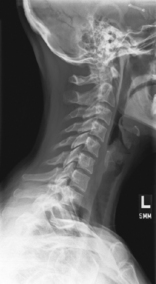
Fig. 6-17 Erect lateral.
image

image

Fig. 6-18 Cervicothoracic (swimmer’s) lateral.
image

Evaluation Criteria

Anatomy Demonstrated:

• Lateral: C1-C7 (minimum) demonstrated

• Swimmer’s: Vertebral bodies from C5-T3 (minimum) demonstrated

Position:

• Lateral: Near superimposition of zygapophyseal joints; no superimposition of mandible on C spine

• Swimmer’s: Separation of humeral heads from C spine; vertebral bodies in lateral perspective

Exposure:

• Optimal density (brightness) and contrast of lower cervical and upper thoracic spine; no motion

• Soft tissue and bony anatomy visible

Lateral Cervical Spine Hyperflexion—Hyperextension*

image

Warning: Do NOT attempt on possible trauma patients.

• 24 × 30 cm L.W. (10 × 12″)

• Grid or nongrid

image

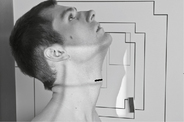
Fig. 6-19 Hyperflexion.

image

Fig. 6-20 Hyperextension.

Position

• Erect preferred (sitting or standing) in lateral position, C spine aligned to CR (and centerline of IR)

• Relax and depress shoulders as much as possible.

First IR:

Depress chin to touch chest if possible.

Second IR:

Elevate chin as far as is comfortable (ensure that entire C spine is included on both projections).

Central Ray:

CR ⊥, to C4 (level of upper border of thyroid cartilage)

SID:

60-72″ (153-183 cm)

Collimation:

To C spine area

Respiration:

Expose on total expiration.

image

Hyperflexion and Hyperextension Laterals

image

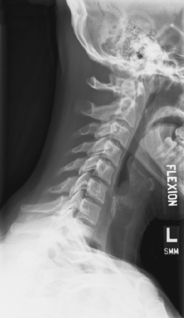
Fig. 6-21 Hyperflexion lateral.
image

image

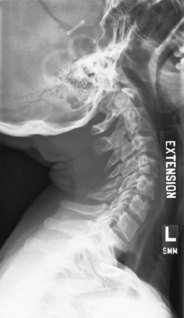
Fig. 6-22 Hyperextension lateral.
image

Evaluation Criteria

Anatomy Demonstrated:

• C1-C7: Range of motion and ligament stability demonstrated

Position:

• Hyperflexion: Spinous processes well separated

• Hyperextension: Spinous processes in close proximity

Exposure:

• Optimal density (brightness) and contrast; no motion

• Soft tissue visible and trabecular markings sharp

Cervical Spine—Trauma Series*

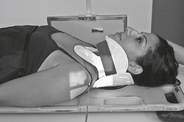
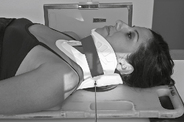
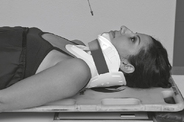
Warning: Do not remove cervical collar unless so indicated by the physician after viewing horizontal beam lateral.
image

Fig. 6-23 Horizontal beam lateral.

Horizontal Beam Lateral

• 24 × 30 cm L.W. (10 × 12″)

• Grid or nongrid

• SID: 60-72″ (153-183 cm)

• CR ⊥, to C4 (upper thyroid cartilage) (top of IR ≈3-5 cm or 1-2″ above EAM)

image

Fig. 6-24 AP axial.

AP

• Depress shoulders.

• 24 × 30 cm L.W. (10 × 12″)

• Grid

• SID: 40-48″ (102-123 cm)

• CR: 15°–20° cephalad, to enter at C4

image

Fig. 6-25 Oblique (both R and L obliques).

AP Axial Oblique

• 24 × 30 cm (10 × 12″) L.W.

• Grid

• SID: 40-48″ (102-123 cm)

• CR: 45° medially (and 15° cephalad if nongrid)

• CR to enter at level of C4

image

Fig. 6-26 Swimmer’s lateral.

Cervicothoracic Lateral

(Optional projection if needed to visualize C7)

• 24 × 30 cm (10 × 12″) L.W.

• Grid

• Elevate shoulder and arm nearest IR. Depress opposite shoulder.

• SID: 40-48″ (102-123 cm)

• CR: IR centered to T1 (approximately 1.5″ [2.5 cm] above level of jugular notch)

AP Thoracic Spine*

image

image

Fig. 6-27 AP thoracic spine.

• 35 × 43 cm L.W. (14 × 17″)

• Grid

• Feet at cathode end (anode heel effect)

• Wedge compensation filter recommended to produce uniform density of spine

Position

• Supine, spine aligned and centered to centerline, flex hips and knees to reduce lordotic curvature

• Top of IR 1.5″ (3 cm) above shoulder

• Ensure no rotation of thorax or pelvis. Shield radiosensitive tissues.
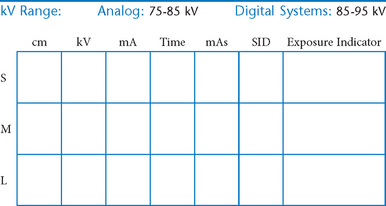
Central Ray:

CR ⊥, to center of IR (at level of T7 as for an AP chest, 3-4″ or 8-10 cm below jugular notch)

SID:

40-44″ (102-113 cm)

Collimation:

Long narrow collimation field to T spine region

Respiration:

Expose on expiration for more uniform density.

image

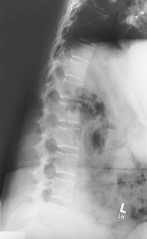
Lateral Thoracic Spine*

image

image

Fig. 6-28 Lateral thoracic spine.

• 35 × 43 cm L.W. (14 × 17″)

• Grid

• Lead blocker posterior to patient

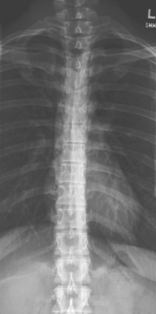
Position

• Recumbent, support under head, lateral with hips and knees flexed, arms raised and elbows flexed. Shield radiosensitive tissues.

• Align and center midaxillary plane to centerline

• Top of IR 1.5″ (3 cm) above shoulders; no rotation

• Supports should be placed under lower back as needed to straighten and align spine near parallel to tabletop. (A slight natural curvature corresponding to divergent rays is helpful.)
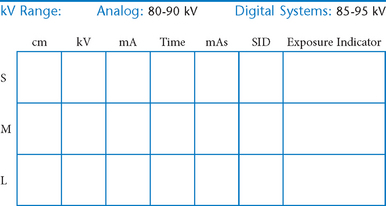
Central Ray:

CR ⊥ to thoracic spine, to center of IR (T7)

SID:

40-44″ (102-113 cm)

Collimation:

Long, narrow collimation field to T spine region

Respiration:

Orthostatic (breathing) technique recommended; or expose on expiration

image

AP and Lateral Thoracic Spine

image

Fig. 6-29 AP thoracic spine.
image

image

Fig. 6-30 Lateral thoracic spine.
image

Evaluation Criteria

Anatomy Demonstrated:

• AP and lateral: 12 thoracic bodies, intervertebral joint spaces, and intervertebral foramina

Position:

• AP: SC joints equidistant from midline, no rotation

• Lateral: Intervertebral joint spaces and intervertebral foramina open

Exposure:

• Optimal density (brightness) and contrast; no motion on AP projection. Breathing technique for lateral projection is desirable.

• Soft tissue visible and trabecular markings sharp

Oblique Thoracic Spine*

image

Both oblique projections generally taken for comparison. May also take as anterior obliques (lower breast dose).
• 35 × 43 cm L.W. (14 × 17″)

• Grid

image

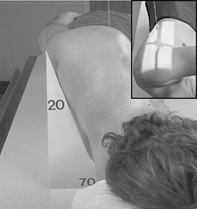
Fig. 6-31 70° RPO (20° from lateral).

Position

• Recumbent, rotated posteriorly 20° from lateral

• Align and center spine to centerline; place arm away from IR behind back and arm closest to IR up in front of head

• Top of IR ≈1 ½″ (3 cm) above shoulders

Central Ray:

CR ⊥, to center of IR (T7)

SID:

40-44″ (102-113 cm)

Collimation:

Long, narrow collimation field to T spine region

Respiration:

Expose on expiration.

image

AP (PA) Lumbar Spine*

image

Note: May be taken PA for better opening of intervertebral spaces by divergent rays.
• 30 × 35 cm L.W. (11 × 14″) or 35 × 43 cm (14 × 17″)

• Grid

image

Fig. 6-32 AP lumbar, hips and knees flexed.

image

Fig. 6-33 Alternate PA.

Position (AP)

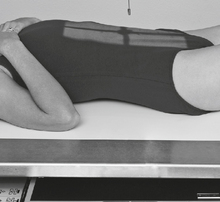
• Supine, spine aligned to centerline

• Flex hips and knees (to reduce lordotic curvature).

• No rotation (ASISs same distance from table)

• Center IR to CR.

Central Ray:

CR ⊥, to ≈1″ (2.5 cm) above iliac crest (L3); or center at crest for 35 × 43 cm IR

SID:

40-44″ (102-113 cm)

Collimation:

Long, narrow collimation field to L spine region (include SI joints)

Respiration:

Expose at end of expiration.

image

AP (PA) Lumbar Spine

Evaluation Criteria

Anatomy Demonstrated:

• T12-S1 (minimum) demonstrated

• Lumbar spine vertebral bodies, intervertebral joints, and transverse processes

Position:

• No rotation evident by symmetry of transverse processes, SI joints, and sacrum.

• Spinous processes are midline.

Exposure:

• Optimal density (brightness) and contrast; no motion

• Soft tissue and sharp trabecular markings clearly demonstrated.

image

Fig. 6-34 AP lumbar spine.
image

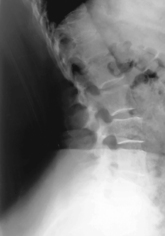
Lateral Lumbar Spine*

image

image

Fig. 6-35 Lateral L spine.

• 30 × 35 or 35 × 43 cm L.W. (11 × 14″ or 14 × 17″)

• Grid

• Feet at cathode end

• Lead blocker, posterior to patient

Position

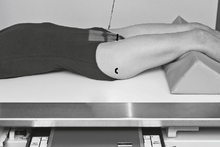
• Recumbent in true lateral position, flex hips and knees, align and center midaxillary plane to centerline

• Place support under waist as needed to place entire spine parallel to tabletop (see Note). Provide support between knees.
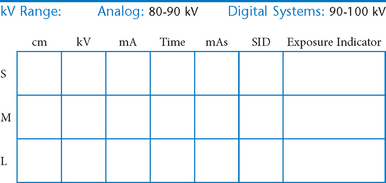
• Center IR to CR.

Central Ray:

CR ⊥, to spine. CR to level of ≈1″ (2.5 cm) above iliac crest (L3), or at iliac crest for 35 × 43 cm IR

SID:

40-44″ (102-113 cm)

Collimation:

Long, narrow collimation field to L spine region

Respiration:

Expose at end of expiration.

Note:

Patient with wide pelvis and narrow thorax may require a 3°–5° caudal CR angle, even with support under waist. If patient has natural lateral curvature (scoliosis), place “sag” or convexity down.

image

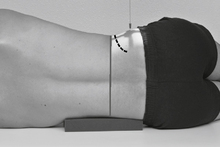
Lateral L5-S1, Lumbar Spine*

image

image

Fig. 6-36 Lateral L5-S1.

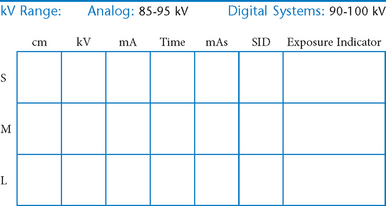
• 18 × 24 cm L.W. (8 × 10″)

• Grid

• Lead blocker posterior to patient

Position

• Recumbent in true lateral position, flex hips and knees, midaxillary plane aligned to centerline and CR

• Place support under waist as needed to place entire spine parallel to tabletop. Provide support between knees.

• Center IR to CR.

Central Ray:

• CR ⊥, to IR if entire spine is parallel to table; or 5°–8° caudad if entire spine is not parallel (most often on females). Angle CR to be parallel to the interiliac plane.

• CR to 1.5″ (4 cm) inferior to iliac crest and 2″ (5 cm) posterior to ASIS

SID:

40-44″ (102-113 cm)

Collimation:

Collimate closely to area of interest.

Respiration:

Suspend during exposure.

image

Lateral and Lateral L5-S1 Lumbar Spine

image

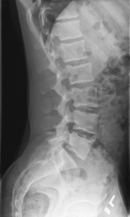
Fig. 6-37 Lateral lumbar spine.
image

image

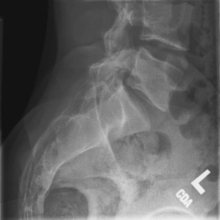
Fig. 6-38 Lateral L5-S1.
image

Evaluation Criteria

Anatomy Demonstrated:

• Lateral: L1-L4 vertebral bodies, intervertebral joints, and foramina and spinous processes

• Lateral L5-S1: Open L4-S1 vertebral bodies, intervertebral joint spaces, and intervertebral foramina

Position:

• Lateral: Vertebral column parallel to IR; intervertebral joint spaces and foramina open; no rotation

• Lateral L5-S1: Intervertebral joint spaces and intervertebral foramina open; no rotation

Exposure:

• Optimal density (brightness) and contrast; no motion

• Soft tissue visible and bony detail of vertebral bodies, joint spaces, and spinous process

Oblique Lumbar Spine*

image

Both oblique projections generally taken for comparison (as either anterior or posterior obliques).
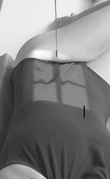
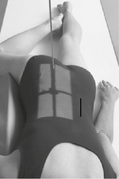
• 11 × 14″ L.W. (30 × 35 cm), or 24 × 30 cm (10 × 12″)

• Grid

image

Fig. 6-39 Posterior oblique (45° RPO).

image

Fig. 6-40 Anterior oblique (45° LAO).

Position

• 45° right and left posterior or anterior obliques (use support angle blocks under pelvis and shoulders to maintain position for posterior obliques)

• Align and center spine to CR and centerline.

Central Ray:

CR ⊥, to body of L3 at level of lower costal margin (1-2″ or 4-5 cm above iliac crest) and 2″ or 5 cm medial to upside ASIS

SID:

40-44″ (102-113 cm)

Collimation:

To area of interest

Respiration:

Suspend during exposure.

Note:

50° oblique is best for L1-L2 zygapophyseal joints, and 30° for L5-S1.

image

Oblique Lumbar Spine

image

Fig. 6-41 Right posterior oblique.
image

image

Fig. 6-42 Right anterior oblique.
image

Evaluation Criteria

Anatomy Demonstrated:

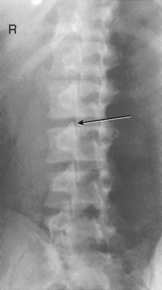
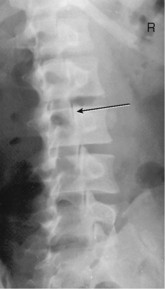
• LPO/RPO: L1-L4 downside zygapophyseal joints. Scottie dog elements visible.

• LAO/RAO: L1-L4 upside zygapophyseal joints. Scottie dog elements visible.

Position:

• Zygapophyseal joints and pedicle (“eye”) centered on the vertebral body

Exposure:

• Optimal density (brightness) and contrast; no motion

• Soft tissue visible and bony detail of vertebral bodies, joint spaces, and elements of Scottie dog (arrows indicate zygapophyseal joints)

Scoliosis Series*

PA (or AP) Ferguson Method

image

PA greatly reduces breast dose.

• 35 × 43 cm L.W. (14 × 17″) or 35 × 92 cm (14 × 36″)

• Grid

• Compensating filters to produce a more uniform density of spine
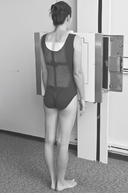
image

Fig. 6-43 PA without block.

image

Fig. 6-44 PA with block under foot on convex side of curve.

Position

First IR:

Erect, standing or seated, spine aligned and centered to centerline, arms at side, no rotation of pelvis or thorax

• Lower margin of IR 1-2″ (3-5 cm) below iliac crest

Second IR:

Place 3- to 4-inch (8- to 10-cm) block under foot (or buttock if seated) on convex side of curvature. (Identifies primary deforming curves from compensatory curve.)

Shielding:

Use gonad shields and breast shields.

Central Ray:

CR ⊥, to center of IR

SID:

40-60″ (102-153 cm); longer SID is recommended

Collimation:

Long and narrow to vertebral column region

Respiration:

On full expiration

image

Lumbar Spine*

AP (PA) Right and Left Bending

image

image

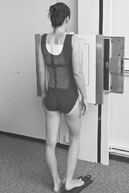
Fig. 6-45 AP, right bending.

image

Fig. 6-46 AP, left bending.

Note: May be taken erect PA to reduce breast dose.

• 35 × 43 cm (14 × 17″), L.W., or 35 × 92 cm (14 × 36″)

• Grid

• Compensating filters to produce a more uniform density of spine
Position

• Supine or erect, spine centered to CR and centerline of table

• Bend laterally as far as possible (right then left) without tilting pelvis (pelvis remains stationary and acts as a fulcrum).

• Ensure no rotation of pelvis and upper torso.

• Lower margin of IR 1-2″ (3-5 cm) below iliac crest

Central Ray:

CR ⊥, to center of IR (higher centering if thoracic spine is area of interest)

SID:

40-60″ (102-153 cm)

Collimation:

Include vertebral column of interest.

Respiration:

Expose at end of expiration.

image

Lumbar Spine*

Lateral Hyperflexion and Hyperextension

image

• 35 × 43 cm L.W. (14 × 17″)

• Grid

• Lead blocker posterior to patient

image

Fig. 6-47 Hyperflexion lateral.

image

Fig. 6-48 Hyperextension lateral.

Position

• Recumbent or erect, spine centered to table

• Support under waist to align spine parallel to tabletop.

• Hyperflex forward as far as possible, then hyperextend back as far as possible for second IR; maintain true lateral position.

• Lower margin of IR 1-2″ (3-5 cm) below iliac crest

Central Ray:

CR ⊥, to center of IR (or to site of fusion if known)

SID:

40-44″ (102-113 cm)

Collimation:

On four sides to near borders of IR

Respiration:

Expose at end of expiration.

image

Lateral Hyperflexion and Hyperextension

image

Fig. 6-49 Hyperflexion lateral.
image

image

Fig. 6-50 Hyperextension lateral.
image

Evaluation Criteria

Anatomy Demonstrated:

• Hyperflexion: Lateral view of lumbar vertebrae in hyperflexion

• Hyperextension: Lateral view of lumbar vertebrae in hyperextension

Position:

• Hyperflexion: True lateral with no rotation; spaces between spinous processes open

• Hyperextension: True lateral with no rotation; spaces between spinous processes closed

Exposure:

• Optimal density (brightness) and contrast; no motion

• Soft tissue visible and bony detail of vertebral bodies, spinous processes, and intervertebral joint spaces

AP Axial Sacrum*

image

• 24 × 30 cm L.W. (10 × 12″)

• Grid

image

Fig. 6-51 AP sacrum, CR 15° cephalad.

Position

• Supine, spine centered to CR and centerline

• No rotation of pelvis (both ASIS same distance from table)

• Center IR to projected CR. (Shield gonads for males.)

Central Ray:

CR 15° cephalad, at 2″ (5 cm) superior to pubic symphysis

SID:

40-44″ (102-113 cm)

Collimation:

On four sides to area of sacrum

Respiration:

Suspend during exposure.

image

AP Axial Coccyx*

image

Note: May be done PA with 10° cephalic angle if patient cannot sustain weight on the coccyx area in a supine position.

Urinary bladder should be emptied before procedure is performed.
• 18 × 24 cm L.W. (8 × 10″)

• Grid

• Cautious use of AEC

image

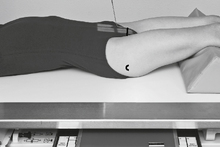
Fig. 6-52 AP axial coccyx, CR 10° caudad.

Position

• Supine, support under knees, gonad shield for males

• Align and center midsagittal plane to centerline, no rotation

• Center IR to level of projected CR

Central Ray:

CR 10° caudad, centered to 2″ (5 cm) superior to symphysis pubis

SID:

40-44″ (102-113 cm)

Collimation:

Close collimation to area of coccyx

Respiration:

Suspend during exposure.

image

AP Axial Sacrum and Coccyx

Evaluation Criteria

Anatomy Demonstrated:

• AP sacrum: Nonforeshortened image of sacrum

• AP coccyx: Nonforeshortened image of coccyx

image

Fig. 6-53 AP sacrum.
image

Position:

• AP sacrum: Sacrum free of superimposition and sacral foramina visible

• AP coccyx: Coccyx free of superimposition and not rotated

Exposure:

• Optimal density (brightness) and contrast; no motion

• Soft tissue visible and sharp bony detail

image

Fig. 6-54 AP coccyx.
image

Lateral Sacrum (and Coccyx)*

image

Note: Lateral sacrum and lateral coccyx may be taken as one projection if both sacrum and coccyx are being examined (reduces patient exposure).
• 24 × 30 cm L.W. (10 × 12″)

• Grid

• Lead blocker posterior to patient

• Use of boomerang-type compensating filter is recommended.

image

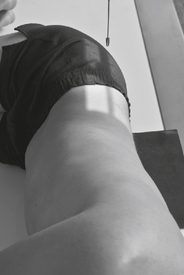
Fig. 6-55 Lateral sacrum.

Position

• Lateral recumbent, hips and knees flexed, true lateral position

• Center sacrum to CR and centerline. (Align patient and IR to correctly centered CR.)

Central Ray (Sacrum):

CR ⊥, directed to 3-4″ (8-10 cm) posterior to upside ASIS

SID:

40-44″ (102-113 cm)

Collimation:

On four sides to area of sacrum

Respiration:

Suspend during exposure.

image

Lateral Coccyx*

image

Note: Lateral sacrum and lateral coccyx are commonly taken as one projection if both sacrum and coccyx are being examined (reduces patient exposure).
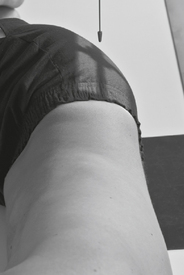
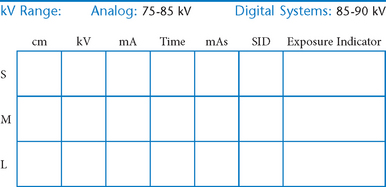
• 18 × 24 cm L.W. (8 × 10″)

• Grid

• Lead blocker posterior to patient

• Cautious use of AEC

image

Fig. 6-56 Lateral coccyx.

Position

• Lateral recumbent, with hips and knees flexed 90°, true lateral position

• Center coccyx to CR and centerline of table (remember the coccyx is located superficially between buttocks slightly superior to level of greater trochanter).

• Center IR to CR.

Central Ray:

CR ⊥, to 2″ (5 cm) inferior to level of ASIS and 3-4″ (8-10 cm) posterior

SID:

40-44″ (102-113 cm)

Collimation:

To area of distal sacrum and coccyx

Respiration:

Suspend during exposure.

image

Lateral Sacrum and Coccyx

Evaluation Criteria

Anatomy Demonstrated:

• Lateral view of sacrum and coccyx

• Lateral view of L5-S1 intervertebral joint

image

Fig. 6-57 Lateral sacrum and coccyx.
image

Position:

• No rotation evident by greater sciatic notches and femoral heads superimposed

• Entire sacrum and coccyx included

Exposure:

• Optimal density (brightness) and contrast; no motion

• Soft tissue and sharp trabecular markings clearly demonstrated

Sacroiliac Joints*

AP Axial

image

• 24 × 30 cm L.W. (10 × 12″)

• Grid

image

Fig. 6-58 AP axial SI joints (CR 30°–35° cephalad).

Position

• Supine, center patient to centerline

• No rotation of pelvis (ASISs the same distance from tabletop)

• Center IR to projected CR. Shield gonads for males.

Central Ray:

CR 30° (males) and 35° (females) cephalad, 2″ (5 cm) below level of ASIS

SID:

40-44″ (102-113 cm)

Collimation:

Four sides to area of interest

Respiration:

Suspend during exposure.

image

Sacroiliac Joints*

Posterior Oblique Projections (Bilateral)

image

• 24 × 30 cm L.W. (10 × 12″)

• Grid

• Bilateral for comparison

image

Fig. 6-59 25°–30° LPO for upside (right) joint.

Position

• Patient in 25°–30° posterior oblique with side of interest elevated (use support to maintain this position)

• Align elevated SI joint to CR and to centerline (1″ [2.5 cm] medial to upside ASIS)

• Center IR to CR.

• Shield gonads for males.

Central Ray:

CR ⊥, to 1″ (2.5 cm) medial to elevated ASIS

SID:

40-44″ (102-113 cm)

Collimation:

Four sides to area of interest

Respiration:

Suspend during exposure.

Note:

CR may be angled 15°–20° cephalad to best demonstrate the distal part of joint.

image

Posterior Oblique SI Joint

Evaluation Criteria

Anatomy Demonstrated:

• Open upside SI joint

Position:

• LPO: Right SI joint open; no overlap of iliac wing and sacrum

• RPO: Left SI joint open; no overlap of iliac wing and sacrum

Exposure:

• Optimal density (brightness) and contrast; no motion

• Soft tissue and sharp trabecular markings clearly demonstrated

image

Fig. 6-60 LPO projection of (right) SI joint.
image


*Bontrager Textbook, 8th ed, p. 308.

*Bontrager Textbook, 8th ed, p. 315.

*Bontrager Textbook, 8th ed, p. 309.

*Bontrager Textbook, 8th ed, p. 310.

*Bontrager Textbook, 8th ed, p. 311.

*Bontrager Textbook, 8th ed, p. 313.

*Bontrager Textbook, 8th ed, p. 314.

*Bontrager Textbook, 8th ed, pp. 591 and 592.

*Bontrager Textbook, 8th ed, p. 318.

*Bontrager Textbook, 8th ed, p. 319.

*Bontrager Textbook, 8th ed, p. 320.

*Bontrager Textbook, 8th ed, p. 335.

*Bontrager Textbook, 8th ed, p. 337.

*Bontrager Textbook, 8th ed, p. 338.

*Bontrager Textbook, 8th ed, p. 336.

*Bontrager Textbook, 8th ed, p. 340.

*Bontrager Textbook, 8th ed, p. 343.

*Bontrager Textbook, 8th ed, p. 344.

*Bontrager Textbook, 8th ed, p. 345.

*Bontrager Textbook, 8th ed, p. 346.

*Bontrager Textbook, 8th ed, p. 347.

*Bontrager Textbook, 8th ed, p. 348.

*Bontrager Textbook, 8th ed, p. 349.

*Bontrager Textbook, 8th ed, p. 350.