CHAPTER 3 Bits, bridles and accessories
Introduction
A veterinarian must understand the action and purpose of bridles, bits, and accessories (e.g., nosebands and martingales) not only to provide optimal health care to horses’ mouths but also to effectively communicate with owners and trainers and to address their concerns about their horses’ performance.1 We must be aware of what a horse does for a living, become familiar with what is expected, and provide the kind of dental care required to help horses perform most comfortably and at their best.2
Refinements in the way that teeth should be floated depend both upon the job of the horse and the type of bit used. The bitting requirements are different for western performance, English pleasure, polo, jumping, dressage, racing, equitation, driving, etc. For example, the D-ring snaffle is a popular bit for Thoroughbred racing, in which the jockey’s hands are above the horse’s neck, but this bit is seldom used in Standardbred racing because the angle of pull on the reins of a driving horse is straight back towards the driver.
The second premolars of a racing Thoroughbred, whose chin must extend to achieve maximum speed, require more rounding than those of a pleasure horse who performs in a nearly vertical head set (compare Fig. 3.1E with Fig. 3.1A and Fig. 3.3C with Fig. 3.3A). The removal of wolf teeth is of more obvious advantage for harness horses with overcheck bits than it is for pleasure horses.1,3,4,5 (Compare Fig. 3.3A with Fig. 3.19.) A barrel-racing horse in a gag bit requires a deeper bit seat than a cutting horse in a grazer curb bit (compare Fig.3.7B with Fig. 3.9D).
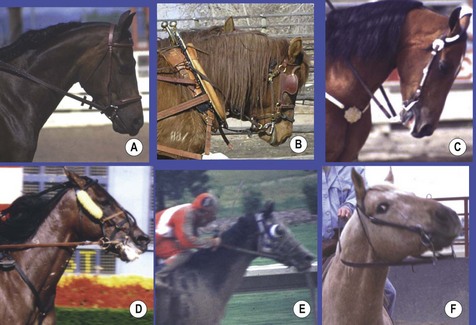
Fig. 3.1 The proper head carriage when a horse is ‘on the bit’ varies depending upon the function of the horse. (A) The pleasure horse with a nearly vertical head set is collected, that is, his weight is shifted to the rear. (B) The draft horse pulling a heavy load may carry his head more vertically. (C) This horse is ‘behind the bit,’ overflexing his chin to his chest to evade bit pressure. (D) The racing Standardbred needs to extend his nose to achieve speed but his head position must be controlled to keep him on gait. (E) The racing Thoroughbred, in order to achieve maximum speed, must be able to fully extend his nose and shift his center of gravity forward. (F) This horse is ‘ahead of the bit,’ overextending his chin to evade bit pressure.
Proper use of bits and bridles
Bits and bridles are for communication. They are not handles to stabilize the rider in the saddle or instruments for punishing the horse.6–8 The western horse is ridden with slack in the rein while the English horse is generally ridden with more contact with the bit, but in either case the accomplished rider uses his seat and legs before his bit to communicate his wishes to his mount. Indeed, the most important factor in having soft, sensitive hands on the reins is developing a good seat.9
Of course, for the driver of the horse in harness, communication via the seat and legs is not an option. Discounting the relatively minor role of the whip, the bridle and reins or lines (the proper name for the reins of a draft horse) are the only nonverbal means of communication and thus assume even more importance than they do in the ridden horse.1
As with all methods of training and communicating with the horse, the key to the proper use of bits and bridles is the principle of pressure and release.6–9 A horse does not intuitively move away from pressure. Rather, he learns to seek a position of comfort to relieve the pressure applied by the bit in his mouth. Consequently, the rein pressure must be released the instant that the horse complies (or even tries to comply) with the request sent to him via the bit. If the pressure is not released, the horse has no way of knowing that his response was correct and becomes confused.6–9 When a rider or driver applies rein pressure, he is asking the horse for a response; when he releases the pressure, he is thanking the horse for complying.6,9
Bits, bridles, and accessories can exert pressure on a horse’s mouth bars (the horseman’s term for the lower interdental space), lips, tongue, hard palate, chin, nose, and poll. Of these, the tongue and the hard palate are the most sensitive and the most responsive to subtle rein pressure. Depending upon the type of headgear used, however, commands sent to the horse via the bars, lips, chin, or nose can be more important than those transmitted via the tongue and palate.
An important concept in bitting is signal, which is defined as the time between when the rider or driver begins to pull on the reins and the time when the bit begins to exert pressure in the horse’s mouth. As a horse becomes schooled, he learns to recognize the initial increase in rein pressure and to respond before significant pressure is applied.7
Signs of bitting problems
Although cut tongues are the most obvious injuries associated with the improper use of bits, less spectacular injuries to the bars and other tissues are also signs of bitting problems. Tissue trapped by a bit may bunch between the bit and the first lower cheek teeth where it is pinched or cut. The damaged area may then be irritated every time the bit moves.1 Trauma to the lower interdental space frequently penetrates to the mandible with resulting mandibular periostitis.8,10,11–15 All types of headgear can press the lips and cheeks against points or premolar caps on the upper cheek teeth.1
Most bit-induced wounds are superficial, heal rapidly due to the extensive blood supply to the mouth and the antibacterial action of saliva, and seldom require treatment.11,16 A severely lacerated tongue, however, often heals with a permanent defect, and mandibular periostitis, in severe cases, can lead to the formation of osseous sequestra.10–13,17,18
A horse with a sore mouth or improperly fitting bit will often gape his mouth and pin his ears. He may nod his head excessively or toss his head. He may extend his neck (get ahead of the bit) or tuck his chin against his chest (get behind the bit; Fig. 3.1).9 Bitting problems can be mistaken for lameness, as when a horse fails to travel straight.
It is a common misconception that a horse with a painful mouth will be especially sensitive to bit cues. In fact horses tend to push into pain.2,8,9 A horse with bilaterally tender bars may root into the bit. A horse which is sore on one side of his mouth may lean on the bit on the tender side. A vicious cycle can result from attempts to gain such a horse’s respect by changing to increasingly severe bits.6 Oral discomfort causes horses to focus on pain rather than on performance. They may fail to respond to the bit cues, may evade the action of the bit or may ignore the bit completely.2
When you are consulted about a horse that has performance problems, you should always inquire about the type of bit used and carefully examine the tongue, lips, bars, palate, chin and nose for subtle signs of injury.19 It is important to compare the left and right interdental spaces to detect subtle differences.10,17
A localized soft and thickened raised area may indicate mandibular periostitis, especially if the horse reacts violently when pressure is applied to it. Techniques such as mental nerve blocks, radiographs, scintigraphy, and computed tomography may be necessary to confirm the presence of this condition in living horses. A simple surgical procedure has been described for removing the periostitis and making the horse more comfortable with his bit.10
Even in the absence of an obvious injury, a change to a gentler bit will often lead to an improvement in a horse’s performance.8,11,13,16
Mouthpieces
The mouthpiece of a bit may be solid or may have one or more joints. A mouthpiece made up of two or more pieces is referred to as a jointed or broken mouthpiece (Fig. 3.2A). The two halves of a simple jointed mouthpiece are called the ‘cannons.’ One purpose of the joint is to form a roof over the tongue, which gives the tongue some relief from the pressure of the bit. Another purpose is to change the angle of pull. As the cannons collapse, pressure is transferred from the tongue to the bars and lips. Some jointed mouthpieces (e.g., Dr Bristol and French snaffle) have an extra link between the cannons. The center link creates more room for the tongue, but changes the angle at which the pressure is applied to the tongue, bars and corners of the lips. There is more pressure on the tongue and less leverage on the bars and lips8 (Fig. 3.3). Of course, the position of the horse’s head, which varies depending upon the horse’s use, will have a profound effect upon the bit’s action (Figs 3.1 & 3.3).
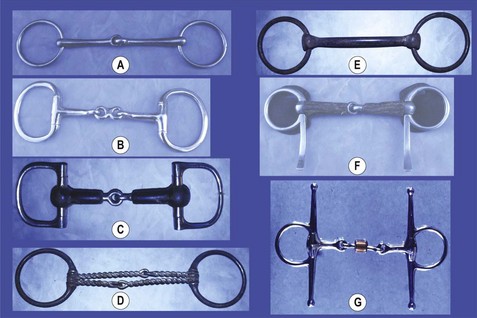
Fig. 3.2 Examples of snaffle bits. (A) O-ring with broken mouthpiece. (B) Egg butt with center link in mouthpiece. (C) D-ring with rubber covered mouthpiece. (D) Fixed ring with double twisted wire mouthpiece. (E) O-ring with solid mullen mouthpiece. (F) Half cheek with leather covered mouthpiece. (G) Full cheek with cricket in mouthpiece.
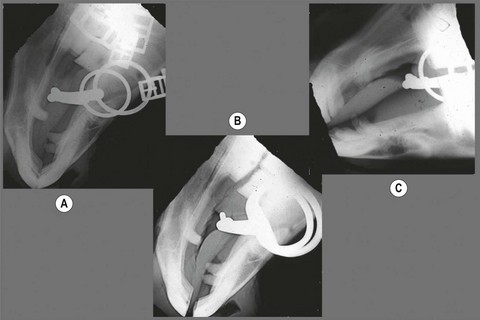
Fig. 3.3 Lateral radiographs of snaffle bits under rein pressure. (A) Broken mouthpiece, poll flexed. (B) Center linked mouthpiece, poll flexed. The extra link transfers pressure from the bars to the tongue. (C) Broken mouthpiece, nose extended. The more a horse’s nose is extended, the more likely that his lips will be pinched against his teeth and his tongue will be punished by the bit.
A solid mouthpiece may be straight, curved or ported. One of the most common misconceptions in bitting is that a low port makes a mouthpiece mild and that a high port makes it severe.6 The error in such a conception becomes evident when we consider that the tongue is the most sensitive part of the horse’s mouth and that the purpose of the port is to prevent the bit from applying the majority of its force directly to the tongue6,20 (Fig. 3.4). A high port is severe only if it comes into contact with the horse’s palate (Fig. 3.7D). For most horses, the port must be at least 2–2.5 inches (5.1–6.4 cm) high to contact the palate.6,9
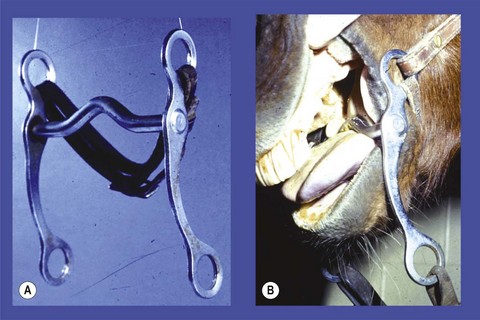
Fig. 3.4 (A) Standard curb bit. (B) The lower the port, the greater the chance that the tongue will be damaged by a curb bit.
A straight, solid mouthpiece can be severe because the tongue takes almost the full force of the pull. The mullen mouthpiece (Figs 3.2E & 3.12A), with its gentle curve from one side to the other, still lies largely on the tongue and gives only a small margin of tongue relief. When using a bit with a straight or mullen mouthpiece, a hard jerk on the reins can easily cut the tongue.8
A mouthpiece’s severity is inversely related to its diameter. Mouthpiece diameter is measured one inch in from the attachment of the bit rings or shanks, because this is the portion of the mouthpiece that ordinarily comes into contact with the bars of a horse’s mouth. A standard mouthpiece is  inch (9.5 mm) in diameter. Most horse show associations prohibit a
  inch (6.4 mm) (or smaller) mouthpiece because it is considered too severe.8 Although a
  inch (1.27 cm) mouthpiece is generally mild, some horses may be uncomfortable carrying so thick a mouthpiece.17,21 Some horses, especially Thoroughbred types, have relatively narrow, sharp bars which are easily damaged by pressure.22 Such horses require thicker and/or softer mouthpieces than do horses with thicker bars. One should always look into a horse’s mouth to assure that a mouthpiece fits comfortably.8
Mouthpieces are constructed of many different materials and combinations of materials (Figs 3.2, 3.5 & 3.12). In order for a bit to function properly, the horse’s mouth must be wet.8,9 Copper is frequently incorporated into mouthpieces because it is reputed to promote salivation. Cold-rolled steel, sometimes called ‘sweet iron’, is second to copper in stimulating salivation. Sweet iron will rust and, while it may be unattractive, rust seems to taste good to many horses and may further stimulate salivation. Rust-proof stainless steel, however, will also promote salivation to some degree and has the advantages of being hard, staying smooth and cleaning easily. Some bitmakers assert that mouthpieces which combine two different metals are superior for saliva production to mouthpieces made with a single metal. Aluminum, chrome-plated, rubber and leather covered mouthpieces are thought to produce dry mouths.
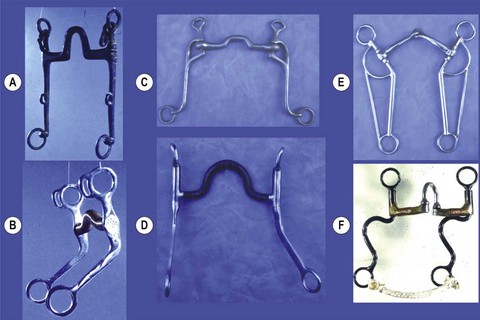
Fig. 3.5 Examples of leverage bits. (A) Straight shanked pleasure horse bit. (B) Grazer bit.
(C) Loose cheeks. (D) Myler bit with fixed cheeks and independently rotating shanks. (E) Loose cheeks, broken mouthpiece. (F) Correction bit.
Of course the metal used in the mouthpiece is not the only factor involved in producing a wet mouth. A dry mouth, usually a result of excessive epinephrine secretion, is a sign of a stressed, unhappy horse. When it comes to generating a wet mouth, the horse’s mental state is probably more important than the metal used in the bit. A severe mouthpiece which causes the horse to worry or fret is unlikely to promote a wet mouth regardless of its chemical make-up. Some mouthpieces incorporate rollers, commonly called ‘crickets,’ or danglers, commonly called ‘keys,’ to stimulate tongue movement and thus enhance salivation. Such tongue toys also have a pacifying effect on nervous horses.
Some horsemen cover their mouthpieces with latex in the early stages of training or use rubber or leather-covered covered mouthpieces on very soft-mouthed horses to protect the bars and tongues.23 Plastic and synthetic mouthpieces are gradually coming into greater acceptance.24
The more complicated the mouthpiece of a bit and the more contact used by the rider, the greater the risk of oral discomfort and/or injuries. Smooth mouthpieces are obviously gentler than those with edges, ridges, teeth or chains.
Snaffle bits (Fig. 3.2)
Regardless of the bit they will ultimately wear, the great majority of today’s horses are started in snaffle bits. Snaffle bits are used on 2–5-year-old western performance horses as well as on all classes of English riding for younger horses. Nearly all racehorses, both ridden and driven, spend their entire careers in snaffle bits.
A snaffle bit is any bit, whether it has a jointed or solid mouthpiece, in which the cheeks of the bridle and the reins attach to the same or adjacent rings on the bit.6,9,25 There is a direct line of pull from the rider’s hands to the horse’s mouth with no mechanical advantage. Tightening of the reins causes all types of snaffle bits to relocate caudally, to rotate on their long axis and to press on the horse’s tongue, bars and lip corners.18
Snaffle bits often are identified by the shape of their rings (e.g., O-ring, D-ring, half-cheeked, full-cheeked) and by how their cannons attach to the rings (e.g., loose-ring, fixed ring, egg butt). All ring shapes and attachments have their advantages and disadvantages. A loose ring snaffle, in which O-shaped rings run through holes in the ends of the mouthpiece (Fig. 3.2A), affords the maximum signal. The rings revolve freely and tend to rotate slightly when the reins are picked up but before the bit engages. However, the rotating rings can pinch the corners of a horse’s mouth.
In egg butt and D-ring snaffles (Fig. 3.2B & 3.2C) a metal cylinder connects the mouthpiece to the cheek rings and prevents pinching at the corners of the mouth. The well-defined corners of the D-ring snaffle (the straight line of the D) increase the pressure on the horse’s cheeks and thus the control over the horse. However, this same pressure increases the chances that the horse’s cheeks will be pressed against points on the upper premolars.
Some snaffles have prongs or ‘cheeks’ attached to the rings (Fig. 3.2F & 3.2G). ‘Full cheek’ snaffles have prongs both above and below the mouthpiece, while half-cheek snaffles have prongs below the mouthpiece. Like the D-ring or cylinder type snaffles, the cheeks encourage the horse to turn in the desired direction by increasing the pressure on the corners of the mouth and sides of the face. The cheeks also prevent the bit from being pulled through the mouth. Because their rings do not rotate, all cheeked, D-ring and egg-butt snaffles provide less signal than loose ringed snaffles.8
Leverage bits (Figs 3.4 & 3.5)
Leverage, or curb, bits provide a mechanical advantage to the rider. There are two sets of bit rings: the upper rings attach to the headstall, and the lower rings attach to the reins. The ratio of the length of the shanks of the bit (the portion below the mouthpiece) to the cheeks of the bit determines the amount of leverage. The severity of a bit increases as the ratio increases.9 For example, in a standard curb bit with 4.5 inch shanks and  inch cheeks (a 3 : 1 ratio), one pound of pressure on the reins translates into 3 pounds of pressure in the horse’s mouth. When using a bit with 8-inch shanks and 2-inch cheeks, one pound of pull results in four pounds of pressure. However, regardless of the ratio, the longer the shanks, the less the force on the reins required to exert a given pressure in the mouth.8
Although the severity of a bit increases with the length of the shanks, this severity is partially offset by the fact that the signal provided to the horse increases as well.8 A long-shanked bit must rotate more than shorter-shanked bit before it exerts significant pressure in the horse’s mouth.
Leverage bits are called curb bits because to exert their leverage they depend upon a curb chain or strap that passes beneath the horse’s chin groove and attaches to the rings on the cheeks of the bit. The bit rotates in the horse’s mouth until the curb strap stops (curbs) the rotation and the leverage action of the bit takes effect (Fig. 3.6). The leverage bit exerts pressure primarily on the chin groove, the tongue and the bars (Fig. 3.4 and 3.7).6,9
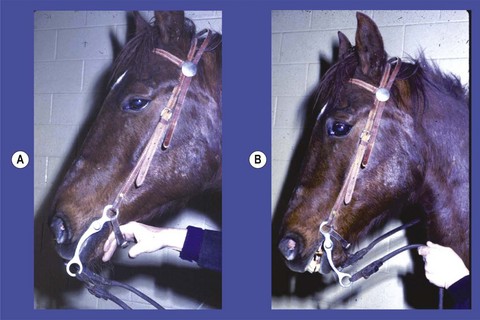
Fig. 3.6 (A) A curb strap’s adjustment is often based upon the number of fingers that can be slipped under it. (B) A better way is to determine how much rotation of the bit is desired and to set the curb strap accordingly.
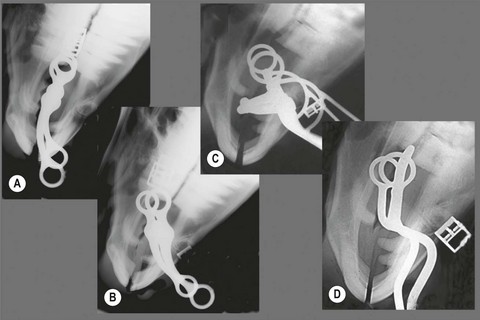
Fig. 3.7 Lateral radiographs of curb bits. (A) No rein pressure. (B) Rotation under rein pressure. (C) Rein pressure on a bit with loose cheeks and a broken mouthpiece can force the mouthpiece against the palate. (D) A bit with a high port or spoon can contact the palate, and a lateral pull of the reins can force the bit against the cheek teeth.
The adjustment of the curb strap determines the point at which it snugs up into the chin groove, how quickly and where the bit makes contact with the mouth, and how far the mouthpiece will rotate (Fig. 3.6). The tighter the setting, the less the pull required to activate the bit. The more the bit rotates before the chin strap engages, the more the pressure is transferred to the corners of the lips and to the poll and the less to the tongue, bars and chin groove. Of course, if the bit has a high port or spoon, and the curb strap is loose, the rotation may be halted by contact with the palate, which then must bear part of the pressure.
Typically, the more moving parts within a leverage bit, the more signal it will provide to the horse.6,8 For example, a loose-jawed bit, one that attaches to the mouthpiece via hinges or swivels, will provide a certain degree of rotation before the bit engages. Add a loose rein ring to the loose jaw, and the bit will provide even more signal. Install a broken mouthpiece in those shanks and you amplify the signal even more.9 The downside of a broken mouthpiece in this type of bit is that it increases the potential severity of the bit. In a swivel ported bit, often called a ‘correction’ bit, there are joints on each side of the port where it joins the bars (Fig. 3.5F). Such bits are capable of exerting tremendous bar and tongue pressure.
The angle between the shanks and the cheeks affects the speed of communication. The straighter the line, the less signal the bit provides. In the so-called grazer bit (Fig. 3.5B), with swept back shanks, the mouthpiece tends to rotate less than in a bit with straighter shanks (Fig. 3.5A) and provides more signal to the horse.8,9 Also, a grazer bit releases its pressure more quickly than a straight-shanked bit when the reins pressure is relaxed. Of course, a tight curb strap reduces the signal of any leverage bit.
Gag bits (Figs 3.8 & 3.9)
In the basic gag bridle, the reins and the cheekpieces of the headstall are one continuous unit.6,9,25 When the reins are pulled, the mouthpiece slides upwards in the horse’s mouth and transfers much of the pressure from the tongue and bars to the lips and poll. A gag bit, when used properly, provides a rider more control than a standard snaffle without proportionally providing more punishment to the horse’s tongue and bars.6,8
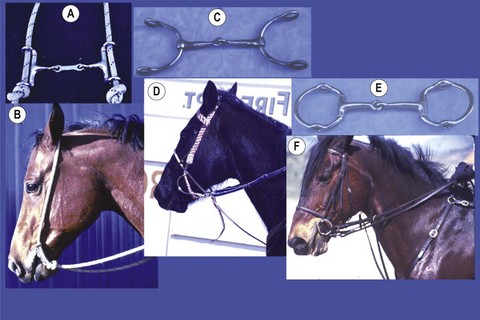
Fig. 3.8 Three types of gag bits. (A, B) Basic gag bit, in this example with a link in the mouthpiece. (C, D) Gag snaffle with half-O-rings. (E, F) Gag with full rings for attachment of snaffle rein.
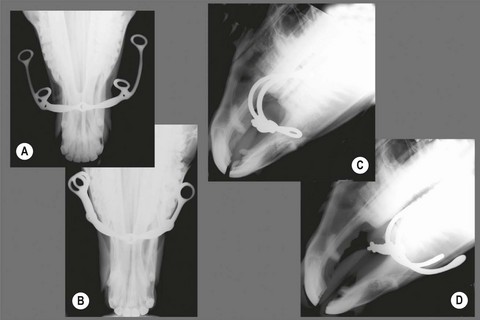
Fig. 3.9 Radiographs of gag bits. (A) Ventrodorsal with no rein pressure. (B) Ventrodorsal under rein pressure. (C) Lateral with no rein pressure. (D) Lateral under rein pressure.
It might be thought that the gag functions to lower the head because tension on the reins places pressure on the poll. But head carriage is more a factor of where the horse finds relief from bit pressure. Since the horse’s mouth is much more sensitive to pressure than his poll, if the gag is used with no auxiliary aids, its net effect is to accentuate the basic head-raising action of a snaffle bit.8 If strong rein pressure is applied to a gag bridle, the bit is pulled relatively far caudally and can severely punish the horse’s tongue, lips and cheeks (Fig. 3.9).
Full bridle
The full bridle or double bridle (Fig. 3.10) has two sets of cheek pieces and two sets of reins. One set is attached to a curb bit; other set is attached to a snaffle bit. The snaffle, which is generally relatively small, is called a bridoon or bradoon and is placed above and behind the curb.22,26
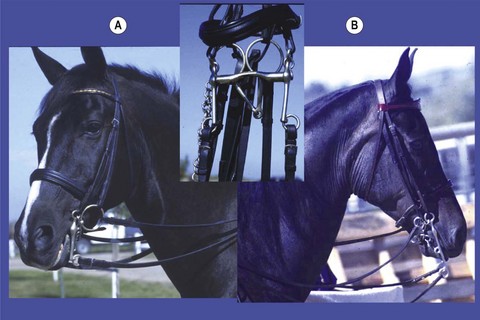
The double bridle with its combination of bits, employing a number of forces to achieve its ends, is an extremely sensitive instrument. When used by a skilled rider on a schooled horse, it can place the head with greater finesse than is possible with any other bridle in current use. But the rider needs a considerable amount of skill for this bridle to be effective and humane.
It is often stated that, with the double bridle, the rider uses the snaffle bit to raise the head and turn the horse and the curb bit to lower the head and stop the horse. When the double bridle is used properly, however, nearly all commands for head position, moving and stopping are given via the snaffle.22 The role of the curb is the basically passive one of promoting poll flexion, collection and balance.8,26 Excessive tension on the curb rein is the most common cause of problems with full bridles.8
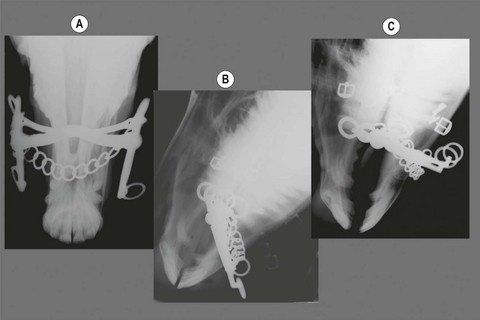
The use of the double bridle when the horse is not sufficiently schooled or the rider is not sufficiently skilled can damage the horse’s psyche as well as his mouth. The double bridle puts a lot of hardware in the horse’s mouth (Fig. 3.11), and the chances of injury are arguably doubled as compared to bridles with a single bit.
Pelhams (Figs 3.12 & 3.13)
A Pelham bit is basically an attempt to gain the advantages of a double bridle with only a single bit in the horse’s mouth. The Pelham bit is really just a curb bit with an extra set of rings at the level of the mouthpiece to which an extra set of reins is attached. Tension on the lower rein gives the effect of a curb bit and tension on the upper rein gives the effect of a snaffle bit.
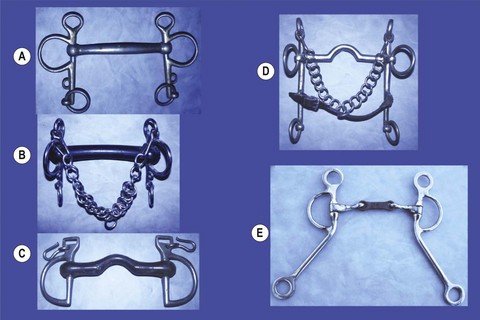
Fig. 3.12 Examples of Pelham bits. (A) Mullen mouthpiece with moderate shanks. (B) Rubber covered mouthpiece with short shanks. (C) Kimberwicke with ported mouthpiece. (D) Long shanked bit with lip strap. (E) Western Pelham with center link, loose cheeks, and long shanks.
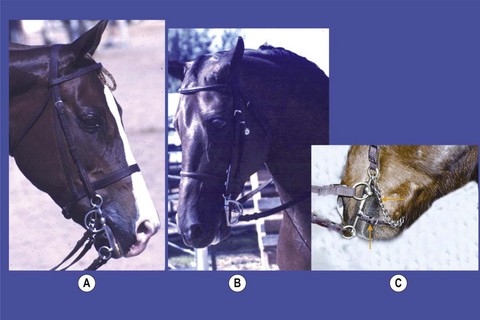
Fig. 3.13 (A) Standard Pelham. (B) Kimberwicke with rein set to lower level in Uxeter cheeks. (C) Proper adjustment of curb chain (upper arrow) and lip strap (lower arrow).
Pelham bits come in a wide variety of forms (Fig. 3.12). The mouthpiece may be straight, curved, jointed, or ported. The shanks may be long or short, fixed or loose. Some have very short shanks and thick rubber mouthpieces and are very mild. Others have ports and long shanks and are more severe. One type, the Kimberwicke (Figs 3.12C & 3.13B), uses only one rein with the hand position, or rein setting, determining whether the bit functions as a snaffle or as a curb.
Critics of Pelhams say that both reins come into play at the same time and confuse a horse. Certainly the Pelham does not work well in a horse with very long narrow jaws or an exceptionally long interdental space. In such a horse, it is essentially impossible simultaneously to have the curb chain in the chin groove and the mouthpiece in its proper position against the lip corners. The curb chain, under such circumstances, tends to pull backwards until it is beneath the branches of the mandible, and pressure on these is quite painful to the horse and may result in severe bruising. The use of a lip strap (Figs 3.12D & 3.13C) can help to counteract this disadvantage.
Despite all of the criticisms, some horses perform better in the Pelham bit than in any other. In the horse with short jaws and a relatively small interdental space, the single mouthpiece of the Pelham may fit better than the double mouthpiece of the full bridle.
Driving bits (Figs 3.14 & 3.15)
In riding horses, we have stressed the importance of ‘getting off of the horse’s mouth.’ In other words, the rider should cue the horse first with his legs and seat and only secondarily via the bit. However, disregarding the relatively minor role of the whip, the driving horse receives non-verbal communication only through the reins (harness horses) or lines (draft horse) and the bit. Communication with the driving horse is further complicated by the fact that, although the distance between the bit and a rider’s hands is seldom more than 30 inches, the distance between the bits of a horse or a pair of horses in harness and a driver’s hands is approximately 12 feet.1,27 The remoteness of contact is increased to 24 feet or more when horses are driven in tandems or larger teams.1,3,22,27,28
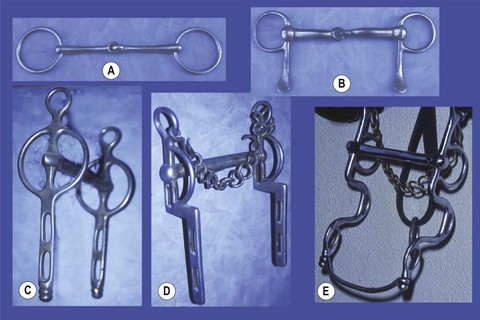
Fig. 3.14 Driving bits. (A) O ring snaffle. (B) Half cheek snaffle. (C) Liverpool. (D) Ashleigh Elbow. (E) Buxton.
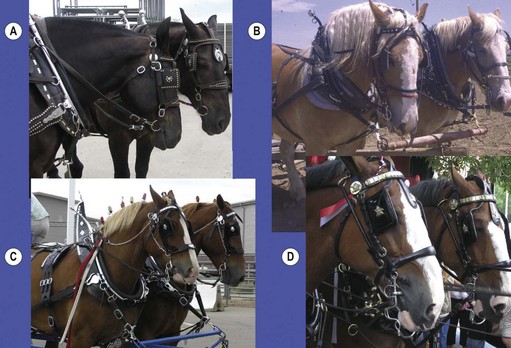
Fig. 3.15 Teams with common driving bits (A) O-ring Snaffle. (B) Liverpool: the line on the horse on the left is attached to the snaffle ring. The line on the horse on the right is attached to the lowest curb ring for greater control. (C) Ashleigh Elbow. (D) Buxton.
Driving bits for racing trotters and pacers are essentially always snaffle bits with solid or, more commonly, jointed mouthpieces. Such bits are often used on other types of driving horses as well. Driving snaffles often have half cheeks to provide extra lateral control.1
The Liverpool, Ashleigh Elbow, and Buxton (Figs 3.14 & 3.15) are curb bits commonly used for driving. The mouthpieces of these bits are most commonly straight with a smooth and a corrugated side. However, these bits are also available with a variety of ported and jointed mouthpieces. The reins are attached to rings at the level of the mouthpiece or to one of the two or three slots which are progressively lower in the shanks – the lower the attachment, the more severe the curb action. With the reins at the top position (i.e., through the ring at the level of the mouthpiece), the curb chain does not operate and the effect is that of a plain bar (unjointed) snaffle.1 All three bits commonly have swiveling (loose) cheeks that can be adjusted so that either the smooth (Fig. 3.14E) or the corrugated side (Fig. 3.14D) of the straight bar mouthpiece is in contact with the horse’s tongue and bars.1,24
The Liverpool bit has cheeks that form complete rings around the ends of its mouthpiece with straight flat bars projecting below them (Figs 3.14C & 3.15B). Because it is symmetrical, the cheeks of a Liverpool bit need not be loose to allow the use of either the smooth or corrugated side of the mouthpiece. It is probably the most widely used driving bit.3
The shanks of the Ashleigh Elbow bit (sometimes referred to as the military bit) extend backward at right angles to the cheeks before extending straight vertically (Figs 3.14D & 3.15C).25 This rearward placement of the shanks prevents a horse from seizing them with his lips. Perhaps more importantly, the angle of the shanks alters the balance of the bit making the elbow bit more forgiving, i.e., requiring more pull on the reins to exert pressure in the mouth and releasing pressure more quickly when the reins are slackened, than the straight-shanked Liverpool bit.1
The Buxton bit (Figs 3.14E and 3.15D), with its S-shaped shanks, prevents a horse from seizing the shanks, but its balance is closer to that of the Liverpool bit than to that of the Ashleigh Elbow bit. The Buxton is a large, ornate bit that is used for most ceremonial and formal occasions throughout the world.1,3,25 The horses in many of the fancy, multiple horse hitches used for advertising or for parades are driven in Buxton bits.
Overchecks and sidechecks (Figs 3.16–3.19)
For most driving horses, a single overcheck rein or two sidecheck reins are added to the bridle to prevent the horse from lowering his head. The overcheck rein runs from the back pad of the harness up between the horse’s ears, passes down the front of the horse’s face and divides into two straps which fasten to either side of a separate overcheck bit that presses upwards in the horse’s mouth (Fig. 3.17). Less commonly, the straps attach directly to the driving bit or to a chin strap.1
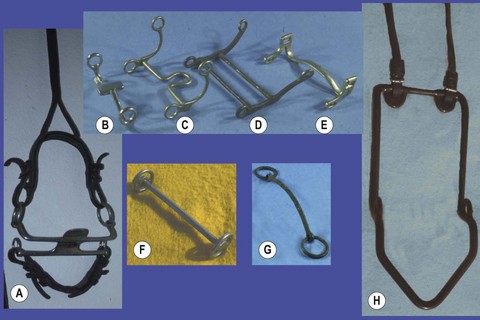
Fig. 3.16 Overcheck bits. (A) McKerron with check rein and nose strap. (B) Burch. (C) Crit Davis. (D) Crabb. (E) Hutton. (F) Speedway. (G) Plain. (H) O’Mara leverage.
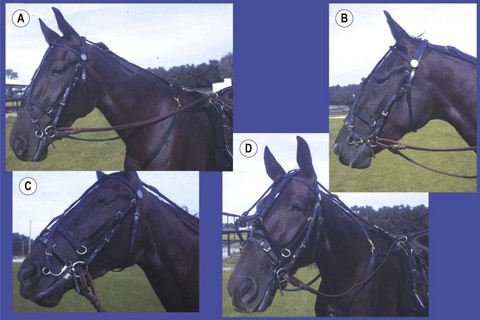
Fig. 3.17 Four overcheck systems used on racing Standardbreds. (A) Plain overcheck bit. (B) McKerron overcheck bit. (C) Crit Davis overcheck bit. (D) O’Mara leverage overcheck. All four driving bits are half-cheek snaffles.
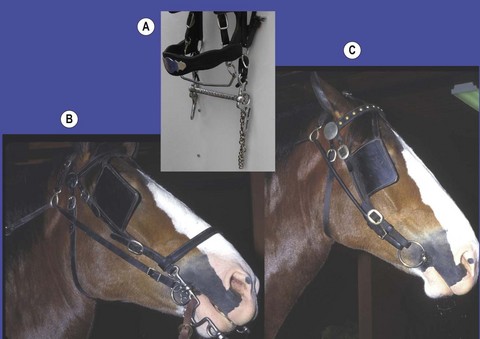
Fig. 3.18 (A) Driving bridle with Ashleigh Elbow and sidecheck bits. (B) Horse bridled with Buxton and sidecheck bits. (C) Sidecheck rein attached to O ring snaffle driving bit.
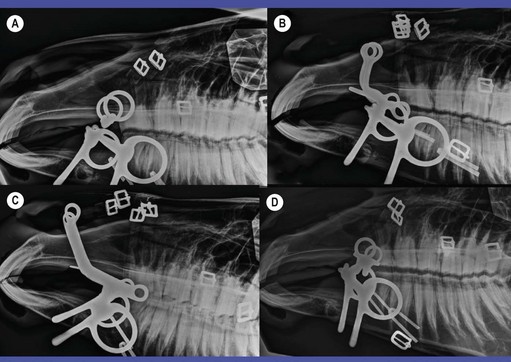
Fig. 3.19 Lateral radiographs of overcheck bits in horses’ mouths. (A) Plain overcheck bit. (B) Crit Davis overcheck bit. (C) Crabb overcheck bit. (D) Burch overcheck bit. All four driving bits are half-cheek snaffles.
The sidecheck is a variation on the overcheck in which two check reins, rather than joining and running over the top of the horse’s head, run through loops on either side of the bridle and back along the sides of his neck to come together at his withers (Fig. 3.18). The practice of some drivers of attaching check reins directly to a leverage driving bit is not recommended, because such an arrangement pulls the bit uncomfortably up into the corners of the horse’s mouth and interferes with curb action and driver contact.1,3
Most draft horse bridles are set up with either an overcheck or a sidecheck to prevent the horse from lowering his head to graze or rub and to keep his head in the optimal position for pulling. A check rein is nearly always required for light horses shown in pleasure driving classes or in fine harness classes. Harness racing horses wear overchecks because their heads must be held in an exact position to keep them balanced and on their gait.1,23
The plain overcheck bit (Figs 3.16G, 3.17A & 3.19A) is a very small straight bar bit. However, there are many other types, varying widely in severity (Fig. 3.16). Some racing overchecks, like the McKerron (Figs 3.16A & 3.17B), Crit Davis (Figs 3.16C, 3.17C & 3.19B), and Crabb (Figs 3.16D & 3.19C), listed in increasing order of severity, are used in combination with nose straps to prevent horses from leaning into their check reins.1,29 Potentially even more severe is the Burch overcheck (Figs 3.16B & 3.19D), which is shaped so as to press directly into the hard palate.
The cumbersome appearing, but reasonably humane and effective, Raymond and O’Mara (the so-called leverage overchecks) involve no bit at all. (Figs 3.16H & 3.17D) When a horse leans into a leverage overcheck, a strap over his face presses down onto his nose and the U- or V-shaped lower portion of the overcheck lifts up on his chin.1,29
The combination of forces applied by the driving and check reins can place marked stress on a horse’s mouth, and one must be aware of the type of overcheck used when caring for a horse’s teeth and mouth. For example, the hard palate should be examined carefully for injury in a harness-racing horse who performs poorly when checked with a McKerron, Hutton, Burch, Crit Davis, or Crabb bit. If the palate is sore, one should consider recommending a change to a chin chain or leverage overcheck.1
Removal of wolf teeth, careful floating and rounding of the upper premolars and removing sharp edges from upper canine teeth are of special importance whenever overchecks are used.1,30 The upper canines are placed more caudally than the lower canines thus providing less space for the overcheck bit than for the driving bit. The overcheck bit may be forced backwards, especially if the horse’s head is checked very high, pinching the gums against the teeth. Even leverage overchecks can force a horse’s cheeks against upper points or caps.
Team driving
The previously mentioned remoteness of control in driving horses is compounded in the case of a pair or larger team, in which each horse is controlled by a draft line (rein) and a coupling or stub line1,3,22,27,28 (Fig. 3.20). The draft and coupling lines are connected so that only one left line and one right line for each pair of horses finally reaches the driver’s hand.1,3,22 In a team of two horses the draft line of each horse extends from the driver’s hand to the outside ring of the horse’s bit. The coupling line of each horse is attached to his draft line as it passes over the horse’s back, passes through a ring at his withers and crosses over to the inside ring of the bit of the opposite horse3,27,28 (Fig. 3.20). Thus, when the left line is pulled, both horses turn left, and when the right line is pulled, both horses turn right. This provision is a practical necessity to make accurate line handling possible, but it does not allow constant even contact to be maintained with each horse’s mouth.1,3
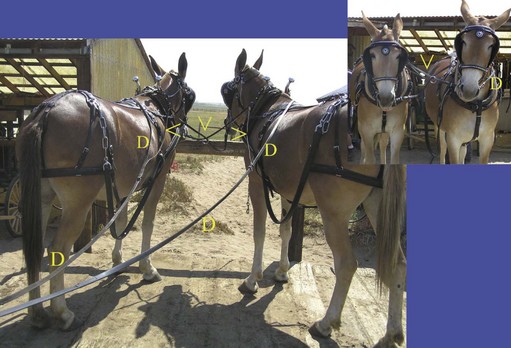
Fig. 3.20 A mule team prior to hitching to show the coupling lines (arrows) and driving lines (D) from the front and rear. The coupling lines attach to the inside rings of the bits, cross each other, pass through rings on the hamess of the opposite horse’s collar and buckle into the driving lines (D). When the team is hitched and traveling straight ahead, the coupling and driving lines join over the mules’ backs.
The exact adjustment of the coupling lines, which may be buckled at varying distances along the draft or outside line, is a critical factor in team driving in assuring that both horses are moving with their heads held straight to the front.3,28 The coupling lines must both be adjusted at the same time, because when only one line is adjusted, the other will pull one horse’s head to one side or the other.22,28 Moving coupling lines further forward on the draft line spreads the team apart, and moving the coupling lines back brings the team closer together.28
Proper alignment of the horses in a team is critical for correct bit function. If one horse is ahead of the other, or if the horses are too far apart or too close together, the bit will be off-center in one or both horses’ mouths.28 Sores at the corners of the lips of one or both horses may be a clue that the alignment of the horses is improper.1 Fortunately, to prevent the chafing or injury that would otherwise occur, horses tend to place their heads so as to center the bits in their mouths.1,28 However, this compensation results in one or both horses’ heads being turned to one side, making straight traveling and turning difficult.28
If one horse is ahead of the other and thus pulling more than his share of the load, his bit should be made more severe, while that of his partner should be made less severe (Fig. 3.15B).1,28 The different slots for attachment of the lines to Liverpool, Ashleigh Elbow, and Buxton bits are ideal for the quick changes in bit pressure that sometimes become necessary in the middle of an event.
Fitting the bit
The variation in size, shape, and degree of sensitivity of horses’ mouths should be considered when selecting and fitting bits and bridles.9,17,18 The width of the mouthpiece should accommodate the width of the mouth. If the mouthpiece is too short, it will pinch the corners of the lips against the cheek teeth. Too long, and the bit can shift sideways, sawing on the lips, tongue and bars. An oversized mouthpiece also puts the port or joint out of position and makes the bit ineffective and possibly painful. Ideally the mouthpiece should not project more than  inch or less than
  inch beyond the corners of the lips on either side.8
The position where the bit fits in the bar space is also important. However, this adjustment varies from horse to horse and bit to bit. A popular rule-of-thumb for adjusting snaffles has been to adjust the bit so that the commissures of the horse’s lips are pulled into one or two wrinkles (Fig. 3.21A).The problem with such a fit is that releasing the pressure on the reins gives the horse no relief at the corners of his mouth.6,8,9 A better method is to first hang the bit relatively loosely until the horse learns to pick it up and carry it and then adjust the headstall to position the bit where the horse has determined it is most comfortable (Fig. 3.21B). A driving horse’s bit should rest squarely against the corners of the mouth without wrinkling them.1
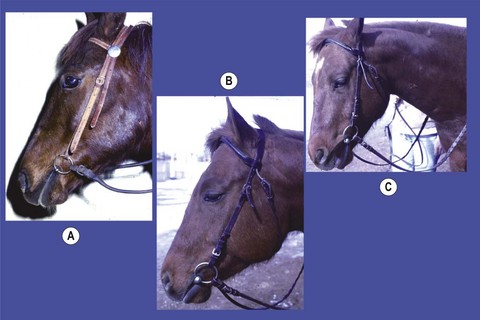
Fig. 3.21 (A) Bridles are often adjusted so that the bit causes a wrinkle at the commissures of the lips. (B) Bridle adjusted so that bit hangs loosely. (C) Bridle adjusted too tight.
A horse with a short or shallow mouth (from lips to corners) carries the bit forward in his mouth where his tongue rides highest. A horse with a deep mouth holds the bit farther back in his mouth where his tongue sits lower in his jaw space and his palate is more concave.9 Consequently, there is less space between the tongue and hard palate in the shallow-mouthed horse and, everything else being equal, he requires a bit with a thinner mouthpiece and a port providing more tongue relief than the bit required by the deeper-mouthed horse.
An older horse may have less space for a bit in his mouth. As a horse ages, his incisors slope further forward while the cheek teeth wear down, causing the palate to sink closer to the tongue. A bit that was comfortable for a horse when he was 5 may no longer be comfortable when he is 20.
One must consider more than the external dimensions of a horse’s head and his age in choosing an appropriate bit. The size and shape of a horse’s oral cavity often correlate poorly with the size and shape of its head, its age or its sex.17 In selecting and properly fitting a bit, there is no substitute for careful manual and digital examination of a horse’s mouth. Periodic reexaminations are indicated because wearing of the teeth, or even dentistry, can change the shape of the oral cavity.17
Bitless bridles
Some horses that don’t respond well to a bit perform quite well with bitless bridles. Bitless bridles can be especially useful in preventing mouth injuries caused by the overzealous hands of a beginning rider or in allowing a mouth injury to heal.13,31
When choosing bitless headgear, horse owners should consider the same factors that they would when choosing any other bridle. Otherwise, they risk dulling the horse’s sensitivity and responsiveness to rein signals.13
Traditional hackamore (Fig. 3.22A)
The hackamore provides a means of promoting poll flexion, collection, and balance along with optimal stopping power and directional control while staying out of the horse’s mouth. It is used with a light bumping action, initiated by gently tugging on one rein at a time. Alternating pulls and releases can be used to ask the horse to flex at the poll and stop.32
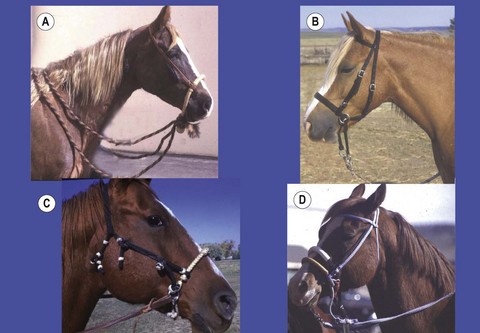
Fig. 3.22 Bitless bridles. (A) Traditional bosal hackamore. (B) Cross-under bitless bridle. (C) Side pull. (D) Mechanical hackamore.
The heart of the hackamore is the bosal, a braided rawhide or leather noseband that is fashioned around a rawhide core. An 18- to 22-foot hair rope, the mecate, is wrapped above the heel knot of the bosal to form a continuous rein and lead rope.9 Bosals vary greatly in diameter, with the appropriate size depending upon the horse’s sensitivity and stage of training. Generally one moves from thicker, heavier bosals to thinner, lighter ones as the hackamore horse progresses.31
The bosal should rest on the bridge of the nose, or just slightly above, where it is supported by the nasal bones. When placed too low, it exerts excessive pressure on the horse’s nasal cartilages and interferes with his breathing.
Obviously, a hackamore does not damage a horse’s tongue and bars, but the bosal contacts some very sensitive points on his face. Rein pressure presses the bosal into the top of the face and into contact with the cheeks and lower jaw all at the same time. Heavy hands on the reins or an ill-fitting bosal can abrade the horse’s nose and jaw and press his cheeks against the upper premolars.
Mechanical hackamore (Fig. 3.22D)
While mechanical hackamores are indeed bitless bridles, they function more like curb bits than like true hackamores.9,31 Mechanical hackamores have metal shanks that attach to a noseband and curb chain. While there is no mouthpiece, the shanks amplify force to the nose, chin and poll in the same way that a leverage bit works on the mouth, chin and poll. Because of the wide variety of mechanical hackamores, it is possible to vary the severity as required.
Other bitless bridles
The Side Pull (Fig. 3.22C) is little more than a hybrid halter.9 Rein rings are placed on each side of the noseband in line with the commisures of the lips. A chin strap beneath the rein rings allows the noseband to be snugged into position. The side pull promotes lateral control with pressure on the reins leading the horse’s nose in the desired direction.9
The Cross Under Bitless Bridle (Fig. 3.22B) distributes pressure across the poll, behind the ears, down the side of the face, behind the chin and across the nose.33 The bridle consists of two loops, one located over the poll and the other located over the nose, with both crossing under the horse’s chin. The reins run from the rider’s hands through two rings on either side of a noseband and then cross beneath the horse’s jaw and loop over the poll. With this figure-eight configuration, simultaneous pressure can be applied to the poll, nose, chin, and cheeks. Pressure on one rein pushes the horse’s head in the desired direction rather than pulling on its mouth with a bit.31,34
The side pull and the cross-under are gentle bridles that minimize the stress on a horse’s mouth and work exceptionally well on some horses.
Accessories
Some bitting problems can be alleviated and a horse’s performance improved by adding bitting accessories, such as nosebands and martingales. We must be familiar with the functions of such accessories in caring for horses’ mouths because they alter the function of, or the direction of pull on, the bit.
Nosebands
The simplest noseband, the cavesson, functions merely to stabilize the bridle (Figs 3.10A &B) or as a point of attachment for a martingale (Fig. 3.24A). Other types of nosebands are used to aid or modify the action of the bit.
Drop, flash, and figure-8 nosebands (Figs 3.23A, 3.23B and 3.23C) are used to hold the bit in the proper position and to keep horses from gaping their mouths. The top of the drop noseband is fitted just at the lower end of the nasal bones while the lower portion passes below the bit and lies in the chin groove. A drop noseband is fairly restrictive and can cause problems if not properly adjusted.35 If it is too long on top and too short below, it will hang too close to the nostrils, interfering with breathing, and the bottom will press the bit into the corners of the lips and hold the mouth too tightly closed.
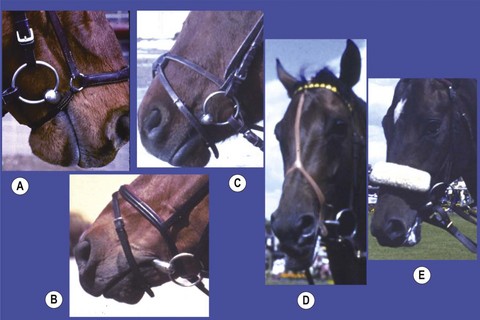
The flash noseband attaches to the center of a simple cavesson above the nose. The lower end passes below the bit and lies in the chin groove. The figure-8 or grackle noseband has a top strap that fastens above the bit and a lower strap that fastens under the bit and lies in the chin groove. The two straps intersect in the middle of the face at about the level where a cavesson would be located. Both the flash and the figure-8 nosebands have actions similar to the drop noseband but are less severe and are not as likely to interfere with breathing.31
The so-called ‘cheeker’ (Fig. 3.23D) is not really a noseband but rather is a rubber strap that runs from the crownpiece of the bridle down the middle of the horse’s face where it separates to attach on either side of a snaffle bit. Like the drop, flash, and figure-8 nosebands, the cheeker holds the bit up in the horse’s mouth.31
Sheepskin-covered cavessons or shadow rolls (Fig. 3.23E) are used to prevent a horse from seeing the ground in front of him, and thus to prevent his shying at shadows or other potentially frightening sights. Cheekers and shadow rolls are used mainly on racehorses.
Martingales
There are two basic kinds of martingales: standing (known in western circles as tie-downs) and running (Fig. 3.24). Both types of martingales promote balance and the proper action of a bit by discouraging, or physically preventing, the horse from raising his head too high or extending his nose too far.9,31 Both types begin with a strap running from the saddle girth up the front of the horse’s chest. The standing martingale, which exerts its pressure on the horse’s nose, continues as a single strap that attaches to the bottom of a noseband. The running martingale, which exerts its pressure on the bit, forks into two straps with rings at their upper ends through which the reins run.
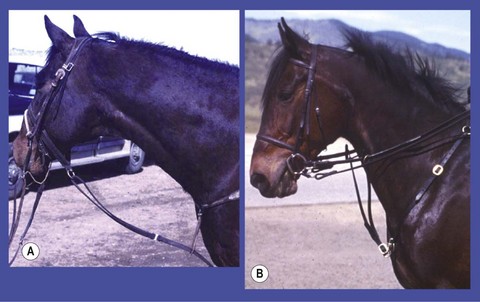
A martingale should not be adjusted so tightly as to pull the horse’s head down into an unnatural or uncomfortable position. The martingale should become active only when the horse raises his head, thus preventing him from evading the bit and becoming unbalanced.31
Conclusion
The knowledge of anatomy, physiology, pharmacology and nutrition, even when coupled with high levels of diagnostic, mechanical and surgical skills and the possession of the best equipment available is not always sufficient to provide optimal dental care to horses. One must consider the age, performance discipline, ability, and level of competition of the horse, not to mention the level of skill and the experience of his rider or driver. The more the veterinarian knows about bits, bridles and accessories as they relate to the above factors, the better he can fulfill the needs of his clients and the more rewarding his dentistry practice will be.
1 Bennett DG, Bitting and dentistry for the driving horse. Proceedings of the 53rd Annual Meeting of the American Association of Equine Practitioners, 2007:451–459.
2 Scoggins RD, Bits, bitting and dentistry. Proceedings of the 47th Annual Meeting of the American Association of Equine Practitioners, 2001:138–141.
3 Coombs T. Bits for harness horses. In: McBane S, ed. The horse and the bit. New York: Howell Book House; 1988:127–131.
4 Scrutchfield WL, Wolf teeth: how to safely and effectively extract and is it necessary. Workbook: American Association of Equine Practitioners Focus on Dentistry, 2006:56–60.
5 Dixon PM, Gerard MP. Oral Cavity and Salivary Glands. In: Auer JA, Stick JA. Equine Surgery. 3rd edn. St Louis: Elsevier; 2006:321–351.
6 Bennett DG, Bits and bitting: form and function. Proceedings of the 47th Annual Meeting of the American Association of Equine Practitioners, 2001:130–137.
7 Young JR. The schooling of the horse. Norman, OK: University of Oklahoma Press; 1982. pp 235–263
8 Bennett DG, An overview of bits and bitting. Workbook: American Association of Equine Practitioners Focus on Dentistry, 2006:181–195.
9 Lynch B, Bennett DG. Bits and bridles: power tools for thinking riders. Austin: EquiMedia; 2000.
10 Johnson TJ, Surgical removal of mandibular periostitis (bone spurs) caused by bit damage. Proceedings of the 48th Annual Meeting of the American Association of Equine Practitioners, 2002:458–462.
11 Smith JC. Osteitis and sequestrum formation of the interdental region of the mandible in 11 polo ponies. Vet Rec. 1993;133:188–189.
12 Tremaine WH. Management of Equine Mandibular Injuries. Equine Vet Educ. 1998;10:146–154.
13 Hague BA, Honnas CM. Traumatic dental disease and soft tissue injuries of the oral cavity. Vet Clin North Am. 1998;14:333–347.
14 Van Lancker S, Van Den Broeck W, Simoens P. Incidence and morphology of bone irregularities of the equine interdental spaces (bars of the mouth). Equine Vet Educ. 2007;19:103–106.
15 Dixon PM, Tremaine WH, Pickles K, et al. Equine dental disease Part 3: a long-term study of 400 cases: disorders of wear, traumatic damage and idiopathic fractures, tumors and miscellaneous disorders of the cheek teeth. Equine Vet J. 2007;2:9–18.
16 Jansson N, Hesselholt M, Falmer-Hanson J. Extirpation of a mandibular canine tooth in a horse as a treatment for severe bit-induced trauma to the bar. Equine Veterinary Education. 1980;10:143–145.
17 Engelke E, Gasse H. An anatomical study of the rostral part of the equine oral cavity with respect to position and size of a snaffle bit. Equine Veterinary Education. 2003;15:158–163.
18 Engelke E, Gasse H. Position of different snaffle bits inside the equine oral cavity. Pferdeheilkunde. 2002;18(4):367–376.
19 Easley J. Dental and oral examination. In: Baker GJ, Easley J. Equine dentistry. 2nd edn. London: Elsevier; 2005:151–169.
20 Sutton A. The bridle and the bit. In: The injury-free horse. Newton Abbott: David and Charles; 2001:59–60.
21 Clayton HM, Lee RA. Fluoroscopic study of the position and action of the jointed snaffle bit in the horse’s mouth. Journal of Equine Veterinary Science. 1984;4:193–196.
22 Edwards EH. The complete book of bits and bitting. Newton Abbot: David and Charles; 2000.
23 Riegle G. Training the pacer. In: Greene C, ed. The new care and training of the trotter and pacer. Columbus, OH: U. S. Trotting Association; 1996:337.
24 McBane S. The illustrated guide to horse tack. Newton Abbot: David and Charles; 1992. pp 49–91
25 Malm GA. Bits and bridles, an encyclopedia. Valley Falls: Grasshopper; 1996.
26 Crossley A. The double bridle. In: McBane S, ed. The horse and the bit. New York: Howell; 1988:60–78.
27 Telleen M. The draft horse primer. Emmaus, PA: Rodale Press; 1977. p 256
28 Bowers S, Steward M. Farming with horses. St Paul: MBI; 2006.
29 Haughton T. Choosing the right equipment. In: Greene C, ed. The new care and training of the trotter and pacer. Columbus: U S Trotting Association; 1996:184–214.
30 Caldwell LA, Canine teeth in the equine patient – the guide to eruption, extraction, reduction and other things you need to know. Workbook: American Association of Equine Practitioners Focus on Dentistry, 2006:47–55.
31 Bennett DG, Bitting accessories and bitless bridles. Workbook: American Association of Equine Practitioners Focus on Dentistry, 2006:237–242.
32 Connell E. Hackamore reinsman. Katy, TX: Lennoche; 1952.
33 Cook WR. Pathophysiology of bit control in the horse. J Equine Vet Sci. 1999;19:196–204.
34 Cook R. Tradition and status quo, or science and advance? Vet Times. 2007;37:16–18.
35 Loriston-Clarke J. The Complete Guide to Dressage. Philadelphia: Courage Books; 1987. pp 130–131