CHAPTER 4 The business of equine dentistry
Customers are the most important visitors on our premises. They are not dependent on us. We are dependent on them. They are not an interruption in our work. They are the purpose of it. They are not an outsider in our business. They are part of it. We are not doing them a favor by serving them. They are doing us a favor by giving us an opportunity to do so.
Horse owners expect dental care to be high quality and delivered with expertise. Enthusiasm is a crucial component of high quality veterinary service. Delivering exceptional levels of dental care with enthusiasm creates a positive atmosphere, making a dental procedure a satisfying experience for both the owner and practitioner. The client’s needs are fulfilled, and the client develops trust in the practitioner, which is a cornerstone of a successful dental practice. Enthusiasm is often the key ingredient that separates a successful equine dental practice from a practice that is less successful.
Dentistry has become an important sub-discipline of veterinary practice. In the recent past, equine dentistry was a discipline overlooked by many veterinarians, perhaps because the economic value of the horses used for agricultural work was low. When horses became valued because of emotional attachment or because of their worth as a sport horse, their economic value increased, and dental care became more important to owners. Many of today’s clients compete in various kinds of sporting events for horses, and the horse’s interaction with the bit and bridle is a critical part of the interaction between horse and rider during these events. Clients recognize that equine dentistry is essential in maintaining a good interaction between the horse and bit. When a practice is not willing to provide high-quality equine dental care, clients seek dental care elsewhere. In many parts of the world, horses are still used in agriculture, and for these horses, dental maintenance is vital for their overall health and welfare.
As drugs for sedation, instrument design and dental techniques have improved, the activity in equine dentistry at modern veterinary practices has increased markedly. Dentistry can easily comprise 10–15 % and sometimes up to 30 % of the total workload and revenue produced in a general equine veterinary practice. To perform this much dentistry effectively, a veterinarian must incorporate an appropriate business model into the practice.
Major contributing business factors
Three major factors are required for a business model to function, and a deficit in any of the three decreases the likelihood of success.
• Structures: the availability of necessary physical and human resources.
• Processes: the use of efficient resources.
• Systems: the provision of useful information to management so that business decisions can be made.
Structures
Expertise develops a trusting relationship
Equine dentistry is the one common service that the entire spectrum of equine clients need throughout all four seasons of the year. This type of service, when expertly offered, can become the cornerstone of a stable’s herd health program. If the veterinarian is able to expertly perform an oral examination and provide for the horse’s dental needs efficiently and competently, the owner is satisfied. After a relationship of mutual trust between the veterinarian and client is established, the client is likely to accept the advice of the veterinarian in other matters of health. During these discussions, dental care strategies for various age groups of horses can be outlined, and the importance of dentistry for the performance and long-term well-being of the horses can be illustrated. When the managers or owners realize how important dental care is for their horses, they become ardent supporters of a herd health strategy scheduled around dental appointments.
It is incumbent upon veterinary graduates to receive extra instruction and to develop skills in the practice of equine dentistry to achieve an acceptable level of judgment and competence in this discipline. Dental procedures must be performed in a competent, efficient manner that is safe for the patient, practitioner, and handler. Like surgery, the practice of equine dentistry requires skill, knowledge, and experience.
Advanced educational programs are readily available for veterinarians seeking to improve their knowledge about equine dentistry and their skills in performing dental procedures. Practitioners must continue to educate themselves to stay current in this rapidly developing discipline. Continuing education in dentistry has never been more accessible. Many organizations and institutions provide avenues for equine dental education taught by leaders in the profession. Interested veterinarians can enroll in module courses to learn more about current techniques in diagnosis of dental diseases and treatment of affected horses. In addition, seminars provide a venue for practitioners interested in improving their knowledge about equine dentistry to meet veterinarians providing high quality dental services who are willing to share their knowledge. Applying knowledge obtained by attending courses dealing with equine dentistry promotes business for a practice.
Total practice commitment
A totally committed staff sends a message to clients that equine dentistry is a priority of the practice. ‘Visual effects’ around the office, clinic, or ambulatory vehicle create a distinctive corporate image (Figs 4.1 & 4.2). Dental posters, audiovisual aids, anatomical specimens, and dental logos on clothing, caps, stationery, and pens provide a special image and a positive atmosphere for the practice.
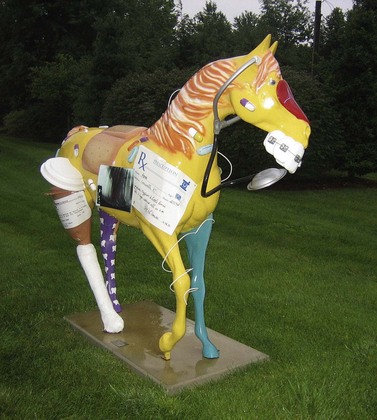
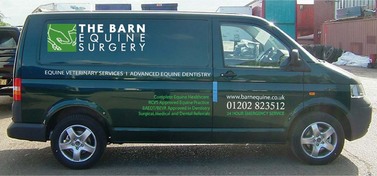
Fig. 4.2 Clinic logos and signage on practice vehicles to promote services offered are ideal methods of advertising. (Contributed by Christopher Pearce MRCVS.)
When equine dentistry becomes a focus for a practice, a dental procedure is no longer just a procedure to ‘fit in’ between vaccinations and the next emergency. To maintain this focus, ample time must be allotted for dental procedures, so that the procedures are performed to a high standard.
The practice team must collectively agree on the level of service to provide and then devise strategies to deliver these levels of service. Dental education and services provided to clients in a pleasant and courteous manner, with enthusiasm and skill, produce referrals given confidently by satisfied clients, and these referrals promote the growth of the practice.
Referral of complex cases
A practice does not have to provide all levels of equine dental care, but members of the practice should have a good knowledge of current standards of dental care. They should be able to accurately diagnose dental problems and if necessary, be willing to refer a horse with a complex dental condition to a more experienced veterinarian. Clients are satisfied if a proper presumptive diagnosis is made and a referral to a veterinarian competent to resolve the condition is provided. They become dissatisfied if they receive an inaccurate diagnosis or feel that ample effort was not provided to resolve the dental condition.
Health management
The health needs of the entire horse should be addressed because comprehensive dental care involves much more than just floating teeth. A dental examination should include a cursory general physical examination before a sedative/analgesic is administered. Queries from the owner about the horse’s nutritional and prophylactic health needs, reproductive health, training strategies, and behavioral problems can be answered during the examination. The ‘value-added’ service builds the owner’s trust and confidence in the veterinarian.
Equipment
When developing a dental specialty within a practice, basic sets of instruments are required to diagnose dental conditions and perform routine dental procedures. Equipment needed to conduct an ambulatory dental practice may differ from that needed in a hospital, and may depend on climatic conditions and the type of infrastructure available at farms and stables. The cost of equipment required to perform basic, good quality dentistry is within the budget of most practices.
As caseload and economic rewards increase, individuals within the practice may develop interests in sub-specialties of dentistry. As individuals develop expertise in advanced dental procedures, investment in more education and additional dental equipment becomes economical. Much of the equipment and instrumentation can be purchased in stages, and selecting equipment to purchase is an important part of business planning. New equipment needed during the growth phase of a dental practice might include exodontic and endodontic instrumentation, restraint devices, imaging modalities, medical record systems, and technical assistance.
Processes
From the client’s perspective, there are four Cs to good veterinary care:
• Client solution: does the service meet the client’s needs?
• Cost: is the economic and emotional justification better than that of other competitors?
• Convenience: is the service easily accessible and convenient?
• Communication: did the veterinarian provide adequate information?
Client awareness (seeing is believing)
In our fast-moving society, giving customers what they expect is no longer enough. To gain an edge on competitors, a practice must help clients learn what they need.1 To do this, a practice should integrate marketing into other activities.
Each veterinarian in the practice can increase the client’s awareness of the importance (i.e., the need) of dental care by incorporating an oral examination into other routine, physical examinations, such as a lameness examination. Incorporating an oral examination into other examinations adds to the client’s knowledge of the status of their horse’s health.
Many clients, including experienced horse owners, have never viewed the inside of a horse’s mouth, and when they can see the dentition, they begin to appreciate the horse’s need for regular dental care. Many horse owners are shocked to see buccal lacerations and large hooks. Seeing is believing, and from that moment on, horse owners understand the importance of dental care.
Cost of service
The value of dental services is determined by the quality of service delivered, the skill of the person delivering the service, the regional cost of living, and business costs. One method of determining a fee schedule for dental services is to consult with local practices to determine what the average charges for the dental services are in the area. Fees for dental procedures can also be compared to fees charged for similar types of veterinary procedures or to fees charged by other equine businesses, such as farrier work. After these guidelines are determined, the practice can calculate expenses required to deliver dental services, and based on these expenses, a fee that produces a suitable profit can be generated.
Convenience
Efficient and convenient delivery of dental services should always be a goal. In some jurisdictions, supervised, licensed, veterinary technicians can assist in providing some aspects of dental care. Using technical personnel to assist with dental procedures, charting medical records, caring for equipment, educating clients, immunizations, and invoicing can greatly increase the efficiency of a practitioner. Clients value a task completed in a timely fashion because it allows them to plan their own day. Clients who have horses that are not easily transported appreciate the convenience of having dental procedures performed on their premises. For others, transporting their horse to a facility that has all the amenities may be more attractive.
Client communication
Mailed notices and electronic mail are important modes of communication to remind clients that their horse is due for physical and dental examinations. Educational brochures for clients can be custom-designed or purchased through veterinary organizations, such as the American Association of Equine Practitioners. Clients appreciate a reminder because scheduling an examination becomes one less thing they have to remember, and the reminder shows that the practice cares about their horse’s well-being. By organizing ‘dental days’ at various venues, a practice can make dental care more economical and convenient for clients. Information notices can be tailored to clients’ needs based on their horse’s age, occupation, or location. Reminders allow a practice to schedule dental procedures months in advance, and this assists management in planning growth of the practice. Scheduling permits work to be distributed evenly throughout the day and among members of the practice.
Absentee clients
The portion of the equine population that is under the care of trainers, and not the owner, presents a special challenge to the veterinarian.2 The owner, trainer, and veterinarian are all members of a business relationship, and good rapport between all members, especially between the veterinarian and the trainer, is fundamental to the success of this relationship. If the owner must receive medical information about his or her horse directly from the veterinarian, the trainer must also receive the same information so that the trainer does not feel threatened.
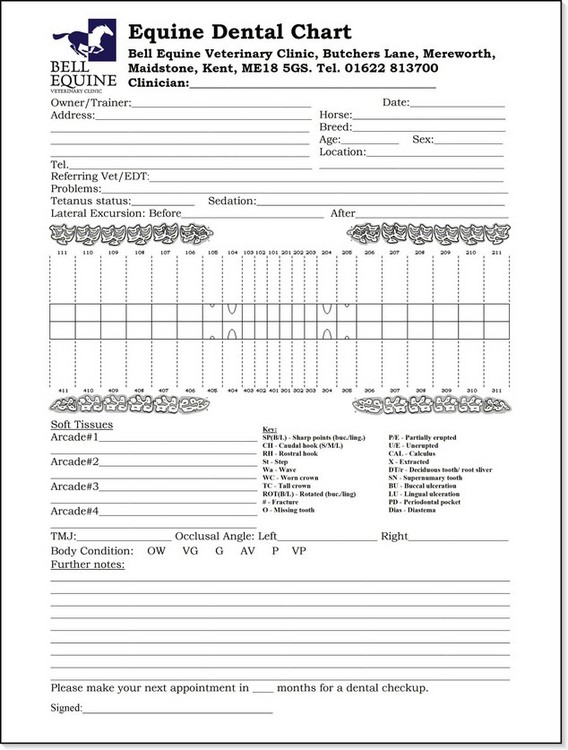
On site, cellular communication with an absent owner is convenient and effective, but the billing statement is the best means of documenting to the owner the health care that his or her horse has received. A billing statement can be used as an opportunity to send the owner a medical record of each horse, along with an additional statement that details the charges for each horse and the total payment that is due. A well-designed billing statement/dental record becomes an advertisement for the practice because it can be used to illustrate the veterinarian’s expertise (Fig. 4.3). Clients appreciate receiving this dental record and share the information contained within it with other horse owners. The dental record should be easy for an owner to understand, it should accurately describe findings of the dental examination, and it should outline procedures done to correct dental abnormalities. The invoice and dental record can be generated at the time of service using a laptop computer, which greatly improves efficiency, and collections, and decreases mistakes in the billing process.
Grouping with scheduled procedures
Opportunities can be found to schedule dental procedures by auditing common veterinary procedures that clients request throughout the year. Procedures such as blood testing for equine infectious anemia, annual vaccinations, insurance examinations, reproductive work, and preparation for competitions, can be scheduled with dental work. All horses involved in competition need regular dental care, and the office staff can use the computer to predict when this regular dental care can be provided to a group of clients.
Systems
Well-organized offices with state-of-the-art information systems report on the resources and processes of the business. The record-keeping system for inventory, invoicing, payroll, medical records, statistics, and research generates reports that allow the managing veterinarian to determine how well the business plan is functioning. Accounting statements from these records also give valuable information that can be used to plan business strategies. Information systems can also identify potential areas for growth in dentistry. Software tools can be used to monitor client and veterinary activity. A high number of dental procedures performed by some members of the practice can be identified as a goal for others in the practice (Table 4.1).
Table 4.1 Number of dental cases that practices treated in the year 2004 (among only those practices who said they provide dental services) (AAEP Poll of 2005 Concerning Dentistry)
| 31 % | More than 200 dental cases |
| 21 % | 101–200 dental cases |
| 21 % | 51–100 dental cases |
| 17 % | 26–50 dental cases |
| 10 % | 1–25 dental cases |
| 1 % | No dental cases |
Numbers of various types of veterinary procedures can also be compared with numbers of dental procedures. For example, horses being tested for equine infectious anemia or immunized so that they can attend an equestrian event are likely to also need dental care (Table 4.2). Many areas of practice activity can be quantified to allow comparisons with the overall amount of dental work performed.
Table 4.2 Practices polled by the authors
| Percentage of dentistry to practice’s total gross income | 7.78 % |
| Percentage of dentistry to equine infectious anemia tests | 81.0 % |
| Percentage of dentistry to influenza and rhinopneumonitis vaccine | 51.0 % |
Often, more dental care could be performed but the practice lacks the personnel to perform it. The information system can predict if hiring a new associate and purchasing new instrumentation to fill the void are economically feasible. Because the cost of basic dental instrumentation is moderate, compared with equipment needed for other subspecialties, deciding whether or not to expand equine dentistry within the practice is usually easy.
Summary
Veterinarians with an interest in equine dentistry have the opportunity to make dentistry a significant part of their practice. The practitioner who is enthusiastic can acquire the requisite knowledge and skills to efficiently and effectively perform dentistry. With the advent of sedative/analgesia agents and motorized instrumentation, equine dental practice is no longer laborious, and anyone who has interest in equine dentistry can include it in his or her practice. Veterinarians who become competent in equine dentistry find it to be one of the most rewarding and interesting aspects of equine veterinary practice.