3 Introduction to pruritus – pathogenesis and evolution of lesions
PRURITUS
Pruritus is a common presentation in small animal practice. A recently published survey (Hill P et al., 2006) showed that it accounts for 30–40% of all small animal dermatological consultations.
Broadly speaking, pruritus is defined as the sensation of itching, which may result in biting, licking, scratching and rubbing of the skin. It is triggered mainly by parasites, allergies and infections, but it can occur with almost any cutaneous disease. The pathophysiology of pruritus is not well understood. It is thought to result from the stimulation of cutaneous neuroreceptors by a range of mediators produced by inflammatory cells and by keratinocytes in the skin.
In many cases of pruritus, the cause is not immediately obvious and establishing the diagnosis is perceived to be a costly and time-consuming process. For this reason symptomatic treatment is often prescribed without first establishing the cause. This approach rarely leads to a cure and can often lead to complications, owner dissatisfaction and ‘vet hopping’. Additionally, and apart from parasitic disease where a cure can usually be achieved, many cases of pruritus are likely to require long-term management, and this lack of a permanent ‘cure’ leads to further owner dissatisfaction. On the other hand, a specific diagnosis allows the clinician to give the owner an accurate prognosis. Furthermore, a detailed discussion of the therapeutic options and any potential adverse effects will help to maximize client compliance, thereby increasing the likelihood of successful long-term management.
The diagnostic process involves thorough history taking, full physical and dermatological examinations, and a series of diagnostic tests and therapeutic trials to rule out the differential diagnoses.
The information gleaned from a detailed and, hopefully, reliable history is of paramount importance when drawing up the list of differential diagnoses. It may help to ask an owner the same question in slightly different ways. Two different answers will make the clinician question the reliability of the history!
The owner should be questioned on the following:
Owners often only associate scratching with pruritus, and it is important to question them regarding rubbing, licking and biting, as well as scratching. All these actions can result in varying degrees of self-induced alopecia, excoriations and in some cases even ulceration. Other lesions commonly seen include papules, pustules, epidermal collarettes, scaling, crusting, hyperpigmentation and lichenification. Some of these lesions may be responsible for the pruritus, while in other cases they are a result of the pruritus. It is often difficult to establish whether the lesions preceded the onset pruritus or not, as unfortunately few owners will have noticed.
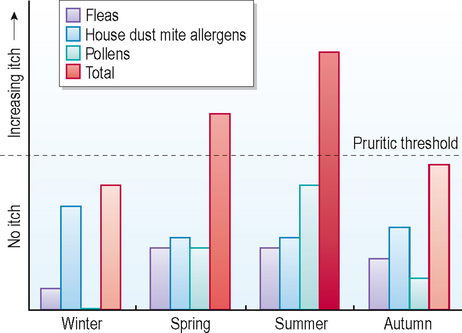
Different individuals show varying degrees of self-trauma associated with pruritus. The individual pruritic threshold and the effects of summation may explain this variation. Recognizing the cause or trigger factors in the chain of events is the key to the successful treatment and/or management of each patient.
PRURITIC THRESHOLD
It is thought that each individual animal only begins to show evidence of pruritus once the sum total of the allergen load passes its pruritic threshold. Each allergen produces a different level of pruritus, which when present at the same time in a pruritic animal will add up, causing the total pruritic stimulus to surpass the threshold. Conversely, if the sum total falls below the threshold, because for example the pollen season is over, the animal will cease to be pruritic (Fig. 3.1).
The aim of each chapter in this section on pruritus is to guide the reader through the approach to a variety of cases where pruritus was the main presenting sign. In each case the aim was to achieve a specific diagnosis with a view to prescribing specific treatments and management options to suit the patient and owner.