Chapter 7 Activity Analysis
Overview
Activity analysis is a process for finding and/or adjusting an occupation to achieve some therapeutic benefit or allow a person to engage in a former or new occupational role. Its aim is to find a fit between the characteristics and needs of a client or client group and an occupation. While there are a number of approaches to activity analysis, basing it on theory both provides a structure for the analysis and brings the explanatory power of theory to help identify activity characteristics and how they influence a client or group.
This chapter presents a theory-driven approach to activity analysis. It begins by identifying key principles underlying activity analysis. Then the chapter presents and discusses four key steps in theory-driven activity analysis. The application of these steps is illustrated through the following case examples.
Selma is an occupational therapist providing service to Elsie a 72-year-old who has osteoarthritis as well as a fracture in her right dominant hand, and is having challenges bathing. Elsie has been referred to occupational therapy. The therapist needs to complete an analysis of the bathing challenges for Elsie in order to support her re-engage with this activity.
Vincent is an occupational therapist providing services to children with special needs in a primary school classroom. He typically works with pupils (students) who have cerebral palsy and are integrated into regular classrooms. A common task Vincent must address is how to enable these pupils to engage in typical classroom activities such as taking notes and completing exams.
Gwen works as an occupational therapist in a residential home. The director of the residential home has approached her and asked if she could initiate some group activities designed to reduce the social isolation observed among many residents with limited cognitive function. Gwen is concerned to identify group activities she can implement that provide opportunities for engaging in meaningful activities, which will not be too difficult for these residents. Additionally, she recognises that since all groups are voluntary, she will need to find activities that will be motivating to entice residents to participate.
Philip is an occupational therapist working in an industrial setting. His responsibilities typically include making recommendations for how clients with a variety of impairments can complete work tasks efficiently and without sustaining further injury.
While each of the practitioners described above face quite different tasks, each will have to engage in a process that is ordinarily referred to in occupational therapy as activity analysis. The aim of this chapter is to provide a practical approach to activity analysis in the context of contemporary practice, which emphasises the importance of theory and evidence.
Overview of activity analysis
Activity analysis is one of the oldest occupational therapy processes. It emerged out of occupational therapists’ need to find and/or adjust an occupation to achieve some therapeutic benefit or allow a person to engage in a former or new occupational role. Basically, the core of all activity analysis is to find a fit between the characteristics and needs of a client or client group and an occupation. The analysis of occupations and their use within therapy are the unique skills of the occupational therapist (Hagedorn 2001). Despite being an essential skill for any occupational therapist, there is not a single definition or set of agreed-upon procedures for activity analysis in the field. In fact, a variety of different discussions can be found on the topic (Fidler and Fidler 1963, Mosey 1986, Lamport et al 2001, Foster and Pratt 2002, Creek 2002, Crepeau 2003).
Discussions of activity analysis do agree that the core of the analysis involves asking questions about the occupation. These questions are designed to help the practitioner understand what doing the occupation involves and what therapeutic potential the activity might have. The following are examples of the types of questions one might ask about an occupation. Is it a simple or complex occupation? Where does the occupation take place? What are the stages or sequences of the occupation? Does the occupation require more than one performer? Sometimes the questions that are asked are based on the type of client or client group that the therapist has in mind when doing the activity analysis? So, for instance, if the client has an impairment that affects movement, the practitioner may focus on asking questions about the kinds of movements required for doing the occupation.
Some authors offer a structure for doing activity analysis. In some instances these structures try to include all things that need to be considered in order to determine what capacities are needed for doing an occupation. This approach to activity analysis will seek to describe physical, sensory, cognitive, social, emotional and cultural demands of the occupation. Box 7.1 shows an example of such a structured approach to activity analysis.
Box 7.1
Having identified the purpose, sequence, and duration of the performance of the activity and the spaces, tools and materials required. It may be necessary to ask any of the following questions and to identify how, when and where within the activity or tasks any particular skills or changes in demands and requirements are needed.
Physical skills
Position
What is the starting position when carrying out the activity – sitting, standing, lying?
Any changes that occur during the sequence of performance of the activity?
Movements
Which joints are involved and what movements are required?
Which muscle groups are involved at specific stages?
What ranges of specific movements are required at each joint?
Is the action unilateral or bilateral?
Is the movement required: active, static, or passive? Repetitive assisted or resisted? Fast, slow, smooth or irregular?
Strength
Does the activity require a high moderate or low level of muscle strength
Is the effort continuous or intermittent?
Does the activity require high, medium, or low levels of stamina and endurance?
Coordination
Does the activity require gross or fine motor coordination?
Is the coordination unilateral or bilateral?
Where does the coordination take place? – hand/hand, hand/eye, lower limbs?
Does the activity require grip – cylinder, ball, hook, plate, pincer, tripod grip?
What levels of manipulative or dexterous movements are needed?
Sensory & perceptual skills
Does the activity require vision – short and/or long distance, colour recognition?
Auditory – is hearing necessary to identify particular sounds, tones or volume?
Gustatory – does the activity involve the ability to identify or discriminate between tastes?
Olfactory – is the ability to identify or discrimate between smells necessary?
Touch–does the activity require gross or fine sensation?
Is the ability to distinguish shapes, textures or temperatures necessary?
Are stereognosis, proprioceptive or vestibular skills required?
Cognitive skills
Is the level of thinking concrete or abstract?
What level of concentration does the activity require – is it constant or changing?
Is short term, long term or procedural memory required?
Are organisational skills needed – logical thinking, planning, decision making, problem solving?
Is specific level of numeracy or literacy required?
Does the activity involve time recognition and time management skills?
What levels of responsibility and control does the activity involve?
Are there any opportunities for use of imagination, creativity or improvisation?
Social interaction skills
Is the activity carried out with others?
Is the interaction formal or informal, cooperative, competitive, in parallel or compliant?
What forms of communication are involved?: receptive (listening and interpreting) expressive (verbal, written, technological), non verbal, touch?
Does the activity involve attention to others through debate or negotiation?
Emotional skills
Does the activity require insight or ability for else expression?
Are attitudes and values inherent in the activity?
Is the activity likely to demand conflict, handling feelings, testing reality, or role identity?
Does the activity require patience managing impulses or self control?
More recently, authors have advocated using occupational theories as a framework for activity analysis (Katz 1985, Foster and Pratt 2002, Crepeau 2003). Crepeau (2003) outlines theory-focused activity analysis. This approach to activity analysis examines the properties of an activity from the perspective of a particular practice theory. She notes that this approach is most appropriate when analysing an occupation in terms of its appropriateness for a particular client or a particular group of clients who share a common impairment or challenge.
This chapter takes the position that activity analysis should always be theory driven. An analysis that is based on theory provides the additional benefits of the explanatory power of theory. Using an occupational therapy theory as the structure for activity analysis serves not only to provide a structure or a framework for the analysis but also an explanation of how the elements identified operate together to support or prevent a person engaging with occupation. Traditional structured approaches to activity analysis that provides ‘lists’ of issues to consider (or lists of questions) offer the first part of what a theory offers (i.e., a structure) but they cannot provide the explanation that enriches the activity analysis making it more comprehensive.
Towards a definition of theory-driven activity analysis
Before discussing the process of theory-driven activity analysis, some key principles that should guide the process are outlined.
Principle 1: Theory-driven activity analysis should reflect the occupation-centred approach that characterises the field’s contemporary perspective
Contemporary occupational therapy emphasises that practice should be occupation-focused (Clark 1993, Trombly 1993, 1995, Polatajko 1994, Fisher 1998, Wood 1998, Christiansen 1999). Along with this is the theme that, while underlying performance components are recognised as necessary to occupational performance, they must always be viewed in the larger context of the client’s occupational life. This top-down approach (Trombly 1993) means that thinking in occupational therapy always begins with asking what a client wants and needs to do in their occupational lives and then proceeds to consideration of personal and environmental barriers and supports to performance.
Principle 2: Theory-driven activity analysis should be part of the therapeutic reasoning process whereby practitioners plan a course of action for a particular client or a group of clients
Analysis is most useful when it is employed as a step in the therapeutic reasoning that guides practice with a given client or client group. As noted at the beginning of this chapter, analysis is undertaken to make specific decisions about selecting and adapting an occupation in order to meet the needs of a specific client or group. Thus, the analysis occurs and relational questions arise about how the characteristics of an occupation compare with the characteristics of a client or group. Analysis, therefore, should always be done to determine how the occupation can be used as part of therapy or modified to allow the clients to engage in occupation part of their overall occupational participation. Analysis is always undertaken with reference to a particular individual or group. To illustrate this point it is helpful to return to the examples with which this chapter began. In these instances analysis would be undertaken to:
Principle 3: Theory driven-activity analysis should be both theoretical and empirical
The most efficient way to do analysis that is theoretical and empirical is to base it on conceptual practice models. Conceptual practice models are bodies of knowledge in occupational therapy that provide explanations of some phenomena of practical concern in the field, while providing a rationale and methods for therapy (Kielhofner 2004). Since conceptual practice models include both theoretical concepts and empirical testing of those concepts and their application in therapy, using them allows a practitioner to be both theoretically and empirically based when doing analysis. Practice-based theories have the added advantage of providing an understanding of how different elements of analysis relate to each other and provides an insight into the change process (Creek 2002).
Each model of practice addresses different phenomena. Most of the traditional models (biomechanical, sensory integration, cognitive disabilities, cognitive-perceptual, motor control) address some aspect of the underlying capacity for performing occupation. In contrast, the model of human occupation (Kielhofner 2007) addresses the motivation for occupation, the lifestyle or pattern of occupation in a person’s life, the environmental context. This model also offers a unique view of skills (Kielhofner 2007) which have been recommended as an important dimension of task/activity analysis (Crepeau 2003, Watson and Wilson 2003).
Let us briefly consider how these principles would frame analysis by returning to one of the examples at the start of this chapter. Consider Vincent who typically works with children who have cerebral palsy in a mainstream school. Vincent will routinely use analysis to determine what gaps exist between the physical, interpersonal, cognitive and socio-cultural demands of the various activities required for being a student and the characteristics of the students he serves. His use of analysis will help him recommend ways that the student can be better integrated into the daily activity stream of a classroom. His analysis will lead him to a series of solutions that enable children to engage in the occupational role of student. In order to undertake analysis Vincent can use the model of human occupation as a broad framework for considering the interpersonal, social and cultural aspects of the analysis as well as the skills involved in classroom activities. He can also employ the motor control model that addresses issues of movement that these children face. To the extent that his clients may have cognitive or sensory problems he might also employ other models that address these concerns as well. Because his analysis is guided by these conceptual practice models, he would go beyond a simple taxonomy of elements to consider and instead, be able to create a more in-depth explanation of the gaps between necessary activities and his pupils’ characteristics which will guide him in seeking ways to close those gaps. Vincent would also have the reassurance that the conceptual practice models that he uses have an identifiable evidence base.
The process of theory-driven activity analysis
This section presents a process of theory-driven activity analysis consisting of four steps. These steps are as follows:
The section below discusses the four steps of analysis in detail. The process of activity analysis will be illustrated with one of the cases presented at the start of this chapter: Selma is a practitioner who is supporting Elsie with bathing challenges.
Step 1. Identify the appropriate practice model(s) to guide the analysis
Before selecting the models one should reflect on the person or group for which the analysis is being done. It is the characteristics of the person or group for which the analysis is being done that should influence the choice of conceptual practice models to be used for the activity analysis.
The conceptual practice model(s) chosen to guide the analysis should reflect:
The model of human occupation (MOHO) provides a comprehensive view of key aspects of occupation and client-centredness (Kielhofner 2007). MOHO also has a substantial evidence base (Kramer and Kielhofner 2007). Moreover, it is designed to be used in combination with models that address performance components and, therefore, easily dovetails with such models.
In addition to MOHO, one should select additional models that address the impairment(s) experienced by the client or client group. If the client has a cognitive impairment, one should choose an appropriate cognitive model, if the client has muscle weakness, one should choose the biomechanical model. If the client has problems controlling motion, one should choose the motor control model. Moreover, if the client has problems with all the above, one should include all the relevant models (see Figure 7.1).
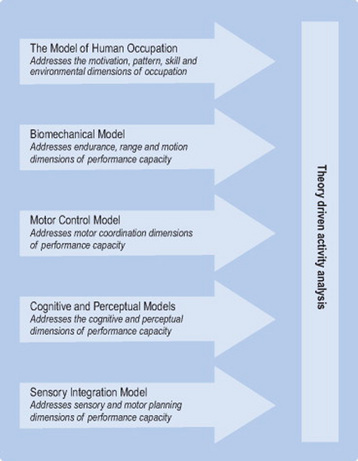
Illustration of step one: selecting models for an analysis of bathing for Elsie
Elsie is a 72-year-old Scottish woman who has osteoarthritis and is having difficulty bathing. As described above, MOHO would be appropriate to understand the broader occupational issues Elsie faces in relation to bathing. MOHO provides an analysis structure for considering such factors as the value of bathing for Elsie, the usual routine within which the bathing occupation happens, the responsibilities Elsie holds that are reliant on bathing, the sense of efficacy Elsie feels towards bathing. MOHO will also call attention to the physical and social environment and how it may impact on Elsie’s bathing. In short, MOHO provides an analysis framework that views bathing in the context of Elsie’s occupational participation. Additionally MOHO will provide a detailed framework for examining what skills Elsie will need to employ in order to complete bathing.
Other models of practice will also be important for this analysis. Because Elsie has osteoarthritis, has fractured her right dominant hand and has orthopaedic limitations, the biomechanical model would provide a structure for considering whether Elsie has the strength and range of motion to get in and out of the bath and whether she has enough endurance to complete bathing safely.
On review of medical notes and feedback from the multidisciplinary team it would be noted that Elsie did not have any cognitive challenges and, therefore, cognitive models are not necessary for this analysis. Similarly because Elsie did not have any sensory or motor control impairments, no additional models were required to provide a comprehensive analysis of her bathing.
Step 2: Select the occupation to be analysed
Selection of the occupation(s) to be analysed should be guided by a top-down approach. That is, the occupation selection should always begin by examining the relevance of the occupation to the volition, habituation and environment of the client or group. If an occupation has no relevance to the person’s/group’s interests, values and sense of competence and if it is not relevant to the client’s/group’s roles or lifestyle, it is hardly worth considering for occupational engagement or participation. Without such relevance, it has no meaning for the client/group. Behind these first considerations, a practitioner will then begin to ask whether the occupation involves at least some skills that the client/group possess and whether the capacities required (e.g., strength, movement, coordination, perception and cognition) overlap with those of the client/group. If not, then the occupation is not a reasonable candidate for the client/group.
An illustration of step 2: Elsie
Bathing has meaning for Elsie and is a part of her longstanding routine. Elsie has high standards of personal hygiene for herself. She previously attended a social club twice a week and this was her only leisure activity. She also reads to local schoolchildren as a volunteer once a week. She has not been doing either occupation because she feels conscious of her body odour. This is causing Elsie to feel isolated and is lowering her mood. Bathing, therefore, is a valued occupation in Elsie’s life and is significantly impacting on her occupational participation. It is, therefore, an appropriate occupation to select for analysis.
Step 3: Generate questions to guide the analysis
Once an occupation is selected for analysis, the practitioner must begin to carefully examine it in light of the client’s characteristics as guided by the model(s) being used for analysis. At this stage the practitioner moves from the more broad kinds of questions shown in Table 7.1 to much more detailed elaborations of those questions in Table 7.2. The aim is to generate a detailed inspection of the occupation and its relationship to the client’s characteristics. Thus, how the analysis is undertaken, depends on the client or group for which it is being done and the needs that are being addressed.
Table 7.1 Examples of broad questions to guide analysis
| MOHO-based questions |
|---|
| What is Elsie’s sense of efficacy with bathing? |
| Does Elsie value bathing? If so, why? |
| Does Elsie find bathing enjoyable? |
| What is Elsie’s routine of bathing? |
| When in the day does Elsie bathe? |
| Does Elsie have full responsibility of bathing? |
| What of Elsie’s responsibilities are dependent on bathing? |
| What physical and/or mental capacities are affecting her bathing? |
| What physical environment does Elsie bathe in? |
| What social supports does Elsie have to support bathing? |
| Biomechanical-based questions |
|---|
| What range of motion does Elsie have at her knee joints? |
| What muscle strength does Elsie have in her limbs? |
| Do Elsie’s physical capacities allow Elsie to transfer in and out of the bath? |
| Does Elsie have reduced strength in her right dominant hand following her fracture? |
| Does Elsie have enough physical endurance to complete the full bathing occupation? |
| Does Elsie have pain anywhere that restricts movement? |
| Does Elsie have enough physical flexibility to be able to reach her toes and her back while bathing? |
| Does Elsie have contractures that may be restricting range of motion or strength? |
Table 7.2 Examples of detailed MOHO questions to guide analysis
| MOTOR SKILLS |
|---|
| ♦ Posture: Can Elsie stabilise and align her body while moving and in relation to bathing objects? |
| Can Elsie steady her body and maintain trunk control and balance while sitting, standing, walking, reaching, or while moving, lifting or pulling objects while bathing? |
| Can Elsie maintain the vertical alignment of the body over the base of support while bathing? |
| Can Elsie place her arms and body in relation to bathing objects in a manner that promotes efficient arm movements. |
| ♦ Mobility: Can Elsie move her entire body or a body part in space when bathing? |
|---|
| Can Elsie ambulate on level surfaces, including turning around and changing direction while bathing? |
| Can Elsie stretch or extend her arm and, when appropriate, her trunk to grasp or place bathing objects that are out of reach. |
| Can Elsie actively flex, rotate, or twist her body in a manner and direction appropriate to bathing? |
| ♦ Coordination: Can Elsie move body parts in relationship to each other and to the bathing environment? |
|---|
| Can Elsie use different parts of her body together to support or stabilise bathing objects during bilateral motor tasks? |
| Can Elsie use dexterous grasp and release, as well as coordinated in-hand manipulation patterns while bathing? |
| Can Elsie use smooth, fluid, continuous, uninterrupted arm and hand movements while bathing? |
| ♦ Strength and Effort: Can Elsie generate muscle force appropriate to actions needed in bathing? |
|---|
| Can Elsie push, shove, pull, or drag bathing objects along a supporting surface or about a weight bearing axis? |
| Can Elsie carry bathing objects while ambulating or moving from one place to another? |
| Can Elsie raise or hoist bathing objects off of a supporting surface? |
| Can Elsie regulate or grade the force, speed, and extent of movements? |
| Can Elsie pinch or grasp in order to securely hold handles or other bathing objects? |
| ♦ Energy: Can Elsie have enough physical exertion and sustained effort over time while bathing? |
|---|
| Can Elsie persist and complete an activity without evidence of fatigue, pausing to rest, or stopping to “catch her breath”? |
| Can Elsie maintain a rate or tempo of performance across an entire bathing occupation? |
| PROCESS DOMAINS AND SKILLS |
|---|
| ♦ Energy: Can Elsie sustain and appropriately allocate mental energy while bathing? |
| Can Elsie maintain a rate or tempo of performance across an entire bathing experience? |
| Can Elsie maintain attention focused on bathing? |
| ♦ Using Knowledge: Can Elsie seek and use knowledge while bathing? |
|---|
| Can Elsie select appropriate tools and materials for bathing? |
| Can Elsie employ tools and materials according to their intended purposes while bathing? |
| Can Elsie support, stabilise, and hold tools and materials in an appropriate manner while bathing? |
| Can Elsie use goal-directed task performance that is focused toward the completion of bathing? |
| Can Elsie seek appropriate verbal/written information by asking questions or reading directions. |
| ♦ Temporal Organisation: Can Elsie initiate, logically order, continue, and complete the steps and action sequences required when bathing? |
|---|
| Can Elsie start or begin doing an action or step without hesitation while bathing? |
| Can Elsie perform an action sequence of a step without unnecessary interruption and as an unbroken, smooth progression? |
| Can Elsie perform steps in an effective or logical order for efficient use of time and energy while bathing? |
| Can Elsie finish or bring to completion single actions or steps without perseveration, inappropriate persistence, or premature cessation while bathing? |
| ♦ Organising Space and Objects: Can Elsie organise bathing space and objects? |
|---|
| Can Elsie look for and locate tools and materials through the process of logical searching while bathing? |
| Can Elsie collect together needed or misplaced bathing tools and materials? |
| Can Elsie logically position or spatially arrange bathing tools and materials in an orderly fashion while bathing? |
| Can Elsie return/put away bathing tools and materials, and restore her immediate space to original condition. |
| Can Elsie modify the movement of the arm, body, or wheelchair to avoid or manoeuvre around existing obstacles that are encountered in the course of moving the arm, body, or wheelchair through space while bathing? |
| ♦ Adaptation: Can Elsie relate to the ability to anticipate, correct for, and benefit by learning from the consequences of errors that arise in bathing? |
|---|
| Can Elsie respond appropriately to nonverbal environmental/perceptual cues that provide feedback regarding bathing progression? |
| Can Elsie modify her action or locate objects within the bathing area in anticipation of or in response to circumstances/problems that might arise in the course of bathing or to avoid undesirable outcomes? |
| Can Elsie change environmental conditions in anticipation of or in response to circumstances/problems that arise in the course of bathing or to avoid undesirable outcomes? |
| Can Elsie anticipate and prevent undesirable circumstances/problems from recurring or persisting while bathing? |
Since activity analysis is done with reference to a particular individual, not all concepts from each model will be necessary to generate necessary questions. Communication and interaction skills questions were not generated since bathing was a solitary activity and process skills questions were not generated because she did not have any cognitive challenges that may impact her processing skills.
Step 4: Identify and test ways occupation(s) can be adapted and/or graded based on identified gaps between the activity and the person
Occupations can be adapted and/or graded, for example:
Since step four involves coming up with possible strategies to address identified gaps between the activity and the person or group, it is important that these strategies be tested to see whether they work.
An illustration of step 4: adapting Elsie’s bathing
Links between the theory base and Elsie’s case example are highlighted in parentheses. Elsie had previously been provided with a bath board and tap spray (MOHO – physical object) in 2003 and had been using this equipment independently until about 4 weeks ago. She reported she is no longer bathing for a variety of reasons including:
Not bathing is affecting other occupations. Her only leisure activity is going to the social club twice a week (MOHO – role) and she reads to local schoolchildren as a volunteer once a week (MOHO – role). She has not been doing either activity in the last 2 weeks because she feels conscious of her body odour. This is causing Elsie to feel isolated (MOHO – disengaged from roles).
The practitioner originally decided on the strategy of using a bath hoist since this was the least costly and involved a kind of adaptation that could be made. In order to assess the suitability of a bath hoist (MOHO – physical object) it was tried out with Elsie. During the assessment Elsie physically struggled to get her legs over the side of the bath tub due to restricted range of motion at her knee joints (biomechanical – range of motion) and required physical assistance (MOHO – social environment). This kind of physical effort against resistance is contraindicated by her high blood pressure and irregular heart beat. Moreover, when she was trying to transfer off the bath hoist her foot caught on the leg of the wash hand basin and she required physical assistance (MOHO – social environment) to move it. Elsie was visibly fearful during the assessment (MOHO – personal causation) which exacerbated her chronic obstructive airways disease (MOHO – performance capacity). In order to manage a bath hoist Elsie would need physical help (MOHO – social environment) due to physical restrictions (biomechanical), anxiety (MOHO – personal causation) and medial conditions (MOHO – performance capacity). Elsie, however, lives alone and does not have physical support available (MOHO – social environment). Thus it was determined that a bath hoist was not an adequate solution for closing the gap between the demands of bathing and Elsie’s characteristics. As a result, the practitioner determined that the only option for bathing would be to have a walk-in shower with non-slip flooring (MOHO – physical environment) which she could manage independently and would allow her to feel she can return to her volunteer responsibility and her social club (MOHO – roles).
Summary
This chapter presented an approach to theory-driven activity analysis. We argue that the demands of an occupation can only be identified in relation to the client or client group who is receiving occupational therapy. We also argue that an analysis that is based on theory provides the additional benefits of the explanatory power of theory to identify the activity characteristics and how they influence a client. That is, theory-driven occupational analysis provides a framework that not only identifies areas of analysis but also provides a theory that supports an explanation of how the identified elements operate together to support or prevent a person engaging in an occupation.
Christiansen C. Defining lives: Occupation as identity: An essay on competence, coherence, and the creation of meaning: Eleanor Clark Slagle Lecture. American Journal of Occupational Therapy. 1999;53:547-558.
Clark FA. Occupational embedded in a real life: Interweaving occupation science and occupational therapy. American Journal of Occupational Therapy. 1993;47:1067-1077.
Crepeau EB. Analyzing occupation and activity: a way of thinking about occupational performance. Crepeau EB, Cohn ES, Boyt Schell BA, editors. Willard and Spackman’s Occupational Therapy, 10th edn, Philadelphia, PA: Lippincott, Williams & Wilkins, 2003.
Creek J3rd. The knowledge base of occupational therapy. In: Creek J, editor. Occupational therapy and mental health. Edinburgh, UK: Churchill Livingstone; 2002:29-49.
Fidler G, Fidler J. Occupational therapy: a communication process in psychiatry. New York: Macmillian, 1963.
Fisher AG. Uniting practice and theory in an occupational framework. American Journal of Occupational Therapy. 1998;54(7):509-521.
Foster M, Pratt J. Activity analysis. In: Turner A, Foster M, Johnston SE, editors. Occupational Therapy and Physical Dysfunction: Principles, Skills and Practice. Edinburgh, UK: Churchill Livingstone; 2002:145-163.
Hagedorn R. Foundations for Practice in Occupational Therapy, 3rd edn. Edinburgh, UK: Churchill Livingstone. 2001.
Katz N, editor. Cognition and occupation across the life span: Models for Interventions in Occupational Therapy, 2nd edn, Bethesda, MD: AOTA Press, 2005.
Kielhofner G. Conceptual Foundations of Occupational Therapy, 3rd edn. Philadelphia, PA: FA Davis. 2004.
Kielhofner G. A Model of Human Occupation: Theory and Application, 4th edn. Baltimore, MD: Lippincott, Williams and Wilkins. 2007.
Kramer J, Kielhofner G. Evidence for practice from the model of human occupation. Kielhofner G, editor. A Model of Human Occupation: Theory and Application, 4th edn, Baltimore, MD: Lippincott, Williams and Wilkins, 2007.
Lamport N, Coffey M, Hersch G. Activity analysis and application building blocks of treatment. Thorofare: SLACK Incorporated, 2001.
Mosey A. Psychosocial Components of Occupational Therapy. New York: Raven Press, 1986.
Polatajko HJ. Dreams, dilemmas, and decisions for occupational therapy practice in a new millennium: A Canadian perspective. American Journal of Occupational therapy. 1994;48(7):590-594.
Trombly C. The issue is – Anticipating the future: Assessment of occupational functioning. American Journal of Occupational Therapy. 1993;47(3):253-257.
Trombly C. Occupation: purposefulness and meaningfulness as therapeutic mechanisms: Eleanor Clark Slagle Lecture. American Journal of Occupational Therapy. 1995;49(10):960-972.
Watson DE, Wilson. Task Analysis: An Individual and Population Approach, 2nd edn. Bethesda, MD: American Occupational Therapy Association. 2003.
Wood W. It is jump time for occupational therapy. American Journal of Occupational Therapy. 1998;52(6):403-411.