Chapter 20 Leadership Skills
Overview
Leadership in occupational therapy requires the same skills as in any other endeavour. In this chapter, important skills for leadership are discussed. The chapter begins with a consideration of how and why people in groups learned to organise to achieve common purposes and how such organisation led to the need for leaders. A definition of leadership is then proposed based on this evolutionary theme, illustrating that the idea of leadership with an orientation toward serving groups (or servant leadership) is centuries old.
The characteristics and skills associated with effective leadership are identified and discussed, based on the idea of increasing circles of influence, beginning with the self. Specific skill requirements associated with ever-widening circles of influence are then identified, including group leadership, communication skills, coaching and mentoring, and building a sense of community based on trust. It is argued that servant leadership is well suited to occupational therapy settings because of the congruence of principles and values between servant leadership and client-centred practice, including collaboration, trust, ethical practices and empathy. Strategic skills necessary for leading larger groups are also identified, including visioning, planning and motivating. Because a vital part of servant leadership involves self-awareness and growth on the part of the leader, the chapter describes strategies for leadership performance appraisal, including the ‘360 degree feedback process’. The chapter concludes with the identification of additional resources for pursuing leadership development drawing from contemporary authorities on leadership in organisations.
Evolutionary and Historical Context
People live and work in groups. Ethnologists contend that these arrangements are key to the evolution of the human species. Humans evolved as social animals who learned to cooperate in order to assure their collective safety, survival and mutual advantage (Dawkins 1989). Robert Trivers proposes that ancestral humans learned cooperative and helping behaviours based on an expectation that kind acts would be reciprocated, leading to future reward (Trivers 1971). The idea of groups of people working together for shared benefit and common purpose is key to the idea of organisation. In fact, an appropriate definition of an organisation is ‘a group of people intentionally organised to accomplish an overall, common goal or set of goals’ (McNamara 2006).
As societies have evolved, groups have become larger and more complex. The division of labour in society, where specific roles are assigned to group members based on tasks necessary to accomplish different purposes, has become commonplace. Specialised groups within larger groups have evolved. Nowadays, these larger groups, or organisations, may have hundreds or thousands of members, with highly sophisticated structures consisting of many smaller workgroups organised within a larger group. The purposes of these organisations may range from serving the needs of communities to producing goods and services on a global scale.
Why Leadership?
Regardless of the size or structure of an organised group, however, each has in common a need for leadership, whether it requires one person or a group of people. Leadership is necessary to determine the common purposes that will be pursued by the group and the means or processes for accomplishing those purposes.
Defining Leadership
Leadership has been defined in many ways. Simply put, leadership is setting directions and influencing the people in a group to work in pursuit of those directions. The overall direction of an organisation may be spelled out in a mission statement. For example, the mission statement of Google ™, Inc., defined by its leadership, is ‘to organise the world’s information and make it universally accessible and useful’ (Google™ 2006). One can easily imagine that each of the smaller workgroups within Google is organised to help achieve that overall purpose. Thus, Google must have workgroups that specialise in collecting information, others that find ways to make it more easy to find, and still others that devote their attention to understanding how and why people seek information in order to make information more useful to them.
While typically, in a large corporation such as Google™, a group of people (the board of directors), determines its direction, there is typically one person charged to assume responsibility for carrying out or executing the actions necessary to attain the mission. This leader, or chief executive officer, is at the top of the leadership hierarchy. As organisations or groups become larger, their hierarchies become more complex. These leadership hierarchies are usually depicted graphically in organisational charts.
Even group-living animals other than humans have a clear hierarchy of leadership. In the animal kingdom, this position in the group is typically determined by strength or power. For example, the pecking order of birds and dominance among primates is established through aggression and demonstrations of strength (Baer and McEachran 1982).
In humans, while the idea of attaining leadership by power, force or family lineage is still alive and well in various parts of the world, in most cases leadership roles in organisations are assumed by people who are appointed or elected based on their leadership capabilities or attributes. The extent to which leadership is effective depends on a complex array of factors, as we shall see in the following section.
What Makes An Effective Leader?
There is a popular cartoon depicting a group of men being whipped by a man expressing a sentiment similar to ‘the floggings will stop when morale improves’. Clearly, we all agree that the use of force or power might be an effective way of motivating people to accomplish a task in the short term, but in the longer term it is unlikely to achieve the desired results. What then, are the characteristics of an effective leader, and how can those attributes and skills be learned or developed?
Because effective leadership typically involves attributes other than size or strength, it is important to consider it along its many other dimensions. As considered below, these dimensions pertain to a leader’s skills, traits and values.
Leadership Skills, Traits and Value Orientations
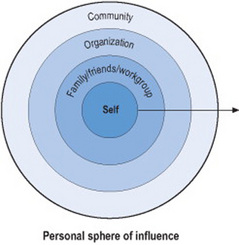
The skills necessary for effective leadership vary by situation. Stephen Covey, in his book Principle Centered Leadership (Covey 1990) notes that leaders have circles of influence. The first circle of influence is the self. Leaders must have the skills necessary to influence individuals immediately around them in positive ways. This is the second circle.
As groups become larger, different skills are needed, since it is difficult to have one-to-one, regular contact with more than a handful of people. Thus, a third important set of skills (and the third circle of influence) pertains to being able to organise people, lead meetings, and communicate effectively with larger groups. Finally, the fourth circle of influence involves much larger numbers of people who may only have indirect or occasional contact with the leader, but are nonetheless influenced by the person’s skills in leading organisations and communities. These skills relate to formulating visions, planning strategically, and making key decisions in complex situations (Figure 20.1).
It is important to appreciate that even though different leadership skills are needed for contexts where larger and more complex organisations of people are involved, the leader of large organisations or communities (or even nations), must nonetheless possess the basic skills necessary for self-leadership and for positively influencing others during one-to-one or personal interactions.
Consider these questions: If a leader is not regarded as trustworthy and competent by those who directly interact with her or him, or if the performance and morale of people within the leader’s immediate workgroup is not effective, how would it be possible for that person to be genuinely effective (or credible?) in leading a large organisation or community?
Level One: Self Leadership
We have noted that effective leadership begins by having sufficient self-leadership skills or personal habits and characteristics, so as to be an effective individual and credible role model. One could call this effective personhood.
The terms authenticity and integrity are often included in the characteristics necessary for becoming an effective individual. An effective individual enjoys the unqualified respect of others. To be respected is to be admired and valued by others. It is important to lead by example.
Consider the attributes and characteristics that contribute to this sort of public image and reputation. Such approval is largely earned through one’s interpersonal relationships. It begins with trust, and through acting in a trustworthy manner. A trustworthy person honours commitments and is dependable in other ways, such as through maintaining confidences. I assert here that the most important characteristic a leader (or effective person) can possess is trustworthiness.
An effective leader is also a responsible individual. One can interpret the word ‘responsible’ as meaning being ‘capable to respond’ or not having one’s actions be at the mercy of others or external events. Thus, the effective leader has a personal orientation that enables the assumption of responsibility (being response-able) for action. When something goes wrong, effective people first ask what they could have done differently to influence a different outcome. Because they are attentive, effective individuals do not act without thought. They are goal-driven when they act, clear about the outcomes they desire to achieve. But their achievement is not pursued in a competitive or selfish manner, and never at the intentional expense of others.
Effective people are also good managers of personal resources. This not only signifies that they are capable of balancing their chequebooks, it also shows that they manage their time and energy in a manner that enables them to be effective and efficient. They keep themselves physically healthy through sound nutrition, exercise, rest and renewal. They attend to their spiritual needs and recognise the importance of balancing their lives to achieve these ends.
An effective leader is also considerate of others. This type of reputation is built over time through a consistent pattern of responsible behaviour. Being considerate means being genuinely concerned with the needs of others and demonstrating such concern with attention and compassion. The attributes of and compassion of an effective leader suggest that one listens carefully, genuinely attempts to see matters from the point of view they present, and recognises and forgives human imperfection.
A positive attitude is also important. No one wants as a leader someone whose emotional demeanour is gloomy and pessimistic. Enthusiasm is contagious, and a positive, optimistic outlook is what everyone expects when they need encouragement.
Closely related to a positive disposition is a good sense of humour. The world is full of strange events and unforeseen circumstances. Things almost never turn out exactly as planned. Therefore, expecting the unexpected and having an attitude of amusement when things go awry helps to keep things in context and reduce the tension often associated with mistakes.
People who are effective also have a personal orientation that truly wants others to succeed and to be able to create their own happiness. Thus, truly effective leaders constantly seek creative solutions that enable everyone to attain their ends.
This idea does not differ significantly from the idea of the benevolent or servant leader. The concept of groups headed by benevolent leaders is well established. Indeed, in the Tao Te Ching, a classical Chinese work of virtues and ways of living and being written by Lao Tzu, who lived 2500 years ago in the 3rd century BC, there is a chapter devoted to the characteristics of effective leaders (Le Guin 1998). This chapter clearly illustrates the principle that effective leaders win the respect of others and are not concerned with gaining recognition for their accomplishments. The personal satisfaction comes when others feel success at having attained an important goal.
Level Two: Influencing Family, Friends and The Immediate Workgroup
The second set of skills pertains to those necessary for influencing those immediately around us. To be maximally effective, leaders must be knowledgeable, socially involved, enthusiastic, upbeat and organise their lives in ways that enable them to be perceived as great role models.
To be an effective leader to those around us means having the ability to teach or coach new skills and abilities. Thus, the effective leader must be knowledgeable about those matters of importance to success in the group and organisation. This means that the leaders must continually study to remain knowledgeable and well-informed.
The effective leader must also be involved socially, so as to be familiar with the issues that are on people’s minds and to be compassionate when personal situations affect individuals with whom they relate on a daily basis. Part of being socially involved is to remain current on the topics of the day, including being informed about local, national and international issues and events.
Successful leaders must be able to organise people, conduct effective meetings and communicate effectively. Effective organisation begins with matching the skills and abilities of people to the tasks needed in a particular workgroup. Occupational therapists are adept at assessing performance skills and selecting challenges that are aligned with skill levels. The effective group manager must likewise fit the task to the appropriate group and assure that the necessary systems are in place to enable success in performance. Of course, a key part of success involves communicating clearly what the tasks or work responsibilities are to those to whom they have been assigned.
Communicating clear expectations is vitally important. The expected outcome must be clearly delineated along with the timeframe for completion and the expected standard of performance. Such standards must be stated in measurable terms. The consequences for failure to perform should also be defined. This does not mean punishment, rather what the consequences to the organisation will be if a particular workgroup fails to meet expectations. Explaining how the work contributes to helping the organisation meet its overall mission is an important connecting link in aligning the workgroup within the organisation. Provided with this information, a workgroup should have a clear sense of what is expected.
Communicating expectations is one part of a larger set of communication skills that an effective leader will need. In general, people in an organisation want to feel connected and informed. Thus, regular communication is a must. The best communication anticipates the information needs of the receiver and provides this in a manner that can be easily understood; i.e., clearly, succinctly and directly. In this technological age, it is too often the case that communication that should be face-to-face or at least synchronous is handled asynchronously by email or voicemail. Direct communication is efficient and effective because it enables quick clarification of uncertainty and ambiguity. The author has learned through many years experience that people can deal with the truth. While it is important to be diplomatic, civil and respectful in all communications, leaders should avoid the temptation to ‘soften’ or avoid unpopular messages. Where ambiguity is present, message recipients will interpret messages according to their own needs. The need for leaders to clarify previous communications may be interpreted as an example of administrative doublespeak.
Finally, the orientation of an effective leader is one of service. One of the principles of servant leadership is having a mission of serving the needs of others (Spears 1996). The mission can only be attained to its highest degree if those in pursuit of it have the encouragement, resources, direction and motivation to work toward it. Another way of imagining success as a leader is to envision the rowers in sculling. A scull is a small, light racing boat that can have as many as eight rowers, each pulling their oars (or “sculls”) together in unison to move the boat down the river. The rowers are perfectly aligned. Not only are they sitting in an aligned position, one behind the other, but team members are also aligned with the group because of their knowledge of the objective, their individual roles and responsibilities, and their motivation and dedication to devote full attention and effort to the task (Figure 20.2). In a racing competition, the scull that achieves the highest degree of alignment or overall cooperation among its team members tends to be most successful, that is, to accomplish the mission of attaining distance, speed and efficiency with the best results.

In a similar manner, the organisation or workgroup that achieves a similar level of alignment, in terms of recruiting the motivation, attention and passion around its mission by its members, is destined to be successful.
Level Three: Organisational Leadership
Third-level leadership competencies add to those previously listed - the ability to effectively organise people, lead meetings and communicate with large groups. The organisation or assignment of people into workgroups is both an art and a science. It is an art in the sense that it assembles workgroups based on the tasks and objectives to be accomplished and an alignment of the people with the training, experience and skills best suited to accomplishing those tasks and objectives. Each workgroup needs an assigned leader, and the successful organisation of workgroups is at least partially dependent on the ‘chemistry’ of the group. Group chemistry refers to the collective personality of a group, and this may be influenced by traditions, shared values, experience and other factors. Thus, one attempts to best match people and their assigned group leaders based on both objective and subjective criteria. Some subjective decision-making is based on intuition, observation and knowledge of personality and individual circumstances.
Another skill necessary with this third level of leadership competence is the ability to effectively lead meetings. While meetings are a ubiquitous, fundamental and necessary part of organisational activities, they vary widely in their value and effectiveness based on the skills of their leaders. No meeting should ever be held without thoughtful preparation. Attention should be given to its objectives, the agenda and the actual conduct of the meeting. Effective meetings start punctually, end punctually, and focus productive discussion on agenda items carefully selected, ordered and communicated in advance. All agenda items should have clear purposes in mind (i.e., information, discussion, action) and to the extent possible, require some advance preparation from participants (Haynes 1997).
The final set of skills at this level of influence pertains to communication with large groups. With larger groups comes the greater probability that one or more persons will misunderstand a message. Therefore, clarity and care must be taken in formulating and delivering messages. One cannot become an effective organisational leader without having the skill to speak convincingly in public arenas and to provide ‘off the cuff’ or extemporaneous presentations when these are required. The effective leader must project confidence, because confidence communicates competence. Of course, being good at speaking is not enough. One must also perform competently in the leadership role using the skills described in this chapter.
Level Four: Influencing Communities; Being a Strategic Leader
As responsibilities of the leader increase, so does complexity. The leader of a large organisation must contend with the political realities of communities, where other organisations may be competing directly or have interests or objectives that conflict or complicate goal completion. Large organisations also have communities within, because as the division of labour becomes more specialised, each division or collection of workgroups takes on its own personality and develops its own culture. The worst possible outcome in such a case is when units of the same organisation begin to compete with each other in a manner that erodes morale or interferes with alignment and efficiency. Recalling the example of sculling, it would not do if members of the same team began to compete with each other to achieve more strokes per minute, since the important objective of synchronised rowing would be lost.
Level four leadership situations require the leader to have a systems perspective, recognising that in systems, each element is connected to and affects the others. Thus, they are interdependent. Interdependence is an important concept in leadership (Senge 1990). No organisation can succeed if it does not recognise the interdependence of its units and if it fails to recognise the important relationships between organisations, neighbourhoods and cultures in society.
This fact calls to mind the important principle of seeking ‘win–win’ solutions (Covey 1989). In this type of solution, the goal is to resolve problems, challenges and conflicts in a manner that best enables all parties of interest to achieve their aims. Too often, in business and in life, situations are viewed as winner takes all competitions. Victories under these conditions are temporary, or obtained at a long-term cost that is not worth what is often a short-term benefit.
Strategic leadership situations also require careful planning, with an eye toward anticipating key trends and envisioning the future. The visioning process is key to strategic planning, since it must anticipate conditions and create bold possibilities that collectively motivate group members to align themselves in support of the imagined future. A good vision serves as the backdrop for strategic planning. Good vision statements are inspiring, succinct and focused (Collins and Porras 1991). The process of imaging the future invites creativity and good leaders have clear visions of what they hope to accomplish. An organisation’s vision should be the overarching element, or mental picture, that provides the motivation for each day. In the absence of a vision, an organisation may be directionless and will certainly not be inspired. Consider these lines from Lewis Carroll:
In the context of a vision, an organisation must carefully plan its activities and the use of its resources. This is where the functions of management come in. Being a leader and being a manager are different organisational roles. A leader focuses on the big picture, determining directions, and motivating people. A manager focuses on the operational requirements for getting the job done, such as scheduling and coordination, maintaining quality, and budgeting. In ideal circumstances, systems are designed to be sustainable. That is, the focus is on the longer-term picture rather than the immediate, so that the organisational climate is conducive to retaining and developing people (has trust), fostering creative problem-solving, and assuring that the organisation has the resources necessary to invest in its future.
Strategic leadership also seeks to gather as much information as possible about how the organisation performs compared to its peers. Organisations can always track their own performance and compare it from year to year, but this information should be supplemented with knowing how an organisation compares to leading organisations of its type. Gathering this type of information is sometimes called benchmarking, a process invented by Rank Xerox. Benchmarking identifies best practices by answering the question: ‘How do the leading organisations do this process?’ In this way, it promotes alternative ways of thinking about process. Two types of benchmarking can be described. In competitive benchmarking, data are collected to analyse how an organisation measures up against the competition. In collaborative benchmarking, organisations or groups cooperate to identify performance ranges and share improvements. Any process within an organisation can be benchmarked and in today’s environment it is critical to be aware of the most efficient and effective ways to get the job done (Hassanali et al 2002). Benchmarking is a type of knowledge management, the modern term used to describe the sharing of information throughout an organisation to improve its performance.
Words often attributed to Goethe, but belonging to the Scottish mountaineer William Hutchinson Murray (Murray 1951: 27) seem to capture the importance of thinking boldly when creating visions: ‘Whatever you can do or dream you can do, begin it. Boldness has genius, power and magic within it.’
Contemporary Views on Servant Leadership
In descriptions of leadership skills at all four levels of leadership that have been described, the notion of servant leadership has been suggested. It has already been noted that this concept dates back thousands of years and yet remains as viable and germane as it did at that time. Modern notions of servant leadership are attributed to an essay by Robert Greenleaf originally published in 1970 (Greenleaf 1991). Servant leadership is collaborative rather than hierarchical, and focuses on the leader as steward of an organisation’s resources, especially its people, while focusing attention on objectives and results. Thus, the service orientation does not come at the expense of organisational success. The principles of trust, integrity and ethical practices are paramount in this approach, which has been adopted by many successful organisations throughout the world. According to Spears, the servant leader as defined by Greenleaf focuses on ten leadership characteristics: listening, empathy, awareness, healing, persuasion, conceptualisation, foresight, stewardship, community and commitment (Greenleaf 1977).
One practice often used in organisations with servant leader philosophies is 360 degree feedback. This is a type of performance appraisal that differs from the traditional top-down evaluation or even from the process where direct reports or subordinates evaluate their leaders. In 360 degree appraisals, these two approaches are combined with appraisals by one’s organisational peers, thus providing a comprehensive view of how the individual is performing. Typically, 360 degree feedback processes focus on identifying areas for leadership training (Lepsinger and Lucia 1997). Hence, it can be viewed as a facet of staff development.
Strategies and Resources for Leadership Development
It is clear that one does not become an effective leader after reading a short chapter on leadership. Effective leadership requires skills that are honed over careers, requiring experience, self-development and feedback. Without objective feedback on how others perceive a leader’s skills in the four levels of leadership, one cannot identify areas to focus on further development.
As suggested by Robert Greenleaf’s characteristics of a servant leader, leadership development requires a commitment to self-development as well as a commitment to others. Developing leadership skills requires a willingness to seek feedback from others, to read widely and participate in formal leadership development programmes, and if possible, to seek a coach who can provide the context in which self-development is able to occur. Effective coaches help leaders through recommending useful self-development strategies and through confidential reflective dialogue that enables the aspiring leader to critically analyse their own leadership behaviours and identify and apply practices that are likely to result in more effective performance.
There are several national and international centres for leadership development of both for-profit and non-profit varieties. In addition, there are many excellent books and articles on effective leadership (see for example Covey 1989, 1992; Greenleaf 1991; and Blanchard et al 2005).
Summary
Occupational therapy settings, whether clinic- or community-based, are often staffed with large numbers of people and exist as part of larger, complex organisations, such as hospitals and systems. As such, they require effective leadership. In this chapter, we have identified four levels of leadership beginning with the self and the skills associated with each level. In describing these skills, references to the concept of the servant leader have been made, and the traditions of servant leadership and client-centred therapy have been compared. Because of their traditions and training, occupational therapists may thus be especially well-positioned to become effective leaders within the confines of therapy units or beyond. Attention to the skills and use of the resources identified in this chapter can be helpful within either context.
Bennis W, Gretchen MS, Cummings TG, editors. The Future of Leadership. San Francisco, CA: Jossey-Bass, 2001.
Blanchard K, Fowler S, Hawkins L. Self-Leadership and the One Minute Manager. New York: HarperCollins Publishers, 2005.
Collins JC, Porras JI. Built to Last: Successful Habits of Visionary Companies. London: Random House, 1998.
Covey SR. Principle-Centered Leadership. New York: Fireside, 1992.
Covey SR, Merrill AR, Merrill RR. First Things First: To Live, to Love, to Learn, to Leave a Legacy. New York: Simon & Schuster, 1994.
dePree M. Leadership Jazz. New York: Currency, 1992.
Farber S. The Radical Leap: A Personal Lesson in Extreme Leadership. Chicago, IL: Dearborn Trade Publishing, 2004.
Gardner JW. On Leadership. New York: The Free Press, 1993.
Gladwell M. The Tipping Point: How Little Things Can Make a Big Difference. New York: Little, Brown and Company, 2002.
Google. Mission Statement of Google, Inc. 2006. http://www.google.com/corporate
Greenleaf RK. Servant Leadership. New York: Paulist Press, 1977.
Joyce W. Transformation Thinking. New York: Berkley Publishing Group, 1995.
Katzenbach JR, Smith DK. The Wisdom of Teams: Creating the High-Performance Organization. New York: HarperBusiness, 1993.
Kegan R, Laskow Lahey L. How the Way We Talk Can Change the Way We Work: Seven Languages for Transformation. San Francisco, CA: Jossey-Bass, 2001.
Senge PM. The Fifth Discipline. New York: Currency Doubleday, 1990.
Baer D, McEachron DL. A review of selected sociobiological principles application to hominid evolution. 1. The development of group social-structure. Journal of Social and Biological Structures. 1982;5(1):69-90.
Carroll L. Alice’s Adventures in Wonderland. The Millennium Fulcrum Edition 3.0 (Project Gutenberg). 1871. Retrieved at http://www.cs.cmu.edu/~rgs/alice-table.html
Collins JC, Porras JI. Organizational vision and visionary organizations. California Management Review. 1991;34(1):30-52.
Covey SR. The Seven Habits of Highly Effective People. In Powerful Lessons in Personal Change. New York: Simon and Schuster; 1989.
Covey SR. Principle Centered Leadership. New York: Simon and Schuster, 1990.
Dawkins R. The Selfish Gene, 2nd edn. Oxford, UK: Oxford University Press. 1989.
Greenleaf RK. The Servant as Leader. Indianapolis, IN: The Robert Greenleaf Center, 1991. originally published in 1970
Hassanali F, Hubert C, Lopez K, et al. Communities of Practice: A Guide for Your Journey to Knowledgement Management Best Practices. Houston, TX: American Productivity and Quality Center, 2002.
Haynes M. Effective Meeting Skills: A Practical Guide for More Productive Meetings. Menlo Park, CA: Crisp Publications Inc., 1997.
Le Guin UK. Lao Tzu: Tao Te Ching, a Book about the Way & the Power of the Way (a translation and commentary). Boston/London: Shambhala, 1998.
Lepsinger R, Lucia AD. The Art and Science of 360 Degree Feedback. New York: John Wiley & Sons, 1997.
McNamara C. Free Management Library. 2006. Located at http://www.managementhelp.org Retrieved August 9, 2006
Murray WH. The Scottish Himalayan Expedition. London: JM Dent, 1951.
Spears L. Reflections on Robert K. Greenleaf and servant-leadership. Leadership & Organization Development Journal. 1996;17(7):33-35.
Trivers RL. The evolution of reciprocal altruism. Quarterly Review of Biology. 1971;46(35):35-57.