7 Kawa model
The Kawa (River in Japanese) model was developed by Michael Iwama, a Japanese-Canadian occupational therapist and social scientist, in conjunction with a group of Japanese occupational therapists. The Kawa model is the most recently developed of those models reviewed in this book (although some models have since been updated). The Kawa model was presented at various conferences in the early 2000s and the main text outlining the model was published in 2006. The model was originally developed in response to a perceived need for an occupational therapy model that was appropriate and useful in Japanese occupational therapy practice contexts. Therefore, the challenge for Western readers when learning about this model is to understand it in the context of the culture within and for which it was developed. The Kawa model uses the metaphor of a river with various elements such as water, rock, driftwood and the river floor and river walls. The potential trap for many readers is to take this metaphor and its elements, and view them from an individualist perspective. Understood in this way, the model could look like any other occupational therapy model that deals with the person, environment and occupation. However, by understanding the assumptions about the nature of self and agency that are embedded within collectivist cultures such as Japanese and various indigenous societies, Western readers are better able to understand the significance of the various elements of this model. To facilitate this process, comments are made throughout the description of the model that emphasize a culturally appropriate understanding of each phenomenon. Reference is also made to the distinction Iwama made between collectivist and existential perspectives. The former is the perspective characterized by many East Asian and indigenous cultures. The latter characterizes the individualist approach common in Western cultures.
Main concepts and definitions of terms
The Kawa model is structured around the metaphor of a river and its elements. It uses the image of the water flowing through a river to represent ‘life energy’ or ‘life flow’. In this model, the purpose of occupational therapy is to facilitate this life flow in the context of a harmonious balance with all aspects of the river. The river itself is used to describe a person’s life history (Figure 7.1) and cross-sections of the river at different times in the person’s history (Figures 7.2 and 7.3) can reveal the elements in the river. These elements are the river floor and walls, rocks, driftwood and the spaces between these. Each element represents an aspect of the person’s life circumstances. The water flows through the channels that are created by the relative positions and sizes of the other elements. Change can occur in the river by alteration of the position, size and shape of the elements to increase or decrease the flow of the water. This potential for change is the basis for occupational therapy intervention.
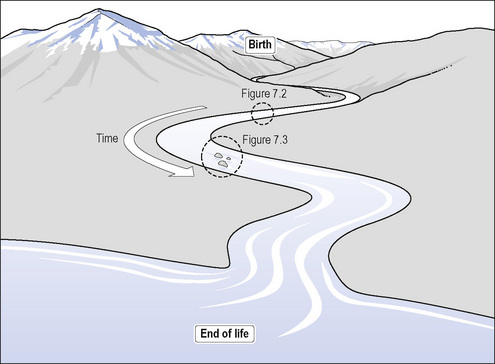
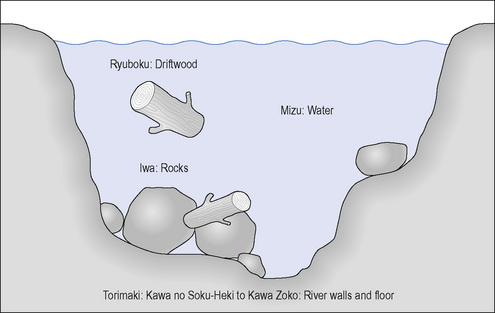
FIG 7.2 Elements of the river.
From Iwama, The Kawa Model (2006) Churchill Livingstone, with permission from Elsevier Ltd.
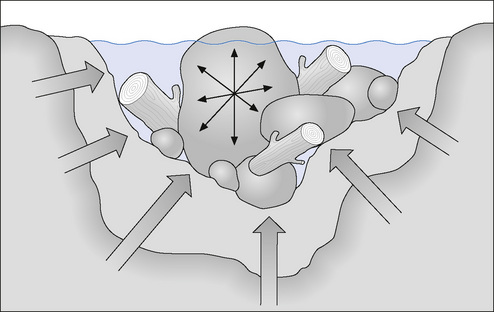
FIG 7.3 Elements constricting water flow.
From Iwama, The Kawa Model (2006) Churchill Livingstone, with permission from Elsevier Ltd.
The river is used to represent the flow or energy of life. It could refer to the life of an individual person, a family or the life of an organization (Iwama, 2006). In the metaphor of a river, the importance of context in shaping the river is emphasized. Rivers start because the moisture from rain and melting snow etcetera flows toward the lowest point of the land. Depending on the surrounding geography, rivers commence with varying amounts and types of water flow. They also flow towards lakes (some of which might be dry in lands such as Australia) and the sea. The course that the river takes depends on the unique combination of the surrounding geography, the strength of the river’s water flow and anything that lies in the river such as rocks and driftwood. Similarly, the flow of the water can vary in different parts of the river as variations occur in the unique combination of the quality of the water flow and other elements of the river.
In the Kawa model, the river is used as a metaphor for the life journey, with birth being represented by the start of the river and end of life being the point at which the river flows into a larger body of water such as the sea. As Iwama (2006) explained, “An optimal state of well-being in one’s life or river, can be metaphorically portrayed by an image of strong, deep, unimpeded flow” (p. 143). As a metaphor for life, the river shows that people’s lives are shaped by the unique contexts into which they are born and live as well as aspects of their own character and skill. Just as the river makes twists and turns, people’s lives change in a variety of ways. Some of these changes can be anticipated, some are unexpected, some are shaped by the surrounding context and others are primarily shaped by the flow of the water, which changes the shape of the river floor and walls. Sometimes the flow of people’s lives is impeded by obstacles and at other times everything seems to flow easily. Some people are born into or live in circumstances that flow easily like a wide river and others’ lives are characterized by obstacles that impact substantially upon their life flow.
While the river as a whole represents a person’s life, a cross-section taken at various points of the river would show different arrangements of the elements of the river. In certain places, the river might be wide and deep and the water flow might be largely unimpeded by obstacles. In other places, it might be narrow and flow over rocks or drop in waterfalls. And still other places, the water flow might become impeded by debris or rock barriers that make the water stagnant. Similarly, the same section of river will look different at different times if the rainfall has varied and the river might run strongly or be almost dried up. In the Kawa model, attention is paid to both the river as a whole and to cross-sections at different places. In the cross-sectional view, the various elements of the river are used as metaphors for different aspects of life.
Elements of the river
The first element in the Kawa model is the water. The element of the river used in the Kawa model to represent life energy or life flow is water, or mizu in Japanese. In many different cultures, water has symbolic meanings that relate to life. It is possible that water is a seemingly universal symbol of life because it is biologically essential for sustaining human life. Iwama (2006) highlighted that, while water is considered to be pure, cleansing and renewing and is often associated with the spirit, culturally specific meanings for water also abound throughout the world. He encouraged people to explore what water symbolizes in the particular cultures with which they might be engaging.
Water has a fluidity that allows it to flow over, around and through a range of different obstacles and channels in its path. As a fluid, it has the capacity to both shape and be shaped by whatever surrounds or contains it. It can take on the shape of a container but it also has the power to shape things that it flows over or through. For example, the erosion that occurs in rocks that are exposed to water attests to its power to shape its surroundings. As Iwama (2006) stated, “Just as people’s lives are bounded and shaped by their surroundings, people and circumstances, the water flowing as a river touches the rocks, walls and banks and all other elements of the river in a similar way to which the same elements affect the water’s volume, shape and flow rate” (p. 144). He also explained how important this mutually influencing relationship between the water and its surroundings is to understanding collective culture. He stated, “collectively oriented people tend to place enormous value on the self embedded in relationships. There is greater value in ‘belonging’ and ‘interdependence’, than in unilateral agency and in individual determinism. In such experience, the interdependent self is deeply influenced and even determined by the surrounding social context, at a given time and place, in a similar way to which water in a river, at any given point, will vary in form, flow direction rate, volume and clarity.” (p. 145.)
Water also has the capacity to fill the spaces between other things and only needs small spaces in which to flow. As a metaphor for life, this might suggest that life flow is possible in even the smallest of avenues. From the perspective of this metaphor, the task of an occupational therapist is to look at all aspects of the person’s context of daily life and facilitate greater life flow. “When life energy or flow weakens, the occupational therapy client, whether defined as individual or collective, can be described as unwell, or in a state of disharmony” (Iwama, 2006, p. 144). An occupational therapist can use any elements of the river (and their combinations) to work towards facilitating life flow.
The next concepts are the river walls and river floor. In the Kawa model, the river walls and river floor are referred to as kawa no soku-heki and kawa no zoko, respectively. Just as the walls and floor of the river shape the course, depth and width of the river, these parts of the river are used in the Kawa model to refer to the contexts that surround clients, that is, their social and physical environments. Iwama (2006) made the point that “these are perhaps the most important determinants of a person’s life flow in a collectivist social context because of the primacy afforded to the environmental context in determining the experiences of self and subsequent meanings of personal action” (p. 146).
In discussing the river walls and floor, Iwama mainly attended to the social environment, possibly because of the importance of emphasizing the nature of a collectivist society to a Western audience. He stressed that the social environment chiefly refers to those people with which clients have direct relationships and he gave examples of what the river walls and floor might represent, such as family members, pets (that are very important to them), friends, workmates, classmates and so forth. He also emphasized that, in some cultures, the memories of departed family members can exert an important influence on people and that, in some cases, conversing with such departed relatives might constitute an important occupation for particular clients.
When using the Kawa model, the various elements of the river have to be considered together for occupational therapists to gain the holist perspective for which they strive. Therefore, when thinking about the river walls and floor, it is important to understand that there is no particular shape that is ‘optimal’. What matters is the amount of water that is able to flow through the combination, placement and interaction of the various elements of the river. For instance, rivers that have reasonably narrow or shallow walls and floor might allow for adequate water flow if there are no obstacles blocking its flow. Similarly, a deep river that has been dammed will restrict the river flow in a way that is unrelated to the natural shape of the walls and floor. Metaphorically, the environment will certainly shape the life flow of a person but this may be in a facilitatory or inhibitory way. Using the Kawa model, occupational therapists can look for ways to help shape the environment to facilitate the flow of the client’s river and to enhance the harmony existing between clients and their contexts.
The third element of the Kawa model is rocks. The Japanese word iwa, which means large rocks or crags, is used in the Kawa model’s representation of life circumstances that are perceived by the client to be problematic. These life circumstances are seen to impede life flow and are considered by the client to be difficult to remove. Just as rocks can disturb the flow of water because of their shape, size and placement in relation to the walls and floor of the river, rocks are used to represent such life circumstances in the lives of people. The rocks in a person’s life might be challenges that derive from bodily impairments that, in a particular environment, impede their life energy. Using the river image metaphorically, the unique size and placement of this rock in relation to the shape of the river walls and floor might impede the flow of the water. However, in a river with differently shaped walls and floor, the same rock might have a minimal effect on the flow of the water. Thus, it is important when using the model to discuss with the client the extent to which potential obstacles to life flow are actually perceived as impacting upon his or her life.
Many of the examples of rocks provided in the major publication on the Kawa model (Iwama, 2006) relate to impairments of body structures and function such as low motivation, anxiety, depression and history of relapse – all symptoms and consequences of mental illness – and brachial nerve injury and pulmonary emphysema; while others relate to problems of performance such as difficulties with activities of daily living and self care. However, other rocks listed are money and human relations, which illustrate that obstacles in one’s life can relate to things other than impairments of body structure and function. Each person’s life circumstances and contexts of living are unique and will differ among people.
The fourth element of the river discussed in the Kawa model is driftwood. The image of driftwood, ryuboku in Japanese, is used to represent:
personal attributes and resources, such as values (i.e. honesty, thrift), character (i.e. optimism, stubbornness), personality (i.e. reserved, outgoing), special skill (i.e. carpentry, public speaking), immaterial (i.e. friends, siblings) and material (i.e. wealth, special equipment) assets and living situation (rural and urban, shared accommodations, etc) that can positively or negatively affect the subject’s circumstance and life flow. (Iwama, 2006, p. 149)
Some of these examples of personal attributes and resources refer to features of an individual while others relate to that individual’s immediate context and circumstance. While driftwood is also described as representing personal assets and liabilities, the concept of personal attributes and resources probably conjures a better image of what the driftwood is used to represent in the model. The image of assets and liabilities is often interpreted from an existential perspective to refer to characteristics that are within the person rather than surrounding him or her whereas driftwood includes resources external to the person.
The utility of the concept of assets and liabilities lies in placing an emphasis on the fact that these attributes and resources can have a negative or positive effect on life flow. For example, Iwama (2006) provided a table listing examples of driftwood and, for each, positive and negative effects that each example might have on the life of an individual. Some of these are as follows: future expectations could have the positive effect of providing goals or something to look forward to, while potentially having negative effects by being a source of frustration, stress and worry; parents’ advantaged financial status could have the positive effect of assisting with equipment purchases and required home renovations while also possibly facilitating increased dependency and contributing to a lack of skill development on the part of the client.
Compared with rocks, driftwood is considered to be less permanent and a more fluid situation within the river. Driftwood can be carried along with the water current and, depending on their shape and number, can become caught on the rocks or combine to create a dam that restricts the flow of the water. However, when carried by the strength of the water flow, they can also dislodge obstacles or carve channels in the river walls or floor, thereby increasing the flow of the water.
The final, but centrally important, element in the Kawa model is the spaces between obstructions. These are called sukima in Japanese and help us to understand the focus of occupational therapy from the perspective of this model. The elegant title of the section of book in which spaces is discussed is “Sukima (space between obstructions) where life energy still flows: The promise of occupational therapy” (p. 151). In the Kawa model, the concept of sukima is based on an understanding of occupational therapy as a strengths-based approach. Rather than focusing on the remediation of problems, sukima emphasizes the importance of understanding where life is flowing in a client’s situation and strategically working to maximize that flow.
While reduction in the size and shape of obstacles might be a strategy that can be used to maximize the life flow, it becomes only one of many ways to enhance life flow in those places in the river where it already exists. Focusing on the spaces between objects rather than the objects themselves, the Kawa model emphasizes the potential to facilitate life flow in a range of ways including reducing the size and shape of problems, making channels in or changing the shape of the environment surrounding the client, and maximizing the power of the client’s existing assets and resources. Using the metaphor of the river, the spaces where the water flows have the potential to increase through the friction that can wear away or dislodge those things that surround and impede its flow.
The river metaphor
In explaining the relevance of the metaphor to occupational therapy practice, Iwama (2006) linked the concept of spaces to social roles and occupation. First he explained, by way of illustration, that a functional impairment such as arthritis might be represented in the model by a rock, and a social group or person might represent the river walls. The space between these two, through which the water flows, might represent a particular social role such as parent, worker or friend, etc. Second, he stated that, “the spaces through which life flows, is representative of ‘occupation’, from an Eastern perspective” (p. 151). This linking of social roles and occupation is useful in understanding an Eastern comprehension of occupation. In collectivist societies, human action takes its meaning from the person’s position in society. Therefore, occupation becomes one vehicle through which individuals can fulfil their social roles. In other situations, for example, non-action might be the way that an individual can fulfil these roles.
Thinking about the river metaphor is useful in highlighting how the Kawa model is employed to understand a person’s life flow and the role that occupational therapy might have in facilitating this. The society in which people live shapes the kinds of roles that a person has (i.e. shapes the form and direction of the river) and obstacles that might relate to the person and/or his or her circumstances (rocks) can impede the life flow of the person and his or her ability to fulfil those social roles. Aspects of the person’s character, skills and circumstances (driftwood) are carried along by the water and may be able to flow through the river unimpeded or might become caught in the spaces between the river walls and floor and any rocks. Where driftwood contributes to a blockage of the river, it might impede the flow of water or its damming effect might combine with the force of the water to dislodge obstacles or divert the water flow through new channels in the river walls and floor.
The fact that the water is frequently able to find new channels through which to flow provides the “promise of occupational therapy” (Iwama, 2006, p. 151). It only takes a small space through which the water can flow to provide the potential for enhancing that life flow. Occupational therapists can use their creativity to work with the client or group and those that are connected to and are instrumental in shaping the client’s social roles to seek ways of increasing the channels through which the water can flow. Using the Kawa model, occupational therapists are encouraged to view each cross-section of the river in a holistic way and keep in mind that the flow of water can be facilitated in a range of ways. Working to expand the current spaces through which water flows could be approached by exploring if there are any ways that the walls and floor of the river could be shaped to increase this space, whether rocks could be moved or reduced in size and how driftwood could best be used to enlarge the spaces that currently exist. The occupational therapist could also look for places where new channels of water could easily be opened up (e.g. new social roles that might be available). Thus, the river metaphor emphasizes that it is the unique combinations of and relations between the various elements of the river that form the basis for understanding a client’s or group’s current needs and the possibilities for addressing these needs within that particular life circumstance.
Historical description of model’s development
The Kawa model was originally developed by a group of Japanese occupational therapists as a model relevant to Japanese culture, characterized by collectivism and hierarchy. As occupational therapy is a profession that developed in Western countries, the Japanese occupational therapists found that many of the assumptions upon which the theoretical basis of the profession was founded differed from their own understanding of life and the nature of humans. Iwama (2006) explained the problem that faced Japanese occupational therapists in trying to use concepts developed in Western countries within the context of Japanese culture. He stated:
By trying to fit theory and assessments based on cultural patterns so remarkably different from those of the Japanese, a professional crisis was evident. The concepts of imported occupational therapy and theories have been left largely unreconciled to indigenous experience of reality. They are written in a foreign symbolic system (language) with many concepts having no direct equivalent in the Japanese lexicon. Their definitions are reduced to straight translations that are rote memorized, having the form of occupational therapy in the West but lacking meaning and the power to inform and guide a meaningful, valued practice. (p. 117)
Although such cross-cultural dilemmas are made explicit in Iwama’s work, he posited that similar cross-cultural challenges exist wherever the cultural norms that underpin the culture of Western occupational therapy, as embodied in its contemporary models, fail to resonate with the cultures of clients and with occupational therapists.
Iwama (2006) illustrated the problem of cultural translation of Western theory into Japanese culture through an anecdote about running a workshop for Japanese occupational therapists on occupational theory. He found that, at the end of the workshop, the participants did not understand the theories any better than when they had started. He gradually became aware that this workshop was probably one of many that the participants had attended in an earnest attempt to understand occupational theory. Due to the pervasive experience by Japanese members of the occupational therapy profession of difficulty in understanding the theoretical concepts underpinning occupational therapy, Iwama began to think that the problem might lie in the cultural relevance of the theory, rather than problems in the participants. As he stated:
Having no tangible narratives or models that held meaning within their own cultural understandings, Japanese therapists were reporting a certain degree of frustration regarding the lack of philosophical and ideological guidelines that defined occupational therapy in a comprehensible way. Their identities as occupational therapists were being jeopardized as they lacked meaningful theory that would aid them in explaining the scope and boundaries of their practice. (p. 119)
This awareness provided the impetus for the development of a culturally relevant occupational therapy theory. Believing that, as occupational therapy had existed in Japan for 35 years, there must be some sort of tacit conceptual basis to the “forms of practice that were observable on the surface” (p. 120), Iwama approached a group of Japanese practitioners and made the suggestion (which he claimed “seemed audacious at the time” (p. 119)) that they develop their own model. This process resulted in the development of the Kawa model.
Japanese cultural context
Iwama (2006) claimed that three concepts fundamental to Western understandings of occupational therapy were critically challenged in the development of the Kawa model. These were “the central incumbency of the individual, a tacit understanding of humans as occupational beings, [and] occupation typified as the interface between self and environment” (p. 139). Each assumption is discussed.
Centrality of the individual
First, like many other Asian cultures, Japan is a collectivist culture in which the concept of a self separate to surrounding phenomena such as other people, plants, animals and inanimate structures like rocks is completely foreign. In explaining the difference between this assumption and the Western worldview that shapes much of occupational therapy’s perspective, Iwama (2006) described a Western view as an “existential perspective” (p. 142) in which the individual self is the focal point. This existential perspective is evident in terms such as person-centred and client-centred (where client is conceptualized as an individual). These terms are commonly used in occupational therapy discourse to emphasize the value placed on people, as distinct from bodies – hence contrasting a holistic perspective with a biomedical one. However, they also attest to the focus on individuals that is paramount in Western cultures.
In contrast, collectivist cultures view each individual as just one of many different elements that combine in a mutually influencing way to constitute life. The collective is the focal point of this cultural view and harmony within the collective becomes the goal, compared to individual mastery of the environment in an individualist culture. Iwama used the term decentralized self to refer to this concept of the self as “embedded in groups and inseparable from nature and environment” (p. 39). Iwama (2006) explained that the decentralized concept of self derives from the “East Asian cosmological myth or worldview, which configures the universe and all of its elements (including deities, natural flora and fauna, animate and inanimate matter) in one inseparable whole” (p. 41).
Occupational beings
The second assumption challenged by Iwama is the concept of humans as occupational beings, which is central to much occupational therapy discourse. In relation to this premise, Iwama raises two issues for consideration. The first is whether humans are ‘occupational’ by nature. The second deals with the doing, being and becoming framework proposed by Wilcock (1998) that flows from the assumption that humans are occupational beings.
Regarding the assertion that humans are occupational by nature, occupational science concluded from empirical research that humans had a biological need for occupation. This assumption underpins the notion that engagement in occupation enhances health and well-being, in that people need to do things in order to maintain their health and well-being. This assumption has been a core principle in occupational therapy theory since its foundation. For example, a well-known quote is that “man [sic], through the use of his hands as they are energized by mind and will, can influence the state of his own health” (Reilly, 1962).
However, Iwama (2006) proposed that the concept of humans as occupational beings is based on an existential, rather than collectivist, understanding of humans and, therefore, might not have relevance for collectivist cultures. He explained that, from an existential perspective, humans obtain mastery over the environment by acting upon it. They exercise their personal agency. That is, through engagement in occupation, they can be agents of change in the environment. The concept of mastery of the environment has been a central concept in occupational therapy theory since the early days of the profession.
This type of association between personal agency and action and health and well-being does not have relevance from a collectivist perspective, in that personal agency does not logically lead to enhanced health and well-being through mastery over the environment. As Iwama explained, “In the Japanese collective experience, more than the self, the group in which one holds membership is agent” (p. 51). In a collectivist society, persons and the environment are not juxtaposed and understood as separate entities, but are all parts of the collective whole. Therefore, to enhance the health of the whole, individuals need to act within environments rather than on them. As the context within which one lives is part of the self, it makes little sense to attempt to maintain mastery over something that is, by definition, a part of your self. Instead, health and well-being are associated with creating and maintaining harmony between people and the contexts in which they live. As Iwama (2006) explained, “states of well-being are contingent on human and natural relations… harmony between self and others and between selves and nature, forms the cornerstones on which ‘security’, belonging and states of well-being among Japanese people ultimately rests. The necessity to belong and the persistent drive for harmony form the basis to Japanese ‘collectivism’.” (p. 116.) Thus, wellness is the result of harmony and balance between all elements in a person’s life.
Emerging from the assumption that humans are occupational beings is the Doing, Being and Becoming framework. In this framework, Wilcock (1998) proposed that “doing well, well-being and becoming what people are best fitted to become is essential to health” (p. 255). However, Iwama (2006) demonstrated the culturally specific nature of this framework by articulating its lack of relevance to Japanese culture. He proposed that, to be more appropriate to Japanese culture, the order of the concepts should be belonging, being and doing (rather than commencing with doing then moving to being and becoming) because Japanese people are primarily accountable to their social relationships. As he stated, “matters of identity and meaning are ascribed in collective rather than in introspective processes… Roles are bestowed by the group and received by the individual, for no individual is considered greater than the collective. And once the role is made explicit, the self emerges to carry out the mandate of the collective.” (p. 52.) Thus, in a collectivist society, belonging precedes and directs doing.
Reconceptualizing occupation
The third assumption critiqued by the Kawa model is that occupation is typified as the interface between self and the environment. As the first two assumptions have demonstrated, an existential approach assumes that the person and environment are separate and that occupation is the means by which persons can act upon the environment to master it. However, when moving away from this perspective, occupation and its purpose require reconceptualizing. From a collectivist perspective, individual action flows from one’s place in the group and is a consequence of belonging, rather than the means by which one interacts with the environment and through which one self-actualizes. Ones sense of self is developed by knowing and experiencing one’s place within the context of the group rather than through individual action. Therefore, individual action is determined by the needs of the collective and engaged in by the individual as a consequence of his or her place within the group. Thus, occupation is not the means by which one masters the environment but a consequence of one’s place in the group.
This difference has important implications for a conceptualization of occupation. In current occupational therapy discourse, occupation is defined as action that is meaningful to the person. In an existential culture, human action becomes meaningful to the individual when it relates to individual goals, interests and values. In a collectivist culture, human action becomes meaningful to the individual when it serves the function of fulfilling the requirements of the collective and sustains the individual’s position within the group. As Iwama (2006) stated, “In Japanese society, doing is important but may not mean much when separated from the social context in which it occurs and from which meaning is derived” (p. 116). Therefore, the contextualized meanings of occupations have to be understood.
The difference in these perspectives is highlighted when considering the assessment and goal setting tools that are used in occupational therapy practice. Because of the association made between (meaningful) occupation and individual goal setting, eliciting and establishing client-centred goals is the primary way that priorities are set within client-centred occupational therapy practice. However, to determine meaningful occupation within a collectivist culture, assessments probably need to commence with an understanding of belonging rather than goals. Such an understanding would then allow the occupational therapist to work with the client to determine what kind of occupation could be used to support the client’s sense of belonging.
Another aspect of Japanese society that differs from Western cultures is a different orientation to time. In general, Western cultures are future oriented. This is evident in occupational therapy practice through the emphasis on goal setting when aiming to be client-centred. The assumption is that mastery of the environment is achieved by achieving goals. However, Japanese society is characterized by a temporal orientation that is located in the present. The implication for occupational therapy practice is that, rather than using therapeutic activity or occupations to meet goals (for the future), the process of therapy itself becomes most important.
Development of the model
The Kawa model was developed by occupational therapists, educators and students in Western Japan using a naturalistic research methodology that combined heuristic research and (modified) Grounded Theory. They used these qualitative research methods to “mine original concepts germane to their experience and interpretation of Japanese occupational therapy” (Iwama, 2006, p. 120). They aimed to develop a conceptual model that was “derived from Japanese subjects, in Japanese language, using Japanese concepts and metaphors having high contextual meaning” (p. 120). Iwama claimed that the Kawa model was one of the first of its kind in Asia where the tendency has been to import their theory from the Western world.
A group of 20 participants, representing a diversity of clinical practice backgrounds, met monthly in focus groups for approximately 6 hours per session over a 2½-year period. In total, the group met over 50 times. The only inclusion criteria for these groups were that participants “had an interest in occupational therapy theory and desired to participate in making their clinical practice theoretically clearer” (p. 121). While grounded theory, which is widely used in Japan, provided the overall structure for the research, culturally relevant modifications were made to the process of collecting data. For example, as the social behaviour of people in Japanese society is influenced by their place within the social hierarchy, they are likely to defer to the opinions of senior members of the group. In order to minimize such hierarchical influences on the data that were collected, three modifications were made. These were: making expectations clear that senior members of the group would both allow and encourage junior members to express their opinions, using smaller sub groups to enhance the expression of a range of group members, and using a range of data collection methods such as writing responses on cards and collectively developing drawn diagrams that did not rely on verbal expression in the context of the larger group.
A number of questions were used to generate data. Initially, two open-ended questions were used to focus the discussion. These were: “How do you as Japanese occupational therapists conceive of the concepts of health and disability and illness?” and “What, if there is any, role or relation does occupational therapy have with these concepts?” These questions were used to explore the participants’ perspectives of the meaning of occupational therapy in Japan. These questions were deemed important, as the identity crisis that occupational therapists appeared to feel was observed to be widespread. Subsequently, the general line of enquiry explored the question, “What is the meaning of Japanese occupational therapy?” Other questions were used to guide the enquiry more specifically and provide more structure for those who required it to complete the task. These included: “What is your role in Japanese society?”; “What do you do (in regard to intervention) and why?”; “Who are your clients?”; “What are you concerned with in your work?”; “How do you (Japanese OTs) define and regard ‘health’, ‘disability’?” (pp. 126–127). Data were recorded in the form of photographs of the sorted and assembled data, notes taken by participants were logged as data, and some sessions were videotaped.
Iwama (2006) described in detail the standard Grounded Theory process of analyzing the data inductively by coding the data using the early steps of open coding and axial coding whereby data are “fractured” (p. 127) into minute sections and then combined into groupings of connected categories, respectively. Iwama remarked that, when explaining the codes produced in the axial coding stage, the participants explained each code in terms of its situational context. He suggested that “situational relativism was apparent throughout the procedure and highlighted the importance that context or ‘ba’ plays as an important factor in the interpretation and judgment of realities for these Japanese therapists” (p. 127). Iwama (2006) also commented on participants’ preference, when asked about the meaning of occupational therapy, to emphasize ‘life’ and ‘life force’.
Through the processes of grouping the data, five tentative thematic categories were developed. These were (Iwama, 2006, p. 128):
The final phase of data analysis in Grounded Theory is selective coding. In undertaking this process, in which a ‘central concept’ is selected and related to the other categories, it became clear that no concept could be identified as more central than the others. Instead, all the concepts were linked and considered to be mutually influencing. As Iwama (2006) explained, “This configuration and structure could be described as a dynamic rubric in which a disruption or change in magnitude and quality of any one concept would affect the magnitude and quality of all of the other concepts.” (p. 129.) He also described how, prior to the selective coding phase of data analysis, one participant’s proposal that these five concepts and their inter relatedness could be explained better through the use of a river metaphor had been met with resounding acceptance by the whole group. This unanimous consent led to the use of the river metaphor, which appeared to be more consistent with a society “whose cosmologies are based on a naturalistic paradigm and whose ideations of humans are constructively inseparable from nature, society and deities” (p. 129) than a diagram consisting of boxes with arrows to show their relationships.
The river metaphor clearly resonated with the Japanese participants during the development of the conceptual model because it had specific cultural meanings. Iwama provided a quote from one of the Japanese research leaders in which she explained the central and symbolic place the river has in Japanese society and culture. After saying that, given the rich meaning of rivers in Japanese culture, it would seem superfluous to state that rivers are metaphors for life, she wrote:
The river evokes in itself a very rich picture of mental imagery for a Japanese. A projection method developed in Japan called ‘fukei kousei hou’ also uses the river as ‘a metaphor of unconscious flow’. By looking at this holistic picture of our clients and by using such images that flow right deep inside our hearts, we may sympathize with their komari (problems) as people who live just like ourselves, otherwise we may understand their komari as something that happens to someone else somewhere in life. The clients that we treat and support are living persons. An approach without such sympathy carries the risk of being superficial and an affront to our clients. (p. 141)
In this quote, she emphasized not only the rich cultural meaning of rivers in Japan but also that this kind of metaphor would help occupational therapists to understand problems as human problems that touch us all.
Iwama (2006) emphasized that using the image of water flowing in a river to represent life flow also refocuses occupational therapy on facilitating life flow rather than increasing an individual’s self-efficacy. In explaining the relationship between life flow and the important concept of occupation, Iwama stated:
Occupation is reconceptualised to be the flow of water in this river. Without water flowing, there can be no river. Without occupation, in the context of this cosmological view of all elements in a frame or context inextricably connected, there can be no life. In this way, one’s own or one’s group’s occupations are interwoven and connected to the occupation of others. Well-being is a collective phenomenon. Occupational therapy’s purpose in this metaphorical representation of human being, then, is to enable and enhance life flow – a flow that encompasses self and context. (p. 144)
Use of the model in practice
One of the ways that the Kawa model appears to differ from many other occupational therapy models is its use in practice. The majority of occupational therapy models have been developed as theoretical perspectives that are used to guide occupational therapists in their conceptualization of humans and human occupation and performance and their consequent collection, organization and integration of information. As such, the primary role of conceptual models is to guide and shape the perspectives of occupational therapists. This is an important function as it assists the profession to define its scope and focus and to articulate the uniqueness of its perspective on phenomena such as health and well-being. As a consequence, these conceptual models assist individual occupational therapists to define confidently the scope and focus of their practice in their local practice context and articulate their particular perspective. However, it is conceivable that the conceptual models that were developed were never intended to be shared with clients or other professionals. Instead, their value lies in providing an organizing structure to guide the practice of occupational therapists and a foundation from which they can use their interpersonal and professional skills to work with clients and professionals.
In contrast, the Kawa model was designed to be used as a basis for discussion with clients. In explaining this approach and with reference to a more traditional approach to theory, Iwama stated, “We may claim to be enacting client-centred practice, yet the clients’ narratives are ultimately reduced, organized and made sense of through the structure, language and explanatory principles of our professional models and theories” (p. 159). In using the Kawa model, the client narrative is preserved as a whole and used as a basis for discussion.
In discussing using the Kawa model in practice, Iwama (2006) stated:
There is not one ‘right’ way to use and apply the Kawa model. The Kawa is a metaphor for life. The right way is realized when the model is adapted and used as a vehicle to illuminate the client’s narrative for his or her life at a certain place and point in time. The Kawa model’s ultimate form will be determined by the unique qualities of the client and the occupational therapy frame. (pp. 162–163)
In emphasizing that there is no right way to use the model, Iwama also stressed that the metaphor of a river might not be the most appropriate metaphor to use for a particular client and an alternative metaphor can be used. The two principles that guide its use are that it honour the client (and their cultural context) and that the occupational therapist trust “that the client’s narrative will emerge through a process of enabling him or her to do so” (p. 160).
While originally designed in the context of Japanese society, the Kawa model has been presented as a model that should be used and changed as appropriate to other cultural and situational contexts. As the only current occupational therapy model to address collectivist cultures, it represents a departure from traditional ways of thinking about human occupation and is likely to provide the catalyst for further development of other models appropriate to collectivist cultures. Recent reports (Iwama, 2009) on the applicability of the Kawa model suggest that the model carries promise for use in individualist cultures as well.
The process of using the Kawa model in practice revolves around the drawing of a river (or other) diagram (or another form of creation of an appropriate metaphor). In doing this, the first decision should be about who will draw the diagram. At times, this might be the client and at other times it might be the occupational therapist in discussion with the client. In many cases, the client is not limited to the individual but may consist of family members, and/or others who represent the client’s best interests. This is particularly seen in contexts of occupational therapy with children, people with dementia, persons with intellectual challenges, various mental health conditions, etc.
In summary, the Kawa model was developed by a group of Japanese occupational therapists in order to develop an occupational therapy model that was culturally appropriate for them. Therefore, the model does not purport to be relevant in its original form to all cultures. Instead, occupational therapists are encouraged to use metaphors (either of the river or something else if that works better) that have cultural significance to the people with whom they are working. In presenting the Kawa model, Iwama (2006) explained the cultural context that it aimed to address. It is important that, in developing an understanding of the model, people understand the many cultural concepts that underpin it, such as the decentralized self within a collectivist culture. Unlike many other occupational therapy models, practitioners are encouraged to adapt the model for use in their local context.
Memory aid
See Box 7.1.
Creation of the client’s river

Significance of the elements
Conclusion
The Kawa model was developed by a group of Japanese occupational therapists because of the difficulty they were having understanding many of the occupational therapy concepts that they were ‘importing’ from Western countries. Therefore, the focus of this model of practice is culturally relevant occupational therapy.
The model uses the metaphor of a river to represent life flow. The various elements of the river are used to represent different aspects of life in the context of a particular society. The river metaphor was chosen as it had particular meaning to Japanese people. Throughout the major text, Iwama emphasized the need to use the model in a way that is relevant culturally for both occupational therapists and their clients. Therefore, the metaphor of a river should only be used if it has cultural relevance, otherwise different metaphors should be selected.
In discussing the model, Iwama explained the nature of Japanese society, with its hierarchical structure and collective nature. Iwama also critiqued many accepted occupational therapy concepts relating to the nature of humans and occupation and explained how embedded in Western views of the world they were. For example, the primacy of belonging over doing in Japanese culture was explained. In these discussions, important cultural concepts were presented such as the decentralized self, the East Asian cosmological myth, and a Japanese cultural understanding of the world. Despite its purported benefits to practical application, the Kawa model’s most important contribution to the discourse on theory in occupational therapy may be in its subtle influence on how power is structured and enacted in occupational therapeutic relationships. The Kawa model aims to privilege the unique narratives of each client, allowing the client to ultimately name the concepts and explain the principles that connect them. Whereas the conventional pattern of model use is for the theorist or therapist to create the concepts and principles of a model and apply them universally to all clients, the Kawa model aims to reverse this familiar power dynamic, and make the client’s unique story of their day-to-day realities the centre of occupational therapy’s concern.
The Kawa model is the most recently developed of the models of practice presented in this book. The purpose of the river metaphor is to facilitate discussion that leads to an understanding of the client’s unique circumstances and needs. Unlike many other models, the Kawa model was devised to be used with clients. Despite being a relatively new model, its development and application to a variety of cultures appears to be rapid and broad.
Iwama M. The Kawa model: Culturally relevant occupational therapy. Edinburgh: Churchill Livingstone, 2006.
Iwama M. The Kawa Model; the power of culturally responsive occupational therapy. Disabil. Rehabil.. 2009;31(14):1125-1135.
Reilly M. Occupational therapy can be one of the great ideas of 20th century medicine. Am. J. Occup. Ther.. 1962;16(1):1-9.
Wilcock A. Reflections on doing, being and becoming. Can. J. Occup. Ther.. 1998;65(5):248-257.