Selected Appendixes
James W. Carpenter, MS, DVM, Diplomate ACZM
APPENDIX 102
Classification of select antibacterials used in exotic animal medicine.
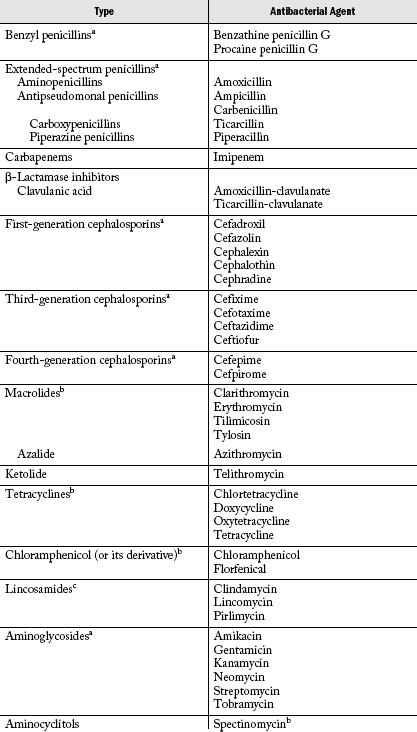
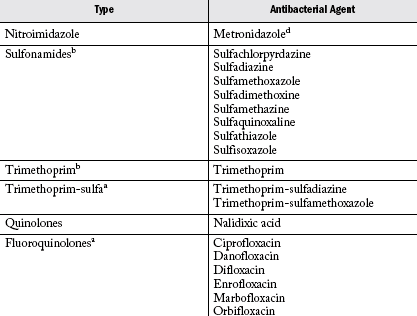
aBacteriocidal.
bBacteriostatic.
cBacteriostatic or bacteriocidal.
dCidal vs. amoebae, Giardia, Trichomonas, and most obligate anaerobes; inactive vs. most aerobic bacteria or facultative anaerobes.
APPENDIX 103
General efficacy of select antimicrobial agents used in exotic animals.
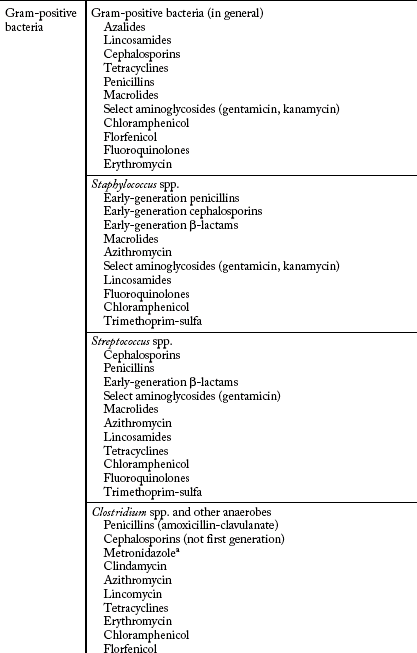
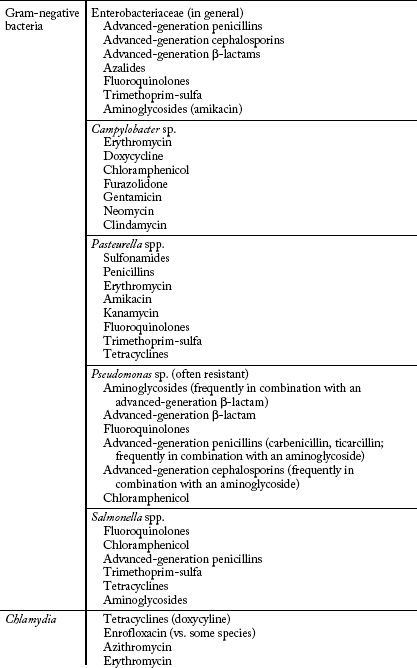
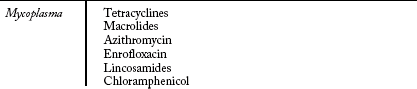
aEffective vs. most obligate anaerobes; inactive vs. most aerobic bacteria or facultative anaerobes.
APPENDIX 104
Antimicrobial therapy used in exotic animals according to site of infection.a,b
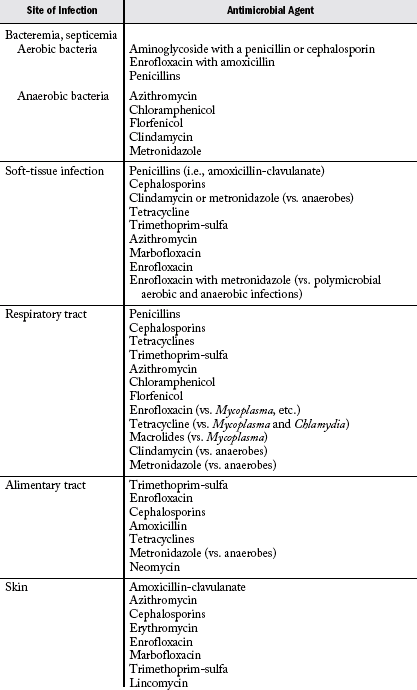
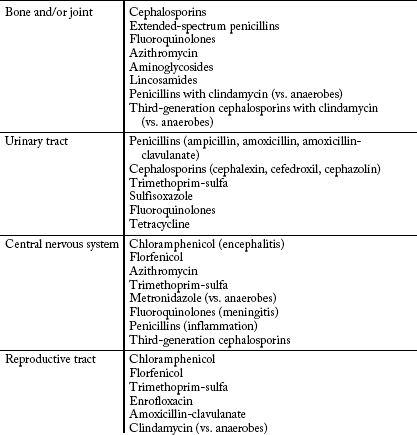
aDefinitive therapy should be based on bacterial culture and sensitivity and host species involved.
bModified from Allen DG, Pringle JK, Smith D. Handbook of Veterinary Drugs. JB Lippincott, Philadelphia, 1993; Gilbert DN, Moellering RC Jr, Sande MA. The Sanford Guide to Antimicrobial Therapy 2003. ed. 33. Antimicrobial Therapy, Inc, Hyde Park, VT, 2003; and Prescott JF, Baggot JD, Walker RD (eds). Antimicrobial Therapy in Veterinary Medicine. Iowa State University, Ames, IA, 2000.
APPENDIX 105
Antimicrobial combination therapies commonly used in exotic animals.a
| Drug |
Synergistic or Combination Drug |
| Aminoglycosideb (amikacin, gentamicin) |
Penicillins (carbenicillin, piperacillin, ticarcillin, amoxicillin, ampicillin), cephalosporins, trimethoprimsulfa, lincomycin, metronidazole, fluoroquinolones |
| Amoxicillin |
Clavulanate |
| Cephalosporin |
Aminoglycosides,b clindamycin, fluoroquinolones, metronidazole, semi-synthetic penicillins |
| Clindamycin |
Penicillins, third-generation cephalosporins, enrofloxacin |
| Fluoroquinolone (enrofloxacin, ciprofloxacin, marbofloxacin) |
Aminoglycosides,b third-generation cephalosporins, extended-spectrum penicillins, clindamycin, metronidazole |
| Lincomycin |
Spectinomycin, aminoglycosidesb |
| Metronidazole |
Amikacin, azithromycin, carbenicillin, cefazolin, cefotaxime, chloramphenicol, enrofloxacin, marbofloxacin, gentamicin, others as indicated |
| Penicillins (carbenicillin, piperacillin, ampicillin) |
Aminoglycosides,b fluoroquinolones |
| Penicillins, early-generation |
Aminoglycosides,b third-generation cephalosporins |
| Ticarcillin |
Clavulanate |
| Trimethoprim |
Sulfadiazine, sulfamethoxine |
| Tylosin |
Oxytetracycline |
aIndicated when synergy is advantageous in definitive therapy, to treat polymicrobial infections, to broaden empiric coverage, or to attempt to prevent the development of antimicrobial resistance.
bGenerally amikacin, occasionally gentamicin, etc.
APPENDIX 106
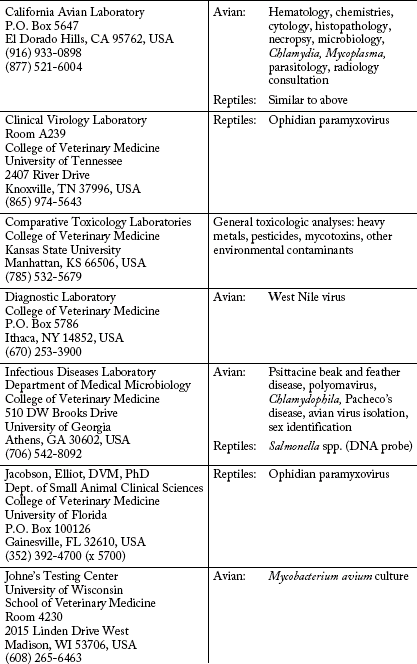
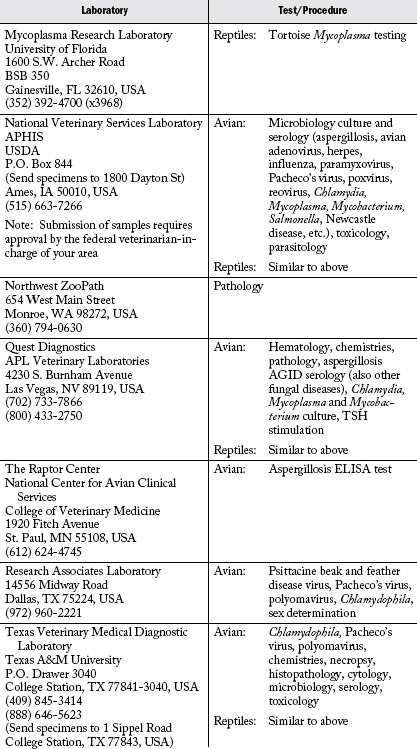
Selected laboratories conducting avian and reptile diagnostic procedures.a
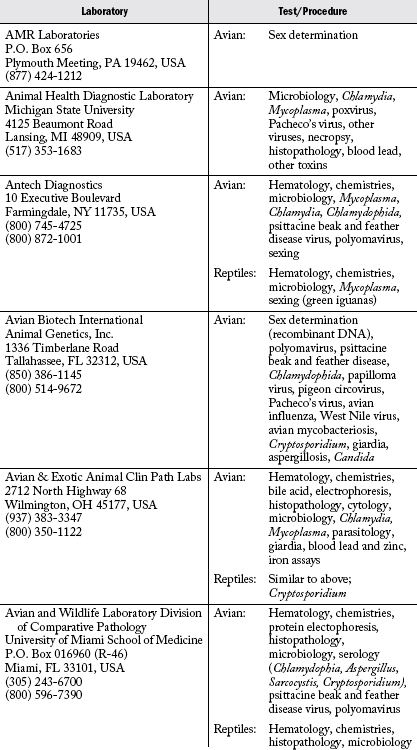
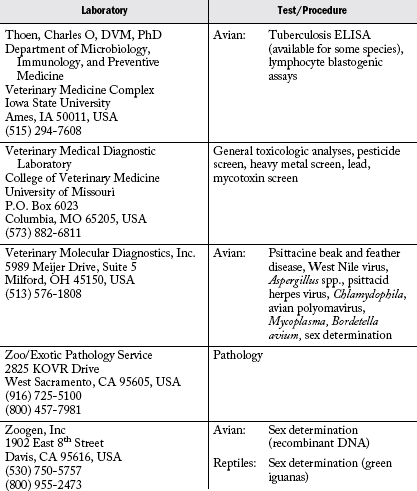
aSimilar services are also offered at most of these laboratories for other exotic animals.
APPENDIX 107 Determining the basal metabolic rate of animals.
The following information is provided so that drugs can be allometrically scaled for different species and to assist in calculating metabolic need for nutritional requirements and fluid therapy.
BMR (basal metabolic rate)
• BMR differs between species.
• The general equation to calculate BMRa is: BMR = kW0.75
BMR = kcal/kg/d
k = kcal/kg constant (nonpasserines = 78, passerines = 129, placental mammals = 70, marsupials = 49, reptiles at 37° C = 10)
W = weight in kg
• Other equations have been determined for passerine and nonpasserine birds in relation to the daylight cycle. These cycles are termed “active phase” and “rest phase.” However, results are similar to the above formula.
| Phase |
Passerine |
Nonpasserines |
| Active phase |
BMR = (140.7)W0.704 |
BMR = (91)W0.729 |
| Rest phase |
BMR = (113.8)W0.726 |
BMR = (72)W0.734 |
• Maintenance energy requirement (MER) = (kcal/d) = (1.5 BMR)
In the bird, the MER can then be adjusted for health status as followsb:
| Physical inactivity |
0.7–0.9 × MER |
| Starvation |
0.5–0.7 × MER |
| Hypometabolism |
0.5–0.9 × MER |
| Elective surgery |
1.0–1.2 × MER |
| Mild trauma |
1.0–1.2 × MER |
| Severe trauma |
1.1–2.0 × MER |
| Growth |
1.5–3.0 × MER |
| Sepsis |
1.2–1.5 × MER |
| Burns |
1.2–2.0 × MER |
| Head injuries |
1.0–2.0 × MER |
aSedgwick C, Pokras M, Kaufman G. Metabolic scaling: using estimated energy costs to extrapolate drug doses between different species and different individuals of diverse body sizes.Proc Annu Conf Am Assoc Zoo Vet 249-254, 1990.
bQuesenberry KE, Mauldin G, Hillyer E. Review of method of nutritional support in hospitalized bird. First Conf Euro Comm Assoc Avian Vet 243-254, 1991.
APPENDIX 108 Allometric scaling of drugs used in animals.
Although allometric scaling provides a means to calculate a drug in terms of an animal’s basal metabolic rate (BMR; see Appendix 107), pharmacokinetically-derived data are the preferred source of information for the dose and frequency. Allometric scaling can complement or be an alternative to empirical dosing and extrapolation from domestic animal and human dosing. Scaling does not guarantee that the dosage would be efficacious, nontoxic, safe, or correct. All allometrically scaled dosages, therefore, should be reviewed by the practitioner before administration. Use of a conventional dosage is preferred over an allometric dose when the allometric dose seems disproportionate. The reader is referred to other sources of information concerning the use of allometric scaling.ab
BMR in kcal/d =kW0.75
k = kcal/kg/d constant (nonpasserines = 78, passerines = 129, placental mammals = 70, marsupials = 49, reptiles at 37° C = 10)
W = weight in kg
The BMR needs to be calculated for avian species for which a dosage is not known as well as for species in which the drug is routinely used. For example, a dosage for enrofloxacin needs to be calculated for a 30 g canary patient (BMRp) on the basis of a model (known) dosage of 7.5 mg/kg q12h for an Amazon parrot (BMRm) weighing 250 g.
1. Model BMR = BMRm = (78 kcal/kg/d) (0.250 kg)0.75 = 27.6 kcal/d
2. Model energy cost = kW−0.25 = (78 kcal/kg/d) (0.250 kg)−0.25 = 110 kcal/d
3. Model dose = 7.5 mg/kg
4. Model dose interval = q12h
5. Model treatment dose = (wt in kg) (dose) = (0.250 kg) (7.5 mg/kg) = 1.875 mg
6. BMRm dose = (model treatment dose)/(BMRm) = (1.875 mg)/(27.6 kcal/d) = 0.068 mg/kcal/d
7. Patient BMR = BMRp = (129 kcal/kg/d) (0.030 kg)0.75 = 9.3 kcal/d
8. Patient energy cost = kW−0.25 = (129 kcal/kg/d) (0.030 kg)−0.25 = 310 kcal/d
9. Patient treatment dose = (BMRm dose) (BMRp) = (0.068 mg/kcal/d) (9.3 kcal/d) = 0.63 mg
10. Patient dose = (patient treatment dose)/(wt in kg) = (0.63 mg)/(0.030 kg) = 21 mg/kg
11. Patient treatment interval = [(patient energy cost/model energy cost)/(model dose interval)]−1 = [(310 kcal/d /110 kcal/d)/(12 hours)]−1 = 4.26 hours
12. Final dose = 21 mg/kg q4h
aFrazier DL, Jones MP, Orosz SE. Pharmacokinetic considerations of the renal system in birds: Part II. Review of drugs excreted by renal pathways. J Avian Med Surg 9:104-121, 1995.
bJensen JM, Johnson JH, Weiner ST.Husbandry and Medical Management of Ostriches, Emus and Rheas. Wildlife and Exotic Animal TeleConsultants, College Station, TX, 1992.
APPENDIX 109
Common abbreviations used in prescription writing.
| a.c. |
before meals |
| a.d. |
right ear |
| ad lib |
at pleasure |
| adm |
administer |
| aq |
water |
| a.s. |
left ear |
| a.u. |
both ears |
| b.i.d. |
twice a day |
| c. |
with |
| cap(s) |
capsule(s) |
| cc |
cubic centimeter |
| disp |
dispense |
| fl oz |
fluid ounce |
| g (gm) |
gram |
| gr |
grain |
| gtt(s) |
drop(s) |
| h (hr) |
hour |
| h.s. |
at bedtime |
| IM |
intramuscularly |
| inj |
inject |
| IP |
intraperitoneally |
| IV |
intravenously |
| kg |
kilogram |
| lb |
pound |
| mg |
milligram |
| ml |
milliliter |
| o.d. |
right eye |
| o.s. |
left eye |
| o.u. |
both eyes |
| oz |
ounce |
| p.c. |
after meals |
| PO (p.o.) |
per os |
| prn (p.r.n.) |
as needed |
| q. (q) |
every |
| q.d. |
every day |
| q4h |
every 4 hours, etc. |
| q24h |
once a day |
| q.i.d. |
four times a day |
| q.o.d. |
every other day |
| q.s. |
a sufficient quantity |
| ® |
trademarked name |
| SC (SQ) |
subcutaneously |
| Sig: |
instructions to patient |
| sol’n |
solution |
| stat |
immediately |
| susp |
suspension |
| tab(s) |
tablet(s) |
| Tbs |
tablespoon |
| t.i.d. |
three times a day |
| tsp |
teaspoon |
| ut dict. |
as directed |
APPENDIX 110 Common weight, liquid measure, and length conversions.
Weights
1 milligram (mg) = 1000 micrograms (mcg or ìg)
1 grain (gr) = 64.8 mg (∼65 mg)
1 gram (g) = 15.43 grains (∼15 grains) = 1000 mg
1 kilogram (kg) = 1000 g
1 ounce (oz) = 28.35 g (∼30 g)
1 pound (lb) = 454 g = 16 oz. = 0.45 kg
2.2 pound = 1 kg
Liquid measures
1 drop = 0.05 (1/20) milliliter (ml)
1 cubic centimeter (cc) = 1 ml
1 liter (L) = 1000 ml
1 teaspoon (tsp) = 5 ml
1 tablespoon (Tbs) = 15 ml
1 fluid ounce (fl oz) = 29.57 ml (∼30 ml)
1 quart = 2 pints = 32 fl oz (∼0.95 L)
1 gallon = 4 quarts = 3.785 L
1 cup = 8 fl oz = 237 ml = 16 Tbs
Linear measures
1 millimeter (mm) = 0.039 inches (in)
1 centimeter (cm) = 0.39 in
1 meter (m) = 39.37 in
1 inch (in) = 2.54 cm0
1 foot (ft) = 30.48 cm
1 yard (yd) = 91.44 cm
APPENDIX 111
Equivalents of Celsius (centigrade) and Fahrenheit temperature scales.
| °C |
°F |
| 0 |
32.0 |
| 1 |
33.8 |
| 2 |
35.6 |
| 3 |
37.4 |
| 4 |
39.2 |
| 5 |
41.0 |
| 6 |
42.8 |
| 7 |
44.6 |
| 8 |
46.4 |
| 9 |
48.2 |
| 10 |
50.0 |
| 11 |
51.8 |
| 12 |
53.6 |
| 13 |
55.4 |
| 14 |
57.2 |
| 15 |
59.0 |
| 16 |
60.8 |
| 17 |
62.6 |
| 18 |
64.4 |
| 19 |
66.2 |
| 20 |
68.0 |
| 21 |
69.8 |
| 22 |
71.6 |
| 23 |
73.4 |
| 24 |
75.2 |
| 25 |
77.0 |
| 26 |
78.8 |
| 27 |
80.6 |
| 28 |
82.4 |
| 29 |
84.2 |
| 30 |
86.0 |
| 31 |
87.8 |
| 32 |
89.6 |
| 33 |
91.4 |
| 34 |
93.2 |
| 35 |
95.0 |
| 36 |
96.8 |
| 37 |
98.6 |
| 38 |
100.4 |
| 39 |
102.2 |
| 40 |
104.0 |
| 41 |
105.8 |
| 42 |
107.6 |
| 43 |
109.4 |
| 44 |
111.2 |
| 45 |
113.0 |
| 46 |
114.8 |
| 47 |
116.6 |
| 48 |
118.4 |
| 49 |
120.2 |
| 50 |
122.0 |
APPENDIX 112
System of International Units conversion factors of clinical chemistries commonly used in exotic animal medicine.a
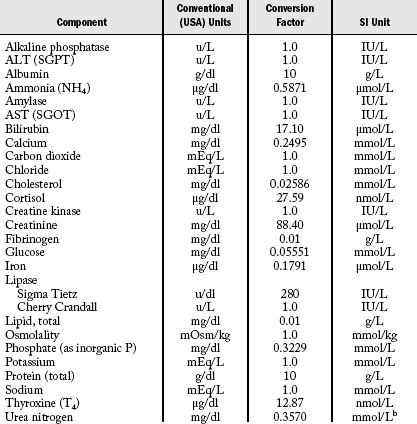
aModified from The Merck Veterinary Manual (8th edition, 1998), as adapted from The SI Manual in Health Care, Metric Commission, Canada, 1981.
bUrea.