Chapter Twenty-one Mental status assessment
PURPOSE
Mental status examination is a commonly performed nursing procedure. In this chapter you will be introduced to the terminology used, the components of the mental status examination including assessing a person’s mental health, the rationale and methods of examination of mental status and how to record the assessment accurately.
KEY CONCEPTS
• Definitions of mental status
• Mental status health history
• Components of the mental status examination
• Overview of substance use disorders
While you are completing your reading assignment, ensure you understand each of the key concepts listed above.
READING ASSIGNMENT
Jarvis, Forbes & Watt (JF&W): Jarvis’s Physical Examination and Health Assessment, Chapter 21, pp. 555–574.
GLOSSARY
After reading the corresponding chapter in the text, learn the following terms. You should be able to cover the definition on the right and state the associated definition in your own words.
Abstract reasoning pondering a deeper meaning beyond the concrete and literal
Affect temporary expression of feelings and state of mind
Aphasia true language disturbance, defect in word choice and grammar or defect in comprehension; defect is in higher integrative language processing; is the loss of the ability to speak or write coherently, or to understand speech or writing
Attention concentration, ability to focus on one specific thing without being distracted
Consciousness being aware of one’s own existence, feelings and thoughts and being aware of the environment
Dysarthria distorted speech sounds; speech may sound unintelligible; basic language (word choice, grammar, comprehension) are intact
Dysphonia difficulty or discomfort in talking, with abnormal pitch or volume, due to laryngeal disease. Voice sounds hoarse or whispered, but articulation and language are intact
Language using the voice to communicate one’s thoughts and feelings
Memory ability to lay down and store experiences and perceptions for later recall
Mental disorder a significant behavioural or psychological pattern that is associated with distress (a painful symptom) or disability (impaired functioning) and has a significant risk of pain, disability or death or a loss of freedom (American Psychiatric Association, 2000)
Mental status a person’s emotional and cognitive functioning
Mood prolonged display of a person’s feelings affecting their whole emotional life
Orientation awareness of the objective world in relation to the self
Perceptions awareness of objects through any of the five senses
Thought content what the person thinks—specific ideas, beliefs, the use of words
Thought process the way a person thinks—the logical train of thought
PREPARATION FOR YOUR LABORATORY SESSION
1. Prior to attending the laboratory, prepare questions that you may ask—during a regional health history—of a patient who presents with another presenting illness, to elicit information about the patient’s mental health status and coping strategies. Write these additional questions in the space provided before the regional write-up worksheet so you can use the questions as a prompt.
2. To enhance your learning concerning examining for mental health issues, choose one of the following mental health disorders, read about the presentation, signs and symptoms of the condition and prepare yourself to become a ‘patient’ with this underlying condition. You may choose another condition if it is of more interest to you.
STUDY GUIDE
After completing the reading assignment, you should be able to answer the following questions in the spaces provided.
1. Define the term ‘mental disorder’ including the subcategories, and provide examples of each.
_____________________________________________________________
_____________________________________________________________
_____________________________________________________________
_____________________________________________________________
2. Mental status function is inferred through the assessment of a patient’s behaviour. List the 10 behavioural areas that are assessed, providing a brief description of each.
_____________________________________________________________
_____________________________________________________________
_____________________________________________________________
_____________________________________________________________
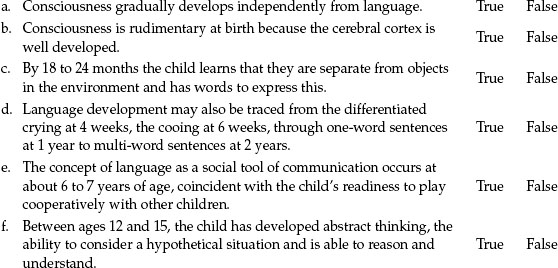
3. Circle True or False to answer the following statements concerning infant and childhood developmental considerations. If the answer is false, state the correct answer.
4. List the 4 main headings/components of a mental state assessment.
5. Explain why mental status can be assessed if integrated into the health history interview.
_____________________________________________________________
_____________________________________________________________
_____________________________________________________________
_____________________________________________________________
6. State 4 situations in which it would be necessary to perform a complete mental status examination.
7. Explain 4 factors that could affect a patient’s response to the mental status examination but have nothing to do with mental disorders.
8. The sequence of steps in the objective mental state examination forms a hierarchy in which the most basic functions are assessed first. Explain why it is vital to accurately assess this first step.
_____________________________________________________________
_____________________________________________________________
_____________________________________________________________
_____________________________________________________________
9. Describe the presentation of patients with each of the following disorders:
_____________________________________________________________
_____________________________________________________________
_____________________________________________________________
_____________________________________________________________
_____________________________________________________________
_____________________________________________________________
_____________________________________________________________
_____________________________________________________________
Alzheimer’s or dementia ______________
_____________________________________________________________
_____________________________________________________________
_____________________________________________________________
_____________________________________________________________
10. Distinguish dysphonia from dysarthria.
_____________________________________________________________
_____________________________________________________________
_____________________________________________________________
_____________________________________________________________
11. Define ‘unilateral neglect’ and state the condition with which it is associated.
_____________________________________________________________
_____________________________________________________________
_____________________________________________________________
_____________________________________________________________
12. List the order in which ‘orientation’ is lost.
_____________________________________________________________
_____________________________________________________________
_____________________________________________________________
_____________________________________________________________
13. Describe how you would assess attention span during a health history interview.
_____________________________________________________________
_____________________________________________________________
_____________________________________________________________
_____________________________________________________________
14. State methods of assessing a person’s recent and remote memory within the context of the initial health history and provide examples of when memory may be altered.
_____________________________________________________________
_____________________________________________________________
_____________________________________________________________
_____________________________________________________________
15. What is the Four Unrelated Words Test intended to test? Include the procedure to be followed during the test and which conditions may cause incorrect responses.
_____________________________________________________________
_____________________________________________________________
_____________________________________________________________
_____________________________________________________________
16. State how and why you would assess for the following while you are performing a health history interview:
_____________________________________________________________
_____________________________________________________________
_____________________________________________________________
_____________________________________________________________
_____________________________________________________________
_____________________________________________________________
_____________________________________________________________
_____________________________________________________________
purpose of tests for higher level functioning
_____________________________________________________________
_____________________________________________________________
_____________________________________________________________
_____________________________________________________________
_____________________________________________________________
_____________________________________________________________
_____________________________________________________________
_____________________________________________________________
_____________________________________________________________
_____________________________________________________________
_____________________________________________________________
_____________________________________________________________
_____________________________________________________________
_____________________________________________________________
_____________________________________________________________
_____________________________________________________________
_____________________________________________________________
_____________________________________________________________
_____________________________________________________________
_____________________________________________________________
17. Identify at least 3 questions you could ask a patient that would screen for suicidal ideation.
18. List 10 cues and warning signs that would indicate a risk of suicide.
19. Discuss purpose and reasons for using the MiniMental State Examination, the scoring method and what scores may indicate.
_____________________________________________________________
_____________________________________________________________
_____________________________________________________________
_____________________________________________________________
20. Differentiate between delirium and dementia.
_____________________________________________________________
_____________________________________________________________
_____________________________________________________________
_____________________________________________________________
21. State the symptoms and physical signs that are characteristic of alcohol withdrawal.
_____________________________________________________________
_____________________________________________________________
_____________________________________________________________
_____________________________________________________________
22. Very briefly define each of the following conditions:
depersonalisation (lack of ego boundaries)
_____________________________________________________________
_____________________________________________________________
_____________________________________________________________
_____________________________________________________________
_____________________________________________________________
_____________________________________________________________
_____________________________________________________________
_____________________________________________________________
_____________________________________________________________
_____________________________________________________________
_____________________________________________________________
_____________________________________________________________
_____________________________________________________________
_____________________________________________________________
_____________________________________________________________
_____________________________________________________________
_____________________________________________________________
_____________________________________________________________
_____________________________________________________________
_____________________________________________________________
_____________________________________________________________
_____________________________________________________________
_____________________________________________________________
_____________________________________________________________
_____________________________________________________________
_____________________________________________________________
_____________________________________________________________
_____________________________________________________________
_____________________________________________________________
_____________________________________________________________
_____________________________________________________________
_____________________________________________________________
_____________________________________________________________
_____________________________________________________________
_____________________________________________________________
_____________________________________________________________
_____________________________________________________________
_____________________________________________________________
_____________________________________________________________
_____________________________________________________________
_____________________________________________________________
_____________________________________________________________
_____________________________________________________________
_____________________________________________________________
_____________________________________________________________
_____________________________________________________________
_____________________________________________________________
_____________________________________________________________
_____________________________________________________________
_____________________________________________________________
_____________________________________________________________
_____________________________________________________________
_____________________________________________________________
_____________________________________________________________
_____________________________________________________________
_____________________________________________________________
_____________________________________________________________
_____________________________________________________________
_____________________________________________________________
_____________________________________________________________
REVIEW QUESTIONS
This test is for you to check your own mastery of the content. Answers are provided in Appendix A.
1. Although a full mental status examination may not be required, the nurse must be aware of the four main headings of the assessment while performing the interview and physical examination. These headings are:
2. Select the finding that most accurately describes the general appearance of a patient.
3. The ability to lay down new memories is part of the assessment of cognitive functions. One way to identify the ability to form new memories is by:
4. In order to accurately plan for discharge teaching, additional assessments may be required for the patient with aphasia. This may be accomplished by asking the patient to:
5. During an interview with a patient newly diagnosed with a seizure disorder, the patient states, ‘I plan to be an airline pilot’. If the patient continues to have this as a career goal after teaching regarding seizure disorders has been provided, the nurse might question the patient’s:
6. Auditory and visual hallucinations occur with all of the following conditions except:
7. On a patient’s second day in an acute care hospital, the patient complains about the ‘bugs’ on the bed. The bed is clean. This would be an example of altered:
8. One way to assess cognitive function and to detect dementia is with:
9. The Behavioural Checklist, completed by a parent, is used to assess the mental status of:
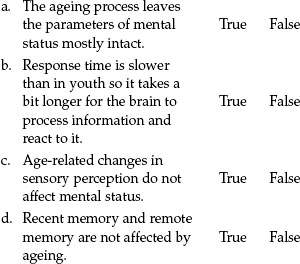
10. Circle True or False to answer the following statements about the over 65-year-old. If the answer is false, state the correct answer.
11. A major characteristic of dementia is:
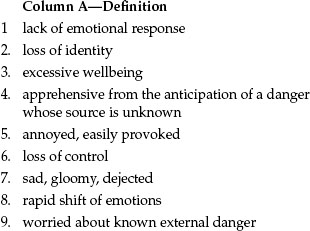
12. Match Column B with the definition in Column A.
13. Nicotine withdrawal is characterised by all of the following signs or symptoms except:
14. A thin, scruffy person walks into the ward waiting room and tells the patients that he is a famous international rugby union player. This is an example of:
PRACTICAL SKILLS IN THE LABORATORY/CLINICAL SETTING
Integrating the mental status examination into the health history interview is adequate for most patients you will deal with, as you can collect enough data to be able to assess mental health strengths, coping skills and the need to screen for dysfunction.
You should already be aware that alterations in mental status can significantly affect the patient’s ability to manage their health, roles and relationships, sexuality, self-concept, coping ability and activities of daily living.
You need to be cognisant that the consequence of illness and its treatment can also impact on mental health and that there will be many times that you will need to perform a complete mental status examination or a minimental status examination in a variety of clinical settings.
Now that you have been introduced to the steps in the mental status examination and reviewed a number of abnormalities you are ready for the clinical component of the mental status examination.
The purpose of the clinical component is to take an integrated subjective health history (to assess the need for further mental health assessment), achieve beginning competency with the administration of the mental status examination (MSE) and/or with the supplemental MiniMental State Examination (MMSE).
CLINICAL OBJECTIVES
At the completion of the clinical laboratory session, with further practice and self-directed learning you should be able to:
INSTRUCTIONS
1. Form pairs. (Do not reveal the condition you will be role-playing to your peer.)
2. Prepare the environment to promote security and confidentiality. Gather equipment: a piece of blank paper (place patient addressograph, or write patient name and unit number. Keep with hard copy data forms), wrist watch, pencil, standardised form with ‘Close your eyes’, standardised form with intersecting pentagons.
4. Gain consent to perform the examination from either your peer or the patient.
5. Obtain a health history integrating the questions you have developed to identify the presence of any mental health issues.
6. Practise the steps of the full mental status examination on a peer or a patient in the clinical setting, providing appropriate instructions as you proceed.
7. Record your findings using the regional write-up worksheet.
8. Next, practise the steps of the MiniMental State Examination (a simplified scored form of the cognitive functions found on the full mental status examination. It is used frequently in clinical and research settings).
9. Record your findings using the MiniMental State Examination form.
10. Swap roles and repeat steps 2–9.
11. Discuss your assessment and questioning techniques, findings and performance with your peer to develop a complete understanding of the process of performing a MSE and/or MMSE.
REGIONAL WRITE-UP WORKSHEET–MENTAL STATUS EXAMINATION
Interview conducted by ______________
Patient ____________________________Age_______________ Gender______________
Occupation ________________________________Medical Record Number______________
A. Complete mental status examination
(Prior to commencing the examination, tell the person the four words you want them to remember and to recall in a few mnutes. These are for the Four Unrelated Words Test.)
Level of consciousness ______________
Facial expression ______________
New learning—Four Unrelated Words Test ______________
Additional testing for aphasia:
Word comprehension ______________
4. Thought processes and perceptions
Thought processes ______________
Thought content ______________
Suicidal thoughts? (When indicated) ______________
B. Perform the MiniMental State Examination
The MiniMental State Examination (MMSE) is an assessment of overall cognitive function.
TABLE 21.1 Mini-Mental State Examination (MMSE)
| MMSE Sample Items |
|---|
| Orientation to Time |
| “What is the date?” |
| Registration |
| “Listen carefully. I am going to say three words. You say them back after I stop. |
| Ready? Here they are … |
| APPLE (pause), PENNY (pause), TABLE (pause). Now repeat those words back to me.” |
| [Repeat up to 5 times, but score only the first trial.] |
| Naming |
| “What is this?” [Point to a pencil or pen.] |
| Reading |
| “Please read this and do what it says.” [Show examinee the words on the stimulus form.] |
| CLOSE YOUR EYES |
Reproduced by special permission of the Publisher, Psychological Assessment Resources, Inc., 16204 North Florida Avenue, Lutz, Florida 33549, from the Mini Mental State Examination, by Marshal Folstein and Susan Folstein, Copyright 1975, 1998, 2001 by Mini Mental LLC, Inc. Published 2001 by Psychological Assessment Resources, Inc. Further reproduction is prohibited without permission of PAR, Inc. The MMSE can be purchased from PAR, Inc. by calling +1 (813) 968-3003.
REGIONAL DOCUMENTATION (SOAP)–MENTAL HEALTH STATUS
Summarise your findings using the SOAP format.
Subjective (Reason for seeking care, health history)
Objective (Physical exam findings as needed)
Assessment (Assessment of health state or problem, diagnosis)
Plan (Diagnostic evaluation, follow-up care, patient teaching)