Appendix II
Cytokines
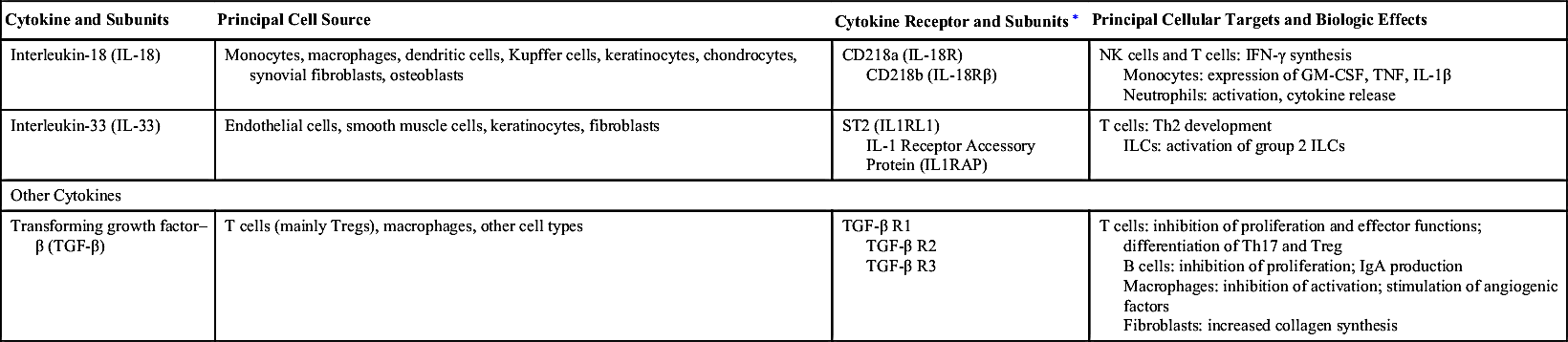
| Cytokine and Subunits | Principal Cell Source | Cytokine Receptor and Subunits∗ | Principal Cellular Targets and Biologic Effects |
| Type I Cytokine Family Members | |||
| Interleukin-2 (IL-2) | T cells | CD25 (IL-2Rα) CD122 (IL-2Rβ) CD132 (γc) | T cells: proliferation and differentiation into effector and memory cells; promotes regulatory T cell development, survival, and function NK cells: proliferation, activation |
| Interleukin-3 (IL-3) | T cells | CD123 (IL-3R) CD131 (βc) | Immature hematopoietic progenitors: induced maturation of all hematopoietic lineages |
| Interleukin-4 (IL-4) | CD4+ T cells (Th2), mast cells | CD124 (IL-4R) CD132 (γc) | B cells: isotype switching to IgE T cells: Th2 differentiation, proliferation Macrophages: alternative activation and inhibition of IFN-γ–mediated classical activation |
| Interleukin-5 (IL-5) | CD4+ T cells (Th2), group 2 ILCs | CD125 (IL-5R) CD131 (βc) | Eosinophils: activation, increased generation |
| Interleukin-6 (IL-6) | Macrophages, endothelial cells, T cells | CD126 (IL-6R) CD130 (gp130) | Liver: synthesis of acute-phase protein B cells: proliferation of antibody-producing cells T cells: Th17 differentiation |
| Interleukin-7 (IL-7) | Fibroblasts, bone marrow stromal cells | CD127 (IL-7R) CD132 (γc) | Immature lymphoid progenitors: proliferation of early T and B cell progenitors T lymphocytes: survival of naive and memory cells |
| Interleukin-9 (IL-9) | CD4+ T cells | CD129 (IL-9R) CD132 (γc) | Mast cells, B cells, T cells, and tissue cells: survival and activation |
| Interleukin-11 (IL-11) | Bone marrow stromal cells | IL-11Rα CD130 (gp130) | Production of platelets |
| Interleukin-12 (IL-12): IL-12A (p35) IL-12B (p40) | Macrophages, dendritic cells | CD212 (IL-12Rβ1) IL-12Rβ2 | T cells: Th1 differentiation NK cells and T cells: IFN-γ synthesis, increased cytotoxic activity |
| Interleukin-13 (IL-13) | CD4+ T cells (Th2), NKT cells, group 2 ILCs, mast cells | CD213a1 (IL-13Rα1) CD213a2 (IL-13Rα2) CD132 (γc) | B cells: isotype switching to IgE Epithelial cells: increased mucus production Macrophages: alternative activation |
| Interleukin-15 (IL-15) | Macrophages, other cell types | IL-15Rα CD122 (IL-2Rβ) CD132 (γc) | NK cells: proliferation T cells: survival and proliferation of memory CD8+ cells |
| Table Continued | |||
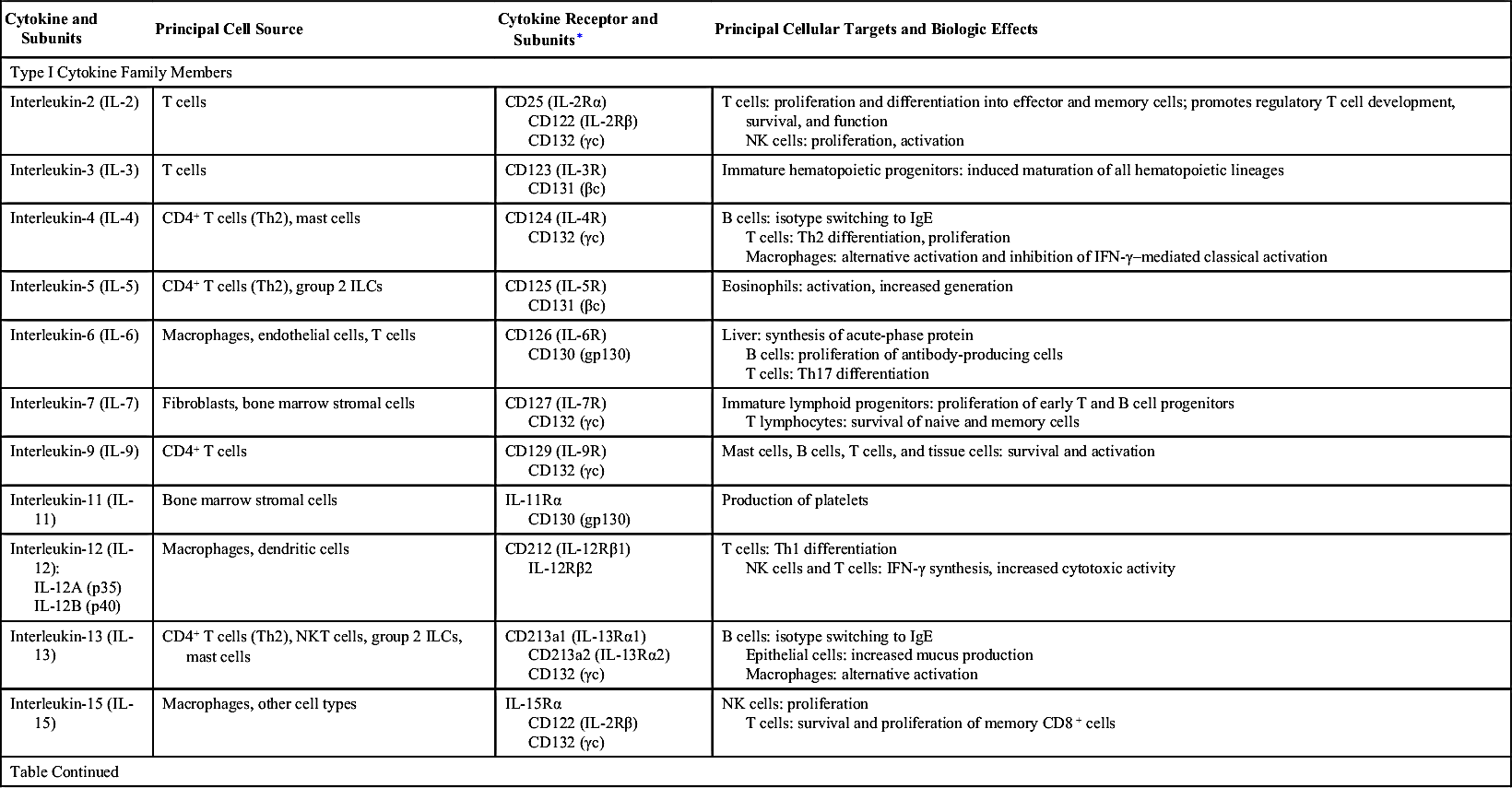
| Cytokine and Subunits | Principal Cell Source | Cytokine Receptor and Subunits∗ | Principal Cellular Targets and Biologic Effects |
| Interleukin-17A (IL-17A) Interleukin-17F (IL-17F) | CD4+ T cells (Th17), group 3 ILCs | CD217 (IL-17RA) IL-17RC | Endothelial cells: increased chemokine production Macrophages: increased chemokine and cytokine production Epithelial cells: GM-CSF and G-CSF production |
| Interleukin-21 (IL-21) | Th2 cells, Th17cells, Tfh cells | CD360 (IL-21R) CD132 (γc) | B cells: activation, proliferation, differentiation Tfh cells: development Th17 cells: increased generation NK cells: functional maturation |
| Interleukin-23 (IL-23): IL-23A (p19) IL-12B (p40) | Macrophages, dendritic cells | IL-23R CD212 (IL-12Rβ1) | T cells: differentiation and expansion of Th17 cells |
| Interleukin-25 (IL-25; IL-17E) | T cells, mast cells, eosinophils, macrophages, mucosal epithelial cells | IL-17RB | T cells and group 2 ILCs: production of IL-5, IL-13 |
| Interleukin-27 (IL-27): IL-27 (p28) EBI3 (IL-27B) | Macrophages, dendritic cells | IL-27Rα CD130 (gp130) | T cells: enhances Th1 differentiation inhibition of Th17 differentiation |
| Stem cell factor (c-Kit ligand) | Bone marrow stromal cells | CD117 (KIT) | Pluripotent hematopoietic stem cells: induced maturation of all hematopoietic lineages |
| Granulocyte-monocyte CSF (GM-CSF) | T cells, macrophages, endothelial cells, fibroblasts | CD116 (GM-CSFRα) CD131 (βc) | Immature and committed progenitors: induced maturation of granulocytes and monocytes Macrophage activation |
| Monocyte CSF (M-CSF, CSF1) | Macrophages, endothelial cells, bone marrow cells, fibroblasts | CD115 (CSF1R) | Committed hematopoietic progenitors: induced maturation of monocytes |
| Granulocyte CSF (G-CSF, CSF3) | Macrophages, fibroblasts, endothelial cells | CD114 (CSF3R) | Committed hematopoietic progenitors: induced maturation of granulocytes |
| Type II Cytokine Family Members | |||
| IFN-α (multiple proteins) | Plasmacytoid dendritic cells, macrophages | IFNAR1 CD118 (IFNAR2) | All cells: antiviral state, increased class I MHC expression NK cells: activation |
| IFN-β | Fibroblasts, plasmacytoid dendritic cells | IFNAR1 CD118 (IFNAR2) | All cells: antiviral state, increased class I MHC expression NK cells: activation |
| Interferon-γ (IFN-γ) | T cells (Th1, CD8+ T cells), NK cells and group 1 ILCs | CD119 (IFNGR1) IFNGR2 | Macrophages: classical activation (increased microbicidal functions) B cells: isotype switching to opsonizing and complement-fixing IgG subclasses (established in mice) T cells: Th1differentiation Various cells: increased expression of class I and class II MHC molecules, increased antigen processing and presentation to T cells |
| Table Continued | |||
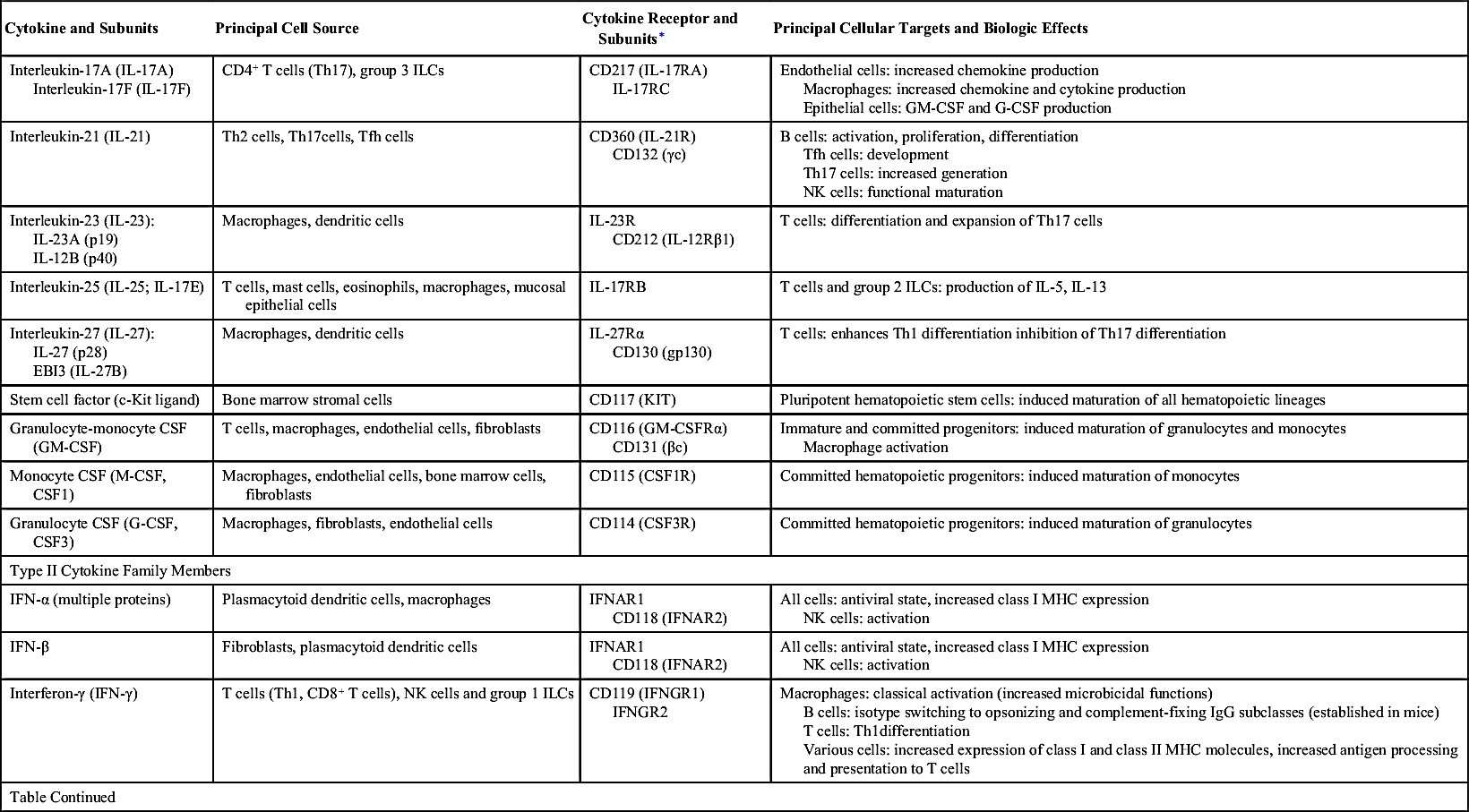
| Cytokine and Subunits | Principal Cell Source | Cytokine Receptor and Subunits∗ | Principal Cellular Targets and Biologic Effects |
| Interleukin-10 (IL-10) | Macrophages, T cells (mainly regulatory T cells) | CD210 (IL-10Rα) IL-10Rβ | Macrophages, dendritic cells: inhibition of expression of IL-12, costimulators, and class II MHC |
| Interleukin-22 (IL-22) | Th17 cells | IL-22Rα1 IL-10Rβ2 or IL-22α2 IL-10Rβ2 | Epithelial cells: production of defensins, increased barrier function Hepatocytes: survival Adipocytes: lipolysis |
| Interferon-λs (type III interferons) | Dendritic cells | IFNLR1 (IL-28R) CD210B (IL-10Rβ2) | Epithelial cells: antiviral state |
| Leukemia inhibitory factor (LIF) | Embryonic trophectoderm Bone marrow stromal cells | CD118 (LIFR) CD130 (gp130) | Stem cells: block in differentiation |
| Oncostatin M | Bone marrow stromal cells | OSMR CD130 (gp130) | Endothelial cells: regulation of hematopoietic cytokine production |
| TNF Superfamily Cytokines† | |||
| Tumor necrosis factor (TNF, TNFSF1) | Macrophages, NK cells, T cells | CD120a (TNFRSF1) or CD120b (TNFRSF2) | Endothelial cells: activation (inflammation, coagulation) Neutrophils: activation Hypothalamus: fever Muscle, fat: catabolism (cachexia) |
| Lymphotoxin-α (LTα, TNFSF1) | T cells, B cells | CD120a (TNFRSF1) or CD120b (TNFRSF2) | Same as TNF |
| Lymphotoxin-αβ (LTαβ) | T cells, NK cells, follicular B cells, lymphoid inducer cells | LTβR | Lymphoid tissue stromal cells and follicular dendritic cells: chemokine expression and lymphoid organogenesis |
| BAFF (CD257, TNFSF13B) | Dendritic cells, monocytes, follicular dendritic cells,B cells | BAFF-R (TNFRSF13C) or TACI (TNFRSF13B) or BCMA (TNFRSF17) | B cells: survival, proliferation |
| APRIL (CD256, TNFSF13) | T cells, dendritic cells, monocytes, follicular dendritic cells | TACI (TNFRSF13B) or BCMA (TNFRSF17) | B cells: survival, proliferation |
| Osteoprotegrin (OPG, TNFRSF11B) | Osteoblasts | RANKL | Osteoclast precursor cells: inhibits osteoclast differentiation |
| IL-1 Family Cytokines | |||
| Interleukin-1α (IL-1α) | Macrophages, dendritic cells, fibroblasts, endothelial cells, keratinocytes | CD121a (IL-1R1) IL-1RAP or CD121b (IL-1R2) | Endothelial cells: activation (inflammation, coagulation) Hypothalamus: fever Liver: synthesis of acute-phase proteins |
| Interleukin-1β (IL-1β) | Macrophages, dendritic cells, fibroblasts, endothelial cells, keratinocytes | CD121a (IL-1R1) IL-1RAP or CD121b (IL-1R2) | Endothelial cells: activation (inflammation, coagulation) Hypothalamus: fever Liver: synthesis of acute-phase proteins T cells: Th17 differentiation |
| Interleukin-1 receptor antagonist (IL-1RA) | Macrophages | CD121a (IL-1R1) IL-1RAP | Various cells: competitive antagonist of IL-1 |
| Table Continued | |||
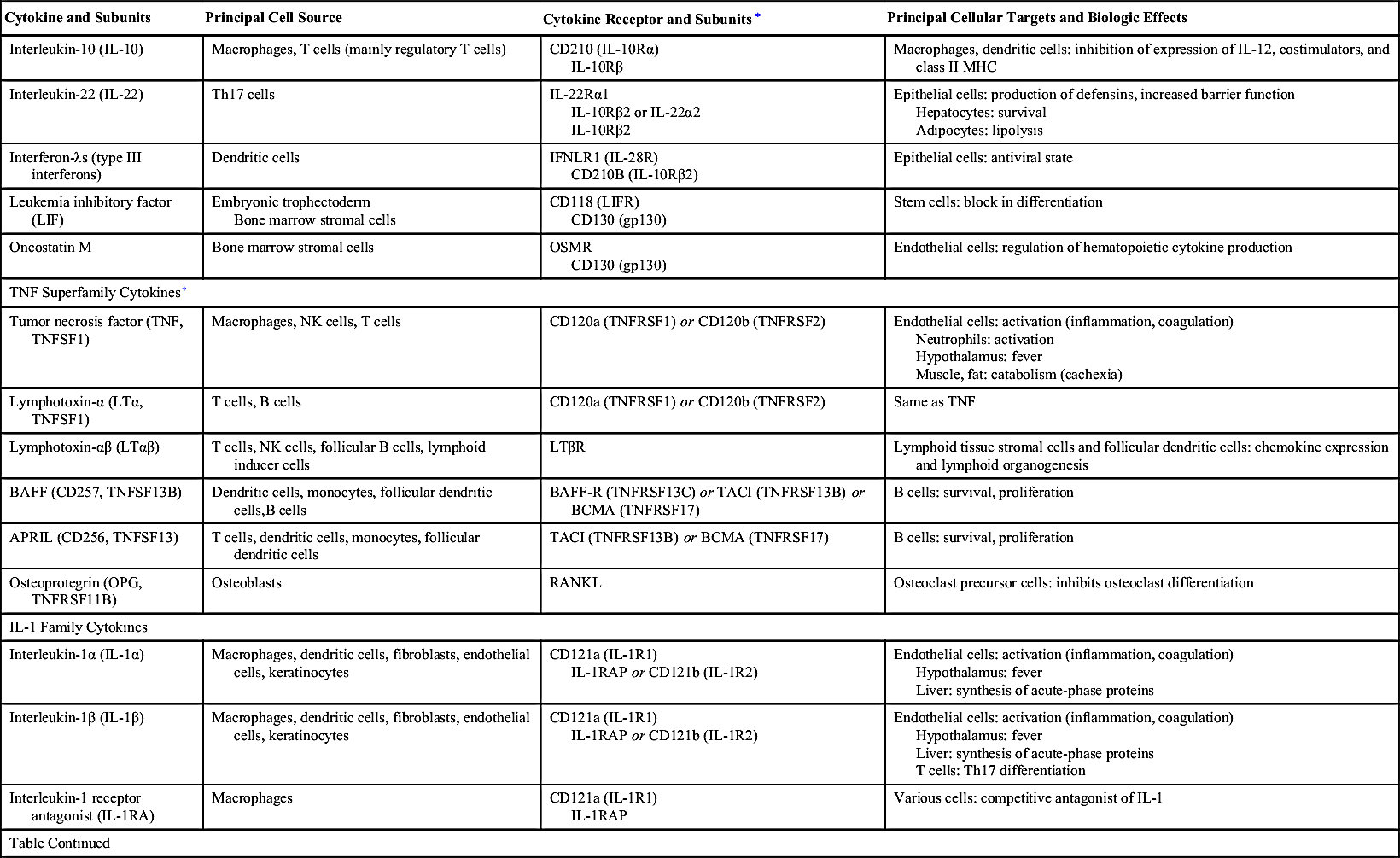
| Cytokine and Subunits | Principal Cell Source | Cytokine Receptor and Subunits∗ | Principal Cellular Targets and Biologic Effects |
| Interleukin-18 (IL-18) | Monocytes, macrophages, dendritic cells, Kupffer cells, keratinocytes, chondrocytes, synovial fibroblasts, osteoblasts | CD218a (IL-18R) CD218b (IL-18Rβ) | NK cells and T cells: IFN-γ synthesis Monocytes: expression of GM-CSF, TNF, IL-1β Neutrophils: activation, cytokine release |
| Interleukin-33 (IL-33) | Endothelial cells, smooth muscle cells, keratinocytes, fibroblasts | ST2 (IL1RL1) IL-1 Receptor Accessory Protein (IL1RAP) | T cells: Th2 development ILCs: activation of group 2 ILCs |
| Other Cytokines | |||
| Transforming growth factor–β (TGF-β) | T cells (mainly Tregs), macrophages, other cell types | TGF-β R1 TGF-β R2 TGF-β R3 | T cells: inhibition of proliferation and effector functions; differentiation of Th17 and Treg B cells: inhibition of proliferation; IgA production Macrophages: inhibition of activation; stimulation of angiogenic factors Fibroblasts: increased collagen synthesis |