Body Mechanics and Patient Mobility
Objectives
1. State the principles of body mechanics.
2. Explain the rationale for use of appropriate body mechanics.
3. Discuss considerations related to mobility for older adults.
4. Discuss the complications of immobility.
5. Demonstrate the use of assistive devices for proper positioning.
6. State the nursing interventions used to prevent complications of immobility.
7. Demonstrate placement of patient in various positions, such as Fowler's, supine (dorsal), Sims', side-lying, prone, dorsal recumbent, and lithotomy positions.
8. State the assessment for the patient's neurovascular status, including the phenomenon of compartment syndrome.
9. Describe and demonstrate range-of-motion exercises and explain their purpose.
10. Identify complications caused by inactivity.
11. Relate appropriate body mechanics to the techniques for turning, moving, and lifting the patient.
12. Discuss use of the continuous passive motion machines.
13. Discuss the nursing process and how it relates to patient mobility.
Key Terms
http://evolve.elsevier.com/Cooper/foundations/
The two concepts of body mechanics and patient mobility are directly related to one another. Nursing personnel must learn and practice proper principles of body mechanics to prevent injury to themselves and injury to their patients. When assisting patients in mobility, nurses must be constantly aware of their own body mechanics. According to the Bureau of Labor Statistics (www.bls.gov), nursing personnel (which includes unlicensed assistive personnel [UAP], such as certified nurse assistants [CNAs], orderlies) rank second in the number of occupational injuries requiring days away from work. Nurses fall just below the top five occupations that require days away from work due to injuries. The vast majority of these injuries are classified as musculoskeletal disorders (MSDs), with back injuries prominent among health care personnel.
Most injuries occur when nursing personnel perform tasks that require repetitive movement, uncomfortable posture, and exertion to assist patients in activities such as feeding, dressing, bathing, toileting, repositioning, and ambulation. Awareness of proper ergonomic principles (ergonomics is the science of matching workplace conditions and job demands to the capabilities of workers, especially in regard to MSDs and their prevention) and good body mechanics helps prevent injury.
Mechanical lifting devices (sling and standing lifts) and assistive patient-handling equipment, such as roller boards, sliders, friction-reduction pads, transfer chairs, and gait belts, work by taking on the energy and force that otherwise are imposed on the nurse during the lifting, transferring, or repositioning of a patient. Regular use of lifts and other assistive devices reduces the risk of injury (see the Evidence-Based Practice box).
Safe patient transfer requires adequate staffing, the right mix of personnel, and appropriate, readily available, well-maintained patient-lifting equipment. The licensed practical/vocational nurse (LPN/LVN) is responsible for being competent in the appropriate and safe use of equipment and for ensuring that UAP are knowledgeable regarding proper use of assistive devices.
 Evidence-Based Practice
Evaluation of Safe Lift Programs
Evidence Summary
This study surveyed 200 long-term care facilities that used mechanical lifting devices for a 3-year period. Ninety-five percent of the facilities had mechanical lifts available for use, with an 80% compliancy of the staff using the devices. All of the facilities reported a decrease in the number of work-related injuries and worker's compensation claims after implementing a safe-lift program. Safe-lift programs incorporated the Director of Nursing (DON) and nursing staff to ensure that mechanical lifts were consistently used and that all nurses and UAP were properly trained in the use of the devices.
Application to Nursing Practice
• All nursing personnel must be trained in proper use of mechanical lifting devices.
• Nursing personnel should strive to use mechanical lifting devices 100% of the time that the patient's condition warrants a mechanical lift.
• DONs must convey the importance of safe-lift programs and ensure that all nursing personnel use mechanical lifts when necessary.
 Lifespan Considerations
Older Adults
Mobility
• The skin of older adults is more fragile and susceptible to injury. When moving or transferring older adults, avoid pulling them across bed linens because this has the potential to cause shearing or tearing of the skin.
• Always support older adults under the joints when moving them in bed. Lifting in any other manner increases the stress on the joint and causes increased pain, particularly if some degenerative joint disease exists. Explain each step in simple language, and avoid jerky sudden movements.
• Aging tends to result in loss of flexibility and joint mobility, which often interferes with normal transfer techniques and necessitates modifications to protect patient and nurse.
• Weakness and hypotension are common signs and symptoms noted in an older adult on bed rest. Proceed slowly and cautiously when helping a patient ambulate for the first time after prolonged immobility. While facilitating independence and proper utilization of patient's body mechanics, use assistive devices such as canes, walkers, and trapeze bars. Provide adequate help to ensure patient safety when moving a patient from a lying to a sitting position and from a sitting to a standing position.
• Older adults who have many diseases or have undergone prolonged bed rest have greater risk for hypotension with postural change (orthostatic hypotension).
• Patients who use medications to reduce blood pressure are at greater risk for orthostatic hypotension.
• Older adults, particularly those with altered sensory perception, sometimes become fearful when hydraulic lifts are used for transfers. Provide eyeglasses and basic instructions.
• Limited positioning alternatives are available for the older adult who has arthritis, neuropathies, or other restrictive conditions.
• Discourage older adult patients from sitting for prolonged periods of time without stretching and moving. Lack of movement presents a risk for contractures of joints.
• Ensuring good body alignment when the patient is sitting is a way to prevent joint and muscle stress.
• Provide patient teaching that includes use of strong joints and large muscle groups for activities that require extra strength to prevent strain and pain in joints.
• For older adult patients with osteoporosis, encourage appropriate exercise programs that prevent fractures and reduce bone loss.
• Encourage exercise programs for those older adults who do not participate in regular exercise. Ensure that patients consult with their health care provider before beginning any exercise program.
• Special adjustments to an exercise program are often necessary to prevent any problems for those older adults in advanced age.
• Older adults who are not able to participate in a structured exercise program are frequently able to achieve improved circulation and joint mobility by stretching and by exaggerating normal movements.
Data from Potter PA, Perry AG, Stocket PA, et al.: Fundamentals of nursing: Concepts, process, and practice, ed 8, St. Louis, 2013, Mosby.
Equally important is the use of appropriate body mechanics or movements that protect large muscle groups from injury and provide safety for patients during ambulation assistance. Special care should be taken in the care of older adults (see Life Span Considerations for Older Adults box regarding mobility). Assistive devices such as splints, crutches, braces, canes, gait belts, and walkers are available to aid in promotion of patient activity. Also important is the need to teach the patient appropriate positioning for home care and to help a family member to learn how to assist the patient at home.
Use of Appropriate Body Mechanics
Understanding of body mechanics (the area of physiology for the study of muscle action and how muscles function in maintaining the posture of the body and prevention of injury during activity) includes knowledge of how certain muscle groups are used. The nurse uses body mechanics daily in making beds, assisting the patient to walk, carrying supplies and equipment, lifting, providing patient care, and carrying out other procedures.
For prevention of injury to the nurse and the patient, principles of body mechanics for health care workers (Table 8-1) should be followed by all health care professionals and personnel. Patients should also be taught principles of good body mechanics to protect themselves. The appropriate use of body mechanics should consistently be practiced in the workplace and in one's personal life so that MSDs do not occur. Maintenance of appropriate body alignment is the key factor in proper body mechanics. The term alignment refers to the relationship of various body parts to each other. Alignment helps balance and helps coordinate movements smoothly and effectively.
Table 8-1
Body Mechanics for Health Care Workers
| ACTION | RATIONALE |
| When planning to move a patient, arrange for adequate help. Use mechanical aids if help is unavailable. | Two workers lifting together divide the workload by 50%. |
| Encourage patient to assist as much as possible. | This promotes patient's abilities and strength while keeping workload to a minimum. |
| Keep back, neck, pelvis, and feet aligned. Avoid twisting. | Twisting increases risk of injury. |
| Flex knees; keep feet shoulder length apart. | A broad base of support increases stability. |
| Position yourself close to patient (or object being lifted). | This minimizes strain and undue stress on the lifter. Holding an object or patient away from the body increases the workload. |
| Use arms and legs (not back). | The leg muscles are stronger larger muscles capable of greater work without injury. |
| Slide patient toward yourself using a pull sheet. | Sliding requires less effort than lifting. Pull sheet keeps to a minimum any shearing forces, which can damage patient's skin. |
| Set (tighten) abdominal and gluteal muscles in preparation for move. | Preparing muscles for the load limits strain to the least possible level.* |
| Person with the heaviest load coordinates efforts of team involved by counting to 3. | Simultaneous lifting keeps the load for any one lifter to a minimum. |
* Back injuries are still the most common occupational injury among nurses.
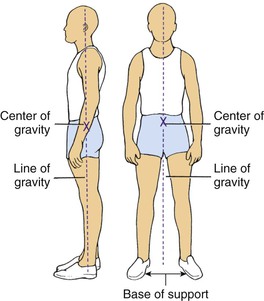
Maintenance of a wide base of support (a stance with feet shoulder width apart) when standing is one of the basic concepts of good body mechanics and alignment that should be followed because it helps in providing better stability (Figure 8-1). Better stability prevents the nurse from losing proper balance while carrying out patient care, which could result in strain or injury to muscles.
The skeletal muscles and the nervous system maintain equilibrium, or balance, which facilitates appropriate body alignment when lifting, bending, moving, and performing other activities. Bending one's knees and hips before attempting these activities protects the back from the stress and potential injury inherent in the physical work of nursing. When stooping, the hips and knees should be flexed or bent and appropriate body alignment maintained (i.e., the back kept straight). Bending from the waist should be avoided because this will, in time, strain the lower back (Figure 8-2). The nurse should work at a height or level that is comfortable to help prevent undue stress and strain on the back muscles. This can be easily accomplished by adjusting the height of the bed to a level appropriate for the nurse's height.
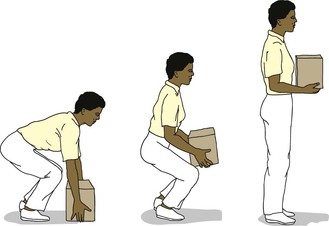
Use of large muscle groups (such as arm and shoulder muscles, hips, and thigh muscles) helps in performing a bigger workload more safely. The more muscle groups used, the more evenly the workload is distributed. If the base of support is widened in the direction of movement, less effort is needed to carry out an activity. To avoid twisting the spine, the nurse should stand directly in front of the person or object being worked with.
Nurses have numerous other ways to protect themselves and the patient from injury. Carrying objects close to the midline of the body (see Figure 8-2), avoiding reaching too far, avoiding lifting when other means of movement are available (such as sliding, rolling, pushing, or pulling), using devices instead of or in combination with lifting, and using alternating periods of rest and activity are just a few of the ways to prevent injury. Knowing the maximum weight that is safe to carry is also important. Many facilities suggest a 50-lb weight limit on lifting for their staff.
Nurses should assess their own abilities and limitations and those of the person helping, if working in pairs. Correct use of body mechanics is essential to providing efficient care while preventing injury (Box 8-1).
 Positioning of Patients
Positioning of patients is a common intervention performed by nursing personnel. Many positions can be used to prevent patients from development of complications (Skill 8-1 and the Patient Teaching box on mobility). Inappropriate positioning poses the risk of causing permanent disability.
 Patient Teaching
Mobility
• Instruct the patient and the family on proper mobility techniques.
• Teach the patient ways to assist with positioning.
• Provide the opportunity for return demonstration.
• Teach the patient and the family signs and symptoms of skin impairment and contractures.
• Teach the patient to avoid prolonged sitting. Frequent stretching decreases joint and muscle contractures.
• Teach the importance of maintaining skin integrity.
• Explain the importance of proper body alignment.
• Explain the importance of rising slowly from lying to sitting, from sitting to standing, and after stooping (prevents orthostatic hypotension).
• Provide time for questions and answers.
• Emphasize the importance of the patient performing active range-of-motion (ROM) exercises when possible.
• If the patient's height prevents the feet from touching the floor when sitting, teach the patient to rest feet on a footstool.
• For prevention of thrombophlebitis, teach patients not to cross their legs when sitting and to avoid prolonged immobility. Teach those at increased risk the signs and symptoms of thrombophlebitis.
Skill 8-1
Positioning Patients


Nursing Action (Rationale)
1. Assess patient's body alignment and comfort level while patient is lying down. (Provides baseline data concerning body alignment and comfort level. Helps determine ways to improve position and alignment.)
2. Assemble equipment and supplies. (Organizes procedure.)
3. Request assistance as needed. (Provides for safety.)
4. Introduce self. (Decreases patient's anxiety.)
5. Identify patient. (Ensures procedure is performed with correct patient.)
6. Explain procedure. (Enlists cooperation from patient and decreases patient anxiety.)
7. Perform hand hygiene. Wear gloves as necessary according to agency policy and guidelines from the Centers for Disease Control and Prevention (CDC) and Occupational Safety and Health Administration (OSHA). (Reduces spread of microorganisms.)
8. Prepare patient. (Prepares for procedure.)
a. Close door or pull curtain. (Provides privacy.)
b. Raise level of bed to comfortable working height. (Promotes good body mechanics in the nurse and safety for the patient.)
c. Remove pillows and devices used in previous position. (Makes access to patient easier.)
d. Put bed in flat position, or as low as patient can tolerate, and lower side rail closest to you. (Facilitates procedure.)
a. Dorsal (supine) position (lying flat on the back) (see illustration).
(1) Place patient on back with head of bed flat. (Necessary for placing patient in supine position.)
(2) Place small rolled towel under lumbar area of back. (Provides support for lumbar spine.)
(3) Place pillow under upper shoulder, neck, and head. (Maintains correct alignment and prevents flexion contractures of cervical lumbar spine.)
(4) Place trochanter rolls parallel to lateral surface of thighs. (Reduces external rotation of hip.)
(5) Place small pillow or roll under ankle to elevate heels. (Reduces pressure on heels, helping to prevent skin impairment.)
(6) Support feet in dorsiflexion with firm pillow, footboard, or high-top sneakers. (Prevents foot drop.)
(7) Place pillows under pronated forearms, keeping upper arms parallel to patient's body (see illustration). (Reduces internal rotation of shoulder and prevents extension of elbows. Maintains correct body alignment.)
(8) Place hand rolls in patient's hands. (Reduces extension of fingers and abduction of thumb.)

b. Dorsal recumbent position (supine position with patient lying on back, head, and shoulder with extremities moderately flexed; legs are sometimes extended).
(1) Move patient and mattress to head of bed. (Ensures appropriate body alignment.)
(2) Turn patient onto back. (Appropriately positions patient.)
(3) Assist patient to raise legs, bend knees, and allow legs to relax. (Puts patient in dorsal recumbent position.)
(4) Replace pillow. Patient sometimes needs a small lumbar pillow. (Provides comfort.)
c. Fowler's position (posture assumed by patient when head of bed is raised 45 to 60 degrees) (see illustration).
(1) Move patient and mattress to head of bed. (Ensures appropriate body alignment.)
(2) Raise head of bed to 45 to 60 degrees. (Positions patient appropriately.)
(3) Replace pillow. (Provides comfort, maintains proper body alignment, and ensures skin integrity.)
(4) Use footboard or firm pillow. (Prevents patient from slipping down in bed.)
(5) Use pillows to support arms and hands. (Provides comfort and maintains correct alignment.)
(6) Place small pillow or roll under ankles. (Reduces risk of skin impairment over heels.)

d. Semi-Fowler's position (posture assumed by patient when head of bed is raised approximately 30 degrees).
(1) Move patient and mattress to head of bed. (Ensures appropriate body alignment.)
(2) Raise head of bed to about 30 degrees. (Positions patient appropriately.)
(3) Replace pillow. (Provides patient comfort.) See Step 9c for positioning of pillows.
e. Orthopneic position (posture assumed by the patient sitting up in bed at 90-degree angle, or sometimes resting in forward tilt while supported by pillow on overbed table) (see illustration). Often used for the patient with a cardiac or respiratory condition.
(1) Elevate head of bed to 90 degrees. (Facilitates positioning.) Patient sometimes sits on side of bed with legs dangling or propped on a chair.
(2) Place pillow between patient's back and mattress. (Provides back support.)
(3) Place pillow on overbed table and assist patient to lean over, placing head on pillow. (Facilitates ease of breathing. Women are more comfortable with arms on pillow and head on arms.)

f. Sims' position (position in which patient lies on side with knee and thigh drawn upward toward chest) (see illustration). The left Sims position is appropriate for the enema procedure and administration of a rectal suppository.
(1) Place patient in supine position. (Prepares patient for position.)
(2) Position patient in lateral position, lying partially on the abdomen. (Patient is rolled only partially on abdomen.)
(3) Draw knee and thigh up near abdomen and support with pillows. (Positions patient appropriately.)
(4) Place patient's lower arm along the back. (Provides appropriate body alignment.)
(5) Bring upper arm up, flex elbow, and support with pillow. (Provides comfort and decreases strain on joints.)
(6) Allow patient to lean forward to rest on chest. (Provides maximum comfort.)

g. Prone position (lying face down in horizontal position) (see illustration).
(1) Assist patient onto abdomen with face to one side. (Facilitates positioning.)
(2) Flex arms toward the head. (Provides appropriate body alignment.)
(3) Position pillows for comfort. Place a pillow under lower leg to release any “pull” on the lower back, or place a pillow under the head as shown (or both). (Increases comfort and maintains proper body alignment.)

h. Knee-chest (genupectoral) position (patient kneels so that weight of body is supported by knees and chest, with abdomen raised, head turned to one side, and arms flexed) (see illustration).
(1) Turn patient onto abdomen. (Facilitates positioning.)
(2) Assist patient into kneeling position; arms and head rest on pillow while upper chest rests on bed. (Allows for as much comfort as possible in this position.)

i. Lithotomy position (patient lies supine with hips and knees flexed and thighs abducted and rotated externally [sometimes feet are positioned in stirrups]) (see illustration).
(1) Position patient to lie supine (lying on the back). (Facilitates positioning.)
(2) Request patient to slide buttocks to edge of examining table. (Facilitates positioning.)
(3) Lift both legs; have patient bend knees and place feet in stirrups. (Positions patient appropriately.)
(4) Drape patient. (Provides privacy.)
(5) Provide small lumbar pillow if desired. (Provides comfort. Pillow under head also provides comfort.)

j. Trendelenburg's position (patient's head is low and the body and legs are on inclined plane) (see illustration).
(1) Place patient's head lower than body, with body and legs elevated and on an incline. Foot of bed is sometimes elevated on blocks. (Not used if patient has a head or chest injury.) Trendelenburg's position was used to treat shock but now is used less often because it causes pressure on the diaphragm by organs in the abdomen and shunts more blood to the brain rather than all of the vital organs. This position is sometimes used to assist in venous distention during central line placement.

k. Lateral position (see Chapter 18).
10. Assess patient for the following: (Provides follow-up with appropriate nursing interventions.)
• Proper body alignment. Small children often need to be propped with pillows to help them maintain a position.
• Comfort. Performing a back massage after turning from one position to another helps prevent impaired skin integrity.
• Skin integrity. Skin of older adults is often thin, lacks elasticity, and needs special care to prevent tearing and further impaired skin integrity.
• Breathing. Additional support is necessary in some positions if patient finds ease of respiratory effort difficult to maintain.
• Tolerance of position. Ongoing observations regarding patient's activity tolerance is provided, and complications of immobility are indicated.
• Repositioning. Reposition debilitated, unconscious, or paralyzed patients at least every 2 hours.
11. Perform hand hygiene. (Reduces spread of microorganisms.)
12. Document. (Records procedure, patient's response, and effectiveness of nursing interventions.)
• Observations (e.g., skin condition, joint movement, patient's ability to assist with positioning)
• Patient teaching (see Patient Teaching and Home Care Considerations boxes).
Step 9a, 9g, and 9h figures from Potter PA, Perry AG: Basic nursing: Essentials for practice, ed 6, St. Louis, 2006, Mosby.
Step 9f figure from Elkin MK, Perry AG, Potter PA: Nursing interventions and clinical skills, ed 4, St. Louis, 2008, Mosby.
Step 9i figure from Seidel HM, Benedict GW, Dains JE, et al.: Mosby's guide to physical examination, ed 6, St. Louis, 2006, Mosby.
Mobility Versus Immobility
Mobility is a person's ability to move around freely in his or her environment. Moving about serves many purposes, including exercising, expressing emotion, attaining basic needs, performing recreational activities, and completing activities of daily living (ADLs; those activities of physical self-care such as bathing, dressing, and eating). In addition, mobility is fundamental to maintaining the body's normal physiologic activities. For normal physical mobility, the body's nervous, muscular, and skeletal systems must be intact, functioning, and used regularly. Although a person may welcome a rare day to lie in bed and rest, the person who is immobile (experiencing immobility, the inability to move around freely) is predisposed to a wide variety of complications (Box 8-2).
Box 8-2
Complications of Immobility and Preventive Measures
Complications
• Muscle atrophy and asthenia (muscle weakness): Muscles decrease in size and strength when not continually used.
• Contractures: When muscles, ligaments, and tendons are not shortened and lengthened with movement, a permanent shortening of these structures may occur.
• Disuse osteoporosis: Lack of weight bearing on bones causes bone demineralization, allowing fractures to occur more easily.
• Pressure ulcer: Tissue ischemia (lack of blood flow to an area) from unrelieved pressure results in skin breakdown.
• Constipation: Immobility slows peristalsis, resulting in stool remaining in the colon longer and muscle atrophy in the abdominal muscles that aid in expulsion of stool.
• Urinary tract infection: Urinary stasis causes changes in pH and allows bacterial growth.
• Renal calculi (kidney stones): Urinary stasis from immobility leads to slowed calcium metabolism, thus leading to stone formation.
• Hypostatic pneumonia: Decreased aeration and accumulation of secretions lead to inflammation and infection in the lungs.
• Orthostatic hypotension (drop in systolic blood pressure of 20 mm Hg or a decrease of 10 mm Hg in diastolic blood pressure within 3 minutes of standing when moving from lying or sitting to standing position): Immobility can lead to a decrease in venous return or decreased cardiac output in response to postural change.
• Anorexia (decreased appetite): Lack of mobility slows the digestive process and slows the metabolic rate, causing decreased appetite.
• Insomnia: Decreased stimuli, depression, and frequent napping during the day as a result of immobility may cause difficulty sleeping at night.
• Disorientation: Lack of stimulation, decreased endorphin production, decreased need for thought processes, and decreased socialization may lead to disorientation.
• Thrombophlebitis and deep vein thrombosis (DVT; blood clot with accompanying inflammation of the involved vein, usually of the lower extremity): Decrease in venous circulation allows blood to pool in lower extremities, leading to inflammation of vessels and clot formation.
• Pulmonary embolism (blood clot that has traveled to the lungs): DVT that has broken loose from vessel and has traveled to the lungs, causing a blockage in a pulmonary vessel.
Interventions
• Reposition at least every 2 hours
• Ensure adequate intake; encourage fluids
• Encourage a well-balanced diet
• Prevent deformities (e.g., footboard or other measures to prevent foot drop)
• Handle and transfer patients carefully; maintain proper body alignment
• Position lower extremities properly (a pillow or wedge between the legs, never under knees)
• Antiembolism measures (thromboembolic deterrent [TED] hose or decompression boots)
During Ambulation
1. Observe the patient closely.
2. Encourage the patient to do the following:
• Keep eyes open and look straight ahead
(These measures aid in preventing vertigo, syncope, weakness, and nausea and vomiting.)
3. If the patient starts to fall, do not attempt to prevent the fall. Ease the patient to the floor. This allows you to break the fall, control its direction, and also protect the patient's head. Follow these steps when assisting a patient's fall:
• Stand with your feet apart. Keep your back straight.
• Bring the patient close to your body as quickly as possible. Use the gait belt if one is worn. If not, wrap your arms around the patient's waist. Move your leg so the patient's buttocks rest on it. Move the leg near the patient (see illustration).
• Lower the patient to the floor by letting the patient slide down your leg. Bend at your hips and knees as you lower the patient (see illustration). (The gravitational pull enables the patient to be lowered to the floor with a minimal amount of strain to your musculoskeletal system.)
• Assist patient to return to bed.
• Report and document the following:
• How activity was tolerated before the fall
• Any report of symptoms before the fall
• The amount of assistance needed by the patient while walking
• Complete an incident report, if required. (Know agency policy.)
4. On a daily basis encourage the following:
• Deep breathing and coughing exercises (spirometry)
 |  |  |
| May support the falling patient under the arms as shown. | The patient's buttocks rest on your leg. | Slide the patient down your leg to the floor. |

Many types of health problems potentially lead to a decline in a patient's mobility. Patients with certain illnesses, injuries, or surgeries sometimes experience a period of immobilization as a result of changes in medical and physical status. In some cases, immobilization is also used therapeutically to limit the movement of the whole body or a body part, and some patients are under ambulation restrictions.
Interventions to prevent complications of immobility are varied, and many do not require a physician's order (see Box 8-2).
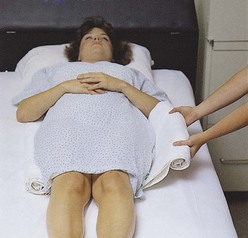
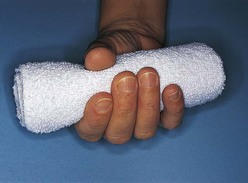
Various assistive devices help maintain correct body positioning and prevent complications that commonly arise when a patient needs prolonged bed rest (Table 8-2). Several of the devices are especially useful in the care of patients who have a loss of sensation, mobility, or consciousness (Figures 8-3 to 8-5).
Table 8-2
Assistive Devices for Proper Positioning
| DEVICE | REASON FOR USE |
| Pillow | Provides support of body or extremity; elevates body part; splints incisional area to reduce postoperative pain during activity or coughing and deep breathing |
| Foot boots or foot boards | Maintain feet in dorsiflexion, which prevents plantar flexion (foot drop) |
| Trochanter roll (see Figure 8-3) | Prevents external rotation of legs when patient is in supine position; possible to make with a bath blanket |
| Sandbag | Provides support and shape to body contours; immobilizes extremity; maintains specific body alignment |
| Hand roll (see Figure 8-4) | Maintains thumb slightly adducted and in opposition to fingers; maintains fingers in slightly flexed position |
| Hand-wrist splint | Individually molded for patient to maintain proper alignment of thumb; slightly adducted in opposition to fingers; maintains wrist in slight dorsiflexion |
| Trapeze bar (see Figure 8-5) | Enables patient to raise trunk from bed; enables patient to transfer from bed to wheelchair; allows patient to perform exercises that strengthen upper arms |
| Side rail | Helps weak patient to roll from side to side or to sit up in bed |
| Bed board | Provides additional support to mattress and improves vertebral alignment |
| Wedge pillow | Also called abductor pillow (triangular pillow made of heavy foam); used to maintain the legs in abduction after total hip replacement surgery |
Modified from Potter PA, Perry AG, Stocket PA: Basic nursing: Essentials for practice, ed 7, St. Louis, 2011, Mosby.

Neurovascular Function
One of the responsibilities of the nurse is frequent monitoring of the patient's neurovascular function, or circulation, movement, and sensation (CMS) assessment. The LPN/LVN checks for skin color, temperature, movement, sensation, pulses, capillary refill, and pain. The affected limb should be compared with the unaffected one (Table 8-3).
Table 8-3
Assessment of Neurovascular Status
| CHARACTERISTIC | ASSESSMENT TECHNIQUE | NORMAL FINDINGS |
| Skin color | Inspect the color of the skin distal to the injury. | The skin color should match that of the unaffected body part. |
| Skin temperature | Palpate the area distal to the injury to determine whether any change in skin temperature has occurred compared with other body parts. | The skin is warm to the touch. |
| Movement | Ask the patient to move the affected area or the area distal to the injury, unless contraindicated. | The patient is able to move with minimal difficulty and with minimal, if any, discomfort. |
| Move the area distal to the injury if the patient is unable to move the body part on his or her own. | No difference in comfort is found compared with the patient actively moving the body part. | |
| Sensation | Ask the patient if numbness or tingling is present (paresthesia), and assess with proper devices as necessary, such as a cotton-tipped applicator or tongue blade. | No numbness or tingling occurs; no difference in sensation is seen in the affected and unaffected body parts. |
| Assess sensation with a cotton-tipped applicator, tongue blade, or other device as indicated. | Loss of sensation may indicate nerve or circulatory impairment. | |
| Pulses | Palpate the pulses distal to the site of injury. | Pulses are strong and easily palpated; no difference is found in the affected and unaffected extremities. |
| Capillary refill | Press the nail beds distal to the injury until blanching occurs (or until the skin near the nail blanches, if nails are thick and brittle); pressure should be applied for approximately 3 to 5 sec. | Blood returns (return to usual color) within 3 sec (5 sec for older adult patients). |
| Pain | Ask the patient about the location, the nature, and the frequency of pain and to rate the pain with a pain scale. | The patient should have no or minimal reports of pain. |
This assessment is especially important when compression from external devices, such as casts and bulky dressings, creates the risk of acute compartment syndrome, which has the potential to cause extensive tissue damage. Acute compartment syndrome occurs in the extremities, especially the legs, where a sheath of inelastic fascia partitions blood vessel, nerve, and muscle tissue. Normally, the pressure in this compartment is less than capillary pressure. However, compression created by external pressure or the accumulation of excessive tissue fluid from severe burns, fractures, crushing injuries, or severely bruised muscles increases compartmental pressure and in some cases leads to compartment syndrome. Ischemic tissue necrosis is likely to occur within 4 to 8 hours unless this pressure is relieved and compartment syndrome reversed (American Academy of Orthopaedic Surgeons, 2009).
Symptoms of acute compartment syndrome include pain within the muscle, especially when stretched, that is more intense than expected from the injury or causative factor; tingling and burning or a feeling of pins and needles in the affected area (paresthesias); and a full or tight feeling in the muscle. Numbness and paralysis are late signs of compartment syndrome and may be indicative of permanent damage.
Acute compartment syndrome is an emergency situation. The earlier compartment syndrome is treated, the better the prognosis. If acute compartment syndrome is caused by an external device, such as a cast or tight bandage, the pressure should be removed immediately by cutting away these devices. If the syndrome is caused by other factors, surgical intervention may be required. A fasciotomy may be necessary, in which the surgeon makes an incision into the skin and fascia to release the pressure. This incision is sometimes left open until swelling subsides.
Chronic compartment syndrome is not an emergency situation and is usually caused by exercise that involves repetitive movement, such as bicycling or running. The symptoms include pain and cramping during exercise, visible muscle bulging, and numbness. These symptoms are usually alleviated by discontinuing the activity and by rest.
Performance of Range-of-Motion Exercises
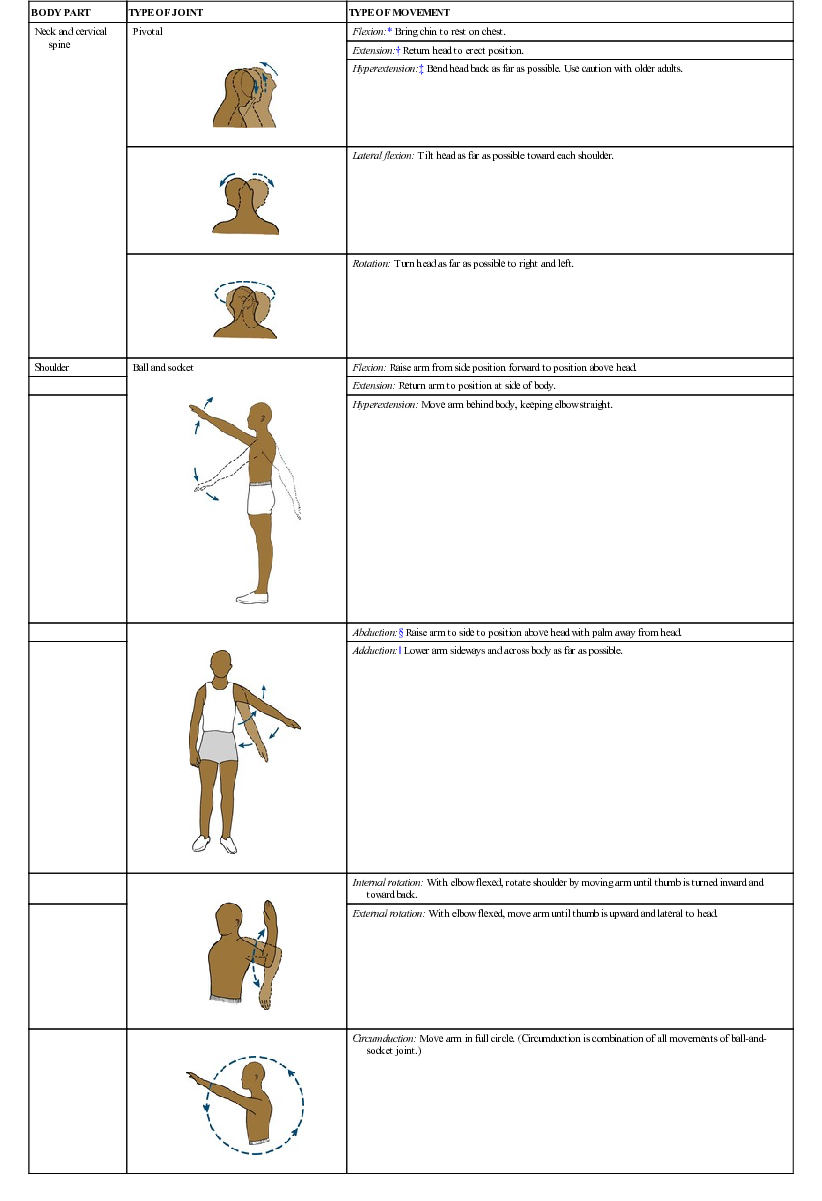
Regardless of whether the causes of immobility are permanent or temporary, the immobilized patient needs some type of exercise to prevent excessive muscle atrophy and joint contracture. The nurse and other health care personnel, including members of the physical therapy department, help the patient with decreased mobility to perform range-of-motion (ROM; movement of the body that involves the muscles and joints in natural directional movements) exercises. Passive ROM exercise is performed by caregivers, and active ROM by patients. The designated joint (any one of the connections between bones) is moved actively or passively to the point of resistance or pain, with avoidance of injury. ROM exercises are increased with subsequent exercises as tolerated (Table 8-4 and Skill 8-2). 
Table 8-4
Joint Range-of-Motion Exercises
| BODY PART | TYPE OF JOINT | TYPE OF MOVEMENT |
| Neck and cervical spine | Pivotal | Flexion:* Bring chin to rest on chest. |
| Extension:† Return head to erect position. | ||
| Hyperextension:‡ Bend head back as far as possible. Use caution with older adults. | ||
 | Lateral flexion: Tilt head as far as possible toward each shoulder. | |
 | Rotation: Turn head as far as possible to right and left. | |
| Shoulder | Ball and socket | Flexion: Raise arm from side position forward to position above head. |
| Extension: Return arm to position at side of body. | ||
| Hyperextension: Move arm behind body, keeping elbow straight. | ||
 | Abduction:§ Raise arm to side to position above head with palm away from head. | |
| Adduction:‖ Lower arm sideways and across body as far as possible. | ||
 | Internal rotation: With elbow flexed, rotate shoulder by moving arm until thumb is turned inward and toward back. | |
| External rotation: With elbow flexed, move arm until thumb is upward and lateral to head. | ||
 | Circumduction: Move arm in full circle. (Circumduction is combination of all movements of ball-and-socket joint.) | |
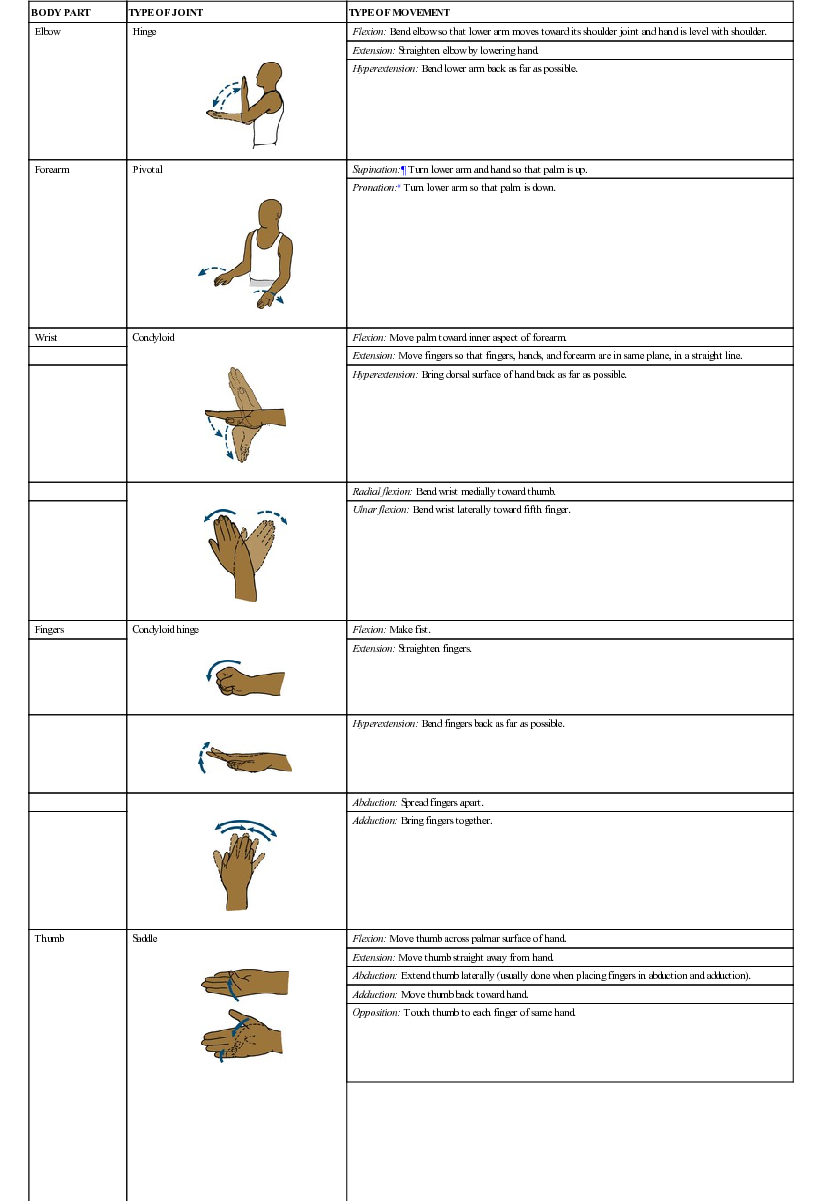
| Elbow | Hinge | Flexion: Bend elbow so that lower arm moves toward its shoulder joint and hand is level with shoulder. |
| Extension: Straighten elbow by lowering hand. | ||
| Hyperextension: Bend lower arm back as far as possible. | ||
| Forearm | Pivotal | Supination:¶ Turn lower arm and hand so that palm is up. |
| Pronation:# Turn lower arm so that palm is down. | ||
| Wrist | Condyloid | Flexion: Move palm toward inner aspect of forearm. |
| Extension: Move fingers so that fingers, hands, and forearm are in same plane, in a straight line. | ||
| Hyperextension: Bring dorsal surface of hand back as far as possible. | ||
 | Radial flexion: Bend wrist medially toward thumb. | |
| Ulnar flexion: Bend wrist laterally toward fifth finger. | ||
| Fingers | Condyloid hinge | Flexion: Make fist. |
| Extension: Straighten fingers. | ||
 | Hyperextension: Bend fingers back as far as possible. | |
 | Abduction: Spread fingers apart. | |
| Adduction: Bring fingers together. | ||
| Thumb | Saddle | Flexion: Move thumb across palmar surface of hand. |
| Extension: Move thumb straight away from hand. | ||
| Abduction: Extend thumb laterally (usually done when placing fingers in abduction and adduction). | ||
| Adduction: Move thumb back toward hand. | ||
| Opposition: Touch thumb to each finger of same hand. | ||
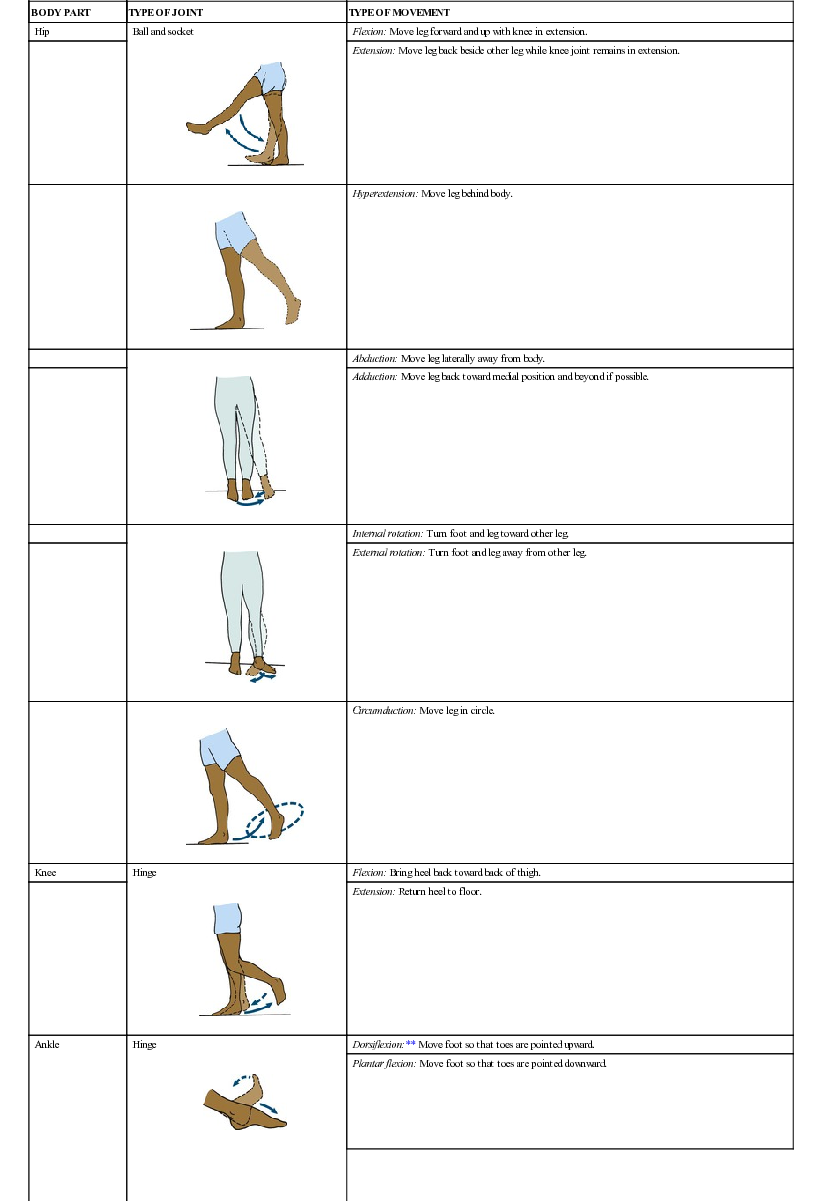
| Hip | Ball and socket | Flexion: Move leg forward and up with knee in extension. |
| Extension: Move leg back beside other leg while knee joint remains in extension. | ||
 | Hyperextension: Move leg behind body. | |
 | Abduction: Move leg laterally away from body. | |
| Adduction: Move leg back toward medial position and beyond if possible. | ||
 | Internal rotation: Turn foot and leg toward other leg. | |
| External rotation: Turn foot and leg away from other leg. | ||
 | Circumduction: Move leg in circle. | |
| Knee | Hinge | Flexion: Bring heel back toward back of thigh. |
| Extension: Return heel to floor. | ||
| Ankle | Hinge | Dorsiflexion:** Move foot so that toes are pointed upward. |
| Plantar flexion: Move foot so that toes are pointed downward. | ||
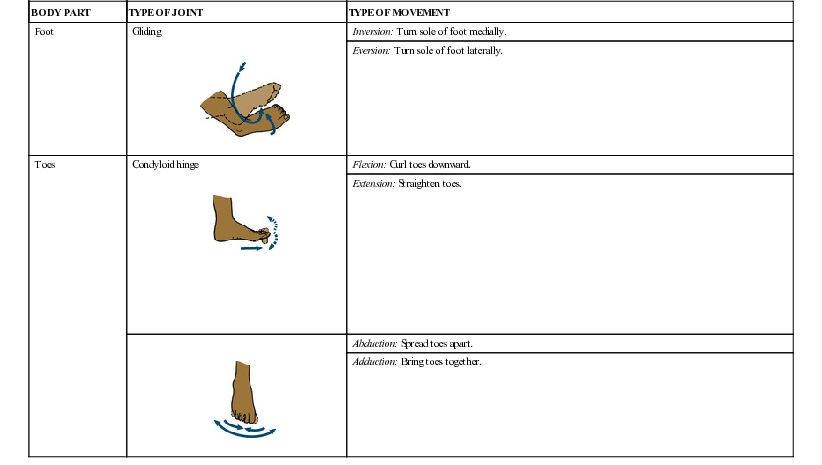
| Foot | Gliding | Inversion: Turn sole of foot medially. |
| Eversion: Turn sole of foot laterally. | ||
| Toes | Condyloid hinge | Flexion: Curl toes downward. |
| Extension: Straighten toes. | ||
 | Abduction: Spread toes apart. | |
| Adduction: Bring toes together. |
* Flexion: Movement of certain joints that decreases angle between two adjoining bones.
† Extension: Movement of certain joints that increases angle between two adjoining bones.
‡ Hyperextension: Extreme or abnormal extension.
§ Abduction: Movement of limb away from body.
‖ Adduction: Movement of limb toward axis of body.
¶ Supination: Kind of rotation that allows palm of hand to turn up.
# Pronation: Palm of hand turned down.
** Dorsiflexion: To bend or flex backward.
Figures from Potter PA, Perry AG: Fundamentals of nursing: Concepts, process, and practice, ed 6, St. Louis, 2006, Mosby.
Modified from Potter PA, Perry AG: Basic nursing: Essentials for practice, ed 7, St. Louis, 2012, Mosby.
Skill 8-2
Performing Range-of-Motion Exercises
Nursing Action (Rationale)
1. Refer to medical record or care plan for special interventions. (Provides basis for care.)
2. Assemble equipment. (Organizes procedure.)
• Clean gloves, if necessary (see step 6).
3. Introduce self. (Decreases patient's anxiety.)
4. Identify patient. (Ensures procedure is performed with correct patient.)
5. Explain procedure. (Enlists cooperation and decreases patient's anxiety.)
6. Perform hand hygiene and don clean gloves according to agency policy and guidelines from CDC and OSHA. (Reduces spread of microorganisms.)
7. Prepare patient for intervention:
a. Close door to room or pull curtain. (Provides privacy.)
b. Drape for procedure if appropriate. (Prevents unnecessary exposure of patient.)
c. Raise bed to comfortable working level. (Promotes good body mechanics in the nurse and safety for the patient.)
d. Assist patient to a comfortable position, either sitting or lying down. (Ensures patient's comfort.)
e. Medicate patient as needed for pain. (Promotes patient comfort.)
8. Support the body part above (proximal to) and below (distal to) the joint by cradling the extremity or by using cupped hand to support the joint being exercised. (Protects the weaker joints and muscles.)

9. Begin by doing exercises in normal sequence (see Table 8-4). Repeat each full sequence 5 times during the exercise period. (Exercises are easiest to perform in head-to-toe manner.) Discontinue exercise if patient reports pain or if resistance or muscle spasm occurs.
10. Assist patient by putting each joint through full range of motion (see Table 8-4). (Provides baseline for joint movement.)
11. Position patient for comfort. To prevent contracture (an abnormal shortening of a muscle), do not allow patients with joint pain to remain continuously in position of comfort; joints must be exercised routinely. (Immobility contributes to contractures.) Periodically provide back massage. (Provides comfort.)
12. Adjust bed linen. (Provides comfort and privacy.)
13. Remove and dispose of gloves and wash hands. (Reduces spread of microorganisms.)
14. Document the following: (Records procedure and patient's response.)
• Presence of edema or pressure areas
• Any discomfort resulting from the exercises
• Patient's tolerance of the exercises
• Patient teaching (see Patient Teaching box Home Care Considerations boxes)
Step 8 figure from Elkin MK, Perry AG, Potter PA: Nursing interventions and clinical skills, ed 4, St. Louis, 2008, Mosby.
Some patients who are weak or partially paralyzed are able to move a limb partially through ROM and the nurse may then assist the patient to finish the full ROM. This is referred to as passive assisted ROM. Active assisted ROM occurs when the patient uses the strong arm to exercise the weaker or paralyzed arm. The LPN/LVN best meets the needs of the patient by encouraging the patient to be as independent as possible.
Assessment by the nurse and the physical therapy department determines the patient's current mobility status. The patient who is able to move about freely independently performs ADLs and active ROM exercises. Patients who are partially immobile or unable to move about freely (from paraplegia, quadriplegia, weakness, or fatigue) need the nurse and other health care personnel to assist with passive ROM exercises.
Encourage and assess active ROM every day (see Life Span Considerations for Older Adults box). The total amount of activity required to prevent physical disuse syndrome (a state in which an individual is at risk for deterioration of body systems due to prescribed or unavoidable inactivity) is only about 2 hours for every 24-hour period. Schedule this activity throughout the day to prevent the patient from remaining inactive for long periods (Ackley and Ladwig, 2011).
Lifespan Considerations
Older Adults
Range-of-Motion Exercises
• Some older adults who have chronic illnesses need to separate range-of-motion (ROM) exercises into two or more sessions to control fatigue.
• Inadequate intake of calcium or exposure to sunlight increases older adults' risk of bone loss and increases the need for ROM and weight-bearing exercise.
• Older people who fear falling often display reluctance to move about freely. Encouragement, reassurance, and assistance from family members and caregivers decrease anxiety.
• Older adult patients who are depressed often prefer to stay in bed, especially when they were accustomed to being very independent and active and now need assistance.
• Many older adults with arthritis require additional time in the morning before resuming activities.
• Even without arthritis, older adults often need more time in the morning to resume activity.
Continuous Passive Motion Machines
Continuous passive motion (CPM) machines flex and extend joints for passive mobilization without the strain of active exercises (Figure 8-6). This therapy is frequently used immediately after total knee replacement surgery (knee arthroplasty), but CPM can also be used in outpatient or home physical therapy programs. The CPM machine's settings must be adjusted according to the health care provider's orders for the degree and the speed of flexion and extension for each individual patient to prevent damage to the joint or surgical site. Some recent studies question the necessity of CPM machines and encourage the use of immediate physical therapy instead.
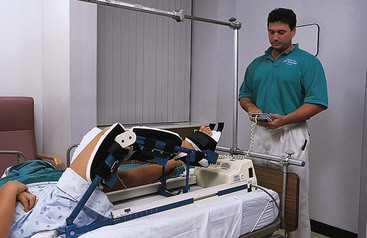
CPM machines can be used on joints other than the knee, including the hip, the shoulder, and the ankle. Mobilization of the joint prevents complications, such as joint contracture, atrophy of surrounding muscles, and thromboembolism.
With use of a CPM machine, consider the following (Perry et al., 2012):
• Older adults who need CPM therapy after discharge sometimes must enter a rehabilitation facility or have home care because the equipment is not easy to manipulate.
• Older adults with fragile skin are at a high risk of skin impairment from pressure of the CPM machine. Closely monitor pressure points such as the heel.
• Physical therapy is frequently used in addition to the CPM therapy.
• If the patient is using CPM at home, ensure that the patient and the family members assisting with care are given instructions on use of the CPM machine, prescribed settings, and parameters for contacting the physician.
• The goals of CPM therapy are to increase or maintain mobility by improving joint range of motion and to prevent skin breakdown at pressure points.
• Care of the patient during CPM therapy can be delegated to assistive personnel, but assessment of the patient must not be. Assessment remains a nursing responsibility.
Moving the Patient
A common nursing action is assisting patients in movement. Patients may need assistance in various ways, such as moving the patient up in bed, out of bed, or from a chair or wheelchair; turning the patient; and assisting the patient in and out of the bed for ambulation (Skill 8-3). For some situations, the nurse uses mechanical equipment for lifting patients, such as the hydraulic lift, roller board, and gurney lift. The nurse should first mentally think through the lift in an effort to be prepared for lifting the patient and then physically perform the lift. The nurse must ensure that patients do not become too dependent on assistance with mobility. Frequent assessment of the patient's ability to assist with mobility is necessary to prevent overdependence. The LPN/LVN should also assess the patient for pain and administer pain medications before activities that cause further pain (Box 8-3 and Coordinated Care box).
 Coordinated Care
Delegation
Mobility
The following information is needed when delegating the skill of position changes to UAP:
• Have the patient wear shoes with a nonslip surface during transfer or ambulation.
• Make slow, gradual position changes.
• Help the patient sit in a chair or return to bed if the patient has symptoms of orthostatic hypotension.
• When assisting with ambulation:
• Do not try to hold patients if they become dizzy or faint. Ease them into a sitting position in a chair or onto the floor.
• Use assistive devices such as walkers, crutches, gait belt, or cane when appropriate.
• Be sure the area is free of clutter, wet areas, and rugs that may slide.
Skill 8-3
Moving the Patient
Nursing Action (Rationale)
1. Refer to the medical record or care plan for special interventions. (Provides basis for care.)
2. Assemble equipment. (Organizes procedure.)
• Lifting devices (see Skill 8-4)
3. Introduce self. (Decreases patient's anxiety.)
4. Identify patient. (Ensures procedure is performed with correct patient.)
5. Explain procedure. (Enlists cooperation and assistance from patient and decreases patient's anxiety.)
6. Perform hand hygiene. (Reduces spread of microorganisms.)
7. Prepare patient for interventions.
a. Close door or pull curtain. (Provides privacy.)
b. Adjust bed level for safe working height. (Promotes good body mechanics in the nurse and safety for the patient.)
c. Medicate patient as needed. (Promotes patient comfort.)
8. Arrange for assistance as necessary. (Provides for safety.)
9. Lift and move patient up in bed (sometimes requires one nurse and sometimes more):
a. Place patient supine with head flat. (Creates less resistance on flat surface.)
b. Face the patient and establish base of support. (Protects your back.)
c. Use a lift (draw) sheet to assist patient up in bed. (Supports patient, assists staff, and prevents shearing of patient's skin.)
(1) Roll patient first to one side and then the other, placing lift sheet underneath patient from shoulders to thighs. (Facilitates the position change.)
(2) Flex knees and face body in the direction of the move. The foot farthest away from the bed faces forward for broader base of support.
(3) With one nurse on each side of patient, grasp lift sheet firmly with hands near patient's upper arms and hips, rolling the sheet material until hands are close to the patient. (The closer the nurse is to the patient, the less the nurse needs to raise the patient up to clear the bed during the move.)
(4) Instruct patient to rest arms over body and to lift head on the count of 3; at the same time, pull the sheet to move the patient up to head of bed.

a. Stand with feet slightly apart and flex knees. (Provides base of support.)
b. If the patient is unable to assist in turning, two people should use the lift sheet to turn the patient. (Provides patient safety and support and protects the back of the persons assisting with the turn.)
c. Move patient's body to one side of the bed. (Allows room for the patient to turn in the bed.)
d. If patient is assisting in turning, turn the patient on side facing raised side rail, toward the nurse. (Prevents patient from falling out of bed.) If patient is not assisting, then use the lift sheet to turn the patient.
e. Flex one of patient's legs over the other. Place pad or pillow between legs. (Reduces pressure on lower leg and prevents skin breakdown by avoiding skin on skin.)
f. Align patient's shoulders; place pillow under head. (Ensures proper body alignment.)
g. Support patient's back with pillows as necessary. A “tuck back” pillow is made by folding pillow lengthwise. Tuck smooth area slightly under patient's back. (Helps keep patient in position.)
a. Assess pulse and respirations. (Provides baseline for assessing patient's response to dangling.)
b. Move patient to side of bed toward the nurse. (Makes it easier for patient to sit up. Request patient do by self if possible.)
c. Lower bed to lowest position. (Provides patient safety when getting up.)
d. Raise head of bed. (Patient can swing around more easily to sitting position.)
e. Support patient's shoulders and help to swing legs around and off bed; do this all in one motion by simply pivoting patient. Ensure patient's feet touch floor. (Prevents strain on patient, especially if patient has an incision.)

f. Another way to accomplish this is by rolling the patient onto his or her side before sitting the patient up. (Decreases the amount the nurse needs to lift because the patient's body weight actually helps the patient to sit upright.) The nurse then stoops and, when standing, brings the patient along with the nurse. (This causes less back strain for the nurse and the patient does not feel pulled on.)
g. Help patient place slippers on; cover legs. (Prevents patient from becoming chilled.) For safety, have patient place slippers on while in bed.
h. Assess patient's pulse and respirations. (Determines patient's response to procedure.)
12. Log-rolling the patient (back, neck, or head conditions sometimes necessitate log-rolling after injury or surgery):
a. Enlist the help of at least one additional person. (Ensures patient safety.)
b. Lower the head of the bed as much as the patient can tolerate. (Maintains alignment of the spinal column.)
c. Place a pillow between the patient's legs. Use of a pull sheet placed between shoulders and knees facilitates turning (see Step 9g[1]). (Maintains position of the lower extremities.)
d. Extend the patient's arm over the patient's head unless shoulder movement is restricted. (Prevents rolling over it during the turn.) If shoulder movement is restricted, keep the arm in extension next to the body.
e. With both nurses on the same side of the bed, one of the nurses places one hand on the patient's shoulder and the other on the hip, while the other nurse places one hand to support the patient's back and the other behind the knee. If a lift sheet is used, space hands in such a way to provide even support for the length of the rolled sheet and to distribute weight evenly.

f. On a count of 3, turn the patient with a continuous, smooth, and coordinated effort. (Maintains body alignment, preventing stress on any part of the body.)
g. Support the patient with pillows as previously discussed (see Step 10g). (Promotes patient comfort.)
13. Transferring the patient from bed to straight chair or wheelchair:
a. Lower bed to lowest position. (Provides patient safety when getting up.)
b. Raise head of bed. (Patient can more easily swing around to sitting position.)
c. Support patient's shoulders and help swing legs around and off bed; perform all in one motion. (Prevents strain on patient, especially if patient has incision.)

d. Help patient don robe and slippers (or do this before beginning procedure). (Prevents chilling.)
e. Have chair positioned beside bed with seat facing foot of bed. (Provides easy access to chair.)
(1) Place wheelchair at right angle to bed and lock wheels after bed is lowered. (Provides safety.)
(2) Place straight chair against wall or have another nurse hold the chair. (Provides safety.)
f. Stand in front of patient and place hands at patient's waist level or below; allow patient to use his or her arms and shoulder muscles to push down on the mattress to facilitate the move. (Prepares the patient for movement to chair.)

g. Assist patient to stand and swing around with back toward seat of chair. Keep the strong side toward the chair. (Provides safety.)
h. Help patient to sit down as the nurse bends his or her knees to assist process. (Prevents patient from slipping and falling. If patient begins to fall, prevent patient injury by holding patient and allowing patient to sit down gently on floor; see Box 8-2, step 3.)

i. Apply blanket to legs. (Provides extra warmth.)
j. If transfer belt is used, apply after patient is sitting on side of bed and follow these guidelines:
(1) Stand in front of the patient. (Permits excellent view of patient.)
(2) Have the patient hold on to the mattress, or ask the patient to place his or her fists on the bed by the thighs. (Any assistance from the patient minimizes strain on you.)
(3) Be sure the patient's feet are flat on the floor. (Provides balance and stability for patient.)
(4) Have the patient lean forward.
(5) Instruct the patient to place his or her hands on the nurse's shoulders, not around the nurse's neck or at the side as shown. (Arms around the neck could result in neck injury to nurse.)
(6) Grasp the transfer belt at each side. (Offers stability of patient for the nurse.)
(7) Brace knees against the patient's knees. Block the patient's feet with the nurse's feet. (Provides safety and prevents patient's foot from slipping.)

(8) Ask the patient to push down on the mattress and to stand on the count of 3. Pull the patient into a standing position as you straighten your knees. (Provides for less strain on your back.)

(9) Pivot the patient so he or she is able to grasp the far arm of the chair. Back of the legs will be touching the chair. (Enables patient to assist in the transfer.)
(10) Continue to turn the patient until the other arm rest is grasped.
(11) Gradually lower the patient into the chair as you bend your hips and knees. The patient assists if able by leaning forward and bending his or her elbows and knees. (Encourages patient to assist in transfer and increases muscle strength and a sense of control.)
(12) Ensure buttocks are to the back of the chair. (Ensures patient safety.)
(13) Cover patient's lap and legs. (Promotes patient's comfort and privacy.)
14. Transferring from bed to stretcher or gurney back to bed:
a. Position bed flat and raise to the same height as stretcher or gurney. Lower side rails. (Facilitates procedure.)
b. Cover patient with top sheet or blanket and remove linens without exposing patient. (Provides privacy.)
c. Assess for IV line, Foley catheter, tubes, or surgical drains, and position them to avoid tension during the transfer. (Prevents accidental tension and possible removal of tubes.)
d. Position the gurney as close to the bed as possible, and lock the wheels of the bed and gurney (with side rails lowered). (Ensures patient's safety.)
e. When patient is able to assist, stand near side of gurney and instruct patient to move feet, then buttocks, and finally upper body to the gurney, bringing blanket along. Be certain patient's body is centered on the gurney. (Promotes safety and security.)
f. When patient is unable to assist, place a folded sheet or bath blanket under the patient so that it supports patient's head and extends to mid-thighs. Roll the sheet or bath blanket close to the patient's body. Assist patient to cross arms over chest. Two nurses reach over the bed to patient, and two more nurses stand as close to the gurney as possible. A fifth nurse stands at the foot to transfer the feet. Using a coordinating count of 3, all five nurses lift the patient to the edge of the bed. With another effort, lift the patient from edge of bed to gurney. Roller devices are available in some facilities to facilitate this transfer.

15. Perform hand hygiene. (Reduces spread of microorganisms.)
16. Assess patient for appropriate body alignment after move. When repositioning, always assess previously dependent skin surfaces (pressure areas). Position pillows for comfort. Do not overtire patient during ambulation. As in all transfers, be certain call device is in easy reach. (Evaluates, determines, and promotes patient safety and comfort.)
17. Document procedure. (Notes procedure and patient's response.)
• Expected and unexpected outcomes
• Patient teaching (see Patient Teaching and Home Care Considerations boxes)
Step 9c(4), 12e, 13j(7), 13j(8) figures from Sorrentino SA: Assisting with patient care, ed 2, St. Louis, 2004, Mosby.
Step 11e figure from Perry AG, Potter PA: Clinical nursing skills and techniques, ed 7, St. Louis, 2010, Mosby.
Step 13c, step 13f, step 13h figures from Potter PA, Perry AG: Basic nursing: Essentials for practice, ed 6, St. Louis, 2006, Mosby.
Step 14f figure from Elkin MK, Perry AG, Potter PA: Nursing interventions and clinical skills, ed 4, St. Louis, 2008, Mosby.
Use of the Lift for Moving Patients
Mechanical devices, such as the patient lift with a sling (Figure 8-7), are useful for moving patients safely and protecting the nurse's back and for full-weight lifting of patients who cannot assist. Follow agency policy for use of the lift (Skill 8-4).

Skill 8-4
Using Lifts for Moving Patients
Nursing Action (Rationale)
1. Refer to medical record or care plan for special interventions. (Provides basis for care.) Read manual for direction.
• Mechanical lift frame (see Figure 8-7)
• Seat sling attachment (may be one piece or two) or a standing frame
3. Introduce self. (Decreases patient's anxiety.)
4. Identify patient. (Ensures procedure is performed with correct patient.)
5. Explain procedure. (Enlists cooperation and assistance from patient and decreases patient's anxiety.)
6. Perform hand hygiene. (Reduces spread of microorganisms.)
7. Prepare patient for interventions.
a. Close door or pull curtains. (Provides privacy.)
b. Adjust bed level to working height (even with level of arm of chair [of lift] if chair is not removable or level with seat if chair is removable.) (Promotes safety.)
c. Medicate patient as needed. (Promotes patient comfort.)
d. Place cotton bath blanket over chair for patient's comfort.
e. Cover patient with remaining bath blanket.
8. Secure adequate number of personnel. (Provides necessary assistance and patient safety.)
9. Place chair near bed. (Prepares seat for patient.)
10. Appropriately place canvas seat under patient; support head and neck. (Helps in lifting safely.)
11. Slide horseshoe-shaped bar under bed on one side. (Places lift close to bed.)
12. Lower horizontal bar to level of sling. (Places lift close to patient.)
13. Fasten hooks on chain to openings in sling. (Attaches lift to sling seat.)
14. Raise head of bed. (Places patient in sitting position.)
15. Fold patient's arms over chest. (Prevents patient injury.)
16. Pump lift handle until patient is raised off bed. (Ensures patient safety during lifting.)
17. With steering handle, pull lift off bed and down to chair. (Places patient safely in chair provided.)
18. Release valve slowly to lift and lower patient toward chair. (Appropriately places patient in chair.)
19. Close off valve and release straps. (Prevents patient injury from boom.)
20. Remove straps and lift. (Provides safety and comfort.)
21. Perform hand hygiene. (Reduces spread of microorganisms.)
22. Document procedure. (Note procedure and patient's response.)
• Evaluate body alignment to help prevent skin impairment.
• Evaluate patient's response to movement to help determine patient's mobility potential.
23. Perform patient teaching (see Patient Teaching and Home Care Considerations boxes).
 Nursing Process for Patient Mobility
The role of the LPN/LVN in the nursing process as stated is that the LPN/LVN.
• Participates in planning care for patients based on patient needs.
• Reviews the patient's plan of care and recommends revisions as needed.
• Reviews and follows defined prioritization for patient care.
• Uses clinical pathways, care maps, or care plans to guide and review patient care.
 Assessment
Assessment focuses on ROM, muscle strength, activity tolerance, gait, and posture. Observation during ADLs enables the nurse to estimate the patient's fatigability, muscle strength, and ROM. Further assessment helps determine the type of assistance the patient needs to change position or transfer from bed to chair or wheelchair. These assessments give the LPN/LVN an understanding of the patient's overall level of mobility and coordination (see the Cultural Considerations box).
 Cultural Considerations
Promotion of Patient Mobility
• Assess and listen carefully to patient's expressions of health and illness beliefs and practices.
• Be aware of the patient's personal space; seek permission before intruding in the patient's territory.
• The nursing process enables the nurse to provide individualized care; adapt care to be culturally sensitive.
• When speaking with a patient (or family member) who does not understand English, many people try to compensate for the lack of understanding by speaking more loudly. Speaking slowly, distinctly, and in a normal volume is more effective (see Chapter 6).
It is acceptable to delegate the skills of safe and effective transfer from bed to chair to UAP who have successfully demonstrated good body mechanics and safe transfer techniques for patients involved.
Teaching patients how to use assistive devices requires critical thinking and knowledge application unique to a nurse. However, UAP are able to assist ambulatory patients with assistive devices.
• Have patient wear shoes with a nonskid surface during ambulation.
• Be sure the area is free of clutter, wet areas, and rugs that may slide or buckle.
• Ensure UAP know how to use an intravenous (IV) pole to assist in ambulation for patients with continuous IV therapy.
• Be sure the patient uses the correct gait and weight bearing during ambulation.
• Ease patients to a sitting position in a chair or on the floor if they become dizzy or faint.
• Alert the LPN/LVN if a patient becomes dizzy or lightheaded or suffers a fall.
The skill of performing ROM exercises can be delegated to UAP. Patients with spinal cord or orthopedic trauma or surgery usually require exercise by nurses or physical therapists. When delegating this skill, the nurse should instruct UAP to perform exercises slowly and provide adequate support to the joint being exercised. In addition, the nurse should remind UAP not to exercise joints beyond the point of resistance or to the point of fatigue or pain. In addition, if muscle spasms occur, exercise should stop until the spasms have subsided.
The nurse may delegate the skill of safe and effective transfer with a mechanical lift to UAP who have demonstrated ability to use good body mechanics and safe transfer techniques and equipment (mechanical lift).
Nursing Diagnosis
Assessment enables the nurse to cluster relevant data and develop actual or potential (risk) nursing diagnoses related to the patient's needs. The nursing diagnoses are stated along with the probable causes “related to (r/t).” Identification of the cause of the problem further individualizes the care plan and leads to selection of appropriate care.
Expected Outcomes and Planning
The nurse should set goals and expected outcomes with the patient to direct interventions. Care planning is individualized to the patient, with the patient's most immediate needs taken into consideration. These goals are based on the nursing diagnosis formulated.
Implementation
Nursing interventions should be individualized according to the level of risk to the patient. The nurse, the patient, and other members of the health care team work together to determine the most effective interventions (Nursing Care Plan 8-1). While implementing the established goals, the nurse should also assess the patient's readiness to learn and teach appropriate body mechanics (see the Home Care Considerations box on mobility).
 Home Care Considerations
Mobility
• Instruct family or caregiver in the rationale for slow, gradual position changes.
• Instruct family or caregiver in the use of a gait belt and correct body mechanics for transfer of patient.
• Instruct family or caregiver to not attempt ambulation if patient reports dizziness or lightheadedness.
• Transfer ability at home is greatly enhanced by prior teaching of family, assessment of home for safety risks and functionality, and provision of applicable aids.
• Have family practice transfer in hospital and achieve success before taking patient home.
• Alternatively, have the patient who lives alone practice activities because he or she will be used at home to manage the toileting and showering. Teach patients to transfer to armchairs for ease of rising and sitting.
• Be sure the home is free of risks (i.e., throw rugs, electric cords, slippery floors). If wheelchair is used, see that access is possible through all doors and that space for transfer is available in bedroom and bathroom.
• Ensure arrangements are made for a home health nurse or support person to continue to assist the family at home.
• Instruct patient in how to use the ambulation aids on various terrains (e.g., carpet, stairs, rough ground, inclines).
• Instruct patient in how to maneuver around obstacles, such as doors, and how to use the aid when transferring, such as to and from a chair, toilet, tub, and car.
• Attach a carrying bag to patient's walker to carry objects; caution patient not to overfill the bag to prevent forward tipping of walker.
• Assess family member or primary caregiver's ability, availability, and motivation to assist patient with exercises that patient is unable to perform independently.
• Assist family or primary caregiver to arrange home environment to promote exercise program (e.g., space allocation, lighting, temperature, safety precautions).
• Teach family members about body mechanics.
• In the absence of a hospital bed and equipment, creative adaptation is necessary.
• Consider the need for a bed that places the bedridden patient at caregiver's waist level.
• Teach caregivers to change patient's position every 1 to 2 hours, if possible, to maintain musculoskeletal alignment and to reduce pressure on bony prominences. Develop and post a realistic turning schedule.
 Nursing Care Plan 8-1
The Patient With Activity Intolerance
Mr. D., a 56-year-old patient hospitalized with multiple orthopedic traumas, reports pain in his left shoulder during movement. He also reports difficulty extending his shoulder joint in carrying out activities of daily living. The nurse observes that he limits motion in his left arm. Range of motion (ROM) is reduced 30 degrees during abduction of arm.
Nursing Diagnosis
Impaired bed mobility, related to (r/t) left shoulder pain as evidenced by (AEB) limited mobility of left arm, c/o (complaints of) pain and favoring left arm
| Patient Goals and Expected Outcomes | Nursing Interventions | Evaluation |
Offer analgesic 30 min before ROM exercises (peak action of analgesic will occur as patient begins exercises). Schedule active ROM exercises between meals and hygiene activities (promotes frequent exercise to affected joints and reduces risk of contracture development). Teach patient specific ROM exercises for left shoulder and arm. (Teaching provides the patient with opportunity and knowledge to maintain and increase ROM.) (See Patient Teaching and Home Care Considerations boxes on mobility.) |

Critical Thinking Questions
1. The nurse is in the process of transferring Mr. D. from his bed to a chair with use of a mechanical lift. The nurse has prepared the chair and placed it near the bed. The nurse turns Mr. D. to his side, places the sling under Mr. Davis to ensure adequate support of his head, returns Mr. D. to his back, and slowly begins to lift him from his bed. What has the nurse forgotten to do, and why is it important?
2. The patient has a trapeze bar across the bed, trochanter rolls, and a footboard. Explain the rationale for use of each of these devices to maintain proper body alignment.
The nurse is aware of the patient's motor deficits, ability to aid in transfer, and body weight. As suggested by the National Institute for Occupational Safety and Health's (NIOSH) Division of Safety Research, health care personnel should never attempt to lift more than 35 pounds of a patient's body weight (Howard, 2010). For the safety of the staff and the patient, additional assistance should always be secured when the transferability of a patient is in doubt.
Many special problems are to be considered in transfer. Patients who have been immobile for several days or longer may be weak or have vertigo (dizziness) and sometimes have orthostatic hypotension (a drop in blood pressure) when transferred. A patient with neurologic deficits perhaps has paresis (muscle weakness) or paralysis unilaterally or bilaterally, which complicates safe transfer. A flaccid arm can easily sustain injury during transfer if unsupported. The nurse must be creative when necessary in the transfer of trauma patients. As a general rule, a gait (transfer) belt should be used and assistance obtained for mobilization of such patients.
Evaluation
The success of interventions is evaluated with a comparison of the patient's response with the outcome established for each nursing goal, such as the following:
1. Ask the patient to rate fatigue on a scale of 1 to 10 (determines need for additional pain control).
2. Note the patient's behavioral response to transfer (reveals level of motivation and self-care potential).
For evaluation of the patient's perception of the interventions, knowledge of the patient's expectations concerning joint mobility, posture, or body alignment is necessary first. What is acceptable or anticipated on the nurse's part is sometimes vastly different from what the patient and family members anticipate or are able to accept.