Chapter 1
History of Microbiology
Introduction
Medical microbiology is a branch of microbiology that deals with the study of microorganisms including bacteria, viruses, fungi and parasites of medical importance that are capable of causing diseases in humans. It also includes the study of microbial pathogenesis, disease pathology, immunology and epidemiology of diseases.
Girolamo Fracastoro (1478–1553 AD) a physician suggested that disease was caused by invisible living creatures. In his book “De contagione, contagiosismorbisetcuratione (On Contagion, Contagious Diseases, and their Treatment),” published in 1546, he proposed the revolutionary theory that infectious diseases are transmitted from person to person by minute invisible particles. He further suggested that infections spread from person to person by minute invisible seeds, or seminaria, that are self-replicating and act on the humours of the body to cause disease. His theories were ahead of their time, and it took about 200 years for the microscope to be invented and his theories to be proved.
Scientists and Their Contributions to the Development of Microbiology
Antony van Leeuwenhoek: The Microscopist
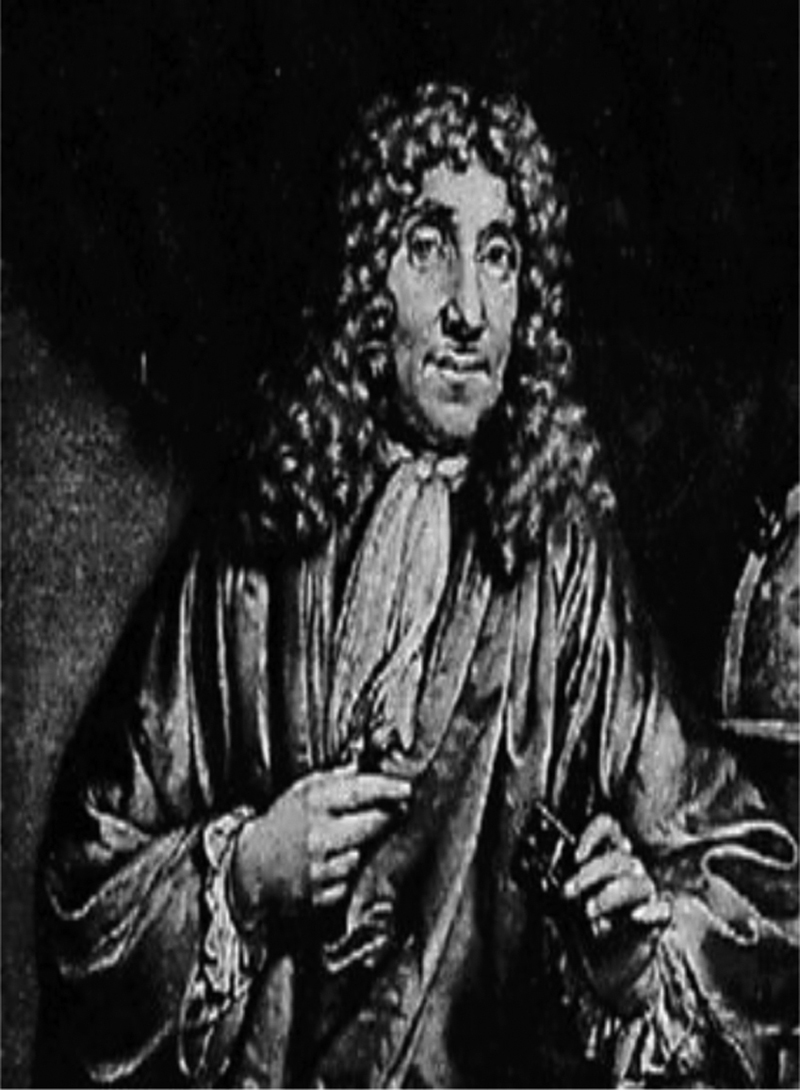
The first person to observe and describe microorganisms accurately was an amateur microscopist Antony van Leeuwenhoek (1632–1723) (Fig. 1-1) of Delft, Holland. Leeuwenhoek earned his living as a draper and haberdasher (a dealer in men’s clothing and accessories), but spent much of his spare time constructing simple microscopes composed of double convex glass lenses held between two silver plates. His microscopes could magnify around 50–300 times. In 1673, Leeuwenhoek sent detailed letters describing his discoveries to the Royal Society of London. It is clear from his descriptions that he saw both bacteria and protozoa. But he did not evaluate these organisms as agents of disease.
Louis Pasteur: Father of Microbiology
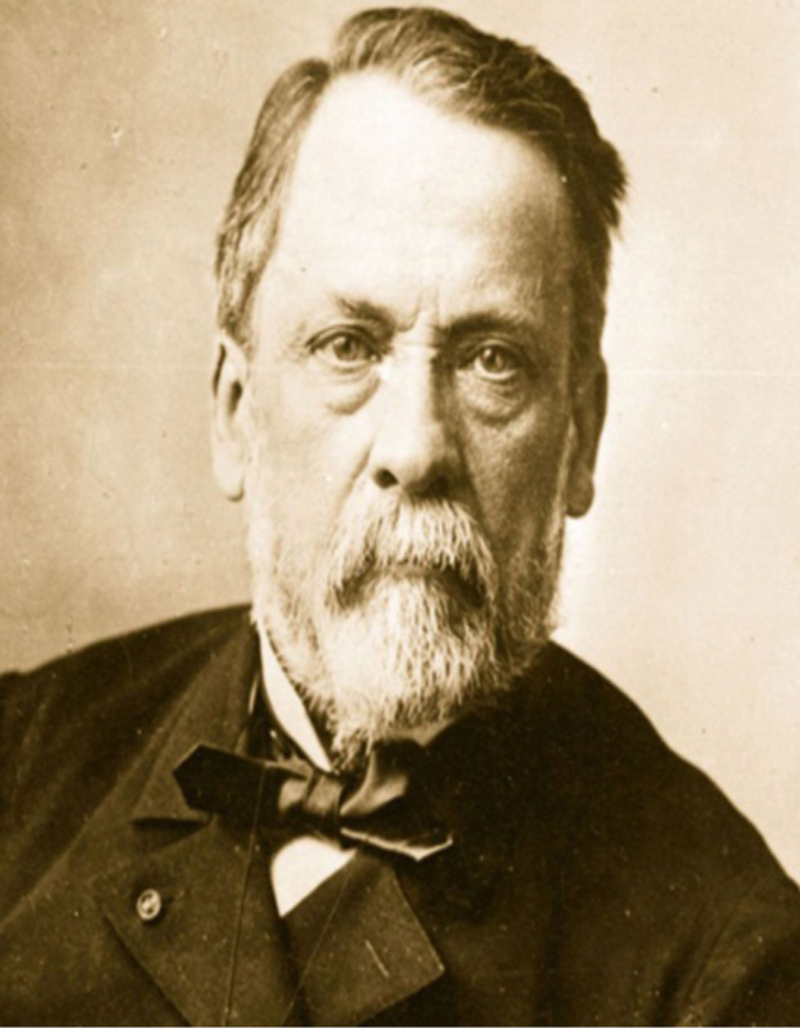
Louis Pasteur, French Microbiologist, is known as the father of medical microbiology for his immense contributions to the field of medical microbiology (Fig. 1-2). He first coined the term “microbiology” for the study of organisms of microscopic size. Many of his important contributions are discussed in subsequent sections.
Germ Theory of Disease
Many scientists have contributed to the theory of spontaneous generation with their experiments, but it was Louis Pasteur (1822–1895) who settled it once for all. Pasteur proved that all life even microbes arose only from their like and not de novo (germ theory of disease). Pasteur had not only resolved the controversy by 1861 but also had shown how to keep solutions sterile.
Support for the germ theory of disease began to accumulate in the early 19th century. Agostino Bassi (1773–1856) first showed that a microorganism could cause disease when he demonstrated in 1835 that the silkworm disease was due to a fungal infection. He also suggested that many diseases were due to microbial infections. In 1845, MJ Berkeley proved that the great potato blight of Ireland was caused by a fungus.
Pasteurisation
Pasteur for the first time demonstrated that he could kill many microorganisms in wine by heating and then rapidly cooling the wine, a process now called as pasteurisation.
Vaccination
1. In 1877, Pasteur studied anthrax, a disease mainly of cattle and sheep. He developed a vaccine using a weakened strain of the anthrax bacillus, Bacillus anthracis. He attenuated the culture of anthrax bacillus by incubation at high temperature of 42–43°C and inoculated the attenuated bacilli in the animals. He demonstrated that animals receiving inoculation of such attenuated strains developed specific protection against anthrax.
2. In 1885, he also developed the first vaccine against rabies in humans that saved millions of human life worldwide.
3. Pasteur coined the term “vaccine” to commemorate Edward Jenner who used such preparations for protection against smallpox.
Joseph Lister: The Pioneer of Antiseptics
Indirect evidence that microorganisms are the agents of human disease came from the work of an English surgeon Joseph Lister (1827–1912) on the prevention of wound infections Lister developed an antiseptic surgery system in order to stop the microorganisms from entering the wounds. In this system the instruments were sterilised by heat and phenol was used in surgical dressing. Phenol was also used to clean the surgical area. This system was successful and it transformed the way surgery was done. It also provided strong indirect evidence for the role of microorganisms in disease because phenol, which killed the bacteria, also prevented wound infections.
Robert Koch: The Founder of Koch Postulates
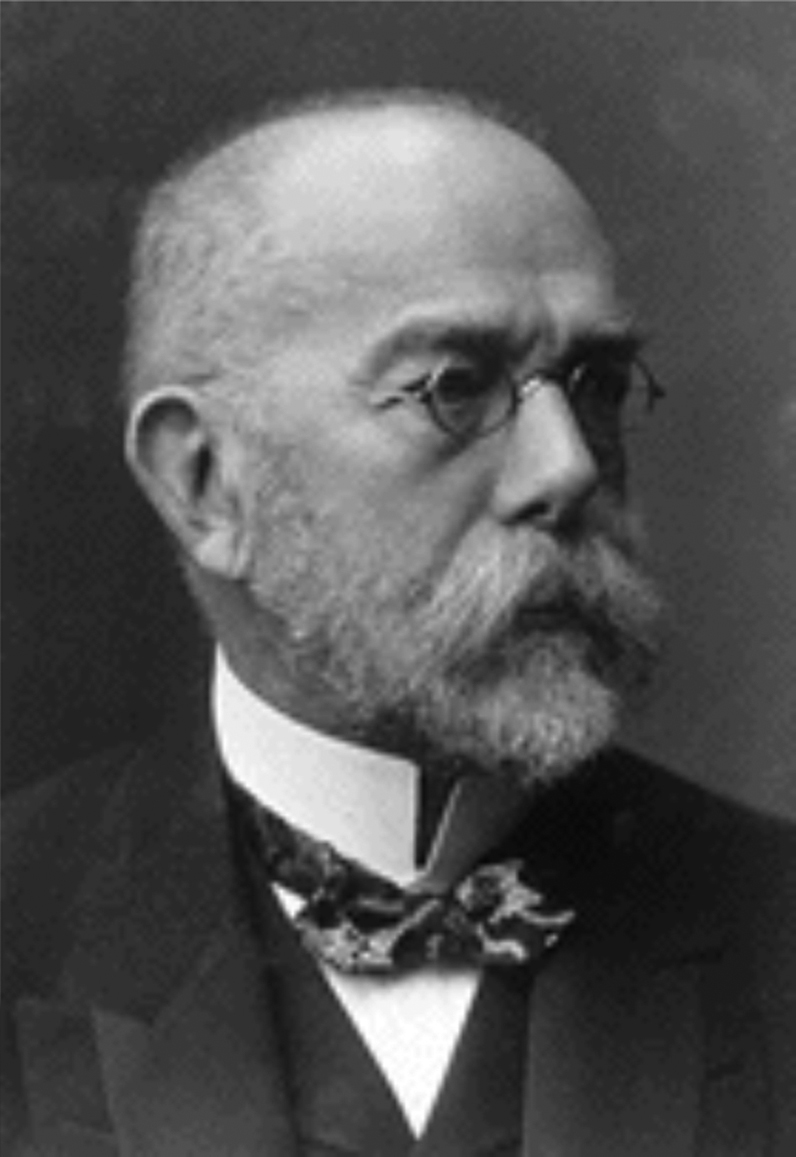
The first direct demonstration of the role of bacteria in causing disease came from the study of anthrax by the German physician Robert Koch (1843–1910) (Fig. 1-3). Koch used the criteria proposed by his former teacher, Jacob Henle (1809–1885), to establish the relationship between B. anthracis and anthrax, and he published his findings in 1876 briefly describing the scientific method he followed.
Koch Postulates
Koch postulates (criteria) were useful to prove the claim that a microorganism isolated from a disease was indeed causally related to it. A microorganism was accepted as the causative agent of infectious disease, only when it satisfied all the following criteria (Fig. 1-4):
1. The microorganism must be present in every case of the disease but absent from healthy host.
2. The suspected microorganism must be isolated and grown in a pure culture from lesions of the disease.
3. The isolated organism, in pure culture, when inoculated in suitable laboratory animals should produce a similar disease.
4. The same microorganism must be isolated again in pure culture from the lesions produced in experimental animals.
5. The specific antibodies to the bacterium should be demonstrable in the serum of patient suffering from the disease. This was an additional criterion that was introduced subsequently.
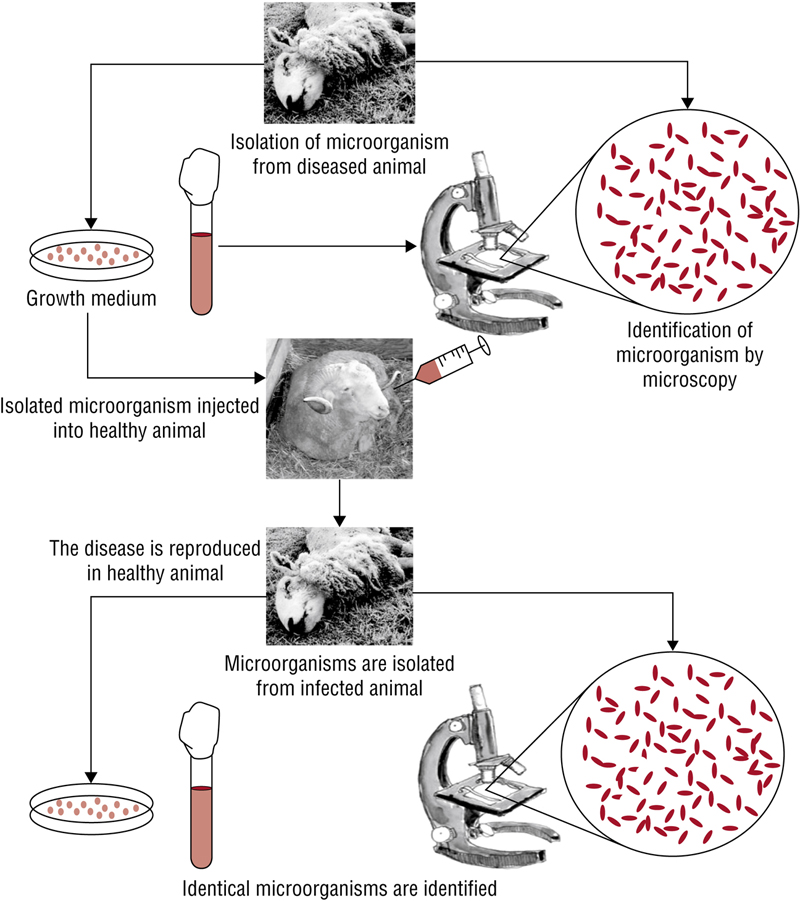
Fig. 1-4 Koch postulates.
Most of the human bacterial pathogens satisfy Koch postulates except for those of Mycobacterium leprae and Treponema pallidum, the causative agents of leprosy and syphilis, respectively. Both these bacteria are yet to be grown in cell-free culture media.
Solid Medium for Culture of Bacteria
Koch pioneered the use of agar as a base for culture media. He developed the pour plate method and was the first to use solid culture media for culture of bacteria. This development made possible the isolation of pure cultures that contained only one type of bacterium and directly stimulated progress in all areas of bacteriology. Koch also developed media suitable for growing bacteria isolated from the body. He developed the nutrient broth and nutrient agar media that are still widely used worldwide. In 1882, Koch had used these techniques to isolate the bacillus that caused tuberculosis in humans. He also discovered that cholera was caused by Vibrio cholerae. He invented the hot air oven and steam steriliser, and also introduced methods to find out the efficacy of antiseptics.
Koch Phenomenon
Koch phenomenon is a hypersensitivity reaction against tuberculosis bacilli demonstrated in guinea pigs. This was first demonstrated by Koch, who showed that guinea pigs already infected with tubercle bacillus, on challenge with tubercle bacillus or its protein, developed an exaggerated inflammatory response.
There followed a golden age of about 40–50 years in which most of the major bacterial pathogens were isolated (Table 1-1).
Table 1-1
Discovery of Important Bacterial Agents Causing Human Diseases
| Scientist | Bacteria | Year |
| Hansen | Mycobacterium leprae | 1874 |
| Koch | Bacillus anthracis | 1876 |
| Neisser | Neisseria gonorrhoeae | 1879 |
| Ogston | Staphylococcus aureus | 1880 |
| Loeffler | Corynebacterium diphtheriae | 1884 |
| Fraenkel | Streptococcus pneumoniae | 1886 |
| Weichselbaum | Neisseria meningitidis | 1887 |
| Bruce | Brucella melitensis | 1887 |
| Kitasato | Clostridium tetani | 1889 |
| Yersin | Yersinia pestis | 1890 |
Virology
In 1892, Dmitri Ivanovsky, a Russian scientist working in St. Petersburg, demonstrated that the sap of leaves infected with tobacco mosaic disease retains its infectious properties even after filtration through Chamberland filter candles. This was an important observation, because it provided an operational definition of viruses and also an experimental technique by which an agent could be considered as a virus.
Beijerinck, a Dutch soil microbiologist, showed that the filtered sap could be diluted and then regain its strength after replication in living and growing tissue of the plant. The agent could reproduce itself (which meant that it was not a toxin) but only in living tissues, not in the cell-free sap of the plant. This explained the failure to culture the pathogen outside its host.
All these observations contributed immensely to the discovery of an organism smaller than bacteria (a filterable agent) that is not observable in the light microscope and is able to reproduce itself only in living cells or tissues. Beijerinck called this agent a contagium vivum fluidum, or a contagious living liquid.
The concept of contagium vivum fluidum or a contagious living liquid began a 25-year debate about the nature of viruses; whether they were liquids or particles? This conflict was laid to rest when d’Herelle developed the plaque assay in 1917 and subsequent development of electron microscopy by Ruska (1934), when the first electron micrographs of tobacco mosaic virus (TMV) were taken in 1939. The viruses were accepted as particles.
Loeffler and Frosch (1898) described and isolated the first filterable agent from animals, the foot-and-mouth disease virus of cattle. Walter Reed and his team in Cuba (1902) recognised the first human filterable virus, yellow fever virus. Landsteiner and Popper (1909) demonstrated that poliomyelitis was caused by a filterable virus and also successfully transmitted the infection to monkeys. Goodpasture (1930) used chick embryos for cultivation of viruses.
Initially, the term virus (taken from the Latin for slimy liquid or poison) was used interchangeably for any infectious agent and so was applied to TMV and all other agents of the class.
d’Herelle and Twort: Founders of the Principles of Modern Virology
Twort and d’Herelle (1915) independently observed a lytic phenomenon in bacterial cultures, which they attributed to viruses. d’Herelle named these viruses as bacteriophages. He developed the use of limiting dilutions with the plaque assay to titre the virus preparation. He suggested that the appearance of plaques in the plaque assay show the viruses to be particulate, or corpuscular.
d’Herelle also demonstrated that the attachment (adsorption) of the virus to the host cell is the first step in the pathogenesis of a virus infection. The attachment of a virus occurred only when bacteria sensitive to the virus were mixed with it, demonstrating the host range specificity of a virus at the adsorption step. He described the process of cell lysis and subsequently the release of infectious virus particles. He developed many other techniques that are still used in virology. d’Herelle was in many ways one of the founders of the principles of modern virology.
Immunology
In the 5th century AD the earliest small pox inoculation took place in China. In 1900s John Lister, an English merchant reported the Chinese method to the Royal Society. The details of this method were provided by a Jesuit priest, Father d’Entrecolles according to him scabs from pustules are to be collected and a powder made from them is to be blown into an infant’s nose. Pus coated scabs or thread can be stored but usually the operation was face to face with a patient. In 1747 the same method was done in Japan. A tika or dot would be made on the child usually on foot of the child by tikadars during pre-colonial period in India.
The method was significantly improved by the English physician Edward Jenner in 1798. Jenner was fascinated that the milkmaid who had contracted the mild disease cowpox was subsequently immune to smallpox. This made him believe that by inoculating cowpox pustule into people may protect them against smallpox. He tested this idea on a 8-year old boy by inoculating him with fluid from cowpox pustule and later he infected the child with smallpox. As predicted, the child did not develop smallpox. Pasteur followed this up with development of vaccines for chicken cholera, anthrax and rabies. Although Pasteur proved that vaccination worked, but he could not explain how.
The experimental work of Emil von Behring and Shibasaburo Kitasato in 1890 gave the first insight into the mechanism of immunity. They demonstrated that serum contained elements that protected against infections thus laying the foundation for the identification of humoral immunity. In recognition of this work, von Behring received the Nobel Prize in Medicine in 1901.
In 1883 Elie Metchnikoff showed that cells also contribute to the immunity of the animal, even before that a serum component could transfer immunity was discovered. He was able to observe that few white blood cells ingested microorganism and other foreign material. He named them phagocytes. He also found that these phagocytes were more active in animals that were immunised. He hypothesised cells other than the serum components were the major effector of immunity. The active phagocytic cells identified by Metchnikoff were most likely blood monocytes and neutrophils.
One of the greatest enigmas facing early immunologists was the specificity of the antibody molecule for foreign material or antigen. Following theories were proposed to explain this mechanism of specificity:
1. The selective theory: The earliest conception of the selective theory dates back to Paul Ehrlich in 1900. In the 1930s and 1940s, the selective theory was challenged by various instructional theories, in which antigen played a central role in determining the specificity of the antibody molecule.
2. The instructional theory: According to the instructional theories, a particular antigen would serve as a template around which the antibody would fold. This concept was first postulated by Friedrich Breinl and Felix Haurowitz in the 1930s and redefined in the 1940s in terms of protein folding by Linus Pauling.
3. The clonal selection theory: The instructional theories were formally disproved in the 1960s, during which information was beginning to appear regarding the structure of DNA, RNA and protein. These information offered new insights into the vexing problem of how an individual could make antibodies against almost anything. In the 1950s, selective theories resurfaced as a result of new experimental data and through the pioneering contributions of Niels Jerne, David Talmadge and F Macfarlane Burnet, who refined into a theory that came to be known as the clonal selection theory.
Chemotherapeutic Agents
There was no chemical treatment against bacterial infections until 1930s. Prevention was the only way to protect patients. The western culture was obsessed with the threat of germs and responsibility to avoid infection. During this time there was lots of hope for a wonder drug. In 1889 Paul Vuillemin pupil of Louis Pasteur coined the term “antibiosis”.
Paul Ehrlich was an exceptionally gifted histological chemist and invented the precursor technique to Gram-staining of bacteria. He demonstrated that dyes react specifically with various components of blood cells and the cells of other tissues. He began to test the dyes for therapeutic properties to determine whether they could kill the pathogenic microbes. He developed Salvarsan, an arsenical compound in 1909. The compound known as “magic bullet” was capable of destroying T. pallidum, the causative agent of syphilis. This treatment proved effective against syphilis. This work was of epochal importance, stimulating research that led to the development of sulpha drugs, penicillin and other antibiotics. He, therefore, is known as the father of chemotherapy.
Antibiotics
The word “antibiotic” did not follow immediately, but the drug pyocyanase, a weakly effective antibiotic, was marketed from the late 19th century into the 1930s. The discovery of an antibacterial factor in the exudates of the fungus Penicillium by Sir Alexander Fleming at St. Mary’s Hospital in 1928 was therefore not totally unexpected. He accidentally discovered that a substance produced by the fungus destroyed the pyogenic bacteria, staphylococci. This initiated the beginning of the antibiotics era. Other similar antibiotics were discovered in rapid succession. The sulphonamide drugs discovered subsequently offered cures for a wide range of bacterial infections.
The list of recent nobel lauretes in the field of microbiology and infectious diseases is summarised in the Table 1-2.
Table 1-2
Recent Nobel Prize Winners
| Year | Name/Names of Scientists | Research Contribution |
| 1993 | Kary Mullis | Polymerase chain reaction |
| 1996 | Peter C Doherty and Rolf M Zinkernagel | Cell-mediated immune defences |
| 1997 | Stanley B Prusiner | Prion discovery |
| 2005 | Barry J Marshall, J Robin Warren | Discovery of Helicobacter pylori and its role in gastritis and peptic ulcer disease |
| 2008 | Herald ZurHausen | Discovery of human Papilloma viruses causing cervical cancer |
| 2008 | Francoise BarreSinoussi, Luc Montagnier | Discovery of human immunodeficiency virus |
| 2011 | Ralph M. Steinman | Discovery of dendritic cell and its role in adaptive immune response |
| 2011 | Bruce A. Beutler, Jules A. Hoffmann | Discoveries concerning activation of innate immunity |
| 2012 | Sir John B Gurdon, Shinya Yamanaka | Mature cells can be reprogrammed to become pluripotent |
| 2015 | William C. Campbell and Satoshi Q-mura | Discoveries concerning a novel therapy (Avermectin & Ivermectin) against infections caused by roundworm parasites |
| 2015 | YouyouTu | Discoveries concerning artemisinin therapy against Malaria |
Study questions
1. List out the contributions of three major scientists in the field of microbiology?
2. List out the contributions of Robert Koch and elaborate on—Koch postulates and Koch phenomenon
3. Short notes:
a. Paul Ehrlich
b. Louis Pasteur
c. Robert Koch
d. Koch postulates
e. Koch phenomenon
Online study material
Multiple Choice Questions
1. The father of microbiology is
A. Louis Pasteur
B. Robert Koch
C. d’Herelle
D. Paul Ehrlich
2. The bacterium although a known human pathogen but still does not fulfill Koch postulates criteria is
A. Staphylococcus aureus
B. Bacillus anthraci
C. Treponemapallidum
D. Mycobacterium tuberculosis
3. The Nobel prize for selective theory of antibody formation was given to
A. Paul Ehrlich and Elie Metchnikoff
B. Watson and Crick
C. Karl Landsteiner
D. Paul Ehrlich
4. The hanging drop method for studying bacterial motility was first used by
A. Louis Pasteur
B. Robert Koch
C. d’Herelle
D. Paul Ehrlich
5. Father of chemotherapy is
A. Louis Pasteur
B. Robert Koch
C. d’Herelle
D. Paul Ehrlich
Keys: 1. A; 2. C; 3. A; 4. B; 5. D