Task, Activity and Occupational Analysis
Cynthia Perlman; Melanie Bergthorson
Abstract
Occupational analysis, a perspective unique to the profession of occupational therapy, is explored as a continuum beginning with task analysis, followed by activity analysis and culminating in occupational analysis itself. The analysis process begins with understanding the sequential components of and inherent skills needed for specific activities, and then builds towards meaningful person-specific, goal-directed occupations. An activity becomes an occupation when it is personally meaningful and when participation is reinforced through the process of grading and adapting. The chapter highlights the conceptual frameworks and models needed for a successful occupational analysis, including the Person-Environment-Occupation (PEO) Model, the Canadian Model of Occupational Performance and Engagement (CMOP-E) and the Model of Human Occupation (MOHO). Examples of each type of analysis and the subsequent grading and adapting of the activity/occupation, including discussion of the environmental contexts (physical, social, cultural, institutional), are provided through a practice story in which grocery shopping is analysed.
▪ The analysis process is viewed as a continuum beginning from a task analysis, to an activity analysis, leading to an occupational analysis.
▪ An activity becomes an occupation when its personal meaning is acknowledged and pursued, the goals are personally set, the required skills to perform are considered and the environmental context is acknowledged.
▪ Occupational analysis is a perspective unique to the profession of occupational therapy enabling the therapist to evaluate and validate the meaning of the occupation for a specific person when performing it within a chosen environmental context.
▪ Occupational analysis is supported by the philosophical influences of the value of purposeful, meaningful occupation on health and well-being.
▪ The Person-Environment-Occupation Model (Law et al., 1996), an open systems theory-based approach, can be used as a foundational support and preanalysis tool for occupational analysis, to further build upon the value of purposeful, meaningful occupations, as well as to promote further understanding of the occupation-based contexts.
▪ Using the results of an occupational analysis, occupational therapists can grade or adapt the activity/occupation to lead to optimal participation, engagement and autonomy for their people receiving occupational therapy.
The meaning of occupation for analysis of activities and occupations
A historical shift in the paradigm of occupational therapy occurred in the 1970s when there was a transition from a mechanistic/reductionist perspective to an occupation-based perspective, which allowed the development of occupation-based intervention (Aiken, Fourt, Cheng, & Polatajko, 2011; Bauerschmidt & Nelson, 2011; Kielhofner, 2008; Wilding & Whiteford, 2007). This shift addressed the personal values and meaning attributed to occupations by an individual, group or community performing the occupation. Meaning is individually constructed and interpreted, thereby acknowledging the human experience – performing in a unique person-specific manner (Blesedell Crepeau, Gillen, & Scaffa, 2013; Kielhofner, 2008; Peloquin, 2005). Occupations are personalised activities chosen and performed by individuals because they hold personal meaning and purpose to that individual (Reed, Hocking, & Smythe, 2011; Thomas, 2012; Townsend & Polatajko, 2013). These chosen occupations occur within the unique context of the person and the environment. Occupational therapists understand the impact of activities and occupations on participation and engagement, through fundamental analysis frameworks that analyse an activity or occupation as a whole considering its inherent component parts, including the environmental contexts (physical, social, cultural, institutional).
The focus of this chapter is on the concepts of task analysis, activity analysis and occupational analysis as a continuum of an analysis process from understanding sequential component parts and inherent skills associated with tasks and activities to more person-specific, goal-directed occupations in which the personal meaning of doing is identified. Through occupation-based activity analysis, and subsequent grading and adapting, the activity’s or occupation’s therapeutic potential is identified (Thomas, 2015).
To understand this continuum, it is first important to differentiate the terms task, activity and occupation, as described in Table 14.1.
Table 14.1
Differentiating Among Task, Activity and Occupation
| A task | A conventional sequence and timing of actions or list of steps required to complete an activity (Thomas, 2015). |
| An activity | The actual concrete doing or completion, without a context, of the list of actions or steps that involve skills, materials and interaction with the environment. Activities comprise components and parts that can be analysed (Mosey, 1986). |
| An occupation | The contextual, meaningful, goal-directed everyday activities that people choose to do to occupy themselves, including caring for oneself (self-care), enjoying and participating in life outside of work (leisure) and contributing to society (productivity/work) (CAOT, 2002). Occupations are shaped by culture and evolve through the lifespan as they are reflective of personal goals, skills, roles, habits and values (Kielhofner, 2008; Thomas, 2015). |
When Does an Activity Become an Occupation?
Therapeutic and meaningful activities and occupations remain core professional concepts that are valued as both a means and an end or outcome from the intervention process. An activity becomes an occupation when the personal meaning of it is acknowledged and pursued, the goals are personally set, the required skills to perform it are considered and the environmental context is acknowledged. Hinojosa, Sabari, and Pedretti (1993) described the attributes of purposeful and meaningful therapeutic activity in occupational therapy. These are presented in Box 14.1.
The Influence of Meaningful Occupation on Practice
An occupation-focused practice founded on a belief that humans are occupational in nature underpins occupational therapy practice. Nelson (1997) reiterated that pride and professional confidence result from full identification and adoption of the term occupation, a definitive domain of occupational therapy. Fisher (2013) posited that a worldview and appreciation of occupation to guide professional reasoning is termed occupation-centred. The actual therapeutic process of engaging a person in meaningful occupations that foster choice-making, satisfaction and restoration is termed occupation-based (Fisher, 2013; Polatajko & Davis, 2012). Emphasis should be placed on the value and meaning personally attributed to the particular occupation. ‘Occupation-based means that practice must enable the performance of, or engagement in, an occupation that a person wants to, needs to, or is expected to do’ (Polatajko & Davis, 2012, p. 259).
When occupational therapists are grounded by the occupation-based paradigm, they acknowledge their expertise in enabling occupation and in maintaining the occupational perspective throughout the therapeutic process (Aiken et al., 2011; Gray, 1998; Letts, 2011). Aiken et al. (2011) revealed the significance of embracing occupation-based practices and placing interventions in the context of meaningful occupation. They found that occupational therapists can gain personal and professional meaning through occupation-based practices using a conscious connection between their actions and the future occupational performance and engagement of people receiving occupational therapy services. Townsend and Polatajko (2013) identified occupation as the following:
▪ Basic human drive to do and participate
▪ Source of meaning and purpose as it reflects personal interests, values and pursuits
▪ Source of control over one’s life through intentional choice making
▪ Source of self-expression leading to self-identity and a trueness of oneself across the lifespan
▪ Source of satisfaction and self-fulfilment through purposeful doing
▪ Means for interaction with the environment (physical, social, cultural, institutional)
▪ Means of organising time, behaviour, space and materials to foster efficiency
▪ Means of skill development and competence
Continuum of analyses: task, activity and occupation
An extensive search of the literature reveals minimal consensus on definitions of, and how to properly differentiate among, the terms task analysis, activity analysis and occupational analysis. This is especially true for the terms task analysis and activity analysis, because delineations between activity and occupational analyses are more evident when based on occupation-based philosophy and terminology. Blesedell Crepeau et al. (2013) advocated for using both activity and occupational analyses to gain a deeper understanding of how people relate to their occupations. ‘Practitioners must be able to analyse both the general idea of how an activity occurs within culture as well as the actual occupations as they are performed by the particular individuals’ (Blesedell Crepeau et al., 2013, p. 237). Extrapolating from the American Occupational Therapy Association position paper on purposeful activity (Hinojosa et al., 1993), the continuum is defined in Figure 14.1.
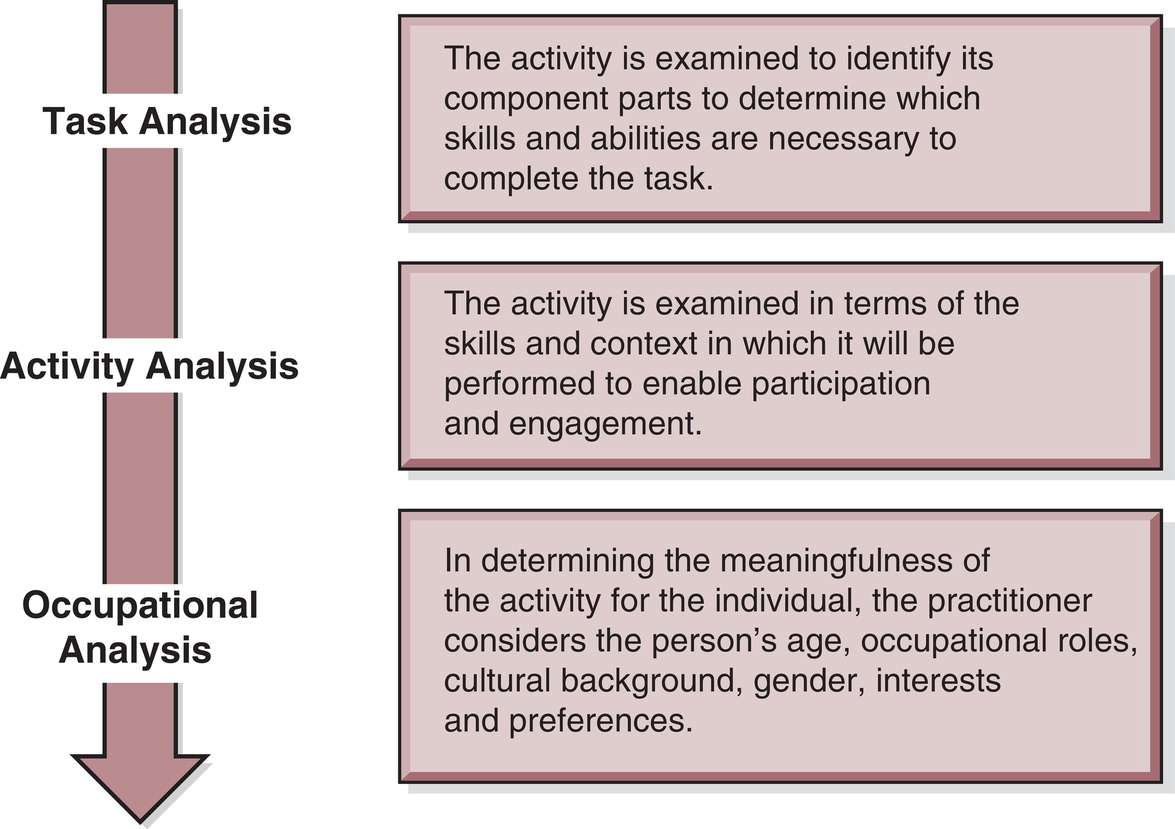
The continuum of the analysis process begins with the task analysis, with an appreciation of the sequence and timing of actions or list of steps comprising an activity or typical procedure (Allen, 1982; Thomas, 2015). Activity analysis, the next step in the continuum, then examines the skills and context of the activity. This step acknowledges the context in which the activity is being performed, how it is normally done and the required body structures or functions (but not specific to an individual’s potential) (Polatajko, Mandich, & Martini, 2000). Hersch, Lamport, and Coffey (2005) stated that an activity analysis involves a step-by-step dissection of an activity and determining the skills required to perform the activity in order to discover its therapeutic characteristics. The third step in the continuum is the occupational analysis, the perspective most unique to the profession of occupational therapy. This perspective validates the meaning of the activity to the individual. This analysis is person specific and combines the two previous analyses with a focus on the person’s specific challenges, interests and lifestyle, as well as the environmental contexts (Pierce, 2001). To demonstrate this continuum, the occupation of grocery shopping will be explored from the perspective of a young mother, Bernice (Practice Story 14.1).
Task Analysis of Grocery Shopping
Bernice’s grocery shopping activity can be broken down into the following component parts or tasks to determine the required skills and abilities. The task analysis simply breaks down grocery shopping into a sequence of steps that could be completed by anyone in any generic store.
1. Retrieve cart and enter store.
2. Walk through aisles to targeted destination while pushing cart; start and stop.
3. Item One – Apples:
a. Retrieve small plastic produce bag.
b. Select and grasp apple.
c. Release apple in bag; repeat for desired number of apples.
d. Twist or tighten bag to close.
e. Release bag of apples into cart.
4. Walk through aisles to targeted destination while pushing cart; start and stop.
5. Item Two – Bread:
a. Select and grasp bread from shelf.
b. Read label on bag for freshness date.
c. Release bread into cart.
6. Walk through aisles for targeted destination while pushing cart; start and stop.
7. Repeat previous steps for additional items:
a. Reach, hold, and release 2 L carton of orange juice.
b. Reach and grasp aluminium foil package and release into cart.
8. At checkout, bend, reach, grasp, lift and place each item onto conveyor belt.
9. Retrieve wallet and take out required amount of money or credit card for purchase.
10. Hand money or credit card to cashier and obtain receipt.
11. Shopping items are bagged and placed into cart by cashier.
12. Push cart out of store to car.
13. Open trunk of car, lift and release each bag into trunk of car.
14. Replace cart.
Activity Analysis of Grocery Shopping
‘Activity analysis is a clinical practice tool which must be learned and applied by all occupational therapy students in order to meet and fulfil the occupational performance needs of their clients, at any point within the lifespan’ (Perlman, Weston, & Gisel, 2005, p. 154). As a result of an activity analysis, the inherent skills and abilities needed to perform the activity are identified; however, they are not specific to a particular individual. The environmental and activity demands are examined in preparation for optimal participation. With regards to Bernice’s grocery shopping, the occupational therapist may anticipate the following expected demands of the activity:
▪ Position of the person in relation to the activity as well as the position of the activity in relation to environmental space
▪ Tools/utensils/objects/materials used to participate in the activity
▪ Environmental opportunities, demands and/or constraints of the large grocery store (physical, social, cultural, institutional)
▪ Contextual opportunities and demands to enable meaning of activity for the client (space; objects; tools; equipment, including virtual or electronic forms; sequence and temporal patterns; social interactions)
▪ Requisite performance skills and abilities needed for successful completion of the activity (motor, sensory-perceptual, cognitive, emotional, social/communicative)
To illustrate, an activity analysis description of the sensory performance skill domain as well as the environmental domain for the activity component of selecting apples are provided in Tables 14.2 and 14.3. Separating each activity component and determining the expected outcomes for success for each component is strongly suggested for an activity analysis (Thomas, 2015).
Table 14.2
Activity Analysis of Selecting Apples: Sensory Performance Skill Domain
| Visual | Visually scanning the environment to locate the plastic bags and to determine where apples are located and which specific type is desired. Visual awareness of potential obstacles or people in path. Visual assessment of apple to ensure it is blemish free, lacking bruises or holes. Visually checking the price above the apple bin. |
| Auditory | Tuning out/habituating to background noise of store (other shoppers, music playing, announcements, etc.) |
| Gustatory | Not utilised at this time unless samples are offered; possible activation of salivary glands when thinking about taste of apple. |
| Olfactory | Smelling apples to help determine freshness. Tuning out other odours in the store (odours of meat, fish, other vegetables, etc.) |
| Tactile | Tactile discrimination is utilised through handling of each apple to verify the appropriate firmness, smooth texture and lack of any spots. Temperature of apple is noted, as well as overall weight. Secured grasp may be adapted according to size and weight of an apple. |
| Vestibular | Maintaining balance while retrieving apples and visually scanning the environment. |
| Proprioceptive | Awareness of position in space relative to the apple display, location of bag in hand and the distance to other shoppers or store displays. |
Table 14.3
Environmental Context for Selecting Apples
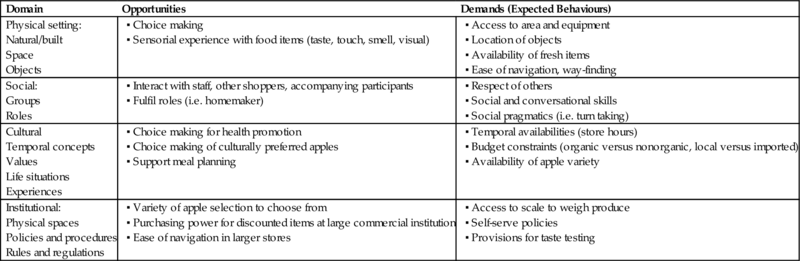
Examples of subcomponents or domains, particularly the sensory and environmental domains that can be analysed for an activity analysis, are provided in Table 14.2 and 14.3, respectively. In Table 14.4, the task of retrieving apples from a fruit bin in the grocery store is analysed through the sensory domain. The expected skill actions within this domain are described. Success for this task would be defined as physically collecting a set number of fresh, unblemished red apples from the bin and placing them in a plastic bag.
Table 14.4
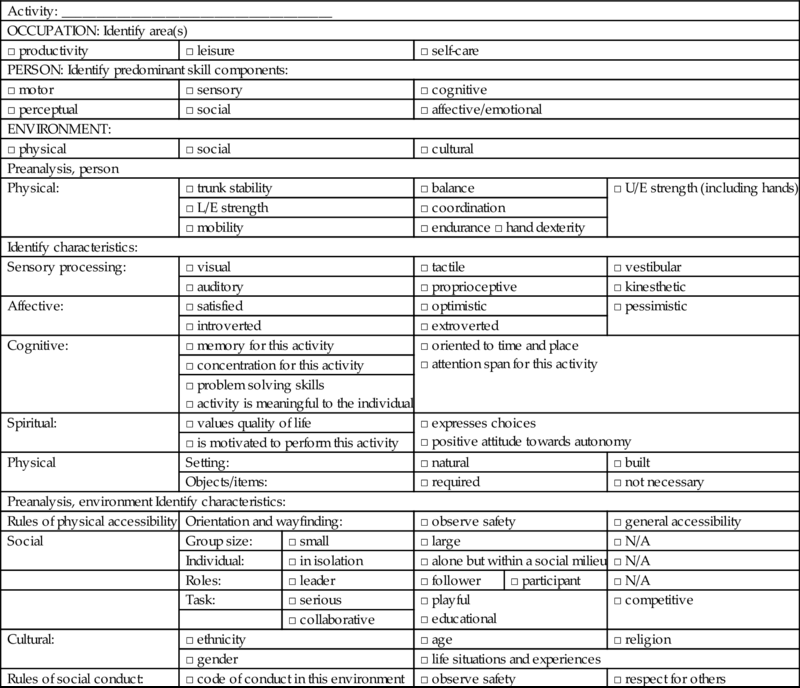
Preanalysis Step to Set the Context of the Activity Leading to Occupational Analysis (Perlman & Gisel, 2000)
| Activity: _______________________________________ | |||||
| OCCUPATION: Identify area(s) | |||||
| □ productivity | □ leisure | □ self-care | |||
| PERSON: Identify predominant skill components: | |||||
| □ motor | □ sensory | □ cognitive | |||
| □ perceptual | □ social | □ affective/emotional | |||
| ENVIRONMENT: | |||||
| □ physical | □ social | □ cultural | |||
| Preanalysis, person | |||||
| Physical: | □ trunk stability | □ balance | □ U/E strength (including hands) | ||
| □ L/E strength | □ coordination | ||||
| □ mobility | □ endurance □ hand dexterity | ||||
| Identify characteristics: | |||||
| Sensory processing: | □ visual | □ tactile | □ vestibular | ||
| □ auditory | □ proprioceptive | □ kinesthetic | |||
| Affective: | □ satisfied | □ optimistic | □ pessimistic | ||
| □ introverted | □ extroverted | ||||
| Cognitive: | □ memory for this activity | □ oriented to time and place □ attention span for this activity | |||
| □ concentration for this activity | |||||
| □ problem solving skills □ activity is meaningful to the individual | |||||
| Spiritual: | □ values quality of life | □ expresses choices □ positive attitude towards autonomy | |||
| □ is motivated to perform this activity | |||||
| Physical | Setting: | □ natural | □ built | ||
| Objects/items: | □ required | □ not necessary | |||
| Preanalysis, environment Identify characteristics: | |||||
| Rules of physical accessibility | Orientation and wayfinding: | □ observe safety | □ general accessibility | ||
| Social | Group size: | □ small | □ large | □ N/A | |
| Individual: | □ in isolation | □ alone but within a social milieu | □ N/A | ||
| Roles: | □ leader | □ follower | □ participant | □ N/A | |
| Task: | □ serious | □ playful □ educational | □ competitive | ||
| □ collaborative | |||||
| Cultural: | □ ethnicity | □ age | □ religion | ||
| □ gender | □ life situations and experiences | ||||
| Rules of social conduct: | □ code of conduct in this environment | □ observe safety | □ respect for others | ||
In Table 14.5, the task of retrieving apples from a fruit bin in the grocery store is analysed through the domains of the environmental context: physical, social, cultural and institutional. These subdomains reflect the environmental domains expressed within the Canadian Model of Occupational Performance and Engagement (CMOP-E) (Canadian Association of Occupational Therapists (CAOT), 2002; Townsend & Polatajko, 2013). The expected opportunities and demands or expected behaviours within the domain are described. Success for this task would be defined as easily accessing the apple bins and choosing preferred produce.
Table 14.5
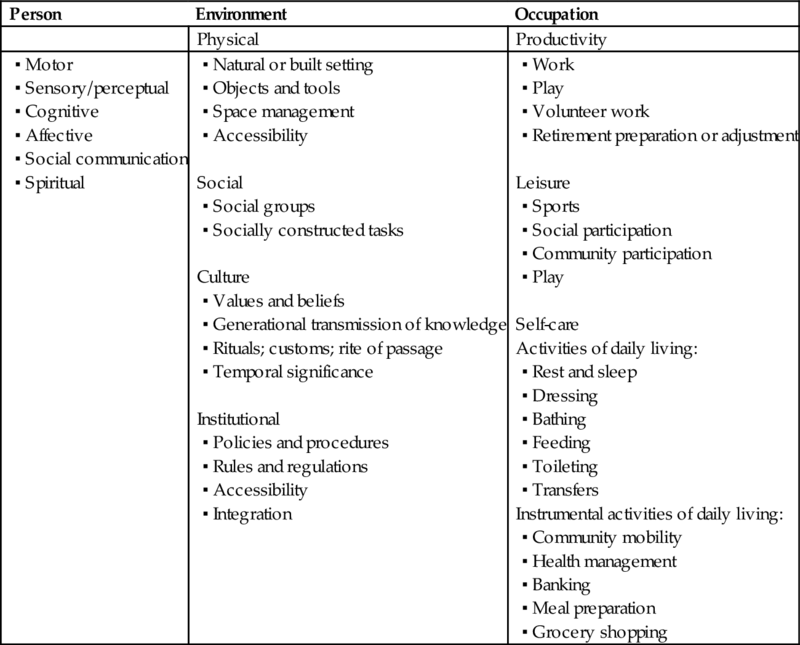
Generic Subdomains Listed Under the Domains of the Person, Environment and Occupation for Occupational Analysis
| Person | Environment | Occupation |
| Physical | Productivity | |
|
▪ Sensory/perceptual ▪ Cognitive ▪ Affective ▪ Social communication ▪ Spiritual |
▪ Objects and tools ▪ Space management ▪ Accessibility Social ▪ Socially constructed tasks Culture ▪ Generational transmission of knowledge ▪ Rituals; customs; rite of passage ▪ Temporal significance Institutional ▪ Rules and regulations ▪ Accessibility ▪ Integration |
▪ Play ▪ Volunteer work ▪ Retirement preparation or adjustment Leisure ▪ Social participation ▪ Community participation ▪ Play Self-care Activities of daily living: ▪ Dressing ▪ Bathing ▪ Feeding ▪ Toileting ▪ Transfers Instrumental activities of daily living:▪ Health management ▪ Banking ▪ Meal preparation ▪ Grocery shopping |
Occupational analysis: a cornerstone of occupational therapy practice
Philosophical Influences on Occupational Analysis
An appreciation of the influence of occupation and purposeful doing on health and self-efficacy promotes a thorough occupational analysis that identifies the meaning and purpose of chosen occupations for the person. Two philosophical influences that support current practices of occupational analysis are an occupational perspective on health and values-based medicine.
The influence of an occupation perspective on health (promotion) leading to well-being supports the opportunity to do, to be true to oneself and to strive to become (Wilcock, 2006). Engagement in occupation is strongly linked to health maintenance systems and the drive to meet not only survival needs but also progression of dignity, self-identity and competence (Kielhofner, 2008; Peloquin, 2005). The outcome is health and well-being through choice, meaning, balance, satisfaction, opportunity and self-actualisation (Wilcock, 1998). Doing, being and becoming (Fidler & Fidler, 1978; Wilcock, 1998) and belonging (Hitch, Pepin, & Stagnitti, 2014; Wilcock, 2007) lead to outcomes of improved health. Doing is living and participating in meaningful occupations. Doing is synonymous with function and occupation. Being is a philosophical state: being true to oneself while engaging in meaningful occupations (spirituality). Becoming is a process leading to self-actualisation, augmenting one’s full potential, in constant development (Wilcock, 1998). Belonging is a socially driven connection to others, connecting within a social network. The social context may be collaborative or competitive, acknowledging the existing diversity of interactions, expectations and role scripts (Hitch et al., 2014). This philosophical perspective highlights the significance of occupational engagement for health, well-being and development.
Values-based medicine, as a theory of philosophical values, promotes the integration of person-centred practice in professional skills development. Fulford (2004) postulated that person-perspective values are at the top of a values hierarchy, signifying the importance of the person’s narrative in collaborative decision making. Embracing differences and diversity in values, beliefs and decisions certainly supports ethical reasoning in daily occupational therapy practice. Values and beliefs are significantly correlated to sense of being (or spirituality) through the occupational experience. In addition, scientific and evidence-based practices are linked with values-based philosophies. ‘Scientific progress increasingly opens up choices and with choices goes values’ (Fulford, 2004, p. 59). When the people receiving occupational therapy services are given volitional power to enable choice making, their values and interests are acknowledged and integrated. The recognition and transparency of values and choices inherent in practice-based decision making facilitates ethical reasoning in occupational therapy practice (Clair & Newcombe, 2014). These value-based philosophies are evident within the Model of Human Occupation (MOHO) (Kielhofner, 2008). For example, personal causation drives the volitional process for choice making and motivation, which are reflective of the human experience and human behaviour in which human values are particularly diverse and personal.
Both philosophies support the occupation-based practice in which occupation remains proximal to health and well-being. Through occupational analysis, the details of the occupations a person chooses to engage in and the benchmarks for personal success are examined to determine their therapeutic benefit. Ensuring that the chosen occupations are tailored to address a person’s occupational performance goals, skills and values can promote health and well-being.
Theoretical Influences on Occupational Analysis
Occupational therapy embraces a dynamic systems approach to the interaction among person, environment and occupation. This is described as an open system in which there is constant interplay among these domains. A change in one domain will affect change in the other two domains and change necessitates adaptation for performance, participation and even survival. For example, a change in a person’s motor capacity (e.g. proximal humeral fracture) will affect the way the person performs or engages in occupations (e.g. washing hair), thereby affecting the environmental demands (e.g. assistance from a family member). Environmental demands will influence the need for adaptation or adaptive aids, for social support or for possibly institutional advocacy.
Occupational performance is an outcome from the dynamic interaction of the person, environment and occupation that continues to evolve throughout a person’s life; as a result occupational performance is flexible and variable. Occupational performance comprises interpretations and experiences by the individual so that the personal meaning of the occupation is acknowledged. It can shape self-identity and adaptability to changing priorities (Law et al., 1996). It enables choice making, occupational organisation and satisfaction from performing and engaging in meaningful occupations (CAOT, 2002).
Occupational engagement fundamentally underlies the notion of enablement, in that people can have the capacity to identify their own needs, to solve their own problems and to generally know what is best for them (Townsend & Polatajko, 2013). To become engaged requires involving oneself through participation in an occupation that has value, thereby fostering meaning. Meaning in occupations is derived from dynamic interactions and personal experiences and therefore is critical to self-identity, self-development and well-being.
The Person-Environment-Occupation Model as a Foundational Framework for Occupational Analysis
The Person-Environment-Occupation (PEO) Model (Law et al., 1996) supports occupation-based intervention and the application of occupational analyses, particularly when applying other models of human occupation. The PEO Model may be seen as a foundational conceptual framework for occupational analyses as it facilitates an understanding of how an individual, group or community may choose meaningful occupations. It also facilitates communication within and outside the profession through a common language of occupation-based domains (Strong et al., 1999). The model assumes that the three major domains (person, environment, occupation) continually interact across time and space in ways that increase or decrease their support for occupational performance. Law et al. (1996) posited that a person is active, determined and perpetual in building skills and attributes, across the lifespan, while interacting with various occupations and environments (Fig. 14.2). If the interaction and overlap of domains is greater, it is assumed that the occupational performance is better supported and therefore more satisfying and meaningful for the person (Law et al., 1996). In a meaningful occupation, the human skills and capacities (of the person) are acknowledged and the environmental context is explored and accounted for through person-centred approaches to intervention. When the interaction between domains is optimal, the person will pursue occupational choices that are meaningful and satisfying.
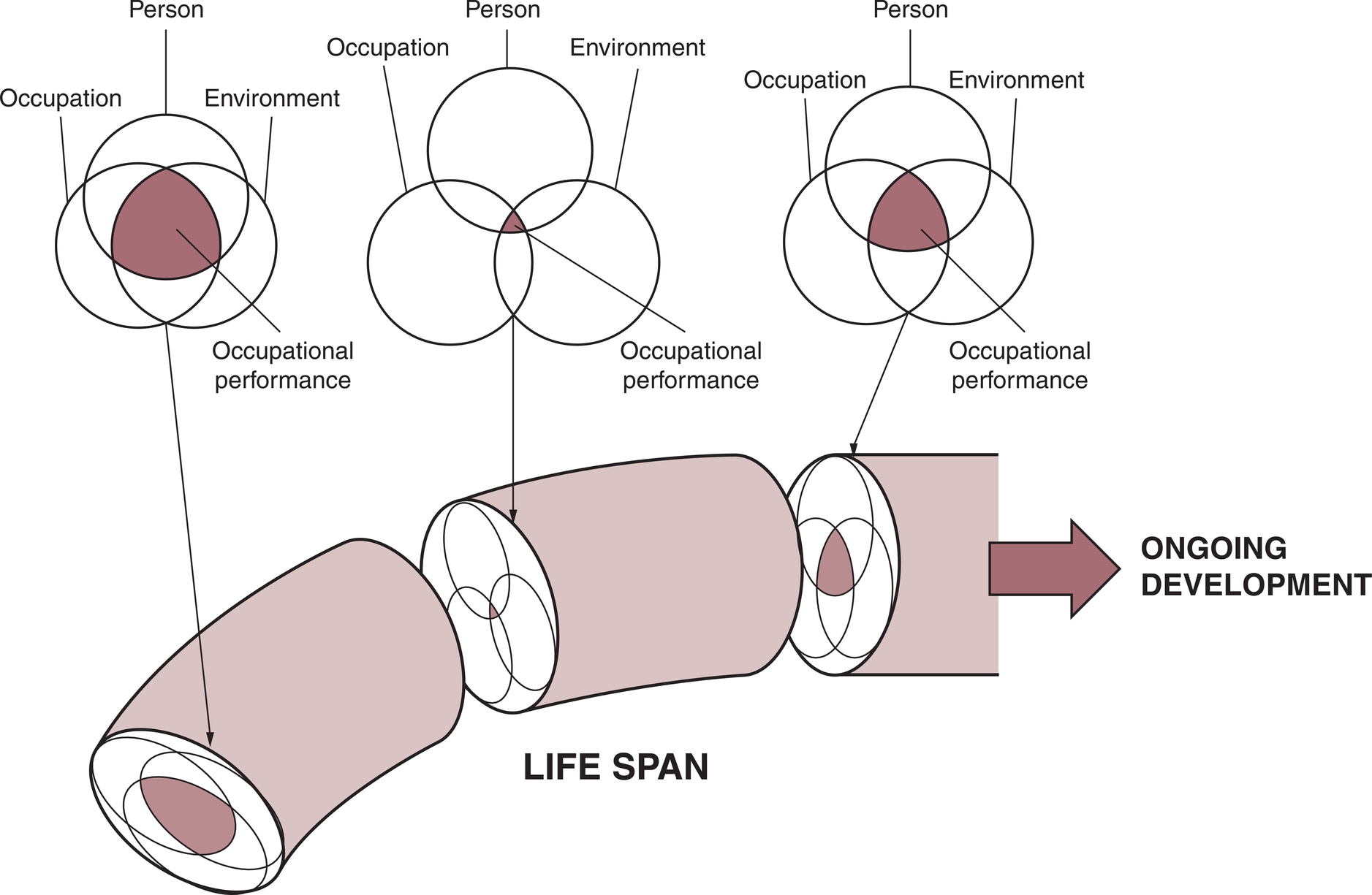
In-depth understanding of the person–environment–occupation dynamic supports the occupational analysis as it recognises what is required for full participation (person: skills, attributes, roles, habits, spiritual capacity) and how and where the activity/occupation is performed (environments: physical, social, cultural, economic, political). In addition, the personal meaning behind the chosen occupations (tasks and activities comprising necessary functions of daily life) is acknowledged and pursued in order to maintain participation and engagement.
A thorough analysis of the environmental contexts must also be implemented to fully enable participation and engagement at the micro, macro and community levels (Leclair, 2010).
Environmental contexts can accommodate or constrain adaptation as they are never static. These contexts function as a feedback loop – for example, the context can affect behaviour, but in turn, behaviour influences the environmental context. Intervention planning comprises activity and occupational analyses, thereby supporting the inclusion of the PEO Model as an appropriate theoretical framework to guide occupational therapy practice applications (Strong et al., 1999). The occupational therapist enables this pursuit and supports meaningful choice through occupational analysis.
The Person-Environment-Occupation Model for Preanalysis
The PEO Model as a framework (Law et al., 1996) may be chosen to support a preanalysis step to set the context of the activity leading to occupational analysis. A preanalysis builds on values of purposeful, meaningful activity and occupation-based frameworks and promotes an understanding of the person-based and occupation-based contexts (Perlman, Weston, & Gisel, 2010; Perlman & Gisel, 2000). By first reflecting on the domains of the PEO Model, the occupational therapist gains an appreciation and understanding for the specific contexts of the person, environment and occupation, so that the occupational analysis remains aligned with the tenets of occupation-based and values-based perspectives. The preanalysis (Perlman & Gisel, 2000) format presented in Table 14.4 allows the therapist to do the following:
▪ Build on prior knowledge of occupation-based models and meaningful activities through the sequence of steps
▪ Review the domains of occupation-based models and appreciate the dynamic relationship between each domain and the impact on performance and participation
▪ Recognise the components of two models of occupation: CMOP-E (Townsend & Polatajko, 2013) and MOHO (Kielhofner, 2008); these two models provide a comprehensive framework for an occupational analysis
▪ Analyse more complex situations and occupations and focus on salient issues for enablement of occupation relevant to specific clients
Essential Domains for Occupational Analysis
Embracing the PEO framework provides a scaffold for an occupational analysis comprising the specific subdomains that should be included in the analysis. A generic list of subdomains or characteristics under each domain of the person, environment and occupation that should be included in an occupational analysis are listed in Table 14.5. This framework aligns well with the two evidence-based models of occupation: CMOP-E (Townsend & Polatajko, 2013) and MOHO (Kielhofner, 2008). These two models focus on domains reflective of human occupation (performance skills and choice making), the person’s attributes and skills and his or her dynamic interactions with the physical, social, cultural and institutional environments. The CMOP-E (Townsend & Polatajko, 2013) comprises the domains of the person (motor, cognitive, affective and spiritual), the occupation (productivity, leisure and self-care) and the environment (physical, social, cultural and institutional). It embraces person-centred enablement of occupation across the lifespan and supports a vision for health, well-being and occupational justice. The model postulates that engagement in meaningful occupations leads to occupational development, competence and identity, which are linked to spirituality (a source of self-determination and personal control through occupational choices).
The MOHO (Kielhofner, 2008) advances an understanding that human occupation is chosen (volition), organised and patterned through habits and roles (habituation) and performed (performance capacity) within an environmental context (physical, temporal, sociocultural). Occupation is described through a person’s participation, occupational performance and skills (motor, process, social and communication skills) while doing (subjective experience through the lived body) within an environmental context (Kielhofner, 2008). Each environmental context affords opportunities, resources, demands and constraints, thereby dynamically influencing the person and occupation. This model also embraces person-centred enablement of occupation (person’s unique attributes and values) across the lifespan and supports occupational competence and self-identity through purposeful, meaningful doing.
The assumptions to support each model’s proximity to occupation-based practice through person-centred enablement and its influence on health and well-being are presented in Table 14.8. In addition, a comparison of the domains of the CMOP-E (Townsend & Polatajko, 2013) and the MOHO (Kielhofner, 2008) with the PEO domains to highlight their association with occupation-based concepts that support an occupational analysis is also presented in Table 14.6.
Table 14.6
Comparison of Domains of Two Models of Occupation, the CMOP-E and the MOHO, with the Domains of the PEO Model
| Model | PEO (Law et al., 1996) | CMOP-E (Townsend & Polatajko, 2013) | MOHO (Kielhofner, 2008) |
| Assumption | Explains person-centred enablement through the dynamic relationship of the person, environment and occupation. Changes in one domain will influence the others and will affect occupational performance and satisfaction | Explains person-centred occupational therapy enablement of occupation to ensure occupational engagement, participation and adaptation. The model envisions health, well-being and justice as attainable through occupation and embraces the dynamic relationship among the person, environment and occupation | Explains how human occupations are motivated (volition), patterned through doing (habituation – habits and roles), and performed (performance capacity) within everyday environmental contexts. These occupations influence the capacity for occupational identity, competence and adaptation through the dynamic relationship among the person, environment and occupation |
| Domains | Person | Person
▪ Cognitive ▪ Affective ▪ Spiritual | Person
▪ Habituation ▪ Performance capacity |
| Environment | Environment
▪ Social ▪ Cultural ▪ Institutional | Environment
▪ Temporal ▪ Sociocultural | |
| Occupation | Occupation
▪ Leisure ▪ Self-care | Occupation/doing
▪ Performance ▪ Skills |
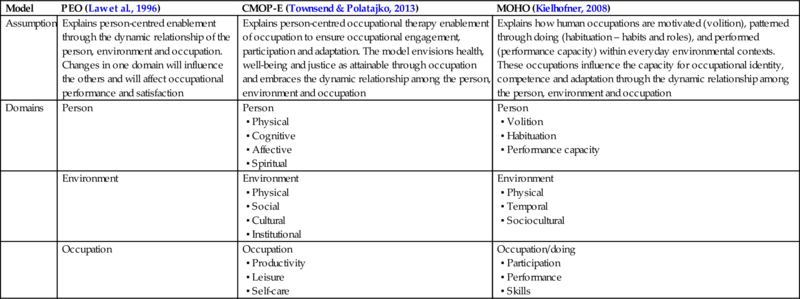
CMOP-E, Canadian Model of Occupational Performance and Engagement; MOHO, Model of Human Occupation; PEO, Person-Environment-Occupation Model.
Application of an Occupational Analysis: Examples Using the CMOP-E and MOHO
An example of the occupational analysis of environment domain of the CMOP-E (Townsend & Polatajko, 2013) as Bernice participates in the occupation of grocery shopping is provided in Table 14.7. The analysis remains specific to the environmental context of the large community-based grocery store. The subdomains of the environment are identified as physical (settings natural or built; objects and space), social (social groups and interactions at the micro [personal], meso [families or work groups] and macro [societal] levels), cultural (values, beliefs, life experiences) and institutional (economic, political, legal and societal influences). These environmental domains may offer facilitators or barriers to participation, engagement and performance.
Table 14.7
Application of CMOP-E for Grocery Shopping: Domain of Environment

CMOP-E, Canadian Model of Occupational Performance and Engagement
An example of the occupational analysis of the domain of volition of the MOHO (Kielhofner, 2008) as Bernice participates in the occupation of grocery shopping is provided in Table 14.8. The analysis remains specific to Bernice’s skills, attributes, roles, habits and spiritual capacity as she performs the activity within the environmental context of the large community-based grocery store. The subdomains of volition are identified as personal causation (knowledge of skill capacity and self-efficacy), values (personal values/beliefs, sense of obligation) and interests (attraction and preferences of a given activity). The volitional domain can be used to explain how Bernice anticipates, chooses, experiences and interprets the grocery shopping activity in its entirety, thereby influencing her occupational engagement. Success in engagement will be determined by her thoughts and feelings about her own capacity for mastery, her values and her enjoyment and satisfaction attributed to the tasks of grocery shopping.
Table 14.8
Application of the MOHO Occupational Analysis for Grocery Shopping: Domain of Volition
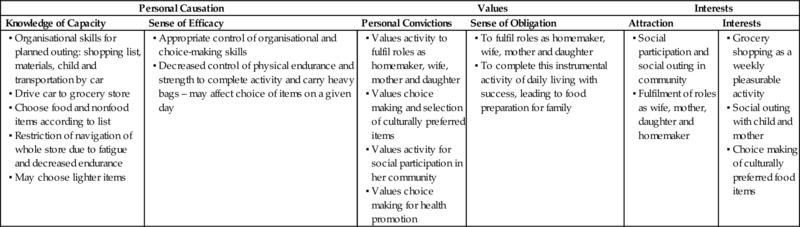
MOHO, Model of Human Occupation.
Therapeutic application of activity and occupational analyses
Grading and Adapting an Occupation
Once an occupational analysis is complete and the intrinsic values of the activity and environment are described, the occupational therapist will then grade or adapt the activity components or environmental factors to understand its meaning and value to an individual. Both grading and adapting foster change and adaptation that potentially leads to greater participation and engagement, as well as increased independence.
Grading is a modification of the occupational challenge (either increased or decreased) for a person as that person performs the activity (Thomas, 2012). Hersch et al. (2005) suggested that this is done by using the results of the occupational analysis and then working backwards to find a way to change the task to allow successful completion. This can be achieved by progressively changing the task complexity, the steps, the physical assistance, the social interaction or the environmental demands. In addition, the demands of the sequence of steps and temporal variables should be considered, including timing or scheduling of the activity during specific times of the day, week or month and the duration of the whole activity. To grade the occupation for success, consider the most challenging activity demands for the person and the impact of these demands on performance and satisfaction.
Examples of grading an occupation include the following:
▪ Reducing steps or repetitions of movements to promote completion
▪ Providing preprepared materials to eliminate task components
▪ Providing lighter weight materials to facilitate grasp or increase endurance
▪ Pairing up two individuals to complete one activity
▪ Positioning all materials on the functional side for easy access
Adapting is explained as modifying or changing an aspect of the occupation or environment with the goal of allowing participation or increased independence (Thomas, 2012). Although adapting shares similarities to grading, the objective is not to increase or decrease the demands of the activity on the person. An occupational therapist can creatively adapt the task or the environment to improve the individual’s ability to perform and succeed at the chosen activity (Hinjosa & Kramer, 1997). This can involve changing components of the environment such as physical space, tools and equipment, lighting and sensory input or may involve the provision of adaptive technologies. Technologies are comprised of technical aids, adaptive supports and virtual or simulated environments that enable participation. Technology in its simple (low) or complex (high) forms supports an adaptive intervention approach that promotes acquisition or restoration of compensatory skills, habits and routines and is often integrated when grading and adapting activities or occupations. An example of a simple low-technology adaptation is the application of a built-up handle of a spoon to facilitate self-feeding. An example of more complex, high-technology grading application is the use of motion capture sensors through a virtual program, such as Jintronix, to stimulate range of motion of the upper extremity and provide biofeedback to the person who will use the technology.
Examples of adapting an occupation include the following:
▪ Providing a tool that allows for a modified grasp (i.e. replace a conventional computer mouse with a joystick mouse for easier grasp and manipulation)
▪ Providing prompting or personal assistance with the activity (i.e. verbal prompting to guide actions to complete a puzzle; hand-over-hand support to brush teeth)
▪ Providing online support to ensure participation (i.e. online shopping with home delivery)
▪ Choosing a time of day when a location is likely to be less occupied and overstimulating (i.e. playing in a park early in the morning rather than midmorning)
▪ Reading a book with an enlarged font (for visual impairments) or with a condensed story line (for attention difficulties)
▪ Engaging in a simplified version of a board game to promote successful participation
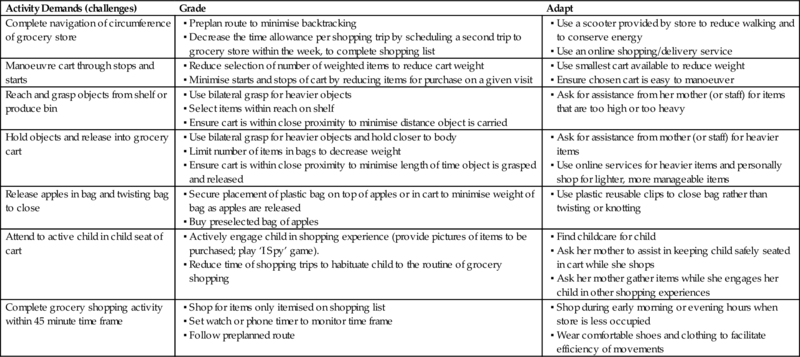
A number of possible ways that the occupation of grocery shopping can be graded or adapted for Bernice are presented in Table 14.9. The activity demands are reflective of Bernice’s challenges with decreased upper extremity strength, fatigue and decreased endurance.
Table 14.9
Grading and Adapting of Grocery Shopping for Bernice
Conclusion
An overview of the concepts of task analysis, activity analysis and occupational analysis within occupation-based frameworks has been provided in this chapter. These analyses are recognised to form a continuum of the analysis process and are appreciated from an occupation-based perspective, in which meaningful occupation is proximal and essential to occupational therapy intervention. The continuum of the analysis process begins with a task analysis describing the sequence and timing of actions or list of steps within an activity. An activity analysis then examines the skills and context of the activity in the environment. Finally, an occupational analysis, the perspective most unique to the profession of occupational therapy, validates the meaning of the activity for the specific person performing it within a chosen environmental context. An activity becomes an occupation when it becomes meaningful to the person performing it.
Theoretical practice models are useful to occupational therapists as a tool to enable analysis of occupations to help guide their interventions. The PEO Model (Law et al., 1996) provides foundational support for occupation-based application of activity/occupational analyses and highlights the dynamic and influential relationship among the person, environment and occupation. The outcome of this dynamic relationship is occupational performance, comprised of interpretations and experiences of the person so that meaning of the occupation is personally expressed. The CMOP-E (Townsend & Polatajko, 2013) and the MOHO (Kielhofner, 2008), two occupation-based models of practice aligned with the concepts and philosophy of the PEO Model (Law et al., 1996), are applied to the occupational analyses. They each focus on domains reflective of human occupation (performance skills and choice making), the person’s attributes and skills, and his or her interactions with the physical, social, cultural and institutional environments.
Occupational therapists have the expertise to assess the environment, inherent sequence and timing of occupations, as well as the required skills and capacities needed for participation in an activity or occupation, to achieve a therapeutic outcome. By grading and adapting activities or occupations, personal meaning is reinforced, potentially leading to greater participation, engagement and independence. This outcome further fosters health, well-being and quality of life for people receiving occupational therapy services.
