Chapter 16 Health promotion in primary care and hospitals
Overview
To change a large and complex organization such as a hospital from being a place of treatment to one where health gain is valued and seen as part of its purpose is a challenging process. Health-promoting hospitals (HPHs) incorporate a variety of different projects, but with the same overall aims:
A hospital, like a school or a workplace, is a social system with its own procedures, culture and values. The process of developing an HPH will thus involve the adaptation of management structures, top-level political commitment and the facilitation of greater participation by staff and patients.
Defining a health promoting hospital
Settings can normally be identified as having physical boundaries (including geographical), a range of people with defined roles and an organizational structure. As we have seen earlier in this part, a settings approach is not about doing a health promotion project such as a display for No Smoking Day nor is it about delegating health promotion to specific departmental or staff ‘champions’ (Johnson & Baum 2001), although both activities may be used as part of wider development. The settings approach to health promotion focuses on bringing about holistic organizational and practice changes to create a more health-promoting environment. The challenge lies in convincing hospital authorities that health promotion does not constitute an additional burden but is very much part of the core business and approach.
The World Health Organization (WHO) definition (Nutbeam 1998) provides a useful starting point for understanding what is required:
A health-promoting hospital does not only provide high quality comprehensive medical and nursing services, but also develops a corporate identity that embraces the aims of health promotion, develops a health-promoting organizational structure and culture, including active, participatory roles for patients and all members of staff, develops itself into a health-promoting physical environment, and actively cooperates with its community.
The hospital as a setting for health was validated by the launch of the Health Promoting Hospitals (HPH) initiative in 1990 by the WHO Regional Office for Europe. This network now includes 669 institutions in 39 countries. In this chapter, the potential of the hospital setting to promote health is examined and examples of good practice are given to illustrate what can be achieved.
Why hospitals are a key setting for health promotion
Many health practitioners assume that health promotion has always been a core task of medicine in general and hospitals in particular. Yet health promotion can be at odds with the hospital context which is based on a medical model of care with an orientation towards cure and treatment. The expectation of the patient role has been one of ‘passivity, trust and a willingness to wait for medical help’ (Latter 2001, p. 78):
Yet hospitals are also a natural focus for health promotion:
 BOX 16.1
There has been a shift in recent years away from an emphasis on the compliant patient to one which is more patient-centred that acknowledges patients’ concerns and their own expertise (see Chapter 9 for an outline of the Expert Patient programme). Considerable evidence exists to show that patient outcomes are much improved when patients are involved in their own care and have adequate explanations and time to discuss their concerns (Coulter 2002; Coulter & Ellins 2007 and see www.pickereurope.org). Researchers from Denmark, for example, showed in various randomized controlled trials that complications and length of stay after surgery were reduced when smokers or heavy drinkers underwent cessation programmes before surgery (Moller et al 2002). A major proportion of hospital admissions are related to patients suffering from one or more chronic diseases. These patients require support to cope with their disease and to achieve some changes in lifestyle, adherence to possibly complicated drug and nutrition regimes and management of their condition. There is evidence that patients are more receptive to information and advice in situations of acute ill health. Although hospitals may appear to be ‘downstream’, the hospital thus provides a ‘window of opportunity’ for patients to understand the potential benefits of behaviour change.
 BOX 16.2
Emergency care
The role of an Emergency Department (ED) or Accident and Emergency (A&E) unit is to provide treatment and care for the acutely ill and injured promptly at any time. This downstream focus paradoxically enables the ED to be a suitable setting for health promotion because it is an established entry point to the health system and because it tends to have good links into the community. Bensburg & Kennedy (2002) offer numerous examples of health promotion strategies from risk assessment (young people and alcohol) to health information (triage nurses providing information to carers who are high users of emergency paediatric services, including a follow-up appointment after discharge), to health education (asthma management training and follow-up telephone calls and using the waiting room to promote reading and literacy to children).
An HPH will also have benefits for its staff and community. Staff sickness/absence rates are likely to be lower, and staff retention is likely to be better. Local communities will benefit from having a large, responsible and responsive employer in their area. HPHs will bring income into local communities (through workforce wages), demonstrate how large organizations can be environmentally aware (through, for example, recycling and local sourcing of food) and provide an accessible and local source of expertise regarding health matters.
Existing performance management measures for hospitals relate to productivity such as number of emergency admissions, unnecessary procedures and inpatient bed stays. What might be indicators of an HPH?
An HPH would be evident in the following core principles, outlined in the Vienna Recommendations (WHO 1997):
Although hospitals will always be places of treatment and the pressure to reduce length of stay may limit health education opportunities, they are still numerous ways in which the setting can be more conducive to health.
The WHO HPH movement focuses on four areas (Pelikan et al 2001):
Promoting the health of patients
The main focus of most health promotion in hospitals is disease management and prevention for patients (Johnson 2000). But even in case of severe diseases, patients are always partly healthy (whether emotionally, socially, spiritually) when they enter the hospital and these aspects (e.g. of self-care, psychological well-being or social contact) can be maintained.
In many health care settings, including hospitals, health promotion strategies are often referred to as opportunistic when a chance has arisen to offer health education or other preventive action during a clinical visit. There are, however, opportunities for more coordinated intervention strategies such as risk assessment for alcohol-related problems or the offer of Chlamydia screening.
Professionals play a minor role in promoting the health of their patients however; the major contributors to patients’ health are themselves, their relatives and friends. Empowering patients to get involved as partners and (co)producers of their health in decision-making and diagnostic and therapeutic processes, through the provision of information and education, is therefore an important health promotion strategy.
Actions such as co-designing pre-admission information with patients, offering computer-based decision aids for treatment options and patient involvement in infection control illustrate how health promotion principles of being equitable, empowering and participatory can become the basis of hospital practice. Maintaining patients’ positive health with greater consideration of their quality of life and psychosocial functioning includes:
One of the poorer aspects of hospital care that is frequently cited by patients is the provision of food.
Food in hospital
Intake of nutritious food is crucial for patients recovering after surgery or medical interventions. Yet over the past few years there has been considerable concern about patient malnutrition, poor-quality food and poor hygiene standards amongst hospital food suppliers. The Council of Europe passed Resolution ResAP (2003) on food and nutritional care in hospitals. In the UK the Better Hospital Food programme was launched in 2001 (www.nhsestates/better_hospital_food).
National Health Service (NHS) trusts spend about £250 million a year on food alone, or £500 million on food, contract and catering staff costs. They serve about 300 million patient meals a year in about 1200 hospitals, as well as several million meals to staff and visitors. According to the Kings Fund (Jochelson et al 2005), food procurement in the NHS is still driven by price. Some hospitals spend only £2 a day on food per patient. Poor-quality food that is overcooked or lukewarm by the time it reaches patients often ends up in the bin. Uneaten meals cost about £18 million a year. If food preparation waste and labour are included, the price of uneaten food rises to over £144 million a year. In Europe organic and local food procurement is commonplace. The UK is slowly adopting the concept of corporate social responsibility which includes sustainability for the NHS (Department of Health 2004, pp. 60–68).
Accessing health care is also a concern for patients. 1.4 million people miss, turn down or do not seek hospital appointments because of problems with transport. Of those without a car, 31% have difficulties travelling to their local hospital, compared to 17% with a car (Social Exclusion Unit 2003). With the concentration of acute facilities into fewer and larger units, such problems are likely to increase. Others may not access care because of barriers of language or fears of discrimination. A low service uptake may be due to a service not meeting needs and not being adapted to take account of diverse cultures and religions. The articulated needs of minority groups focus on communication, information, account to be taken of religion, dietary preferences and consent (Bhopal 2007).
Promoting the health of staff
The hospital as a physical and social setting also has an impact on the health of staff. Hospitals are potentially dangerous workplaces, encompassing physical risks (e.g. exposure to biological, chemical, nuclear agents), mental risks (e.g. stress, night shifts) and social risks (e.g. night shifts have a negative impact on social life, bullying, violence against staff).
Shift work
Shift work is a feature for all hospital staff. The Hospital at Night project was introduced to find ways of reducing trainee doctors’ working hours to comply with the European Working Time Directive (WTD). The law states that, by 2009, junior doctors must not work more than 48 hours a week. Hospital at Night redefined how medical cover is provided in hospitals during the out-of-hours period. It moved away from cover defined by professional demarcation and grade, to cover that is defined by competency.
Other aspects of the environment that affect the health of staff are less addressed. For example, patients, staff, visitors and the local community are also affected by the physical environment of the hospital setting, including its functionality and aesthetic design. In 1859 Florence Nightingale commented:
People say the effect is on the mind. It is no such thing. The effect is on the body, too. Little as we know about the way in which we are affected by form, colour, by light, we do know this, that they have a physical effect. Variety of form and brilliancy of colour in the objects presented to patients is the actual means of recovery.
For many of today’s patients, visitors and staff, however, the hospital environment remains soulless, drab and depressing. One report (Commission on Architecture and the Built Environment 2004) highlighted the following as key factors in the poor working environment:
Gardens have long been attached to hospitals for therapeutic uses. In one study Ulrich (1984) found that the surgical patients who had a window view of the outdoors were discharged earlier, took fewer painkillers and received fewer negative evaluations from nurses than matched patients in similar rooms that faced a brick wall. Similarly, staff frequently cite the lack of access to a green space in which to relax as a feature of their poor work environment. Johnson & Baum (2001) reported on the activities of Adelaide Hospital which sought to address this through lunchtime walking groups and staff aerobic classes. These activities were organized by the corporate services division of the hospital, which wished to be seen as a caring employer, rather than any coordinated vision of an HPH.
Violence against health care staff is increasingly common and may include verbal abuse, threats and physical assaults. Those working in A&E and psychiatry are most likely to suffer abuse. What could a hospital do to protect the health of its staff?
The most common response is one of zero tolerance, a message which is promoted through publicity campaigns and education programmes for staff who are encouraged to report violent incidents with formal protocols for documentation of violent episodes. Although such programmes are seen to be protecting the health of staff, they are not tackling the systemic issues that give rise to these events.
Early studies of nursing, for example, focused on the profession’s lack of power. The explanation for this was said to lie in nursing’s predominantly female workforce, its function as the alleged hand-maiden to medicine, and because it had absorbed the values of its own activities which assumed a level of passivity and compliance.
Kanter (1977) suggests that organizations can be empowering or disempowering and there are key tools which help to generate power which include:
The hospital and the community
The hospital also has an impact on the health of people living and working in the surrounding neighbourhood. The largest capital development programme in the history of the NHS means large car parks, energy-intensive air conditioning, heating and lighting as well as huge quantities of waste. Sustainability is central to the development of an HPH.
Hospitals can further promote health in their community by:
Organizational health promotion
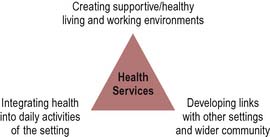
The hospital is however not just a site for health promotion activities but a social entity that creates health. An HPH must therefore incorporate the vision, concepts, values and basic strategies of health promotion (equity, empowerment, participation and collaboration as well as sustainability) into the structures and culture of the hospital and thus health becomes its outcome (Figure 16.1).
 BOX 16.9
An ecological social systems approach of developing a healthy setting requires both change from the top in relation to organizational development and political commitment and change from the bottom from high-visibility innovative projects, engagement of all users of the setting and establishing the values of HPH into the institutional agenda and core business. HPH could be linked and combined with other strategies of hospital development (e.g. health education, patients’ rights, self-help movements, health at work, hospital hygiene, the ecological and sustainable development movement, strategies for personal and organizational development, quality management) Dooris (2006).
In pairs practise the following role play in which one of the pair is the Chief Nurse who has been asked to address the hospital board and must give five reasons why the hospital should become an HPH. The other partner is the hospital Chief Executive who must give five reasons why an HPH is not a good idea.
The HPH movement
The HPH network, launched by the WHO European Regional Office in 1990, now operates in 39 countries on all continents. This initiative seeks to promote good practice by developing concepts and strategies, developing and disseminating model projects and networking via conferences and newsletters (www.healthpromotinghospital.org). The HPH focuses on the health of staff, patients and its local community.
Hospitals accepted into the HPH network have to meet certain conditions (WHO 2004):
Think of a hospital with which you are familiar. Does it promote health in the ways outlined above? What do you think might be barriers to extending its health-promoting role?
The complex organizational structures of many hospitals and the fact that most health professionals in the hospital setting do not readily associate health promotion as part of their role make the HPH a challenging setting. Whitehead (2004) argues that the hospital setting is the least visible of all the Ottawa Charter settings and ‘there is little empirical evidence of a measurable health impact’ of policies focused on creating healthy environments as part of HPH (Dooris 2006, citing McKee 2000). In order to realize its full potential, the HPH strategy needs to be implemented not only within limited projects, but also embedded as an integral aspect of hospital service (quality) management systems (WHO 2004). Many hospitals now define themselves as an HPH, employ a coordinator, have specific projects (e.g. being smokefree or migrant-friendly) and endeavour to be learning organizations.
Conclusion
Although core activities of hospitals remain focused on medical diagnosis and treatment, the HPH concept has taken root and there are many examples of hospitals embracing health promotion principles. Health-promoting initiatives occur at all levels, from individual practitioners using checklists to include health promotion systematically in client contacts, to hospital-wide initiatives to increase service user participation and reduce environmental impact. In between lies a range of activities at ward or departmental level, including the use of arts therapies and the provision of healthy locally sourced food. All initiatives are guided by core health promotion principles: a holistic concept of health, empowerment, participation, intersectoral collaboration, equity and sustainability.
The HPH needs to be supported by an organizational structure: support from management, a budget, specific aims and targets and action plans for implementing health promotion into everyday business. All hospital staff need to make health promotion their business. This can be a challenge, particularly for staff in acute settings who are trained in other (diagnosis and treatment) priorities (Latter 2001). Treating health promotion as one specific quality aspect to be monitored can aid its incorporation into core processes. Integrating health impact assessments into all decision-making within the hospital will also help to advance the HPH.