18 Predicting and guiding career success in medicine
Personality; Agreeableness One of the ‘Big Five’ personality traits. Agreeableness, or its opposite tough-mindedness, refers to the degree to which an individual is generally cooperative and compliant to the wishes of others. Agreeable individuals tend to be likeable and straightforward. Tough-mindedness is however, when making essential but unpopular decisions.
Personality; Conscientiousness One of the ‘Big Five’ personality traits. Conscientiousness refers to the amount that a person is generally organised, tidy, and methodical, pays attention to detail, and is achievement-motivated. Low C individuals are often more imaginative and artistic, and find it easier to see the bigger picture or take imaginative risks.
Contest mobility Sociological view of success in which all individuals are perceived as having the potential to achieve and compete with one another in open and equal contest for success. Particularly favours hard work.
Personality; Extraversion One of the ‘Big Five’ personality traits. Extraversion and its opposite, introversion, refer to the amount that a person generally enjoys stimulation from the environment. Extraverts tend to be sociable and enjoy exciting activities. Introverts tend to prefer their own company and enjoy quieter activities.
Career success; Extrinsic Objective aspects of career success, for example salary increases, promotion.
Generalised self-efficacy The belief in one’s overall ability to achieve across a variety of situations.
Holland’s typology Psychological theory of career choice and success which outlines 6 types of interest and 6 corresponding types of career. These are Realistic, Investigative, Artistic, Social, Enterprising, and Conventional (often abbreviated to RIASEC). The more congruence between a person’s interests and their career type, the more satisfied that person is hypothesised to be.
Human capital Sociological concept of the skills, experience, and knowledge that an individual acquires, and which increases a person’s economic value and chances of success at the workplace.
Individual differences psychology The study of how individuals differ from one another in terms of factors that influence success or failure. Particularly concerned with personality and intelligence.
Career success; Intrinsic Subjective psychological aspects of career success; for example, job satisfaction.
Locus of control Psychological trait or state describing the amount of control individuals believe they have over outcomes affecting them. Individuals with Internal LOC tend to believe that their actions determine outcomes, whereas those with External LOC tend to believe that outcomes are determined mainly by the actions of others. Some measures also include a third form, known as Fate or Chance, which is completely out of anyone’s control.
Motivation; extrinsic See main Glossary, p 339.
Motivation; intrinsic See main Glossary, p 339.
Personality; Neuroticism One of the ‘Big Five’ personality traits. Neuroticism, and its opposite, Emotional Stability, refer to a person’s typical level of anxiety. High Neuroticism is associated with anxiousness, depression, and self-consciousness. Moderate levels of anxiety have, however, evolved to be adaptive and low N individuals often take unnecessary risks without considering their consequences.
Personality; Openness to experience One of the ‘Big Five’ personality traits. Openness to Experience refers to the amount that a person is generally interested in theories and ideas. High O individuals tend to be intellectual and artistic. Low O individuals tend to prefer the concrete to the abstract, are less good at fantasising, and are more conservative politically and morally.
Organisational sponsorship Opportunities for career progression offered by organisations to their employees.
Outcome expectations From social cognitive career theory; the belief that a particular behaviour or course of action will lead to specific outcomes.
Personality: the Big 5 Modern trait personality theories generally recognise five important dimensions of personality, consisting of: Agreeableness; Conscientiousness; Extraversion; Neuroticism; and Openness to Experience, which are described separately. Together they account for much of the important variations in personality.
Socio-cognitive career theory (SCCT) Lent and Brown’s application of Bandura’s Social Cognitive Theory to career success. It emphasises the importance of outcome expectations, goal setting, and self-efficacy on career outcomes.
Self-determination theory (SDT) Psychological theory of motivation and behaviour from Edward Deci and Richard Ryan. Particularly concerned with the influences on self-determined (i.e. autonomous, self-regulated) behaviour. Distinguishes between intrinsic and extrinsic motivation.
Self-efficacy See main Glossary, p 340.
Social cognitive theory; see also self-efficacy See main Glossary, p 340.
Sponsored mobility Sociological view of success in which individuals are singled out early on as having potential and given specific help and advantages in order to help them reach that potential.
Vocational psychology Study of the work-related experiences and behaviours of individuals. Particularly concerned with theories of career choice, motivation, and satisfaction.
‘Each of them – as is often the way with men who have selected careers of different kinds – though in discussion he would even justify the other’s career, in his heart despised it.’
Leo Tolstoy (1877, Anna Karenina)
Overview
This chapter provides information, first on which doctors can base the career advice they give to other doctors, second which can help them reflect on and gain insight into their own careers, and third to assess the extent to which general theoretical principles can inform an understanding of medical careers. We examine various psychological theories of career success and apply the findings to medicine. They enable us to understand what it means to have a successful medical career, and whether we can predict which doctors will be successful and under which circumstances. If the chapter contains one key message, it is that ‘people differ’; or as it was put so much more elegantly by Kluckhohn (1953):
‘Every man is in certain respects a) like all other men, b) like some other men, c) like no other men.’
Any understanding of careers has to acknowledge those three levels, of invariance, similarity, and individuality.
A good career
What is a good or a successful career? Such a seemingly simple question has no obvious answer, for the crucial reason that not only do careers differ so very much but so also do the people having them. As therefore was the case for Tolstoy’s Levin and Oblonsky, ‘one man’s meat is another man’s poison’. The point would seem trivially obvious were it not that medicine has a long tradition of looking for simple, one-size-fits all, solutions to complex problems. When new drugs are introduced, the typical question is, ‘Does it work?’, but less commonly is it asked, ‘For whom does it work, why, and how would we know?’ Career guidance for UK medical students and doctors is likewise often based on a similar model of a single method, applied to all, and intended to help all. Many years ago, clinical psychology adopted a very different approach to managing the problems of patients, there being no single off-the-peg treatment for most psychological conditions, because people and their symptoms differ so much. So, instead, there are general principles, and most cognitive and behavioural therapies are bespoke treatments, tailored to the specific circumstances of individual patients.
Parsons (1909) recognised the importance of choosing the right career in the opening words of his book, Choosing a vocation, published in 1909:
No step in life, unless it may be the choice of a husband or wife, is more important than the choice of a vocation. The wise selection of the business, profession, trade or occupation to which one’s life is to be devoted and the development of full efficiency in the chosen field are matters of the deepest moment.
It is worth re-emphasising Parsons’ point that it is not only career choice that matters but also career development.
Careers and specialities differ in many of their working conditions, but there is at least as much variation in the ways that different people experience any particular working condition. The psychological literature is rich with theories about how and why different individuals choose and enjoy their careers, and likewise, why they do not enjoy their careers. Career counsellors and vocational psychologists, whose primary interests are in how individuals choose careers, and what determines success in those careers, respectively, are interested in how individual and environmental factors influence career choice and outcomes. They are interested in how insight into the values, beliefs, personality, and aptitudes of individuals, typically determined by psychometric test results, relates to success. Career success is viewed not only in the objective terms of financial reward, promotion, responsibility or productivity but also as individuals’ experiences, satisfaction, sense of personal achievement, opportunities, and life-satisfaction.
Within the broad remit of career counselling, ‘medicine’ is often treated as a single entity, with little consideration given to the vast range of its specialities. Early medical training is indeed fairly uniform. In the United Kingdom, the General Medical Council oversees curriculum standards for undergraduate education and the majority of graduates are employed in the National Health Service (NHS), which has a nationally standard set of career structures. That apparent homogeneity masks the differences in training approaches and day-to-day experiences of, for instance, a neurosurgeon, a part-time GP in a remote rural practice, an inner-city GP, a full-time medical school dean, a clinical oncologist, a forensic psychiatrist, and a molecular biology researcher. Although all underwent a broadly equivalent undergraduate education, each needs different knowledge, skills, and abilities; they need to update those skills continually in different ways; they gain differing types and amounts of recognition for their work; and they differ in the satisfaction and stress they get from their careers. They also differ in their sense of perspective, not only on their careers but also on those for whom they are caring, as was nicely described by Helman (2006):
On the one hand is family medicine with its slow revelation to the doctor of a life pattern, or a pattern of disease, in an individual or a family. On the other is the image of a person revealed instantaneously in a hospital clinic by the technology of scientific medicine: X-rays, scans, blood tests – and often in a rushed consultation between two strangers. It’s the fundamental difference between the briefest glimpse and a lengthy narrative. Between a snapshot and a long novel.
The lessons learnt from vocational psychology and career counselling provide a challenge for doctors when thinking about their own careers and also when guiding other doctors in making successful career choices.
Career success
Career success can be defined as the positive work-related and positive psychological outcomes of an individual’s experiences over the course of their working life (Judge et al, 1994; Seibert and Kraimer, 2001). It can be extrinsic, measured objectively in terms of material rewards such as pay and promotion to high-status and prestigious jobs. It can also be intrinsic, measured subjectively in terms of the psychological rewards received such as inherent enjoyment of one’s work, attainment of personal goals, and satisfaction of personal values (Judge et al, 1999; Ng et al, 2005; Pachulicz et al, 2008). Extrinsic and intrinsic career success are conceptually different and only moderately correlated, just as job performance (the degree to which people accomplish objectively measurable tasks) is only moderately correlated (r = 0.3) with subjective job satisfaction (Judge et al, 2001). Understanding how and why intrinsic and extrinsic outcomes differ is therefore a vital part of making informed and successful career choices.
Intrinsic versus extrinsic outcomes: self-determination theory
The intrinsic–extrinsic distinction came to prominence with Richard Ryan and Edward Deci’s self-determination theory (SDT: cf. Deci and Ryan, 2008). SDT is concerned with why people are motivated to make particular choices in their lives, such as taking exercise or studying hard, and what effect those choices have on their well-being and life satisfaction. It identifies three universal human psychological needs of autonomy (having choice), relatedness (being close to other people), and competence (believing one is good at what one does). It argues that the more opportunity we have to fulfil those needs, the more motivated and more happy we are likely to be. Indeed, a recent study showed that adults with a mean age of 75 who felt they had attained their life’s intrinsic goals by, for example contributing to their community, aspiring to personal development, and building up meaningful relationships, had greater psychological need satisfaction, and were less anxious about and more accepting of their own death than those who had attained extrinsic goals of financial success, power, physical appeal, and social recognition (Van Heil and Vansteenkiste, 2009).
Intrinsic motivation
Intrinsically motivated behaviours are those which, by their nature, fulfil the need for autonomy. They are performed simply because it is enjoyable to perform them. If you are lucky enough to have a job which you would do regardless of extrinsic rewards such as pay or recognition, you are likely to be motivated to continue in that job and work hard. Intrinsic motivation is a feature of early life: babies tend to be motivated to do things they find intrinsically enjoyable. Unfortunately, as responsibilities grow, there are fewer and fewer chances to engage in intrinsically motivated behaviours and one has to rely instead on extrinsic rewards and punishments for motivation. Some extrinsically motivated behaviours, doing the ironing to avoid being nagged for example, can be unfulfilling and unsatisfying, and it is difficult to summon up the motivation to perform them, and perform them well. However, other extrinsically motivated behaviours can lead to considerable satisfaction.
Extrinsic motivation
The key difference between unsatisfying and satisfying extrinsically motivated behaviours is, according to SDT, the amount of autonomy one has in deciding to perform the behaviour, as well as the competence and relatedness the behaviour affords. If you had little say in whether or not you did the ironing (low autonomy), and you are not very good at it (low competence), and you do it alone (low relatedness), you will probably avoid doing it again, except to avoid the extrinsically motivating punishment of being nagged. However, if you feel that it is important to dress neatly for work and make your own decision to do the ironing (high autonomy), and then you find you are actually an efficient ironer (high competence), and your partner chats to you as they hang the clothes after you have ironed them (high relatedness), you will probably feel a greater sense of satisfaction from doing it and will be motivated to continue (e.g. Richer et al, 2002). In that situation, the level of autonomous motivation you felt was determined by the amount you had internalised the importance of looking neat at work. That is still extrinsic (you are not ironing for the love of it), yet it is motivating.
Autonomy
Extrinsic motivation can therefore be strong and persistent if it is autonomous. Autonomous motivation (whether intrinsic or extrinsic) is a predictor of success in terms of job satisfaction, job commitment (Lam and Gurland, 2008; Richer et al, 2002), persistence in academic contexts, and good grades (Burton et al, 2006; Vansteenkiste et al, 2004). It also leads to effective performance, particularly on complex tasks that require creativity and problem solving (Deci and Ryan, 2008). In doctors, autonomy positively predicts job satisfaction, job commitment, and higher publication rates for clinical academics, and negatively predicts burnout. In medical students, autonomous motivation predicts greater academic attainment and increased persistence with medical studies (Barnett et al, 1998; Freeborn, 2000; Hoff et al, 2002; Sobral, 2004). Self-determination theorists would suggest choosing careers that mostly involve tasks you would just love doing (intrinsic autonomous motivation) or consider very important (extrinsic autonomous motivation), whilst avoiding those that consist of pointless tasks you would be forced to do (extrinsic controlled motivation).
Reward
This may seem obvious, but the rewards a job offers can sometimes tempt people to ignore the need for autonomy. Indeed, the intrinsic or extrinsic nature of rewards and career goals are themselves predictors of success. A longitudinal study of German graduates showed that those with extrinsic career goals at graduation were less likely to be satisfied with their careers after 7 years, despite having achieved greater salary and status (Abele and Spurk, 2009). This may be because the participants’ expectations were unrealistically high and therefore remained unfulfilled, or because the pursuit of extrinsic goals is associated with the attainment of extrinsic rewards of status and money rather than the intrinsically rewarding job satisfaction. Similarly, a study from the United States found that workers who had a particular desire for the extrinsic goal of promotion were less likely to be satisfied (Wayne et al, 2001). In medicine, a study of 165 US medical students found that the intrinsic goals and rewards of ‘a balanced work and professional life’, ‘being a good communicator with patients’ and ‘professional and intellectual growth’, were rated as the most important determinants of satisfaction (Reed et al, 2004) above extrinsic factors of ‘financial security’ and ‘respect from colleagues and the community’
According to SDT, a job or career that rewards you by allowing you to be with the people who are important to you at home or at work, that makes you feel like you are good at what you do, and that gives you the chance to make your own decisions is more likely to lead to job satisfaction than one that only affords financial rewards and status. There is even evidence from numerous studies that extrinsic rewards such as material wealth, outward physical beauty, and social status can undermine intrinsic motivation (Deci et al, 1999), reduce creativity, and inhibit complex problem-solving ability (Gagne and Deci, 2005), and thus lead to less needs satisfaction. It has, however, been argued that it is not whether the reward is extrinsic, but how the reward is presented that is important. A study of 947 primary care physicians in the United States showed that job satisfaction was negatively associated with financial incentives for productivity, but positively associated with financial incentives for quality assessed by audit (Grumbach et al, 1998). So, it is worth considering whether the rewards on offer for a job are likely to make the job seem trivial, because this will probably decrease intrinsic motivation, or whether they convey the job’s personal or social significance, as this is thought to increase intrinsic motivation.
Importantly, autonomous motivation is not inborn or static, but can be nurtured in medical students by clinical teachers (Williams et al, 1997). Doctors wanting to support career development could therefore consider making the learning and/or working environments of doctors in training more autonomous and supportive. That can be achieved by listening to the needs of students and trainees, understanding their points of view, encouraging them to make their own choices, and giving them sufficient information to make those choices.
Individual and environmental predictors of career success
Motivation and rewards influence career success, but what about other predictors? As with almost all aspects of human life, influences on career success arise both from within individuals and from the environment, and often interact to determine outcomes. For example, a study of 1435 UK junior doctors found that doctors’ ratings of job quality were mostly related to the particular team, hospital, or trust in which they worked. In contrast, reported stress levels in the same doctors related almost entirely to individual differences in personality and other attributes, rather than to job characteristics. In fact the stress levels of two doctors working in identical posts were no more similar than those of two doctors chosen at random and working in different teams, in different hospitals, in different trusts, overseen by different deaneries (McManus et al, 2002). The individual and environmental variables commonly explored in vocational and occupational psychology include self-efficacy, human capital, organisational sponsorship, personality, locus of control, and demographics. An overview of research evaluating the impact of these factors on career success is given, and also discussed in the context of medicine.
Self-efficacy and socio-cognitive career theory
The concept of self-efficacy, the belief that one has the motivation and ability to perform a specific task, was made famous by Albert Bandura’s Socio-Cognitive Theory of Behaviour (Bandura, 1977; also discussed in Chapter 2), which emphasises the reciprocal influences of behaviour and thoughts on each other. For example, if medical students believe they are able to take blood effectively because they know they have practised in the clinical skills lab (‘thoughts’), the first time they take blood in real life, their hands are less likely to shake, they are more likely to remember the steps to take, and they are more likely to be successful (‘behaviour’). Their success then feeds back to influence how they feel about themselves as someone who takes blood (‘thoughts’) and how likely they think it is they will be able to successfully take blood from patients in the future (‘thoughts’), which then influences how successful their subsequent attempts actually are (‘behaviour’). SCT therefore focuses on the ways in which people act, or in psychological terms, behave, to change specific situations and thus change their beliefs, thoughts, feelings, and subsequent behaviours in similar situations. Within the SCT cycle of behaviour change, self-efficacy determines choice of action, persistence, and emotional reactions to obstructions. Self-efficacy has been found to be positively related to task performance across a variety of occupations (Judge et al, 2007; Stajkovic and Luthans 1998) and, in the context of SCT, self-efficacy is considered to be situation-specific and amenable to change.
Social cognitive career theory
Robert W. Lent’s social cognitive career theory (SCCT: Lent et al, 1994) applies Bandura’s ideas to a career setting. Self-efficacy is central to the theory, as are outcome expectations and goals. Outcome expectations are personal beliefs about the consequences of one’s actions: for example, a person might believe that ‘if I decide to become a doctor (action) then I will help sick people recover/never be out of a job/be respected by society (consequences)’. Personal success, seeing other people succeeding in similar situations, being encouraged verbally by others, and feeling positive whilst engaging in tasks are all theorised to improve both self-efficacy and positive outcome expectations. Self-efficacy and positive outcome expectation encourage people to set positive career goals, which improve career success by organising and guiding behaviour, and encouraging persistence in the face of setbacks.
According to SCCT, doctors wanting to improve their trainees’ career success should try to improve trainees’ self-efficacy, manage their outcome expectations, and help them set positive and achievable goals. That can be achieved by creating positive environments in which trainees can practise their skills, receive constructive feedback and encouragement, and encounter people who are role models of good professional clinical practice.
Generalised self-efficacy
It should be pointed out that psychologists have also postulated the existence of an individual differences trait called generalised self-efficacy (GSE), which is the general self-perception that people have of themselves as more or less capable in most situations (Eden and Zuk, 1995). GSE is relatively stable across situations and is conceptually and psychometrically distinct from state self-efficacy (Stajkovic and Luthans, 1998). In some ways, it is conceptually closer to personality than Bandura’s version of self-efficacy. GSE is a potentially important predictor of job satisfaction: a meta-analysis of studies from between 1967 and 1997 found that GSE had a corrected correlation of 0.45 with job satisfaction, explaining 9% of the variance in that variable (Judge and Bono, 2001), and a more recent study found that GSE measured at graduation positively predicted career satisfaction in medicine and other jobs 7 years later, both directly and indirectly via increasing salary and status (Abele and Spurk, 2009).
Human capital and organisational sponsorship
SCCT explains how person variables (self-efficacy, outcome expectancies, goals, and socio-demographic variables) interact with environmental variables and behaviour in a reciprocal fashion. The environmental variables important in SCCT include objective factors such as amount and quality of educational experiences available and financial support for training. That is what sociologists call organisational sponsorship. SCCT also highlights the interaction between person and environmental variables and in particular the amount of investment people put into their own resources, such as education. That is what sociologists refer to as human capital (Becker, 1964).
Sponsored mobility
The sociological concepts of organisation sponsorship and human capital originated in the sponsored mobility and contest mobility perspectives of career progression and success. In the sponsored mobility approach, those with potential are identified early-on by the elite, and because resources are finite, only they are given support to progress (Coleman, 1988). Thus, in the sponsored mobility approach, organisational sponsorship and mentoring are vital to success.
Contest mobility
By contrast, the contest mobility approach is based on the belief that anyone can progress in a career as long as they show themselves to perform well in their job and be useful to the organisation in which they work. It is considered to be the foundation of the ‘American dream’; the lowliest individual can achieve the highest rewards, as long as they work hard enough. An example is Sonia Sotomayor, the first Hispanic Latin appointment to the US Supreme Court, who said
[my mother] taught [my brother and myself] that the key to success in America is a good education. And she set the example, studying alongside my brother and me at our kitchen table so that she could become a registered nurse. We worked hard. I […went on to] Yale Law School, while my brother went on to medical school.
In the contest mobility approach, individual motivation, self-efficacy, and human capital are considered keys to success.
Organisational sponsorship, human capital, and career success
Organisational sponsorship and human capital have varying and even additive effects on career success. Wayne et al (2001) studied several hundred workers at a large US manufacturing organisation. Their regression analysis showed that workers who had positive relationships with their superiors (organisational sponsorship) had higher salary increases over an 18-month period (beta = 0.20), were more likely to be rated as worthy of promotion (beta = 0.30), and also had higher job satisfaction (beta = 0.12). The link between human capital and success was less clear; workers with more education were no more likely to be promoted, have pay increases, or be satisfied than their less-educated colleagues, but having the opportunity for greater training whilst employed was linked to higher job satisfaction (beta = 0.24). A meta-analysis by Ng et al (2005) also found that workers who had greater organisational sponsorship in terms of supervisor support, career sponsorship, and training and skills development opportunities were more likely to be satisfied (mean r = 0.43) and also had higher salaries (mean r = 0.23). However, in contrast to Wayne et al, Ng et al also found that salary was positively correlated with the human capital variables of hours worked, work experience, educational level, and political skills and knowledge (mean r = 0.27).
Mentoring
Mentoring is a form of organisational sponsorship that has attracted much attention. It can vary in formality, and mentors can be from within or without the protégé’s field. Eby et al (2008) conducted a meta-analysis of youth, academic, and workplace mentoring. Outcomes were measures of behaviours, health, relations, motivation, attitudes, and extrinsic and intrinsic career outcomes. The results showed a small but statistically significant effect of mentoring on extrinsic career success (r = 0.05) and a larger effect on job skills development: that is, increases in human capital (r = 0.11). The largest effects of mentoring were on satisfaction (r = 0.16) and positive attitudes (r = 0.14), but even these were relatively small.
It can be difficult to know what aspect of mentoring improves success; for example, does the psychological support from a mentor improve a worker’s confidence and self-efficacy? Or is it that a mentor can introduce the worker to powerful people? A meta-analysis by Kammeyer-Mueller and Judge (2008) explored how the differing functions of mentors influenced success. Having a mentor, increased job satisfaction (beta = 0.25), even after taking into account human capital (e.g. education) and self-evaluations, and this was due to practical rather than psychological aspects of mentor support. However, in terms of salary, human capital (beta = 0.26) and demographics (beta = 0.10) had more influence than mentorship.
The question of who gets a mentor is also important. Is it the more proactive, motivated, well-educated, well-connected workers who seek out and get mentors? And if so, is it these factors rather than the mentoring per se that influence success? Singh et al (2009b) attempted to disentangle the effects of mentoring from human capital, engagement in proactive career behaviours, and the creation of career-related social networks. They used a powerful longitudinal design to determine whether having an informal mentor impacted on the extrinsic and intrinsic career success of 236 Australian public and private sector employees, when controlling for those other factors. The results showed that people with an informal mentor were more likely to be promoted over a 2-year period (beta = 1.15) but were no more likely to have an increase in salary. Salary increase was instead predicted by human capital: that is, training (beta = 0.17) and education (beta = 0.16). Protégés were also more likely to expect to get promotion (beta = 0.77) and less likely to want to change careers (beta = −0.33) but were no more likely to be satisfied with their careers. Career satisfaction was instead predicted by perceptions that work was challenging (beta = 0.11). In an accompanying study, Singh et al (2009a) looked at who gets a mentor, showing that ‘rising stars’ – those who had previously been more likely to be promoted, who expected to get promoted, and who developed their skills and engaged in career progression activities – were more likely to get mentors, which does indeed suggest that underlying individual factors are an important confounder.
Mentoring in medical career development
A systematic review of the effects of mentoring on career progression in academic medicine showed that mentors were generally perceived by participants to be an important part of their training experience, particularly in terms of career satisfaction, although the studies showed wide variation in the proportion of medical students and doctors who reported having a mentor (Sambunjak et al, 2006). Unfortunately, 87% of the studies in the review were cross-sectional, and the authors report that the poor quality of many of them as well as diverse outcome measures made it impossible to calculate an effect size for mentoring in medicine.
To summarise, organisational support, including mentoring, appears to have a positive effect on workers’ career satisfaction and retention as well as on extrinsic measures such as promotion and salary. Much of the research within medicine however involves small-scale cross-sectional research projects, which make it difficult to assess the size of the effects of these factors on doctors’ progression, and few studies control for personality variables, which we will see, can be a key influence on career outcomes.
Personality
SDT and SCCT explain how motivations, goals, and outcome expectancies influence attainment and satisfaction. Sociological career theories explain how human capital and organisational sponsorship affect career progression and success, and predict that demographic variables will also exert a key influence. But what explains how people react differently in the same situation? Although much of psychology examines what people have in common (e.g. how we perceive objects, how we learn to use language, and how we remember facts), there are also many studies looking at how each person differs from other people, which is known as the study of individual differences. Personality is a key area of individual differences research and, because it is a major influence on motivations, attitudes, behaviours, and career outcomes, it is also important in career research.
The idea that there are different personality traits which influence human thought and behaviour is an ancient one, and the English language is full of words used to describe different human dispositions and aspects of character. Over the course of the twentieth century, researchers came to a consensus that personality traits influence behaviour, and that these traits are generally stable over time (Matthews and Deary, 1998). So, although people’s reactions will differ in different situations, people who are worriers will tend to be anxious, those who like talking to people will seek out opportunities to interact with others, and so on. There are many competing theories of personality, and factors such as GSE (see earlier) and locus of control (see later) are sometimes considered facets of personality. In the early 1990s, however, the Five Factor Model (FFM) of personality became predominant.
The FFM of personality
The Big Five personality traits are Neuroticism (N), Extraversion (E), Openness to Experience (O), Agreeableness (A), and Conscientiousness (C). They have been found in both men and women across many different cultures (McCrae and Costa, 1997). High N is associated with anxiety, hostility, depression, self-consciousness, impulsivity, and vulnerability. Neurotic individuals tend to worry and have low mood, whereas Low N (stable) individuals are calm, poised, and emotionally stable. High E is associated with gregariousness, assertiveness, activity, excitement seeking, and positive emotions, so extraverted individuals enjoy high-energy situations involving others, whereas Low E (introverted) individuals prefer their own company and avoid risk. High O is associated with creativity, appreciating aesthetics, and thinking about feelings, actions, ideas, and values, so open individuals tend to be intellectual, whereas Low O individuals favour the concrete over the abstract. High A is associated with being trustworthy, straightforward, altruistic, compliant, modest, and tender-minded. Agreeable individuals tend to be kind, likeable, and person-oriented, whereas low A individuals tend to be perceived as arrogant, aloof, and uncaring. High C is associated with self-discipline, achievement-striving, order, deliberation, and competence. Conscientious individuals tend to work hard, whereas Low C individuals tend to be non-conformist and disorganised.
Although it is tempting to assume that some personality types are intrinsically better (it seems a no-brainer to ask who would not want to employ agreeable, conscientious, stable individuals?), it must be remembered that modern societies have many and varied roles, and all personality types probably have niches in which they are particularly effective. Creative individuals, for instance, such as research scientists or art students, are often less agreeable and less conscientious than others, in large part because they need to create a space in which they can follow their own ideas, rather than satisfy the immediate needs of the society around them. About a half of the variance in personality is probably due to genes, which suggests that it may well be variance itself that has been selected for. Intermediate levels of anxiety or neuroticism are probably optimal so that, to use a cartoon-strip analogy, all of us are descendants of those Palaeolithic ancestors who were neither so free of anxiety that they were rapidly eaten by sabre-toothed tigers, nor so obsessed with personal safety that they never left their caves for fear of being eaten and died of starvation as a result. Society does need some people who are very anxious (disasters happen and we need people who worry about the future), and it also needs people who are not anxious in high-risk situations and get on with the job in hand (soldiers, surgeons, and so on).
Personality and career outcomes
Personality predicts career outcomes. A meta-analytic review across various professions showed that conscientiousness was significantly related to job proficiency (corrected r(rc) = 0.23) in many different occupational groups (Barrick and Mount, 1991) and another study by the same authors showed that the link between C and job performance was particularly high in jobs with higher levels of autonomy (Barrick and Mount, 1993). A longitudinal paper from the United States showed C positively predicted extrinsic career success (r = 0.50; Judge, et al, 1999) and a meta-analysis by Ng et al (2005) showed C positively predicted salary (rc = 0.07), promotion (rc = 0.06), and satisfaction (rc = 0.14). It should be remembered, however, that most of these and other studies have mainly looked at jobs which are extrinsically rewarded and where the outcomes are clearly defined rather than open-ended and creative. Part of the reason conscientiousness predicts extrinsic career outcomes is that it also predicts the human capital factor of academic success. In particular, C positively predicts attainment at medical and dental school (Ferguson et al, 2002).
Just as conscientiousness positively predicts outcomes, so neuroticism is often found to be a negative predictor of both extrinsic and intrinsic success (Judge et al, 1999; Ng et al, 2005), whereas the relationships of extraversion, openness, and agreeableness with job outcomes are less clear. The most recent meta-analysis by Ng et al (2005) showed that E and O were both positively correlated with satisfaction, salary, and promotions, whereas A was positively related to satisfaction but negatively correlated with salary. A US study of nearly 500 university students and graduates tested whether the type of occupation mediated the effect of personality on career success, finding that for individuals in people-oriented occupations, A was negatively related to salary, which suggests that agreeable individuals want to work in people-oriented occupations even when they do not receive financial rewards for it (Seibert and Kraimer, 2001). A study of 1668 UK doctors (McManus et al, 2004) showed that personality influenced stress levels, approaches to work, and perceptions of the workplace. Neurotic doctors were more stressed and perceived they had higher workloads as well as lower autonomy in their work. By contrast, extraverted doctors were less stressed, and agreeable doctors perceived their workplace to be supportive with help available as needed, possibly because they were better at getting on with other members of their teams. Conscientious doctors tended to feel they had lower workloads, which is probably partly because conscientious doctors were more organised than the neurotic doctors.
How can we interpret these research findings in practice? Personality traits are stable and enduring, but that does not mean that the unconscientious neurotics amongst us are doomed to a life of failure. Just as it has been said that ‘genes are not destiny’, nor is personality. Personality does influence the way humans react in many situations, but humans can choose to behave contrary to their innate personality. Encouraging individuals to have an insight into their own strengths and weaknesses by knowing and understanding their personality traits, and recognising how they might behave, think, and feel differently in situations to the ways that other people do, are probably helpful in a range of situations. For example, understanding that one is not, say, terribly conscientious can help someone make a particular effort to be organised; or knowing that one is more neurotic than others can help in making special efforts to learn to cope with stressful situations. Insight can also help in choosing certain jobs that particularly suit one’s personality. Indeed, a meta-analysis found that personality predicted satisfaction, but that the effect was mediated by environmental factors, the suggestion being that people self-select into particular jobs in which they feel suited (Dormann and Zapf, 2001).
Locus of control
Individual differences help explain how people differ in the ways they interpret what may objectively seem like very similar situations. According to SCCT, a person’s beliefs about their own abilities and their outcome expectations are key determinants of behaviour, actual outcomes, and subsequent thoughts and beliefs. However, some people appear pessimistic in the face of success and others appear to be unfazed by failure (Rotter, 1990). This behaviour is considered by some to be a function of people’s beliefs about how much their behaviour influences their experiences, which in psychology is called locus of control (LOC). People who believe they can influence their own fate have internal LOC. They tend to be alert, take action, and believe that their actions and behaviours have specific consequences. Those who believe that their fate is out of their hands have external LOC. They tend to attribute events in their lives to luck, misfortune, or the actions of powerful others. Some researchers believe that LOC is a personality trait which, although similar to neuroticism, is additional to the Big Five. Thus, they believe it to be relatively stable (Ng et al, 2006). Timothy Judge and colleagues consider that internal LOC, along with self-efficacy, high self-esteem, and low neuroticism, is a key component of self-regard or self-evaluation (Judge and Bono, 2001). It is not clear, however, that LOC is the same across all situations and therefore care should be taken in considering it to be a stable personality trait like the Big Five.
Locus of control and career development
Internal LOC (the belief that one can control one’s environment) is related to psychological well-being (Judge et al, 1998), which fits with the SDT idea that autonomy (the opportunity to exert control over one’s actions and environment) is a basic psychological need which leads to well-being if satisfied. And, as with autonomy, LOC has been found to correlate with both intrinsic and extrinsic career success. A meta-analysis of 222 studies showed that people with internal LOC had higher job satisfaction (rc = 0.33) and were more committed to their jobs (rc = 0.24). They were more intrinsically motivated (rc = 0.18) and of higher self-efficacy (rc = 0.28). They experienced their jobs more positively in terms of autonomy (rc = 0.24), found their jobs challenging (rc = 0.26), and were less likely to burn out (rc = −0.27), feel overloaded, have work–family conflict, or be stressed. They also had more extrinsic success. They were more likely to be highly rated by others (rc = 0.17) and themselves (rc = 0.12) and had higher salaries (rc = 0.16) (Ng et al, 2006). Another meta-analysis of the predictors of extrinsic and intrinsic career satisfaction by the same group found that locus of control was one of the variables that correlated most closely with career satisfaction (rc = 0.47) (Ng et al, 2005).
Socio-demographic variables
As well as the psychological factors of motivation, self-efficacy, and personality, and the sociological variables of organisational sponsorship and human capital, two key influences on career outcomes are the demographic variables of gender and ethnicity. These are discussed in relation to medical careers.
Gender and career outcomes
Overall, fewer women than men are registered to practice medicine in the United Kingdom; however, the proportion varies between specialities, general practice, and paediatrics having the highest proportion of women and surgery having the lowest. The male to female ratio in the United Kingdom mirrors that in many countries around the world, including the United States, Norway, Russia, Sweden, Finland, Australia, and Canada (Elton, 2009; Kilminster et al, 2007). The proportion of women entering medical school in the United Kingdom however is now slightly higher than the proportion of men. This has stirred up interest and debate about the career choices, progression, and success of women medical students and doctors, and how they may affect patient outcomes and workforce planning in the NHS and elsewhere. As an aside, it is important to note that the absolute number of men entering medicine in the United Kingdom has been stable for some time (Elton, 2009). This section concentrates on research which has investigated how being male or female impacts on extrinsic and intrinsic career success in medicine.
Gender and extrinsic success
Women medical students are generally more extrinsically successful than men (Ferguson et al, 2002; Kilminster et al, 2007) as is mostly the case across higher education (although; gender differences are less predictable in UK Royal College membership examinations (British Medical Association, 2006; Dewhurst et al, 2007)). It is unclear why males underperform in some undergraduate examinations, although there is some evidence that female medical students are more conscientious, which positively predicts academic performance (Woolf, 2009). It has been suggested that differences are due to consultation style, particularly as women doctors tend to achieve higher marks in practical clinical examinations than men. Differences between the genders in communication are however probably smaller than the differences within the genders (Cameron, 2009) and reported gender differences in communication style may be partly due to stereotypical views of and expectations on women (Kilminster et al, 2007).
In domains other than assessment, female medics tend to be less extrinsically successful than males. A study of 13,844 Norwegian doctors showed that men were much more likely to hold a position of leadership, even when the results were stratified by age, thus allowing for cohort effects (Kværner et al, 1999). A study of 235,776 US medical school graduates from 1979 to 1993 showed that, although women doctors were more likely to enter academic medicine than men, they were less likely to progress to associate or full professor (Nonnemaker, 2000). In the United Kingdom, women are less likely to achieve consultant or GP principal status compared to men and, if they do achieve it, it takes them longer, mainly because they are more likely to work part-time or take career breaks than men (Taylor et al, 2009). Unsurprisingly, women doctors earn less over the course of their careers than men, as is also the case outside medicine (Elton, 2009).
Gender and intrinsic success
Are women doctors less intrinsically successful than men? A study of 2584 Canadian doctors, 10% of whom were female, showed that women were more stressed at work than men but did not report less global job satisfaction (Richardsen and Burke, 1991); but a more recent study of nearly 400 Canadian psychiatrists and surgeons found that women in both specialities were less satisfied with their careers than men (Lepnurm et al, 2006). Environmental factors may be important in determining gender differences in doctors’ career satisfaction. In a study of nearly 2000 US medical school faculty members, women with children were more likely to take on the majority of child-related responsibilities and were less likely than men with children to be satisfied with their careers, whereas men and women without children were equally satisfied (Carr et al, 1998). Another US study of 4501 female doctors found that approximately 80% of participants were satisfied with their careers (as is generally found across occupations; Furnham, 2008); however, nearly a third of the female doctors surveyed said they might not choose medicine if they had their time again, and having children was again related to job dissatisfaction (Frank et al, 1999).
Ethnicity and career outcomes
First, it is important to point out that ethnicity is a complex variable, which has different interpretations and meanings in different situations (Malik, 2008). To lessen confusion, the following research findings relate mainly to the United Kingdom and ‘ethnic minority’ is used to describe people from non-white groups.
The number of ethnic minority doctors practising medicine in the United Kingdom has increased (Goldacre et al, 2004) and is likely to continue to do so because ethnic minorities are well-represented at medical school (British Medical Association, 2004). This partly reflects the fact that ethnic minorities are more likely to enter higher education generally than their white counterparts (Connor et al, 2004). Modood (2005) has commented on the desire that South Asians have for their children to gain qualifications and thus attain ‘upward mobility’. It is unclear exactly how these factors affect the motivations and goals. There is, however, a stereotype that Asian medical students and doctors are more likely to have been coerced into medicine by pushy parents (Woolf et al, 2008), and there is a danger that applying this stereotype to individuals will have detrimental affects on their self-efficacy and performance (Steele, 1997).
Ethnicity and extrinsic and intrinsic success
Once at medical school, UK ethnic minority medical students are more likely to fail or perform poorly in undergraduate examinations (Ferguson et al, 2002; Woolf, 2009). This does not appear to be due to any significant differences in socio-economic status or learning styles (Woolf, 2009) and reflects patterns found elsewhere in higher education (Richardson, 2008). Furthermore, as a group, ethnic minority doctors, including those trained in the United Kingdom, are in many ways less extrinsically successful than white doctors. They are more likely to be referred to the General Medical Council (Esmail and Abel, 2006), they are at greater risk from discrimination in job applications (Esmail and Everington, 1993), are less likely to be selected for GP training (Brown et al, 2001), and are more likely to fail membership examinations of many of the Royal Colleges (British Medical Association, 2006; Dewhurst et al, 2007). In terms of intrinsic success, doctors from ethnic minorities on the whole have less job satisfaction, and are more likely to want to leave patient-facing jobs (Sibbald et al, 2003; Simoens et al, 2002). Ethnic minority doctors are less likely to view the NHS as an equal opportunities employer, feel less supported by nursing staff, and be gloomier about their career prospects (Lambert et al, 2000). Doctors and medical students from ethnic minorities are, however, somewhat less likely to report stress and burnout (Prosser et al, 1999).
It is clear that further steps need to be taken to explore and ensure gender and ethnic equality in the medical profession.
Choice and career success
Many of the antecedents of career success discussed earlier – gender, ethnicity, socio-economic factors influencing education and personality, for example – are originally determined by chance or, to put it differently, by genetics. However, most people also have choices in their careers (although, as we have seen, people differ as to how much choice they perceive they have). We have discussed the SDT view of choice, which considers autonomy to be fundamental to well-being and intrinsic success, but there are plenty of other theories that examine the career choices people make. One of us has written elsewhere about theories of career choice applied to medicine (McManus and Goldacre, 2008), in particular Holland’s typology. Briefly, Holland’s theory seeks to predict career success by the degree to which people’s interests and their personality match the characteristics of their jobs, called congruence (Holland, 1996). According to Holland, people and their jobs can be categorised as realistic (conservative, practical, and seeks tangible rewards), investigative (analytical, intellectual, and enjoys deep learning), artistic (innovative, unconventional, and creative), social (empathetic, enjoys interacting with others and helping others), enterprising (persuading, gregarious, and seeks material rewards) or conventional (orderly, technical, and careful). These categories are arranged in a hexagon shape, some types being closer than others. Medics are often thought to be investigative (e.g. surgeon, anaesthetist), artistic (e.g. hospital physician), and social (e.g. psychiatrist) types (Borges et al, 2004; Petrides and McManus, 2004).
Intrinsic career success is a key component of Holland’s theory, according to which person–environment congruence should lead to satisfaction. Meta-analyses have yielded mixed support. The most recent one at the time of writing is by Tsabari et al (2005). They found a correlation of r = 0.16 between congruence and satisfaction but there was also significant variation in the studies analysed, part of which seems to be due to different measurement instruments. Congruence, however, does appear to predict other pertinent outcomes. Tracey and Robbins (2006) conducted a study of 80,574 students at 87 US universities, which showed that subject and interests congruence predicted academic success and persistence over and above entry qualifications, and that congruence was particularly important if those with low interest at entry were to persist with their studies. Few studies have examined the impact of congruence in different medical careers, presumably because medicine is often seen as a single career, rather than embracing many different types of career.
Modelling the predictors of career success
We have seen the person and environmental variables suggested by various career theorists affect extrinsic and intrinsic job success, but do those factors affect one another and can we combine them to more powerfully predict career success? In this section, we provide a summary of a longitudinal study by Pachulicz et al (2008), which examined the predictors of extrinsic and intrinsic career success in a group of 1269 emergency physicians in the United States. It provides a good overview of the various types of factors that predict the different types of outcomes that make a good medical career.
Pachulicz and colleagues administered 38-page questionnaires at three time points, measuring human capital, organisational sponsorship, socio-demographics, and individual differences. Extrinsic career success was measured as the number of academic leads, the number of emergency medicine (EM) leads, and salary change from time 1 to time 3. Intrinsic career success was measured as career satisfaction and meeting of expectations. There were also three outcome measures of staff turnover: retirement, thinking of leaving EM, and thinking of leaving medicine. In addition to gaining longitudinal information about participants over three time points, new participants were added at each time point to the total sample to maintain sample sizes. Over 80% of the respondents were male, about 90% were white, over 80% were married, and nearly 80% had children living with them.
The authors conducted three analyses: one for men, one for women, and one for men and women combined. A diagram of the latter is shown in Figure 18.1. Doctors who had high career satisfaction and the greatest increases in salary were most likely to intend to stay in EM or in another field within medicine, and were least likely to intend to retire within 5 years. Career satisfaction was driven by the nature of the work: those who perceived it as challenging, who had organisational support, and whose work did not interfere with other commitments were most satisfied. Individual differences also played their part. Doctors with higher self–efficacy, and interestingly those who were less social, were most satisfied. In terms of extrinsic success, doctors who worked longer hours were more likely to be promoted to leadership positions and have salary increases, and were more likely to intend to stay in EM. Older doctors and those who had spent the longest time in EM had the smallest increases in salary and were most likely to retire or leave EM. Pachulicz et al speculated that a lack of an increase in salary drove doctors to retire; however, an alternative explanation is that older doctors were more likely to be earning high salaries at the start of the study and thus their salaries did not increase as much as younger doctors over the course of the study, and they were more likely to retire due to their age.
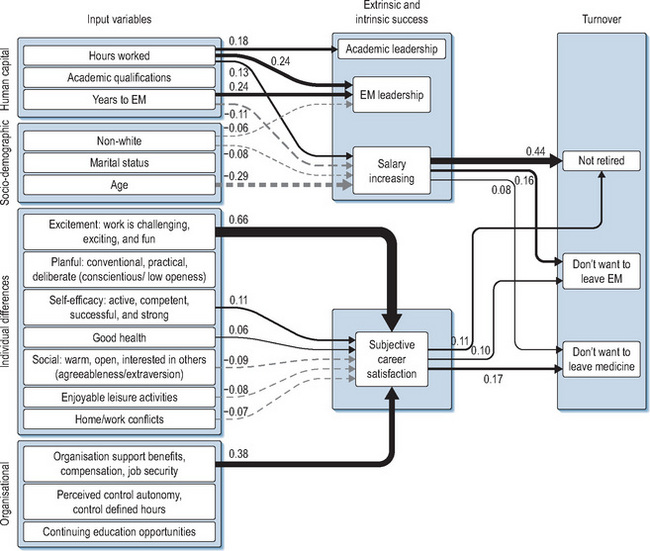
Figure 18.1 • Standardised estimates of the relationship of extrinsic success (promotions and salary increases) with human capital and socio-demographics; and of intrinsic success (career satisfaction) with individual differences and organisational variables. Relationships of extrinsic and intrinsic success with turnover (retirement, desire to leave emergency medicine (EM), and desire to leave medicine) also shown. Data from Pachulicz et al’s longitudinal study of 1269 EM physicians in the United States. Black arrows show positive relationships and grey broken arrows show negative relationships. Variables to the left are theorised to predict variables to the right. Correlations between input variables were not calculated, neither were relationships between intrinsic and extrinsic success factors.
The other two analyses showed some gender differences. For women, having more qualifications was negatively related to salary, whereas there was no effect for men. Conversely, the negative effect of age on salary was only significant for men. There was a significant interaction between ethnicity and gender on salary, with white females achieving greater salary increases than non-white females, but white males achieving smaller increases than non-white males. In terms of career satisfaction, women’s career satisfaction was positively predicted by self-efficacy. Less clear were the reasons why satisfaction was, for women, negatively predicted by the ‘social’ individual differences variable. For men, work excitement and organisational support were the most important predictors of career satisfaction.
Career counselling and success
Having given an overview of predictors of career success, the next step is to examine how trainees are guided into successful careers. The national restructuring of UK doctors’ careers in 2005 means they now have to make decisions about their specialities approximately 18 months after graduation; however, little formal career counselling is built into UK medical training. Medical schools may run a few sessions on speciality choice, and once qualified, doctors can refer to online resources or an educational supervisor to help them choose specialities. Doctors in difficulty can be referred to a career counselling service via their postgraduate deanery. But, in general, medics rarely come into contact with trained career counsellors or partake in official career interventions.
Career intervention and choice
Could career interventions help doctors make more successful career choices? There is evidence from outside medicine that career interventions can be effective, at least when the outcome variables are related to certainty and/or satisfaction with choice. Less clear is how career interventions lead to extrinsic or intrinsic career success. Brown et al (2003) and Richard (2005) have reviewed the evidence surrounding the ‘active ingredients’ of career interventions and put forward suggestions for effective interventions. Brown et al (2003) combined their review with evidence from the broader psychological literature to formulate 15 hypotheses around which future career interventions could be built. These fall into four main categories. First, successful interventions should include written goal setting and planning. Second, this planning should be conducted in conjunction with individualised feedback and advice from counsellors based, for example on a participant’s completion of a computer-guided intervention, and taking account of special or unusual circumstances. Third, career interventions should encourage participants to use resources that provide information about occupations. Fourth, interventions should include some career-related disclosures by seniors about difficulties they have overcome, thus providing modelling opportunities.
Richard (2005) takes a broader view of career interventions, encompassing their content and process as well as the infrastructure required to deliver them in practice. In terms of content, Richard suggests that interventions should enable participants to synthesise self-knowledge about their values, interests, personality, and skills with knowledge about organisations, occupations, and educational requirements. Interventions should equip participants with the ability to plan and make decisions. In terms of process, Richard reiterates Brown et al’s suggestions in relation to written goal setting and so on. In addition, Richard advocates the use of a variety of delivery modes to reach people from disparate groups: the collaboration, articulation, and communication of goals and plans to family and friends; the integration of interventions in existing educational programmes; and stringent intervention evaluations. In terms of infrastructure, Richard suggests that effective interventions require qualified and committed leadership and staff as well as institutional support in the form of adequate facilities, materials, and resources. Peer advisory services or alumni shadowing services are recommended to increase participant acceptance, collaboration, and communication of goals and plans. Finally, Richard takes a broader view, extolling the virtues of a ‘lifelong career guidance services’ to improve the productivity and economic viability of entire countries.
This chapter has mainly been concerned with early medical careers and the decisions taken then. There is perhaps a case for integrating lifelong career support for doctors with existing professional development programmes. Medical schools are well placed to start the delivery of career interventions, which should be evidence-based, stringently evaluated, and could be used to test hypotheses and refine career theory, as well as of course, increase doctors’ extrinsic and intrinsic career success.
Chapter summary
At the start of this chapter, we said it is difficult to know what a good career is, let alone how to predict who will have one and why. That is because career success is, in many ways, subjective and, as with all complex human phenomena, depends on the interplay between a multitude of individual and environmental variables. Bearing that in mind, we have overviewed some key psychological theories to illuminate the predictors of intrinsic and extrinsic career success.
According to SDT, autonomy is one of the underpinnings of psychological well-being in human beings and many, although not all, studies have shown that it influences both intrinsic and extrinsic career success. When making career choices, then, it may be useful for individuals to evaluate their own motivations and ensure that they are as autonomous as possible. Encouraging people to follow their intrinsic rather than their extrinsic goals may also help them achieve greater overall well-being. SCCT states that high self-efficacy leads to career success, both extrinsic and intrinsic. Whilst some researchers believe that self-efficacy is a personality-type trait which is generalisable across situations, its original socio-cognitive conceptualisation emphasises that an individual’s feelings of self-efficacy depend on the situation and can change with feedback from their own actions as well as from others. Doctors can therefore make efforts to bolster their students’ and trainees’ self-efficacy and self-confidence by providing feedback in a manner which is constructive and designed to improve performance; and those responsible for organising doctors’ training programmes can help provide the space and development opportunities which will enable this to happen in practice. Indeed, research into the organisational support and human capital influences on careers shows that supervisors’ actions and the way organisations are structured in terms of providing training opportunities can have a crucial influence on individual trainees’ career success. Opportunity for skills development and support from supervisors can be effective in promoting career satisfaction (and thus reducing turnover) and also, to an extent, in helping employees achieve promotions and salary increases. When choosing a career, it is therefore important to establish whether it will provide these types of support and opportunities.
Other individual variables – personality, gender, and ethnicity – are also predictive of success. Individuals high in neuroticism and low in conscientiousness, as well as females and ethnic minorities, are less likely to achieve many types of extrinsic and intrinsic career successes. So what can be done about this? In terms of personality, self-knowledge is the key to adapting positively to a situation. Knowing a person’s preferences, strengths, and weakness can help them make choices based on their values, motivations, and knowledge of how they are likely to react and feel in different situations. There is also some evidence that a match between interests and job characteristics is likely to lead to employee satisfaction. In the case of gender and ethnicity, the responsibility is also with employers to acknowledge and better understand group differences and make appropriate changes to ensure equality and fairness.
To sum up, then, the key requirements for making and guiding successful career choices are, first, knowledge of oneself and about the details of jobs and career path, and second, an ability to reflect on and plan around that knowledge. This chapter has outlined some important areas to consider when making those plans; however, it cannot be a substitute for career guidance interventions, more of which should be given to doctors throughout their training. Most of the studies we have cited come from the psychological rather than the medical education literature and many of the best were conducted in the United States with largely non-medical samples. The relative homogeneity of medical education and postgraduate medical employment in the United Kingdom provides an ideal environment for conducting high-quality research. We need to take this opportunity to conduct longitudinal studies, grounded in theory, with large samples. We also need to ensure career counselling and interventions with doctors are evidence-based and stringently evaluated. Only then will we really understand how best to predict and guide doctors’ careers.
Implications for practice
A good career means different things to different people. Individuals should reflect on their own work-related motivations, preferences, and strengths and weaknesses, and make decisions in the light of those reflections. Supervisors can help their trainees’ career progression by encouraging them to reflect in that way, and by tailoring the advice they provide to individuals accordingly.
Motivation is a driver of career success. Supervisors can encourage autonomous, self-determined motivation by listening to students and trainees, trying to understand their points of view, and encouraging them to make their own work-related choices by giving them sufficient information, skills, and opportunities.
Bolstering self-efficacy, managing outcome expectations, and setting positive and achievable goals can positively influence career success. Supervisors can do so by creating positive environments in which students and trainees can practice their skills; and by giving constructive feedback and encouragement. Superiors should also be aware that they are role models and act accordingly.
Support from senior staff, including mentoring, can improve career outcomes. Trainees should make efforts to foster good relationships with their supervisors, particularly early in their careers. Supervisors can take on formal or informal mentoring roles.
Some psychological factors that influence career success (e.g. GSE, locus of control, personality) are partly genetically determined, but that does not mean that they cannot be altered. Humans have large frontal lobes, whose function, in large part, is to provide voluntary control over more primitive instinctual impulses. Supervisors can encourage individuals to have insight into their own strengths and weaknesses by knowing and understanding their personality traits, and recognising how they might behave, think, and feel differently from other people.
Gender and ethnicity influence career success. The ethnic differences remain difficult to explain. Wide-ranging, high-quality research is required to understand them, which should include trials of interventions with careful monitoring of outcomes. Gender differences in career progression seem to be at least partly related to the higher proportion of women with greater family commitments. Changes to working environments and the working culture to allow more flexibility may facilitate gender equality at the medical workplace.
Formalised, evidence-based career counselling could start at the medical school and continue throughout professional development. Medical schools are well placed to start the delivery of career interventions, which should be evidence-based and stringently evaluated. They could be used to test hypotheses and refine career theory, as well as increase doctors’ perceived career success.
Abele A.E., Spurk D. The longitudinal impact of self-efficacy and career goals on objective and subjective career success. J Vocat Behav. 2009;74:53-62.
Bandura A. Self-efficacy: toward a unifying theory of behavioral change. Psychol Rev. 1977;84:191-215.
Barnett R.C., Carr P.L., Boisnier A.D., et al. Relationships of gender and career motivation to medical faculty members’ production of academic publications. Acad Med. 1998;73:180-186.
Barrick M.R., Mount M.K. The big five personality dimensions and job performance: a meta-analysis. Pers Psychol. 1991;44:1-26.
Barrick M.R., Mount M.K. Autonomy as a moderator of the relationships between the big five personality dimensions and job performance. J Appl Psychol. 1993;78:111-118.
Becker G.S. Human capital: a theoretical and empirical analysis, with special reference to education. New York: National Bureau of Economic Research, 1964.
Borges N.J., Savickas M.L., Jones B.J. Holland’s theory applied to medical specialty choice. J Career Assess. 2004;12:188-206.
British Medical Association. Demography of medical schools – a discussion paper. London: British Medical Association, 2004.
British Medical Association. Examining equality: a survey of Royal College examinations. London: British Medical Association, 2006.
Brown C.A., Wakefield S.E., Bullock A.D. The selection of GP trainees in the West Midlands: audit of assessment centre scores by ethnicity and country of qualification. Med Teach. 2001;23:605-609.
Brown S.D., Ryan Krane N.E., Brecheisen J., et al. Critical ingredients of career choice interventions: more analyses and new hypotheses. J Vocat Behav. 2003;62:411-428.
Burton K.D., Lydon J.E., D’Alessandro D.U., et al. The differential effects of intrinsic and identified motivation on well-being and performance: prospective, experimental, and implicit approaches to self-determination theory. J Pers Soc Psychol. 2006;91:750-762.
Cameron D. A language in common. Psychologist. 2009;22(7):578-581.
Carr P.L., Ash A.S., Friedman R.H., et al. Relation of family responsibilities and gender to the productivity and career satisfaction of medical faculty. Ann Intern Med. 1998;129:532-538.
Coleman J.S. Social capital in the creation of human capital. Am J Sociol. 1988;94:S95-S120.
Connor H., Tyres C., Modood T., et al. Why the difference? A closer look at higher education minority ethnic students and graduates. 2004. Department for Education and Skills. RR552
Crombie N. Sotomayor pledges impartial justice if confirmed. 13 July, 2009. The Oregonian
Deci E.L., Ryan R.M. Facilitating optimal motivation and psychological well-being across life’s domains. Can Psychol. 2008;49:14-23.
Deci E.L., Koestner R., Ryan R.M. A meta-analytic review of experiments examining the effects of extrinsic rewards on intrinsic motivation. Psychol Bull. 1999;125:627-668.
Dewhurst N., McManus I.C., Mollon J., et al. Performance in the MRCP(UK) examination 2003–4: analysis of pass rates of UK graduates in relation to self-declared ethnicity and gender. BMC Med Educ. 2007;5(1):8.
Dormann C., Zapf D. Job satisfaction: a meta-analysis of stabilities. J Organ Behav. 2001;22:483-504.
Eby L.T., Allen T.D., Evans S.C., et al. Does mentoring matter? A multidisciplinary meta-analysis comparing mentored and non-mentored individuals. J Vocat Behav. 2008;72:254-267.
Eden D., Zuk Y. Seasickness as a self-fulfilling prophecy: raising self-efficacy to boost performance at sea. J Appl Psychol. 1995;80:628-635.
Elton M.A. Women and medicine: the future. London: Royal College of Physicians, 2009.
Esmail A., Abel P. The impact of ethnicity and diversity on doctors’ performance and appraisal. Br J Health Care Manag. 2006;12:303-307.
Esmail A., Everington S. Racial discrimination against doctors from ethnic minorities. BMJ. 1993;306:691-692.
Ferguson E., James D., Madeley L. Factors associated with success in medical school: systematic review of the literature. BMJ. 2002;324:952-957.
Frank E., McMurray J.E., Linzer M., et al. For the Society of General Internal Medicine Career Satisfaction Study Group. Career satisfaction of US women physicians: results from the Women Physicians’ Health Study. Arch Intern Med. 1999;159:1417-1426.
Freeborn D.K. Satisfaction, commitment, and psychological well-being among HMO physicians. West J Med. 2000;174:13-18.
Furnham A. The psychology of behaviour at work: the individual and the organization, ed 2. Hove: Psychology Press, 2008.
Gagne M., Deci E.D. Self-determination theory and work motivation. J Organ Behav. 2005;26:331-362.
Goldacre M.J., Davidson J.M., Lambert T.W. Country of training and ethnic origin of UK doctors: database and survey studies. BMJ. 2004;329:597-600.
Grumbach K., Osmond D., Vranizan K., et al. Primary care physicians’ experience of financial incentives in managed-care systems. N Engl J Med. 1998;339:1516-1521.
Helman C. Suburban Shaman: tales from medicine’s frontline. London: Hammersmith Press, 2006.
Hoff T., Whitcomb W.F., Nelson J.R. Thriving and surviving in a new medical career: the case of hospitalist physicians. J Health Soc Behav. 2002;43:72-91.
Holland J.L. Exploring careers with a typology. Am Psychol. 1996;51:397-406.
Judge T.A., Bono J.E. Relationship of core self-evaluations traits – self-esteem, generalized self-efficacy, locus of control, and emotional stability – with job satisfaction and job performance: a meta-analysis. J Appl Psychol. 2001;86:80-92.
Judge T.A., Cable D.M., Boudreau J.W., et al. An empirical investigation of the predictors of executive career success. 1994. Working Paper 9 4 – 0 8. Center for Advanced Human Resource Studies (CAHRS) Cornell University ILR School
Judge T.A., Locke E.A., Durham C.C., et al. Dispositional effects on job and life satisfaction: the role of core evaluations. J Appl Psychol. 1998;83:17-34.
Judge T.A., Higgins C.A., Thoresen C.J., et al. The big five personality traits, general mental ability, and career success across the life span. Pers Psychol. 1999;52:621-652.
Judge T.A., Thoresen C.J., Bono J.E., et al. The job satisfaction–job performance relationship: a qualitative and quantitative review. Psychol Bull. 2001;127:376-407.
Judge T.A., Jackson C.L., Shaw J.C., et al. Self-efficacy and work – related performance: the integral role of individual differences. J Appl Psychol. 2007;92:107-127.
Kammeyer-Mueller J.D., Judge T.A. A quantitative review of mentoring research: test of a model. J Vocat Behav. 2008;72:269-283.
Kilminster S., Downes J., Gough B., et al. Women in medicine – is there a problem? A literature review of the changing gender composition, structures and occupational cultures in medicine. Med Educ. 2007;41:39-49.
Kluckhohn C. Personality in nature, society, and culture. New York: Knopf, 1953.
Kværner K.J., Aasland O.G., Botten G.S. Female medical leadership: cross sectional study. BMJ. 1999;318:91-94.
Lam C.F., Gurland S.T. Self-determined work motivation predicts job outcomes, but what predicts self-determined work motivation? J Res Pers. 2008;42:1109-1115.
Lambert T.W., Goldacre M.J., Evans J. Views of junior doctors about their work: survey of qualifiers of 1993 and 1996 from United Kingdom medical schools. Med Educ. 2000;34:348-354.
Lent R.W., Brown S.D., Hackett G. Toward a unifying social cognitive theory of career and academic interest, choice, and performance. J Vocat Behav. 1994;45:79-122.
Lepnurm R., Dobson R., Backman A., et al. Factors explaining career satisfaction among psychiatrists and surgeons in Canada. Can J Psychol. 2006;51:243-255.
McCrae R.R., Costa P.T.J. Personality trait structure as a human universal. Am Psychol. 1997;52:509-516.
McManus I.C., Goldacre M.J. Predicting career destinations. In: Carter Y., Jackson N., editors. Medical education and training: from theory to delivery. Oxford: Oxford University Press; 2008:59-78.
McManus I.C., Winder B., Paice E. How consultants, hospitals, trusts and deaneries affect pre-registration house officer posts: a multilevel model. Med Educ. 2002;36:35-44.
McManus I.C., Keeling A., Paice E. Stress, burnout and doctors’ attitudes to work are determined by personality and learning style: a twelve year longitudinal study of UK medical graduates. BMC Med. 2004;2:29.
Malik K. Strange fruit: why both sides are wrong in the race debate. Oxford: Oneworld Publications, 2008.
Matthews G., Deary I.J. Personality traits. Cambridge: Cambridge University Press, 1998.
Modood T. Multicultural politics: racism, ethnicity and muslims in Britain. Minnesota: University of Minnesota Press, 2005.
Ng T., Eby L.T., Sorensen K.L., et al. Predictors of objective and subjective career success: a meta-analysis. Pers Psychol. 2005;58:367-408.
Ng T., Sorensen K.L., Eby L.T. Locus of control at work: a meta-analysis. J Organ Behav. 2006;27:1087.
Nonnemaker L. Women physicians in academic medicine – new insights from cohort studies. N Engl J Med. 2000;342:399-405.
Pachulicz S., Schmitt N., Kuljanin G. A model of career success: a longitudinal study of emergency physicians. J Vocat Behav. 2008;73:242-253.
Parsons F. Choosing a vocation. Boston: Houghton Mifflin, 1909.
Petrides K.V., McManus I.C. Mapping medical careers: questionnaire assessment of career preferences in medical school applicants and final-year students. BMC Med Educ. 4(18), 2004.
Prosser D., Johnson S., Kuipers E., et al. Mental health, burnout and job satisfaction in a longitudinal study of mental health staff. Soc Psychiatry Psychiatr Epidemiol. 1999;34:295-300.
Reed V.A., Jernstedt G.C., McCormick T.R. A longitudinal study of determinants of career satisfaction in medical students. Med Educ Online. 2004;9:11.
Richard G.V. International best practices in career development: review of the literature. Int J Educ Vocat Guid. 2005;5:189-201.
Richardsen A.M., Burke R.J. Occupational stress and job satisfaction among physicians: sex differences. Soc Sci Med. 1991;33:1179-1187.
Richardson J.T.E. The attainment of ethnic minority students in UK higher education. Stud High Educ. 2008;33:33-48.
Richer S., Blanchard C., Vallerand R.J. A motivational model of work turnover. J Appl Soc Psychol. 2002;32:2089-2113.
Rotter J.B. Internal versus external control of reinforcement: a case history of a variable. Am Psychol. 1990;45:489-493.
Sambunjak D., Straus S.E., Marusic A. Mentoring in academic medicine: a systematic review. JAMA. 2006;296:1103-1115.
Seibert S.E., Kraimer M.L. The five-factor model of personality and career success. J Vocat Behav. 2001;58:1-21.
Sibbald B., Bojke C., Gravelle H. National survey of job satisfaction and retirement intentions among general practitioners in England. BMJ. 2003;326(7379):22.
Simoens S., Scott A., Sibbald B. Job-satisfaction, work-related stress and intentions to quit of Scottish GPs. Scott Med J. 2002;47:80-86.
Singh R., Ragins B.R., Tharenou P. Who gets a mentor? A longitudinal assessment of the rising star hypothesis. J Vocat Behav. 2009;74:11-17.
Singh R., Ragins B.R., Tharenou P. What matters most? The relative role of mentoring and career capital in career success. J Vocat Behav. 2009;75:56-67.
Sobral D.T. What kind of motivation drives medical students’ learning quests? Med Educ. 2004;38:950-957.
Stajkovic A.D., Luthans F. Self-efficacy and work-related performance: a meta-analysis. Psychol Bull. 1998;124:240-261.
Steele C.M. A threat in the air: how stereotypes shape intellectual identity and performance. Am Psychol. 1997;52:613-629.
Taylor K.S., Lambert T.W., Goldacre M.J. Career progression and destinations, comparing men and women in the NHS: postal questionnaire surveys. BMJ. 2009;338:b1735.
Tolstoy L.K. Anna Karenina. 1887. Available from http://www.readprint.com/work-1431/AnnaKarenina-Leo-Tolstoy Accessed November 26, 2009
Tracey T.J.G., Robbins S.B. The interest-major congruence and college success relation: a longitudinal study. J Vocat Behav. 2006;69:64-89.
Tsabari O., Tziner A., Meir E.I. Updated meta-analysis on the relationship between congruence and satisfaction. J Career Assess. 2005;13:216-232.
Van Heil A., Vansteenkiste M. Ambitions fulfilled? The effects of intrinsic and extrinsic goal attainment on older adults’ ego-integrity and death attitudes. Int J Aging Hum Dev. 2009;68:27-51.
Vansteenkiste M., Simons J., Lens W., et al. Motivating learning, performance, and persistence: the synergistic effects of intrinsic goal contents and autonomy-supportive contexts. [Miscellaneous Article]. J Pers Soc Psychol, 87. 2004:246-260.
Wayne S.J., Liden R.C., Kraimer M.L., et al. The role of human capital, motivation and supervisor sponsorship in predicting career success. J Organ Behav. 2001;20:577-595.
Williams G.C., Saizow R., Ross L., et al. Motivation underlying career choice for internal medicine and surgery. Soc Sci Med. 1997;45:1705-1713.
Woolf K. The academic underperformance of medical students from ethnic minorities. University of London, 2009. PhD thesis
Woolf K., Cave J., Greenhalgh T., et al. Ethnic stereotypes and the underachievement of UK medical students from ethnic minorities: qualitative study. BMJ. 2008;337:a1220.