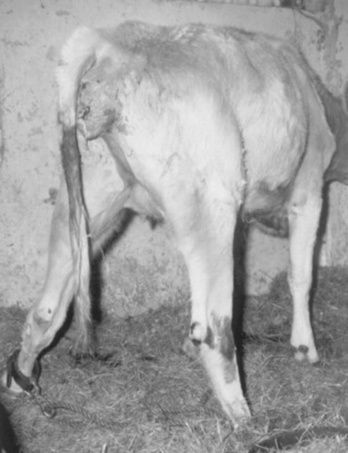
TRIARYL PHOSPHATE POISONING (CHRONIC ORGANOPHOSPHATE POISONING; DYING-BACK AXONOPATHY)

Ingestion of lubricants containing triaryl phosphates causes a neurologic disturbance of livestock characterized by a delayed neuropathy resulting in incoordination and paralysis. Common sources of the triaryl phosphate esters include turbojet lubricants, hydraulic oils, industrial solvents, plasticizers, and automotive brake fluid. Chronic organophosphate poisoning also occurs in some families of sheep after treatment with organophosphorus anthelmintics.2229 At least six different phenotypes of sheep have been identified with respect to their ability to metabolize carboxylic acid esters.2230,2231 These are designated as Esa/a, Esa/b, and Esa/c (high-enzyme groups) and Esa/c, Esb/b, and Esc/c (low-enzyme groups). This genetically determined inability to inactivate organophosphates governs the appearance of demyelination after administration of therapeutic dosages of the drugs.

Triaryl phosphates have few effects on the glial cells,2232 but they have profound neurotoxicity for the longest axons.2233 These fibers degenerate first at the distal, nonterminal areas. The degenerative lesions then spread proximally from the terminal nerve rootlets into the spinal cord until the cell body dies (dying-back axonopathy). Dosages of triaryl phosphate ranging from 5 to 10 g/kg cause paralysis by 19 to 36 days after exposure.2234 Cats may be poisoned by a single topical application of tri-o-cresyl phosphate ester at 1000 mg/kg or by daily application of 1 to 100 mg/kg,2235 and massive topical exposure may cause toxicity in livestock. The poisoning may be cumulative because in some outbreaks, compounds containing as little as 0.4% tri-o-cresyl phosphaester have been found in toxic materials. Animals belonging to the low-enzyme groups are much more susceptible than their high-enzyme herdmates.

Clinical Signs

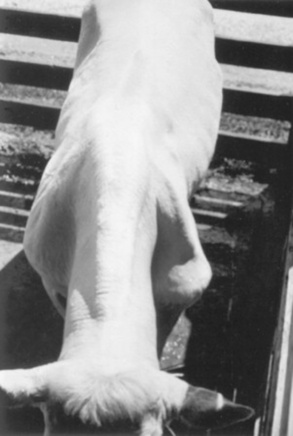
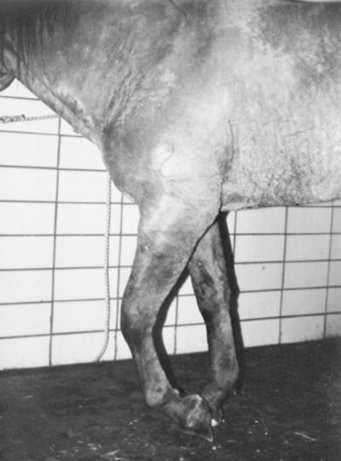
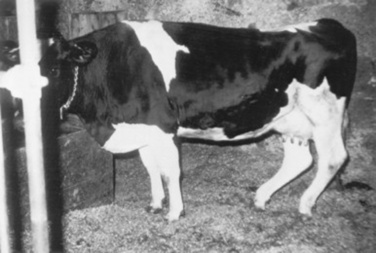
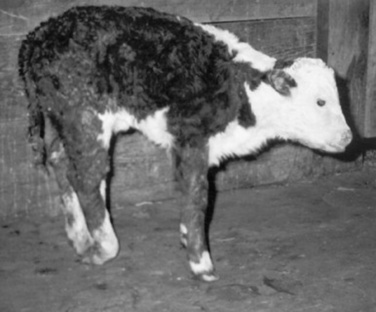
The onset of slowly progressive neurologic signs occurs about 10 days to a few months after exposure.2236-2238 The clinical signs of chronic organophosphate intoxication are rough hair coat, bloat, dyspnea, muscular weakness, and incoordination of the rear legs. The animals may slip on their hindlimbs and assume a dog-sitting posture. The limbs are circumducted and lack normal conscious proprioceptive responses. Affected animals become recumbent, attempt to rise, but do so incompletely and fall. Muscular tone and flexor reflexes may be normal, or flaccid paralysis may be evident.2237 The tail, bladder, and rectum often are paralyzed, and affected animals show signs of incontinence, constipation, and perineal scalding. Slight ventrolateral strabismus has been described, and some animals have been reported to become mute.2238,2239 Most animals retain a normal appetite and sensorium during the development of the paralysis. Electromyographic changes in experimentally poisoned animals include increased insertional activity, positive sharp waves, and fibrillation potentials in the muscles of the hindlimb, consistent with denervation of affected muscles.2240 Organophosphate-induced neuropathy also has been reported in horses, where the most striking clinical sign was bilateral laryngeal paralysis.2241,2242 Degeneration similar to that caused by delayed organophasphate toxicity in other species was most severe in the recurrent laryngeal nerves, but milder changes were present in other peripheral nerves.

Pathology

Laboratory confirmation of the condition usually is based on histopathologic detection of a dying-back axonopathy in the peripheral nervous tissues. Clinical pathologic parameters usually are normal. The RBC cholinesterase is low or undetectable at clinical onset but may return to normal concentrations by the time the animals display profound paralysis. The specific concentration of cholinesterase depends largely on the type of organophosphate and the patient’s genetic ability to metabolize the toxic compounds. Whole-blood cholinesterase concentrations in haloxon-treated esterase A–deficient animals remain significantly lower than in controls for at least 27 days after administration of 375 mg. In comparison, the enzyme concentrations in the plasma of normal sheep do not decrease after drug treatment.2243 Cholinesterase levels in exposed animals are not predictive of the later onset of delayed neurotoxicity.2238

  Page 1092 

Macroscopic lesions are not usually seen. Microscopic lesions are found exclusively in the central nervous system, and their severity appears to be dose dependent. The lesions begin distally and progress retrograde along the long, unsynapsed proprioceptive and motor tracts. The dorsospinal, cerebellar, gracile, and cuneate tracts are most susceptible to the effects of the toxins.2240 Specific lesions include demyelination, internodal axonal swelling, and wallerian degeneration. There also is a vacuolation of the large neurons of the ventral motor nucleus of the spinal cord. The mechanism of neurotoxicity is unknown, but alteration of a cell membrane protein found in neurons and some other cells has been implicated.2243-2245 This protein has been designated a “neuropathy target esterase” and is thought to be “aged” by phosphorylation induced by the toxicosis.

Newer compounds in the triaryl phosphate group are less capable of causing delayed neurotoxicity, which offers some hope that the incidence of this type of toxicity may decline in the future.2245 Delayed organophosphate toxicity is not treatable and is irreversible.

MOTOR UNIT AND CAUDA EQUINA DISEASES

MARY O. SMITH

ELECTROMYOGRAPHY AND NERVE CONDUCTION TESTING IN MOTOR UNIT DISEASE

A number of electrodiagnostic techniques are now applied to the diagnosis of neurologic disease in animals. They are particularly useful when clinical signs of generalized weakness, muscle atrophy, tremors, or obscure lameness are present. Electromyography (EMG) and peripheral nerve conduction testing (NCT) are of great value for diagnosing diseases that affect the motor unit, for assessing the prognosis, and for determining the effects of therapy. EMG and NCT are simple, relatively noninvasive techniques that provide objective information on the functional status of the nerves and muscles that cannot be determined by other means.

Motor Unit

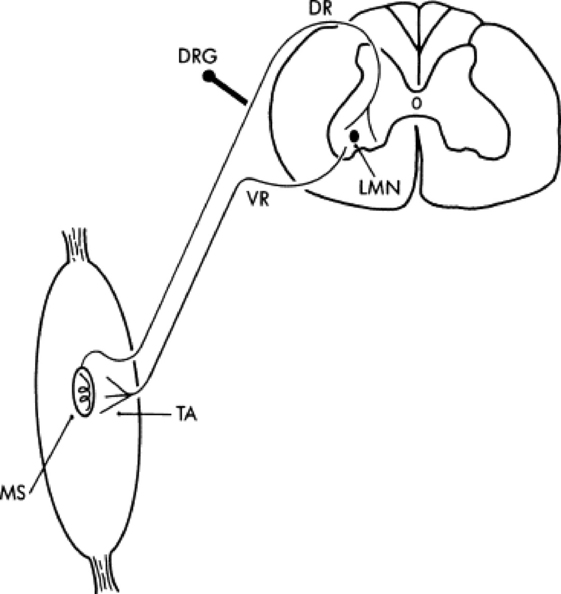
The motor unit is the smallest functional unit of the peripheral motor system. It comprises a single motoneuron and all the myofibers innervated by that motoneuron.2246 In muscles in which precise control of movement is necessary, each motoneuron innervates only a few muscle fibers, whereas in large postural muscles in which fine control is not required, a single motoneuron innervates many hundreds of muscle fibers. The cell body of the alpha motoneuron lies in the ventral horn of the spinal cord or, in the case of cranial nerves, in cranial nerve nuclei in the brainstem. The myelinated axon of the motoneuron runs within the ventral root to the spinal nerve and peripheral nerves and finally terminates in small, unmyelinated terminal arborizations (Fig. 35-41). Enlargements of the ends of the terminal arborizations form the presynaptic components of the neuromuscular junctions. The postsynaptic part of the neuromuscular junction consists of a specialized region of the muscle fiber membrane. When acetylcholine release from the nerve terminal is sufficient to provoke an action potential in the myofibers, all the myofibers of the motor unit respond equally, an “all or nothing” response. Motor unit disease (lower motoneuron disease) may result from damage to any one of the following: the alpha motoneuron cell body or axon, the Schwann cells that form the myelin sheath of the alpha motoneuron, the neuromuscular junction, or the muscle fiber.

image

Fig. 35-41 Components of the motor unit. DR, Dorsal root of spinal nerve; DRG, dorsal root ganglion; LMN, lower motor neuron; MS, muscle spindle; TA, terminal arborizations of lower motor neuron axon; VR, ventral root of spinal nerve.

Although they are not part of the motor unit, the neurons that provide the sensory supply to the skeletal muscles may be involved in motor unit diseases in animals. Dysfunction of the peripheral sensory nerves causes clinical signs similar to those seen with motor unit disorders, even when all the components of the motor unit are normal.2247 The cell bodies of sensory neurons lie in the dorsal root ganglia or in the sensory nuclei of cranial nerves. Their axons extend centrally to synapse with lower motoneurons and interneurons in the spinal cord and brainstem and extend distally in peripheral nerves to the stretch receptors in the muscle spindles of skeletal muscles and to proprioceptors in joints (see Fig. 35-41).

Instrumentation

The recording of the electrical activity of nerve and muscle cells requires an electrode system, an amplifier, and a device to display the recording. An electrical stimulator is needed for NCT. A variety of computer-based units are now available for EMG and NCT, with a range of specifications to supply the different needs of investigators and clinicians. The components of a system may be purchased individually, but most clinicians prefer to use a complete unit. Portable units make this technology easy to use in the field, not only in hospital situations. EMG units offer a range of specializations to improve signal amplification while minimizing interference, including high- and low-frequency filters, common mode rejection (to reduce 60-Hz interference from nearby electricity sources), and signal-averaging capabilities to facilitate the recording of nerve action potentials. Data can be stored in the computer memory for later transfer to disc or other external memory and to create paper printouts. An audioamplifier is a useful addition to the system, because many of the potentials recorded by EMG produce characteristic sounds when converted to an audible signal. It is often easier for an experienced electromyographer to make a diagnosis by listening to the audio EMG than by trying to follow a series of rapidly changing potentials displayed on the cathode ray oscilloscope (CRO) screen. Programs that can analyze data (e.g., motor unit potentials) and filters that facilitate the study of periodic motion (gait) are now available.2248-2250

  Page 1093 

For recording, three electrodes are required: an active or exploring electrode, a reference electrode, and a ground electrode. A number of different arrangements are possible, but the coaxial needle electrode is typically used. The central wire of the coaxial electrode is the active component, and the surrounding hollow needle is the reference component. The wire is insulated from the needle along its length by a material such as Teflon, except at its tip, where it is exposed. This type of electrode is particularly suited to use in large animals because it minimizes the problem of poor electrical contact encountered with surface electrodes and does not seem to cause undue discomfort. For similar reasons, a subcutaneous needle electrode usually is chosen for the ground electrode, which is placed a short distance from the recording and reference electrodes, usually over a bony prominence. Surface electrodes can be used to study activity in muscles during exercise, both to determine the presence of disease and to direct training exercises where development of particular muscles is desired.2251,2252

Electromyography

Electromyography usually can be performed in a conscious animal, although some restraint is necessary, such as placing the animal in stocks and administering a sedative agent. General anesthesia may be necessary for EMG in extremely fractious animals, but not without significant risks, particularly when animals are weak and may have difficulty rising after anesthesia. Caudal epidural anesthesia may offer a safer alternative when examination of hindquarter muscles alone is deemed adequate for evaluation.2253 Common sedatives such as xylazine and acepromazine do not interfere with EMG. An electromyographic examination should include testing of many muscles over the whole body, focusing on those thought to be involved in the disease process. The recording electrode must be inserted into four or five sites in each muscle tested to ensure that focal abnormalities are not missed.

Electromyography alone usually does not provide a definitive diagnosis of the disease process present. EMG does help to localize the lesion and provides information that can then be used in selecting further diagnostic modalities (e.g., NCT) and the most suitable site for muscle or nerve biopsy.

Normal Muscle

INSERTION ACTIVITY

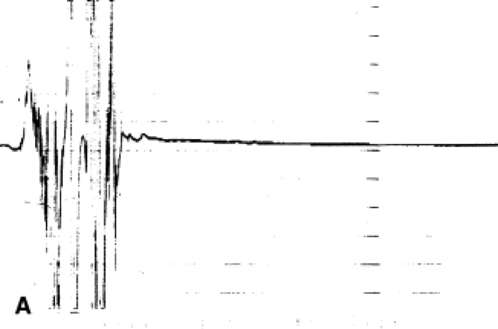
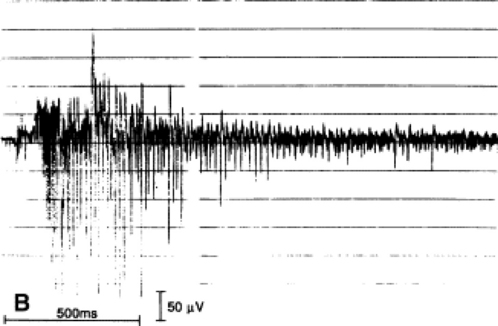
Insertion of the recording electrode into a muscle or its movement in the muscle results in a burst of electrical activity that stops abruptly when movement of the electrode stops (Fig. 35-42). It is accompanied by a harsh, crackling sound. This “insertion activity” is the result of direct stimulation of muscle fibers by the moving electrode.

image image

Fig. 35-42 Electromyogram insertion activity. A, Normal: insertion activity ends abruptly when movement of the exploring electrode stops. B, Abnormal: insertion activity persists after the exploring electrode is at rest.

ELECTRICAL SILENCE

When the electrode is motionless in a normal resting muscle (one that is not actively contracting), no electrical activity is seen on the electromyograph. The electron beam of the CRO traces a straight line, and the audio electromyograph is silent. Electrical silence is the normal state in resting muscle except in the endplate zone.

MOTOR UNIT ACTION POTENTIAL (MUAP)

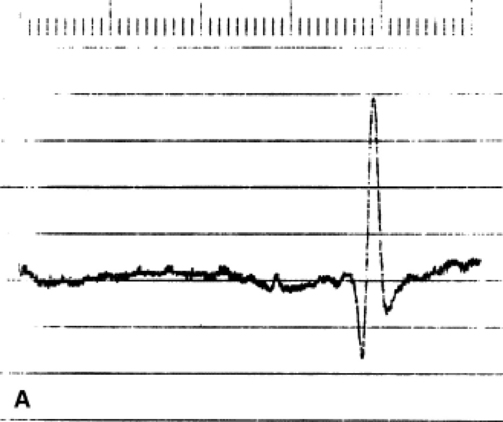
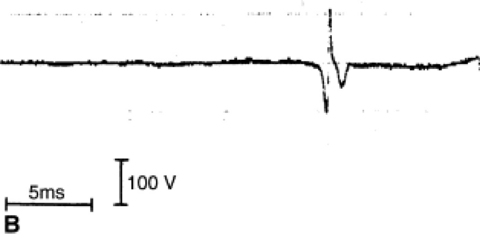
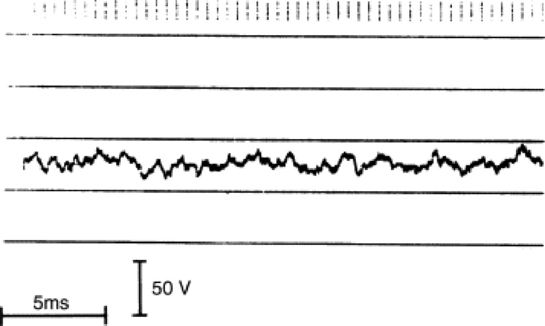
An MUAP is the electrical activity of a single motor unit (Fig. 35-43). Only the activity of the fibers lying within approximately 1 mm of the electrode tip is recorded.2254 MUAPs may be observed during EMG of normal active muscle. The parameters of an MUAP vary with the motor unit that produced it, with the type of electrode arrangement and electromyograph used, and with the position of the electrodes in relation to the electrical event itself. The important characteristics of the MUAP are the amplitude, duration, and number of phases. Normal MUAPs are biphasic or triphasic with amplitudes of 500 to 3000 μV and durations of 3 to 15 msec.2254,2255 In very active muscles, many MUAPs are superimposed, producing “interference patterns.” This may be observed in the limb muscles of a standing animal.

image image

Fig. 35-43 Motor unit action potentlals. A, Normal: amplitude is approximately 550 μV. B, Abnormal: amplitude is decreased by approximately 200 μV.

MINIATURE ENDPLATE POTENTIALS (MEPPS)

The neuromuscular junctions of the myofibers of one muscle tend to lie in a band across the midpoint of the muscle fibers; this region is called the endplate zone. The spontaneous release of quanta of acetylcholine from the nerve terminal at a neuromuscular junction results in local electrical responses in the muscle fiber. This activity can be recorded when the recording electrode lies close to the neuromuscular junction in the endplate zone (Fig. 35-44). MEPPs are monophasic-negative potentials having amplitudes of 10 to 20 μV and durations of 0.5 to 1 msec.2256 MEPPs are local electrical responses in the muscle fiber that are not propagated throughout the whole fiber and thus do not result in fiber contraction. MEPPs are present even in resting muscle and are normal. MEPPs may be absent in disorders in which acetylcholine release is lacking from the nerve (neuropathies), in those with an abnormality in transmission across the neuromuscular junction (junctionopathies), and in some myopathies. MEPPs cannot be detected when the recording electrode is not close to a neuromuscular junction.

image

Fig. 35-44 Miniature endplate potentials (MEPPs). MEPPs are a normal electromyographic finding.

  Page 1094 

Age of the patient has been shown to have an effect on EMG findings, even in animals that are clinically healthy. Insertional activity, spontaneous activity, and motor unit morphology all have been shown to differ in elderly horses (>18 years old) compared with young and adult horses, with the elderly horses displaying a greater amount of EMG activity usually considered to indicate muscle pathology.2257 This factor must be taken into account when interpreting EMG findings.

Abnormal Muscle

INSERTION ACTIVITY

In both neuropathic and myopathic diseases, insertion activity may be prolonged or occasionally reduced (see Fig. 35-42). Either of these findings is evidence of abnormality. Abnormalities in EMG recordings caused by neuropathic disease do not begin to appear until approximately 5 days after the onset of the neuropathy.

MOTOR UNIT ACTION POTENTIALS

In both myopathies and neuropathies, changes in the characteristics of MUAPs occur. These include reductions in amplitude, polyphasia, temporal dispersion, and even absence of MUAPs.

After damage to some nerve fibers, others may undergo collateral sprouting, where new terminal arborizations grow and innervate denervated myofibers. The net result of this process is an increase in the size of the motor unit. The MUAPs of these large motor units have correspondingly larger amplitudes and thus are called giant MUAPs (see Fig. 35-43).

Quantitiative analysis of MUAPs adds another level of sophistication to EMG examination.2248,2250 Characteristics of MUAPs in healthy horses include amplitude, duration, and number of phases turns within the MUAP. Changes in these characteristics are found when either myopathy or neuropathy are present.2258

FIBRILLATION POTENTIALS AND POSITIVE SHARP WAVES

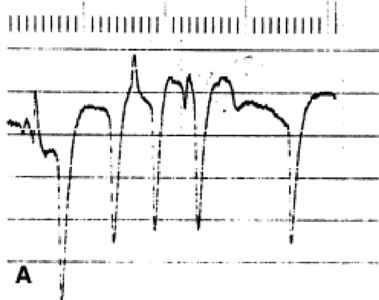
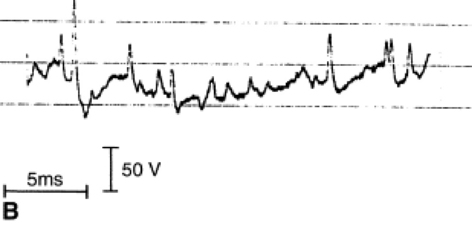
These activities result from the electrical activity of single muscle fibers (Fig. 35-45). The muscle activity may be spontaneous or the result of mechanical stimulation of the fiber by the electrode. It is thought that the occurrence of spontaneous individual fiber contraction is a manifestation of an increase in the excitability of the muscle fiber membrane. Fibrillation potentials and positive sharp waves occur in both neuropathies and myopathies. The presence of either activity is not pathognomonic for the type of pathologic condition present.

image image

Fig. 35-45 Abnormal electromyographic potentials. A, Positive sharp waves. B, Fibrillation potentials.

  Page 1095 

Fibrillation potentials are biphasic spikes with an initial positive phase. Their peak-to-peak amplitude is less than 1 mV and their duration less than 5 msec.2256 Fibrillation potentials are recorded when the recording electrode lies a short distance from the muscle fiber whose activity is being recorded.

Positive sharp waves have an initial positive phase with amplitude of up to 1 mV and duration under 5 msec, followed by a negative phase with lower amplitude and a duration of 10 to 100 msec.2256 They are recorded when the recording electrode tip lies close to the electrically active myofiber.

In addition to EMG changes induced by primary myopathic and neuropathic disease, electrolyte disturbances such as hypocalcemia and hypomagnesemia also have been shown to result in EMG abnormalities, both inducing spontaneous muscle activity and altering the waveform characteristics of MUAPs.2259 Therefore, a complete history, physical examination and serum chemistry are essential for correct interpretation of EMG findings.

Nerve Conduction Testing

Nerve conduction studies usually require that the animal be sedated or under general anesthesia, because the procedure is somewhat painful. Routinely used sedatives and anesthetic agents do not interfere with the results of testing. Two stimulating needle electrodes, the anode and cathode, are placed on or close to the nerve to be stimulated. A short pulse of current is applied to the nerve. A compound nerve action potential (CNAP) is evoked in the nerve by the applied current and is propagated along the nerve in the same manner as a naturally occurring action potential. Either the CNAP is recorded directly from the nerve itself, or the compound muscle action potential (CMAP) evoked in the muscle innervated by that nerve is recorded. To ensure that all the nerve fibers are stimulated, the stimulus intensity is varied to determine the maximum stimulus (i.e., the current that just evokes the maximum CNAP or CMAP). A supramaximum stimulus (150% to 200% of the maximum stimulus) is applied when making recordings.2255,2260

MOTOR NERVE CONDUCTION (MNC)

MNC is determined by stimulating a mixed peripheral nerve such as the radial or median nerve and recording the CMAP evoked in a muscle innervated by that nerve. By recording the CMAP evoked by stimulating the nerve, only the activity of the alpha motoneurons in that nerve is evaluated. The latency between the application of the stimulus and the onset of contraction of the muscle can be broken down into three components: the time for conduction of the action potential in the nerve, the time for neuromuscular transmission, and the time for conduction of the muscle action potential from the neuromuscular junction to the vicinity of the recording electrode. By stimulating the nerve at two or more points, the latter two variables can be eliminated from the calculation and the velocity of conduction of the nerve action potential between the stimulus points determined.

SENSORY NERVE CONDUCTION (SNC)

SNC is determined by stimulating a purely sensory nerve peripherally (e.g., palmar digital nerves)2260 and recording the CNAP from the same nerve at a more proximal point. Because the amplitude of the CNAP is relatively small, usually less than 1 mV, the technique of signal averaging is used; the responses to repeated stimuli are recorded and electrically averaged, eliminating background electrical activity that otherwise would obscure the evoked potential.

Physiologic alterations in nerve conduction must be differentiated from pathologic changes. Cooling of the nerve results in a slowing of conduction velocity.2261 Therefore it is important to monitor limb temperature when doing NCTs to avoid erroneous interpretation of results. Heating pads and lamps can be used to maintain normal temperature. Conduction velocity of the action potential in the nerve is proportional to fiber diameter. In ponies and dogs, nerve conduction velocity is faster in the proximal portion of the nerve because of the greater diameter of the proximal regions of peripheral nerves.2262 SNC velocity is slower in horses than in ponies because of distal tapering of peripheral nerves.2261 Nerve conduction velocity is slower in young and aged dogs than in mature adults.2263 This finding is probably true for all species.

Specific techniques for peripheral nerve testing in the horse have been described, and normal values for both MNC and SNC velocities have been determined for a number of peripheral nerves.2260,2261,2264 Nerve conduction velocity, amplitude, and waveform characteristics all provide valuable information on the functional status of the nerve. In pathologic conditions, changes in nerve function occur that depend only on the nature of the pathologic process in the nerve, not on its etiology.

SLOWING OF NERVE CONDUCTION

Reduction in the velocity of nerve conduction is the result of segmental demyelination, which may occur in sensory or motor fibers or both. Demyelination may be present as the sole pathologic change or may be accompanied by other neuropathologic processes. No pathologic significance has been attributed to increased conduction velocity; it is the result of technical error.

INCREASED TEMPORAL DISPERSION

Increased temporal dispersion of an action potential also results from segmental demyelination and differences in the rate of conduction in individual nerve fibers. For example, if some fibers are normal and some are undergoing demyelination, increased dispersion of the action potential is recorded, whether a nerve or a muscle action potential. In this case, because some nerves are normal, the nerve conduction velocity calculated will be normal.

REDUCTION IN AMPLITUDE

The amplitudes of the CNAP and the CMAP depend on the number of functional neurons stimulated. The CMAP also depends on the number of functional myofibers in the motor unit and on the functional integrity of the neuromuscular junctions. Because different complements of neurons are present in different nerves and in the same nerve in different animals, and also because the size of muscles themselves varies, it is not possible to determine absolute parameters for the amplitude of CNAP or CMAP. However, qualitative evaluations of amplitude can be made. Reduced amplitude of nerve action potentials is seen as a result of primary axonopathy (wallerian degeneration), junctionopathy (e.g., botulism), and nerve conduction block in some demyelinating diseases.2265 Reduction in the amplitude of the CMAP also may be caused by primary muscle disease, resulting in a reduction in the number of functional myofibers.

POLYPHASIA

In cases of collateral sprouting, the resulting larger motor units are distributed more widely in the muscle. Some of the nerve terminal arborizations are longer than others; therefore the nerve action potential does not arrive at all the neuromuscular junctions at the same time. A polyphasic waveform in the CNAP results.

Electromyography and NCT are valuable aids to the diagnosis of motor unit disease in animals. Although they provide considerable information about the nature, extent, and progress of pathologic changes, they do not define the etiology of those changes. Further diagnostic procedures, such as muscle or nerve biopsy, CSF analysis, and serologic testing, are required to arrive at a specific diagnosis.

  Page 1096 

BOTULISM (SHAKER FOALS; FORAGE POISONING)

ROBERT H. WHITLOCK

Definition and Etiology

Botulism spores are ubiquitous in the soil in most areas of the United States and cause isolated occurrences of botulism in humans, animals, birds, and fish.2266 The clinical signs of botulism result from the effect of the neurotoxin, an exotoxin produced by Clostridium botulinum, on the myoneural junction, leading to progressive muscular weakness.2267-2272 Seven neurotoxin types have been identified: A, B, C, D, E, F, and G.2273,2274 In North America, horses are most often affected by type B botulism (>85% of cases) and occasionally by types A and C toxins.2275,2276 Types A and B botulism are associated with forage or hay and do not involve an animal carcass. Type A cases have been reported in California, Utah, Idaho, Oregon, and Ohio, but almost never in the mid-Atlantic region.2275 Type C toxin is typically associated with a decomposing carcass,2276 feeding poultry litter,2277 or situations where ravens or crows feed on a decomposing carcass, then transport toxin to the feed buckets or feed troughs of horses.2277,2278

Type D botulism occurs more frequently in South America and South Africa and has been linked to phosphorus-deficient cattle chewing bones of decaying carcasses to restore their phosphorus stores.2279,2280 Feeding poultry litter to cattle in North America,2281,2282 Europe, Israel,2283-2285 and Australia2286 has been associated with type D botulism, often in massive outbreaks.2287-2294 More recently, type D botulism was confirmed in a group of beef cattle in Canada being fed bakery waste,2295 then later in dairy cattle in Canada.2296

Recently, types C and D botulism have been reported in Switzerland horses.2297 Type E botulism in humans2273,2274 is typically associated with fish, but rarely reported in animals. Birds that eat fish with type E botulism have recently been reported in areas surrounding lakes Erie and Ontario.2298 Types F and G have rarely been reported in humans.2274

Clinical botulism occurs by one of three routes: (1) ingestion of the preformed toxin (the most common form in cattle and adult horses), (2) ingestion of spores, leading to toxicoinfectious botulism (shaker foal syndrome), and (3) wounds contaminated with botulism spores and subsequent production and absorption of the neurotoxin. Wound botulism occurs in horses, most often in castration sites,2299 umbilical hernia repairs (typically with hernia clamps), or deep puncture wounds that occur with injections of counterirritants.2300 Horses are much more susceptible to botulinum toxin than cattle. If botulinum-containing forage is fed to both horses and cattle, the horses will develop clinical signs first, and usually more horses will be affected than cattle.2301 This likely results from degradation of toxin by the rumen microbes,2302 whereas horses have more time to absorb the toxin from the intestinal tract before the toxin reaches the colon, the site of microbial degradation.

Clinical Signs in Foals (“Shaker Foal Syndrome”)

The owner’s chief complaint is often that the foal is found lying down more than normal. When forced to rise, it stands for a few moments, develops generalized muscle tremors (“shaker foal syndrome”), then drops to the ground, usually in lateral recumbency.2303,2304 Some foals present with colic, whereas others present with pneumonia or respiratory distress.2305 Closer physical examination usually reveals a well-nourished foal that is bright, alert, and has normal vital signs and normal clinical pathologic findings, which help to differentiate botulism from other diseases. Affected foals often drool milk from their mouth when suckling the mare. Decreased tongue tone is evidenced by the tongue being easier to pull from the mouth than normal and the foal slowly retracting the tongue when released.2306 Mild mydriasis and weak eyelid tone may be detected in most foals. Progressive symmetric myasthenia, along with the absence of fever and other signs of systemic disease leading to recumbency, remains the predominant clinical sign. Constipation and ileus are consistent findings.2307 As the disease progresses, the heart rate and respiratory rate increase, which may progress to inhalation pneumonia and terminate in respiratory failure. A small proportion of foals will stabilize at a certain level of neuromuscular weakness and then gradually recover over 10 to 14 days with intensive nursing care. Although botulism may occur at any age, the peak age of occurrence is 4 weeks, with 70% of cases occurring between 2 and 6 weeks of age.2308

Clinical Signs in Adult Horses History

Generalized muscle weakness (myasthenia) and dysphagia are typically the first clinical signs of botulism in adult horses detected by an alert horse owner. Astute individuals may detect subtle early signs of botulism, including changes in the horse’s attitude (slight depression) and decreased exercise tolerance. This is especially true after a few cases of botulism have occurred on their premises.2309 Other early signs include slowness to eat, with reduced ability to swallow hay and water. Colic may be the initial clinical sign, presumably from ileus and accumulation of gas.2310-2313 Occasionally, the pain will be severe enough that an experienced clinician recommends general anesthesia with surgical intervention, later to determine the pain was attributable to botulism. Draft horses have reduced work capacity, leading to progressive weakness, dysphagia, and recumbency. Some owners may not seek veterinary attention until the horse is recumbent.

PHYSICAL EXAMINATION

Decreased Tongue Tone

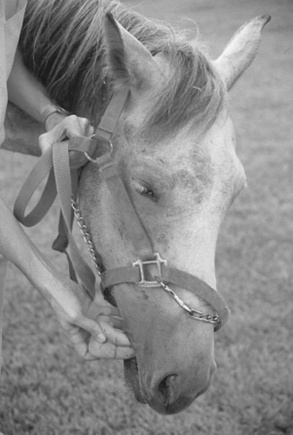
Characteristic early signs of botulism include reduced tongue strength. Assessment of tongue strength is best done by keeping the jaws closed with the left arm under the jaw, then placing the hand on the top of the nasal bones. The tongue is gently retracted with the other hand through the interdental space and allowed to hang down, then slowly released. Most normal horses quickly retract the tongue into the mouth after release with one or two “tugs” or attempts to retract the tongue.2310 The strength of the normal tongue retraction response varies significantly from horse to horse and must be considered when assessing tongue strength in a suspect horse. In more advanced stages of the disease, but before recumbency, the horse will retract the tongue very slowly, if at all (Fig. 35-46). This procedure, the “tongue stress test,” if done properly, represents one of the earliest and most sensitive clinical signs of botulism in horses.

image

Fig. 35-46 Horse with very weak tongue. The tongue may hang over the lips for several seconds, up to a minute or longer in severe cases. This test is not specific for botulism, but is characteristic, and with other compatible clinical signs, strongly suggests botulism.

Botulism Grain Test

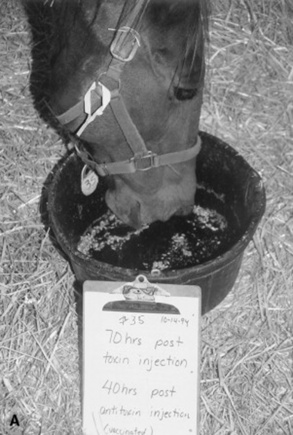
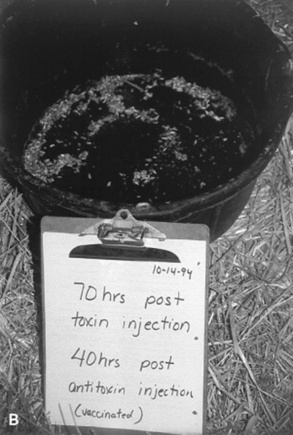
The horse is offered 8 ounces of sweet feed in a large, flat feeding tube on the ground. The horse is timed and observed for ability to consume the feed. Most normal horses will consume an 8-oz cup of grain (sweet feed) in less than 2 minutes, often in less than 1 minute.2313 In outbreaks of equine botulism, owners should be taught to perform the grain test and the tongue stress test to detect early signs of botulism and allow early treatment of affected horses. As the ability to retract the tongue diminishes, the time required for the horse to eat sweet feed increases. Grain mixed with some saliva often falls out of the mouth through the horse’s lips while eating. This creates a row of grain in the feed tub and a ring on the horse’s lip. This is very characteristic of botulism and is one of the earliest clinical signs2313 (Fig. 35-47).

image image

Fig. 35-47 A, Abnormal “grain test,” showing sweet feed mixed with saliva falling out of the side of the mouth. B, Note the trail of grain on the bottom of the bucket.

Dysphagia

Horses with beginning dysphagia may eat hay but have difficulty swallowing it. Inability to swallow water occurs after the loss of the ability to swallow hay. Horses seem to respond differently to the inability to drink water; many refuse to attempt to drink, whereas others immerse their muzzles under the surface of the water. Decreased tongue strength and dysphagia typically occur before onset of obvious muscle weakness. Recumbent horses with botulism are very difficult to assess with regard to swallowing ability because the struggle to stand takes priority over eating and drinking. During an outbreak of botulism in a herd of horses, if one horse is recumbent, it is always advisable to assess tongue tone on the other horses to detect early cases of botulism.

  Page 1097 

OTHER SIGNS AND PROGRESSION OF DISEASE

Decreased eyelid and tail tone may be detected in affected horses; however, the variation in tail tone from horse to horse makes this assessment problematic. Moderately affected horses walk with a shuffling gait, occasionally dragging their toes, and show evidence of muscle weakness. As the disease progresses, the dysphagia becomes more complete and the myasthenia more obvious, often with muscle tremors leading to recumbency and difficulty rising. Although the rate of progression can vary and is toxin dose dependent, clinical signs of botulism are always symmetric and gradually progressive, often leading to recumbency, followed by death from respiratory paralysis or euthanasia for humane considerations.

Vital signs, including capillary refill, are normal in the early stages of the disease. Once the horse is recumbent, both the heart rate and respiratory rate increase in proportion to the intensity of the struggle to rise and severity of the disease. Borborygmal sounds are gradually diminished as affected horses eat less. In the early phases of type C botulism, the character of the respiratory effort changes; the respiratory rate does not increase, but the expiratory effort becomes more exaggerated, with a prolonged abdominal lift. This unusual respiratory effort rarely occurs with other types of botulism, which helps to differentiate type C from types A and B in horses.2298

  Page 1098 

Moderate mydriasis is an early sign that persists for several days, with a sluggish pupillary response to light persisting for up to several weeks. Muscle trembling and inability to lift the head are two additional but inconsistent signs of type C botulism. The muscle trembling often starts in the triceps and extends to other large muscle groups. As the disease progresses, some horses have increased difficulty lifting their heads, and their head carriage becomes lower and lower. Massive edema of the muzzle and face may interfere with breathing, primarily in type C botulism. Supporting the head in a sling several hours at a time may result in some relief. Affected horses, when treated with botulism antitoxin, gradually regain strength to lift their heads over 7 to 14 days.2313

During examination of 40 horses with type C botulism in a California outbreak, dysphagia was not readily apparent or detected.2314 The absence of dysphagia in these horses with confirmed type C botulism is unexplained. Horses in Canada,2311 a Florida foal,2315 and horses with experimentally induced type C botulism2298 all had evidence of dysphagia. Some California horses that recovered from botulism had unusual prominent muscle atrophy of the supraspinatus and gluteal muscles. The atrophy was still apparent after 2 months but had healed by 5 months in four of the seven surviving horses.2314 This previously unreported type of muscle atrophy also has not been reported since this case.

The higher the dose of botulinum toxin present at the neuromuscular junction, the more rapid is the progression of the clinical signs and the poorer the prognosis for survival. Low levels of toxin (103 mouse lethal dose [MLD] units) result in a more gradual onset of clinical signs, which progress over 5 to 10 days and exhibit reduced severity of signs. Mildly affected horses may only have transient dysphagia and recover with minimal treatment. Larger doses of toxin (108 MLD units) result in peracute, rapidly progressive illness. These horses may become recumbent within 8 to 12 hours of the first detectable signs. In herd outbreaks of equine botulism, cases may continue to develop up to 14 days after removal of the suspect feed source.

Adult recumbent horses are more difficult to manage medically than foals and therefore also have a worse prognosis for survival (<15%). Once an adult horse is recumbent as a result of botulism and unable to rise, the prognosis for recovery is poor, despite the most intensive care, including mechanical ventilation.2300 Some horses, however, quickly learn to adjust to their muscular weakness and do not object to being recumbent. These horses may stabilize at a certain point and gradually improve over time, but may develop massive decubital sores, even when bedded deeply with straw. Terminally ill horses paddle their legs in an intermittent struggling manner and die of respiratory distress from paralysis of the diaphragm. Euthanasia is recommended when horses are recumbent, unable to rise, and have respiratory compromise.

Clinical Signs in Cattle

HISTORY

Most clinical cases of botulism in cattle occur as a herd outbreak, whereas botulism in horses most frequently occurs as a single case. In cattle the veterinarian is usually called to evaluate several down cows that may have initially responded to treatment for hypocalcemia, but then relapsed.2316 These downer cows are often not associated with recent parturition. Multiple cattle in a herd with clinical signs similar to milk fever and evidence of progressive muscular weakness typify many outbreaks of botulism in cattle. Affected cattle are anorexic and hypogalactic and may develop paraparesis, which leads to recumbency. Affected cows have decreased strength and frequency of rumen contractions and firm feces.2317

Further investigation of the herd outbreak usually finds a point source of botulinum toxin. Recent feeding of small grain silage such as barley, ryelage, oatlage or wheatlage stored in large plastic bags is often present 3 to 4 days before onset of clinical signs. In some outbreaks the plastic covering the forage may be damaged, allowing mold and spoilage to occur, which may lead to anaerobic conditions with botulism spores producing toxin. Ryelage and haylage stored in plastic bags or in long plastic tubes are major risk factors for botulism in cattle.2318 Corn silage is rarely associated with botulism; however, spoiled corn silage with a pH above 5.0 has been reported as a source of botulism for cattle.2318

Occasionally, the incorporation of an animal carcass during the silage-making process may lead to an outbreak of botulism. Cats, dogs, and poultry carcasses are typical sources that lead to type C botulism. In one California outbreak, feed contaminated with a cat carcass was responsible for the death of more than 420 adult cattle in 1 week.2276 Poultry litter containing decomposing chicken carcasses may also predispose cattle to either type C or D botulism.2282,2285,2286,2319 Repeated occurrences of types C and D botulism in beef cattle have occurred in West Virginia, Arkansas, and other states where feeding poultry litter–based rations is common.2316

TONGUE TEST

Reduction in tongue strength has been reported as the most important clinical sign of botulism in cattle.2320 A tongue stress test assesses three aspects of tongue muscular strength. First, insert your right hand and fingers through the interdental space while your other arm and hand keep the jaws closed. Assess the tongue muscular tone by reaching back in the mouth and putting pressure on the base of the tongue. Normally, the tongue is firm and relatively turgid. Softness and lack of tongue turgor indicate weakness. Second, grasp the tongue and pull it out the side of the mouth to test lingual strength. Normally, it not easy to grasp or pull the tongue out of a cow’s mouth. Third, with the jaws held closed, slowly release the tongue from your grasp, allowing it to hang out of the side of the cow’s mouth. Normally, when the tongue is pulled out of the side of the mouth with the jaws closed, most cows quickly retract the tongue back into the mouth. If the tongue rests limply over the lip, even for a few seconds, this is very abnormal and suggests a very weak tongue.

In herds experiencing a botulism outbreak, some cattle in herds experiencing botulism will appear normal but have decreased tongue strength and reduced jaw tone; these affected cows are early in their clinical course. Rating the tongue strength of all the exposed animals allows treatment decisions regarding which cows are candidates for prophylactic treatment with botulism antitoxin. Tongue weakness is not specific for botulism, but is characteristic. Reduction in tongue strength has been considered as the most important clinical sign in cows with botulism.2320 Rarely do cows with botulism protrude their tongue spontaneously.

If tongue strength is normal, another cause for the weakness should be considered. Decreased lingual strength may occur with listeriosis and other causes of hypoglossal nerve injury. In cases of botulism, tongue weakness is symmetric and often associated with dysphagia and progressive muscle weakness, with several animals typically involved in the same herd. During a herd outbreak of type D botulism in Ontario, the tongue test was assessed as normal, and affected cows did not have evidence of dysphagia.2296

JAW MOVEMENT AND MUSCLE TONE

In addition to tongue strength, one should also assess the masseter muscle strength by lateral movement of the mandible. Masseter muscle strength is best assessed by grasping the mandible in the area of the symphysis, then moving it laterally to determine tone of the masseter muscles. In cattle with botulism, little resistance is encountered, and the jaw seems very loose compared to normal cattle. Cows with listeriosis may also have weak masseter muscles.

  Page 1099 

PUPILLARY RESPONSE AND DYSPHAGIA

Botulism-affected cattle have pupils that tend to be dilated and poorly responsive to light. The animals may drool saliva because of their inability to swallow. These cattle rarely develop severe acidosis, as may occur with listeriosis. Often, botulism-affected cattle appear to prehend hay or grass, chew, and then swallow. However, on closer examination, the affected cow continually chews the same cud for hours without swallowing. Examination of the pharynx or oral cavity may reveal evidence of chewed hay cud or a forage bolus resulting from the inability to swallow.

Drooping ears have been reported in cows with botulism,2320 but as with tail weakness, this sign is subjective. Additionally, pricking the skin with a needle often results in no or minimal response. Botulism-affected cattle are dull, depressed, lethargic, and often become dehydrated because of the inability to swallow. They closely resemble cattle with milk fever, except with botulism, multiple cows are involved at the same time. Animals may show muscle tremors and truncal ataxia, even to the point of dribbling urine, before becoming recumbent. They remain in sternal recumbency in the initial phases and in the more advanced stages become laterally recumbent with evidence of respiratory failure.

CLINICAL COURSE

As with horses, the rate of progression of clinical signs in cattle after ingestion of toxin-contaminated forage is toxin dose dependent. Typically, cattle that absorb a moderate amount of botulinum toxin exhibit evidence of weakness 24 to 48 hours before becoming recumbent, then are unable to rise for 2 to 3 days before death. Low toxin concentrations may not yield any clinical signs for 7 to 10 days or longer after toxin ingestion.2316 Massive concentrations of toxin may lead to clinical signs within 12 to 24 hours of ingestion, but this is rare.

Animals with clinical evidence of botulism should have minimal physical activity. This includes not standing the animal up frequently or hauling in a truck long distance. Physical activity adversely affects the progression of clinical signs. Physically active cattle or cattle that are stimulated to walk some distance are more likely to be affected by lower doses of toxin. The physical activity results in depletion of acetylcholine reserves and may exacerbate muscle weakness, leading to recumbency within 12 to 24 hours, which results in a poorer prognosis for survival.

Most cattle that progress quickly to recumbency after botulinum toxin absorption die as a result of respiratory failure, dehydration, or other complications of recumbency. Cattle with a more gradual progression of clinical signs before becoming recumbent are often able to eat, drink, and swallow and may recover. Typically, down cattle affected with botulism that recover will be down for 5 to 10 days and then gradually regain sufficient muscular strength to rise again. In the author’s experience, in a typical herd outbreak, many cattle will have subclinical signs, such as a weak tongue and decreased jaw tone, possibly mild dysphagia, and will never become recumbent. These animals should have a detectable antibody response to botulinum toxin 3 to 4 weeks after recovery from subclinical botulism.2321-2324 The clinical course ranges from 2 to 30 days, depending on the dose of toxin absorbed and treatment provided. In cattle, 30% to 50% mortality rates are most common.

Other Large Animal Species

Type C botulism has been reported in bighorn sheep in California2325 and in sheep in South Africa associated with feeding poultry litter.2326,2327 The later report indicates the importance of sampling both the rumen and the cecal contents for botulinum toxin testing, because in this case the rumen samples were negative but the cecal contents were positive for preformed toxin.

Differential Diagnosis

DIAGNOSTIC RULE-OUTS FOR HORSES

Differential diagnoses for horses include any disease associated with muscular weakness and dysphagia, equine protozoal myelitis (EPM), rhinopneumonitis (spinal cord myeloencephalopathy),2328 West Nile virus, white muscle disease, azoturia, eclampsia, guttural pouch mycosis, leukoencephalomalacia (moldy corn poisoning), eastern and western equine encephalitis, yew poisoning (Taxus species), rabies, white snakeroot poisoning, yellow star thistle toxicosis, hypocalcemia, organochlorine toxicosis, and pharyngeal ulceration. EPM with brainstem involvement is one of the most difficult diseases to differentiate from early botulism. However, most horses with EPM have asymmetric neurologic deficits, which rarely occur with botulism. Ionophorous antibiotics (monensin, salinomycin, narasin) may produce signs of profound muscular weakness similar to those seen in botulism, but dysphagia and the absence of increased muscle enzymes distinguish botulism. The absence of systemic signs of illness also helps the practitioner differentiate botulism from sepsis and more generalized infectious diseases.

Hyperkalemic periodic paralysis (HYPP) should be included in the diagnostic rule-out list for myasthenic quarter horses. HYPP, a dominant inheritable condition of quarter horses, is characterized by episodes of muscular fasciculations, weakness, myotonia, and recumbency.2329 These episodes are associated with hyperkalemia attributable to a defect in sodium channels. Electromyographic examination, plasma potassium, and demonstration of a DNA marker help confirm HYPP.2330

DIAGNOSTIC RULE-OUTS FOR CATTLE

Most herd outbreaks of botulism involve several cows at the same time in all stages of lactation. Hypokalemia and hypocalcemia resemble botulism but are easy to differentiate, because most cases of hypocalcemia occur in the periparturient period, and hypokalemia is most common in early lactation. Listeriosis almost always has localized cranial nerve involvement, which is not present with botulism cases. Organophosphate toxicosis results in sailosis, nervousness, and constricted pupils, not mydriasis as occurs with botulism. Spinal cord compressions, as may occur with lymphosarcoma or vertebral body abscess, are single-animal diseases and not herd problems.

Clinical Pathology and Diagnostic Approach

Laboratory support for a diagnosis of botulism requires one of the following: (1) demonstration of preformed toxin in the patient’s serum or gastrointestinal (GI) contents or in a wound; (2) demonstration of Clostridium botulinum spores in the GI contents or feed materials, with compatible clinical signs; or (3) the detection of an antibody response to C. botulinum in patients recovering from suspected botulism. A definitive diagnosis may be obtained by demonstration of preformed toxin in plasma or GI contents, but this is rarely possible in adult horses. Preformed toxin has been identified in about 30% of GI contents of shaker foals, but rarely in adult horses. Finding botulinum spores in the intestinal or rumen contents, with clinical signs compatible with botulism, is strongly supportive of botulism because botulinum spores are rarely detectable in the rumen or GI contents of normal cattle or horses.

  Page 1100 

Botulinum toxin is relatively stable in tissues or plasma frozen at −20° C (−4° F) for several weeks. The mouse bioassay, the most sensitive test for botulism currently available, requires a minimum of 5 mL of plasma or serum from an affected animal as early in the clinical course as possible. Detection of toxin in the serum is likely only in animals with peracute onset and rapidly progressive clinical signs (onset to death in less than 48 hours). The serum (1 mL) is injected into two ICR Swiss Webster mice. If clinical signs of botulism occur in the mice (“wasp waist”), four additional mice are injected with the suspect serum. Two of the mice receive either a monovalent or a polyvalent botulism antiserum, depending on the history, along with the test serum. If mice are protected by a specific antitoxin, the test is definitive for the presence of botulinum toxin of that type.2329 Unfortunately, because horses are very susceptible to botulinum toxin, the level of circulating toxin in an affected horse is often below the threshold of detection of the mouse bioassay. Few reports have demonstrated preformed toxin (type B) in plasma (or serum) from an acutely affected foal or horse.2330,2331

A tentative diagnosis may be based on the presence of botulinum spores and toxin in feedstuffs recently consumed by animals having clinical signs compatible with botulism.2301 Spores of C. botulinum type B are found in the feces of approximately 34% of adult horses (three fecal samples per horse) with clinical signs compatible with botulism. C. botulinum toxin and spores can be found in the feces of approximately 20% and 70%, respectively, of foals affected with botulism. Spores are rarely detected in fecal samples from normal foals or adult horses.2310 The presence of neutralizing botulinum antibody is a recently recognized indicator of botulism in nonvaccinated animals.2321-2324 The polymerase chain reaction (PCR) for the detection of botulinum neurotoxin gene type B was reported to be more sensitive than the mouse bioassay in a natural case of type B botulism in Australia.2332,2333 At present, however, this technique remains a research tool that is not readily available for routine diagnostic purposes. In the author’s experience, electromyographic evaluation has not been very rewarding to confirm a diagnosis of botulism in horses.2301

Typically, botulism is a diagnosis by exclusion, ruling out other diseases that may result in similar clinical signs. Both hematologic and routine plasma biochemical findings in early to moderate cases of botulism show few abnormalities. Hyperglycemia is often present2334 and expected in cases of botulism, because elevated blood glucose is expected in many life-threatening diseases of cattle. If significant abnormalities are present, a disease other than botulism should be strongly considered. The gradual progression of clinical signs over 1 to 4 days, including dysphagia, decreased tongue tone, and muscular weakness leading to recumbency, is fully compatible with botulism.

Pathophysiology

Botulinum toxin acts primarily presynaptically at the peripheral cholinergic neuromuscular junction by blocking the evoked release of acetylcholine.2268 The three steps involved in the neuromuscular blockage are (1) a primary step in which toxin heavy chain binds rapidly and irreversibly to receptors on the presynaptic nerve terminal, (2) an internalization process involving receptor-mediated endocytosis of the toxin light chain, and (3) a final blocking step to prevent the release of acetylcholine from the vesicle,2272 leading to a flaccid paralysis. Once toxin is bound at the motor endplate, improved neuromuscular function is achieved only by the regeneration of new endplates; thus the prolonged time of a week to 10 days for clinical improvement after antitoxin therapy. Each neurotoxin serotype has its own specific receptor, an endopeptidase,2335,2336 which may explain differences in species susceptibility to different toxin types. (For more detail about the neurotransmission, see Dasgupta.2269)

Toxicoinfectious botulism occurs in foals and was initially reported as “shaker foal syndrome.” Foals may ingest botulinum spores with their food material as “normal” contaminants. The spores then produce toxin in vivo in the GI tract, resulting in neurologic disease.2303,2304,2315 Toxin is detectable in the feces of approximately 30% of shaker foals, but only in the acute clinical phase of the condition.2310 Normal intestinal flora of adult horses, humans, and other animals inhibit intraintestinal growth of botulism spores, limiting the occurrence of toxicoinfectious botulism to neonates.2337 In human infants less than 6 months of age, C. botulinum may colonize the GI tract, which lacks competing microbial microflora. After their ingestion, botulism spores vegetate to produce botulinum toxin, which may be detectable in the stool for several weeks.2338

Most cases of type B equine botulism are associated with spores in the hay and rarely with commercial grain contaminated by decomposed animal carcasses. Commercial feeds (grains) are seldom proven to be the source of botulism toxin for horses. The origin of botulism affecting only one or two horses on a farm is often not identified. When several horses are involved, the source is typically found to be the forage, as in outbreaks in California (hay cubes),2314 Ohio (contaminated wheat fed to work horses),2295 North Carolina (baled alfalfa hay),2309 England (big baled hay),2330,2339 Sweden (big bale ensilage),2340 and Australia (oaten chaff).2341 Silage and hay contaminated with type B botulinum toxin and spores are the typical sources of exposure for horses.2310 Hay stored in plastic bags or tubes has become a common factor in many outbreaks of botulism in the United States and England.2342,2343

Conditions of low acidity (pH >4.5), low oxygen, and high water content favor spore germination and toxin production. Small-grain forage, such as ryelage, oatlage, wheatlage, and barley,2344 frequently provides these conditions and is a major risk factor for bovine botulism. The small-grain forages have a narrow window of harvest; if harvested too early or too late, fermentation is inadequate, and the pH remains high, helping botulism spores to vegetate, producing botulinum toxin. Spoiled hay or poorly fermented silage also represents potential sources of botulism exposure for horses.2281 Silage with high pH (>4.5) is a well-known source of botulism for horses and is not a recommended equine feed because horses are much more susceptible to botulism toxin than cattle.2301

Necropsy Findings

Typically, no obvious gross or histologic lesions are associated with botulism in most species. Myositis or aspiration pneumonia may be present in some foals and adult horses because the deglutition reflex is abnormal. Patches of edema among the cervical muscles of an adult horse suggest type C botulism because some horses are unable to lift their head when affected with this toxin type.

Treatment and Prognosis

Equine botulism is usually fatal unless affected animals are promptly treated with specific antitoxin.2310 In a series of 91 foals, yearlings, and adults with presumed type B botulism, none was treated with antitoxin and only two of the foals survived.2345 On the other hand, a recent report of 30 foals affected with botulism had a survival rate of greater than 98% when treated with antitoxin.2346 Neutralization of circulating toxin with a specific or multivalent botulinum antiserum should be the first and immediate therapeutic objective. Every hour between initial examination and antitoxin treatment results in a poorer prognosis for survival. Only one dose of antitoxin is needed because the half-life of botulinum antitoxin of equine origin is about 12 days in normal horses. Unfortunately, the antitoxin has no effect on the toxin after binding to the cell receptor; thus the importance of immediate treatment.2269 Once an adult horse is recumbent, the prognosis for survival is greatly reduced, with less than 15% survival. Because the prognosis for survival in recumbent horses is poor, these animals should not be treated with antitoxin, unless the owners are fully appraised of the poor prognosis, the extensive nursing care that will be required, and the huge financial costs of an attempt to save these recumbent animals.

  Page 1101 

The recommended dose of antitoxin is 200 mL (30,000 IU) for a foal and 500 mL (70,000 IU) for an adult horse. A single dose of antitoxin should provide passive protection for more than 60 days. Horses with mild, slowly progressive disease may survive without antitoxin, as long as the patient is confined to a stall to restrict muscular activity as much as possible. Frequent attempts to force the horse to rise are also contraindicated to avoid further depletion of acetylcholine stores and exacerbation of the clinical signs. Antimicrobials may be given for specific secondary complications (e.g., aspiration pneumonia). If antimicrobials are used, those that may potentiate neuromuscular weakness should be avoided (e.g., aminoglycosides).2347,2348 Metronidazole, often effective against anaerobic bacteria,2349 is not effective against botulism and has predisposed laboratory animals and human patients to develop botulism.2350 Mineral oil is often recommended as a cathartic for horses with ileus to prevent impaction colic. Parasympathomimetics (e.g., neostigmine) and 4-aminopyridine are countraindicated for the treatment of botulism in animals.2310

Most equine patients cannot swallow, so supportive alimentation is required. A high-quality protein slurry composed of 4 lb of alfalfa meal and up to 12 L of water should be administered twice daily by nasogastric tube using a bilge pump to support a 1000-lb horse. Hydration should be monitored by daily determinations of packed cell volume (PCV) and total plasma protein (TPP). Alfalfa meal gruel with adequate water was shown to maintain dysphagic horses for more than 2 weeks.2313 Expensive mixtures of electrolytes and semipurified nutrients are not necessary for oral alimentation.2351 If the horse or foal is recumbent, it should be fed in a sternal position and supported during gastric emptying. Recumbent foals are prone to developing ileus and may accumulate a large amount of fluid in their stomach, which must be relieved by nasogastric intubation. Additionally, recumbent male horses require bladder catheterization several times daily because they are unable or unwilling to urinate. If not catheterized, severe cystitis or bladder necrosis may result. Because most animals continue to attempt to eat, muzzling may be necessary to prevent aspiration of food or bedding, which can lead to aspiration pneumonia.

Foals often require intragastric feeding with either mare’s milk, goat’s milk, or a commercial milk replacer (Foal-Lac; Borden) through an indwelling nasogastric tube (Levin Tube, 16 Fr, 1.27 m; Davol). Additional therapy often includes histamine receptor (H2) blockers such as ranitidine or cimetidine, along with sucralfate to help prevent gastric ulcers, which occur frequently in shaker foals.2308 Ophthalmic lubricating ointments (Lacri-Lube; Allergan Pharmaceuticals) are often needed to prevent corneal abrasions that may result from decreased eyelid tone. Recumbent foals must be turned frequently to help prevent decubital ulcers and muscle necrosis. Parenteral antibiotics (e.g., potassium penicillin, ceftiofur sodium) are indicated to help reduce secondary infections, especially inhalation pneumonia. Approximately 50% of foals with botulism will require supplemental oxygen, and 30% will require mechanical ventilation.2352 In foals requiring mechanical ventilation, 87.5% survived.2352

Recovery from botulism depends on toxin dose and the resulting severity of the clinical disease. Dysphagic horses that are able to stand will gradually regain the ability to swallow over 3 to 7 days. The more complete the dysphagia, the longer is the time required for recovery. An occasional horse will remain dysphagic for more than 2 weeks. Most adult horses are able to eat hay and swallow grain and water by 7 to 10 days after treatment with antitoxin. Return to full strength often takes more than 1 month. Very few adult horses that become recumbent and are unable to rise for 24 hours recover unless they are provided meticulous nursing care. Decubital ulcers and secondary respiratory problems are the major complications. Recumbent foals are usually able to stand after 7 to 10 days of intensive nursing care.2308

Prevention

A toxoid for Clostridium botulinum type B, BotVax B, is available from Neogen Corporation (Lexington, Ky). Three doses of vaccine 1 month apart are required to successfully immunize horses according to current recommendations.2353 Alternatively, three vaccinations given at 10-day to 12-day intervals may provide protective antibody after 3 weeks, if necessary for emergency situations (e.g., outbreaks).2354 Annual revaccination of pregnant mares 4 to 6 weeks before foaling is highly recommended. Horses from an endemic area should be revaccinated annually. The colostrum from vaccinated mares receiving boosters 6 to 8 weeks before foaling should contain adequate antibody to protect the foal for 8 to 12 weeks.2355 Foals vaccinated with toxoid in the first few days of life should be immunoresponsive and should develop antibodies to the toxoid, even in the presence of passive antibody.2354 Foals or weanlings given only two doses of toxoid may not be protected.

Botulism toxoid is considered highly efficacious when administered properly and is regarded as one of the safest and most effective vaccines for horses. Occurrence of clinical botulism in fully immunized horses has not been reported. No multivalent vaccine or licensed type C toxoid for horses is available in North America at this time. However, horses have been vaccinated and immunized with a type C toxoid approved for use in mink. This vaccine has been used for several years in endemic type C areas, such as southwestern United States.

POLYNEURITIS EQUI (NEURITIS OF CAUDA EQUINA; CAUDA EQUINA NEURITIS)

Definition and Etiology

The etiology of polyneuritis equi in horses is unknown. Inflammatory changes occur in various nerve roots, particularly those of the cauda equina and cranial nerves. All nerve roots may be affected to a greater or lesser degree, which has led to the use of the term polyneuritis equi as a more descriptive name for the condition than its previous name of “cauda equine neuritis.”2356-2358

The disease usually occurs in adult horses,2356-2361 although it has been described in a yearling filly.2359 No breed or gender predilection has been noted.2360

  Page 1102 

Several hypotheses have been proposed for the cause of this disease. The lesions it causes bear some histopathologic resemblance to experimental allergic neuritis of rats, coonhound paralysis of dogs, and Guillain-Barré syndrome in humans, all of which are suspected of having an autoimmune basis.2361,2362 Other proposed etiologies include a hypersensitivity reaction after systemic infection, aberrant migration of helminth larvae, and association with equine herpesvirus type 1 (EHV-1) and equine viral arteritis (EVA) infections.2359,2360,2363-2365 However, conclusive evidence supporting any of these theories is lacking.

Clinical Signs and Differential Diagnosis

The clinical signs of polyneuritis equi reflect the involvement of the lower motoneurons and sensory neurons at the level of the nerve roots. In the initial stages of the acute form, horses show signs of hyperesthesia, particularly around the tailhead, and rub and chew at this area.2361 Sometimes pain is apparent, and horses become apprehensive of handling.2366 The condition can progress to hypoesthesia or anesthesia of the affected areas.2356,2357,2363 In the chronic form a gradually progressive paresis of the tail, bladder, rectum, and anal sphincter develops, which may terminate in paralysis.

Common signs include weakness or paralysis of the tail.2367,2368 The anus may be hypotonic or atonic and distended.2356,2366-2369 Fecal retention or incontinence is sometimes a feature.2356,2357,2363,2366,2370 Urinary incontinence occurs in many horses because of involvement of parasympathetic fibers in the sacral nerves and is the lower motoneuron type (i.e., bladder is atonic, distended, and easily expressed manually). In severe cases, overflow incontinence develops, and urine dribbling may cause vaginal hyperemia and scalding of the perineum in mares and scalding of the thighs in animals of either gender.2356,2357,2363,2367-2371 Retention of urine predisposes to urinary tract infections.2369 In males the penis may be relaxed and protruding, with decreased sensation in the perineal skin.2356,2357,2369 Impotence resulting from incomplete erection and inability to achieve intromission was the presenting complaint in one stallion with polyneuritis equi.2372 The preputial skin, which derives its innervation from spinal cord segments L2 to L4 through the genitofemoral nerve, usually retains normal sensory function.2373 When the nerve roots of the lumbosacral enlargement of the spinal cord are involved, hindlimb weakness with ataxia is seen.2360,2361,2363,2366 Weakness and ataxia have been observed in all four limbs of some horses.2357,2361,2367,2370 The gait may be stiff,2366,2369 and denervation atrophy of muscles may result.2366

Cranial nerves can be involved. The signs depend on the individual nerves affected and the severity of the disease. The motor branch of the trigeminal nerve is reported to be most often involved, resulting in atrophy of the temporal and masseter muscles, with drooling and dysphagia.2367,2370,2371,2374 Involvement of the facial nerve results in unilateral or bilateral facial paralysis, which can cause keratitis and corneal ulceration.2361,2363,2367,2370,2374 Head tilt and other signs of cranial nerve dysfunction may also occur.2357,2367,2374

Any disorder that affects the cauda equina may cause similar signs. These include instabilities of the caudal spine caused by luxations or fractures, EHV myelitis, sorghum intoxication, and infectious diseases that involve the cauda equine, as well as some primary diseases of the lower urinary tract.2375-2377

Clinical Pathology

Cerebrospinal fluid (CSF) may have a mononuclear and neutrophilic pleocytosis, sometimes with more than 100 cells/μL.2359 The CSF protein concentration usually is moderately to markedly increased.2360,2370,2374 Electromyographic abnormalities occur in polyneuritis equi as a result of denervation of affected muscles. A recent study suggests that the presence of circulating antibodies to P2 myelin protein may prove to be a useful diagnostic test, but further research is required to confirm this.2378,2379

Pathophysiology

The finding that some horses with polyneuritis equi possess antibodies to P2 myelin protein supports the theory that this disease has an autoimmune etiology.2378,2379 An initial traumatic or infectious insult might cause the release of autoantigens from nerve tissue and disrupt the blood-nerve barrier so as to permit an autoimmune reaction.2366 Experimental inoculation of P2 protein in rats produces an antibody response and an allergic neuritis that shares some pathologic features with polyneuritis equi.2380 However, such autoantibodies may represent an epiphenomenon and may not be central to the pathogenesis of the disease.

Necropsy Findings

The main lesions are in the nervous system. The cauda equina is thickened, discolored, and covered with edematous tissue and fibrous material.2361,2371,2381 There may be adhesions of the nerve roots or the spinal cord to the meninges and the periosteum of the vertebral canal.2356,2369 Subdural or epidural petechiation and hemorrhage are sometimes seen.2356,2363,2366

At the microscopic level the major finding is a granulomatous inflammation that is most intense in the extradural part of the nerve roots. On rare occasions, microabscesses are found at the center of the granulomatous lesions.2356,2361 The epineuria, perineuria, and endoneuria are thickened and are infiltrated to varying degrees by lymphocytes, plasma cells, lymphoblasts, macrophages, giant cells, eosinophils, and in rare cases, neutrophils.* Intraneural inflammation, necrosis, and endoneurial thickening can obliterate nerves.2356,2363,2366 Axonal degeneration and demyelination are present.2361 Often, myelinated axons are absent in the affected nerves. Mildly affected nerves have axonal swelling and ballooning of myelin sheaths. Nerve bundles are separated by large amounts of fibrous tissue. There is minimum to moderate evidence of nerve regeneration.2361

Lesions can also be found in the spinal cord itself, having occurred secondary to the nerve root lesions, such as wallerian degeneration in the dorsal columns and axonal reaction in the ventral horn cells.2366 Inflammatory lesions in dorsal root ganglia and in trigeminal ganglia have been found in some horses with this disease.2367

Treatment and Prognosis

Treatment with corticosteroids at antiinflammatory doses early in the course of the disease may be helpful.2359,2363,2371,2382 However, no therapy has consistently been shown to be effective. Immunosuppressive drugs, such as azathioprine, may be useful in the treatment of polyneuritis equi, but their use for this disease has not been reported.2383 General supportive care should be given, including fluid therapy when necessary, and the bladder and bowels should be manually evacuated. Because of the slow progression of signs in some horses, these animals may be maintained on supportive care for a long time. Because of the severity of the clinical signs, the gradual deterioration, and the poor prognosis, euthanasia usually is the eventual choice.

  Page 1103 

SORGHUM TOXICITY

Definition and Etiology

A syndrome of ataxia and cystitis in horses, cattle, and sheep has been linked to the feeding of Sorghum species.2384-2389 The underlying mechanism is probably toxic damage to the central nervous system, but the precise toxin responsible is not known. This disease does not appear to be linked to the breed, gender, or age of an animal.2385

Clinical Signs

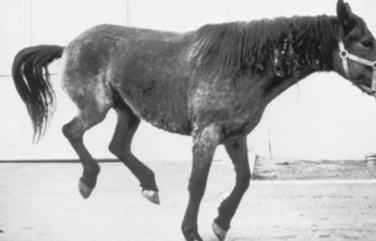
The first sign observed usually is ataxia of the hindlimbs, usually followed by urinary incontinence. Affected animals have a swaying hindlimb gait and a tendency to knuckle over. Occasionally, affected horses may walk with a hopping gait, in which both hindlimbs are lifted off the ground simultaneously (Fig. 35-48). Signs in horses tend to worsen on backing, and animals may fall or even become recumbent.2385 During an outbreak of the disease in cattle, 3 of 54 affected cows became recumbent, and two of these died.2386 The perineal muscles are relaxed, and urine dribbles from a flaccid, distended bladder.2385,2386 In mares the vulva opens and closes repeatedly; in stallions and geldings the penis is relaxed and protrudes from the prepuce.2385 Paresis of the tail may be present in both horses and cattle. Loss of skin sensation over the hindquarters has been described in a cow, suggesting involvement of both sensory and motor nervous pathways.2386 Head shaking, ataxia, weakness, recumbency, opisthotonos, and death have been reported in sheep, and mortality can approach 50%.2384

image

Fig. 35-48 Characteristic “rabbit hopping” gait of a horse with lathyrism. This horse was believed to have eaten sweet peas (Lathyrus species). Horses may also simply show ataxia and paraparesis.

Courtesy Dr. G.P. Carlson.

Cystitis in affected animals may be severe and occurs secondary to urine retention. Dribbling of urine onto the skin of the perineum and hindlimbs results in scalding of the skin and dermatitis. Pyelonephritis is a common sequela to chronic cystitis and may be fatal.2385,2387 Sometimes the clinical signs may be chronic; in one outbreak, horses had been showing signs for as long as 3 years.2385

Abortion in mares, arthrogryposis as a congenital deformity of foals and lambs, and neurologic abnormalities in newborn lambs also have been linked to the feeding of Sorghum plants.2384,2385

Clinical Pathology

Diagnosis of sorghum toxicity is made by the presence of typical clinical signs in association with a history of feeding Sorghum plants. No specific diagnostic test is available. Cystitis and pyelonephritis are identified by typical findings on routine urinalysis, serum biochemistry, and urine culture.

Pathophysiology

The precise nature of the toxic substance in Sorghum plants that causes this syndrome is unknown. Most Sorghum species are cyanogenetic plants that contain hydrocyanic acid at potentially toxic concentrations.2389 Chronic exposure to cyanide has been suggested as the cause of the neuropathologic changes found in affected animals.2385 Similarities in the clinical signs of this syndrome and those of neurolathyrism in humans have led to the suggestion that the toxic principle in Sorghum plants may be a lathyrogen-like substance.2390

Epidemiology

The cyanide content of Sorghum plants is increased by drought or freezing and also is higher in new shoots and wet plants.2389,2390 In one survey of the disease in horses, most cases occurred during the wet season and involved young, growing plants.2385 The period of grazing before the onset of signs ranges from 1 week to many months.2385,2386

Necropsy Findings

Wallerian degeneration, swelling of axons and myelin sheaths, and demyelination in a small number of nerve fibers throughout the length of the spinal cord, in the cerebellum, cerebellar peduncles, and the pons have all been described, together with the presence of phagocytic gitter cells.2384-2386 These changes are not associated with specific tracts.2386 Ultrastructural studies of brains and spinal cords of affected sheep have revealed that the axonal swelling (spheroids) are composed of aggregates of neurofilaments, mitochondria, vesicular bodies, and dense bodies, enclosed within a thin myelin sheath.2384

Treatment and Prognosis

Withdrawal of Sorghum plants from the diet of affected animals results in a gradual improvement in the clinical signs over weeks to months, although recovery may not be complete.2384,2386 Death is a potential sequela, however, and mortality can be high in some cases.2384 There is no specific treatment for affected animals. Supportive therapy includes antibiotics for treatment of bacterial urinary tract infections.

Control

Avoidance of feeding Sorghum plants as a predominant part of the diet or the sole diet is the only method of control. This plant has considerable feed value and should not present a major hazard when used as part of a diversified feeding regimen.

STRINGHALT (SPRINGHALT; HAHNENTRITT)

Definition and Etiology

Stringhalt is a disorder of unknown etiology that produces a characteristic hyperflexion of one or both hock joints in affected horses. The sporadic form usually affects a single hindlimb and is often associated with traumatic injury, although in some cases no inciting cause is identified. The epidemic form affects both hindlimbs and sometimes the forelimbs. This form also is called bilateral stringhalt, rather than “epidemic” stringhalt. Laryngeal paresis from involvement of the recurrent laryngeal nerves also has been described in this form of the disease. This form of stringhalt occurs often as an outbreak in groups of horses grazing poor-quality, weed-infested pastures; it is suspected to have a toxic etiology.

Clinical Signs

Affected horses appear normal at rest but have a characteristic involuntary hyperflexion of the tarsocrural joint when moving. The disorder may be unilateral or bilateral and can vary in severity from a slight exaggeration of normal movement to a motion wherein the rear foot strikes the belly. A grading system has been proposed, with the severity of signs classified from grade I to grade V.2391 In grade I, mild signs are noted just as the horse begins to move; in grade V, animals are reluctant to move and have a “bunny-hopping” gait when forced to do so. The signs generally worsen on turning or backing and may also be more severe when the animal is frightened, after a period of rest, or in cold weather.2392-2394 Knuckling of the forelimbs may occur in the epidemic form of the disease, sometimes with evidence of laryngeal weakness in the form of dyspnea or “roaring.” Atrophy of muscles in the affected limbs is usually a feature of stringhalt and is most severe in distal limb muscles.

  Page 1104 

Clinical Pathology

No abnormal clinical pathologic findings are associated with stringhalt. Electromyography of affected muscles reveals increased insertion activity and abnormal spontaneous activity, such as fibrillation potentials and positive sharp waves, consistent with denervation.2395,2396 Nerve conduction velocity is slowed in the peroneal nerves of affected limbs, indicating demyelination, and improves as animals recover clinically.2391

Pathophysiology

The etiology and pathophysiology of stringhalt are unknown. The sporadic form occurs in individual animals. In some sporadic cases, a history of traumatic injury to the limb, particularly to the dorsoproximal metatarsus, precedes the development of stringhalt by several months,2397,2398 although in other cases the cause is unknown. Explanations for the development of stringhalt after traumatic injury include tendinous adhesions and alterations in the function of nervous or muscular components of the myotactic reflex in the affected muscles.2393,2399,2400 Outbreaks of stringhalt among horses in Australia and the United States have been associated with ingestion of certain plants, particularly Hypochoeris radicata (catsear), but a causal role for a plant toxin has not been proved experimentally.2401-2403 Other related plants that have been associated with the development of stringhalt include Taraxacum officinale (dandelion) and Malva parviflora (cheeseweed mallow).2394 Lathyrism, a toxicity caused by plants of the Lathyrus (flatpea) family, can cause signs similar to stringhalt (see earlier discussion). Detailed pathologic studies of horses affected by the epidemic form of stringhalt have revealed that the lesion is a distal axonopathy in peripheral nerves that selectively affects large-diameter myelinated axons.2402,2404 The pathologic changes are widespread and involve nerves of the forelimb and the recurrent laryngeal nerves, as well as those supplying the hindlimbs. Neurogenic myofiber atrophy is present in muscles innervated by the affected nerves, with type II fibers being more severely affected than type I fibers. Recovery in affected horses is presumed to result from axonal regeneration, a process that requires an intact neuronal cell body.2402

Epidemiology

The sporadic form of stringhalt occurs in individual animals worldwide and at any time of year. The epidemic form occurs in outbreaks in which several horses in the same location are affected; it has a seasonal incidence, being most prevalent in the late summer or early autumn after a period of very dry weather. Outbreaks have been reported in Australia (thus the alternative name for the epidemic form, “Australian stringhalt”) and in the western United States.2405,2406

Necropsy Findings

Lesions are limited to the peripheral nerves and muscles.2402 There is a loss of large-diameter myelinated fibers in a number of peripheral nerves, especially those innervating the hindlimbs and the recurrent laryngeal nerves. The pathologic changes in the nerves include demyelination, fibrosis, and proliferation of Schwann cells. Longer nerves are more severely affected. Muscles innervated by the affected nerves show evidence of denervation atrophy, particularly of type II myofibers.

Treatment and Prognosis

Individual cases rarely recover spontaneously. Surgical therapy by tenotomy or tenectomy of the lateral digital extensor tendon has been the treatment of choice in sporadic cases, resulting in a guarded to favorable prognosis for recovery.2392,2393,2407 Conservative treatment using gradually increasing exercise or intraarticular administration of corticosteroids also has been advocated for animals with a history of trauma to the affected limb.2397,2398 One study found no apparent significant difference in outcome between horses that underwent surgery and those managed conservatively.2397 Steroid therapy was successful in the one case reported, whereas exercise alone resulted in improvement in two of four horses but complete recovery in only one horse.2397

In the epidemic form, most horses recover in weeks to months without treatment.2401 Because a toxic etiology is suspected, it is usually recommended that the horses be removed from the pasture they were grazing when they developed signs. Administration of phenytoin (10 to 15 mg/kg orally once or twice daily) resulted in clinical improvement and reduced abnormal electromyographic activity within 24 hours of starting therapy and reached full effect by 1 week.2396,2408 Horses that did not recover spontaneously while receiving phenytoin showed reappearance of signs within a few days. Mild sedation is a possible side effect of this treatment. Other drugs reported to have variable beneficial effects include mephenesin and baclofen.2409-2411

Control

Because plant toxicity is suspected as the cause of the epidemic form of stringhalt, control is best effected by not grazing horses on weed-infested pasture and by using weed control and good pasture management where horses are being grazed. Judicious exercise regimens may be helpful in reducing the likelihood of stringhalt in horses that have sustained traumatic injuries to the dorsoproximal region of the metatarsus.2397

TICK PARALYSIS

Definition and Etiology

An ascending lower motoneuron paralysis has been described in horses, sheep, cattle, and goats in Australia, associated with infestation by the tick Ixodes holocyclus.2412-2417 In the United States a similar disease occurs in dogs, humans, cattle, New World camelids, and wild animal species as a result of infestation with several Dermacentor species.2418,2419 A similar problem occurs in small ruminants in Africa, where Ixodes rubicundus and Rhipicephalus evertsi evertsi are the tick species implicated.2420

Clinical Signs

Progressive generalized paresis develops over one to several days, terminating in recumbency. Death from respiratory paralysis may occur in as little as 24 hours in severe cases.2412 Animals may be found recumbent or may be paraparetic and ataxic in the early stages of disease. When signs are mild to moderate, differential diagnoses include a variety of neurologic and nonneurologic diseases, such as rabies, colic, uterine torsion, trauma, myelopathies, myopathies, and metabolic disorders. These do not usually progress to the profound muscular flaccidity seen in tick paralysis.2421 Reflex withdrawal from a noxious stimulus and the blink reflex both are reduced to absent, although sensory function appears normal. The major differential diagnosis for fully developed tick paralysis is botulism. Tick paralysis often is fatal when caused by I. holocyclus, but animals affected by Dermacentor species recover if the ticks are removed before the animals are moribund. Diagnosis is made on the basis of the clinical signs and finding ticks on the affected animal.

  Page 1105 

Clinical Pathology

There are no pathognomonic findings in affected animals except for the presence of ticks on the patient. Electromyography in tick paralysis in dogs in North America reveals minimal spontaneous activity and lack of evoked compound muscle action potentials in response to motor nerve stimulation.2422 Findings in large animals can be expected to be similar. Cerebrospinal fluid is normal in tick paralysis, helping to differentiate it from some, but not all, myelopathies.

Pathophysiology

The cause of tick paralysis is believed to be a neurotoxin in the saliva of female ticks that is inoculated into the host when the tick feeds. Nymphs and larvae also may cause the disease.2413,2415,2416 In the case of I. holocyclus the toxin has been named holocyclotoxin. The toxin elaborated by Dermacentor species has been less well characterized. The pathogenesis of the disease is blockage of transmission at the neuromuscular junction as a result of reduced release of acetylcholine. Mortality is common in tick paralysis caused by I. holocyclus despite tick removal.

Epidemiology

The disease occurs worldwide, associated with different tick species in different areas. In North America the region from the Pacific coastal range to the Continental Divide provides especially favorable conditions for the proliferation of Dermacentor andersoni.2418 Tick paralysis in the United States and Canada occurs mainly in the Pacific Northwest and the Rocky Mountains, although the range of the tick species involved covers a much wider area.2421 The disease tends to be seasonal in North America, with most cases occurring in the spring, when ticks are most active. Smaller animals, such as sheep and New World camelids, are more often affected than cattle, probably because they receive a larger dose of the tick neurotoxin relative to their body size.2421 Tick factors probably influence disease severity, and genetic variation within I. holocyclus may play a role in toxin potency.2423 A short-lived immunity has been demonstrated in dogs exposed to ticks. Tick paralysis is most common in the early part of the season and in younger animals, suggesting that a similar phenomenon may occur in other species.2421 The significance of host immunity is supported further by the finding that D. andersoni has reduced virulence in hamsters after the ticks are prefed on cattle previously exposed to the same species of tick compared with ticks prefed on naive cattle.2424

Necropsy Findings

There are no pathognomonic findings at necropsy, although the presence of ticks should increase suspicion of this disease. Death usually results from respiratory paralysis.

Treatment and Prognosis

Treatment is symptomatic after removal of the ticks, which is essential. Lack of improvement suggests that ticks remain on the animal, except in cases of I. holocyclus infestation, where signs persist and may worsen despite removal of all ticks. Spraying or dipping affected animals facilitates tick removal. In small animals, shaving the hair coat may be necessary to ensure detection and removal of all ticks. Areas such as the axillae and groin, in particular, provide good sites of attachment for ticks. The prognosis is good in the case of Dermacentor-induced paralysis when tick removal and supportive care are instituted before animals are moribund. Fatalities occur frequently in the case of Ixodes-induced paralysis despite removal of ticks. Cooling of the patient has been suggested in treatment of I. holocyclus toxicity because anecdotal clinical reports suggest that patients may be more likely to survive when cool. In vitro studies revealed that binding of holocyclotoxin at the neuromuscular junction is reduced in a cooler environment.2425 However, such an approach may increase risk of severe complications in patients that are paralysed and cannot thermoregulate. A better approach may be to avoid warming the patient excessively.

Administration of hyperimmune serum has been shown to be beneficial in the treatment and prevention of this disease in dogs and in one llama.2417,2426 Adverse reactions such as anaphylaxis, bradycardia, and hypotension occur in a small number of dogs and cats treated with hyperimmune serum, but these can be avoided by premedication of atropine.2427 No report of such treatment in other species was found.

Control

Environmental control to reduce tick populations and routine use of acaricides may decrease the incidence of tick paralysis.

EQUINE DYSAUTONOMIA (GRASS SICKNESS)

Equine dysautonomia, commonly known as grass sickness, is a disorder of unknown etiology that occurs in horses, ponies, and donkeys in Great Britain and northern Europe.2428-2434 A disease with similar clinical signs (“mal seco”) has been described in horses in Colombia.2435 The major clinical finding is a decrease in or cessation of gut motility. The signs of grass sickness, which are mainly caused by intestinal stasis, include colic, bloat, constipation, inappetence, weight loss, and dehydration. Esophageal dysfunction may be manifested by dysphagia. Paralysis of the urinary bladder occurs in some animals, and in males the relaxed penis may protrude from the prepuce. Significant cardiac functional disturbance has been documented in horses with grass sickness.2436 The course of the disease varies from peracute with sudden death to chronic; some animals survive for many months despite alimentary dysfunction.2429,2430,2437 Survival and return to function has been documented in horses midly affected with the chronic form of disease when they received good nursing care.2437-2441 Risk factors for developing the disease include younger age, male gender, and location on premises that have previously experienced the disease. Dry weather has been identified as a risk factor, but not all studies support meteorologic influences on disease occurrence.2442 Peak incidence occurs from April to June.2443

Histologic examination reveals characteristic degenerative changes in peripheral autonomic ganglia, in the myenteric and submucous plexuses, cardiac ganglia, and in certain central nervous system nuclei, particularly in the medulla oblongata.2431,2432,2436,2444,2445 A reduction in the number of interstitial cells of Cajal within the gut wall has been demonstrated; these cells are believed to have a “pacemaker” activity, and their depletion may be central to the clinical manifestations of equine dysautonomia.2446 Furthermore, electrical activity in the gut is decreased in grass sickness, possibly including that of the interstitial cells of Cajal.2447 Studies of animals that recovered from the disease indicate that the histopathologic changes may be reversible.2439 Some degree of esophageal dysfunction occurs in all horses with grass sickness.2434 The histopathology of autonomic ganglia in horses that showed complete clinical recovery from grass sickness was virtually normal, with normal morphology in all four horses studied and normal cells numbers in three of the four horses.2444

  Page 1106 

Diagnosis rests mainly on clinical presentation; there are no definitive clinicopathologic abnormalities in grass sickness.2448,2449 A small study demonstrated that the presence of chromatolytic neurons in rectal biopsies might be a useful adjunctive test for diagnosis.2450

Evidence for pathology not related to the gastrointestinal (GI) tract was found in a study of motor nerves and skeletal muscle in horses with grass sickness. The investigators found electromyographic evidence of a subtle peripheral neuropathy, which was further supported by mild pathologic changes in both muscle and nerve at necropsy.2451

There is mounting evidence for an association between equine dysautonomia and Clostridium perfringens type C neurotoxin.2429,2452-2454 The presence of a neurotoxic factor in the plasma of affected horses was suggested by induction of typical neuropathologic lesions in ponies by intraperitoneal inoculation of plasma and serum from horses with acute disease. Clinical illness was not observed in the ponies.2455 Circulating antibodies to C. perfringens type C endotoxin have been positively associated with the development of grass sickness.2456 Growth of the organism in the GI tract (toxicoinfection) is hypothesized to be the source of the botulinum toxin. On the other hand, horses with grass sickness have lower circulating levels of antibodies directed against the surface antigens of clostridia, suggesting that these may have a protective effect against the disease.2457 This finding also raises the possibility of a vaccine against grass sickness. The number of bacteria, including clostridial species, is significantly increased in the intestines of horses with grass sickness, posing the question as to whether change in GI flora is a cause or a consequence of the disease.2458

Treatment of equine dysautonomia is supportive and includes supplementary feeding and fluid therapy. The indirect-acting cholinergic cisapride (0.5 to 0.8 mg/kg orally every 8 hours for 1 week) facilitates release of acetylcholine from the myenteric plexus and increases gut motility in chronic grass sickness. Colic signs may increase shortly after administration of this drug.2459 Many affected animals die, but recovery has been reported in some chronic cases, as well as in 50% to 70% of chronically affected horses that receive appropriate treatment.2431 Analgesia with intravenous flunixin meglumine or intravenous or oral phenylbutazone is appropriate in some cases, and diazepam (0.05 mg/kg every 2 hours) may be helpful as an appetite stimulant. Factors associated with a better prognosis include willingness to eat concentrates and milder signs of dysphagia.2460

PERIPHERAL NERVE DISORDERS

LISLE W. GEORGE

Most peripheral nerve disorders of large animals are traumatically induced, but injections, abscesses, tumors, and parasitic invasion of the nerves may occur in rare cases. The following section discusses the peripheral nerves most often damaged in large animals.

PERIPHERAL NERVES

Suprascapular Nerve

Mechanical damage to the suprascapular nerve results in paralysis of the infraspinatus and supraspinatus muscles.2461 Early denervation is characterized by a slight outward bowing of the scapulohumeral joint as weight is placed on the limb. Neurogenic atrophy develops after several months, and the scapular spine becomes prominent (Fig. 35-49). The common name for this condition is “Sweeney.”

image

Fig. 35-49 “Sweeney” (neurogenic atrophy) of the left supraspinatus and infraspinatus muscles in a Charolais bull. The lesion was caused by trauma related to running through a cattle chute.

Brachial Plexus

Damage to the brachial plexus may result in any combination of dysfunction of the biceps and coracobrachialis muscles (musculocutaneous nerve), as well as the pectoral, subscapularis, and triceps muscles.

Lesions of the brachial plexus are caused by trauma to the shoulder, deep penetrating axillary wounds, or traction on the forelimbs of a fetus during relief of a dystocia. Because of their tendency to rear and jump over objects, horses are most susceptible to brachial plexus injuries. The condition may occur in small ruminants after automobile accidents, carnivore attacks, or blows from larger animals.

MOTOR DEFICITS

Severe lesions of the brachial plexus result in complete flaccidity of the forelimb. The animals are unable to bear weight. Triceps reflexes are absent. Loss of pectoral nerve function results in abduction of the elbow. Subscapular muscle paralysis results in dropped shoulder.2462 Musculocutaneous nerve paralysis results in a hyperextension of the elbow at rest and an inability to flex the joint. There is loss of the biceps reflex. The clinical signs of radial nerve paralysis are described next.

SENSORY DEFICITS

Avulsions of the brachial plexus result in complete desensitization of the entire forelimb.

  Page 1107 

Radial Nerve

The radial nerve is motor to the extensor muscles of the forelimbs. The nerve courses over the lateral aspect of the elbow joint and is vulnerable to traumatic insult at that point. Radial nerve paralysis most often arises from direct trauma to the nerve, during prolonged anesthesia, or during restraint in lateral recumbency with inadequate padding of the forelimb.2463,2464 Degeneration of the triceps muscles also plays a significant role in many cases of radial nerve paralysis.2463

The limb position varies, depending on the location of the lesion in the radial nerve. Lesions at or near the elbow joint result in high radial nerve paralysis, characterized by a dropped elbow, failure of limb protraction with scuffing of the toe, and flexion of all distal limb joints (Fig. 35-50). The foot is knuckled over at rest, and the animal is unable to bear weight on the leg. Lesions of the distal radial nerve result in knuckling of the carpus, fetlock, and pastern joints. The animal can support weight on the affected limb if the metacarpus and distal limb are held in extension. The triceps reflex is depressed to absent. Chronic dysfunction of the radial nerve results in neurogenic atrophy of the extensor muscles of the forelimb. Detectable sensory deficits resulting from radial nerve paralysis tend to be vague and probably vary from patient to patient.

image

Fig. 35-50 High radial nerve paralysis in a horse showing knuckling of the carpus and digit and dropped elbow.

Courtesy Dr. R.H. Whitlock.

“KANGAROO GAIT” IN SHEEP

A bilateral forelimb locomotor disorder of pregnant and lactating female sheep has been reported in Scotland and northern England.2465 The problem appears to be a bilateral radial paresis and is strongly associated with pregnancy and lactation.2466 Sheep recover after weaning their lambs or even while still lactating. Sheep kept in lowland areas are more frequently affected than those in hilly areas, although it is unclear whether this results from environmental factors or differing susceptibilities inherent to the different breeds of sheep kept in these areas. Most sheep affected are outdoors grazing, and sheep that are housed, even for part of the day, are less likely to be affected. “Kangaroo gait” occurs most often in the late winter and early spring, when the greatest numbers of sheep are in late pregnancy and early lactation. There is no specific treatment, and most animals recover uneventfully, although signs may recur at later pregnancies. The most common differential diagnosis is lameness caused by the numerous orthopedic conditions of sheep.

Femoral Nerve

The femoral nerve is distributed to the quadriceps femoris muscles and the skin of the rear limb extending from the medial thigh to the medial part of the coronet (saphenous nerve). Traumatic overextension of the hip and stifle joint from a fall or other injury or forced posterior delivery can damage the femoral nerve. The clinical signs of femoral nerve paralysis are related to an inability to extend and fix the stifle.2461 The reciprocal apparatus is unable to fix the hock, resulting in collapse of the limb during weight bearing and constant flexion of all distal digital joints. Chronic lesions of the femoral nerve result in atrophy of the quadriceps femoris muscles and the muscles of the posterior part of the gluteals. The patellar reflex is absent or depressed, and the patella often is displaced laterally. There is analgesia to anesthesia of the medial part of the rear limb extending from the proximal thigh to the medial malleolus of the tibia.

Sciatic Nerve

The sciatic nerve innervates the extensor muscles of the hip, the flexor muscles of the stifle, and most of the muscles of the distal limb.

Sciatic nerve paralysis occurs most often in postpartum cows after forced fetal extraction. Loss of function of the lumbar branches of the nerve most likely plays a major role in the so-called calving or obturator paralysis syndrome.2467 Injection of irritating drugs into the space between the greater trochanter and the ischial tuberosity may cause a sciatic neuritis. This occurs most frequently in neonates but can occur rarely in adult cattle and small ruminants. Other causes of sciatic nerve damage are pelvic fractures, tumors, or abscesses located along the course of the nerve.

  Page 1108 

The sciatic nerve innervates most of the musculature of the rear limb, so the motor deficits associated with denervation are profound. At rest the limb is hanging behind the animal. The stifle is dropped and extended (Fig. 35-51). The foot is constantly knuckled. If the limb is positioned properly, the animal usually can bear weight for a limited period because of the normal function of the quadriceps muscles and the action of the reciprocal apparatus. Chronic denervation of the sciatic nerve results in neurogenic atrophy of the caudal thigh muscles and all of the muscles distal to the stifle.

image

Fig. 35-51 Characteristic posture of a cow with partial sciatic nerve paralysis. The condition pictured here was induced during correction of a severe dystocia. Note the flexion of the hocks, fetlocks, and stifle. These signs differentiate the condition from peroneal paralysis.

Courtesy Dr. R.H. Whitlock.

The sciatic nerve divides into the tibial and the peroneal nerves in the distal limb. Therefore, except for the medial part of the thigh and rear limb, there is analgesia and anesthesia of the entire limb distal to the stifle.

Peroneal Nerve

The peroneal branch of the sciatic nerve is distributed to the flexor muscles of the hock joint and the extensor muscles of the digit. The nerve becomes superficial and is exposed to damage as it crosses over the lateral condyle of the fibula.2468 The condition is typically seen in all species of large animals and is common in postpartum dairy cattle that have been recumbent as a result of hypocalcemia or other causes and in horses because of postanesthetic myopathy. Neurologic deficits of the peroneal nerve result in a hyperextended hock joint and flexion of the fetlock and pastern2461,2468,2469 (Fig. 35-52). Many cows knuckle at the fetlock even when the foot is flat on the ground, and others may be able to bear weight only when the limb is manually placed in the proper position.

image

Fig. 35-52 Calf with peroneal nerve paralysis. Note the flexed fetlock and digit and the hyperextended carpus. This condition was caused by injection of antibiotics into the peroneal nerve on the caudolateral aspect of the leg.

Courtesy Dr. R.H. Whitlock.

There is desensitization of the skin over the craniolateral aspect of the limb extending from the stifle to the hoof.

Tibial Nerve

The tibial nerve supplies the extensor muscles of the hock joint (gastrocnemius) and the digital flexors.

Tibial paralysis is most often observed in periparturient cattle or neonates that have been given an injection of an irritant drug in the caudal leg at the level of the stifle. Tibial paralysis also is seen in sheep and goats and is a common sequela to dog-bite injuries. With tibial paralysis, the hock is overflexed and is pulled higher than normal when the limb is protracted. The toe does not drag on the ground, and the limb is dropped suddenly perpendicular to the ground at the end of the stride. At rest the pelvis is asymmetric, with the affected side held lower than normal.2461 Chronic loss of tibial nerve function results in atrophy of the gastrocnemius and digital flexor muscles. There is anesthesia to analgesia of the skin of the caudomedial aspect of the leg.

Obturator Nerve

The obturator nerve supplies motor impulses to the adductor muscles. The nerve is well protected in the equine and small ruminants, and therefore damage is rare in these species. The cow has a shallow acetabulum and a poorly developed round ligament. Consequently, the condition is often seen in peripartum cows. Reports of obturator nerve paralysis of cattle accompanied by knuckling and inability to support weight on the rear limbs probably represent a combination of sciatic and obturator nerve deficits. Coxofemoral luxation is a common complication of obturator paralysis in cattle housed in stalls with slippery flooring. Such luxation can be recognized by the identification of crepitus during passive manipulation of the hip joint. There may be a difference in the length of the rear limbs.

Obturator nerve paralysis is most common in cattle and is almost always a result of dystocia. The nerve injury is located in the pelvis at the level of the obturator foramen. Of all dystocias, 9.2% result in paraplegia.2470

The obturator nerve innervates the adductor, pectineus, and gracilis muscles. Only minimum deficits are observed if the cow is placed on a surface that has good traction. Clinical signs of an obturator nerve deficit include a hopping gait when the animal attempts to run and severe abduction or splay-leggedness when the animal is placed on a slippery surface (Fig. 35-53). In severe cases the cow may be sternally recumbent with the rear limbs extending laterally to each side. Experimental studies have indicated that the so-called calving paralysis syndrome is actually a result of a combination of lesions of the lumbar root (L6) of the sciatic nerve and the obturator nerve. Experimental sectioning of the obturator nerve alone does not produce paralysis, provided the animal has a nonslip footing.2461,2467,2471 Obturator nerve paralysis does not result in a cutaneous sensory deficit.

image

Fig. 35-53 Cow with obturator nerve paralysis caused by relief of a difficult dystocia. Note the base-wide stance, yet the apparent ease with which the cow is able to stand on the deep bedding. Note also that rope hobbles are being applied to prevent further abduction and possible luxation of the coxofemoral joint.

  Page 1109 

Damage of one or more peripheral nerves during parturition or milk fever may play a large role in the so-called downer cow syndrome (see later discussion).2472,2473 The incidence of the condition ranges from 4% to 28% of all cases of milk fever and is associated with a mortality rate ranging from 20% to 67%.2474-2477

PERIPHERAL FACIAL NERVE PARALYSIS

The facial nerve becomes superficial as it courses across the lateral aspect of the mandibular ramus and the masseter muscle. It is most susceptible to blunt trauma or laceration at that site. Horses are most often injured from prolonged recumbency or from trauma caused by a poorly designed halter. Halters with large brass rings in the caudodorsal aspect of the cheek pouch are most likely to result in iatrogenic facial palsy. Similar conditions occur in goats and are caused by excessive pull on neck chains while the animal is being led onto the milk stand or tied with the neck chain. In cattle, facial nerve deficits usually are the result of space-occupying masses at the caudal aspect of the mandibular ramus.

Most animals with facial nerve paralysis caused by trauma recover after 1 to 10 days of treatment, but some animals may require several months before resolution is observed. Occasionally the nerve deficits are permanent. In chronic cases, food should be removed from the cheek pouches twice daily, and the tongue and fauces should be routinely examined for ulcers. If present, oral ulcers should be treated by flushing the mouth.

TREATMENT OF PERIPHERAL NERVE DISEASES

Medical management of peripheral nerve injuries consists of reducing inflammation in the nerves, relieving musculoskeletal pain, preventing secondary medical complications (e.g., mastitis, fractures, joint/ligament tears), and preventing malnutrition and dehydration. Medical treatment for reduction of neurologic inflammation should be instituted as soon as possible after the injury.2472 Dexamethasone (0.05 mg/kg IV daily for the first 3 to 5 days after injury) may be beneficial. Plasma concentrations of calcium, magnesium, and potassium should be measured repeatedly, because low levels of these electrolytes may aggravate the muscular weakness, increase the animal’s struggling, and enhance the severity of the musculoskeletal lesions. Calcium gluconate can be given empirically to down cows (500 mL SC daily), as may potassium chloride (100 g in 20 L of water given daily by stomach tube). Concomitant administration of phenylbutazone by intravenous injection and application of cold water or ice packs to the affected part also may be beneficial during the first 24 hours after injury. Appendicular pain may be controlled by administration of nonsteroidal antiinflammatory drugs (e.g., banamine, phenylbutazone, or salicylic acid) and/or narcotic analgesics, including Demerol (0.2 to 2 mg/kg IV or IM) or morphine (0.07 to 0.14 mg/kg IV).

Affected patients should be placed in a dry soil stall that has been deeply bedded. Concrete-floored stalls should be avoided because the poor footing may promote an accidental fall that worsens the musculoskeletal lesions. Recumbent animals should be turned six to eight times daily to prevent decubital ulcers and pressure myopathy. Support of some patients in slings may be useful for minimizing decubitus and maintaining strength in the opposite limbs. Goats tolerate dog slings well, but care must be used when lifting cattle in a hip sling because the device may cause severe contusions of the muscles at the point or attachment to the tuber coxae. The hip sling should not be used repeatedly to support cattle that fail to support weight when lifted. Abduction of the rear limbs may be prevented in cattle by application of a hobble around the metatarsus. The distance between the legs should be approximately 35.6 to 50.8 cm (14 to 20 inches) when the legs are tied together and held abducted. It is important to apply the hobbles with a nontightening bowline knot to prevent strangulation of the foot.

The prognosis is poor for animals with neurologic dysfunctions lasting longer than 2 weeks.

DOWN COWS (ALERT DOWNERS)

JOHN A. ANGELOS

BRADFORD P. SMITH

Down cows, downer cows, or downers are cattle that are recumbent and cannot stand; those that can maintain sternal recumbency while continuing to eat and drink are classified as “alert downers.” Common underlying causes of recumbency in cattle include mastitis (especially coliform mastitis), metritis, musculoskeletal disease (primary musculoskeletal injuries, including fractures and torn muscles/tendons), neuropathies secondary to pelvic trauma (calving paralysis or “obturator” paralysis), spinal cord compression (secondary to lymphosarcoma), and metabolic disease (hypocalcemia, hypokalemia, hypophosphatemia, hypomagnesemia).2478 Following the initial episode of recumbency, secondary muscle and nerve injury caused by extended periods of recumbency on a firm surface may further exacerbate the recumbency. Heavy cattle down on concrete are particularly susceptible to pressure ischemia of the muscles and nerves and to muscle and ligament tearing secondarily to repeated struggling and slipping. The severity of pressure damage depends on regional anatomic factors and the duration of compression.

Identifying underlying causes for recumbency in downer cattle represents a diagnostic challenge for the practitioner. Assessing prognosis and determining reversibility of the underlying condition are necessary for practitioners to assist producers in making treatment decisions, as well as to conform to laws and abide by ethical norms surrounding humane handling of down animals. The American Veterinary Medical Association (AVMA) Position Statement on Disabled Livestock indicates that nonambulatory animals on the farm are not to be dragged; in cases of irreversible recumbency or extreme distress to the animal, the animal should be humanely euthanized or humanely slaughtered on the farm (where allowed by state law).2479 Although current U.S. law prohibits dragging of nonambulatory animals under any circumstances,2480 legislation that would require humane euthanasia of any recumbent animal at a place of commerce has also been proposed (Downed Animal Protection Act).2481

Laboratory testing for metabolic causes of recumbency would be ideal in all circumstances, but this is often not feasible or possible. As such, many downer cattle are treated empirically for suspected metabolic abnormalities, and response to treatment aids in establishing the diagnosis. Periparturient downer cows should be treated for hypocalcemia with one or more doses of calcium. Animals that become more alert but that are not standing after one or two doses of calcium are classified as alert downer cows. It is reported that 3.8% to 28.2% of all milk fever cases become alert downers,2474-24762482 with a mortality rate of 20% to 67%.2474-2477 The incidence of downers (24 hours or longer) was 21.4 cases per 1000 cow-years in Minnesota dairy herds, with a 33% recovery rate.2483 Fifty-eight percent of downers occurred within a day of calving, and 97% occurred within the first 100 days after calving.2483

  Page 1110 

Because the pressure damage done to muscles and nerves is aggravated by recumbency, it is desirable to have the animal on soft bedding (e.g., sand,2484 grass) and to have the animal stand as soon as possible. Eight of 16 normal cows anesthetized for 6 to 12 hours in sternal recumbency with the right hindlimb under the body were unable to stand on recovery and became alert downers.2485 Those that could stand exhibited swelling and stiffness and peroneal nerve deficits and paresis in the right hindlimb.2485 These signs are typically seen in cows that have been recumbent for several hours on a hard surface. As pressure applied to a nerve increases, nerve conduction is impaired and eventually lost.2486

Serum creatine kinase (CK) values in experimental downer cows increased, starting at 12 hours and continuing up for the first 48 hours, and then decreased, even though the cow remained down.2485 The CK values at 12 and 24 hours did not differ statistically for the cows that could rise after anesthesia and the downers. After 48 hours and 96 hours, the downers had higher mean CK values than the ambulatory group, but there was a great range in values.2485 In another study of downers, aspartate transaminase (AST) levels were greatly elevated on days 4 to 7, even after CK levels fell.2487 The clinical difference between cows that recovered and those that remained downers was attributed to damage to the sciatic nerve or its branches, particularly the peroneal nerve.2485 Peroneal nerve damage results in knuckling over at the fetlock. Serum levels of creatine phosphokinase, AST, and lactate dehydrogenase have been examined to determine whether these indices of muscle damage can predict recovery of recumbent dairy cattle. Of the three enzymes, AST has been shown to be most useful in predicting nonrecovery. Dairy cattle with an AST level greater than 171 IU/L are 80% more likely not to recover than a dairy cow with an AST level less than 171 IU/L.2488

Devices that aid and promote standing traditionally include hip lifters (hip clamp), slings, and inflatable bags. Although these devices help less severely affected animals to stand temporarily, they do not allow the animal to stand comfortably for hours and may even cause further trauma in animals that struggle. For these reasons, the use of water flotation has been explored as a tool in the management of downer cows. Rasmussen2489 first reported on the use of a warm-water flotation system in Denmark in 1982. Commercial flotation systems practical for cows* are marketed in the United States.

For flotation therapy to allow the best chances for recovery, the animal should first be examined to determine that it is a good candidate for flotation, by ruling out fractures, severe spinal cord compression, and severe systemic illness. Identifying and correcting electrolyte disturbances (e.g., hypocalcemia, hypophosphatemia, hypomagnesemia, hypokalemia) are required for successful application of flotation therapy. Once metabolic or systemic illnesses have been addressed and the cow is considered strong enough to stand once supported by water, the cow is placed in the flotation tank as follows: (1) the water tank is positioned near the down cow; (2) the wheels and tongue are detached, and both ends of the tank are removed; (3) a mat is pulled from the tub to a position beside the cow, and the down cow is rolled or slid onto the mat; (4) the mat is winched or otherwise pulled into the tub, and the ends of the tub are put in place; they seal with rubber gaskets and large turnbuckles; and (5) the cow’s head is held up a few inches by a rope halter, and a hose is inserted into the tub, which is filled with water as quickly as possible; the water temperature should be 37.7° C to 38.7° C (100° F to 102° F). Cows in lateral recumbency on the mat become sternal when 12 to 24 inches of water fills the tub and usually attempt to stand beginning when the tub is one-half to two-thirds full. If no hot water is available near the cow, or if the tub is not next to dirt or grass suitable for the cow to exit on, the wheels can be put back on and the cow easily trailered to a better location. In addition, it is helpful to have an assistant support the tail or have a means to pull the tail once the cow attempts to rise. This helps the cow maintain a sternal position during early efforts at struggling before the cow is actually standing. Before floatation of lactating cattle at the University of California, Davis, cows are milked and teat ends sealed with a rubber teat sealant; this is removed once the cow is removed from the tank before milking. The sealant is reapplied after milking in preparation for the next flotation.

Once the cow is standing in warm water, it is possible to determine which limb or limbs are paretic or painful by observing which limbs the cow is using to support weight. Most cows calm down and relax in a standing position within 5 minutes. Most will eat hay, and even first calf heifers that have not been handled much seem to be remarkably calmed by the warm water. Unlike horses, cattle do not panic or attempt to jump out. The cow can be left in the water for 12-24 hours. If the water temperature drops below 35° C (95° F), some water should be released from the discharge valve and replaced with hot water; this is especially recommended in cold weather. When the decision is made to remove the cow from the tub, the water is drained, and the end of the tub facing the dirt, sand, or grass is opened. The cow is encouraged to exit slowly into a pen with good footing. Some cows fall as the water is let out, and others collapse once they try to walk. By observing how a cow is ambulating on exit, it is possible to determine whether hobbles should be placed onto the cow before the next flotation. If cows are considered at risk for splaying out while exiting the tank, it is recommended to apply hobbles before placing the cow in the tank.

Careful observation as the cow moves can be very helpful in trying to locate anatomic or functional problems. The animal that collapses can be pulled out on the mat and left on suitable bedding, dirt, sand, or grass until refloated after a period of rest. Advanced planning on location is important for successful use of flotation therapy. Cows that can walk out into a pen may or may not be able to stand by the next day and may need to be refloated. Cows may need to be floated for up to 10 consecutive days before they can arise by themselves. If cases are carefully selected to rule out fractures, severe traumatic stifle injuries, septic arthritis, and spinal cord compression, a recuperative success rate of 46% to 90% can be expected.2489,2490

  Page 1111 

Flotation is most effective if applied early, before a downer cow develops serious myopathy and neuropathy. Studies have shown that water flotation is practical and effective, even when cattle have been down for 24 hours or longer.2489 The sooner a postparturient alert downer cow can be floated after onset of recumbency, the shorter the time to stand. In one study of postparturient alert downer cattle treated with flotation therapy, the mean time to stand was shorter for cattle floated within 1 day of going down (mean, 2.8 days to stand) than for cattle floated after being down for 2 or more days (mean, 5.3 days to stand).2490

REFERENCES

1 Davson H, Segal M. Physiology of the CSF and blood-brain barriers. Boca Raton, Fla: CRC, 1996.

2 Hochwald G, Wallenstein M. Exchange of albumin between blood cerebrospinal fluid and brain in the cat. Am J Physiol. 1967;212:1199.

3 Hochwald G, Wallenstein M. Exchange of γ-globulin between blood cerebrospinal fluid and brain in the cat. Exp Neurol. 1967;19:115.

4 Olendorf W, Davson H. Brain extracellular space and the sink action of cerebrospinal fluid. Arch Neurol. 1967;17:196.

5 Frankhauser R. The cerebrospinal fluid. In: Innes JRM, editor. Comparative neuropathology. New York: Academic, 1962.

6 Bozanovic-Sosic R, Mollanji R, Johnston MG. Spinal and cranial contributions to total cerebrospinal fluid transport. Am J Physiol Regul Integr Comp Physiol. 2001;281:R909.

7 Mollanji R, Bosanovic-Sosic R, Silver I, et al. Intracranial pressure accommodation is impaired by blocking pathways leading to extracranial lymphatics. Am J Physiol Regul Integr Comp Physiol. 2001;281:R1573.

8 Mollanji R, Bosanovic-Sosic R, Zakharov A, et al. Blocking cerebrospinal fluid absorption through the cribriform plate increases resting intracranial pressure. Am J Physiol Regul Integr Comp Physiol. 2002;282:R1593.

9 Scott P. Diagnostic techniques and clinicopathologic findings in ruminant neurologic disease. Vet Clin North Am Food Anim Pract. 2004;20:215.

10 Mayhew IG. Collection of cerebrospinal fluid from the horse. Cornell Vet. 1975;65:500.

11 Moore RM, Trims CM. Effect of xylazine on cerebrospinal fluid pressure in conscious horses. Am J Vet Res. 1992;53:1558.

12 Moore RM, Trim CM. Effect of hypercapnia or xylazine on lateral ventricle and lumbosacral cerebrospinal fluid pressures in pentobarbital-anesthetized horses. Vet Surg. 1993;22:151.

13 Audigie F, Tapprest J, Didierlaurent, et al. Ultrasound-guided atlanto-occipital puncture for myelography in the horse. Vet Radiol Ultrasound. 2004;45:340.

14 Aleman M, Borchers A, Kass PH, et al. Ultrasound-assisted collection of cerebrospinal fluid from the lumbosacral space in equids. J Am Vet Med Assoc. 2007;230:378.

15 Chodobski A, Szmydynger-Chodobska J, McKinley MJ. Cerebrospinal fluid formation and absorption in dehydrated sheep. Am J Physiol. 1998;275:F235.

16 Boulton M, et al. Raised intracranial pressure increases CSF drainage through arachnoid villi and extracranial lymphatics. Am J Physiol. 1998;275:R889.

17 Silver I, et al. Relationship between intracranial pressure and cervical lymphatic pressure and flow rates in sheep. Am J Physiol. 1999;277:R1712.

18 Sweeney CR, Russell GE. Differences in total protein concentration, nucleated cell count, and red blood cell count among sequential samples of cerebrospinal fluid from horses. J Am Vet Med Assoc. 2000;217:54.

19 Freeman KP, Brewer B, Slusher SH. Membrane filter preparations of cerebrospinal fluid from normal horses and horses with selected neurologic disease. Compend Cont Educ (Pract Vet). 1989;11:1100.

20 Mayhew IG, Beal CR. Techniques of analysis of cerebrospinal fluid. Vet Clin North Am Small Anim Pract. 1980;10:155.

21 Kirstensen F, Firth EC. Analysis of serum proteins and cerebrospinal fluid in clinically normal horses using agar rose electrophoresis. Am J Vet Res. 1977;38:1089.

22 Hurtt AE, Smith MO. Effects of iatrogenic blood contamination on results of cerebrospinal fluid analysis in clinically normal dogs and dogs with neurologic disease. J Am Vet Med Assoc. 1997;211:866.

23 Mayhew IG, Whitlock RH, Tasker JB. Equine cerebrospinal fluid: reference values of normal horses. Am J Vet Res. 1977;38:1271.

24 Furr M, Chickering WR, Robertson J. High resolution protein electrophoresis of equine cerebrospinal fluid. Am J Vet Res. 1997;58:939.

25 Leatherman DJ, Valdez SA, Grant BG, et al. Clinical evaluation of protein electrophoresis of cerebral spinal fluid. J Equine Vet Sci. 1999;19:776.

26 Andrews FM, Geiser DR, Sommardahl CS, et al. Albumin quotient, IgG concentration, and IgG index determinations in cerebrospinal fluid of normal foals. Am J Vet Res. 1994;55:741.

27 Andrews FM. Cerebrospinal fluid analysis and blood-brain barrier function. Compend Cont Educ (Pract Vet). 1998;20:376.

28 Miller MM, Sweeney CR, Russell GE, et al. Effects of blood contamination of cerebrospinal fluid on Western blot analysis for detection of antibodies against Sarcocystis neurona and on albumin quotient and immunoglobulin G index in horses. J Am Vet Med Assoc. 1999;215:67.

29 Furr MO, Bender H. Cerebrospinal fluid variables in clinically normal foals from birth to 42 days of age. Am J Vet Res. 1994;55:781.

30 Stocker H, Sicher D, Rusch P, et al. Reference values in the cerebrospinal fluid of calves between four and eight weeks of age. Schweiz Arch Tierheilkd. 2002;144:283.

31 Wilson JW. Clinical application of cerebrospinal fluid creatine phosphokinase determination. J Am Vet Med Assoc. 1977;171:200.

32 Welles EG, et al. Composition and analysis of cerebrospinal fluid in clinically normal adult cattle. Am J Vet Res. 1992;53:2050.

33 Furr MO, Tyler R. Cerebrospinal fluid creatine kinase activity in horses with central nervous system disease: 69 cases (1984–1989). J Am Vet Med Assoc. 1990;197:245.

34 Jackson C, de Lahunta A, Divers T, et al. The diagnostic utility of cerebrospinal fluid creatine kinase activity in the horse. J Vet Intern Med. 1996;10:246.

35 Smyth GB, Vaughn DM, Frischmeyer KJ. Neurotransmitters in atlanto-occipital cerebrospinal fluid of normal foals. Prog Vet Neurol. 1994;5:13.

36 Cornefjord M, Nyberg F, Rosengren L, et al. Cerebrospinal fluid biomarkers in experimental spinal nerve root injury. Spine. 2004;29:1862.

37 Njoku CJ, Saville WJA, Reed SM, et al. Reduced levels of nitric oxide metabolites in cerebrospinal fluid are associated with equine protozoal myeloencephalitis. Clin Diagn Lab Immunol. 2002;9:605.

38 Gudnadottir M, Palsson PA. Successful transmission of visna by intrapulmonary inoculation. J Infect Dis. 1976;115:217.

39 Sigurdsson B, Palsson PA, Grimmson H. Visna, a demyelinating, transmissible disease of sheep. J Neuropathol Exp Neurol. 1957;16:389.

40 Sigurdsson B, Palsson PA, Von Bogaert L. Cultivation of visna virus in tissue culture. Arch Gesamte Virusforsch. 1960;10:368.

41 Gudnadottir M, Palsson PA. Host virus interaction in visna-infected sheep. J Immunol. 1965;95:1116.

42 Thormar H, Helgadottir H. A comparison of visna and maedi viruses. II. Serological relationships. Res Vet Sci. 1965;6:456.

43 DeBoer GF. Zwoegerziektie virus, the causative agent for progressive interstitial pneumonia (maedi) and meningoleucoencephalitis (visna) in sheep. Res Vet Sci. 1975;18:15.

44 Stamp JT. Slow virus infections of the nervous system of sheep. Vet Rec. 1980;107:529.

45 Ressang AA, Stam FC, DeBoer GF. A meningoleucoencephalomyelitis resembling visna in Dutch Zwoeger sheep. Pathol Vet. 1966;3:401.

46 Petursson G, et al. Pathogenesis of visna. I. Sequential virologic, serologic and pathologic studies. Lab Invest. 1976;35:402.

47 Sigurdsson B, Gunson H, Paulsson PA. Maedi, a chronic progressive pneumonia of sheep lungs. J Infect Dis. 1952;90:223.

48 Straub OC. Maedi-visna virus infection in sheep: history and present knowledge. Comp Immunol Microbiol Infect Dis. 2004;27:1.

49 De la Concha-Bermejillo A. Maedi-visna and ovine progressive pneumonia. Vet Clin North Am Food Anim Pract. 1997;13:13.

50 Dawson M. Lentivirus diseases of domesticated animals. J Comp Pathol. 1988;99:401.

51 Callan RJ, van Metre DC. Viral diseases of the ruminant nervous system. Vet Clin Food Anim. 2004;20:327.

52 Rowe JD, East NE. Risk factors for transmission and methods for control of caprine arthritis-encephalitis virus infection. Vet Clin North Am Food Anim Pract. 1997;13:1.

53 Gjerset B, Jonassen CM, Rimstadt E. Natural transmission and comparative analysis of small ruminant lentiviruses in the Norwegian sheep and goat populations. Virus Res. 2007;125:153.

54 Pisoni G, Bertoni G, Puricelli M, et al. Demonstration of coinfection with and recombination by caprine arthritis-encephalitis virus and maedi—visna virus in naturally infected goats. J Virol. 2007;81:4948.

55 Harter DH, et al. Visna virus: a slow neurotropic agent with tumor virus properties. Trans Am Neurol Assoc. 1971;96:249.

56 Pepin M, Vitu C, Russo P, et al. Maedi-visna virus infection in sheep: a review. Vet Res. 1998;29:341.

57 Benavides J, Fuertes M, Garcia-Pariente C, et al. Natural cases of visna in sheep with myelitis as the sole lesion in the central nervous system. J Comp Pathol. 2006;134:219.

58 Molitor T, Schipper IA, Berryhill DL. Evaluation of the agar gel immunodiffusion test for the detection of precipitating antibodies against progressive pneumonia virus of sheep. Can J Comp Med. 1979;43:280.

59 Cutlip RA, Jackson TA, Laird GA. Immunodiffusion test for ovine progressive pneumonia. Am J Vet Res. 1977;38:1081.

60 Georgsson G, et al. An ultrastructural study of the cerebrospinal fluid in visna. Acta Neuropathol (Berl). 1979;48:39.

61 Griffin DE, et al. The cerebrospinal fluid in visna, a slow viral disease of sheep. Ann Neurol. 1978;4:212.

62 Narayan O, Griffin DE, Silverstein AM. Slow virus infection: replication and mechanisms of persistence of visna virus in sheep. J Infect Dis. 1977;135:800.

63 Nathanson N, et al. Pathogenesis of visna. II. Effect of immunosuppression upon early central nervous system lesions. Lab Invest. 1976;35:444.

64 Haase AT, Varmus HE. Demonstration of a DNA provirus in the lytic growth of visna virus. Nature (New Biol). 1973;245:237.

65 Preziuso S, Sanna E, Sanna MP, et al. Association of maedi visna virus with Brucella ovis infection in rams. Eur J Histochem. 2003;47:151.

66 Summers BA, Cummings JF, De Lahunta A. Veterinary neuropathology. St Louis: Mosby, 1995.

67 Georgsson G, et al. Experimental visna in foetal Icelandic sheep. J Comp Pathol. 1978;88:597.

68 Sigurdsson B, Palsson PA, Van Bogaert L. Pathology of visna: transmissible demyelinating disease in sheep in Iceland. Acta Neuropathol (Berl). 1962;1:343.

69 Haase AT, et al. Slow persistent infection caused by visna virus: role of host restriction. Science. 1977;195:175-177.

70 Alvarez V, Arranz J, Daltabuit-Test M, et al. Relative contribution of colostrum from maedi—visna virus (MVV) infected ewes to MVV-seroprevalence in lambs. Res Vet Sci. 2005;78:237.

71 Leginagoikoa I, Juste R, Barandika J, et al. Extensive rearing hinders maedi—visna virus (MVV) infection in sheep. Vet Res. 2006;37:767.

72 Saman E, et al. A new sensitive serological assay for detection of lentivirus infections in small ruminants. Clin Diagn Lab Immunol. 1999;6:734.

73 Fevereiro M, Barros S, Fagulha T. Development of a monoclonal antibody blocking ELISA for detection of antibodies against maedi—visna virus. J Virol Methods. 1999;81:101.

74 Varea R, Monleon E, Pacheco C, et al. Early detection of maedi-visna (ovine progressive pneumonia) virus seroconversion in field sheep samples. J Vet Diagn Invest. 2001;13:301.

75 De Andres D, Klein D, Watt NJ, et al. Diagnostic tests for small ruminant lentiviruses. Vet Microbiol. 2005;107:49.

76 Thormar H, et al. Visna in sheep as a model for chemotherapy of lentiviral central nervous system infections. Clin Microbiol Infect. 1998;4:618.

77 Bellet V, Duval R, Delabassee S, et al. AZT inhibits visna/maedi virus—induced apoptosis. Arch Virol. 2004;149:583.

78 Gonzalez B, Reina R, Garcia I, et al. Mucosal immunization of sheep with a maedi—visna virus (MVV) env DNA vaccine protects against early MVV productive infection. Vaccine. 2005;23:4342.

79 Brülisauer F, Vogt HR, Perler L, et al. Risk factors for the infection of Swiss goat herds with small ruminant lentivirus: a case-control study. Vet Rec. 2005;157:229.

80 Norman S, Smith MC. Caprine arthritis-encephalitis: review of the neurologic form in 30 cases. J Am Vet Med Assoc. 1983;182:1342.

81 Stavrou D, Deutschlander N, Dahme E. Granulomatous encephalomyelitis in goats. J Comp Pathol. 1969;79:393.

82 Dahme E, et al. Klinik und pathologie einer ubertragbaren granulomatosen meningoencephalomyelitis (MEM) bei der hausziege. Acta Neuropathol (Berl). 1973;23:59.

83 Cork LC, Hadlow WJ, Crawford TB. Infectious leukoencephalomyelitis of young goats. J Infect Dis. 1974;129:131.

84 Thomson RG. Viral leukoencephalomyelitis arthritis of goats. Can Vet J. 1981;22:358.

85 O’Sullivan BM, et al. Leucoencephalomyelitis of goat kids. Aust Vet J. 1978;54:479.

86 Wilkie IW. Leukomyelitis in the goat: a report of three cases. Can Vet J. 1980;21:203.

87 Summers BA, Appel MJG, Griesen HA. Studies of viral leukoencephalomyelitis and swayback in goats. Cornell Vet. 1980;70:372.

88 Crawford TB, Adams DS. Caprine arthritis-encephalitis: clinical features and presence of antibody in selected goat populations. J Am Vet Med Assoc. 1981;178:713.

89 De Andres D, Klein D, Watt NJ, et al. Diagnostic tests for small ruminant lentiviruses. Vet Microbiol. 2005;107:49.

90 Konishi M, Tsuduku S, Haritani M, et al. An epidemic of caprine arthritis encephalitis in Japan: isolation of the virus. J Vet Med Sci. 2004;66:911.

91 Cork LC. Differential diagnosis of viral leukoencephalomyelitis of goats. J Am Vet Med Assoc. 1976;171:1303.

92 Cork LC, Narayan O. The pathogenesis of viral leukoencephalomyelitis-arthritis of goats. I. Persistent viral infection with progressive pathologic changes. Lab Invest. 1980;42:596.

93 Cork LC, et al. Pathology of viral leukoencephalomyelitis of goats. Acta Neuropathol (Berl). 1974;29:281.

94 Mathews REF. Classification and nomenclature of viruses. Intervirology. 1979;12:132.

95 Niemi SM, Evermann JF, Huffman EM. Border disease virus isolation from postpartum ewes. Am J Vet Res. 1982;44:86.

96 Plant JW, Acland HM, Gard GP. A mucosal disease virus as a cause of abortion, hairy birth coat, and unthriftiness in sheep. I. Infection of pregnant ewes and observations on aborted fetuses and lambs dying before 1 week of age. Aust Vet J. 1976;52:57.

97 Barlow RM, et al. The definition of border disease: problems for the diagnostician. Vet Rec. 1979;104:334.

98 Terlecki S. Border disease: a viral teratogen of farm animals. Vet Annu. 1977;17:74.

99 Nott JA, Shaw IG. Border disease in sheep: its effect on fertility, viability, and wool. Vet Rec. 1967;80:534.

100 Markson LM, et al. Hypomyelinogenesis congenita in sheep. Vet Rec. 1959;71:269.

101 Sawyer MM, et al. Border disease in a flock of sheep. J Am Vet Med Assoc. 1986;189:61.

102 Terpstra C. Border disease: virus persistence, antibody response, and transmission studies. Res Vet Sci. 1981;30:185.

103 Dickinson AG, Barlow RM. The demonstration of the transmissibility of border disease in sheep. Vet Rec. 1967;81:114.

104 Sawyer MM. Border disease of sheep: the disease in the newborn, adolescent, and adult. Comp Immunol Microbiol Infect Dis. 1992;15:171.

105 Gibbons DF, Winkler CE, Shaw IG. Pathogenicity of the border disease agent for the bovine fetus. Br Vet J. 1974;130:357.

106 Roeder PL, Drew TW. Persistence in tissues of border disease virus antigen demonstrable by immunofluorescence. Res Vet Sci. 1980;29:394.

107 Terpstra C. Detection of border disease antigen in tissues of affected sheep and in cell cultures by immunofluorescence. Res Vet Sci. 1978;25:350.

108 Huck RA, Evans DH, Woods DG. Border disease of sheep: comparison of the results of serological testing using complement fixation, immunodiffusion, neutralization, and immunofluorescent techniques. Br Vet J. 1975;131:427.

109 Gardiner AC, Zakarian B, Barlow RM. Periarteritis in experimental border disease of sheep. III. Immunopathological observations. J Comp Pathol. 1980;90:469.

110 Sweasey D, Patterson DSP. Congenital hypomyelinogenesis (border disease) of lambs: postnatal neurochemical recovery in the central nervous system. J Neurochem. 1979;33:705.

111 Westbury HA, Naphthine DV, Straube E. Border disease: persistent infection with the virus. Vet Rec. 1979;104:406.

112 Sweaseu D, et al. Border disease: a sequential study of surviving lambs and an assessment of its effect on profitability. Vet Rec. 1979;104:447.

113 Burrells C, et al. Lymphocyte subpopulations in the blood of sheep persistently infected with border disease virus. Clin Exp Immunol. 1989;76:446.

114 Woldehiwet Z, Sharma R. Effects of persistent infection with border disease virus on lymphocyte subpopulations of sheep. Proceedings of the Eleventh International Symposium of the World Association of Veterinary Microbiologists, Immunologists, and Specialists in Infectious Diseases, Perugia, Italy. 1989.

115 Harkness JW, et al. Border disease of sheep: isolation of the virus in tissue culture and experimental reproduction of the disease. Vet Rec. 1977;100:71.

116 Clarke GL, Osburn BI. Transmissible congenital demyelination encephalopathy of lambs. Vet Pathol. 1978;15:68.

117 Nettleton PF, et al. The production and survival of lambs persistently infected with a border disease virus. Comp Immunol Microbiol Infect Dis. 1992;15:179.

118 Barlow RM. Experiments in border disease. IV. Pathological changes in ewes. J Comp Pathol. 1972;82:151.

119 Callan RJ, Van Metre DC. Viral diseases of the ruminant nervous system. Vet Clin North Am Food Anim Pract. 2004;20:327.

120 Gardiner MR, Nairn ME, Sier AM. Viral meningoencephalitis of calves in western Australia. Aust Vet J. 1964;40:225.

121 Hill BD, et al. Meningoencephalitis in calves due to bovine herpesvirus type 1 infection. Aust Vet J. 1984;61:242.

122 Carrillo BJ, et al. Meningoencephalitis caused by IBR virus in calves in Argentina. Zentralbl Veterinarmed. 1983;30:327.

123 Moore S, Gunn M, Walls D. A rapid and sensitive PCR-based diagnostic assay to detect bovine herpesvirus 1 in routine diagnostic submissions. Vet Microbiol. 2000;75:145.

124 Ely RW, d’Offay JM, Ruefer AH, et al. Bovine herpesviral encephalitis: a retrospective study on archived formalin-fixed, paraffin-embedded brain tissue. J Vet Diagn Invest. 1996;8:487.

125 D’Offay JM, Ely RW, Baldwin CA, et al. Diagnosis of encephalitic bovine herpesvirus type 5 (BHV-5) infection in cattle: virus isolation and immunohistochemical detection of antigen in formalin-fixed bovine brain tissues. J Vet Diagn Invest. 1995;7:247.

126 Alegre M, Nanni M, Fondevila N. Development of a multiplex polymerase chain reaction for the differentiation of bovine herpesvirus-1 and -5. J Vet Med B Infect Dis Vet Public Health. 2001;48:613.

127 Wentink GH, van Oirschot JT, Verhoeff J. Risk of infection with bovine herpes virus 1 (BHV1): a review. Vet Q. 1993;15:30.

128 Cascio KE, Belknap EB, Schultheiss PC, et al. Encephalitis induced by bovine herpesvirus 5 and protection by prior vaccination or infection with bovine herpesvirus 1. J Vet Diagn Invest. 1999;11:134.

129 Perez SE, Bretschneider G, Leunda MR, et al. Primary infection, latency, and reactivation of bovine herpesvirus type 5 in the bovine nervous system. Vet Pathol. 2002;39:437.

130 Roels S, Charlier G, Letellier C, et al. Natural case of bovine herpesvirus 1 meningoencephalitis in an adult cow. Vet Rec. 2000;146:586.

131 D’Offay JM, Mock RE, Fulton RW, et al. Isolation and characterization of encephalitic bovine herpesvirus type 1 isolates from cattle in North America. Am J Vet Res. 1993;54:534.

132 Meyer G, Lemaire M, Ros C, et al. Comparative pathogenesis of acute and latent infections of calves with bovine herpesvirus types 1 and 5. Arch Virol. 2001;146:633.

133 Belknap EB, Collins JK, Ayers VK, et al. Experimental infection of neonatal calves with neurovirulent bovine herpesvirus type 1.3. Vet Pathol. 1994;31:358.

134 Straub OC. BHV1 infections: relevance and spread in Europe. Comp Immunol Microbiol Infect Dis. 1991;14:175.

135 Wells GAH, et al. A novel progressive spongiform encephalopathy in cattle. Vet Rec. 1987;121:419.

136 Prusiner SB. Novel proteinacious infectious particles cause scrapie. Science. 1982;216:136.

137 Prusiner SB. Molecular biology of prion diseases. Science. 1991;252:1515.

138 Prusiner SB, et al. Transgenetic studies implicate interactions between homologous PrP isoforms in scrapie prion replication. Cell. 1990;63:673.

139 TSE Community Reference Laboratory. TSE video clips (clinical signs). 2003. http://www.defra.gov.uk/corporate/vla/science/science-tse-rl-video.htm

140 Braun U, Pusterla N, Schicker E. Bovine spongiform encephalopathy: diagnostic approach and clinical findings. Compend Cont Educ (Pract Vet). 1998;20:S270.

141 Berthelin-Baker C, Austin A. Transmissible spongiform encephalopathies: clinical features. Proc ACVIM Forum. 1999;17:277.

142 Konold T, Bone G, Ryder S, et al. Clinical findings in 78 suspected cases of bovine spongiform encephalopathy in Great Britain. Vet Rec. 2004;155:659.

143 Konold T, Sivam S, Ryan J, et al. Analysis of clinical signs associated with bovine spongiform encephalopathy in casualty slaughter cattle. Vet J. 2006;171:438.

144 Doherr MG, Hett AR, Cohen CH, et al. Trends in prevalence of BSE in Switzerland based on fallen stock and slaughter surveillance. Vet Rec. 2002;150:347.

145 Wells GAH, et al. Preliminary observations on the pathogenesis of experimental bovine spongiform encephalopathy (BSE): an update. Vet Rec. 1998;142:103.

146 Bellworthy S, Hawkins S, Green R, et al. Tissue distribution of bovine spongiform encephalopathy infectivity in Romney sheep up to the onset of clinical disease after oral challenge. Vet Rec. 2005;156:197.

147 Wells GAH, et al. Limited detection of sternal bone marrow infectivity in the clinical phase of experimental bovine spongiform encephalopathy. Vet Rec. 1999;144:292.

148 Wells G, Spiropoulos J, Hawkins S, Ryder S. Pathogenesis of experimental bovine spongiform encephalopathy: preclinical infectivity in tonsil and observations on the distribution of lingual tonsil in slaughtered cattle. Vet Rec. 2005;156:401.

149 Wells GAH, Wilesmith JW. The neuropathology and epidemiology of bovine spongiform encephalopathy. Brain Pathol. 1995;5:91.

150 Bovine spongiform encephalopathy in Great Britain:a progress report. Ministry of Agriculture, Fisheries, and Food (MAFF; now DEFRA), 2000.

151 Transmissible spongiform encephalopathies (TSE) in Great Britain:a progress report. Department for Environment, Food and Rural Affairs (DEFRA); 2005. (http://www.defra.gov.uk/animalh/bse/publications/index.html#progress ) and DEFRA BSE Statistics ( http://www.defra.gov.uk/Animalh/bse/statistics/incidence.html ), September 2006 (updated regularly)

152 Office International des Epizooties (OIE): BSE statistics and world maphttp://www.oie.int/eng/info/en_esb.htm

153 Casalone C, Zanusso G, Acutis P, et al. Identification of a second bovine amyloidotic spongiform encephalopathy: molecular similarities with sporadic Creutzfeldt-Jakob disease. Proc Natl Acad Sci USA. 2004;101:3065.

154 Biacabe AG, Laplanche JL, Ryder S, Baron T. Distinct molecular phenotypes in bovine prion diseases. EMBO Rep. 2004;5:110.

155 Bruce ME, et al. Transmissions to mice indicate that “new variant” CJD is caused by the BSE agent. Nature. 1997;389:498.

156 Hill AF, et al. The same prion strain causes vCJD and BSE. Nature. 1997;389:448.

157 Creutzfeldt-Jakob disease statistics. National Creutzfeldt-Jakob Disease Surveillance Unit, United Kingdom; 2006. http://www.cjd.ed.ac.uk/index.htm (), August (updated regularly)

158 Haritani M, Spencer YI, Wells GAH. Hydrated autoclave pretreatment enhancement of prion protein immunoreactivity in formalin-fixed, bovine spongiform encephalopathy—affected brain. Acta Neuropathol (Berl). 1994;87:86.

159 Collinge J, et al. Molecular analysis of prion strain variation and the aetiology of “new variant” CJD. Nature. 1996;383:685.

160 Somerville RA, et al. Biochemical typing of scrapie strains. Nature. 1997;386:564.

161 Grassi J, et al. Specific determination of the proteinase K—resistant form of the prion protein using two-site immunometric assays: application to the postmortem diagnosis of BSE. Proceedings of the Symposium on the Characterisation and Diagnosis of Prion Diseases in Animals and Man, Tübingen, Germany. 1999.

162 Oesch B, et al. Detection of disease-specific PrP for routine diagnosis of BSE and scrapie. Proceedings of the Symposium on the Characterisation and Diagnosis of Prion Diseases in Animals and Man, Tübingen, Germany. 1999.

163 Wells GAH, Spencer YI, Haritani M. Configurations and topographic distribution of PrP in the central nervous system in bovine spongiform encephalopathy: an immunohistochemical study. Ann N Y Acad Sci. 1994;724:350.

164 Simmons MM, et al. BSE in Great Britain: consistency of the neurohistopathological findings in two random annual samples of clinically suspect cases. Vet Rec. 1996;138:175.

165 Orge L, et al. Similarity of the lesion profile of BSE in Portuguese cattle to that described in British cattle. Vet Rec. 2000;147:486.

166 Jeffrey M. Neurohistopathological observations on bovine spongiform encephalopathy submissions in Scotland. State Vet J. 1990;44:151.

167 Wells GAH, McGill IS. Recently described scrapielike encephalopathies of animals: case definitions. Res Vet Sci. 1992;53:1.

168 Buschmann A, Gretzschel A, Biacabe AG, et al. Atypical BSE in Germany: proof of transmissibility and biochemical characterization. Vet Microbiol. 2006. August

169 Woodgate SL. Pilot plant studies in BSE/scrapie deactivation. Proceedings of a Seminar in the CEC Agricultural Research Programme, Brussels. 1990.

170 Gordon WS. Advances in veterinary research: louping ill, tick-borne fever, and scrapie. Vet Rec. 1946;58:516.

171 Hunter GD, Millson GC. Studies on the heat stability and chromatographic behavior of the scrapie agent. J Gen Microbiol. 1964;37:251.

172 Taylor DM, et al. Effect of rendering procedures on the scrapie agent. Vet Rec. 1997;141:643.

173 Parry HB. Scrapie: a transmissible and hereditary disease of sheep. Heredity. 1962;17:75.

174 Brotherson JG, et al. Spread of scrapie by contact to goats and sheep. J Comp Pathol. 1968;78:9.

175 Hadlow WJ, et al. Virologic and neurohistologic findings in dairy goats affected with natural scrapie. Vet Pathol. 1980;17:187.

176 Harcourt RA. Naturally occurring scrapie in goats. Vet Rec. 1974;94:504.

177 Pattison IH. The spread of scrapie by contact between affected and healthy sheep, goats, or mice. Vet Rec. 1964;76:333.

178 Clark AM, Moar JAE. Scrapie: a clinical assessment. Vet Rec. 1992;130:377.

179 Hoinville LJ. A review of the epidemiology of scrapie in sheep. Rev Sci Tech. 1996;15:827.

180 Detwiler L. Rev Sci Tech. 1992;11:491.

181 Carp RI, et al. Interaction of scrapie agent and cells of the lymphoreticular system. Arch Virol. 1994;136:255.

182 Somerville RA, et al. Immunodetection of PrPSc in spleens of some scrapie-infected sheep but not BSE-infected cows. J Gen Virol. 1997;78:2389.

183 Brown KL, et al. Scrapie replication in lymphoid tissues depends on prion protein-expressing follicular dendritic cells. Nat Med. 1999;5:1308.

184 Beekes M, Baldauf E, Diringer H. Sequential appearance and accumulation of pathognomonic markers in the central nervous system of hamsters orally infected with scrapie. J Gen Virol. 1996;77:1925.

185 Van Keulen LJM, et al. Immunohistochemical detection of prion protein in lymphoid tissues of sheep with natural scrapie. J Clin Microbiol. 1996;34:1228.

186 Van Keulen LJM, et al. Scrapie-associated prion protein in the gastrointestinal tract of sheep with natural scrapie. J Comp Pathol. 1999;121:55.

187 Kimberlin RH, Walker CA. Pathogenesis of mouse scrapie: dynamics of agent replication in spleen, spinal cord, and brain after infection by different routes. J Comp Pathol. 1979;89:551.

188 Pattison IH. Scrapie in the Welsh mountain breed of sheep and its experimental transmission to goats. Vet Rec. 1965;77:1388.

189 Martin WB, Stamp JT. Slow virus infections in sheep. Br Vet J. 1980;136:290.

190 Zlotnik I, Katiyar RD. The occurrence of scrapie disease in sheep of the remote Himalayan foothills. Vet Rec. 1961;73:543.

191 Dickinson AG, Stamp JT, Renwick CC. Maternal and lateral transmission of scrapie in sheep. J Comp Pathol. 1974;84:19.

192 D’Angelo A, et al. Scrapie in Italy: clinical aspects. Proceedings of the Fourteenth Annual ESVN Symposium, Turin, Italy. 2000.

193 Hourrigan JL, Klingsporn AL. Scapie: studies on vertical and horizontal transmission. In: Gibbs CJ, editor. Bovine spongiform encephalopathy: the BSE dilemma. New York: Springer-Verlag, 1996.

194 Race RE, Jenny A, Sutton D. Scrapie infectivity and proteinase K—resistant prion protein in sheep placenta, brain, spleen and lymph node: implications for transmission and antemortem diagnosis. J Infect Dis. 1998;178:949.

195 Parry HB. Elimination of natural scrapie in sheep by sire genotype selection. Nature. 1979;277:127.

196 Kimberlin RH. Aetiology and genetic control of natural scrapie. Nature. 1979;278:303.

197 Carlson GA, et al. Linkage of prion protein and scrapie incubation time genes. Cell. 1986;46:503.

198 Hunter N. Scrapie. Mol Biotechnol. 1998;9:225.

199 Hunter N, Cairns D. Scrapie-free Merino and poll Dorset sheep from Australia and New Zealand have normal frequencies of scrapie-susceptible PrP genes. J Gen Virol. 1998;79:2079.

200 Dawson M, et al. Guidance on the use of PrP genotyping as an aid to the control of clinical scrapie. Vet Rec. 1998;142:623.

201 O’Rourke KI, et al. Preclinical detection of PrPSc in nictitating membrane lymphoid tissue of sheep. Vet Rec. 1998;142:489.

202 Schreuder BEC, et al. Tonsillar biopsy and PrPSc detection in the preclinical diagnosis of scrapie. Vet Rec. 1998;142:564.

203 Langeveld J, Jacobs J, Erkens J, et al. Rapid and discriminatory diagnosis of scrapie and BSE in retro-pharyngeal lymph nodes of sheep. BMC Vet Res. 2006;2:19.

204 Schmerr MJ, et al. Use of capillary electrophoresis and fluorescent-labeled peptides to detect the abnormal prion protein in the blood of animals that are infected with a transmissible spongiform encephalopathy. J Chromatogr A. 1999;853:207.

205 Giese A, et al. Putting prions into focus: ultrasensitive detection of pathological prion protein aggregates by fluorescence correlation spectroscopy. Proceedings of the Symposium on Characterisation and Diagnosis of Prion Diseases in Animals and Man, Tübingen, Germany. 1999.

206 Tshoeke S, et al. Analysis of PrPSc deposition in human and animal prion diseases by PET blot. Proceedings of the Symposium on Characterisation and Diagnosis of Prion Diseases in Animals and Man, Tübingen, Germany. 1999.

207 Beck E, Daniel PM, Parry HB. Degeneration of the cerebellar and hypothalamoneurohypophyseal systems in sheep with scrapie and its relationship to human system degeneration. Brain. 1964;87:153.

208 Palmer AC. Wallerian-type degeneration in sheep scrapie. Vet Rec. 1968;82:729.

209 Summers BA, Cummings JF, de Lahunta A. Veterinary neuropathology. St Louis: Mosby, 1995;136.

210 Katz JB, et al. Assessment of western immunoblotting for the confirmatory diagnosis of ovine scrapie and bovine spongiform encephalopathy (BSE). J Vet Diagn Invest. 1992;4:447.

211 Van Keulen LJM, et al. Immunohistochemical detection and localization of prion protein in brain tissue of sheep with natural scrapie. Vet Pathol. 1995;32:299.

212 Mohri S, et al. Immunodetection of a disease-specific PrP fraction in scrapie-affected sheep and BSE-affected cattle. Vet Rec. 1992;131:537.

213 Barnard G, et al. The measurement of aggregated prion protein in bovine brain tissue by DELFIA. Proceedings of the Symposium on Characterisation and Diagnosis of Prion Diseases in Animals and Man, Tübingen, Germany. 1999. (poster)

214 Miller JM, et al. Immunohistochemical detection of prion protein in sheep with scrapie. J Vet Diagn Invest. 1993;5:309.

215 US Department of Agriculture, Animal Disease Eradication Division. Eradicating scrapie of sheep. Washington, DC: US Government Printing Office, 1965.

216 Hoare M, Davies DC, Pattison IH. Experimental production of scrapie-resistant Swaledale sheep. Vet Rec. 1977;101:482.

217 Nussbaum RE, Henderson WM, Pattison IH. The establishment of sheep flocks of predictable susceptibility to experimental scrapie. Res Vet Sci. 1975;18:49.

218 Chatelan J, et al. Epidemiologic comparisons between Creutzfeldt-Jakob disease and scrapie in France during the 12-year period 1968–1979. J Neurol Sci. 1981;51:329.

219 Consultation on public health and animal-transmissible spongiform encephalopathies: epidemiology, risk, and research requirements. Geneva: World Health Organization, 1999.

220 Berthelin-Baker C, et al. Unusual neurological diseases in ruminants: video presentations and discussion. Proc ACVIM Forum. 2000;18:248.

221 Harley WJ, Loomis LN. Murrurundi disease: an encephalopathy of sheep. Aust Vet J. 1981;57:399.

222 Harper PA, Duncan DW, Plant JW, et al. Cerebellar abiotrophy and segmental axonopathy: two syndromes of progressive ataxia of Merino sheep. Aust Vet J. 1986;63:18.

223 O’Sullivan BM. Humpyback of sheep: clinical and pathological observations. Aust Vet J. 1976;52:414.

224 Pearse BHG, Peucker SKJ, Hoey WA. Hyperthermia in Merino wethers affected with humpyback disease. Aust Vet J. 1992;69:94.

225 Dunster PJ, McKenzie RA. Does Solanum esuriale cause humpyback in sheep? Aust Vet J. 1987;64:119.

226 Donaldson MT, Sweeney CR. Equine herpes myeloencephalopathy. Compend Cont Educ (Pract Vet). 1997;19:864.

227 K Borchers, K Frolich. Antibodies against equine herpesviruses in freeranging mountain zebras from Namibia. J Wildl Dis 33 812, 1197.

228 Ostlund EN. The equine herpesviruses. Vet Clin North Am Equine Pract. 1993;9:283.

229 Wilson WD. Equine herpesvirus 1 myeloencephalopathy. Vet Clin North Am Equine Pract. 1997;13:53.

230 Stierstorfer B, Eichhorn W, Schmahl W, et al. Equine herpesvirus type (EHV-1) myeloencephalopathy: a case report. J Vet Med B. 2002;49:37.

231 Friday PA, et al. Ataxia and paresis with equine herpesvirus type 1 infection in a herd of riding school horses. J Vet Intern Med. 2000;14:197.

232 Goehring LS, van Winden SC, van Maanen C, et al. Equine herpesvirus type 1—associated myeloencephalopathy in The Netherlands: a four-year retrospective study (1999–2003). J Vet Intern Med. 2006;20:601.

233 Donaldson MT, Sweeney CR. Herpesvirus myeloencephalopathy in horses: 11 cases (1982–1996). J Am Vet Med Assoc. 1998;213:671.

234 Slater JD, Lunn DP, Horohov DW, et al. Report of the equine herpesvirus-1, Havermeyer workshop, San Giminiano, Tuscany, 2004. Vet Immunol Immunopathol. 2006;111:3.

235 McCartan CG, et al. Clinical, serological and virological characteristics of an outbreak of paresis and neonatal foal disease due to equine herpesvirus 1 on a stud farm. Vet Rec. 1995;136:7.

236 Greenwood RES, Simson ARB. Clinical report of a paralytic syndrome affecting stallions, mares, and foals on a thoroughbred stud farm. Equine Vet J. 1980;12:113.

237 Scarratt WK, Friday PA. Diagnosis and management of equine herpesvirus 1 myeloencephalitis. Proc ACVIM Forum. 2000;18:178.

238 Goodman LB, Wagner B, Flaminio MJBF, et al. Comparison of the efficacy of inactivated combination and modified-live virus vaccines against challenge infection with neuropathogenic equine herpesvirus type 1 (EHV-1). Vaccine. 2006;24:3636.

239 Edington N, Welch HM, Griffiths L. The prevalence of latent equid herpesviruses in the tissues of 40 abattoir horses. Equine Vet J. 1994;26:140.

240 Welch HM, et al. Latent equid herpesviruses 1 and 4: detection and distinction using the polymerase chain reaction and cocultivation from lymphoid tissues. J Gen Virol. 1992;73:261.

241 Whitwell KE, Blunden AS. Pathological findings in horses dying during an outbreak of the paralytic form of equid herpesvirus type 1 (EHV-1) infection. Equine Vet J. 1992;24:13.

242 Charlton KM, et al. Meningoencephalomyelitis in horses associated with equine herpesvirus 1 infection. Vet Pathol. 1976;13:59.

243 Aujeszky’s disease. Diseases Fact Sheets, Center for Food Security & Public Health, Iowa State University. Content update: December 2006. Last reviewed: July 2007. Available at: http://www.cfsph.iastate.edu/Factsheets/pdfs/aujeszkys_disease.pdf

244 Callan RJ, Van Metre DC. Viral diseases of the ruminant nervous system. Vet Clin North Am Food Anim Pract. 2004;20:327.

245 Dee SA. Pseudorabies. In: Kahn CM, Line S, editors. Merck veterinary manual. Whitehouse Station, NJ: Merck, 2003. Available at: http://www.merckvetmanual.com/mvm/index.jsp?cfile=htm/bc/102200.htm

246 OIE. Terrestrial Animal Health Code (2006) and Manual of Standards Diagnostic Tests and Vaccines. 2000. (Updated April 2002). Parts 2, Sections 2.2., Chapters 2.2.2. Available at, respectively: http://www.oie.int/eng/normes/mcode/code2006/en_chapitre_2.2.2.htm and http://www.oie.int/fr/normes/mmanual/ancien_manuel/a_00039.htm

247 Van den Ingh TS, Binkhorst GJ, Kimman TG, et al. Aujeszky’s disease in a horse. Zentralbl Veterinarmed B. 1990;37:532.

248 Aujeszky A. Uber eine neue infektionskrankheit bei haustieren (a new infectious disease in husbandry animals). Zentralbl Bakteriol I Abt Orig. 1902;32:353.

249 Dow C, McFerran JB. The pathology of Aujeszky’s disease in cattle. J Comp Pathol. 1962;72:337.

250 Herweijer CH, De Jonge WK. De ziekte van Aujeszky bij de geit. Tijdschr Diergeneeskd. 1977;102:425.

251 Beasley TR, et al. A clinical episode demonstrating variable characteristics of pseudorabies infection in cattle. Vet Res Commun. 1980;4:125.

252 Hagemoser WA, Hill HT, Moss EW. Nonfatal pseudorabies in cattle. J Am Vet Med Assoc. 1978;173:205.

253 Crandell RA. Selected animal herpesviruses: new concepts and technologies. Adv Vet Sci Comp Med. 1985;29:281.

254 Baker JC, Esser MB, Larson VL. Pseudorabies in a goat. J Am Vet Med Assoc. 1982;607:181.

255 Van Oirschot JT, Gielkens ALJ. In vivo and in vitro reactivation of latent pseudorabies virus in pigs born to vaccinated sows. Am J Vet Res. 1984;45:567.

256 Bitsch V. A study of outbreaks of Aujeszky’s disease in cattle. Acta Vet Scand. 1975;16:420.

257 Romero CH, Meade PN, Homer BL, et al. Potential sites of virus latency associated with indigenous pseudorabies viruses in feral swine. J Wildl Dis. 2003;39:567.

258 Benfield DA, Libal MC. Pseudorabies in a flock of lambs. Compend Cont Educ (Pract Vet). 1986;8:F116.

259 Van Alstine WG, Andersen TD, Reed DE. Vaccine-induced pseudorabies in lambs. J Am Vet Med Assoc. 1984;185:409.

260 Wright JC, Thawley DG. Role of the raccoon in the transmission of pseudorabies: a field and laboratory investigation. Am J Vet Res. 1980;41:581.

261 Maes RK, et al. Pseudorabies virus infections in wild and laboratory rats. Am J Vet Res. 1979;40:393.

262 Bitsch V. Correlation between the pathogenicity of field strains of Aujeszky’s disease virus and their ability to cause cell fusion syncitia formation in cell cultures. Acta Vet Scand. 1980;21:708.

263 Brown TT. Laboratory evaluation of selected disinfectants as virucidal agents against porcine parvovirus, pseudorabies virus, and transmissible gastroenteritis virus. Am J Vet Res. 1981;42:1033.

264 Gibbs EPJ. Equine encephalitides caused by alphaviruses. In: Coetzer JAW, Tustin RC, editors. Infectious diseases of livestock. Oxford: Oxford University Press; 2004:1014.

265 Paredes A, Weaver S, Watowich S, Chiu W. Structural biology of Old World and New World alphaviruses. Arch Virol Suppl. 2005;19:179.

266 Grady GF, et al. Eastern equine encephalitis in Massachusetts, 1957–1976: a prospective study centered upon analyses of mosquitoes. Am J Epidemiol. 1978;107:170.

267 Calisher CH, Monath TP, Karabatsos N, Trent DW. Arbovirus subtyping: applications to epidemiologic studies, availability of reagents, and testing services. Am J Epidemiol. 1981;114:619.