Part 2 Strategies and methods
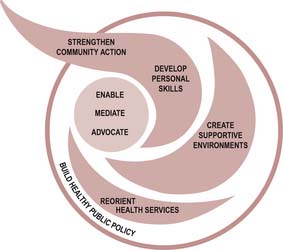
The Ottawa Charter for Health Promotion (World Health Organization 1986) remains one of the most influential policy documents in the history of health promotion. It established the fundamental guiding principles and values of health promotion and described five key action areas:
Each of these areas is the focus of a chapter in Part 2 and Part 3 focuses on supportive environments for health. Together these five areas encompass the goals of health promotion: to go ‘ upstream ’ and have an impact on the socioeconomic and environmental determinants of health; to focus on population health; to emphasise prevention rather than treatment; and to build capacity in communities and individuals. Whilst social and physical determinants of health were highlighted in the Ottawa Charter, the global, environmental and economic contexts were relatively invisible. This reflects the reality of the 1980s, when such issues were not on the agenda (Hills & McQueen 2007). However many of these issues can be addressed using the strategies outlined in the Ottawa Charter.
Improving the health of the population depends on many factors. Amongst the most important are:
These principles, and the values they encompass, underpin the Ottawa strategies. Tackling socio-economic inequalities in health promotes equity and moves upstream, from a focus on blaming individuals to tackling the policies that shape environments.
The Ottawa Charter called for support for personal and social development through providing information, educating about health and enhancing life skills. By so doing, health promotion increases the options available to people to exercise more control over their own health and over their environments, and to make choices conducive to health. Individual skills therefore include not just knowledge about health issues, but also practical life skills such as negotiation, setting realistic and achievable targets and building self-esteem, all of which have an impact on the ability to make lasting behavioural changes.
Although not specifically flagged up in the Ottawa Charter, using the media is a core health promotion strategy and one that may be put to many different uses. Media coverage may be sought to promote individual lifestyle campaigns, to lobby for policy change or to highlight the importance of socioeconomic determinants of health. Using the media therefore contributes to all the other strategies and is the subject of Chapter 12.
Community development is one of the most fundamental strategies that informed the development of the concept and principles of health promotion, and featured as a strategy in the Ottawa Charter. It was conceived as a process that draws on existing human and material resources in the community to enhance self-help and social support, and to develop flexible systems for strengthening public participation in, and direction of, health matters. A focus on communities provides a route to tackle the social determinants of health through, for example, improving access to education, employment and housing. Strengthening communities is therefore a key strategy in moving upstream. The theoretical and policy base for community action has been informed more recently by research into community capacity building, and concepts such as social capital.
Building healthy public policy remains a key strategy for health promotion, and one that is currently being used in relation to an expanding number of issues, e.g. smoking bans, healthy transport systems and food labelling. It combines diverse but complementary approaches, including legislation, fis-cal measures, taxation and organizational change. It requires an interventionist role by government, advocacy by practitioners and co-ordinated and joint action by different sectors. Globalization presents new challenges for international action.
Reorienting the health services, from treatment towards prevention, is the subject of Chapter 8. In some respects, this strategy has proved most taxing and impervious to change. There is always a demand that exceeds supply for health services, so trying to shift services away from immediate treatment to long-term prevention is extremely difficult. Treatment is high-profile, media-friendly and politically popular. Prevention is low-profile and its long timescale for effects to be evident makes it politically unpopular.
Creating supportive environments is the subject of Part 3, where different environments are discussed in separate chapters.
The Ottawa Charter stated that all of these actions would be required to promote health and illustrated this in a spiral image (Figure 1). At the heart are the skills of enablement, mediation and advocacy. Increasingly health promotion activities are conducted in combination in a comprehensive approach using a mix of such strategies and at multilevel (national, regional, community) action.