Chapter 28 Labelling of dispensed medicines
All dispensed medicines should be individually labelled by the dispenser. The label on a dispensed medicine has several main functions:
In the UK there are both legal (UK and EU) and professional requirements which must be complied with when labelling a dispensed medicine. It is the pharmacist’s responsibility to ensure that these requirements are satisfied and that all labelling is accurate and comprehensible. The regulations indicate standard details which must appear on every label. In certain circumstances additional details are also required. Useful sources of information are Medicines, Ethics and Practice and the British National Formulary (BNF). In this chapter only the requirements for the labelling of dispensed medicines in the UK are dealt with. However, similar requirements will be in place in other countries. It should also be noted that provision of an adequate label does not remove the need to give advice and counselling to the patient (see Ch. 44).
All labels must be in printed form, either typewritten or computer generated. This should mean that the information on the label is legible; however, there have been reports of labels which were unreadable because the printer was not working properly or the ink or toner cartridges were low or empty. Hence there is a need for pharmacists or dispensers to check each label for legibility before handing the item to the patient. It is also important that the font size of the print is suitable for the patient (see later).
In summary, the details which must appear on the label of a dispensed medicine are:
The name which appears on the label must be the same as the one which appears on the prescription. The preparation may be prescribed generically but only be available as a proprietary or branded product; however, the prescribed name must be used. The reason for this is to avoid the patient becoming confused with a variety of names.
The letters NP on a prescription stand for ‘nomen proprium’ – the proper name of the medicine. Occasionally a prescriber may not wish the name of the preparation to appear on the container. To indicate this they will delete the NP instruction on the prescription. In these cases the type of medicine (e.g. ‘the tablets’, ‘the mixture’) should replace the name of the product.
Another occasion when the name may be omitted is when the product contains several active ingredients and has no official or proprietary name and it would be extremely difficult to list all the ingredients on the label. In these instances the pharmaceutical form is used, e.g. ‘the ointment’, ‘the mixture’.
If the preparation is available in more than one strength, the strength must be included on the label, for example, amoxicillin 250 mg capsules and amoxicillin 500 mg capsules. Such information clearly identifies the medicine.
Similarly, the form of the medicines should be included on the label. This is especially important if the product is available in more than one form (e.g. amoxicillin capsules, syrup, suspension, sachets, injection). The inclusion of the form identifies the medicine and may give an indication of how it is to be used/taken (e.g. forms such as suppositories, inhalations, enemas).
Normally the quantity which appears on the label will be the quantity which has been prescribed. Nowadays, many medicines are supplied in the manufacturer’s patient packs, which will be labelled according to the legal requirements. If the quantity on the prescription requires more than one of these patient packs to be dispensed, for example two patient packs each containing 28 tablets of the same medicinal product (a total of 56 tablets), then the quantity on the label should be the amount in each container. In other words each container should be labelled.
Where several containers (manufacturer’s patient packs) of the same medicinal product are required to supply the quantity stated on the prescription (multiple packs), then the name of the product, directions for use and precautions relating to the use of the product need only appear on the package containing the individual packs or on one of the individual packs. All the individual packs must be labelled with the name of the patient, the name and address of the pharmacy, the date of dispensing and the words ‘keep out of the reach of children’.
No patient should leave a pharmacy without knowing how much, how often and how to use/take his or her medication. Although the label should be seen as a back-up to the verbal counselling and advice given by the pharmacist, it is still essential to ensure that the wording on the label is clear, concise and comprehensible to the patient. The prescriber’s instructions should therefore be translated into an appropriate form. If instructions are missing or incomplete it is the pharmacist’s professional duty to obtain instructions from the prescriber or use professional discretion to interpret BNF statements.
The way in which instructions are worded is very important and will greatly influence how easily a patient understands the message. Pharmacists should therefore give serious consideration to the wording on medicine labels.
The Royal Pharmaceutical Society working party report (1990) on ‘The Labelling of Dispensed Medicines’ made several recommendations. The use of active verbs is preferred, e.g. ‘take’ instead of ‘to be taken’, ‘apply’ instead of ‘to be applied’. The reason is that research has shown that active verbs are more easily understood and remembered than passive verbs. It is bad practice to have two numbers appearing together in instructions, e.g. ‘take two three times daily’. It is easy for a patient to mentally transpose the position of the numbers so that the previous instruction becomes ‘three twice daily’ in the patient’s mind. To avoid this, the numbers should always be separated by using the formulation name, e.g. ‘take two tablets’, ‘two capsules’, ‘two powders three times daily’. Other recommendations in the report can be seen in Table 28.1.
Table 28.1 Recommended wording for directions
| Recommended wording | Wording to be replaced |
| Do not swallow | Not to be taken |
| Take ‘x’ times a day, spaced evenly through the day (This wording was considered preferable for antibiotics) | Take every ‘y’ hours (For analgesics this remains the desirable wording) |
| Put two drops in the affected eye | Instil two drops in the affected eye |
| For creams or ointments: | |
| Spread thinly | Use sparingly |
| For pessaries or suppositories: | |
| Gently put one into the vagina/rectum | Insert one into the vagina/rectum |
Numbers which are part of an instruction must always be written as words except in the case of 5 mL, when referring to a 5 mL spoonful, or oral syringe quantities, e.g. a 2.5 mL dose using the oral syringe provided.
Many manufacturers’ packs of medicines contain a patient information leaflet. These normally give detailed instructions (with illustrations) of how to use a medicine, along with other details about the medicine. Patients should be told to read the patient information leaflet before using the medicine. This is a back-up to the labelling.
Labelling the product with precautions relating to use is for safety reasons. Such labelling will be specific to the product and includes ‘Caution flammable: keep away from fire or flames’ and ‘Not to be consumed by mouth’.
It is a legal requirement that the name of the patient for whom the medication has been prescribed must appear on the label of all dispensed medicines. If possible, the status of the patient, i.e. Mr, Mrs, Miss, Master, Child or Baby, should be included in order to clearly differentiate from other members of a household, where there may be other persons with the same name. For the same reason a full first name should also be included if possible, rather than an initial, e.g. Mr James Burnett instead of J. Burnett.
The majority of pharmacies use computer systems for prescription labelling and this information will normally appear automatically, with the date being re-set daily. This information is a legal requirement, but enables the source of the medicine to be traced and date of dispensing, if necessary. For example, in the case of possible overdose or poisoning, the label would assist any investigation.
In order to prevent accidental ingestion of medicines by children, all dispensed medicines are required to carry the label ‘Keep out of the reach of children’. Any pharmacist in the UK who issues a dispensed medicine without this warning on the label is guilty of contravening the Medicines Act. Nowadays it is recommended that the wording ‘Keep out of the reach and sight of children’ is used for consistency because this wording is used on all labels of manufactured patient packs of medicines.
In addition to the standard details required on all dispensed medicines there are several extra details which are required in certain circumstances. Some information may be specific to a particular type of formulation.
General information for different types of preparation can be found in the relevant chapters in this book. Some formulations require special storage and this information should be attached to the label, e.g. transdermal patches should be stored in a cool place. Other labels relating to storage include ‘protect from light’ and ‘store in a fridge’. Any specific pharmaceutical precautions relating to storage should always be indicated, for example glyceryl trinitrate tablets should be labelled ‘discard after 8 weeks of use’.
The British Pharmacopoeia (and other pharmacopoeias) use the terms ‘freshly prepared’ and ‘recently prepared’ for extemporaneously prepared products with a short keeping time. ‘Freshly prepared’ is defined as having been made no more than 24 hours before issue for use, but there is no indication of when it should be discarded. In this case, it is usual to give a 1 week discard date. The term ‘recently prepared’ is used for products which should be discarded 4 weeks after issue when stored at 15–25°C.
Information on proprietary medicines can be accessed in the Association of British Pharmaceutical Industries (ABPI) Medicines Compendium.
Ideally, any liquid preparation should state ‘Shake the bottle’, and ‘For external use only’ is a legal requirement on external liquid and gel preparations.
Many drugs cause side-effects about which the patient should be informed. Information on these can be found in Appendix 9 of the BNF (BNF no. 56, September 2008; note that the appendix number may be different in later editions). It is a professional requirement, subject to the pharmacist’s discretion, that if indicated, these special warnings should be affixed to the container. Nowadays most computer systems will automatically print these warnings when a label for a particular drug is being produced. However, there are instances when use of this information is inappropriate and professional discretion should be used. For example, the antihistamine chlorphenamine requires the warning: ‘Warning. May cause drowsiness. If affected do not drive or operate machinery. Avoid alcoholic drink’. Young children may be prescribed a drug such as this but this warning would be inappropriate. Obviously it is important to draw attention to the problem of sedation and in this case the more suitable warning ‘Warning. May cause drowsiness’ could be used. If a doctor does not wish the warning labels to appear, the prescription should be endorsed ‘NCL’ (no cautionary labels).
Some of the BNF warning labels have been known to cause confusion, such as numbers 5, 6, 7, 11 and 14. All of these may require additional explanation to be given to the patient.
It is useful to give the patient an indication of the colour, e.g. phenolphthalein (pink), levodopa (dark reddish) or rifampicin (red).
When a product has been prepared extemporaneously it is good practice to award it a batch number and incorporate this onto the label. This is standard practice in hospital pharmacy. When preparing an extemporaneous product, details of the ingredients used should be recorded (see Ch. 25). The batch number allows referral back to this information.
It is not normally necessary to put an expiry date on the label of a dispensed medicine, although with the increasing dispensing of manufacturers’ original packs this information will be part of the pack labelling. Manufacturers’ expiry dates relate to ideal storage conditions but, unfortunately, when a product has been dispensed and given to the patient there is no longer any control over how it is stored. For this reason, under current legislation, when a product is repackaged for dispensing, no expiry date is stated. Patients should be encouraged to complete the course of medication or, if for any reason a supply is not finished and is no longer required, to bring any remainder back to the pharmacy.
There are, however, specific occasions when an expiry date must be added to the label.
Although the majority of patients will understand what ‘expiry date’ means, it is important to express the information in a clear and unambiguous way. ‘Any unused to be discarded on … (date)’ or ‘Do not use after … (date)’ are preferred methods of expressing expiry dates.
The words ‘For animal use only’ or similar must always be added to the label of a dispensed veterinary product. Instead of the patient’s name, the name of the animal’s owner should appear, along with the owner’s address or address where the animal lives.
When a preparation is dispensed using the emergency supply procedures, the words ‘Emergency supply’ must appear on the label.
A label for a medicine dispensed from a private prescription must bear a reference number. This reference number will relate to the entry in the private prescription register and will also be endorsed on the private prescription.
Some patients may have difficulty in reading the normal print size of a label due to partial or complete blindness. In such cases consideration should be given to providing additional support to these patients, in the form of large print size on labels or the provision of large print size copies of the labels. In all cases the medicinal products should be labelled. Additionally, consideration should be given to providing Braille labels for those patients able to read Braille.
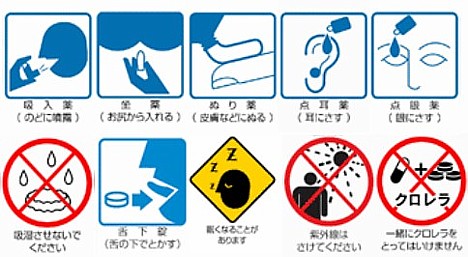
Some patients may not be able to read the language on the label due to either illiteracy or being a non-native language reader. It may be possible to provide such a patient with a picture or series of pictures to illustrate the instructions. Many pictograms (a symbol representing a concept, object, activity, place or event by an illustration) have been developed for labelling medicines with instructions on how often and how to take medicines. Similarly many toxic chemicals are labelled with pictograms to avoid harm to the public. The Risk-benefit Assessment of Drugs-Analysis and Response (RAD-AR) Council of Japan has recently released a series of new pictograms for use on pharmaceutical packaging. These may be viewed on www.pinktentacle.com/images/pictograms.jpg.
Clearly any patient with difficulty reading or understanding a label on a dispensed medicine should be given advice and counselling by the pharmacist before leaving the pharmacy.
The potential for making errors when producing a label is considerable and it is important that constant checking is carried out. Practice procedures should be such that the chances of errors occurring are minimized (see Ch. 24). Dispensing is usually carried out in a busy environment with many distractions and it takes considerable effort to maintain the 100% concentration required to ensure that errors do not occur.
Apart from errors in interpreting prescribers’ instructions or missing off any of the details already mentioned, the advent of computerized labelling has brought its own problems, two of which will be mentioned.
When using a computer system, if a patient presents a prescription for several items, the patient’s name is typed in once and the number of items to be dispensed bearing that patient’s name is entered. Occasionally an item may not be dispensed or the number of items may be entered incorrectly. This means that when the next prescription for a different patient is to be dispensed, the name of the first patient will occur on the label even if all the other information is correct.
It is not uncommon that two labels have been produced on the pharmacy computer and two medicines have been prepared. At this point the labels could be applied to the incorrect container unless care is taken.
An awareness of how easily these errors can occur is at least one step to ensuring that they do not happen.
The name of the patient was Mrs Marjory Nicol. Comment on the accuracy of the following labels produced for this prescription. (Assume that the name and address of the pharmacy and ‘Keep out of the reach and sight of children’ are included.)