Blockage of the Fallopian Tubes
Introduction
Very fine muscular tubes, called the fallopian tubes, are responsible for transporting the egg (and embryo) from the ovary to the uterus. It is blockage in this passage which is the cause of one-third of cases of female infertility.
Can Chinese Medicine Treat Fallopian Tube Blockage?
Once a disease has changed or damaged the tissue of the fallopian tube, then acupuncture and herbal medicine can offer limited therapeutic benefit. Western medicine, similarly, offers little to reverse such damage but often has ways of removing or side-stepping the problem. From the point of view of the TCM doctor, blockage of the fallopian tubes is a much more difficult cause of infertility to cure than functional causes. However, from the Western specialist’s point of view, this sort of infertility, in the absence of any other complicating factors, is one of the easiest and most satisfying to treat, whether by microsurgery, which removes the damaged portion of the tube, or more commonly by in vitro fertilization (IVF) techniques which circumnavigate the tubes altogether.
Where the structure of the tube is not damaged but its function is impaired, then treatment with Chinese medicine can expect a good outcome.
In determining just how much help a TCM doctor can offer to a woman suffering from infertility due to tubal blockage, we need to know just how much damage has been done and what it is that is causing the obstruction.
Diagnosis of Tubal Blockage
There is no way to test the patency of the tubes other than with rather invasive procedures. A tubal blockage is itself asymptomatic, although a history of pelvic infection will raise suspicion of tubal disease.
A hysterosalpingo-contrast-sonography (HyCoSy) is the preferred technique for investigation of Fallopian tube patency. It is a dynamic ultrasound of the uterus and tubes taken while a solution of galactose and 1% palmitic acid (Levovist) – or a mixture of air and saline – is infused into the uterine cavity and observed as it moves through the Fallopian tubes. The bright echoes generated by the solution and the use of color Doppler imaging allow clear visualization of the tubes and their function. The procedure is performed in the first 10 days of the menstrual cycle and after the period has finished. The HyCoSy also allows examination of the other pelvic organs including the ovaries.
A hysterosalpingogram (HSG) is an X-ray of the inside of the uterus and tubes, which is achieved by injection of an X-ray opaque medium through the cervix. This dye is forced into the uterus and tubes under pressure until it spills into the pelvic cavity if the tubes are patent.
A degree of discomfort is often experienced by the woman having either the HyCoSy or the HSG. Period pain medication taken before the procedure can lessen the cramps.
The pressure of the fluid passing through the tubes may have the therapeutic function of clearing some tubal obstructions (such as those caused by muscle spasm or mucus secretions).
A laparoscopy is a surgical procedure by which a surgeon can see directly into the pelvic cavity by means of a small fiberoptic tube passed down a catheter. The health of the fallopian tubes from the outside can be seen and their patency tested by passing a colored dye up through the cervix and watching for its appearance at the far end of the tube. The patient does not experience the immediate discomfort of the HSG but there will be postoperative discomfort and the after-effects of general anesthesia.
The Structure of the Fallopian Tubes
Each fallopian tube is a thin, fragile tube about 10 cm long (Fig. 6.1). At the end near the ovaries, it fans out like a hand with fingers (the fimbriae) to catch the egg as it is released from the ovary. The section of tube attached to the fimbria is called the ‘ampulla’ and is wide and thin-walled. The section of the tube attached to the uterus is called the ‘isthmus’ and is much narrower and has thicker, more muscular walls. Inside the tube are secretory cells, which produce substances essential for the survival of the egg and the embryo. Also lining the inside of the tube are ciliated cells, so-called for their hair-like projections which push the egg down the tube toward the isthmus with waving motions.
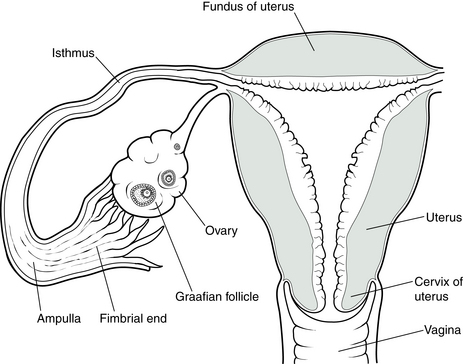
The point where the ampulla meets the narrow isthmus is where the egg waits to meet its sperm, and then where the pre-embryo, if fertilization has occurred, waits to go through its first few cell divisions. The rising levels of progesterone produced by the corpus luteum clear the secretions and relax the muscles in the isthmus to allow the pre-embryo through to the uterus. Although we do not yet know all the secrets of the tube and its relationship with the new embryo, presumably there are special conditions and nutrients provided by the cells lining the tube that are important for the fertilized egg as it completes its first few cell divisions. Two or three days later it will be launched into the uterine cavity to find its nesting spot.
Damage to the Structure of the Tube
Fallopian tubes sustain damage most frequently through infection and inflammation. Chlamydia is one of the most common causes of tubal infection. About 40% of untreated chlamydia infections cause pelvic inflammatory disease (PID), and about 20% of such infected women become infertile. Gonorrhea is the second most common sexually transmitted disease after chlamydia in developed nations, and it also causes PID and consequent infertility. Tuberculosis and yeast infections can also damage the tubes. Intrauterine devices or IUDs have a now infamous history of causing infection, although the subsequent damage is usually isolated to one tube.
If antibiotic therapy is instituted quickly, some of these infections can be controlled in time to prevent damage to the tubes. However, if the infection produces few clinical symptoms and therefore escapes treatment, it often becomes chronic. This leads to chronic salpingitis (chronic inflammation of the tube). In this case, scarring occurs along the inner walls, disrupting the natural function of the cells lining the tube and most often blocking its passage too.
If the blockage occurs near the fimbrial end, the tube can become distended with fluid secretions which cannot escape either from the blocked end or from the isthmus end near the uterus. This creates a hydrosalpinx. In the luteal phase, increasing levels of progesterone relax and clear the isthmus and the fluid is released. The fluid that is released from the hydrosalpinx will flood the uterus and pass out through the vagina, experienced as a watery discharge by the patient. If there has been a conception and an embryo has arrived in the uterus via the other tube (if it is not blocked) or via an IVF transfer procedure, then it is in critical danger of being washed out by this fluid. Therefore, tubes that form hydrosalpinges are usually removed or clipped before IVF procedures.
Microsurgery offers a good treatment option if the tubes are not damaged along too much of their length. If the blockage is in the isthmus near the uterus, then microsurgery is more effective and post-surgery pregnancy rates up to 70% have been reported.1 If there is extensive damage to the tubes, however, IVF becomes the only option. IVF was developed for exactly these conditions and still obtains its best results in young women who are infertile due to blocked tubes.
Treatment with Chinese Medicine for Early-Stage Structural Blockages
TCM works best if the structure of tissues and organs has not been too damaged by a disease process. In the case of pelvic infections, this means acting as soon as infection is suspected, i.e., giving herbs and antibiotics. In a developing country such as China, where advanced microsurgery techniques or IVF procedures may not be so readily available or affordable for many women, some attempt has been made to develop ways of breaking down blockages in the tubes. The best results are obtained when herbs are administered per rectum in addition to oral administration, and, although clinical research in China is not as scientifically rigorous as in the West, there are a number of reports in their medical literature which indicate encouraging possibilities. Six clinical trials examining fallopian tube blockage are described, which include not only herbs to be swallowed but also herbs used as retention enemas and herbs applied to the abdomen. One paper claims a 72% conception rate in 50 women after 3–6 months treatment; another paper reports a 70% conception rate in 150 women after a year of treatment and a third paper reports a 55% conception rate after 6 months.2 Until the research is carried out in a regulatory monitored environment, the results should not be accepted uncritically.
Diagnosis
Diagnosis of fallopian tube blockage is based on an understanding of the origins of the disease and the presenting signs and symptoms. Using modern technology is a helpful first step – first, to confirm the blockage itself; then, to determine its extent and site. Prognosis can be helped with this information, e.g.: whether the blockage is an absolute one or one which can be forced open with pressure; whether the tube is extensively damaged and stiff and sclerosed along its length or just in one site; and whether the site of obstruction is near the ovary or the uterus. TCM specialists claim better success with treatment of blockages near the fimbrial end, whereas microsurgeons can treat blockages at the uterus end more effectively.
TCM describes tubal blockage – as it does for any physical tissue damage or obstruction – as Blood stagnation, but in varying degrees and with various complications.
The Blood stagnation in this case can arise from:
and is classified as mild (the Blood is retarded) through severe (there is complete Blood stasis).
Blood Stagnation Due to Invasion by Cold
Invasion by Cold of the uterus occurs at times when the uterus is open or vulnerable, i.e. during the period, just after delivery of a baby or after a miscarriage or abortion. Cold is said to congeal the Blood such that its movement is inhibited and local circulation quickly becomes inefficient. Thus, Cold reaching the tubes affects their function and contributes to infertility. There may be a feeling of cold in the abdomen and any period pain or ovulation pain will respond well to warmth. The pulse will be retarded and tight if there is pain, otherwise thready. The tongue may be unaffected if the Cold invasion is recent, or it may be purplish if stagnation has become entrenched.
Herbal formula: If the obstruction of the tube is partial or caused by spasms or contractions, then use of the well-known formula Shao Fu Zhu Yu Tang to warm the lower abdomen and resolve Blood stagnation will be effective.
Shao Fu Zhu Yu Tang (Lower Abdomen Eliminating Stasis decoction)
| Dang Gui | 9 g | Radix Angelicae Sinensis |
| Chuan Xiong | 6 g | Radix Ligustici Wallichii |
| Chi Shao | 9 g | Radix Paeoniae Rubra |
| Xiao Hui Xiang | 6 g | Fructus Foeniculi Vulgaris |
| Yan Hu Suo | 6 g | Rhizoma Corydalis Yanhusuo |
| Wu Ling Zhi | 6 g | Excrementum Trogopterori |
| Pu Huang | 9 g | Pollen Typhae |
| Mo Yao | 6 g | Myrrha |
| Rou Gui | 6 g | Cortex Cinnamomi Cassiae |
| Gan Jiang | 6 g | Rhizoma Zingiberis Officinalis |
The addition of warming medicinals (Xiao Hui Xiang, Rou Gui, and Gan Jiang) to a collection of Blood-regulating herbs (Dang Gui, Chuan Xiong, Chi Shao, Yan Hu Suo and Mo Yao) encourages movement of Blood which has been retarded by Cold. Wu Ling Zhi and Pu Huang in combination dissolve any Blood which has congealed and clotted due to the Cold.
If the blockage is complete, add to the decoction 1.5 g of a powder made from grinding:
| Wu Gong | 1 or 2 pieces | Scolopendra Subspinipes |
| Quan Xie | 6 g | Buthus Martensi |
Acupuncture points: Points (Table 6.1) used in the treatment are:
Table 6.1
Acupuncture pointsa used in the treatment of tubal blockage from Blood stagnation and Cold
| Treatment goal | Acupuncture points |
| To regulate and move Qi and Cold and/or masses in the abdomen | Choose from KI-14, Ren-4, ST-29, ST-28, SP-13 |
| To regulate Qi and Blood in the lateral abdomen | SP-6 and LIV-5 |
aUse even or reducing method and use moxa on the abdomen points.
| KI-14 | Siman |
| Ren-4 | Guanyuan |
| ST-29 | Guilai |
| ST-28 | Shuidao |
| SP-13 | Fushe |
| LIV-5 | Ligou |
| SP-6 | Sanyinjiao |
Blood Stagnation Due to Invasion by Heat
Invasion by Heat to the Uterus causes inflammation and bleeding and eventually Blood stagnation. Endometritis and some forms of acute infection fall into this category. There may be burning pain in the abdomen, thirst and irritability and frequent heavy periods or functional uterine bleeding.
Herbal formula: Combining some herbs from a Blood stagnation formula (Ge Xia Zhu Yu Tang) with one to clear Heat (Dan Zhi Xiao Yao San), addresses the inflammation and the tube obstruction. Antibiotics may also be required in this case.
Ge Xia Zhu Yu Tang plus Dan Zhi Xiao Yao San (Eliminating Stasis below the Diaphragm decoction plus Moutan Gardenia Free and Easy powder)
| Dang Gui | 9 g | Radix Angelicae Sinensis |
| Chuan Xiong | 9 g | Radix Ligustici Wallichii |
| Tao Ren | 9 g | Semen Persicae |
| Hong Hua | 9 g | Flos Carthami Tinctorii |
| Wu Ling Zhi | 9 g | Excrementum Trogopterori |
| Wu Yao | 9 g | Radix Linderae Strychnifoliae |
| Yan Hu Suo | 6 g | Rhizoma Corydalis Yanhusuo |
| Zhi Zi | 6 g | Fructus Gardeniae Jasminoidis |
| Chi Shao | 9 g | Radix Paeoniae Rubra |
| Mu Dan Pi | 9 g | Cortex Moutan Radicis |
| Xiang Fu | 6 g | Rhizoma Cyperi Rotundi |
| Zhi Ke | 6 g | Fructus Citri seu Ponciri |
| Fu Ling | 12 g | Sclerotium Poriae Cocos |
| Bo He | 3 g | Herba Menthae |
| Gan Cao (zhi) | 3 g | Radix Glycyrrhizae Uralensis |
This formula combines herbs to dispel Blood stasis (Dang Gui, Chuan Xiong, Tao Ren, Hong Hua, Wu Ling Zhi, Yan Hu Suo) with herbs to clear Heat (Chi Shao, Mu Dan Pi, Zhi Zi, Bo He) and regulate the Qi (Xiang Fu, Zhi Ke, Wu Yao). Fu Ling helps clear any Damp that might become associated with the Heat and create chronic pelvic disease. Chai Hu is removed from Dan Zhi Xiao Yao San in this combination because of its lifting effect on the herbs; this formula needs to be active in the lower Jiao.
Acupuncture points: Points (Table 6.2) used in the treatment are:
Table 6.2
Acupuncture pointsa used in the treatment of tubal blockage from Blood stagnation and Heat
| Treatment goal | Acupuncture points |
| To clear Heat in the Blood and regulate Qi | LIV-2 |
| To clear Heat in the Blood to stop bleeding and regulate Qi in the lower Jiao | LIV-1 |
| To cool and regulate Blood and dispel stagnation | SP-10 |
| To regulate Blood in the Chong and Ren vessels, clear Heat from the Blood and stop bleeding | KI-8 and KI-13 |
| LIV-2 | Xingjian |
| LIV-1 | Dadun |
| SP-10 | Xuehai |
| KI-8 | Jiaoxin |
| KI-13 | Qixue |
Blood Stagnation Due to Accumulation of Damp-Heat
This type of tubal obstruction is associated with pelvic infection which will usually require antibiotic treatment. If any infection or inflammation persists after antibiotic treatment (i.e., chronic PID develops), then further effort is required to clear Heat and Damp and resolve Blood stasis.
Herbal formula: Use the following formula:
Fu Fang Hong Teng Jian (Sargentodoxae Compound decoction)
| Hong Teng | 30 g | Caulis Sargentodoxae |
| Bai Jiang Cao | 30 g | Herba cum Radice Patriniae |
| Pu Gong Yin | 15 g | Herba Taraxaci Mongolici |
| Zi Hua Di Ding | 15 g | Herba Viola cum Radice |
| Ru Xiang | 6 g | Gummi Olibanum |
| Mo Yao | 6 g | Myrrha |
| Mu Xiang | 6 g | Radix Saussureae seu Vladimiriae |
| Dang Gui | 9 g | Radix Angelicae Sinensis |
| Chi Shao | 9 g | Radix Paeoniae Rubra |
| Wu Ling Zhi | 9 g | Excrementum Trogopterori |
| Yi Yi Ren | 30 g | Semen Coicis Lachryma-jobi |
Hong Teng, Bai Jiang Cao, Pu Gong Yin and Zi Hua Di Ding are all used in large doses to clear Heat and pus. Ru Xiang and Mo Yao and Wu Ling Zhi break up Blood stasis and aid in getting the above detoxifying medicinals to the necessary sites in and around the tubes. Dang Gui and Chi Shao also help circulate Blood and Yi Yi Ren dispels Damp. The addition of Mu Xiang ensures movement of Qi in the abdomen and relieves abdomen pain.
Acupuncture points: Points (Table 6.3) used in the treatment are:
Table 6.3
Acupuncture pointsa used in the treatment of tubal blockage from Blood stagnation and Damp-Heat
| Treatment goal | Acupuncture points |
| To clear Damp-Heat and Blood stagnation in the lower Jiao | LIV-5 and LIV-8 |
| To clear Damp-Heat | KI-7, GB-26 and ST-40 |
| To regulate Qi and Blood in the tubes | SP-12 |
| LIV-8 | Ququan |
| LIV-5 | Ligou |
| KI-7 | Fuliu |
| GB-26 | Daimai |
| ST-40 | Fenglong |
| SP-12 | Chongmen |
Blood Stagnation Due to Accumulation of Cold-Damp
Obstruction by Cold-Damp manifests as edema of the tube, thick mucus secretions or some adhesions of tubes to the ovary or other organs. Only this latter case (adhesions) represents structural blockage. Blockage caused by mucus or edema will be discussed in the next section on functional blockages.
Herbal formula: If adhesions of the tube are associated with Cold-Damp, Gui Zhi Fu Ling Tang is an appropriate guiding formula.
Gui Zhi Fu Ling Tang (Ramulus Cinnamomi – Poria Decoction)
| Gui Zhi | 9 g | Ramulus Cinnamomi Cassiae |
| Fu Ling | 9 g | Sclerotium Poriae Cocos |
| Mu Dan Pi | 9 g | Cortex Moutan Radicis |
| Tao Ren | 9 g | Semen Persicae |
| Chi Shao | 9 g | Radix Paeoniae Rubra |
This is a famous formula that combines the warming function of Gui Zhi with the Damp-clearing function of Fu Ling to dispel Cold-Damp and allow Blood-regulating herbs like Tao Ren, Chi Shao and Mu Dan Pi to penetrate masses in the lower Jiao.
Acupuncture points: Points (Table 6.4) used in the treatment are:
Table 6.4
Acupuncture pointsa used in the treatment of tubal blockage from Blood stagnation and Cold-Damp
| Treatment goal | Acupuncture points |
| To clear Damp in lower Jiao | GB-26 and SP-9 |
| To move fluid and Qi in the tubes | ST-28 |
| To clear Damp and Blood stagnation in the lower Jiao | SP-6 |
| To move mucus from the tubes and clear Blood stagnation | KI-5 |
aUse even or reducing method, depending on the nature of the obstruction. Moxa is applicable but used with caution, or avoided, if thick mucus is thought to be blocking the tubes.
| GB-26 | Daimai |
| ST-28 | Shuidao |
| SP-9 | Yinlingquan |
| SP-6 | Sanyinjiao |
| KI-5 | Shuiquan |
Blood Stagnation Due to Retention of Pregnancy Products or Placenta
Retention of pregnancy products or placenta after delivery, miscarriage or an abortion represents an acute clinical situation which will usually be addressed by surgical curettage and antibiotic therapy. Chinese herbs and acupuncture can be used adjunctively if appropriate.
Herbal formula: Combine Ge Xia Zhu Yu Tang with Heat-clearing and detoxifying herbs.
Ge Xia Zhu Yu Tang (Eliminating Stasis below the Diaphragm decoction) modified
| Dang Gui | 9 g | Radix Angelicae Sinensis |
| Chuan Xiong | 6 g | Radix Ligustici Wallichii |
| Tao Ren | 9 g | Semen Persicae |
| Hong Hua | 9 g | Flos Carthami Tinctorii |
| Wu Ling Zhi | 9 g | Excrementum Trogopterori |
| Wu Yao | 6 g | Radix Linderae Strychnifoliae |
| Yan Hu Suo | 6 g | Rhizoma Corydalis Yanhusuo |
| Chi Shao | 6 g | Radix Paeoniae Rubra |
| Mu Dan Pi | 6 g | Cortex Moutan Radicis |
| Chuan Niu Xi | 9 g | Radix Cyathulae |
| Xiang Fu | 9 g | Rhizoma Cyperi Rotundi |
| Zhi Ke | 6 g | Fructus Citri seu Ponciri |
| Zhi Zi | 9 g | Fructus Gardeniae Jasminoidis |
| Hong Teng | 9 g | Caulis Sargentodoxae |
| Gan Cao (zhi) | 3 g | Radix Glycyrrhizae Uralensis |
Ge Xia Zhu Yu Tang is a formula which strongly eliminates stasis below the diaphragm with herbs such as Dang Gui, Chuan Xiong, Tao Ren, Hong Hua, Wu Ling Zhi and Yan Hu Suo to regulate Blood and Wu Yao, Xiang Fu and Zhi Ke to regulate Qi. Mu Dan Pi and Chi Shao clear any Heat from the Blood. Added to this formula are Chuan Niu Xi to make descending action more pronounced and encourage expulsion of retained products, and Zhi Zi and Hong Teng to clear Heat and prevent sepsis. Gan Cao (zhi) is added to moderate and harmonize the strong actions of these herbs.
Acupuncture points: Points (Table 6.5) used in the treatment are:
Table 6.5
Acupuncture pointsa used in the treatment of tubal blockage from retained products and Blood stagnation
| Treatment goal | Acupuncture points |
| To treat stagnation in the Uterus | SP-8 and ST-29 |
| To regulate Qi and Blood in the Uterus | SP-6 |
| To encourage the Uterus to expel its contents in conjunction with SP-6 | CO-4 |
aAll points will be reduced. If large clots are passed and abdomen pain and fever resolve, reinforcing treatments can be applied.
| SP-6 | Sanyinjiao |
| SP-8 | Diji |
| ST-29 | Guilai |
| CO-4 | Hegu |
Blood Stagnation Due to Stagnation of Liver Qi
Stagnation of Liver Qi due to emotional stress can cause spasm and tension in the muscles of the fallopian tubes, causing a functional blockage (discussed below). If the Qi stagnation continues long term, then it can develop into Blood stagnation, i.e., the tubes may become blocked or stiff and sclerosed, effectively making them useless in their function of egg or embryo transport. Liver Qi stagnation also increases the severity of menstrual cramps. When the uterus contracts strongly during a period, it is more likely that some menstrual blood will be forced up into the fallopian tubes. If this happens repeatedly over a long time and the blood is not removed, then Blood stagnation in the tubes may develop.
Herbal formula: Use as a guiding formula:
Chai Hu Tong Liu Ying (Bupleurum Free Lodged Phlegm formula)
| Chai Hu | 12 g | Radix Bupleuri |
| Dang Gui | 9 g | Radix Angelicae Sinensis |
| Chi Shao | 9 g | Radix Paeoniae Rubra |
| Yu Jin | 9 g | Tuber Curcumae |
| Su Mu | 6 g | Lignum Sappan |
| Si Gua Luo | 9 g | Vascularis Luffae, Fasciculus |
| Ju He | 3 g | Semen Citri Reticulatae |
Chai Hu and Yu Jin regulate Liver Qi to move stagnant Qi and Blood. Dang Gui and Chi Shao regulate the Blood. Si Gua Luo is used in this context to clear channels (specifically the tubes) and Su Mu to remove obstructions from the tubes; additionally, this herb appears to have strong antibiotic activity in in-vitro tests. Ju He are the seeds of the tangerine from which Chen Pi is made. They help to break up and reduce Qi accumulation and congealed Blood obstructions.
Acupuncture points: Points (Table 6.6) used in the treatment are:
Table 6.6
Acupuncture pointsa used in the treatment of tubal blockage from Liver Qi and Blood stagnation
| Treatment goal | Acupuncture points |
| To regulate Qi in the lateral abdomen and the tubes | LIV-3, LIV-4 or LIV-5 |
| To calm the mind and regulate Liver Qi and Blood | PC-7 and PC-5 |
| To regulate Qi and clear stagnant Blood from the tubes | SP-13 or SP-12 |
aUse reducing or even method, depending on the nature and severity of the obstruction.
| LIV-3 | Taichong |
| LIV-4 | Zhongfeng |
| LIV-5 | Ligou |
| PC-7 | Daling |
| PC-5 | Jianshi |
| SP-13 | Fushe |
| SP-12 | Chongmen |
Functional Blockages
Whereas a structural blockage presents an absolute barrier for passage of the sperm to the egg, a functional tubal blockage may obstruct the tube just some of the time. A functional disorder of the tube will usually have the effect of stopping a fertilized egg from reaching the uterus or preventing the embryo from reaching the uterus at the right time. It can also prevent the sperm reaching the egg.
Functional tubal disorders that affect the passage of the embryo include the following.
Spasm or Stiffness of the Muscles of the Tube Walls: We know that general muscle tension or stress can close the fallopian tubes, because an HSG (which can be a stressful procedure for some women) can sometimes indicate completely closed tubes which, when examined again during a laparoscopy and general anesthetic, prove to be perfectly patent. Women who have been trying to become pregnant for a long time understandably feel some level of stress when attempting to make love at that all crucial time, midcycle, and it is easy to see how tension held in the body and especially in the pelvis might translate into tight or rigid tubes.
In TCM terms, it is when the Qi does not move freely and smoothly that spasms and tension can affect the muscles. When it is the Liver Qi that does not move freely (as a result of emotional factors), then it is in the organs in the pelvis, especially the reproductive organs, that the obstruction will manifest. The main Liver channel traverses the lateral aspect of the inner abdomen wherein lie the fallopian tubes. Obstruction of Qi in this channel quickly damages function and flexibility of the tubes.
Thus, there may be difficulty in releasing the egg and ovulation pain results, the fimbriae may not be nimble enough to catch and guide the egg into the ampulla, and the tube itself may be too rigid or tight to allow smooth passage of the egg or embryo. Stagnation of the Heart Qi can compromise the flow of Qi in the Bao vessel and also the tubes.
Excess Secretions Blocking the Tubes: During the Yin part of the cycle, when there is plenty of estrogen, the cells lining the tubes will produce ample secretions. These are designed to lubricate the tube and nourish the egg and embryo. In a pathologic situation (Phlegm-Damp accumulation in TCM terms), these secretions may be produced excessively or they may not be able to be mobilized or drained efficiently from the tube, causing congestion and blockage.
Asynchrony at Ovulation: If you remember the intricate sequence of midcycle events described in Chapter 2, you will appreciate why even small disturbances of synchrony in midcycle events – the release of the egg, fertilization, transport in the tube and the beginning of production of progesterone – can upset development and seriously compromise the future of the embryo right from the outset. The embryo needs to arrive at the uterus at the right point in its development and that of the uterine lining for effective implantation.
If the embryo tarries too long at the isthmus, its stage of development when it reaches the uterus may be inappropriate for implantation. This occurs if the secretions at this part of the tube remain too thick to allow the embryo’s passage, a situation that may arise if the progesterone levels grow too slowly. In TCM terms, it is the Kidney Yang function that influences the production of progesterone. If corpus luteum activity is sluggish, then it is Kidney Yang that needs attention.
The embryo may also experience a slow journey down the tube if the ampullary section is not flexible and the cilia are not moving freely. In TCM terms, this is a manifestation of Qi stagnation. Qi stagnation can also retard the release of the egg from the ovary, which may affect its developmental stage at implantation.
On the other hand, if it travels down the tube too fast, the embryo may arrive in the uterus at a stage of development that is too immature for implantation. This might occur if the follicle is luteinized and producing progesterone but the release of the egg is delayed. The secretions of the isthmus may be thinned and dispersed prematurely, allowing the embryo to pass too quickly.
It is important for the correct development of the new embryo that it grows in synchrony with the Yang of the mother’s cycle.
Treatment with Chinese Medicine for Functional Blockages
Most cases of functional tubal blockage will be dealt with effectively by correct management of the events approaching ovulation, as described in Chapter 4.
To recap, close attention is paid to the Kidney Yang as ovulation is approached. Herbs to activate Kidney Yang are employed just before midcycle to ensure the production of progesterone at the right time.
This prepares the internal environment of the tube and keeps its internal secretions moving. Malfunction of Kidney Yang can quickly lead to disorders of transportation and nourishment of the egg/embryo while it is in the fallopian tube. Secretions can build up and cause blockage. Such Phlegm-Damp accumulation will be addressed by boosting Kidney Yang, reinforcing Spleen Qi and dispelling Damp.
Attention is also paid to the Liver and Heart Qi, especially where there is emotional stress or symptoms such as ovulation pain, irritability, anxiety or midcycle breast soreness. Herbs which address Liver and Heart Qi stagnation are useful, and acupuncture, particularly around the lower abdomen and on the Liver and Pericardium channels, relaxes muscle tension and encourages flexibility of the tubes. Scheduling appointment times for acupuncture around midcycle is important for cases like these.
When the Liver and Heart Qi move smoothly and the Kidney Yang develops appropriately, then the function of the tubes is assured and functional tube blockages will be avoided or resolved. In addition to the treatment protocols outlined in Chapter 4, some of the herbs or points suggested in the previous discussion of structural blockages related to Cold-Damp obstruction and Qi stagnation will be applicable.
Additional Treatments for Structural Blockages
Specialists in China, who may not have recourse to microsurgery and IVF, have developed other ingenious ways of dealing with tubal blockages. Most of these treatments are not appropriate or necessary in the West because we have good surgical alternatives but I include them here for interest and, sometimes, some aspects of these treatments might be included in an overall management plan.
Flushing the Tubes
An injection of liquid through the cervix and up through the tubes is carried out in much the same way as the dye is applied for the HyCoSy or HSG, i.e., it is injected through the cervix under gentle pressure. The liquid can be a sterile saline mix containing antibiotics or, if there is definite evidence of structural damage (Blood stagnation), then a saline-diluted decoction of the formula Fu Fang Dang Gui Zhi Shi Ye (below) is injected through the tubes to activate Blood and resolve stagnation. Such flushing must be done soon after the end of the period, so there is time for any reaction or inflammation the injected herbs might cause to settle down before ovulation. The procedure is done once or twice each cycle. If the obstruction is at the distal end of the tube, such therapy achieves better results than if it is at the uterus end. The flushing works in two ways: first, by forcing a passage through an obstruction which is not absolute; second, if the herbal decoction is used, by the action of the active ingredients in the herbs directly on the tissue. In some clinics in China, this procedure has been made more precise with the use of fine catheters introduced into the fallopian tubes and the delivery of small amounts of the herbs direct to the site of the blockage.
Application of Herbal Medicines Per Rectum
A volume of 100 mL of a decoction of Fu Fang Dang Gui Zhi Shi Ye (above) is introduced per rectum (PR) by enema before going to bed and remains there all night. This is done every second night unless there is abdomen pain, in which case it is done every night. If the blocked tubes are related to pelvic inflammatory disease which is still active, then an enema made from a decoction of Fu Fang Hong Teng Bai Jiang San (see below) may be more effective. The herbs are absorbed through the intestine directly to the inflamed areas. Doctors in China claim much better results with herbal enemas than with oral herbs for such conditions. Pain is controlled more quickly and obstructions resolved more often. Also, herbs which are not so kind to the stomach can be used without concern for damaging the digestion.
Herbal formula: The PR formula of choice is:
Fu Fang Hong Teng Bai Jiang San (Sargentodoxae Patriniae Compound powder)
| Dang Gui | 9 g | Radix Angelicae Sinensis |
| Chi Shao | 9 g | Radix Paeoniae Rubra |
| Bai Shao | 9 g | Radix Paeoniae Lactiflorae |
| Hong Teng | 15 g | Caulis Sargentodoxae |
| Bai Jiang Cao | 15 g | Herba cum Radice Patriniae |
| Mu Xiang | 6 g | Radix Saussureae seu Vladimiriae |
| Yan Hu Suo | 9 g | Rhizoma Corydalis Yanhusuo |
| Chai Hu | 6 g | Radix Bupleuri |
| Chen Pi | 6 g | Pericarpium Citri Reticulate |
| Sang Ji Sheng | 12 g | Ramulus Sangjisheng |
| Shan Zha | 12 g | Fructus Crataegi |
| Yi Yi Ren | 15 g | Semen Coicis Lachryma-jobi |
Dang Gui, Bai Shao and Chi Shao nourish and regulate the Blood. Mu Xiang and Chen Pi regulate the Spleen and Stomach Qi while Chai Hu moves the Liver Qi. Hong Teng and Bai Jiang Cao are herbs used to detoxify and disperse stagnant Blood and reduce inflammation. Yan Hu Suo and Shan Zha also move the Blood. Yi Yi Ren clears Damp. Sang Ji Sheng clears Damp and at the same time supplements Liver and Kidney.
For more Blood-invigorating action, add:
| Mo Yao | 9 g | Myrrha |
| Ru Xiang | 9 g | Gummi Olibanum |
or for badly scarred or obstructed tubes, add herbs which soften and break adhesions:
| Lu Lu Tong | 9 g | Fructus Liquidambaris Taiwaniae |
| Su Mu | 9 g | Lignum Sappan |
Physiotherapy
Deep tissue massage to the abdomen done two or three times before ovulation is also useful, especially where there are adhesions around the tubes or stiffening of the tubes. In China another form of therapy is sometimes applied with electrodes placed over right and left fallopian tubes. The electrodes are wrapped in gauze and soaked in the above herbal decoction before being placed on the abdomen and attached to an electrical source.
Acupuncture
Acupuncture is a useful therapy for some types of tubal obstruction. A general systemic approach aimed at decreasing muscle tension and increasing the movement of Qi helps some forms of functional blockage. Where there is structural damage to the tubes, and surgery or IVF technology is not acceptable, then it is always worth applying acupuncture to the abdomen with deep but cautious needling to mobilize the Blood and Qi locally. Electrical stimulation can be added, especially if there is pain. This sort of acupuncture treatment can be done in conjunction with herbal enema treatment to good effect.
Choose from the following points (and see Table 6.7):
| LIV-5 | Ligou |
| LIV-3 | Taichong |
| LIV-4 | Zhongfeng |
| LIV-8 | Ququan |
| SP-6 | Sanyinjiao |
| SP-8 | Diji |
| KI-14 | Siman |
| ST-29 | Guilai |
| ST-28 | Shuidao |
| SP-12 | Chongmen |
| SP-13 | Fushe |
| Tituo | |
| Abdomen Zigong | |
| BL-18 | Ganshu |
| BL-22 | Sanjiaoshu |
| BL-24 | Qihaishu |
| BL-32 | Cilaio |
| PC-5 | Jianshi |
| CO-4 | Hegu |
Table 6.7
Acupuncture pointsa used in the treatment of functional fallopian tube blockage
| Treatment goal | Acupuncture points |
| To circulate Qi and Blood in the fallopian tubes | LIV-5 |
| Distal points to regulate Qi and Blood in the lower Jiao | LIV-4, LIV-3 or LIV-8 |
| To regulate Qi in the Spleen and Liver channels | SP-6 and SP-8 |
| Local points to regulate Qi | ST-28, ST-29, KI-14 or Abdomen – zigong with moxa if there is Cold obstruction |
| For pain or discomfort in lateral abdomen at midcycle | SP-12, SP-13 or Tituo |
| Back points to assist regulation of Qi in the lower Jiao | BL-22, BL-24 and BL-32 |
| To regulate Liver Qi | BL-18 |
| To balance upper and lower body and calm the mind | PC-5 and CO-4 |
aThe points on the leg will be needled with even technique or with reducing technique if there is pain. Use even technique on the back and the hand points.