Communication Styles
At the end of the chapter, the reader will be able to:
1 Describe the component systems of communication.
2 Discuss influence of gender and culture on professional communication.
3 Identify five communication style factors that influence the nurse-client relationship.
4 Discuss how metacommunication messages may affect client responses.
5 Cite examples of body cues that convey nonverbal messages.
6 Discuss application of research studies for evidence-based clinical practice.
This chapter explores styles of communication that serve as a basis for communications in the nurse-client relationship. Effective communication has been shown to produce better health outcomes, greater client satisfaction, and increased client understanding. Style is defined as the manner in which one communicates. Verbal style includes pitch, tone, and frequency. Nonverbal style includes facial expression, gestures, body posture and movement, eye contact, distance from the other person, and so on. These nonverbal behaviors are clues clients provide to us to help us understand their words. Sharpening our observational skills helps us gather data needed for nursing assessments and interventions. Both the client and the nurse enter their relationship with their own specific style of communication. Some individuals depend on a mostly verbal style to convey their meaning, whereas others rely on nonverbal strategies to send the message. Some communicators emphasize giving information; others have as a priority the conveying of interpersonal sensitivity. Longer nurse-client relationships allow each person to better understand the other person’s communication style.
Basic concepts
Communication is a combination of verbal and nonverbal behaviors integrated for the purpose of sharing information. Within the nurse-client relationship, any exchange of information between two individuals also carries messages about how to interpret the communication.
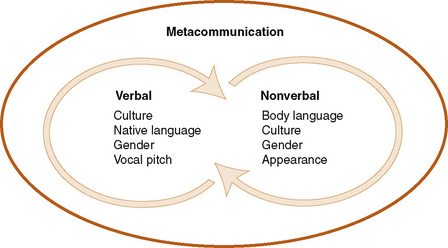
Metacommunication is a broad term used to describe all of the factors that influence how the message is perceived (Figure 9-1). It is a message about how to interpret what is going on. Metacommunicated messages may be hidden within verbalizations or be conveyed as nonverbal gestures and expressions. The following case example should clarify this concept.
In this metacommunicated message about how to interpret meaning, the student nurse used both verbal and nonverbal cues. She conveyed a verbal message of caring to her white, middle-class client by making appropriate, encouraging responses, and a nonverbal message by maintaining direct eye contact, presenting a smooth face without frowning, and using a relaxed, fluid body posture without fidgeting.
In a professional relationship, verbal and nonverbal components of communication are intimately related. A student studying American Sign Language for the deaf was surprised that it was not sufficient merely to make the sign for “smile,” but rather she had to actually show a smile at the same time. This congruence helped convey her message. You can nonverbally communicate your acceptance, interest, and respect for your client.
Verbal communication
Words are symbols used by people to think about ideas and communicate with others. Choice of words is influenced by many factors (e.g., your age, race, socioeconomic group, educational background, and sex) and by the situation in which the communication is taking place.
The interpretation of the meaning of words may vary according to the individual’s background and experiences. It is dangerous to assume that words have the same meaning for all persons who hear them. Language is useful only to the extent that it accurately reflects the experience it is designed to portray. Consider, for example, the difficulty an American has communicating with a person who speaks only Vietnamese, or the dilemma of the young child with a limited vocabulary who is trying to tell you where it hurts. Our voice can be a therapeutic part of treatment.
Meaning
There are two levels of meaning in language: denotation and connotation. Both are affected by one’s culture. Denotation refers to the generalized meaning assigned to a word; connotation points to a more personalized meaning of the word or phrase. For example, most people would agree that a dog is a four-legged creature, domesticated, with a characteristic vocalization referred to as a bark. This would be the denotative, or explicit, meaning of the word. When the word is used in a more personalized way, it reveals the connotative level of meaning. “What a dog” and “His bark is worse than his bite” are phrases some people use to describe personal characteristics of human beings, rather than a four-legged creature. We need to be aware that many communications convey only a part of the intended meaning. Don’t assume that the meaning of a message is the same for the sender and the receiver until mutual understanding is verified. To be sure you are getting your message across, ask for feedback.
Culture
Some people speaking English as a second language say the most difficult aspect is trying to translate the many slang terms and phrases that have double meanings. Extra time is needed when clients are experiencing stress or with clients who speak English as a second language. Use planned spaces of silence, which allows time to understand your meaning and to prepare a response. Verify to make sure that nuances of communication do not get lost.
Culture affects the pitch and tone clients use. For example, the tone of voice used to express anger varies according to culture and family. It may be difficult for you to tell when someone from another culture is angry because their vocalization of strong emotion may be more controlled. By contrast, you might interpret loud conversation with rapid vocalization as conveying anger when it is just a culturally acceptable way to convey emotional intensity. Chapter 11 discusses cultural communication in detail.
Verbal style factors that influence nurse-to-client professional communication
The following six styles of communication are summarized in Table 9-1:
TABLE 9-1
Styles That Influence Professional Communications in Nurse-Client Relationships
| Verbal | Nonverbal |
| Moderates pitch and tone | Allows therapeutic silences |
| Varies vocalizations | Uses congruent nonverbal behaviors |
| Encourages client involvement | Uses facilitative body language |
| Validates client’s worth | Uses touch appropriately |
| Advocate for client as necessary | Proxemics |
| Appropriately provides needed information | Attends to client’s nonverbal cues |
1. Moderate pitch and tone in vocalization. The oral delivery of a verbal message, expressed through tone of voice, inflection, sighing, and so on, is referred to as paralanguage. It is important to understand this component of communication because it affects how the verbal message is likely to be interpreted. For example, you might say, “I would like to hear more about what you are feeling” in a voice that sounds rushed, high-pitched, or harsh. Or you might make this same statement in a soft, unhurried voice that expresses genuine interest. In the first instance, the message is likely to be misinterpreted by the client, despite your good intentions. Your caring intent is more apparent to the client in the second instance. Voice inflection (pitch and tone), loudness, and fast rate either supports or contradicts the content of the verbal message. Ideas may be conveyed merely by emphasizing different portions of your statement (LeFebvre, 2008). When the tone of voice does not fit the words, the message is less easily understood and is less likely to be believed. A message conveyed in a firm, steady tone is more reassuring than one conveyed in a loud, abrasive, or uncertain manner. In contrast, if you speak in a flat, monotone voice when you are upset, as though the matter is of no consequence, you confuse the client, making it difficult for him to respond appropriately.
2. Vary vocalizations. In some cultures, sounds are punctuated, whereas in other cultures, sounds have a lyrical or singsong quality. We need to orient ourselves to the characteristic voice tones associated with other cultures.
3. Encourage client involvement. Professional styles of communication have changed over time. We now partner with our clients in promoting their optimal health. We expect and encourage our clients to assume responsibility for their own health. Consequently, provider-client communication has changed. Paternalistic, “I’ll tell you what to do” styles are no longer acceptable.
4. Validate client’s worth. Styles that convey “caring” send a message of individual worth that sustains the relationship with the client. For example, clients prefer providers who use a “warm” communication style to show caring, give information, and to allow them time to talk about their own feelings.
Confirming responses validate the intrinsic worth of the person. These are responses that affirm the right of the individual to be treated with respect. They also affirm the client’s autonomy (i.e., his or her right, ultimately, to make his or her own decisions). Disconfirming responses, in contrast, disregard the validity of feelings by either ignoring them or by imposing a value judgment. Such responses take the form of changing the topic, offering reassurance without supporting evidence, or presuming to know what a client means without verifying the message with the client. More-experienced nurses use more confirming communication. These communication skills are learned.
5. Advocate for client when necessary. Our personalities affect our style of social communication; some of us are naturally shy. But in our professional relationships, it often becomes necessary that we take on an assertive style of communicating with other health providers or agencies to obtain the best care or services for our client.
6. Provide needed information appropriately. Providing accurate information to our client in a timely manner in understandable amounts is discussed throughout this book. In our social conversations there often is a rhythm: “you talk—I listen,” then “I get to talk, you listen.” However, in professional communications, the content is more goal focused. Self-disclosure from the nurse needs to be limited. Telling a client your problems is not appropriate.
Nonverbal communication
The majority of person-to-person communication is nonverbal. Think of the most interesting lecturer you ever had. Did this person lecture by making eye contact? Using hand gestures? Moving among the students? Learners generally are most interested in lecturers whose nonverbal actions convey enthusiasm. The function of nonverbal communication is to give us cues about what is being communicated. Skilled use of nonverbal communication through (therapeutic) silences, use of congruent nonverbal behaviors, body language, touch, proxemics, and attention to client nonverbal cues such as his facial expression can improve your relationship and build rapport with a client (Kacperek, 1997).

Nonverbal style factors that influence nurse-to-client professional communication
We need to be aware of the position of our nonverbal messages as we talk to our client. Awareness of the position of our hands, the look on our face, and our body movements gives cues to our client (LeFebvre, 2008; Levy-Storms, 2008). It is important to use attending behaviors to convey to the client that his conversation is worth listening to. Think of the last time an interviewer kept fidgeting in his seat, glancing frequently at his wall clock or shuffling papers. How did this make you feel? What nonverbal message was being conveyed? Table 9-1 summarizes the following six nonverbal behaviors of a competent nurse:
1. Allow silences. In our social communications, we often become uncomfortable if conversation lags. There is a tendency to rush in to fill the void. But in our professional nurse-client communication, we use silence therapeutically, as described in Chapter 10, giving our clients needed time to think about things.
2. Use congruent nonverbal behaviors. Nonverbal behavior should be congruent with the message and reinforce it. If you knock on your instructor’s office door to seek help, do you believe her when she says she’d love to talk if you see her grimace and roll her eyes at her secretary? In another example, if you smile while telling your nurse-manager that your assignment is too much to handle, the seriousness of the message is negated.
Try to give nonverbal cues that are congruent with the message you are verbally communicating (Stovis, 2008). When nonverbal cues are incongruent with the verbal information, messages are likely to be misinterpreted. When your verbal message is inconsistent with the nonverbal expression of the message, the nonverbal expressions assume prominence and are generally perceived as more trustworthy than the verbal content.
You need to comment on any incongruences to help your client. For example, when you enter a room to ask Mr. Sala if he is having any postoperative pain, he may say “No,” but he grimaces and clutches his incision. After you comment on the incongruent message, he may admit he is having some discomfort. Can you think of a clinical situation in which you changed the meaning of a verbal message by giving nonverbal “don’t believe what I say” cues?
3. Use facilitative body language. Kinesics is an important component of nonverbal communication. Commonly referred to as body language, it is defined as involving the conscious or unconscious body positioning or actions of the communicator. Words direct the content of a message, whereas emotions accentuate and clarify the meaning of the words. Some nonverbal behaviors such as tilting your head or facing your client promote communication.
• Posture. Leaning forward slightly communicates interest and encourages your client to keep the conversation going. Keep your knees unlocked and body loose, not tight and tense.
• Facial expression. Six common facial expressions (surprise, sadness, anger, happiness/joy, disgust/contempt, and fear) represent global, generalized interpretations of emotions common to all cultures. Facial expression either reinforces or modifies the message the listener hears. The power of the facial expression far outweighs the power of the actual words. So try to maintain an open, friendly expression without being boisterously cheerful. Avoid furrowed forehead or a distracted or bored expression.
• Eye contact. Making direct eye contact with your client generally conveys a positive message. Most clients interpret direct eye contact as an indication of your interest in what they have to say, although there are cultural differences.
• Gestures. Some gestures such affirmative head nodding help facilitate conversation by showing interest and attention. Use of open-handed gestures can also facilitate your nurse-client communication. Avoid folding arms across chest or fidgeting.
4. Touch. Touching a client is one of the most powerful ways you have to communicate nonverbally. Within a professional relationship, affective touch can convey caring and reassurance. In studies, nurses’ touching clients has been reported to be perceived both positively as an expression of caring and negatively as threat (Harding, North, & Perkins, 2008; Inoue, Chapman, & Wynaden, 2006). Care must be taken to abide by the client’s cultural proscriptions about the use of touch. This varies across cultures. An example would be the proscription some Muslim men and Orthodox Jewish men follow against touching women outside of family members. They might be uncomfortable shaking the hand of a female health care provider. In another example, some Native Americans use touch in healing, so that casual touching may be taboo.
All nurses caring directly for clients use touch to assess and to assist. We touch to help our client walk, roll over in bed, and so on. However, just as you are careful about invading the client’s personal space, you are careful about when and where on his body you touch your clients. Gender of the nurse nuances the client’s perception of the meaning of being touched. Harding et al.’s (2008) findings suggest that in our culture, whereas a woman’s touch is seen as a normal expression of caring, we have sexualized male touching. This is a potential problem for male nurses. Therapeutic touch is discussed in Chapter 10.
5. Proxemics. We can use physical space to improve our interactions with clients (Buetow, 2009). Proxemics refers to a client’s perception of what is a proper distance to be maintained between him and others. Use of space communicates messages. You’ve heard the phrase “Get out of my face” used when someone stands too close, often interpreted as an attempt to intimidate.
• Each culture proscribes expectations for appropriate distance depending on the context of the communication. For example, the Nonverbal Expectancy Violations Model defines “proper” social distance for an interpersonal relationship as 1.5 to 4 feet in Western cultures. Americans feel crowded if someone stands closer than 3 feet (Stuart, 2009). The interaction’s purpose determines appropriate space, so that appropriate distance in space for intimate interaction would be zero distance, with increased space needed for personal distance, social distance, and public distance. In almost all cultures, zero distance is shunned except for loving or caring interaction. In giving physical care, nurses enter this “intimate” space. Care needs to be taken when you are at this closer distance, lest the client misinterpret your actions. Violating the client’s sense of space can be interpreted as threatening.
6. Attend to Client’s Nonverbal Body Cues.
• Posture. Often, the emotional component of a message can be indirectly interpreted by observing the client’s body language. Rhythm of movement and body stance may convey a message about the speaker. For example, when a client speaks while directly facing you, this conveys more confidence than if he turns his body away from you at an angle. A slumped, head-down posture and slow movements might give you an impression of lassitude or low self-esteem, whereas his erect posture and decisive movements suggest confidence and self-control. Rapid, diffuse, agitated body movements may indicate anxiety. Forceful body movements may symbolize anger. Bowing his head or seeing him slump his body after receiving bad news conveys his sadness. Can you think of other cues your client’s body posture might give you?
• Facial expression. Facial characteristics such as frowning or smiling add to the verbal message conveyed. Almost instinctively, we use facial expression as a barometer of another person’s feelings, motivations, approachability, and mood. From infancy, we respond to the expressive qualities of another’s face, often without even being aware of it. Therefore, assessing our client’s facial expression together with his other nonverbal cues may reveal vital information that will affect the nurse-client relationship. Observing your client’s facial expressions can signal his feelings. For example, a worried facial expression and lip biting may suggest an anxious client. Absence of a smile in greeting or grimacing may convey a message about how ill the client feels.
• Eye contact. Research suggests that individuals who make direct eye contact while talking or listening create a sense of confidence and credibility, whereas downward glances or averted eyes signal submission, weakness, or shame. In addition to conveying confidence, maintaining direct eye contact communicates honesty (Puetz, 2005). Failure to maintain eye contact, known as gaze aversion, is perceived by adults and children as a nonverbal cue meaning that the person is lying to you. If your client’s eyes wander around during a conversation, you may wonder if he is being honest. Even 6- and 9-year-olds in Einav and Hood’s (2008) study were more likely to attribute lying to those who avert their gaze.
• Gestures. Movements of his extremities may give cues about your client. Making a fist could convey how angry he is, just as use of stabbing, abrupt hand gestures may suggest distress or hugging arms (self-embracing gestures) might suggest fear.
Assessing the extent to which the client uses these nonverbal cues to communicate emotions helps you communicate better. Studies repeatedly show us that failure to acknowledge nonverbal cues is often associated with inefficient communication by the health provider (Mauksch, Dugdale, Dodson, & Epstein, 2008; Uitterhoeve et al., 2008).
It is best if we verify our assessment of the meaning of our client’s nonverbal behaviors. Body cues, although suggestive, are imprecise. When communication is limited by the client’s health state, pay even closer attention to nonverbal cues. Pain, for example, can be assessed through facial expression even when the client is only partially conscious.
Effects of sociocultural factors on communication
Communication is also affected by such factors as gender, cultural background, ethnicity, age, social class, and location.
Gender
Communication patterns are integrated into gender roles defined by an individual’s culture. Gender differences in communication studies have been shown to be greatest in terms of use and interpretation of nonverbal cues. This may reflect gender differences in intellectual style, as well as culturally reinforced standards of acceptable role-related behaviors. Of course, there are wide variations within the same gender.
We are now questioning whether traditional ideas about male and female differences in communication are as prevalent as previously thought. Is there really a major difference in communication according to gender? Not according to many reports. Some studies suggest different styles may be more greatly associated with social status differences in the two communicators rather than being a function of their gender (Helweg-Larsen et al., 2004).
What is factual and what is stereotype? More health care communication studies need to be done before we will really know. Because traditional thinking about gender-related differences in communication content and process in both nonverbal and verbal communication are being revised, consider critically what you read.
Traditionally, female individuals in most cultures were said to tend to avoid conflict and to want to smooth over differences. They were said to demonstrate more effective use of nonverbal communication and to be better decoders of nonverbal meaning. Feminine communication was thought to be more person centered, warmer, and more sincere. Studies show that women tend to use more facial expressiveness, smile more often, maintain eye contact, touch more often, and nod more often. Women have a greater range of vocal pitch and also tend to use different informal patterns of vocalization than men. They use more tones signifying surprise, cheerfulness, and unexpectedness. Women tend to view conversation as a connection to others.
Traditionally, male individuals in Western cultures were thought to communicate in a more task-oriented, direct fashion, demonstrate greater aggressiveness, and boast about accomplishments. They also have been viewed as more likely to express disagreement. Studies show that men prefer a greater interpersonal distance between themselves and others, and that they use gestures more often. Men are more likely to maintain eye contact in a negative encounter, though overall they maintain less direct eye contact; they use less verbal communication than women in interpersonal relationships. Men are more likely to initiate an interaction, talk more, interrupt more freely, talk louder, disagree more, use hostile verbs, and talk more about issues.
Gender Differences in Communication in Health Care Settings: It has been suggested that more effective communication occurs when the provider of the care and the client are of the same gender, although this was not found to be true in some studies. In professional health care settings, women have been noted to use more active listening, using encouraging responses such as “Uh-huh,” “Yeah,” and “I see,” and to use more supportive words.
Culture
Although there is clear evidence that effective communication is related to better client health outcomes, greater client satisfaction, and better compliance, there is less evidence showing how cultural competency directly affects health outcomes. However, there is anecdotal information indicating our communication is perceived through the filter of our client’s cultural beliefs. For this reason, our health information is not always relevant to the client. Do you feel skillful in communicating with culturally diverse clients? To communicate as a culturally competent professional, you need to develop an awareness of the values of a specific client’s culture and adapt your style and skills to be compatible with that culture’s norms. Chapter 11 deals in depth with intercultural communication concepts.
Location
A few studies, such as the one by Wallace et al. (2008), indicate that clients in urban areas report poorer communication by their health care providers. One factor that might affect these results is that rural clients tend to be cared for by the same “usual” providers. In a clinic or other busy location, lack of privacy certainly affects the style, as well as the content of your communication.
Applications
Knowing your own communication style
The style of communication you use can influence your client’s behavior and his compliance with treatment. According to Milton (2008), evidence suggests clients are dissatisfied with poor communication more than other aspects of their care. Exercises in prior chapters should give you basic skills used in the nurse-client relationship, but you bring your own communication style with you, as does your client. Because we differ widely in our personal communication styles, it is important for you to identify your style and to understand how to modify it for certain clients. Experienced nurses adapt their innate social style so their professional communication fits the client and the situation. Personality characteristics influence your style. For example, would you be described as more shy or assertive? One nurse might be characterized as “bubbly,” whereas another is thought of as having a “quiet” manner. Similarly, clients have various styles. You need to make modifications so your style is compatible with client needs. Think about the potential for incompatibility in the following case.
Recognize how others perceive you. Consider all the nonverbal factors that affect a client’s perception of you. Your gender, manner of dress, appearance, skin tone, hairstyle, age, role as a student, gestures, or confident mannerisms may make a difference. Exercise 9-1 may increase your awareness of gender bias.
The initial step in identifying your own style may be to compare your style with that of others. Ask yourself, “What makes a client perceive a nurse either as authoritarian or as accepting and caring?” The Exercise 9-2 video may help you to compare your style with that of others. The next step is to develop an awareness of alternative styles that you can comfortably assume if the occasion warrants. Next, it is important to figure out whether some other factors influence whether your style is appropriate for a particular client. How might their age, race, socioeconomic status, or gender affect their response to you?
Interpersonal competence
As early as 1984, Kasch proposed that nurse-client communication processes are based on the nurse’s interpersonal competence. Interpersonal competence develops as the nurse comes to understand the complex cognitive, behavioral, and cultural factors that influence communication. This understanding, together with the use of a broad range of communication skills, helps you interact with your client as he or she attempts to cope with the many demands placed on him or her by the environment. Good communication skills are associated with competency. Competent communication skills are identified as one of the attributes of expert nurses who were perceived as having clinical credibility (Smith, 2005). In dealing with the client in the sociocultural context of the health care system, two kinds of abilities are required: social cognitive competency and message competency.
Social cognitive competency is the ability to interpret message content within interactions from the point of view of each of the participants. By embracing the client’s perspective, you begin to understand how the client organizes information and formulates goals. This is especially important when your client’s ability to communicate is impaired by mechanical barriers such as a ventilator. Clients who recovered from critical illnesses requiring ventilator support reported fear and distress during this experience.
Message competency refers to the ability to use language and nonverbal behaviors strategically in the intervention phase of the nursing process to achieve the goals of the interaction. Communication skills are used as a tool to influence the client to maximize his adaptation. When your instructor responds to your answer with a smile and affirmative head nod, saying, “Great answer,” doesn’t this make you feel successful?
Style factors that influence relationships
The establishment of trust and respect in an interpersonal relationship with client and family is dependent on open, ongoing communication style. Having knowledge of communication styles is not sufficient to guarantee successful application. You need to understand how the materials discussed in this chapter interrelate. For example, providers who sit at client’s eye level, at optimal distance (proxemics), without furniture between them (special configuration) will likely have more eye contact and use more therapeutic touching (Gorawara-Bhat, Cook, & Sachs, 2007). Box 9-1 contains suggestions to improve your own professional style of communicating.
Slang and jargon
Different age groups even in the same culture may attribute different meanings to the same word. For example, an adult who says, “That’s cool,” might be referring to the temperature, whereas a teenager might convey his satisfaction by using the same phrase. In health care, the “food pyramid” is understood by nurses to represent the basic nutritional food groups needed for health; however, the term may have limited meaning for individuals not in the health professions.
Medical Jargon
Beginning nursing students often report confusion while learning all the medical terminology required for their new role. Remembering our own experiences, we can empathize with clients who are attempting to understand their own health care. Careful explanations help clients overcome this communication barrier. For successful communication, words used should have a similar meaning to both individuals in the interaction. An important part of the communication process is the search for a common vocabulary so that the message sent is the same as the one received. Consider the oncology nurse who develops a computer databank of cancer treatment terms. When admitting Mr. Michaels as a new client, the nurse uses an existing template model on her computer to create an individualized terminology sheet with just the words that would be encountered by him during his course of chemotherapy treatment.
Responsiveness of participants
How responsive the participants are affects the depth and breadth of communication. Reciprocity affects not only the relationship process, but also client outcomes (Sheldon & Ellington, 2008). Some clients are naturally more verbal than others. It is easier to have a therapeutic conversation with extroverted clients who want to communicate. You will want to increase the responsiveness of less verbal clients and enhance their communication responsiveness. Verbal and nonverbal approval encourages clients to express themselves. Elsewhere, we discuss skills that promote responsiveness such as active listening, demonstration of empathy, and acknowledgment of the content and feelings of messages. Sometimes acknowledging the difficulty your client is having expressing certain feelings, praising efforts, and encouraging use of more than one route of communication helps. Such strategies demonstrate interpersonal sensitivity. Studies show that listening to the care experience of a client, responding to verbal or nonverbal cues, and not “talking down” empowered open speaking (Sadler, 2008; Uitterhoeve et al., 2008). A responsive care provider has been shown to improve compliance with the treatment regimen in multiple studies. Exercise 9-3 will help you practice using confirming responses.
Roles of participants
Paying attention to the role relationship of the communicators may be just as important as deciphering the content and meaning of the message. The relationships between the roles of the sender and of the receiver influence how the communication is likely to be received and interpreted. The same constructive criticism made by a good friend and by one’s immediate supervisor is likely to be interpreted differently, even though the content and style are quite similar. Communication between subordinates and supervisors is far more likely to be influenced by power and style than by gender. When roles are unequal in terms of power, the more powerful individual tends to speak in a more dominant style. This is discussed in Chapter 23.
Context of the message
Communication is always influenced by the environment in which it takes place. It does not occur in a vacuum but is shaped by the situation in which the interaction occurs. Taking time to evaluate the physical setting and the time and space in which the contact takes place, as well as the psychological, social, and cultural characteristics of each individual involved, gives you flexibility in choosing the most appropriate context.
Involvement in the relationship
Relationships generally need to develop over time because communication changes with different phases of the relationship. Uitterhoeve and colleagues (2008) validated prior research showing that nurses respond to less than half of client concerns, and tend to focus on physical care whereas ignoring client’s social emotional care. In these days of managed care, nurses working with hospitalized clients have less time to develop a relationship, whereas community-based nurses may have greater opportunities. To begin to explore ethical problems in your nursing relationships, consider the ethical dilemma provided.
Advocate for continuity of care
DeVoe et al.’s (2008) study showed that client’s perception of positive health care communication is higher when the same individuals provide their care. These providers were more likely to listen to them, to explain things clearly, to spend enough time with them, and to show them respect. Because physicians and nurses communicate differently with clients, it is crucial that these professionals pool their information.
Summary
Communication between nurse and client or nurse and another professional involves more than the verbalized information exchanged. Suggestions for improving your communication style are provided. Professional communication, like personal communication, is subtly altered by changes in pitch of voice and use of accompanying facial expressions or gestures. This chapter explores factors related to effective styles of verbal and nonverbal communication. Cultural and gender differences associated with each of these three areas of communication are discussed. For professionals, maintaining congruence is important. Style factors that affect the communication process include the responsiveness and role relationships of the participants, the types of responses and context of the relationships, and the level of involvement in the relationship. Confirming responses acknowledge the value of a person’s communication, whereas disconfirming responses discount the validity of a person’s feelings. More nonverbal strategies to facilitate nurse-client communication are discussed in later chapters.
References
Buetow, S.A. Something in nothing: negative space in the clinician-patient relationship. Ann Fam Med. 2009;7(1):80–83.
DeVoe, J.E., Wallace, L.S., Pandhi, N., Solotaroff, R., Fryer, G.E. Comprehending care in a medical home: a usual source of care and patient perceptions about healthcare communication. J Am Board Fam Med. 2008;21(5):441–450.
Einav, S., Hood, B.M. Tell-tale eyes: children’s attribution of gaze aversion as a lying cue. Dev Psychol. 2008;44(6):1655–1667.
Gorawara-Bhat, R., Cook, M.A., Sachs, G.A. Nonverbal communication in doctor-elderly patient transactions [NDEPT]: development of a tool. Patient Educ Couns. 2007;66(2):223–234.
Harding, T., North, N., Perkins, R. Sexualizing men’s touch: male nurses and the use of intimate touch in clinical practice. Res Theory Nurs Pract. 2008;22(2):88–102.
Helweg-Larsen, M., Cunningham, S.J., Carrico, A., et al. To nod or not nod: an observational study of nonverbal communication and status in female and male college students. Psychol Women Q. 2004;28(4):358–362.
Inoue, M., Chapman, R., Wynaden, D. Male nurses’ experiences of providing intimate care for women clients. J Adv Nurs. 2006;55(5):559–567.
Kacperek, L. Non-verbal communication: the importance of listening. Br J Nurs. 1997;6(5):275–279.
Kasch, C.C. Communication in the delivery of nursing care. Adv Nurs Sci. 1984;6:71–88.
LeFebvre, K.B. Strengthen your verbal and nonverbal communication. ONS Connect. 2008;23(9):21.
Levy-Storms, L. Therapeutic communication training in long-term institutions: recommendations for future research. Patient Educ Couns. 2008;73:8–21.
Mauksch, L.B., Dugdale, D.C., Dodson, S., Epstein, R. Relationship, communication, and efficiency in the medical encounter. Arch Intern Med. 2008;168(13):1387–1395.
Milton, C. Boundaries: ethical implications for what it means to be therapeutic in the nurse-person relationship. Nurs Sci Q. 2008;21(1):18–21.
Puetz, B.E., The winning job interview. Am J Nurs, 2005;Career Guide 2005 Supp:30–32.
Sadler, C. Listen and learn. Nurs Stand. 2008;22(28):22–23.
Sheldon, L.K., Ellington, L. Application of a model of social information processing to nursing theory: how nurses respond to patients. J Adv Nurs. 2008;64(4):388–398.
Smith, C.S. Identifying attributes of clinical credibility in registered nurses. Nurs Adm Q. 2005;29(2):188–191.
Stovis, T.L., The art of communication: strategies to improve patient and information flow: radiology perspective. Pediatr Radiol, 2008;Suppl 4:S651–S654.
Stuart, G.W. Principles and practice of psychiatric nursing, ed 9. St. Louis: Mosby/Elsevier, 2009.
Uitterhoeve, R., de Leeuw, J., Bensing, J., et al. Cue-responding behaviors of oncology nurses in video-simulated interviews. J Adv Nurs. 2008;61(1):71–80.
Wallace, L.S., DeVoe, J.E., Bennett, I.M., Roskos, S.E., Fryer, G.E. Perceptions of healthcare providers’ communication skills: do they differ between urban and nonurban residents? Health Place. 2008;14:653–660.