Resolving Conflict Between Nurse and Client
At the end of the chapter, the reader will be able to:
1 Define conflict and contrast the functional with the dysfunctional role of conflict in a therapeutic relationship.
2 Recognize and describe personal style of response to conflict situations.
3 Discriminate among passive, assertive, and aggressive responses to conflict situations.
4 Specify the characteristics of assertive communication.
5 Identify four components of an assertive response and formulate sample assertive responses.
6 Identify appropriate assertive responses and specific nursing strategies to promote conflict resolution in relationships.
7 Discuss how findings from research studies can be applied to clinical practice.
Conflict is a natural part of human relationships. We all have times when we experience negative feelings about a situation or person. When this occurs in a nurse-client relationship, clear, direct communication is needed. This chapter emphasizes the dynamics of conflict and the skills needed for successful resolution.
Effective nurse-client communication is critical to efficient care provision and to receiving quality care (Finke, Light, & Kitko, 2008). Knowing how to respond in emotional situations allows you to use feelings as a positive force. Nurses often find themselves in dramatic situations in which a calm response is required. Some clients approach their initial encounter with a nurse with hostility or embarrassment, such as the intoxicated client admitted to an emergency department (Baillie, 2005). To listen and to respond creatively to intense emotion when your first impulse is to withdraw or to retaliate demands a high level of skill. It requires self-control and empathy for what your client may be experiencing. It is difficult to remain cool under attack, and yet your willingness to stay with the angry client may mean more than any other response.
Assertive skills, described in this chapter, can help you deal constructively with conflict. As nurses, our goal is to prevent or reduce levels of conflict (Bowers et al., 2008). We know that resolving some long-standing conflicts is a gradual process in which we may have to revisit the issue several times to fully resolve the conflict. Workplace conflict between nurse and colleagues will be discussed in Chapter 23. The focus of this chapter is conflict between nurse and client.
Basic concepts
Conflict has been defined as tension arising from incompatible goals or needs, in which the actions of one frustrate the ability of the other to achieve their goal, resulting in stress or tension (Wikipedia). Conflicts in any relationship are inevitable: They serve as warning that something in the relationship needs closer attention. Conflict can lead to improved relationships.
Nature of conflict
All conflicts have certain things in common: (a) a concrete content problem issue; and (b) relationship or process issues, which involve our emotional response to the situation. It is immaterial whether the issue makes realistic sense to you. They feel real to your client and need to be dealt with. Unresolved, they will interfere with success in meeting goals. Most people experience conflict as discomfort. Previous experiences with conflict situations, the importance of the issue, and possible consequences all play a role in the intensity of our reaction. For example, a client may have great difficulty asking appropriate questions of the physician regarding treatment or prognosis, but experience no problem asking similar questions of the nurse or family. The reasons for the discrepancy in comfort level may relate to previous experiences. Alternatively, it may have little to do with the actual persons involved. Rather, the client may be responding to anticipated fears about the type of information the physician might give.
Causes of conflict
Lack of communication is a main cause of misunderstanding and conflict (Jasmine, 2009). Other psychological causes of conflict include poor communication, differences in values, personality clashes, and stress. Clashes occur between nurse and client or even between two clients. If your nursing care does not fit in with your client’s cultural belief system, conflict can result (Chang & Kelle, 2007).
Why work for conflict resolution?
Unresolved conflicts impede quality of client care. Conflicts, even those between two clients, poison the working environment. Nurse-client conflict undermines your therapeutic relationship with your client. Energy is transferred to conflict issues instead of being used to build the relationship. Once you identify a conflict, take action immediately and work to resolve it.
Understanding own personal responses to conflict
Conflicts between nurse and client are not uncommon. The first step is to gain a clear understanding of your own personal response. No one is equally effective in all situations. Completing Exercise 14-1 may help you identify your personal responses.
The second step is to understand the context of the situation. Most interpersonal conflicts involve some threat to one’s sense of control or self-esteem. Nurses have been shown to respond to the stress of not having enough time to complete their work by imposing more controls on the client, who then often reacts by becoming more difficult (Macdonald, 2007). Other situations that may lead to conflict between you and your client include:
• Having your statements discounted
• Being asked to give more information than you feel comfortable sharing
• Encountering sexual harassment
• Being the target of a personal attack
• Having the client’s family make demands
• Wanting to do things the old way instead of trying something new
Clients who feel listened to and respected are generally receptive. Be careful what you say and how you say it. Avoid acting in ways which create anger or conflict with your client; examples are listed in Box 14-1.
Four styles of personal conflict management
There are distinct styles of response to conflict. Although not specifically addressing nurse-client conflict, the literature shows that, in the past, corporate managers felt that any conflict was destructive and needed to be suppressed. Current thinking holds that conflict can be healthy and can lead to growth. These concepts can be applied to nursing.
A common response to conflict by nurses is to distance themselves from their client or to provide them less support (Macdonald, 2007); this is known as avoidance. Sometimes an experience makes you so uncomfortable that you want to avoid the situation or person at all costs, so you withdraw. This style is appropriate when the cost of addressing the conflict is higher than the benefit of resolution. Sometimes you just have to “pick your battles,” focusing your energy on the most important issues. However, use of avoidance postpones the conflict, leads to future problems, and damages your relationship with your client, making it a lose-lose situation.
Accommodation is another common response. We surrender our own needs in a desire to smooth over the conflict. This response is cooperative but nonassertive. Sometimes this involves a quick compromise or giving false reassurance. By giving into others, we maintain peace but do not actually deal with the issue, so it will likely resurface in the future. It is appropriate when the issue is more important to the other person. This is a lose-win situation. Harmony results and credits may be accumulated that can be used at some future time (McElhaney, 1996).
Competition is a response style characterized by domination. In this contradictory style, one party exercises power to gain his own goals at the expense of the other person. It is characterized by aggression and lack of compromise. Authority may be used to suppress the conflict in a dictatorial manner. This leads to increased stress. It is an effective style when there is a need for a quick decision, but it leads to problems in the long term, making it a lose-lose situation.
Collaboration is a solution-oriented response in which we work together cooperatively to problem solve. To manage the conflict, we commit to finding a mutually satisfying solution. This involves directly confronting the issue, acknowledging feelings, and using open communication to solve the problem. Steps for productive confrontation include identifying concerns of each party; clarifying assumptions; communicating honestly to identify the real issue; and working collaboratively to find a solution that satisfies everyone. This is considered to be the most effective style for genuine resolution. This is a win-win situation.
Factors that influence responses to conflict
Expression of emotion may differ according to gender. A traditional female socialized response was to “smooth over” conflicts. Women still tend to use more accommodative conflict management styles such as compromise and avoidance, whereas men tend to use collaboration more often and prefer competitive or aggressive methods. However, the literature is inconclusive regarding the effects of gender and style on the outcome of conflict resolution.
Culture
Many of a nurse’s responses are determined by cultural socialization, which prescribes proper modes for behaviors. Personal style and past experiences influence the typical responses to conflict situations. Individuals from societies that emphasize group cooperation tend to use more avoidance and less confrontation in their conflict resolution styles. People from cultures that value individualism more tend to more often use competing/dominating styles. Nurses are individuals with different attitudes toward the existence of conflict and different ways of responding. The underlying feelings generated by conflict situations may be quite similar. Common emotional responses to conflict include anger, embarrassment, and anxiety. Awareness of how we cope with conflict is the first step in learning assertiveness strategies. Fortunately, assertiveness and other skills essential to conflict resolution are learned behaviors that any nurse can master.
Types of conflict: intrapersonal versus interpersonal
A conflict can be internal (intrapersonal); that is, it can represent opposing feelings within an individual. Intrapersonal conflict arises when nurses are faced with two different choices, each supported by a different ethical principle. For example, nurses traditionally were socialized to follow orders. Studies have shown that up to 75% of the ethical dilemmas reported in nurse surveys involve their perceptions about inadequate client care (Redman & Fry, 1996). Conflict more often occurs between two or more people (interpersonal).
Functional uses of conflict
Traditionally, conflict was viewed as a destructive force to be eliminated. Actually, conflicts that are successfully resolved lead to stronger relationships. The critical factor is the willingness to explore and resolve it mutually. Appropriately handled, conflict can provide an important opportunity for growth. Box 14-2 gives helpful guidelines regarding your responsibilities when involved in a conflict.
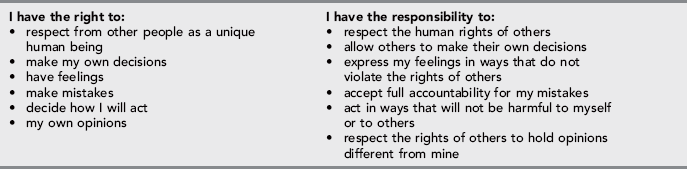
Nature of assertive behavior
Assertive behavior is defined as setting goals, acting on those goals in a clear, consistent manner, and taking responsibility for the consequences of those actions. The assertive nurse is able to stand up for the rights of others, as well as for her own rights. Box 14-3 lists characteristics of assertive behaviors.
Components of assertion include the following four abilities: (1) to say no; (2) to ask for what you want; (3) to appropriately express both positive and negative thoughts and feelings; and (4) to initiate, continue, and terminate the interaction. This honest expression of yourself does not violate the needs of others but does demonstrate self-respect rather than deference to the demands of others.
The goal of assertiveness is to communicate directly, standing up for your personal rights while respecting the rights of others (Stuart, 2009). Conflict creates anxiety that may prevent us from behaving assertively. Assertive behaviors range from making a direct, honest statement about your beliefs to taking a very strong, confrontational stand about what will and will not be tolerated in the relationship. Assertive responses contain “I” statements that take responsibility. This behavior is in contrast with aggressive behavior, which has a goal of dominating while suppressing the other person’s rights. Aggressive responses often consist of “you” statements that fix blame on the other person.
Assertiveness is a learned behavior. Some nurses were socialized to act passively. Passive behavior is defined as a response that denies our own rights to avoid conflict. An example is remaining silent and not responding to a client’s demands for narcotics every 4 hours when he displays no signs of pain out of fear that he might report you to your superior.
Assertiveness needs to be practiced to be learned (Exercises 14-2 and 14-3). Effective nursing encompasses mastery of assertive behavior (see Box 14-3). Nonassertive behavior in a professional nurse is related to lower levels of autonomy. Continued patterns of nonassertive responses have a negative influence on you and on the standard of care you provide. Evaluate your own assertiveness with Exercise 14-4.
Dysfunctional conflict
Several elements may occur in dysfunctional conflict. The dysfunction occurs when emotions distort the content issue (e.g., when some information is withheld so that you must guess at what is truly going on in the mind of the other person). Sometimes the conflict is obscured by hidden messages, denied feelings, or feelings projected onto others. Nonproductive conflicts are characterized by feelings that are misperceived or stated too intensely. In other dysfunctional conflicts, the feelings are stated accurately, but they are expressed so strongly that the listener feels attacked. The listener then tends to respond in a defensive manner.
Principles of conflict resolution
Figure 14-1 describes the principles of conflict resolution. Recognize your own “trigger” or “hot buttons.” What words or client actions trigger an immediate emotional response from you? These could include having someone yelling at you or speaking to you in an angry tone of voice. Once you recognize the triggers, you can better control your own response. It is imperative that you focus on the current issue. Put aside past history. Listing prior problems will raise emotions and prevent both of you from reaching a solution. Identify available options. Rather than immediately trying to solve the problem, look at the range of possible options. Create a list of these options and work with the other party to evaluate the feasibility of each option. By working together, the expectation shifts from adversarial conflict to an expectation of a win-win outcome. After discussing possible solutions, select the best one to resolve the conflict. Evaluate the outcome based on fair, objective criteria.
Applications
In addition to managing your own responses to client provocations by adopting a professional, “calm” demeanor and low tone of voice, other conflict prevention strategies may be useful. Signal your readiness to listen with attending behaviors such as good body position, eye contact, and receptive facial expression (Jasmine, 2009). Give your undivided extra attention to a client or a visitor whom you identify as potentially becoming aggressive. Finke et al.’s (2008) review of 12 nurse-client communication studies showed that nurses’ anti-communication attitudes were cited in half the studies as a barrier to communication. Increasing your positive appreciation of your client does facilitate communication. As nurses, we hold the belief that all clients have worth as human beings. Remind yourself of this basic belief whenever you are in a conflict situation with your client. Remember we “choose” to enter into each relationship in a therapeutic manner (Milton, 2008). These strategies may be effective in preventing conflict or in preventing escalation of the conflict. Remember your primary goal is to prevent conflict or defuse escalating aggressive behavior (Phillips, 2007).
Assessing the presence of conflict in the nurse-client relationship
To get resolution, you need to acknowledge the presence of conflict. Often the awareness of our own feelings of discomfort is an initial clue. Evidence of the presence of conflict may be overt, that is, observable in the client’s behavior and expressed verbally. For example, the client may criticize you. No one likes to be criticized, and a natural response might be anger, rationalization, or blaming others. But as a professional nurse, you recognize your response, recognize the conflict, and work toward resolution so that constructive changes may take place.
More often, conflict is covert and not so clear-cut. The conflict issues are hidden. Your client talks about one issue, but talking does not seem to help and the issue does not get resolved. He continues to be angry or anxious. Subtle behavioral manifestations of covert conflict might include a reduced effort by your client to engage in self-care; frequent misinterpretation of your words; behaviors that are out of character for him such as excessive anger. For example, when your client seems unusually demanding, has a seemingly insatiable need for your attention, or is unable to tolerate reasonable delays in having needs met, the problem may be anxiety stemming from conflictive feelings. Client behaviors are often negatively affected by feelings of pain, loss, frustration, or fear. As nurses, we affect the behavior of our clients through our actions. This can lead to positive or negative outcomes. See Exercise 14-5 for practice in defining conflict issues.
Sometimes the feelings themselves become the major issue, so that valid parts of the original conflict issue are hidden; consequently, conflict escalates. Consider the following situation.
At this point, you probably can sense the presence of conflictive feelings, but it is unclear whether the emotions being expressed relate to anxiety over the surgery or to anger over some real or imagined invasion of privacy because of the necessary laboratory tests and physical examination. Your client might also be annoyed by you or by a lack of information from her surgeon. She may feel the need to know that hospital personnel see her as a person and care about her feelings. Before you can respond empathetically to the client’s feelings, they will have to be decoded.
Nurse (in a concerned tone of voice): You seem really upset. It’s rough being in the hospital, isn’t it?
Notice that the reply is nonevaluative and tentative, and does not suggest specific feelings beyond those the client has shared. There is an implicit request for her to validate your perception of her feelings and to link the feelings with a concrete issue. You process verbal as well as nonverbal cues. Concern is expressed through your tone of voice and words. The content focus relates to the client’s predominant feeling tone, because this is the part of the conflict that she has chosen to share with you. It is important to maintain a nonanxious presence.
Nursing strategies to enhance conflict resolution
One goal is to de-escalate the conflict (Pryor, 2006). Use the strategies for conflict resolution described in this section. Mastery takes practice. Although this

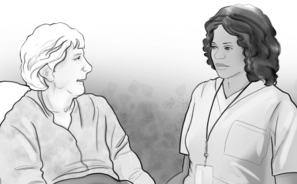
Reaching a common understanding of the problem in a direct, tactful manner is the first step in conflict resolution.
seems like a lot of information, Susanne Gaddis, the “Communications Doctor,” calls these a “4-second rule” to improve communications.
Prepare for the encounter
Careful preparation often makes the difference between being successful or failing to assert yourself when necessary. Clearly identify the issue in conflict. In discussing assertive communication, For communication to be effective, it must be carefully thought out in terms of certain basic questions:
• Purpose. What is the purpose or objective of this information? What is the central idea, the one most important statement to be made?
• Organization. What are the major points to be shared, and in what order?
• Content. Is the information to be shared complete? Does it convey who, what, where, when, why, and how?
• Word choice. Has careful consideration been given to the choice of words?
If you wish to be successful, you must consider not only what is important to you in the discussion but what is important to the other person. Bear in mind the other person’s frame of reference when acting assertively. The following clinical example illustrates this idea.
The issue in this case example is not one of food intake alone. Any attempt to talk about why it is important for him to eat or expressing your point of view in this conflict immediately on arriving is not likely to be successful. Mr. Pyle’s behavior suggests that he feels there is little to be gained by living any longer. His actions suggest further that he feels lonely and may be angry with his relatives. Once you correctly ascertain his needs and identify the specific issues, you may be able to help Mr. Pyle resolve his intrapersonal conflict. His wish to die may not be absolute or final, because he eats when food is prepared by his neighbor and he has not yet taken a deliberate, aggressive move to end his life. Each of these factors needs to be assessed and validated with him before an accurate nursing diagnosis can be made.
Organize information
Organizing your information and validating the appropriateness of your intervention with another knowledgeable person who is not directly involved in the process is useful. Sometimes it is wise to rehearse out loud what you are going to say. Remember to adhere to the principle of focusing on the conflict issue. Avoid bringing up the past.
Manage your own anxiety or anger
Recognizing and controlling your own natural emotional response to your client’s upsetting behavior may be one key factor in managing conflict. Conflict produces anxiety, but anxiety increases your perception of conflict, creating feelings of helplessness (Stuart, 2009). This discomfort should signal you that you need to deal with the situation. Confronting the client’s behavior now should keep you from losing control later as the problem escalates. Most people experience some variation of a physical response when taking interpersonal risks. A useful strategy for managing your own anger is to vent to a friend using “I” statements, as long as this does not become a complaining, whining session. Another strategy to manage your own anger is to “take a break.” A cooling-off period, doing something else for a few minutes or hours until your anger subsides, is acceptable. Take care that you reengage, however, so that this does not become just an avoidance response style. Communicate with the correct person; do not take out your frustration on someone else. Focus on the one issue with the client involved. Try saying, “I would like to talk something over with you before the end of shift/before I go.” Before you actually enter the client’s room, do the following:
• Cool off. Wait until you can speak in a calm, friendly tone.
• Take a few deep breaths. Inhale deeply and count “1-2-3” to yourself. Hold your breath for a count of 2 and exhale, counting again to 3 slowly.
• Fortify yourself with positive statements (e.g., “I have a right to respect.”). Anticipation is usually far worse than the reality.
Time the encounter
Timing is a determinant of success. Know specifically the behavior you wish to have the client change. Make sure that the client is capable physically and emotionally of changing the behavior. Select a time when you both can discuss the matter privately and use neutral ground, if possible. Select a time when the client is most likely to be receptive.
Timing is also important if an individual is very angry. The key to assertive behavior is choice. Sometimes it is better to allow your client to let off some “emotional steam” before engaging in conversation. In this case, the assertive thing to do is to choose silence accompanied by a calm, relaxed body posture. These nonverbal actions convey acceptance of feeling and a desire to understand. Validating the anger and reframing are useful. Comments such as “I’m sorry you are feeling so upset” recognize the significance of the emotion being expressed without getting into the cause.
Put situation into perspective
Don’t play the blame game. Put the issue into perspective. Will the issue be significant in a year? In 10 years? Will there be a significant situational change with resolution? This is another way of saying to pick your battles. Not every situation is worth using up your time and energy. Remind yourself that anger may be caused by a problem communicating; the client who is frustrated may become angry when he cannot make staff understand.
Use therapeutic communication skills
Refer to the discussion on therapeutic communication in Chapter 10. Particularly useful is active listening. Really trying to understand what the client is upset about requires more skill than just listening to his or her words. Listening closely to what the client is saying may help you understand his or her point of view. This understanding may decrease the stress. Repeat to assure the client you have heard what was said.
Use clear, congruent communication
Riley (2008) adapted a CARE acronym to help nurses confront conflict situations. Refer to Box 14-4. The C is clarify. Choose direct, declarative sentences. Use objective words, and directly state the behavior that is the problem. Then proceed to A and articulate why their behavior is a problem by stating facts.
Make sure verbal and nonverbal communication is congruent. Maintain an open stance and omit any gestures that might be interpreted as criticism, such as rolling your eyes or sighing heavily. Avoid mixed messages. One example of inappropriate communication might be found in the case of Larry, a staff nurse who works the 11-7 shift. Larry needs to get home to make sure his children get on the bus to school. A geriatric client routinely asks for a breathing treatment while Larry is reporting off. Instead of setting limits, Larry uses a soft voice and smiles as he tells her he can be late to begin the report. Another example is Mr. Carl, the 29-year-old client in Room 122 who constantly makes sexual comments to a young student nurse. She laughs as she tells him to cut it out.
Take one issue at a time
You may need to first focus on acknowledging the feelings associated with the conflict, because it is these that generally escalate conflict. It is always best to start with one issue at a time.
• Choose words that may lead to a positive outcome.
• Focus only on the present issue. The past cannot be changed.
Limiting your discussion to one topic issue at a time enhances the chance of success. Usually it is impossible to resolve a conflict that is multidimensional in nature with one solution. By breaking the problem down into simple steps, enough time is allowed for a clear understanding. In the case example just given, you might paraphrase the client’s words, reflecting the meaning back to the client to validate accuracy. Once the issues have been delineated clearly, the steps needed for resolution may appear quite simple.
Mutually generate some options for resolution
Focus on ways to resolve the problem by listing possible options. You are familiar with the “fight-or-flight” response to stress: Many people can respond to conflict only by either fighting or avoiding the problem. But brainstorming possible options and discussing pros and cons can turn the “fight” response into a more mutual “seeking a solution” mode of operations.
Make a request for a behavior change
Avoid blaming. This would only make your client feel defensive or angry. As in Box 14-4, the R in the CARE acronym is your request for a change in his behavior. Clearly ask him or her for the needed behavior change. Take into consideration his developmental stage, values, and life experiences. His willingness to change needs to be considered. In addition, for an ill client, level of self-care, as well as outside support systems, are factors. To approach the task without this information is risky.
Rather than just stating your position, try to use some objective criteria to examine the situation. Saying, “I understand your need to_______, but the hospital has a policy intended to protect all our clients” might help you talk about the situation without escalating into anger. Psychiatric units have known rules against verbal abuse, violence such as throwing objects, violence against others, and so on. You can restate these “rules,” together with their known violation outcomes (medication, seclusion, manual restraint), in a calm but firm voice.
There obviously will be situations in which such a thorough assessment is not possible, but each of these variables affects the success of the confrontation. For example, a client with dementia who makes a pass at a nurse may simply be expressing a need for affection in much the same way that a small child does; this behavior needs a caring response rather than a reprimand. A 30-year-old client with all his cognitive faculties who makes a similar pass needs a more confrontational response.
Client readiness is vital. The behavior may need to be confronted, but the manner in which the confrontation is approached and the amount of preparation or groundwork that has been done beforehand may affect the outcome.
Understand cultural implications
Often what appears to be an inappropriate response in Western culture is a highly acceptable way of interacting in a different culture. For example, some clients experience conflict related to taking pain medication. In the cultures of these clients, pain is supposed to be endured with stoicism. It is often necessary to help such clients express their discomfort when it occurs and to give them guidelines, as well as explicit permission to develop a different behavior. It is easier for these clients to take such medication when they can assure their families that the nurse said it was necessary to take it. By focusing on the behavior required to meet the client’s physical needs, the nurse bypasses placing a value on the rightness or wrongness of the behavior. Refer to chapter 11 for a more detailed discussion of cultural differences that can create conflict.
Evaluate the conflict resolution
The E is the CARE acronym stands for encouraging the client to change by stating the outcomes, the positive consequences of changing or the negative implications for failing to change (Riley, 2008). The E could also stand for evaluation of conflict resolution. Evaluate the degree to which the interpersonal conflict has been resolved. This depends somewhat on the nature of the conflict. Sometimes a conflict cannot be resolved in a short time, but the willingness to persevere is a good indicator of a potentially successful outcome. Accepting small goals is useful when large goal attainment is not possible. Your goal is open communication with frequent feedback leading to successful problem solving.
For a client, perhaps the strongest indicator of conflict resolution is the degree to which he is actively engaged in activities aimed at accomplishing tasks associated with treatment goals. As the nurse, there are two questions you might want to address if modifications are necessary:
Identify client intrapersonal conflict situations
The initial interpersonal strategy used to help clients reduce strong emotion to a workable level is to provide a neutral, accepting, interpersonal environment. Within this context, you can acknowledge your client’s emotion as a necessary component of adaptation to life. You convey acceptance of the individual’s legitimate right to have feelings. Telling a client, “I’m not surprised that you are angry about…” or simply stating, “I’m sorry you are hurting so much,” acknowledges the presence of an uncomfortable emotion in the client, conveys an attitude of acceptance, and encourages the client to express himself or herself. Once a feeling can be put into words, it becomes manageable because it has concrete boundaries.
Talk about IT
The second step in defusing the strength of an emotion is to talk the emotion through with someone. For the client, this someone is often the nurse. For the nurse, this might be a nursing supervisor or a trusted colleague. Unlike complaining, the purpose of talking the emotion through is to help the person connect with all of his or her personal feelings surrounding the incident. If one client seems to produce certain negative emotional reactions on a nursing unit, the emotional responses may need the direct attention of all staff on the unit.
Use tension-reducing actions
The third phase is to take action. The specific needs expressed by the emotion suggest actions that might help the client come to terms with the consequences of the emotion. This responsibility might take the form of obtaining more information or of taking some concrete risks to change behaviors that sabotage the goals of the relationship. Convey mutual respect and avoid any “put-down” type of comment about yourself or the client.
Sometimes the most effective action is simply to listen. Active listening in a conflict situation involves concentrating on what the other person is upset about. Listening can be so powerful that it alone may reduce the client’s feelings of anxiety and frustration.
Physical activity can reduce tension. For example, taking a walk can help your client control his anxiety behaviors and can defuse an emotionally tense situation. If your client is so upset that he constitutes a danger to himself or others, talk softly in a calm tone; face him but allow maximum space and an exit for yourself should it become necessary. Many hospitals and psychiatric units have a “code word “ that is used to summon trained help.
Humor is frequently used by nurses to engage a client or to initiate an interaction. Humor can also be used as a means of reducing tension. To paraphrase a famous advice columnist, two of the most important words in a relationship are “I apologize.” And she recommended making amends immediately when you’ve made a mistake, because it is easier to eat crow while it is still warm. Is this advice easier to take (we won’t say swallow) since it comes with a chuckle? Humor serves as an immediate tension reliever.
Defuse intrapersonal conflict
Intrapersonal conflicts develop when you hold opposing feelings within yourself. The client with a myocardial infarction who insists on conducting business from the bedside probably feels conflicted about the restraints placed on his or her activities, as does the diabetic client who sneaks off to the food vending machine for a candy bar.
There are times when the conflictive feelings begin intrapersonally within the nurse (e.g., in working with parents of an abused child or treating a foul-mouthed alcoholic client in the emergency department). Such situations often stir up strong feelings of anger or resentment in us. In this case, we may need to defuse destructive emotions before proceeding further. The following are interventions you can use to defuse intrapersonal conflicts:
• Identify the presence of an emotionally tense situation.
• Talk the situation through with someone.
• Provide a neutral, accepting environment.
• Take appropriate action to reduce tension.
For the nurse, the first step in coping with difficult emotional responses is to recognize their presence and to assess the appropriateness of expressing emotion in the situation. If expressing the emotion does not fit the circumstances, one must deliberately remain unruffled when every natural instinct argues against it. Ambivalence, described as two opposing ideas or feelings related to any life situation or relationship coexisting within the same individual, is relatively common. It is not the responsibility of the nurse to help a client resolve all intrapersonal conflict. Long-standing conflicts require more expertise to resolve. In such cases, refer your client to the appropriate resource.
Interpersonal conflict interventions
Demonstrate Respect
Responsible, assertive statements are made in ways that do not violate the rights of others or diminish their standing. They are conveyed by a relaxed, attentive posture and a calm, friendly tone of voice. Statements should be accompanied by the use of appropriate eye contact.
Use “I” Statements
Statements that begin with “You” sound accusatory and always represent an assumption because it is impossible to know exactly, without validation, why someone acts in a certain way. Because such statements usually point a finger and imply a judgment, most people respond defensively to them.
“We” statements should be used only when you actually mean to look at an issue collaboratively. Thus, the statement “Perhaps we both need to look at this issue a little closer” may be appropriate in certain situations. However, the statement “Perhaps we shouldn’t get so angry when things don’t work out the way we think they should” is a condescending statement thinly disguised as a collaborative statement. What is actually being expressed is the expectation that both parties should handle the conflict in one way—the nurse’s way.
Use of “I” statements are one of the most effective conflict management strategies you can use. Assertive statements that begin with “I” suggest that the person making the statement accepts full personal responsibility for his or her own feelings and position in relation to the presence of conflict. It is not necessary to justify your position unless the added message clarifies or adds essential information. “I” statements seem a little clumsy at first and take some practice. The traditional format is this:
“I feel _____ (use a name to claim the emotion you feel) when ______ (describe the behavior nonjudgmentally) because _____ (describe the tangible effects of the behavior).”
“I feel uncomfortable when a client’s personal problems are discussed in the cafeteria because someone might overhear confidential information.”
Make Clear Statements
Statements, rather than questions, set the stage for assertive responses to conflict. When questions are used, “how” questions are best because they are neutral in nature, they seek more information, and they imply a collaborative effort. “Why” questions ask for an explanation or an evaluation of behavior and often put the other person on the defensive. It is always important to state the situation clearly; describe events or expectations objectively; and use a strong, firm, yet tactful manner. The following example shows how a nurse can use the three levels of assertive behaviors to meet the client’s needs in a hospital situation without compromising the nurse’s own needs for respect and dignity.
In this interaction, the nurse’s position is defined several times using successively stronger statements before the shift can be made to refocus on underlying client needs. Notice that even in the final encounter, however, the nurse labels the behavior, not the client, as unacceptable. Persistence is an essential feature when first attempts at assertiveness appear too limited. After careful analysis, if you find that a client’s behavior is infringing on your rights, it is essential that the issues be addressed directly in a tactful manner. If they are not, it is quite likely that the undesirable behavior will continue until you are no longer willing to tolerate it.
Use Proper Pitch and Tone
The amount of force used in delivery of an assertive statement depends on the nature of the conflict situation, as well as on the amount of confrontation needed to resolve the conflict successfully. Starting with the least amount of assertiveness required to meet the demands of the situation conserves energy and does not place the nurse into the bind of overkill. It is not necessary to use all of one’s resources at one time or to express ideas strongly when this type of response is not needed. You can sometimes lose your effectiveness by becoming long-winded in your explanation when only a simple statement of rights or intent is needed. Long explanations detract from the true impact of the spoken message. Getting to the main point quickly and saying what is necessary in the simplest, most concrete way cuts down on the possibility of misinterpretation. This approach increases the probability that the communication will be constructively received.
Pitch and tone of voice contribute to another person’s interpretation of the meaning of your assertive message. A soft, hesitant, passive presentation can undermine an assertive message as much as vocalizing the message in a harsh, hostile, and aggressive tone. A firm but moderate presentation often is as effective as content in conveying the message (see Exercise 14-3).
Analyze Personal Feelings
As mentioned earlier, part of an initial assessment of an interpersonal conflict situation includes recognition of the nurse’s intrapersonal contribution to the conflict, as well as that of the client. It is not wrong to have ambivalent feelings about taking care of clients with different lifestyles and values; however, this needs to be acknowledged to yourself.
Focus on the Present
The focus of assertive responses should always be on the present. Because it is impossible to do anything about the past except learn from it, and because the future is never completely predictable, the present is the only reality in which we have much decision-making power as to how we act. To be assertive in the face of an emotionally charged situation demands thought, energy, and commitment. Assertiveness also requires the use of common sense, self-awareness, knowledge, tact, humor, respect, and a sense of perspective. Although there is no guarantee that the use of assertive behaviors will produce desired interpersonal goals, the chances of a successful outcome are increased because the information flow is optimally honest, direct, and firm. Often the use of assertiveness brings about changes in ways that could not have been anticipated. Changes occur because the nurse offers a new resource in the form of objective feedback with no strings attached.
Structure Your Response
In mastering assertive responses, it may be helpful initially to use these steps in an assertive response.
1. Express empathy: “I understand that ______”; “I hear you saying ______.”
“I understand that things are difficult at home.”
2. Describe your feelings or the situation: “I feel that ______”; “This situation seems to me to ______.
“But your 8-year-old daughter has expressed a lot of anxiety, saying, ‘I can’t learn to give my own insulin shots.’”
3. State expectations: “I want _________”; “What is required by the situation is _______.”
“It is necessary for you to be here tomorrow when the diabetic teaching nurse comes so you can learn how to give injections and your daughter can, too, with your support.”
4. List consequences: “If you do this, then __________ will happen” (state positive outcome); “If you don’t do this, then __________ will happen” (state negative outcome).
“If you get here on time, we can be finished and get her discharged in time for her birthday on Friday.”
Clinical encounters with demanding, difficult clients
Every nurse encounters clients who seem overly demanding of your limited time and resources. Although this may reflect a personality characteristic, most often it is sign of their anxiety. Box 14-1 describes behaviors that increase anger in others. Nurses often respond to difficult clients, especially those who display inappropriate sexual aggression, by ignoring their verbal comments, physically avoiding the client, or by adopting a very “no-nonsense” professional behavior (Higgins, 2009). Try some of the more therapeutic approaches in Box 14-4. Usually we have labeled people as “difficult to deal with” when our normal way of dealing with them has failed. So remember, we cannot change other’s personalities, but we can change the way we react to them (Salazar, 2004).
Clinical encounters with angry clients
You can expect to encounter clients who express anger. This may take the form of refusal to comply with the treatment plan, exhibition of hostile behaviors toward staff, verbal or even physical actions, or perhaps withdrawal from any positive interaction with you. When dealing with a difficult client, ask yourself what the client is gaining from such behavior. Some people have not learned successful communication, so they revert to behavior that has gained them something in the past. For example, as children they may have only gotten needed attention when they acted out in a negative way or when they pouted or sulked. Ask yourself if the client behaving in a difficult way is getting rewarded by focusing a lot of staff attention on himself, for example. Does the client just need to learn a more effective way of communicating? Remind yourself that usually the client’s feeling center on their disease or treatment and are not a reflection of their feeling about you. Nurses cited by Servodidio (2008) comment, “One of the hardest things to learn as a nurse is not to take a patient’s frustration or anger personally” (p. 17).
Nonverbal clues to anger include grimacing, clenching jaws or fists, turning away, and refusing to maintain eye contact. Verbal cues by a client may, of course, include use of an angry tone of voice, but they may also be disguised as witty sarcasm or as condescending or insulting remarks. To become comfortable in dealing with client anger, the nurse must first become aware of his or her own reactions to anger so that the nurse does not threaten or reject the individual expressing anger, or respond in anger. Interventions include those listed in Box 14-5.
Help the client own the angry feelings by getting the client to verbalize things that make him or her angry. Acknowledging a client’s anger may prevent an expression of abusive ranting. It is essential that you use empathetic statements or active listening to acknowledge the client’s anger and maintain a nonthreatening demeanor before moving on to try to discuss the issue. Remember your goal is to maintain safety while helping your client.
Defuse Hostility
Avoid responding to a client’s anger by getting angry yourself. Verbal attacks follow certain rules, in that the abusive person expects you to react in specific ways. Usually people will respond by becoming aggressive and attacking back or by becoming defensive and intimidated. Keep your cool using strategies discussed earlier. Take a deep breath! Remember, if you lose control, you lose! If you become defensive, you lose! Abusive people want to provoke confrontations as a means of controlling you.
• Use empathy in your communication. An angry client needs to have you acknowledge both the issue and their feelings about that issue. Only then can the client begin to interact in a meaningful way. Your empathy may help defuse the situation (Nau, Dassen, Halfewns, & Needham, 2007).
• Deliberately begin to lower your voice and speak more slowly. When we get upset, we tend to speak quickly and use a higher tone of voice. If you do the opposite, the client may begin to mimic you and thus calm down.
• Realistically analyze the current situation that is disturbing the client.
• Be assertive in setting limits. If the client persists, you need to assert limits, saying, for example, “Jim, I want to help you sort this out, but if you continue to raise your voice, I’m going to have to leave. Which do you want?” or, “Yelling at me isn’t going to get this worked out. I will not argue with you. Come back when you can talk calmly and I will try to help you.”
• Assist the client in developing a plan to deal with the situation (e.g., use techniques such as role-playing to help the client express anger appropriately, using “I” statements such as “I feel angry” rather than “You make me angry”). Bringing behavior up to a verbal level should help alleviate the need for other acting out of destructive behaviors.
Prevent Escalation of Conflict
Depending on the type of feedback received, an intrapersonal conflict can take on interpersonal dimensions. In the following example, the mother initially experiences an intrapersonal conflict. The wished-for perfect infant has not appeared, and her personal ambivalence related to coping with her infant’s defect is expressed indirectly through her partial noncompliant behavior. If the nurse interprets the client’s behavior incorrectly as poor mothering and acts in a manner that reflects this attitude, the basically intrapersonal conflict can become interpersonal.
This client appears to reframe the experience from her own perspective. In this situation, a client strength would be the mother’s ability and willingness to express her uncomfortable feelings so that they can be addressed. Even though the mother may be unclear about the nature of her feelings, reframing the issues in this way builds on strengths instead of on personal deficits.
Prevent any escalation in interpersonal conflict. Hurt feelings or misunderstandings can quickly escalate a conflict. In talking to an angry client, as his voice rises, lower yours. If eye contact seems confrontational, then break eye contact. If the client is acting out by throwing or hitting, set limits: “No hitting (spitting, or other physical behavior) is allowed here.” If you set limits, be sure to follow through. Ask the client to verbalize his or her anger (e.g., “Talk about how you feel, instead of throwing things”). Studies show that talking will dramatically reduce aggressive behavior. Use other strategies described in this book for defusing conflict situations. Active listening (i.e., really listening to your client’s viewpoint), using attentive body language, and summarizing the client’s viewpoint can defuse some of the tension of the conflict.
Clinical encounters with aggressive/violent clients
Some clients have mental problems, are truly confused, intoxicated, or have cognitive deterioration. The U.S. Preventive Services Task Force (USPSTF, 2008) recommends clinicians assess the client’s level of cognitive functioning when this is suspected, using the Mini-Mental Status Examination (MMSE). It helps you to respond more positively if you perceive that their behavior is not “evil” but a result of their illness. Be aware that escalating conflict can be a threat not only to your client, but to your own safety. In no case is violence acceptable. Limits must be set. Failing this, you need to remove yourself from a potentially harmful situation. Starcher (1999) describes the behavior of an emotionally disturbed client admitted to a geriatric unit. Sam’s behavior ranged from bullying or pushing other clients to noncompliance with his treatment. Staff tried setting clear limits and identifying specific negative outcomes, including restraints and medication, without success. Eventual successful interventions included consistent response by all staff members and using written patient contracts for each of his unacceptable behaviors. Outcomes were specifically stated for both negative behaviors (restrictions) and positive acceptable behaviors (rewards with his favorite activities).
Box 14-5 lists some useful strategies for coping with angry clients. Deliberate use of “calming interventions” have been validated in Pyror’s (2006) analysis of expert nurses’ behaviors. An additional strategy for helping nurse-client problem interactions is the staff-focused consultation. Consider the following situation.
Students are particularly prone to feeling rebuffed when they first encounter negative feedback from a client. Support from staff, instructors, and peers, coupled with efforts to understand the underlying reasons for the client’s feelings, help you resist the trap of avoiding the relationship. To develop these ideas further, practice Exercise 14-5.
Defusing potential conflicts when providing home health care
Recognizing potential situations lending themselves to conflict is, of course, an important initial step. Caregivers have been shown to experience conflict through incompatible pressures suffered between caregiver demands and demands from their other roles, such as parenting their children or maintaining employment (Stephens et al., 2001). In addition to this inter-role conflict, caregivers suffer pressures when a nurse comes into their home to participate in the care of an ill relative. A Canadian study of home health nurses and family caregivers of elderly relatives identified four evolving stages in the nurse-caregiver relationship. The initial stage is “worker-helper,” with the nurse providing care to the ill client and the family helping. Next comes “worker-worker,” when the nurse begins teaching the needed care skills to family members. Third is “nurse as manager; family as worker,” as the family members learn needed care skills. The final stage, “nurse as nurse for family caregiver,” occurs as the family member becomes exhausted (Butt, 2000). A source of conflict for nurses was the dual expectation of the family that the nurse would provide care not only for the identified client but also provide relief for the exhausted primary caregiver. When the nurse operated as manager and treated the caregiver as worker, the discrepancy in expectations and values resulted in increased tension in the relationship. Discussion of role expectations is essential. Because of the high cost of providing direct care to chronically ill clients, home health nurses may be expected to quickly shift to teaching the necessary skills to the family members. You can clarify that this shift in responsibility results in a reduction of expensive professional time but not in your commitment to the family.
Summary
Conflict represents a struggle between two opposing thoughts, feelings, or needs. It can be intrapersonal in nature, deriving from within a particular individual; or interpersonal, when it represents a clash between two or more people.
All conflicts have certain things in common: a concrete content problem issue and relationship issues arising from the process of expressing the conflict. Generally, intrapersonal conflicts stimulate feelings of emotional discomfort. Strategies to defuse strong emotion include talking the emotion through with someone and temporarily reducing stress through the use of distraction or additional information. Most interpersonal conflicts involve some threat, either to one’s sense of power to control an interpersonal situation or to ways of thinking about the self. Giving up ineffective behavior patterns in conflict situations is difficult; such patterns are generally perceived to be safer because they are familiar.
Behavioral responses to conflict situations fall into four categories. Nurses most commonly choose avoidance. However, this chapter describes other strategies (e.g., assertion) that have been more successfully used by nurses to manage client-nurse conflicts. Assertive behaviors range from making a simple statement, directly and honestly, about one’s beliefs, to taking a very strong, confrontational stand about what will and will not be tolerated.
The principles of conflict management are described. To apply conflict management principles, you need to identify your own conflictive feelings or reactions. For internal conflict, feelings usually have to be put into words and related to the issue at hand before the meaning of the conflict becomes understandable. In conflict between nurse and client, you need to think through the possible causes of the conflict, as well as your own feelings, before making a response. To resolve these kinds of conflict, you need to use “I” statements and respond assertively.
References
Baillie, L. An exploration of nurse-patient relationships in accident and emergency. Accid Emerg Nurs. 2005;13(9):9–14.
Bowers, L., Flood, C., Brennan, G., et al. A replication study of the city nurse intervention: reducing conflict and containment on three acute psychiatric wards. J Psychiatr Ment Health Nurs. 2008;15(9):739–742.
Butt, G. Nurses and family caregivers of elderly relatives engaged in 4 evolving types of relationships. Evid Based Nurs. 2000;3:134.
Chang, M., Kelle, A.E. Patient education: addressing cultural diversity and health literacy issues. Urol Nurs. 2007;27(5):411–417.
Finke, E.H., Light, J., Kitko, L., et al. A systematic review of the effectiveness of nurse communication with patients with complex communication needs with a focus on the use of argumentative and alternative communication. J Clin Nurs. 2008;17(16):2102–2115.
Higgins, A., Barker, P., Begley, C.M., et al. Clients with mental health problems who sexualize the nurse-client encounter: the nursing discourse. J Adv Nurs. 2009;65(3):616–624.
Jasmine, T.J.X. The use of effective therapeutic communication skills in nursing practice. Singapore Nurs J. 2009;36(1):35–40.
Macdonald, M. Origins of difficulty in the nurse-patient encounter. Nurs Ethics. 2007;14(4):510–521.
McElhaney, R. Conflict management in nursing administration. Nurs Manag. 1996;27(3):49–50.
Milton, C. Boundaries: ethical implications for what it means to be therapeutic in the nurse-person relationship. Nurs Sci Q. 2008;21(1):18–21.
Nau, J., Dassen, T., Halfewns, R., et al. Nursing students’ experiences in managing patient aggression. Nurs Educ Today. 2007;27(8):933–946.
Phillips, S. Countering workplace aggression: an urban tertiary care institution exemplar. Nurs Adm Q. 2007;31(3):209–218.
Pryor, J. What do nurses do in response to their predictors of aggression? J Neurosci Nurs. 2006;28(3):177–182.
Redman, B.K., Fry, S.T. Ethical conflicts reported by RN/certified diabetes educators. Diabetes Educ. 1996;22(3):219–224.
Riley, J.B. Communication in nursing, ed 6. St. Louis, MO: Mosby/Elsevier Inc, 2008.
Salazar, J. Dealing with difficult people, Michigan Nurses Association. Available online: http://www.minurses.org. [Accessed May 5, 2009].
Servodidio, C.A. Nurses discuss working with challenging patients. ONS Connect. 2008;23(3):17.
Starcher, S. Sam was an emotional terrorist. Nursing. 1999;99(2):40–41.
Stephens, M.A., Townsend, A.L., Martire, L.M., et al. Balancing parent care with other roles: interrole conflict. J Gerontol B Psychol Sci Soc Sci. 2001;56(1):24–34.
Stuart, G.W. Principles and practice of psychiatric nursing. St. Louis: Mosby/Elsevier, 2009.
USPSTF, U.S. Preventive Services Task Force The Guide to Clinical Preventive Services, 2008. Available online:, www.preventiveservices.ahrq.gov, http://en.wikipedia.org/wiki/Conflict.