Chapter 10 Strengthening community action
Overview
We have seen in previous chapters how there are many different ways of working for health. Strengthening community action is one of the key action areas identified in the Ottawa Charter (World Health Organization (WHO) 1986). This chapter focuses on community development – a strategy which aims to empower people to gain control over the factors influencing their health. Working with communities to increase their participation in decisions affecting health is an essential aspect of health promotion. This chapter begins by defining what is meant by a community and goes on to explore different ways in which health promoters can work with communities. Some of the dilemmas that confront the health promoter who wants to work in this way are discussed and illustrated using examples of community development projects.
Defining community
The concept of community is frequently used in discussions about health and health care. In general, the context of the community is taken to be desirable; thus we have care in the community, community policing and community education, all of which are seen as preferable to alternative (non-community) practice. In contrast to the state or the bureaucratic organization, services provided by and in the community are viewed as being more appropriate and sensitive. But what is the community which is referred to in these ways?
There are different ways of defining a community, but the most commonly cited factors are geography, culture and social stratification. These factors are viewed as being linked to the subjective feeling of belonging or identity which characterizes the concept of ‘community’. Other characteristics of communities are social networks or systems of contact, and the existence of potential resources such as people’s skills or knowledge.
 BOX 10.1
Geography
A community may be defined on a geographical or neighbourhood basis (see Chapter 15). A well-known example is the East End of London, but this use of community is not restricted to working-class or urban areas. It is this notion of community which gives rise to ‘patch’-based work, where people such as social workers, police officers or health visitors are assigned a geographically bounded area. The assumption is that people living in the same area have the same concerns, owing to their geographical proximity. This in turn rests on an assumption that the physical environment is a key factor in influencing health and social identity.
Culture
Community may be defined in cultural terms, as in ‘the Chinese community’ or ‘the Jewish community’. Here the assumption is that common cultural traditions may transcend geographical or other barriers, and unite otherwise scattered and disparate groups of people. There is an expectation that members of a cultural community will assist each other and share resources. The most commonly cited elements of a common cultural heritage are ethnic origin, language, religion and customs.
Social stratification
A community may be based on interests held to be common, which are usually the product of social stratification. Thus we have ‘the working-class community’ and ‘the gay community’. This definition implies that members of a community share networks of support, knowledge and resources which may transcend other boundaries, even national ones.
 BOX 10.2
Which definitions of community are being used in the following quotations?
Most definitions of community tend to suggest that it is a homogeneous entity. However, it is obvious that any geographical community will include people whose primary identity is based on different factors, e.g. class, race, gender or sexual orientation. People who feel united by a shared interest, e.g. pensioners, or the unemployed, will also be members of other communities, geographical and otherwise. People may belong to several different communities, some of which may have more salience for the individual than others. In practice, people may find their allegiance to different communities shifting at different points in their life span.
The meaning and significance of community vary enormously. How one defines community is important because it influences how practitioners understand the dynamics within communities and the potential challenges that may present when working with them. Some communities may be easier to work with than others and practitioners may feel more comfortable working with some communities than others.
Defining community development
Community development has been defined as:
Building active and sustainable communities based on social justice and mutual respect. It is about changing power structures to remove the barriers that prevent people from participating in the issues that affect their lives. Community workers support individuals, groups and organisations in this process (Standing Conference for Community Development 2001).
Community development is both a philosophy and a method. As a philosophy its key features are:
There is a difference between community-based work and community development. Many practitioners may work in the community, organizing projects to meet people’s health needs or doing outreach work where a professional service such as screening is extended into the community to make it more accessible. The Sure Start programme is an example of a community project providing early educational interventions in specific areas. Table 10.1 illustrates some of the differences between community-based work and community development work.
Table 10.1 Characteristics of community-based versus community development models
| Community-based | Community development |
|---|---|
| Problem, targets and action defined by sponsoring body | Problem, targets and action defined by community |
| Community seen as medium, venue or setting for intervention | Community itself the target of intervention in respect to capacity-building and empowerment |
| Notion of ‘community’ relatively unproblematic | Community recognized as complex, changing, subject to power imbalances and conflict |
| Target is largely individuals within either geographic area or specific subgroup in geographic area defined by sponsoring body | Target may be community structures or services and policies that impact on the health of the community |
| Activities largely health-oriented | Activities may be quite broad-based, targeting wider factors with an impact on health, but with indirect health outcomes (empowerment, social capital) |
After Labonte (1998).
The community development approach has been influenced by the work of Paulo Freire, a Brazilian educationalist who worked on literacy programmes with poor peasants in Peru and Brazil during the 1970s. Freire saw education as a way to liberate people from cycles of oppression. He aimed to engage the people in critical consciousness-raising or ‘conscientization’, helping people to understand their circumstances and why they have been oppressed. The process of ‘conscientization’ begins with problem-posing groups which seek to break down barriers and establish a dialogue between individuals and between individuals and the facilitator. Eventually a state of praxis is reached in which there is a common understanding and development of action and practice, whereby people collectively can transform their circumstances. The process is summarized as:
Community development is a recognized way of working which has given rise to a specific profession – community development workers, who are generally employed by local authorities to support, facilitate and empower communities. Community development workers have their own training courses, qualifications and professional associations.
Community development and health promotion
Community development is a recurring theme in health promotion. In the 1960s the Women’s Movement emphasized the need to reclaim knowledge about our bodies and control over our lives. Shared personal experience led to a new understanding of health issues as well as providing positive effects and social cohesion for participants. Black and ethnic-minority groups also addressed health issues, particularly the effect of racism within the health services (Jones 1991).
In the 1970s and early 1980s numerous community development projects were set up, mostly funded and located outside the National Health Service (NHS). Inner-city decline prompted youth work, neighbourhood centres and planning groups which drew attention to the relationship between poverty, health and inequalities in service provision (Rosenthal 1983). Within the health services, community development approaches remained marginalized.
In the latter part of the 1980s there was widespread lip service to the notion of community development, stimulated in part by WHO.
Consider the following statements from WHO on the importance of participation, involvement and community development. What do you think contributed to this emphasis on working with ‘the community’?
‘The people have a right and a duty to participate individually and collectively in the planning and implementation of their health care’ (WHO 1978).
‘Health for all will be achieved by people themselves. A well-informed, well-motivated and actively participating community is a key element for the attainment of the common goal’ (WHO 1985, p. 5, original emphasis).
‘Health promotion works through concrete and effective community action in setting priorities, making decisions, planning strategies and implementing them to achieve better health. At the heart of this process is the empowerment of communities, their ownership and control of their own endeavours and destinies’ (WHO 1986).
‘Community action is central to the fostering of health public policy’ (WHO 1988).
‘Health promotion is carried out by and with people, not on or to people. It improves the ability of individuals to take action, and the capacity of groups, organisations or communities to influence the determinants of health. Improving the capacity of communities for health promotion requires practical education, leadership training and access to resources’ (WHO 1997).
Community development has been seen as the central defining strategy for health promotion (Green & Raeburn 1990). By the mid-1980s the Community Health Initiatives Resource Unit estimated that there were 10 000 local projects in existence. By the 1990s the lead health promotion agencies for developing strategies were under pressure as community development was seen as too radical. Its focus on structural causes of inequality, such as class, race and gender, was not acceptable to New Right political ideology (see Chapter 7 for more discussion of this). The Community and Professional Development Division of the Health Education Authority (HEA) was disbanded. The National Community Health Resource (NCHR) lost its funding from the HEA and Community Health UK (CHUK) lost its funding from the Department of Health.
Yet the 1990s also saw an emphasis on the concept of ‘community’. Strategies for service delivery were linked to the notion of community, and care in the community, community policing and community education emerged as key policies. The focus on the community needs to be seen in relation to the developing crisis in the role of welfare state provision and broader debates around accountability. Chapter 7 has shown how neoliberal concerns to retreat from welfare have been linked to a focus on individuals as consumers of services. Devolved services and an emphasis on participation and ‘consumer involvement’ were all strategies designed to achieve these aims.
‘Third-way’ politics in the UK draws upon ideas of communitarianism – that we are all linked together as citizens. Communal relations such as trust and reciprocity are to be valued and government action aims to bolster social capital (see Chapter 15 for a discussion of how neighbourhoods and the community became a focus for policy and analysis). A new government department of communities and local government, a public service agreement to build more cohesive, empowered and active communities, and Chapter 4 of the public health White Paper Choosing Health: Making Healthy Choices Easier (Department of Health 2004) all show a commitment to working through communities to create a stable, inclusive society.
The tradition of community development has radical roots and is closely associated with work to challenge the status quo, redistribute resources and address power imbalances across society. Although many have welcomed the adoption of once-radical terms such as empowerment and participation into mainstream policy language, there are those who suggest this mainstreaming of community development has diluted its aims and processes and resulted in a gulf between theory and practice (Berner & Philips 2005). There have been warnings that such ‘state-commissioned’ community development results in ‘not government by communities but government through communities’ (Shaw 2005). The policy focus on communities to bring about change (e.g. in neighbourhood renewal or antisocial behaviour) leads to communities, rather than society, being seen as responsible for the problems they face. This may be viewed as an extension, from individuals to communities, of the ‘victim-blaming’ principle.
Working with a community development approach
The ways in which community development is carried out vary enormously. However there are a number of core principles underpinning community development work, which overlap and link together. These principles are:
Participation
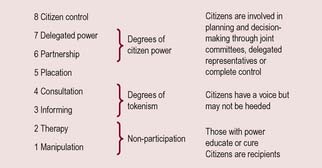
Participation, engagement and involvement are terms that are frequently used in the health sector. While these terms have different meanings they all relate to a central aspect of community development, that of increasing people’s involvement in decisions, service design and delivery. The emphasis in community development on increasing people’s power and control means increasing their participation in decision-making. Participation may be thought of as a ladder which includes many different activities (Figure 10.1). At the low or weak end, it may mean consultation to ‘rubber-stamp’ plans already drawn up by official agencies. At the high or strong end of the spectrum, it may mean control over the setting of priorities and implementation of programmes.
Community empowerment
Empowerment as a health promotion approach is discussed in Chapter 5 and the distinction is made between empowerment of individuals and empowerment of communities. Empowering communities is a core principle of community development and has been defined as:
a process by which communities gain more control over the decisions and resources that influence their lives, including the determinants of health. Community empowerment builds from the individual to the group to the wider collective and embodies the intention to bring about social and political change (Laverack 2007, p. 29).
Community empowerment begins through a process of critical consciousness-raising whereby individuals and communities begin to question and challenge the social justice of their situation (Ledwith 2005) (see the section on defining community development earlier in this chapter for a more detailed discussion of critical consciousness-raising).
Laverack (2007) identifies nine domains or areas of influence of community empowerment as a way of further clarifying how we understand this term:
Community-led
In contrast to professionally determined priorities, community development starts with priorities identified by and common to communities. The term community-led requires us to make a commitment to learning from communities, being accountable to communities and working in partnership. This is not without its tensions, for example when needs and priorities identified by communities are not compatible with those identified by statutory and funding bodies. An important aspect of community development work is legitimizing people’s knowledge about health and illness and giving this a voice. Not only does this pose a challenge to medical dominance; it is also very different from the systematic research into needs which we describe in Chapter 18. Establishing the needs of the community also means a shift towards more participatory and locality-based involvement.
Social justice
Community development recognizes that inequalities exist within society and that some communities are more privileged and better resourced – and consequently more healthy – than others. Community development sees these inequalities as having been created by society and therefore amenable to change by society. Community development seeks to strengthen civil society in a democratic and participatory way by giving a voice to communities that are disadvantaged or oppressed (Craig et al 2004). In so doing, it focuses on the determinants of health rather than on individual lifestyles. This may mean:
The community development approach is challenging. It offers the prospect of change for health but there are many practical difficulties to overcome (Table 10.2).
Table 10.2 Advantages and disadvantages of the community development approach
| Advantages | Disadvantages |
|---|---|
| Starts with people’s concerns, so it is more likely to gain support | Time-consuming |
| Focuses on root causes of ill health, not symptoms | Results are often not tangible or quantifiable |
| Creates awareness of the social causes of ill health | Evaluation is difficult |
| The process of involvement is enabling and leads to greater confidence | Without evaluation, gaining funding is difficult |
| The process includes acquiring skills which are transferable, for example communication skills, lobbying skills | Health promoters may find their role contradictory. To whom are they ultimately accountable – employer or community? |
| If health promoter and people meet as equals, it extends principle of democratic accountability | Work is usually with small groups of people |
| Draws attention away from macro issues and may focus on local neighbourhoods |
Types of activities involved in community development
A large number of activities may be included as part of a community development approach:
Profiling
Undertaking a community profile is much broader than a needs assessment. Community profiling involves the community, statutory and voluntary organizations in identifying the community’s needs, particular issues and resources. It is an important and early stage of the community development process. Profiling creates a better understanding of both the strengths and challenges within a community whilst simultaneously developing the skills and capacity of community members (Hawtin & Percy-Smith 2007). The key task of a community development worker is to build a picture of the community, identifying key individuals, groups and resources, and get to know the community formally and informally. Building networks and identifying communities takes time. The role of the community worker is to build on initial research and contact with people living and working in the community, so that the needs identified can be expanded upon and solutions developed (see Chapter 18).
Capacity-building
Capacity-building is working with individuals and groups within communities to recognize and develop the skills and resources they have (their assets) in order to identify and meet their own needs. The Charity Commission sees it as being concerned with two key areas of work:
 BOX 10.7
Community capacity-building: untangling the web in Prestonpans
The Scottish Executive provided three free public internet access points in Prestonpans as part of its initiative to get more people in Scotland online. Staff at these access points noticed that they were very underused and did not seem an effective way to introduce new users to computing or the internet. During an open day to launch the community website participants were able to get hands-on experience, sign up to a short course and get a personal follow-up from staff. This increased the community’s use of the internet.
Organizing
An important area of work that community development workers are engaged in is the process of helping to organize the community to work together effectively. This may include helping to establish small self-help groups or organizing community events such as health forums.
Refugee action
A refugee advocate describes their role:
Community development can be quite an invisible job, but the relationships you build with groups over the months or years is vital. By getting to know different groups, you can identify the issues they face and where they can work together. We have strategic bodies at one level, and the communities and grassroots activity at another level, and community development somewhere in the middle. If you take that out, the structures will collapse; the issues which need to be addressed by policy makers just won’t reach them … one of the things I have done is to help set up a Refugee Forum. The refugee community organisations now come together in a group and talk about their issues, what action they want to take and how to make a strong voice (Mani Thapa, Community Development Officer Refugee Action, quoted in Community Development Exchange, undated).
Networking
Networks are the ties that link people together within a community. Gilchrist (2004, 2007) identifies two different types of networks: those linked by strong ties and those linked by weak ties. Networks linked by strong ties are based on bonds of friendship or family relations and are those we are most likely to turn to for daily support and companionship. Networks based on weak ties link different clusters of networks together. They have been described as the links that operate over the whole network forming bridges between sections of the community or between organizations. Both types of network are an important asset within a community and are an indicator of levels of social capital. Strong networks create opportunities for skills, information and learning to be shared across the community, to create synergy and lead to more effective community action. Building such networks by making the links between individuals, groups and local organizations is therefore an important part of the community development worker’s role.
Negotiating
Community development work recognizes the diversity and division that exist within communities. Communities are not homogeneous entities but include hierarchies, imbalances in power and differences. Such diversity must be negotiated and managed in order to achieve a consensus, particularly in relation to prioritizing needs and agreeing actions to meet needs. As well as negotiating and managing conflict within communities, the community development worker must negotiate and advocate on behalf of the community. This may involve negotiating with funding or statutory bodies to ensure that the needs and views of the community are heard and considered.
Community development in practice
Carol Osgerby, Community Health Development Worker for West Hull Primary Care Trust describes community development work:
Question: Please explain your job as simply as possible.
Answer: When people want their community to get more healthy and prevent illness, I help them to set up groups and keep them going, by encouraging them and helping sort out problems.
Question: Please describe a typical week.
Answer: Monday: Work on an evaluation of the health impact of community groups. Later, I join a local walking group to talk to them about raising funds and developing the group.
Tuesday: Prepare display materials for Thursday’s event. Attend a committee meeting of a local Community Orchard. Discuss insurance, tenancy agreement and annual budget. Agree to work with the secretary to draft a funding application and help them make contacts with other similar groups so they can share information.
Wednesday: Catch up with paperwork and e-mails. Team meeting in the afternoon. We are a team of four community health development workers, trying to cover a city of 250 000 people.
Thursday: More paperwork, and reading the latest on the reorganization of public health in Hull. Later I attend a health event at a community centre where I run a quiz about food labelling and offer tasters of fruit smoothies. Get into discussion with many of the residents and workers there about nutrition, exercise, slimming and assorted queries about health care and illness. My real aim is to publicise community groups, and maybe make some links that could lead to new projects. In the evening I attend a neighbourhood management meeting. Good turnout of residents, as well as council staff, Community Empowerment Network, youth workers, etc. I help to get residents’ ideas on to paper.
Friday: Meet with the Community Orchard secretary to help draft a budget and fill in grant application form. We discuss how we can encourage local residents to get involved in winter, when there is less physical work to do. Later, I work on our community groups newsletter.
Question: Please describe what you feel makes your work specifically ‘community development’.
Answer: Community development develops and leaves behind structures that were not there before, and those structures are managed by members of the community. A vital part of community development is to support individuals to develop skills which they can use to develop community groups, organizations and networks. When I’m asked to take on a new piece of work, I ask myself: ‘Is there potential to produce a project which is truly led by the community it’s meant to serve?’ If not, to me it’s not community development. You have to respect the ability of the communities you work with to make their own decisions (Community Development Exchange (CDX) information sheet).
Dilemmas in community development practice
The question of whether the community development worker is engaged in radical practice or supporting the status quo is at the root of much of the ambiguity surrounding practice. Common dilemmas facing the community development worker relate to funding, accountability, acceptability, the role of the professional and evaluation.
Funding
Most community development projects are funded by statutory agencies, such as health and education authorities, sometimes in partnership, through joint funding. Other projects which might come under the label ‘community development’ belong in the voluntary sector, and are funded from a variety of sources, including direct government grants and independent fund-raising. Most community development work is funded in the short term only. Lack of security and the impossibility of guaranteeing an input in the long term increase the problems of planning and evaluating such work. Insecure funding arrangements can also subvert a project’s focus, leading workers to spend time fund-raising instead of working around defined issues.
Accountability
All community development workers have a dual accountability: to their employers and to their communities. Funding agencies naturally require projects to be accountable, and this can lead to problems where the priorities of the community and the agency are not the same. Organizational objectives such as service take-up may become incorporated into the community development worker’s role.
Community and worker responses to issues may also differ. For example, both may identify safety as a priority, but whereas the worker may respond by advocating structural changes such as better lighting and common responsibility for shared areas, the community might respond by advocating increased vigilance or the exclusion of specific groups, families or individuals.
Community development workers may feel themselves to be trapped in the role of mediator, informing statutory services about community needs and informing the community about how services work so that people can participate.
Acceptability
Employing authorities often view community development as not quite respectable. Community development may be seen as absorbing unacceptably large amounts of time and resources for dubious results. Community development tends to focus on small numbers of people whereas employers tend to be responsible for large populations. The long-term nature and diffuse outcomes of community development are at odds with the organizational need to allocate resources on the basis of demonstrable results.
Issues which are raised through a community development approach (such as discrimination in service provision) may be unacceptable to employing authorities. By allying themselves with dissent, community development workers may be seen as betraying the organization.
Community development workers may also find that they need to establish and negotiate their role before they are accepted by a community. The role of the worker is ambiguous. Their status and employment set them apart from the community in which they are working. Relationships of trust may need to be created before any other work can take place.
Role of the professional
Community development also poses problems for workers whose primary training lies in other areas.
Problems may arise from the different kind of client–worker relationship envisaged in professional training and community development work. Professional workers are taught a particular area of expertise and tend to assume that they know what is best for their clients. They may be sensitive to individual circumstances but the secondary socialization encountered during professional training reinforces the notion of expertise.
A health visitor wishes to adopt a community development approach in her work. She has identified setting up a postnatal mothers’ group as an appropriate project.
The health visitor might argue that such work is important for health because it increases self-esteem, autonomy and confidence, and a sense of belonging. She could argue that such work is effective. For example, postnatal networking amongst mothers could prove effective in reducing mental illness amongst this client group. The health visitor might also argue that time spent on setting up the group will reduce claims on her time in future, and is therefore a cost-effective option.
The health visitor’s manager might respond that there is not enough time to carry out such work. Full caseloads and many other priority claims (such as visiting all new mothers and carrying out child development check-ups) mean there is no spare time available for other activities. The manager might also argue that such activities need to be thoroughly evaluated and of proven effectiveness before resources can be committed.
Sociologists argue that professional culture is actually an occupational strategy designed to increase the status and rewards of the professional group (Freidson 1986; Johnson 1972). By acquiring professional jargon, expertise and qualifications, professionals can justify their right to practise and defend their area of work.
By contrast, community development workers see their role as that of catalyst and facilitator rather than expert. Their task is to enable a community to express its needs, and support the community in meeting those needs themselves. This requires a different worker–client relationship, based on egalitarianism and the sharing of knowledge. For professionals, whose identity is bound up in their work role, this can be a difficult switch to make.
The skills involved in community work also tend to be different from those acquired in professional training (unless this includes community development). Key skills concern process rather than content and include:
Evaluation
Community development has often been described as difficult to evaluate because it works on so many levels, is a long-term strategy and encompasses so many strands of work. However, many of the principles used for evaluating health promotion work discussed in Chapter 20, particularly around assessing process, impact and outcomes are relevant. Barr (2002) provides a useful checklist of questions to consider when evaluating community development work which reflect the principles and goals of this approach:
As part of the drive to build an evidence base in community development work as well as to support work of practitioners, a number of evaluation models that provide frameworks for assessing work have been developed. The ABCD model was developed by the Scottish Community Development Centre to support both the planning and evaluation of projects and provides a framework for measuring participation and empowerment (Barr & Hashagen 2000). This model was used as the basis for the Learning Evaluation And Planning (LEAP) model. LEAP provides a strategy through which community representatives and professionals jointly consider:
The answers to these questions are used to devise a framework against which community activity is planned, monitored and evaluated.
Conclusion
Community development does not fit tidily into most health promoters’ working lives. In contrast to how most health promotion workers have been trained, community development relies upon a different set of assumptions about the nature of health and a different set of skills. This can make it a problematic activity to undertake. However, practitioners who have espoused community development are enthusiastic about its potential and outcomes. It is claimed to be the most ethical and effective form of health promotion, and one which makes a real impact on people’s lives.
What [inner-city community health projects] are doing is creating a climate in which some of the most oppressed and deprived sections of our urban communities can find a voice with which to challenge the forces which both determine their health and control the quantity and quality of health services to which they have access (Rosenthal 1983).
Community development does appear to address many of the problems inherent in more traditional forms of health promotion. It avoids victim-blaming, addresses structural causes of inequalities in health and seeks to empower people. This goes some way to explain its popularity with health promoters.
Community development has been endorsed both at the international level, by various WHO declarations, and at the local level, by project workers. It is not such a popular option at the middle level of large-scale organizations, including the NHS. This is in part due to the practical difficulties of implementation and evaluation. However, there are also ideological conflicts if community development is to be practised within the NHS. It has been stated that community development represents a challenge to the medical model of health, and previous experience in the UK has also demonstrated that it is perceived as an overtly political strategy. The political implications of community development have been attacked from both the right and left wings of the political spectrum. Community development has been viewed as both a subversive left-wing activity and a subtle means of policing and controlling communities.
A global review of community projects has shown that they do tackle broader influences on health and promote health behaviour change in individuals (Gillies 1997).
Community development in Costa Rica
A comprehensive community development programme in Costa Rica involved links across government departments, health and local authorities working together, local people contributing to decision-making through local social action committees, needs assessments, educational opportunities for women and microenterprise developments to boost income in the poorest groups. The programme led to improved infant mortality rates, improved access to services and improved social, economic and physical environments. The key elements of success were: