9 Teaching and learning in small groups
Active listening A communication skill characterised by the deliberate act of maintaining eye contact and using appropriate body language when listening to an individual. In addition, a listener may reflect back what the speaker has said to indicate that their message has been completely received.
Andragogy; see also adult learning See main Glossary, p 337.
Assessment; formative See main Glossary, p 337.
Attention conflict Distraction from performing a task optimally by an individual in a group caused by giving attention to other group members.
Brainstorming A small group teaching activity in which individuals are encouraged to call out ideas in an informal and uninhibited way. Learners should be free to say what they like without interruption during the initial phase of the process. The technique is frequently used to generate a large variety of ideas, concepts, and information, which can then be processed and analysed in a more structured way. It is termed ‘thought showering’ in the United States.
Cognitive dissonance See main Glossary, p 337.
Constructive alignment A curriculum principle that emphasises the importance of mapping learning outcomes to teaching opportunities and learning experiences, which are then matched to assessment requirements and processes.
Constructivism See main Glossary, p 338.
Deep learning; see also approaches to learning See main Glossary, p 338.
e-facilitation; see virtual group The process by which a facilitator engages with a virtual group of learners ‘on-line’.
Elaboration The cognitive process whereby learners expand their knowledge networks by making connections between elements of their knowledge and new information, frequently facilitated by active learning, application, and problem solving.
Evaluation apprehension A stressful feeling engendered in an individual within a group caused by being observed, assessed, or evaluated by other group members.
Experiential Learning Theory See main Glossary, p 338.
Facilitation The process whereby an individual helps or enhances the learning of others by organising appropriate learning resources or experiences and giving encouragement and feedback. Frequently associated with small group learning. Requires good interpersonal and communication skills and an ability to empathise with learners. More advanced facilitation skills are required to facilitate problem-based learning groups.
Feedback See main Glossary, p 338.
Forming A stage in small group dynamics during which members of the group come together for the first time.
Free riding A strategy adopted by an individual in a group in which they reduce their contribution to the group product because they perceive other group members to be more competent.
Ground rules A set of working principles developed and/or approved by a small group of learners (e.g. a problem-based learning group) that guides their working activities and provides a framework to which all group members can adhere when conflict or other group problems arise.
Ice-breaking An activity designed to allow members of a newly formed group to introduce themselves to one another in an informal and often light-hearted way in order to reduce initial anxiety and develop group cohesion.
Learning outcomes See main Glossary, p 339.
Learning set A small group of students who meet on a regular basis to share knowledge acquired via self-directed learning and/or to engage in a group activity with a specific aim. Learning sets may also engage via virtual learning environments.
Maslow’s hierarchy of needs See main Glossary, p 339.
Metacognition See main Glossary, p 339.
Norming A stage in group dynamics when group members have agreed on roles and are deciding how the group will engage with the task, activity or discussion.
Problem-based learning (PBL) See main Glossary, p 339.
Performing A stage in small group dynamics during which a group is actively engaged with an activity, task or discussion.
Process losses Potential losses of intellectual capacity due to inhibitory factors that might be operating in a small group. For example, some individuals might be inhibited from participating due to the presence of a more dominant group member, activities may be uncoordinated, or participants may lack appropriate motivation.
Professionalism See main Glossary, p 340.
Self-actualisation See main Glossary, p 340.
Seminar A teaching and learning session, usually midway in size between a small group and a lecture, during which there may be a presentation (often by a student) followed by a discussion. Seminars are often focused on advanced topics and include an element of interactivity allowing learners to engage in deep learning and the critical evaluation of evidence.
Social cognitive theory; see also self-efficacy See main Glossary, p 340.
Social inhibition Reduction in an individual’s output in a small group due to the presence of others.
Social loafing The reduced contribution to a group task by an individual, who perceives that their input cannot be identified and consequently their involvement cannot be evaluated. This motivational loss becomes more prevalent as group size increases.
Storming A stage of small group dynamics when members of a group attempt to identify their roles and how they will work together.
Student-centred See main Glossary, p 341.
Surface learning; see also deep learning See main Glossary, p 341.
Syndicate group Small group of learners (e.g. 3–5) put together from a larger group for the purpose of carrying out a specific task or engaging in a particular discussion or activity.
Teacher-centred See main Glossary, p 341.
Time management The ability to use one’s time effectively by prioritising and balancing the variety of activities one engages in during the working day.
Transferable skills See main Glossary, p 341.
Tutorial A small group session with a relatively small number of learners or even just one, usually focused on a particular topic, during which learners engage with questions and problems or discuss specific issues. Tutorials are designed to encourage deep learning by application, problem solving, and critical evaluation.
Virtual group; see e-facilitation A group of learners connected by means of computers and information technology engaging in group-orientated tasks and activities ‘on-line’.
Zone of proximal development (ZPD) See main Glossary, p 341.
Outline
In the past two to three decades, there has been increasing disquiet about the didactic nature of much large group teaching and its tendency to encourage passive learning. Meantime, teaching and learning in small groups has gained prominence and become a major element of students’ experience in classrooms and lecture theatres, workplace settings, independent study groups or learning sets, and, increasingly, on-line – so-called virtual groups. Yet, compared to large groups (see Chapter 10), small group teaching can be very costly in terms of human and physical resources and may be used inappropriately or ineffectually. Small group sessions need to be carefully planned to match tasks and methods with intended outcomes. Resource material needs to be developed, problems anticipated, and strategies for dealing with them thought through. Consideration has to be given to evaluation of the session and assessment of learning. Of course, most of this applies to any learning situation but the point here is that small group teaching and learning (SGTL) is neither an easy option nor a panacea.
In this chapter, we discuss the definition of a small group, the benefits of teaching and learning in groups, and some theoretical perspectives both on the learning process and group functioning. The process of facilitation is explored in some depth, including theories of facilitation and the attributes of effective facilitators, and we consider the skills they need to deploy, particularly communication skills. The types of groups commonly encountered in medical education are then discussed, along with some of the problems that may arise, and the developmental stages groups pass through. A number of group techniques that can be used both to facilitate active involvement and to troubleshoot problems are outlined. Finally, ‘virtual groups’ are considered before we explore issues related to assessment and evaluation, and highlight some of the practical implications.
What is a ‘small group’?
First, what is a group? A precise definition is not possible, but there is general agreement that a group can be said to exist, as more than just a collection of people, when the following features are manifest: a shared perception of being a group; shared aims; a degree of interdependence; a sense of cohesion; social organisation (e.g. norms, ground rules, and power relationships); and interactivity (Jaques and Salmon, 2007).
What about the small group? Andy Warhol famously quipped: ‘One’s company, two’s a crowd, and three’s a party’. He might have added that ‘four or more is a small group’! (http://posters.seindal.dk/p1813776_Threes_a_Party.html#similar – accessed October 2009)
Size does matter, although not as much as some might think (see later). The number of participants inevitably influences the quality and quantity of members’ verbal contributions as well as their non-verbal communication. By general consensus, the optimum size for a small group meeting face-to-face is between five and eight participants. When there are more than 10 members, the interpersonal dynamics change and the quality and quantity of spontaneous interaction falls off. With a ‘virtual’ (on-line) group, the equivalent number is up to 15 for a single facilitator (or ‘e-moderator’). However, both face-to-face and ‘virtual’ groups can function productively and satisfactorily even if their size lies outside those limits; the tutor or facilitator just has to work harder! The classification in Table 9.1 links the type of small group teaching, the approach adopted, and the typical group size. See glossary for a definition of the terms used in it.
Table 9.1 Characteristics of small groups
| Type of small group | Examples | Typical student numbers |
|---|---|---|
| Tutor-led small group teaching | Clinical sessions (bedside or in clinics) | 2–4 |
| Tutorial | 4–12 | |
| Seminar | 10–25 | |
| Problem-based learning | 8–12 | |
| Student-led small group teaching | Self-directed clinical sessions | 2–4 |
| Tutorless tutorials | 4–8 | |
| Learning sets | 4–8 | |
| Self-help groups | 4–8 | |
| Small group teaching in large groups | Syndicate work | 10–200 |
| Group practicals | 10–200 | |
| Workshops | 10–200 | |
| Virtual small groups | Virtual tutorials | 4–15 |
| Email and social networking discussions | > 4 |
(adapted from Dennick and Exley, 1998)
The educational benefits of small group teaching and learning
A fundamental aim of SGTL is to enable learners to talk and engage in a variety of collaborative activities, which enable them to go below the surface of a subject and question its fundamental concepts. Marton and Säljö (1976a,b) and Entwistle et al (1992) identified different strategies that may be adopted when learners are confronted by different learning environments. There is a tendency to adopt a ‘surface’ approach when involved in passive, didactic learning (like a traditional lecture) but a ‘deep’ approach when small group action prompts questioning, discussion, and interaction with subject matter. The result is ‘deep learning’, whereby facts, concepts, and principles are elaborated and restructured into a robust cognitive framework. Learners in a small group, at least in principle, can address all the domains of learning identified by Bloom and modified (in the knowledge domain) by Anderson and Krathwohl (2001) (see Table 9.3). Importantly, learners’ assumptions and prejudices can be challenged and reflection promoted, leading to the development of appropriate personal and professional attitudes. Coles (1999) emphasised the importance of ‘context’ and ‘elaboration’ in learning, which group learning can certainly provide. Relevant problems can form the focus of learning, particularly in problem-based learning (PBL), and the talking and questioning that follow provide an ideal environment for learners to elaborate their learning and apply it to relevant contextualised tasks.
Table 9.3 Questions aimed at different levels of the learning hierarchy
| Cognitive level | Type and focus of questions | Examples of key verbs and specimen questions |
|---|---|---|
| Creation | Questions aimed at the creation of new ideas, concepts, or plans. Problem solving | Create; speculate; design; plan |
| Evaluation | Questions involving making judgements on the basis of standards, criteria, rules, or the critical evaluation of evidence | Judge; defend; evaluate the evidence for; justify |
| Analysis | Questions aimed at analysing assumptions, reasons, evidence. Problem solving | What are the assumptions? What is the evidence? How does this fit together? |
| Application | Questions aimed at applying or using knowledge in new situations or problems | How would you? What would you do in this situation? |
| Understand | Questions aimed at reformulating or explaining existing knowledge | Compare; contrast; explain; differentiate between |
| Remember | Questions aimed at recalling factual information | What is that called? Define; describe; give me an example of; list some of the causes of |
But deeply engaging with intellectual content is only one part of the purpose of group learning. Another equally important aim is the process of verbal interaction itself and the development of interpersonal and communication skills. Thus, SGTL has both content and process aims. Depending on the context and intended outcomes, process is as important as content (Box 9.1).

The content dealt with in group learning can range widely from discussing a topic in order to clarify understanding, through participating in PBL triggered by a scenario, to learning a practical skill with group feedback. Process outcomes, which are more generic than content ones, are chiefly related to interpersonal communication: presenting an argument, listening, responding, questioning, challenging, and being challenged. On the clinical side, reasoning (the ability to hypothesise, theorise, and deduce) is a skill that can be nurtured in small groups. The ability to handle scientific evidence cuts across content and process, as some understanding is required before analysis, synthesis, and critical evaluation can take place. Other important professional skills that can be acquired in group sessions are the ability to collaborate and work with others, function as part of a team, take personal responsibility, and develop leadership potential. Finally, questioning, challenging, and defending ideas in small groups promote reflection and contribute to both personal and professional growth. It should be emphasised that the sheer pleasure and enjoyment of learning in a human group is an end in itself! There is considerable anecdotal evidence that most students enjoy working in collaborative groups, and that this provides significant motivation for learning.
Groups provide an ideal environment for monitoring and supporting the learning of individuals. People cannot easily hide in a group and they can be given constructive feedback, whether they are struggling or thriving. The intimate nature of a group allows closer relationships to develop between learners and facilitators, who may find themselves in the role of counsellor or advisor.
The theoretical basis of small group teaching and learning
Educational theories
A variety of theories provide a rationale for learning in small groups (see also Chapter 2). A constructivist approach emphasises building on learners’ existing knowledge in active learning environments, when old concepts can be challenged and new ones applied and elaborated (Dennick, 2008). Both Piaget’s later work on socio-cognitive conflict (Richardson, 1998), and Vygotsky’s writings stressed the part that social interaction plays in cognitive development. Vygotsky’s ‘zone of proximal development’ – the gap between an individual’s developmental level and their potential level – can be closed by collaborating with more capable peers in groups (Wertsch, 1985). Experiential learning theory (Kolb, 1984) emphasises that reflection on experience leads to cognitive elaboration and subsequent action planning, which can be fostered by small group interaction. Social cognitive theory (Bandura, 1977) stresses the role of social interaction in learning, the hallmark of SGTL. The framework of Lave and Wenger (1991) describes how learners are inducted into ‘communities of practice’, again stressing the primacy of social learning. Communities of practice are environments in which learners engage in reflective practice as described by Schön (1983), a process encouraged and fostered by learning in groups.
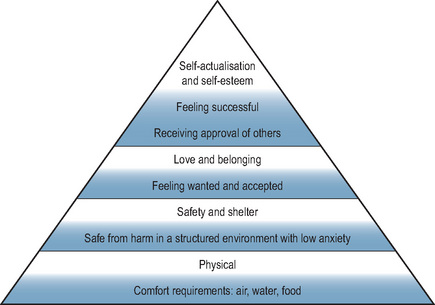
The more intimate relationships between teachers and learners that develop in groups can be understood in terms of the humanistic theories of Rogers (1983) and Maslow (1968). These theories embed individuals in sets of social relationships that need to be optimised for effective personal development and learning to occur. Maslow’s work highlighted the fundamental importance of creating supportive psychological and social environments. He suggested that each individual is motivated to fulfil basic needs (e.g. physiological) before moving on to address other, more complex needs (e.g. psychological); these levels are often portrayed as a ‘hierarchy of needs’ (Maslow, 1943). See Figure 9.1 (and later).
A significant amount of learning comes about through observing and reflecting on the thoughts and actions of others, and group learning is the ideal context for so-called vicarious learning. The discussion that follows observation promotes deep learning and in the context of professional or vocational education this also includes the acquisition of domain-specific language and concepts (McKendree, 2003). Dialogue thus enhances experience through what has been called a ‘conversational apprenticeship’ (McKendree et al, 1998).
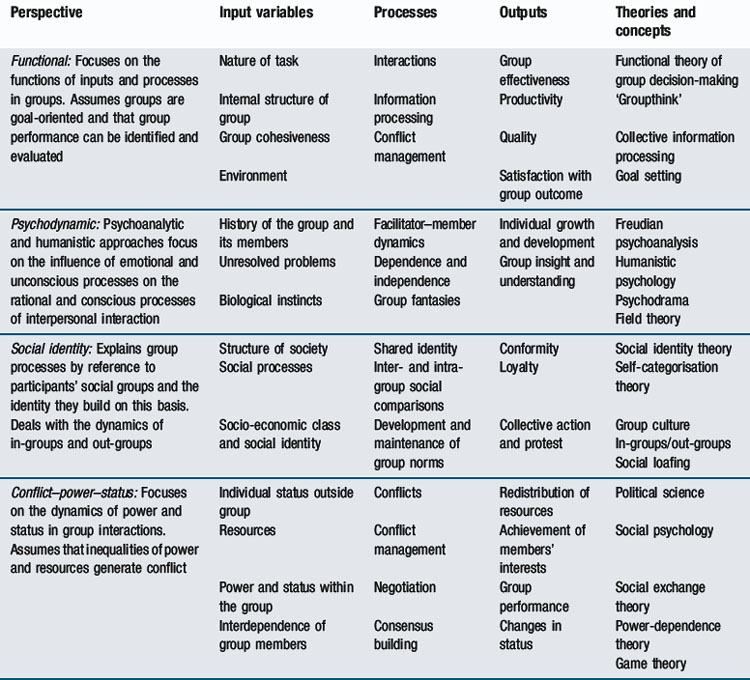
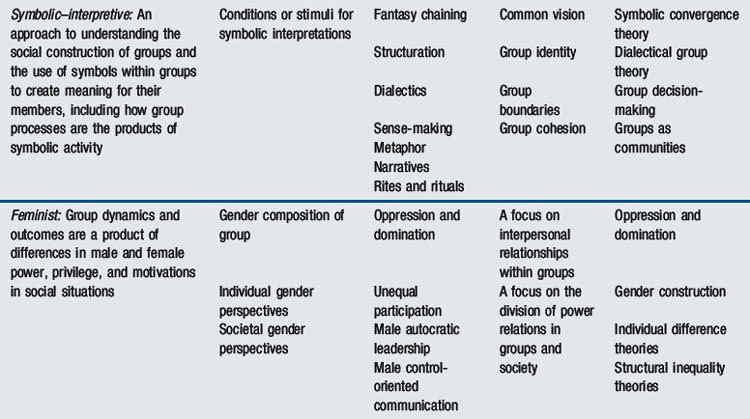
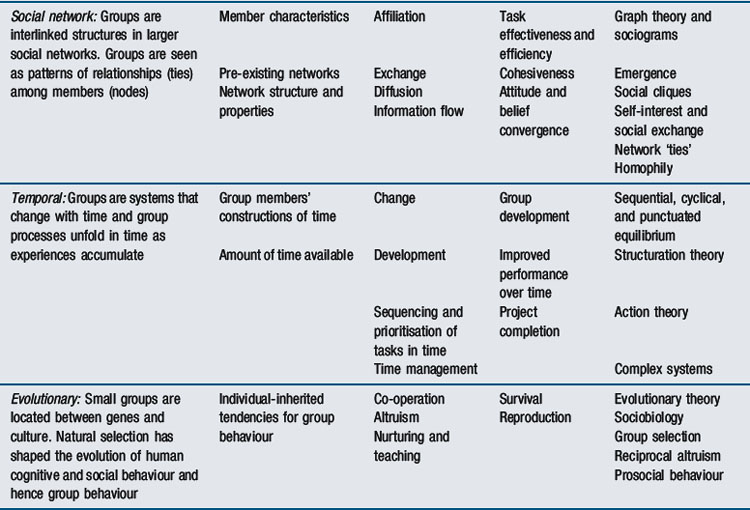
A broader viewpoint on groups has recently been provided by a large interdisciplinary study, which has categorised a number of theoretical perspectives listed in Table 9.2. Each theoretical perspective is briefly described, the inputs, processes, and outputs of group activities are listed, and some of the main theoretical ideas and concepts that the perspective deals with are also listed (Pool and Hollingshead, 2005). Some of the concepts overlap with ideas in social psychology described later, but some are independent theoretical constructs in their own right.
Most recently, the language of complexity theory has been invoked to explain some of the processes and outcomes of small group learning. Mennin explored this in relation to PBL (Mennin, 2007), quoting Arrow et al: “Groups, are open complex systems that interact with smaller systems (group members) embedded within them and the larger systems (organisations, classes, and society) within which they are embedded. Groups have fuzzy boundaries that both distinguish them from and connect them to their members and embedding contexts” (Arrow et al, 2000). It can be argued that all groups (not just PBL groups) demonstrate features of a complex adaptive system; i.e. comprise a set of interdependent units – group members and facilitator – and are non-linear, adaptive, and self-organising.
The social psychology of groups
In addition to educational theories, there are some important social psychology theories that can be used to understand the nature of groups and their dynamics. First, there are theories about social influences in small groups, which deal with issues such as compliance, conformity, and obedience. Second, there are theories that explore concepts such as in-group/out-group behaviour, aggression, and prejudice (Avermaet, 2001). Third, and more important from a small group teaching perspective, there are theories that deal with group performance (Wilke and Wit, 2001). These are discussed in more detail since they illuminate group dynamics and practical facilitation issues. Social psychologists observe that group performance is optimal when members collaborate and use their collective resources effectively. However, as a result of so-called ‘process losses’, such as poor co-ordination of group activities or reduction in the motivation of group members, optimal performance is not always achieved. Process losses can be caused by someone’s mere presence influencing another’s performance, a phenomenon termed ‘social inhibition’. This inhibition can itself be caused by ‘evaluation apprehension’ when an individual is concerned that their contribution will be criticised by other group members. Social inhibition can also be caused by ‘attention conflict’ when, for example, an individual’s attention to a task is distracted by the presence or behaviour of other group members. It is self-evident on the other hand that individuals are often positively motivated by others’ presence. Those inhibitory and activating factors affect different group members in different ways, depending on the nature of the group task; for example, whether it is a simple one with a clear goal or a complex, open-ended one. Other factors in group working identified by social psychologists are ‘social loafing’, when an individual reduces their effort (a motivational loss) so that their contribution cannot be identified, and ‘free-riding’, when individuals who consider their contribution to be dispensable leave the work to other group members. Recognising those phenomena and being able to deal with their consequences are among the most important skills required of a group facilitator.
Conditions for successful SGTL: features of effective small groups
The educational benefits of SGTL can only be realized if the correct conditions are met. The skills of a facilitator, dealt with in a later section, are very important. Here, we describe the organisational, environmental, psychological, and interpersonal conditions for small group interaction to result in deep learning (Box 9.2). Failure to optimise the conditions results in group dysfunction and failure to achieve the full potential of the method.
Preparation is everything
The old adage that ‘by failing to prepare you are preparing to fail’, attributed to Benjamin Franklin (http://www.quotedb.com/quotes/988 – accessed October 2009), is nowhere more relevant than in small group teaching. We now outline some conditions for effective SGTL.
Know your group
Facilitators should find out about the background of the group they will be tutoring, particularly the stage of the programme they are at. Letting people know you know (and care) who they are right from the beginning will greatly facilitate subsequent interpersonal relationships.
Develop appropriate aims and outcomes
In a constructively aligned curriculum (Biggs and Tang, 2009), all learning experiences (lectures, seminars, practical sessions, self-directed learning, and small group teaching sessions) fit together into an integrated whole and are embedded in a matrix of learning outcomes. The facilitator should have a broad idea of what learning outcomes are appropriate for an individual session before it starts. They may be more or less well defined or they may develop as the session progresses, as in PBL when a set of intended learning outcomes is formulated through group debate (see later).
Identify or create resources
While many small group sessions can function without additional resources, some will require use of materials such as worksheets, handouts, video clips, envelopes, cards, pens, overhead transparencies, drawing pins, and flip charts. Reference books and, increasingly, the internet can be used to ensure that factual material under discussion is up to date and accurate. If the session is being used to introduce and rehearse practical skills, then appropriate equipment must be available.
Getting the psychological conditions right
SGTL is most likely to meet its goals if participants are physically, psychologically, spatially, and temporally organised, bearing in mind Maslow’s hierarchy of needs (see Figure 9.1, and later).
Physical conditions
Group size
The size of a group will influence any individual’s ability to make a contribution. Conversation between two individuals will be limited to a modest exchange whilst eight people will contribute a greater variety of alternative viewpoints. But if the membership grows bigger still, individual contributions will be reduced and some people may find themselves inhibited. As stated earlier, evidence and experience suggest that the number that optimises interaction and the variety of knowledge, experience, and viewpoints available ranges from five to eight people. However, as McCrorie noted: ‘group size is probably less important than what the group actually does’ (McCrorie, 2006). Small group techniques can be incorporated into any teaching environment so long as large groups are broken up into smaller units to encourage interaction and active participation (see later).
Group arrangements
The physical arrangement of participants also influences how they interact. The best arrangement is a circular or semicircular configuration of seats, which ensures that all participants can maintain eye contact with one another and the facilitator. Obviously this creates a potential challenge in respect of virtual groups (see later).
The position of the facilitator
A facilitator who physically joins the group is more likely to create an environment that encourages discussion and interpersonal interaction. So, it is generally best for the facilitator to join the circle. On the other hand, if one of the aims of the group session is to foster learners’ autonomy (or if the facilitator finds the temptation to intervene too great), it may be better to sit outside the circle and function as observer and commentator.
Choice of room
The influence of venue on group functioning should not be underestimated. For example, a room may have particular associations in members’ minds and may not be seen as entirely ‘neutral’ territory. Room size is also important. If there is a choice, smaller rooms are more suitable for small groups, but it is sometimes necessary for several groups to work simultaneously in a large room or even in a raked lecture theatre. The advantage of a circular grouping becomes apparent in such situations since group members in an inward-facing configuration can concentrate on their task without too much outside interference.
Interpersonal conditions
Group learning thrives on discourse, debate, discussion, and argument but learners need to feel comfortable engaging in those activities and will be inhibited from participating if the conditions are not right. First impressions are important and many potential problems (see later) can be avoided by the facilitator starting a session in an appropriate way. There are a range of activities that need to be carried out early in a session to create the right conditions and context for deep learning.
Introductions and ice-breakers
When people get together for the first time, there is often a period of embarrassment, insecurity, and even anxiety during which they attempt, consciously or subconsciously, to work out the ‘pecking order’ and dynamics. This process may be slight when members already know one another but will be a significant feature of newly formed groups’ first moments together (especially mixed groups). Effective facilitators use appropriate introductory techniques to reduce anxiety and optimise self-confidence, helping ensure good interpersonal relations later on. The process of encouraging group introductions and facilitating an ice-breaking activity should reduce initial anxiety levels and make group members feel more comfortable. However, it is important that the facilitator is clear about the purpose of an ice-breaker, and articulates that to members. Ice-breakers have the potential to contribute more to a group process than simply to warm it up. They can be used, for example, to develop organisational or decision-making skills, or team working. They can thus be used strategically; in the words of one author “… . they could be used irrespective of their icebreaking properties if they meet the needs of the course or session” (Jones, 1991).
Ground rules
All groups have ground rules, the problem being that they are usually implicit and ‘hidden’ yet may influence, for example, relationships within the group, not necessarily in a helpful way. Before moving into the main part of a group session, therefore, it is worthwhile establishing some explicit ground rules. This is particularly important with a new group, especially one that a facilitator will be working with over a period of time, or if sensitive subjects are to be discussed. Ground rules provide an attitudinal, behavioural, and procedural framework for all subsequent work. The facilitator can recommend a pre-existing set of ground rules, though getting members to generate their own will result in greater likelihood of adherence to them through ‘ownership’. For this, they will probably value guidance and a facilitator’s knowledge of rules that other groups have used successfully will be very useful (see Box 9.3).
Aims and outcomes
Students arrive at ‘deep learning’ by analysing assumptions they have about their knowledge and critically evaluating the meanings they are trying to construct. Thus, most of the aims and outcomes of SGTL are at higher levels of the cognitive and attitudinal domains. They should not, however, just be plucked out of the air. They should gradually be introduced as the context of the session is introduced and revealed. It is sometimes appropriate, however, for students to generate their own learning outcomes. That is a fundamental feature of PBL but may also occur in more traditional group settings. It is useful to discuss with learners if there are any specific outcomes they might like to achieve over and above those intended. Important outcomes may emerge during sessions and facilitators should be responsive enough to incorporate them.
Clarifying tasks
Tasks and activities direct the focus of a group and so the facilitator needs to give clear and unambiguous instructions. Group members need to know precisely what they are supposed to do, how long to take, what to do when they have finished, and what to do if they need help. Depending on the tasks and the number of groups involved, verbal explanations may be all that is required but using a flip chart or handout can be useful.
Facilitation
Facilitation has been defined as ‘ensuring the right structures and processes exist for helping the group to meet its agreed objectives, and in helping the group members to identify and overcome problems in communicating with one another and in managing emotions’ (Elwyn et al, 2001). In this section, we examine the facilitator’s role, including attitudes towards learners and towards groups, aspects of communication such as questioning and giving feedback, and time management and organisation.
Attitudes towards individual learners
An effective facilitator will have an attitude that encourages participants to talk, debate, and question. A facilitator needs to be ‘learner-centred’, acknowledging learners’ needs and their existing knowledge and skills, and building on them in an active, collaborative, and democratic way. They must recognise the autonomy of individuals and the responsibility they have towards their own personal growth and development. For some teachers, giving up their didactic ‘transmitter of knowledge’ role and adopting a more learner-centred approach is challenging. For others, it is a liberating acknowledgement of something they have always known: that people learn best when they are in control and, with appropriate support, take responsibility for their own learning. In the words of Carl Rogers, “As I began to trust students … . I changed from being a teacher… to being a facilitator of learning” (Rogers, 1983). There is a spectrum of potential interventions from total control at one end to a completely ‘hands-off’ approach at the other. A facilitator must be flexible enough to move back and forth along this spectrum in response to the evolving aims and dynamics of particular groups.
The nature of learners
A fundamental issue concerns the status of human knowledge, a topic that is also covered in Chapter 2. Are we born with some innate knowledge and a ‘human nature’ encoded in the hardwiring of our brains? Or are we born with a mind that is a blank slate or ‘tabula rasa’ on which experience writes (Pinker 2002)? Are we the products of ‘nature’ or ‘nurture’? The answers we give to those questions influence how we structure educational environments and how facilitators interact with learners. If we think learners are ‘blank slates’ we will assume we can mould and manipulate them as we please. If, on the other hand, we accept that human beings have a ‘nature’, then we will be more receptive to some of the developments in cognitive psychology and neuroscience that support constructivist teaching methods (Goswami, 2004).
Self-actualisation
As previously explained, Maslow (1968) argued that an important motivating factor in human behaviour is “the need to become as much as one can possibly become;” to self-actualise. Each person has a hierarchy of needs (Fig 9.1) that must be satisfied, ranging from basic physiological requirements to love, esteem, and finally, self-actualisation itself. Box 9.4 lists the tasks that face the facilitator in helping create the conditions for the needs to be met and, ultimately, self-actualisation to occur.
Box 9.4 Maslow’s hierarchy of needs and task for the facilitator
| Needs | Tasks |
|---|---|
| Self-actualisation needs | Encourage personal growth through helping learners develop insight and self-awareness, openness to change, and problem-solving skills. |
| Self-esteem needs | Praise good work and new ideas but give constructive and specific feedback. Be optimistic and supportive. |
| Social needs | Adopt a caring attitude towards participants. Encourage groups to interact and bond by means of appropriate warm-up activities and collaborative tasks. |
| Safety needs | Treat participants with respect and honesty. Ensure that participants remain within a psychological ‘comfort zone’ with minimum anxiety, respecting personal privacy and confidentiality. Create ground rules. |
| Physiological needs | Make sure that rooms are big enough, well ventilated, and neither too hot nor too cold. Ensure that seats are comfortable. Participants need regular breaks for food, drink, and the toilet. |
Carl Rogers, who also supported the concept of self-actualisation, developed his person-centred psychotherapeutic ideas to deal with the optimum type of human relationships that would lead to educational effectiveness (Rogers, 1983). His key principle was that individuals have a self-actualising tendency focused on achieving their own potential, and their individuality needs to be respected. Facilitators must demonstrate a positive and trusting attitude, personal genuineness, and empathy. Facilitation is about building relationships, the implication of which is that facilitators should engender a climate of trust, allow students to participate in decisions about their learning, and encourage curiosity and a desire to learn. In addition, facilitators should help students build confidence and develop self-esteem. All those attributes are ones that facilitators need if they are to run small groups successfully.
Student-centred learning
The ideas of Maslow and Rogers are also related to the concept of learner-centredness. The idea of child-centred education can be traced back to eighteenth- and nineteenth-century scholars, particularly Jean-Jacques Rousseau. It was also advocated by the American philosopher John Dewey (Dewey, 1916), who asserted that educational processes must start with and build upon the interests of learners; they must involve both thinking and activity; the teacher should be a guide and co-worker (i.e. facilitator) rather than someone who prescribes rigid learning tasks (teacher-centredness); and the goal of education should be the personal growth of individuals. Those ideas resonate strongly with the concepts of client-centredness in psychotherapy and patient-centredness in clinical practice (Stewart et al, 2003). Acknowledging the importance of the learner’s own cognitive framework as a platform for building further knowledge and understanding is a fundamental assumption of constructivist theories of learning (Dennick, 2008).
Adult learning
Medical education is aimed at adult learners, a type of teaching and learning for which Knowles (1990) coined the term ‘andragogy’. Adults have needs and motivations that are different from those of younger learners and they approach learning situations with more mature expectations. From the point of view of group learning, adults have more life experiences to draw on in discussions. Facilitators therefore need to be aware that they are dealing with independent adults with rich personal backgrounds rather than dependent children with relatively little experience. The concept of the ‘adult learner’ has, however, been contested (Norman, 1999), as also discussed in Chapter 2. Andragogy is predicated on adult learners’ ability to identify their own learning needs and monitor their progress in meeting those needs. There is, however, little empirical support they can do so reliably. Indeed, some people are notoriously inaccurate at identifying their learning needs and assessing their own performance (Eva and Regehr, 2008). Also, differences between the way adults and children learn may be less than previously thought, and so the concept that ‘adult’ learners are distinct from child learners is debatable.
Attitudes towards groups
Having dealt with individual attributes that are relevant to group facilitation, we now explore the attitudes facilitators might have towards the group. Lewin (1951) is one of the more important authors to have addressed this problem and his categorisation of facilitators as ‘democratic’, ‘autocratic’, or ‘laissez-faire’ is a useful starting point. Autocratic facilitators are authoritarian and control all the objectives and activities of groups and intervene constantly. Laissez-faire facilitators allow groups to decide what their objectives should be and what activities they will carry out, intervening minimally. Between those two extremes, democratic facilitators collaborate with groups on objectives and activities and only intervene to keep them orientated. Lewin found that groups operated best when conducted in a democratic manner. Facilitators, however, may adopt any of these roles in different situations and even during the same session.
John Heron has made an important contribution to understanding the structure and dynamics of group learning with his ‘six dimensions’ of facilitation (Heron, 1989). According to him, facilitators need to be aware of six independent influences on group processes that weave constantly through each session:
A fundamental question is whether the facilitator, the group, or a combination of the two decide on each of these dimensions. This leads to three modes of facilitation for each dimension, a classification reminiscent of Lewin:
Heron suggests that the most effective attitudinal stance for a facilitator is to value autonomy, co-operation, and hierarchy in that order as this acknowledges the personal autonomy of group members to self-actualise in collaboration with others, the facilitator taking responsibility to achieve group goals.
Communication in facilitation
The skills of initiating, structuring, and monitoring a group session have been described. However, in addition, effective communication skills are absolutely essential. The ability to listen, respond, question, and explain, and to be flexible constitutes a set of key communication skills that all facilitators should possess. These are similar to core skills for effective communication in a range of other contexts, not least doctor–patient interactions (Kurtz et al, 2005).
Active (or attentive) listening
Non-verbal communication is a key element of ‘active’ or ‘attentive’ listening. Maintaining eye contact and using appropriate facilitatory gestures, for example, nodding and making encouraging noises (“Uh-huh”, “Go on”, and so on) are essential micro-skills. Hand gestures may be used, consciously or unconsciously, to guide discussion (e.g. bringing in or shutting out a participant). Being attentive requires a focused awareness of oneself and one’s surroundings, a kind of ‘situational awareness’. It requires alertness to the presence of cues, both verbal and non-verbal, which indicate levels of engagement or discomfort of members. When there is an incongruity between verbal and non-verbal messages, the non-verbals have it! (Silverman et al, 2005). Responding appropriately to such cues is important and demands sensitivity and judgement. Paraphrasing and summarising (the discussion) are also useful tools that help both the learner and the facilitator.
Questioning
Learning is driven by questions, not answers. When learners are questioned, they have to think; whether they respond is another matter. Questioning serves a wide variety of functions: arousing interest and motivating learners; activating prior knowledge; diagnosing strengths and weaknesses; checking progress and understanding; assessing achievement; manipulating group dynamics by encouraging participation and discussion; encouraging deep-level thinking and active learning; modelling professional thinking and providing new insights; and reviewing and summarising (Sachdeva, 1996). Questions and questioning techniques can be categorised in a number of ways (Box 9.5).
Open and closed questions
Closed or ‘convergent’ questions are usually limited to a single answer and are thus directed at the lowest levels of cognitive activity, namely recall. They are useful in establishing facts and activating prior learning at the beginning of a session. Because they are generally straightforward and usually easy to answer, they are also useful in warming up learners before moving to more complex questioning. Open or ‘divergent’ questions, on the other hand, are of a higher cognitive order. They may have several possible responses or no fixed response. They may require learners to defend or justify a particular course of action or moral position, apply their knowledge in novel situations, or make judgements requiring the critical evaluation of evidence. They demand more elaborate and thoughtful answers and cannot usually be answered by simple recall. They elicit deep-level thinking and can focus, for example, on application and problem-solving, analysis of complex concepts, creative speculation, and decision-making.
Questions aimed at different levels of the learning hierarchy
Bloom’s revised taxonomy (after Anderson and Krathwohl, 2001), previously referred to, can be used to formulate different levels of questions in the cognitive domain of learning, see Table 9.3.
Probing questions
There will always be situations when facilitators need to ask questions to encourage learners to clarify or elaborate their initial responses. Those probing questions, and questioning sequences allow facilitators to ensure that deep-level thinking is taking place or to diagnose misunderstandings and take appropriate action. Such questions can be classified into the following types: prompting; justifying; clarifying; extending; and re-directing. A prompting question is used when a learner does not respond to a question or gives an incorrect or incomplete answer. The question might contain suggestions, clues, or a ‘prompt’ that will trigger the necessary response. Justification questions can be used when a learner has provided a correct answer without explaining why they chose it. If a learner has articulated an answer poorly or given an incomplete one, clarification can be sought. The student can be asked to re-phrase or elaborate their answer until the facilitator is satisfied they have answered the question satisfactorily. Extension questions ask learners to extend their thinking to new situations. Their answers may give clues to the depth of their understanding. Finally, re-direction questions ask different students the same open-ended questions to generate a variety of responses and increase participation.
The questioning process
As well as having a good working knowledge of question types, facilitators need to be aware of the ways questioning can affect learners’ behaviour. For example, simple closed questions activate prior learning at the beginning of a session and encourage participation, whereas open-ended and more complex questions might be used later in the session. So-called ‘pivotal questions’, incorporated prospectively into a questioning sequence, are usually planned ahead. Emerging questions, on the other hand, are not planned and reflect a facilitator’s ability to adapt according to the particular demands of the situation. The facilitator’s approach to asking and responding to questions may have powerful effects on group dynamics. They should generate an atmosphere of trust and co-operation, which will make members feel comfortable about asking and responding to questions and confident that they will not be ridiculed when they expose their lack of knowledge. The way in which questions are asked can have a significant impact. For example, people should be given plenty of ‘think time’ to respond before the facilitator either re-phrases the question or uses a prompting question. It is useful to tell students in advance that they are going to have plenty of time to think about their answers. There is evidence (Carin and Sund, 1971) that leaving a long silence after asking a question makes students more likely to respond and result in longer and more elaborate answers.
Responding to answers
How a facilitator responds to an answer is not only extremely important to the individual answering the question but also sends messages to the rest of the group about how they will be treated if they answer a question. A correct answer should be acknowledged and positive, supportive feedback given. If an answer is incorrect or incomplete, probing techniques discussed previously should be used. On no account should a facilitator use negative, sarcastic, or personally demeaning language. One can speculate (correctly, as it happens) that Albert Einstein suffered as a result of such an approach when he wrote “Humiliation and mental oppression by ignorant and selfish teachers wreak havoc in the youthful mind that can never be undone and often exert a baleful influence in later life” (Einstein, 1934).
Socratic questioning
So-called ‘Socratic questioning’ is a form of questioning that brings together all the skills and types of question referred to earlier. It aims, through systematic dialogue, probing, and challenging understanding, to promote critical thinking. A facilitator poses a question, then responds to the answer with further questions. The dialogue evolves in an organic fashion but is not a free-for-all. Participants are helped to go beneath the surface of the topic and delve into the complexities of one or more fundamental ideas (https://www.criticalthinking.org/TGS_files/SocraticQuestioning2006.pdf – accessed November 2009).
Giving feedback
Feedback, described as ‘the lifeblood of learning’, aims to close the gap between current and desired performance. It is as much about the future – feeding forward – as it is about the past. It is important because, as previously mentioned, self-assessment can be inaccurate with, on the whole, poor performers tending to overestimate their abilities, and good performers tending to underestimate (Regehr and Eva, 2006). Feedback is one of the areas of teaching, learning, and assessment that has a significant evidence base and general principles can be drawn from the literature to inform the process, whether the feedback is to a group or an individual. In terms of influences on learning, specific information about ‘the task’ – how to do it more effectively – focused on goals or intended outcomes appears to be more effective than rewards, marks and grades, punishment, or praise. Indeed, praise that is non-specific and targeted at the person, however well-intentioned and ‘nice’, may have an adverse effect. Furthermore, although people need and generally crave feedback, they may not be very good at receiving it, and it invariably invokes an emotional reaction. A host of defensive reactions have been described, including ignoring feedback, or arguing against it – ‘shooting the messenger’.
Generally, then, constructive feedback should be: based on observation, not inference; descriptive and non-judgemental; specific and concrete; as succinct as possible; and linked, where possible, to goals or intentions. It should also be timely; feedback given at the wrong time and in the wrong way is worse than no feedback at all. Various models have been described for one-to-one feedback, such as the so-called Pendleton’s rules and agenda-led, outcomes-based feedback (Kurtz et al, 2005), which can be adapted for group situations. An important principle is to ask the recipient what they feel is working well, then get them to consider things they might do differently. Elwyn et al (2001) suggested a set order for giving feedback to a group, giving priority to individual(s) first, followed by the group, and last the facilitator. Feedback is a key component of assessment and evaluation in groups – see later.
Time management, monitoring, and control
Facilitators have a responsibility to manage and direct the work of a group effectively and efficiently despite the often open-ended and potentially unstructured nature of their work. They should make clear during the introduction or setting of ground rules that the session has aims and outcomes, a focus on particular activities, a specific structure, and that it has to finish at a particular time. Facilitators perform a balancing act between being autocratic and hierarchical, and allowing autonomy and a ‘laissez-faire’ attitude; they are essentially benign dictators in charge of the group’s freedom! Good time management and organisation also induce confidence in the participants which translates into effective and efficient group dynamics. The facilitator needs to ensure that the group remains focused on the task(s), whilst keeping a watchful eye on group dynamics. It is important to monitor the group’s achievement and progress and it may be useful to record it, either to strategically use the information or simply for ‘the record’. For example, after a ‘brainstorming’ activity, the ideas generated may need to be recorded for subsequent analysis and prioritisation; during a discussion, opinions and questions might be listed to clarify issues, or guide further study. Finally, conclusions and action points of the group need to be recorded.
Closure
An important feature of all teaching sessions is closure, during which achieved outcomes can be summarised, conclusions emphasised, reflection promoted, and learners’ sense of accomplishment nurtured. An effective facilitator will have the time management skills to ensure that there is time for closure. A useful technique is to ask members of the group to summarise the key points learnt, which can use ‘pyramid’ techniques (see later) or a facilitated discussion in which all group members participate.
Types of group
There are many types of small groups, each with its own particular dynamics and each requiring different approaches from the facilitator. We now look at several common types encountered in medical education, and consider how the conditions necessary to create effective group function can be applied.
‘One-off’ groups
This type of group, in which students do not necessarily know either one another or the facilitator and will not meet again, is familiar in clinical settings. The facilitator’s key task is to ‘warm up’ participants and encourage them to talk to one another. There should be special emphasis on anxiety-reducing measures: friendly introductions, ice-breaking activities, non-threatening questioning to activate prior learning, and clear, unambiguous instructions and goals. Because the group will not convene again, it is worth saving time by recommending a set of ground rules rather than getting the group to generate them de novo. Such a group is likely to be very task-oriented, focused, for example, on a specific topic, but even so, will ignore group process and dynamics at their peril.
Regular groups
A common example is a PBL group meeting weekly during a whole semester. Members get to know one another and the facilitator, resulting in better group interactivity and collaboration. Introductions, ice-breaking, and ground rules can be tackled in the first meeting and minimised in subsequent sessions, leaving more time to work on subject matter. The regularity of meetings makes it possible to rotate roles and duties, such as chairing, recording, and summarising progress, demonstrating practical procedures or giving presentations, thus helping participants develop a range of useful skills. Seeing group members over an extended period allows an observant facilitator to monitor the development of interpersonal skills, depth of thinking, strengths and weaknesses in particular situations, and maturing of attitudes in individual learners. Sensitive, confidential feedback from the facilitator can enhance all those developments.
Potential disadvantages of regular small group meetings are that group members may develop antipathy towards one another, which might inhibit collaboration or cause outright conflict. However, a good facilitator who watches out for the development of such problems can hopefully prevent them arising or, if they do, can minimise their effects on group dynamics.
Mixed groups
The individual members of a mixed group differ from one another, for example, in terms of their knowledge, experience, or professional group. For example, a multi-professional group of health professionals might include medical students, doctors of varying levels of seniority, nurses, physiotherapists, and social workers. Working together in multi-professional or multi-cultural groups helps learners, in theory, accommodate one anothers’ beliefs and cultural views, and challenges prejudice. Although there is significant potential for conflict, the tensions within such a group can also be fertile ground for creative learning. The most important issue for a facilitator is to acknowledge differences openly from the start and to stress the benefits that can result from diversity. Problems can then be viewed from the holistic perspective of multi-professional teams, which is much more analogous to professional practice (Becher, 1989); see also Chapter 4. Encouraging students to explore their different knowledge bases, values, and perspectives together can lead to much useful learning.
Peer-led groups
Learners have long gathered together spontaneously without a tutor or facilitator to study or revise, and self-help groups and learning sets (see Table 9.1) have become commonplace in postgraduate and professional settings. Now, student-led group working is gaining prominence as a formal component of undergraduate medical curricula (Ross and Cumming, 2009) not only in recognition of its inherent virtues but also as a pragmatic response to increasing student numbers, and because professional regulating bodies require graduates gain experience in areas such as leadership and teaching skills (General Medical Council, 2009). Many benefits are claimed for so-called peer-assisted learning (PAL): it is self-evidently learner-centred; it can foster collegiality and collaboration; it can nurture the development of generic skills such as facilitation; and there are potential pedagogic gains – not least the value of learning through teaching, but also positive effects on motivation. More able students benefit from helping their less able peers, which leads to deeper and more lasting understanding (Biggs and Tang, 2009; Boud et al, 2001). There is, as well, convincing theoretical support for PAL from cognitive, affective, and organisational perspectives (see Ross and Cumming, 2009). Disadvantages include the learning being patchy or superficial, the potential for dysfunction and conflict within groups, and ‘value for money’ to the institution, given the amount of organisation and faculty support that some PAL schemes seem to require. There are many variations on the theme; for example, group members may all be at the same stage or senior students may act as facilitators, instructors, or mentors. It is important to recognise that not all students are suited to the role of tutor, so they have to be carefully selected, then trained and supported.
Problem-based learning groups
PBL, or perhaps less ambiguously ‘problem-first learning’ (Maudsley, 1999), is an instructional method in which a problem is the primary stimulus for learning (as opposed to the more traditional approach of theory first, problems later). The problem is, typically, a carefully crafted written scenario describing a problem such as clinical case which can only be fully understood by further enquiry. In small groups, with or without a tutor, learners explore the problem, identify gaps in their understanding, decide what they need to do to fill the gap – then fill it. This inquiry is carried out over a week or two, often supplemented by ‘resource sessions’ of one sort or another. A number of theories provide ‘compelling support’ for PBL (Albanese, 2007), including information processing theory, co-operative learning, self-determination, and control theory. The role of the PBL tutor has been described as a ‘custodian of the group process and guide for discovery’ (Maudsley, 1999). PBL has been the subject of a vast amount of research, often with conflicting findings. Notably, the debate about whether a facilitator should be a ‘content’ or ‘process’ expert is still unresolved, although intuition might suggest that a content expert with exemplary process skills would be the ideal. The research has been confounded by variable definitions of what constitutes ‘content expertise’. However, Albanese has argued that the more important question is not whether content expertise is important, but what is the minimum expertise needed for effective tutoring (Albanese, 2007). He quotes a recent review article on the topic whose title, he contends, sums up the ‘state of the art:’ Problem-based learning: the confusion continues (Miflin, 2004).
One consistent finding in research, however, is that both learners and faculty enjoy PBL. There is a need for an on-going faculty development to sustain PBL programmes and prevent didactic, teacher-centred learning from dominating tutor interventions.
Challenging or dysfunctional groups
Conditions for effective group learning need to be maintained throughout a session. This involves monitoring the progress of the group as described earlier, and also monitoring the activity and contributions of individuals whose behaviour may affect group functioning, for better or worse. In all cases, ‘prevention is better than cure’. The best way for a facilitator to deal with the challenge of a dysfunctional group is not to let it become dysfunctional in the first place.
Dysfunctional organisation
Groups become dysfunctional when facilitators do not pay attention to preparation, organisation, and monitoring, leaving group members anxious and reluctant to participate. Activities should be appropriate to the group’s experience or maturity and the facilitator should check that activities are not too complex to be completed within the time available and not so simple that they leave time to spare.
Dealing with group conflict
Conflict is an essential, even desirable, feature of a group process since it exposes opinions and engages participants in debate. Participants challenging the assumptions of others may lead to conflict and even hostility. ‘Cognitive dissonance’, a state in which someone is confronted by a perception, idea, or fact that does not fit into their cognitive framework (Festinger, 1957), can be a powerful stimulus to learning. Acknowledging that disagreement may arise but that it is legitimate will help set the scene. Emphasising the importance of adhering to ground rules, not using ad personam arguments, and criticising peoples’ arguments rather than them as individuals reduces the risk of hostilities. Another helpful ground rule is to get members to ‘own’ their comments (“I think … .” rather than “Doctors think … .” unless, of course, the assertion is evidence-based!). Sensitively monitoring debates helps facilitators prevent hostility but should conflict arise, it is important to establish the cause(s) at an early stage and encourage ‘ownership’ of the problem. Getting the group to write about issues on a flip chart or self-adhesive notes may help. It is also important for the facilitator to be alert to some of the ‘games groups play’, such as scapegoating (i.e. ‘sacrificing’ a group member by focusing on their behaviour and diverting attention away from group dynamics) or ‘flight’ (where the group goes into a state of denial of conflict, for example, by adopting distracting behaviours, changing the subject, trivialising issues through use of humour, etc.). Ideally, a skilled facilitator will use conflict creatively and help the group learn something from it.
Dealing with dominant group members
One of the commonest questions asked by group facilitators is ‘How can I deal with the situation where one person dominates the discussion and prevents others from participating fully?’ Reminding the group of ground rules about participation can help, supplemented by a gentle statement such as: ‘John, you’ve made quite a lot of interesting points, can we hear from someone else?’ Breaking the group into smaller units or pairs to allow individuals to talk to one another should also prevent domination by one individual and give others an opportunity to discuss. If dominant behaviour still continues and threatens to disrupt the group, then stronger measures are called for. The use of peer pressure and group consensus are often more effective than requests from the facilitator. When such a situation has arisen, it is important to discuss it with the person outside the group. Ultimately, a facilitator has the responsibility of ensuring ‘the greatest good for the greatest number’ and might have to ask a challenging participant to leave the group.
Dealing with passive group members
Another common problem is a very quiet group, whose members seem reluctant to participate. The most important thing to do here is warm up the group and use ice-breakers that will help members feel comfortable with one another. That will be less effective when the problem is a boring, trivial, or overwhelmingly complex material, is either too advanced or too basic for the group, or if the facilitator has slipped into ‘lecture’ mode. Nonetheless it is important not to assume that a quiet group member is only superficially or passively engaged with the group’s tasks. There may be a cultural explanation, such as the learner in question coming from a background in which deference to tutors and a seemingly passive approach to learning are the norm.
Dealing with a non-participating individual
Since one of the goals of SGTL is to develop interpersonal communication, complete non-participation is not an option, and this should be made clear to participants while framing ground rules. A non-participating individual might, of course, simply be very shy, unhappy, anxious, or ill. As with a passive group, cultural factors may also be relevant. It is the facilitator’s role to make an individual diagnosis whilst maintaining group collaboration.
Dealing with cynical group members
Some participants, particularly those who strongly prefer passive or solitary learning or who enjoy didactic teaching and are simply focused on acquiring facts, will find group learning challenging. They may not understand that they will develop important interpersonal skills as a result of interacting within a group or that they will achieve deeper learning from engaging in discourse. One approach is to promote ‘metacognition’ through encouraging individuals to explore their underlying beliefs about learning, and how they learn. Rewarding cynical participants with positive feedback on their contributions can also help to bring down barriers.
Developmental stages of a group
Groups are ‘developing and thriving organisms’ (Jaques and Salmon, 2007). Tuckman described a four-stage developmental process – forming, storming, norming, performing – arguing that it is inevitable and necessary for a group to go through those stages in order to function effectively (Tuckman, 1965). While ‘forming’, group members are orienting themselves and checking out what is expected in terms of behaviour, tasks, and roles. Figuratively speaking, the main question at this stage is ‘Why am I here?’ and group dependency is high (see Table 9.4). The ‘storming’ stage is characterised by conflict and polarisation as members attempt to change the group to meet their own needs. Conflicts such as role assignment, role strain, and role ambiguity may arise. The question here is ‘Why should we do things this way?’ Although diversity within a group is more likely to generate tension and be more challenging for a facilitator, such groups are often more flexible, creative, and adaptable in the long term (Jaques and Salmon, 2007) and less prone to ‘group think’ if the tension can be harnessed. In the ‘norming’ stage, tensions are reconciled through negotiation, and perhaps, compromise. Group cohesion begins to develop, and energy and attention are increasingly focused on the group’s aims and tasks, and group norms emerge and ground rules are established, the main question now being ‘How shall we do things?’ Finally, in a group that is ‘performing’, members have settled into functional roles, and the group’s energy is channelled into the task. That is not to say the group will go on to achieve its tasks effortlessly. In fact there needs to be a ‘constant cycle of observation, reflection and intervention’ (Elwyn et al, 2001) to avoid dysfunction. Tuckman later added a fifth stage, ‘adjournment’, recognising that groups that have existed over a period of time may go through a phase akin to mourning as the group winds down, tasks are completed, roles terminated, and dependency reduced. Other developmental models have been described; for example, a seven-stage model whose authors claim it is particularly pertinent to situations where the group leader has particular responsibility for effective functioning of the group (Jaques and Salmon, 2007).
Table 9.4 The relative influence on members’ behaviour of individual, group, and task needs, and dependency on the facilitator, during Tuckman’s development stages
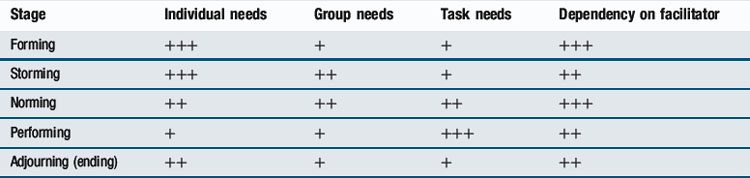
It is important for facilitators and group members to understand that a group will experience these stages, sometimes with ‘regression’ to previous stages (e.g. if there are personality clashes or if the group has difficulty understanding the tasks). If the stages are negotiated successfully, the group will function more efficiently and harmoniously. Table 9.4 illustrates relationships between the needs of individuals, the group, and the task, and dependency on the facilitator in each of Tuckman’s stages.
Group techniques
David Jaques described one of the key principles of effective facilitation as ‘More structure, less intervention’ (Jaques, 2003), and this can be achieved by building in exercises that demand participation and by breaking a group into smaller units to promote active participation. Although this chapter is not intended as a ‘How to Do It guide’, it is pertinent to describe briefly some of the techniques that can be used in this way.
Brainstorming
The purpose of brainstorming is to promote creative thinking, although it is also useful as an ice-breaker and for activating prior knowledge. Important principles are that: the problem or question should be clearly articulated; “anything goes” (within reason!); and “quantity breeds quality”, based on the notion that it is necessary to work through conventional ideas in order to reach original ones. It is important, however, that the generation of ideas is separated from their evaluation since the latter may stifle the creativity that is the hallmark of the technique. Despite its popularity, the technique has been criticised by social psychologists on a number of counts, including a contention that its creative potential is illusory and that other group methods such as nominal group technique (see later) are more productive (Elwyn et al, 2001).
Buzz groups
A buzz group is one of several structured methods of breaking down group into smaller units. Working in pairs or 3s, usually for just a few minutes, group members undertake a task (“Discuss the reasons why …”) or tackle a problem. The task needs to be clear and achievable within the time allocated to it. Once the buzz has died down, the facilitator solicits feedback from the subgroups; for example, key points from the discussion using a technique such as a round robin (“One key point from each pair …”). The ideas generated can then be summarised, analysed or synthesised unless the method is used simply to ‘unstick’ a group or activate prior knowledge, when there is no need to use the generated material.
Snowball (or pyramids)
This technique builds on the buzz group principle, allowing ideas and concepts to be developed in a structured fashion through a progressive doubling of subgroup size, for example, from 2 to 4, then to 8, and so on. It is important, however, that each step-up demands a new level of challenge and is not merely a repeat of the previous task – boredom and hostility will ensue quickly if not!
Nominal group
A technique more commonly used in research and development that aims to identify and rank problems related to a predefined topic, a nominal group allows consensus to be reached fairly quickly, is pragmatic, and is efficient. The group is ‘nominal’ in that the interactions are highly structured, but it has been shown to generate a better range of ideas than brainstorming. It gives everyone a voice and overcomes problems of hierarchy (the technique was originally devised, appropriately enough, in the context of community development – Delbecq et al, 1986). Silent generation of ideas is followed by a ‘round robin’ (one idea per person), when all ideas are listed. Those ideas are then discussed, clarified, reworded, grouped, or broken down into simpler categories, before a series of ranking exercises, which prioritise the ideas. Obviously, a facilitator using this technique necessarily adopts a dominant and directive role.
Line-up
Line-ups are useful for swiftly surveying opinion or soliciting attitudes about a topic, when there is likely to be a range of views. Participants take up a position representing their views along a hypothetical line representing the possible range. Their reasons for choosing the position are justified and further discussed. Line-ups are useful for ‘unsticking’ a group (or waking one up!), with the clear benefit that it requires physical activity and considerable interaction as people negotiate their positions.
Role play
Role play is a powerful method for exploring different scenarios and experimenting with different approaches, particularly in the area of interpersonal communication, attitudes, and feelings (van Ments, 1999). It provides an opportunity for rehearsing new skills and can generate new insights, promote empathy, contextualise understanding, and integrate thinking and feeling. It can be thought of as ‘a safe introduction to reality’ – it is not the real thing, but almost (even though the scenario is a simulation and demands some suspension of disbelief, the thoughts and feelings evoked are perfectly genuine). Its use requires care, however, because it can distress individuals if misused and may damage group dynamics or trust. Facilitators need to be clear, therefore, why they are using role play, and what they intend to achieve. Roles need to be carefully prepared and clearly described. There should be adequate time for preparation and briefing, for enactment, for reflection and discussion, and finally for debriefing (the latter particularly when the role play has tackled an emotionally challenging issue). Many areas of learning can be explored using role play, focused on a role, a situation, and/or a task (Elwyn et al, 2000).
Fishbowl
The fishbowl is a technique commonly used with role play. Participants sit at the front or in the middle of a group, which observes the action. Whilst a role play is enacted, those ‘outside’ the bowl observe and then give constructive feedback on specific things they agreed to observe. There are many variations on the fishbowl theme, depending on the intended purpose of the session (see Jaques and Salmon, 2007).
Such techniques provide effective means for promoting interaction and participation. However, they should not be used simply for their own sake – it is important to think strategically about why and when a technique might be used, as well as how. The reader is referred to the Further reading at the end of this chapter for more extensive guidance on using these and other techniques.
Virtual groups
The globalisation of learning and advances in technology have increased the use of on-line learning, and thus of virtual groups, both synchronous (i.e. interacting in real time) and asynchronous. The main differences between face-to-face and virtual groups include: the obvious dependence on technology; the context, notably physical location; the timing and immediacy of interactions; and opportunities to record and archive discussions, and to monitor contributions. There are also obvious communicative differences resulting from lack of face-to-face contact, notably absence of non-verbal signals (despite the advent of videoconferencing using webcams). On-line discussion, however, may be of particular value for less assertive learners; also, it allows more time for participants, including the e-moderator, to consider their words, reflect on and review the discussion, and to formulate responses.
Despite the aforementioned points, it can be argued that there more similarities than differences between virtual and face-to-face groups, in terms both of factors that promote effective function and factors that detract from it. Most of the structured group techniques described earlier (and more extensively in other texts – see Jaques and Salmon, 2007) can be adapted for use on-line. Group dysfunction will, however, occur if members are not sufficiently involved in the discussion, or if tasks are not clear. Participants in virtual groups need ‘to learn how to collaborate all over again’, with communication lying ‘somewhere between the formality of the written word and informality of the spoken’ (Jaques and Salmon, 2007). Put another way, ‘Working together on-line involves a hybrid of familiar forms of communication’ (Elwyn et al, 2001). Planning is as crucial as in other contexts, and particular questions e-moderators should ask themselves include: How will members interact? How much input will be required from the e-moderator? Do I need to break group size down and, if so, what techniques will I use? and, Who will lead discussions, summarise them, and chase-up contributions?
Key requirements for effective function of virtual groups
Key requirements include thoughtful design of tasks, flexible facilitation, and technical support. As with face-to-face groups, the early stages are crucial, and time invested by the e-moderator in articulating objectives and clarifying tasks will be time well spent. Participants also need time to become acquainted with the technology and clear guidelines about modes of collaboration. Ground rules are as important as in other contexts, as are ice-breakers that encourage social interaction and personalisation of participants through, for example, short autobiographies.
In the absence of the social and contextual clues that influence face-to-face communication and group dynamics, the tasks faced by an e-moderator are somewhat different. They include: ‘weaving’, that is, synthesising and integrating various threads, and keeping the discussion moving; summarising; sorting and archiving material. Problems often arise because of delayed or muddled discussions, or poor time management (Jaques and Salmon, 2007).
Encouraging active participation is a continual challenge but can be achieved using so-called ‘e-tivities’. A framework for crafting such activities has been proposed (Jaques and Salmon, 2007). An e-tivity should be as simple as possible; it requires an illustrative title and a stimulus or challenge, also known as ‘the spark’. An invitation to respond is followed by the interactive element including responding to the postings of other group members, and provision of clear timelines. Finally, there should be a summary, possibly some feedback from the facilitator, a critique, and crucially, reflection.
The received wisdom is that a virtual group will function reasonably effectively, efficiently, and spontaneously with up to 15 members. Above that number, a facilitator will probably have to use similar techniques to those used in face-to-face groups to break down the group into smaller units for some or all tasks. For example, buzz groups can be created (using email or bulletin boards) that can then lead to snowballing, with the large group eventually reconvened to share and synthesise ideas.
A 5-stage developmental process has been described for virtual groups (Jaques and Salmon, 2007). Each stage requires mastery of specific competencies by participants, and demands different skills of the facilitator. The stages are as follows:
As with face-to-face groups, careful attention must be given by the e-moderator to question style and sequence. On-line interaction may lend itself particularly well to a Socratic approach, with evidence that critical thinking is promoted and sustained (Ya-Ting et al, 2005). The ‘conversational apprenticeship’ referred to earlier may also lend itself well to both asynchronous and synchronous discussions on bulletin boards and videoconferencing, respectively (McKendree et al, 1998).
Assessment and evaluation in groups
Assessment (of students) and evaluation (of the group) are interlinked; after all, the performance of individuals is the main influence on whether or not a group achieves its potential and intended outcomes.
Assessment
There are strong arguments in favour of delegating assessment to learners, with potential benefits for all parties, although learners will probably have to learn new skills to be able to do so effectively (Jaques and Salmon, 2007). Assessment in groups poses considerable challenges, although it is inevitably more transparent and somewhat more straightforward than the assessment of individuals. The reader is referred to Chapter 14 for a discussion of basic principles and concepts of assessment but, as with assessment in any situation, the choice of method will depend on the intended purpose. It will depend, for example, on whether the assessment is formative or summative and whether is to be used to grade members’ contributions to diagnose strengths and weaknesses, or to predict future performance.
Assessment at the group level can focus on either the product (e.g. completion of tasks) or the process. Methods include participant self-report; and observation, either by the tutor or an external observer. A common focus for assessment of individuals is their contribution to the group’s outputs, for example, completion of a project. There are a number of methods: allocation of a shared group grade (the best approach is probably to decide the criteria for allocation at the start of the project); a project-based examination; and oral or written reports (Jaques and Salmon, 2007). Assessment of an individual’s contribution to group process is more problematic but, depending on the context, equally important. Criteria on which such assessments are based might include attendance, quantity or quality of learners’ contributions, and how much support they gave to the process and others. Methods include tutor observation, process review, and reflective logs. Multi-source feedback is another useful approach (see Chapter 13).
Evaluation
Evaluation can serve many purposes (Elwyn et al, 2001). It can help members understand and reflect on the group process (e.g. in order to move towards a more advanced stage of development following a period of ‘storming’), foster a culture of collaboration, provide feedback to facilitators, and be used in quality assurance. Evaluation may also be viewed as an integral part of the learning process, both for the tutor and the group members. Other considerations include who the evaluation is for and who should conduct it, whether or not it is formative or summative, and timing (e.g. as a continuous process, at the end of the session, or after a delay). The intended purpose(s) will guide what aspects are evaluated and which methods are used but, as with assessment, it can be targeted at many levels: the task, the group process, use of resources, organisation, intended outcomes. Methods include: observation (e.g. asking a colleague to observe the session and provide feedback about what worked well and what not so well); videotaping the session for later analysis; using a structured group technique such as a buzz group to solicit feedback from the learners; a checklist, or questionnaire with rating scales and/or space for comments (e.g. how useful and interesting the session was, list 3 things learners got out of the session, and any (constructive) criticisms or suggestions for improving it); and descriptions, critical incidents, thoughts, and opinions about how the session went, for example, in a reflective log or portfolio. Review of group process should ideally be conducted at regular intervals. The method need not be complicated or take up too much time but will be useful at all stages of a group’s ‘life’ (e.g. during the ‘forming’ stage, process review will provide feedback to the facilitator about effectiveness of their interventions, and to members about how the group is shaping up). Methods include asking learners what is working well and what not so well, for example, using a flip chart or post-it labels, or a more detailed checklist. The tutor leaving the room for a few minutes may catalyse a more honest review. A sociogram is a useful tool for evaluating contributions and providing insight into the process. It is essentially a map detailing who is talking and interacting with whom and how often, and may provide both qualitative and quantitative perspectives (Elwyn et al, 2001).
Evaluation, although intended to be positive, may be experienced as a negative process. It may be perceived as externally imposed, there may be a perception of evaluation ‘overload’, it may fail to identify problems or help a group move forward, and it may be divisive. Such problems and reactions may be prevented or forestalled by being clear from the start about the purpose, methods, and intended outcomes of evaluation.
Both assessment and evaluation in on-line groups may be carried out effectively and efficiently, and depending on a number of factors, may enable a more honest and thoughtful appraisal than with face-to-face groups.
Implications for practice
To organise a small group of students and give them a relevant and interesting task that makes them discuss, challenge, and elaborate their knowledge and attitudes is surely one of the most stimulating and exciting areas of teaching and learning. To engage with a group of learners who are controlling their own path through a learning activity expands one’s role as a teacher from a provider of information to a facilitator of learning. This requires an approach to learners and learning involving flexibility and trust, plus a range of communication skills, particularly attentive listening, a repertoire of questioning techniques, and the ability to give constructive feedback. It also demands that certain conditions (organisational, physical, psychological, and interpersonal) are established at the start, and an effective facilitator will plan ahead and anticipate problems and challenges.
SGTL is also about activity and facilitators need to develop a repertoire of activities and exercises that encourage learners to interact, usually involving breaking the group into smaller units, whilst retaining a ‘light touch’ (“More structure, less intervention”!). Group size itself is ultimately less important than what the group gets up to, although the ideal might between 5 and 10 members (slightly larger for virtual groups). However, the most important activity that group members need to engage in is talking, and the ability of a facilitator to warm up or break the ice and set off a group talking with each other has to be a primary skill. Although SGTL may sometimes feel unstructured and may contain opportunistic and unplanned elements, facilitators must ensure that deep learning takes place in a time-managed environment by skilfully guiding and manipulating the group. The facilitator must not only attend to the requirements of the task but also to the needs of the group, both the individuals within it and the group as an organic whole. In this respect, the process is often as important as the intended outcomes and tasks; thus facilitators need to understand how groups develop and function, and the factors that may cause dysfunction. Thus, developing a range of strategies for dealing with challenges is important. Most of the principles and guidance described earlier apply to learning in virtual groups, albeit with a different emphasis, and some new skills are demanded of both the group members and the e-moderator.
Box 9.6 describes the features of an ideal small group.
An ideal group knows exactly what it is supposed to be doing and works collaboratively towards deep learning goals that have been agreed between its members. It has been warmed up by a facilitator, who has made sure its members have introduced themselves, decided on ground rules, are aware of the context and the goals of the session, and feel comfortable with and understand the activities they are to undertake. Group members engage in deep-level discussions or carry out challenging tasks and activities that push them to the edge of their knowledge and experience. The facilitator keeps them on track by asking judicious questions and managing time expertly. Closure is achieved at the end of the session when all outcomes have been met and summarised verbally. And pigs are to be seen flying past the window! This situation, whilst ideal, is the one to be aimed for by good group facilitators.
We finish, appropriately, with the views of learners. A recent study of Canadian medical students’ perceptions of small group teaching (Steinert, 2004) offers a pragmatic perspective on those factors associated with effective group function. They identified the following: being able to ask questions and think things through; having their understanding checked out; working as a team and learning from one another; being able to apply content to ‘real-life’ situations; and learning to solve problems. In addition, they thought that a good tutor promoted thinking and problem-solving, was not threatening, encouraged interaction, did not lecture, highlighted clinical relevance, and ‘wanted to be there’. Effective tutors were obviously interested in teaching and created an atmosphere conducive to learning. They also acted as guides in helping students see links between current material and ‘the big picture’, and facilitated reflection. Students’ messages to tutors included those shown in Box 9.7.
Box 9.7 Students’ advice to tutors about running an effective group
(from Steinert, 2004)
We are there to learn, not to be drilled
We all come from different backgrounds
Albanese M. Problem-based learning. Understanding medical education. Edinburgh: Association for the Study of Medical Education, 2007.
Anderson L.W., Krathwohl D.R. A taxonomy for learning, teaching, and assessing. Boston: Longman, 2001.
Arrow H., McGrath J.E., Berdahl J.L. Small groups as complex systems: formation, coordination, development, and adaptation. Thousand Oaks, CA: Sage Publications, Inc, 2000. quoted in Mennin S: Small-group problem-based learning as a complex adaptive system, Teach Teach Educ 23:303–313
Avermaet E.V. Social influence in small groups. In: Hewstone M., Stroebe W., editors. Introduction to social psychology. Oxford: Blackwell, 2001.
Bandura A. Social learning theory. New Jersey: Prentice Hall, 1977.
Becher T. Academic tribes and territories, intellectual enquiry and the cultures of disciplines. Buckingham: Society of Research into Higher Education and Open University Press, 1989.
Biggs J., Tang C. Teaching for quality learning at university. Buckingham: Society for Research into Higher Education and Open University Press, 2009.
Boud D., Cohen R., Sampson J. Peer learning in higher education: learning from and with each other. London: Kogan Page, 2001.
Carin A.A., Sund R.B. Developing questioning techniques: a self-concept approach. Columbus, OH: Charles E. Merrill, 1971.
Coles C. Is problem-based learning the only way? In Boud D., Feletti G., editors: The challenge of problem-based learning, 2nd ed., London: Kogan Page, 1999.
Delbecq A.L., van de Ven A.H., Gustafson D.H. Group techniques for program planning. A guide to nominal group and delphi processes. Middleton, WI: Green Briar Press, 1986.
Dennick R.G. Theories of learning: constructive experience. In Matheson D., editor: An introduction to the study of education, ed 3, London: Routledge, 2008.
Dennick R.G., Exley K. Teaching and learning in groups and teams. Biochem Educ. 1998;26:11-115.
Dewey J. Democracy and education. New York: Macmillan, 1916.
Einstein A. Almanak van het Leidsche Studentencorps. (Leiden: Deosburg-Verlag, 1934). Calaprice A., editor. The expanded quotable Einstein. Princeton: Princeton University Press. 2000:69.
Elwyn G., Greenhalgh T., Macfarlane F. Groups. A guide to small group work in healthcare, management, education and research. Oxford: Radcliffe Medical Press Limited, 2001.
Entwistle N., Thompson S., Tait H. Guidelines for promoting learning in higher education. Edinburgh: Centre for Research on Learning and Instruction, University of Edinburgh, 1992.
Eva K.W., Regehr G. “I’ll never play professional football” and other fallacies of self-assessment. J Contin Educ Health Prof. 2008;28(1):14-19.
Festinger L. A theory of cognitive dissonance. Stanford: Stanford University Press, 1957.
General Medical Council. Tomorrow’s doctors 2009. London: GMC, 2009.
Goswami U. Neuroscience and education. Br J Educ Psychol. 2004;74:1-14.
Heron J. The facilitators’ handbook. London: Kogan Page, 1989.
Jaques D. Teaching small groups. ABC of learning and teaching in medicine. BMJ. 2003;326:492-494.
Jaques D., Salmon G. Learning in groups. A handbook for face-to-face and online environments, ed 4. Oxford: Routledge, 2007. (ISBN 978-0-415-36526-0)
Jones K. Icebreakers: a sourcebook of games, exercises and simulations. London: Kogan Page, 1991.
Knowles M. The adult learner: a neglected species. Houston: Gulf Publishing, 1990.
Kolb D.A. Experiential learning. New Jersey: Prentice Hall, 1984.
Kurtz S., Silverman J., Draper J. Teaching and learning communication skills in medicine, ed 2. Oxford: Radcliffe Medical Press, 2005.
Lave J., Wenger E. Situated learning: legitimate peripheral participation. Cambridge: Cambridge University Press, 1991.
Lewin K. Field theory in social science. New York: Harper & Row, 1951.
McCrorie P. Teaching and leading small groups. Edinburgh: Association for the Study of Medical Education, 2006.
McKendree J. Focus: better learning through discussion. 2003. LTSN-01 Newsletter No 1. Available at: http://www.medev.ac.uk/external_files/pdfs/01_newsletter/LTSN011.pdf Accessed November 2009
McKendree J., Stenning K., Mayes T., et al. Why observing a dialogue may benefit learning: the vicarious learner. J Comput Assist Learn. 1998;14(2):110-119.
Marton F., Säljö R. On qualitative differences in learning – I. Outcome and process. Br J Educ Psychol. 1976;46:4-11.
Marton F., Säljö R. On qualitative differences in learning – II. Outcome as a function of the learner’s conception of the task. Br J Educ Psychol. 1976;46:115-127.
Maslow A.H. A theory of human motivation. Psychol Rev. 1943;50(4):370-396.
Maslow A.H. Toward a psychology of being. New York: Van Nostrand Reinhold, 1968.
Maudsley G. Roles and responsibilities of the problem based learning tutor in the undergraduate medical curriculum. BMJ. 1999;318:657-661.
Mennin S. Small-group problem-based learning as a complex adaptive system. Teach Teach Educ. 2007;23:303-313.
Miflin B. Problem based learning. The confusion continues. Med Educ. 2004;38:921-926.
Norman G. The adult learner: a mythical species. Acad Med. 1999;74:886-889.
Pinker S. The blank slate. London: Allen Lane, 2002.
Pool M.S., Hollingshead A.B. Theories of Small Groups: interdisciplinary perspectives. Thousand Oaks, CA: Sage Publications, 2005.
Regehr G., Eva K. Self-assessment, self-direction, and the self-regulating professional. Clin Orthop Relat Res. 2006;449:34-38.
Richardson K. Models of cognitive development. Hove: Psychology Press, 1998.
Rogers C. Freedom to learn for the 80s. New York: Merrill, 1983.
Ross M.T., Cumming A.D. Peer-assisted learning. In Dent J.A., Harden R.M., editors: A practical guide for medical teachers, ed 3, Edinburgh: Churchill Livingstone, 2009. (Ch 18)
Sachdeva A.K. Use of effective questioning to enhance the cognitive abilities of students. J Cancer Educ. 1996;11:1.
Schön D. The reflective practitioner: how professionals think in practice. New York: Basic Books, 1983.
Silverman J., Kurtz S., Draper J. Skills for communicating with patients, ed 2. Oxford: Radcliffe Medical Press, 2005.
Steinert Y. Student perceptions of effective small group teaching. Med Educ. 2004;38:286-293.
Stewart M., Belle Brown J., Weston W.W., et al. Patient-centred medicine. Transforming the clinical method, ed 2. Oxford: Radcliffe Medical Press, 2003.
Tuckman B.W. Developmental sequence in small groups. Psychol Bull. 1965;63:384-399.
van Ments M. The effective use of role play, ed 2. London: Kogan Page, 1999.
Wertsch J.V. Vygotsky and the social formation of mind. Cambridge, MA: Harvard University Press, 1985.
Wilke H., Wit A. Group performance. In: Hewstone M., Stroebe W., editors. Introduction to social psychology. Oxford: Blackwell, 2001.
Ya-Ting C.Y., Newby T.J., Bill R.L. Using Socratic questioning to promote critical thinking skills through asynchronous discussion forums in distance learning environments. Am J Distance Educ. 2005;19(3):163-181.
There is a website associated with the book at: www.learningingroups.com
Kindred M., Kindred M. Once upon a group. Southall: 4M Publications, 1998. (ISBN 0 9530494 2 6)
Exley K., Dennick R. Small group teaching: tutorials, seminars and beyond. London: RoutledgeFalmer, 2004. (ISBN 0-415-30717-1)
Hare A.P., Blumberg H., Davies M.F., et al. Small group research: a handbook, ed 2. Norwood New Jersey: Able Publications, 1994. (ISBN 0 893916927)