Chapter 21 Routes of administration and dosage forms
Introduction
Following the administration of a medicine, the drug has to reach its site of action or receptor in order to produce an effect. How this is achieved is often a complex process affected by many factors. The first stage will be the release of the drug from the dosage form, to be followed by absorption into the body (unless it is for a surface effect at the site of administration). There is then a distribution process, usually in the blood, which will take the drug to the site of action. As soon as it is in the body, metabolic processes, especially in the liver, will start to change the drug and the elimination process will also commence. A detailed discussion of these processes is outside the scope of this book, although it does have a significant impact on the choice of both the route of administration and the actual dosage form. There is a growing awareness that the correct choices can have an important impact on therapeutic outcomes for the patient. Further details about biopharmacy can be found in Aulton (2007) and on pharmacokinetics in Walker & Wittlesea (2007). This chapter will review the various routes of administration used for drug delivery and discuss some of their advantages and disadvantages. Brief details of a variety of dosage forms are also given. Figure 21.1 illustrates the principal routes of administration.
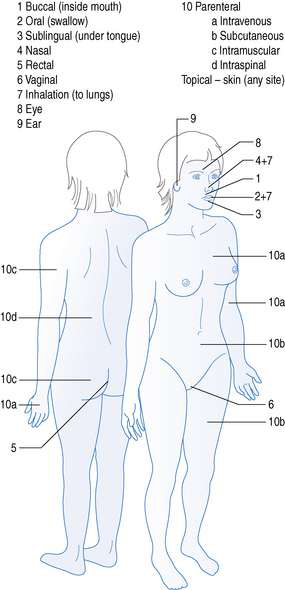
Routes of administration
The oral route
The oral route can produce either a systemic or a local effect. For a systemic effect the drug, formulated in either a solid or a liquid form, is absorbed from the gastrointestinal tract (GIT). This is the most commonly used route for drug administration. There are several reasons for this:
However, there are disadvantages which should be borne in mind:
The buccal routes
A drug is administered by these routes by being formulated as a tablet or spray and is absorbed from the buccal cavity. The highly vascular nature of the tongue and buccal cavity, and the presence of saliva which can facilitate the dissolution of the drug, make this a highly effective and useful route for drug administration. It can also be used for a local action.
Two sites are used for absorption from the buccal cavity:
It is important that patients are made aware of the difference between the two sites and they should be given full instructions on how to administer their tablets, to ensure maximum benefit. For details of suitable patient instructions, see Chapter 36.
The rectal route
For administration by this route, drugs are formulated as liquids, solid dosage forms and semi-solids (see Ch. 34). The chosen preparation is inserted into the rectum from where the drug is released to give a local effect or it may be absorbed to give a systemic effect.
The rectum is supplied by three veins, namely the middle and inferior (lower) rectal veins which drain directly into the systemic circulation and the upper rectal vein which drains into the portal system which flows into the liver. This means that, depending on the position within the rectum, only some of the drug absorbed from the rectum will be subject to the first pass effect. Bioavailability, therefore, may be less than 100% but may be better than obtained from other parts of the GIT.
The amount of fluid present in the rectum is small, estimated at approximately 3 mL of mucus. This affects the rate of dissolution of the drug released from the suppository. However, there is also muscular movement which spreads the drug over a large area and promotes absorption.
The advantages and disadvantages of this route of administration are as follows.
The vaginal route
For administration by this route, drugs may be formulated as pessaries, tablets, capsules, solutions, sprays, creams, ointments and foams which are inserted into the vagina. Most often this route is used for a local effect. However, drugs absorbed from the vagina are not subject to the first pass effect and can give systemic bioavailability better than with the oral route.
The inhalation route
Drugs are administered usually by inhalation through the nose or mouth to produce either local or systemic effects. This route is used predominantly for local administration to treat respiratory conditions such as asthma. For this, drugs are delivered directly to the site of action, i.e. the lungs. A variety of dosage forms are used, from simple inhalations consisting of volatile ingredients such as menthol to sophisticated inhaler devices (see Ch. 37). A major benefit of the inhaled route is that the drug dose required to produce the desired effect is much smaller than for the oral route, with a consequent reduction in side-effects. Because of the high blood flow to the lungs and their large surface area, drug absorption by this route is extremely rapid and can be used to give systemic action.
The nasal route
The nasal cavity has been traditionally used for producing local effects using solutions as drops or sprays. More recently it has been used for systemic action because of its good vascular supply which avoids first pass metabolism, although it does have some local enzymic activity.
The topical route
In the topical route the skin is used as the site of administration. This route is most commonly used for local effects using liquid and powder dosage forms in addition to the traditional ointments, creams and pastes (see Ch. 33). The skin has a natural barrier function, but specialized dosage forms have been developed which, when applied to the skin, allow the drug to pass through and produce a systemic effect. This avoids first pass effects and can produce close to zero-order kinetics over prolonged time intervals. A more detailed discussion of this route of administration can be found in Chapter 33.
The parenteral route
This is the term used to describe drug administration by injection. Within this general term there is a variety of different routes. The main ones are:
These and other specialized types of injection are discussed more fully in the chapter on parenteral products (see Ch. 38).
Dosage forms
Drugs are presented in a wide variety of dosage forms. How a drug is formulated is dependent on a variety of factors and the same drugs may be presented in several different dosage forms. It is important for pharmacists to appreciate the different properties of the varying dosage forms in order that the most appropriate or most acceptable formulation is given to the patient. This section gives brief information on the different types of dosage forms. Additional, more detailed, information is found in the chapters dealing with specific formulations (see Chs 30–39) and in Aulton (2007).
Aerosols
These consist of pressurized packs which contain the drug in solution or suspension and a suitable propellant. They are most commonly used for their local effect in the treatment of asthma. These devices are fitted with a metering valve which allows a known dose of drug to be delivered each time the device is fired. Some aerosols are for topical use, particularly in the treatment of muscle sprains and injuries. These may contain substances such as non-steroidal anti-inflammatory drugs or counterirritants.
Applications
This is the name given to solutions, suspensions or emulsions which are for topical use. They contain substances such as ascaricides or antiseptics.
Capsules
These are solid dosage forms, generally for oral use. Some drugs formulated as capsules are intended to be inhaled. It is therefore important to inform the patient on their appropriate use. For both types of capsule, the drug is contained in a gelatin shell, usually as a powder or a liquid. Modified-release preparations are available where the drug is presented in the gelatin container as small pellets with different coatings.
Collodions
These are liquid preparations for external use. The liquid is painted on the skin, where it forms a flexible film. They contain substances such as salicylic acid which is useful in the treatment of corns.
Creams
These are semi-solid emulsions for external use. Because of the water content they are susceptible to microbial contamination and either include a preservative or are given a short shelf life. Creams are easier to apply and are less greasy than ointments, so patients often prefer them.
Dusting powders
These are finely divided powders for external use. Their main uses are as lubricants to prevent friction between skin surfaces and for disinfection and antisepsis in minor wounds.
Ear drops
These are used topically to treat a variety of ear problems. The drug, or mixture of drugs, is presented as a solution or suspension in a suitable vehicle such as water, glycerol, propylene glycol or alcohol. The drops are inserted into the ear, using a dropper. Some vehicles, such as alcohol, may cause a degree of stinging when applied to the ear. Ensure that the patient is aware of this and is assured that it is a normal sensation. If patients find the degree of stinging unacceptable they may have to be given ear drops with an aqueous vehicle. Oils such as almond or olive are often recommended for the alleviation of impacted earwax. It is usually suggested that such oils, before being dropped into the ear, should be warmed. This must be done very carefully and only minimal heat applied, i.e. the oil placed on a warm spoon. Excessive heat will have serious consequences for the integrity of the ear.
Elixirs
An elixir is a solution of one or more drugs for oral use. The vehicle generally contains a high proportion of sucrose or, increasingly nowadays, a ‘sugar-free’ vehicle such as sorbitol solution, which is less likely to cause dental caries. The therapeutic action of drugs presented as elixirs varies widely and includes antihistamines, antibiotics and decongestants.
Emulsions
These are mixtures of two immiscible liquids, usually oil and water. When the term ‘emulsion’ is used this refers to a preparation for oral use.
Enemas
An enema is an oily or aqueous solution which is administered rectally. A variety of drugs are formulated as enemas and are used to treat conditions such as constipation or ulcerative colitis. They are also used in X-ray examination of the lower bowel and for systemic effects, such as the use of diazepam in status epilepticus and febrile convulsions.
Gargles
Gargles are aqueous solutions used to treat infections of the throat. They are often presented in a concentrated form with instructions to the patient for dilution. Gargles should not be swallowed but held in the throat while exhaling through the liquid. After a suitable time period, usually a minute or so, the patient should spit out the gargle.
Gels
Gels are semi-solid dosage forms for topical or other local use. They are usually transparent or translucent and have a variety of uses. Spermicides and lubricants are often presented in a gel form. Preparations containing coal tar or other drugs used in the treatment of psoriasis and eczema are also presented in this form. Many patients prefer this formulation because it is non-greasy.
The term ‘gel’ is also used to describe colloidal suspensions of drugs such as aluminium and magnesium hydroxides.
Granules
This term is used to describe a drug which is presented in small irregularly shaped particles. Granules may be packed in individual sachets containing a unit dose of medicament or may be provided in a bulk format where the dose is measured using a 5 mL spoon. Some laxatives are among the drugs currently presented as granules.
Implants
This term refers to solid dosage forms which are inserted under the skin by a small surgical incision. They are most commonly used for hormone replacement therapy or as a contraceptive. Release of the drug from implants is generally slow and long-term therapy is achieved. In the case of the contraceptive implant the effect continues for up to 3 years. A testosterone implant used in the treatment of male hypogonadism will maintain adequate hormone levels in the patient for 4–5 months. Implants must be sterile.
Inhalations
These are preparations which contain volatile medicaments which may have a beneficial effect in upper respiratory tract disorders such as nasal congestion. Some inhalations contain substances which are volatile at room temperature and the patient can obtain a degree of relief by adding a few drops to a handkerchief or a pillowcase and breathing in the vapour. Other inhalations are added to hot water and the impregnated steam is then inhaled. Many users of the latter type of inhalation use boiling water. Pharmacists should advise against this, as the steam produced is too hot and can damage the delicate mucous membranes of the upper respiratory tract. Overuse of this type of preparation should also be avoided as it may cause a chronic condition to develop. The use of these strong aromatic decongestants is contraindicated in children under 3 months owing to the risk of apnoea.
Insufflations
This term is used to describe drugs presented in a dry powder form, usually in a capsule, which is inserted into a specially designed device where the capsule is broken, the contents released and the patient inhales the powder. Today, the most common use being made of insufflations is in the treatment of asthma. Some patients find these ‘breath-actuated’ devices easier to use than aerosol devices.
Irrigations
These are sterile solutions most commonly used in the treatment of infected bladders. Sterile solutions of sodium chloride 0.9% (physiological saline) are used to treat a wide range of common urinary tract pathogens. Antifungal drugs such as amphotericin and locally acting cytotoxics, e.g. doxorubicin and epirubicin, are introduced into the bladder, as irrigations, to treat mycotic infections and bladder tumours, respectively.
Linctuses
A linctus is a viscous liquid for oral use, the majority being for the relief of cough. The viscous nature of the preparation coats the throat and helps to alleviate the irritation which is causing the problem. Previously, many linctuses contained a high level of sucrose; however, many have been reformulated as ‘sugar-free’ products to reduce the risk of dental caries. Because the viscous nature of linctuses is beneficial, they should not be diluted prior to administration.
Liniments
These are liquids for external use. They are used to alleviate the discomfort of muscle strains and injuries. Because of the rubefacient nature of some of the ingredients, some sportsmen will use them prior to starting a sporting activity in an attempt to avoid any muscle damage. Examples of active ingredients found in liniments are turpentine oil and methyl salicylate.
Lotions
These are liquids for external use and may be solutions, suspensions or emulsions. They have a variety of uses which include antiseptic, parasiticidal and soothing. Care should be taken when recommending lotions for the treatment of head lice. Those which have an alcohol base should be avoided in asthmatics and young children, as the alcoholic fumes may cause breathing difficulties. Aqueous-based products should be advised.
Lozenges
These are large tablets designed to be sucked and remain in the mouth for up to 15 minutes. They do not contain a disintegrant and the active ingredient is normally incorporated into a sugar base, such as sucrose or glucose. The main use of lozenges is in the treatment of mouth and throat infections.
Mouthwashes
These are similar to gargles but are used specifically to treat conditions of the mouth. The active ingredients are usually antiseptics or bactericidal agents.
Nasal drops and sprays
These are isotonic solutions used to treat conditions of the nose. Locally acting decongestants are commonly presented as nose drops. The container includes a dropper device to allow the patient to deliver the appropriate dose into the affected nostril(s). Overuse of nose drops is common as patients find it difficult to judge the number of drops being delivered. Other preparations for both local and systemic use are presented as sprays (metered or pump).
Paints
Paints are solutions for application to the skin or mucous membranes. Those used on the skin are often formulated with a volatile vehicle. This evaporates on application and leaves a film of active ingredient on the skin surface. Paints to be used on the throat and mucous surfaces normally include a viscous vehicle such as glycerol, which enables the preparation to remain in contact with the affected area. Paints are used for their antiseptic, analgesic, caustic or astringent properties, and should be supplied with a brush to assist application.
Pastes
These are semi-solids for external use. They differ from creams and ointments in that they contain a high proportion of fine powder, such as starch. This makes them very stiff and means they do not spread readily over the skin’s surface. Corrosive drugs such as dithranol are often formulated as pastes so that paste applied to the psoriatic lesion will not spread onto healthy skin and cause irritation.
Pastilles
Pastilles are for oral use and, like lozenges, are designed to be sucked. They contain locally acting antiseptics, astringents or anaesthetics and are used to treat, or give symptomatic relief of, conditions affecting the mouth and throat. They have a jelly-like consistency produced by their basis of gelatin or acacia.
Pessaries
Pessaries are solid dosage forms for insertion into the vagina. They are used for both local and systemic action.
Pills
Pills are a moulded oral dosage form which has been superseded by tablets and capsules. The term is still used by the general public, incorrectly, to describe any solid oral dose form.
Powders (oral)
These occur as both bulk and divided powders. Bulk powders usually contain non-potent active ingredients such as antacids. The dose is measured using a 5 mL spoon.
Individual powders are used for more potent drugs where accuracy of dosage is more important. An individual dose is packaged separately, either in a sheet of paper or in a sachet.
Suppositories
These are solid dosage forms for insertion into the rectum. They are used for both local and systemic actions.
Suspensions
Suspensions are liquid dose forms where the active ingredient is insoluble. Suspensions are available for both oral and external use.
Syrups
These are concentrated aqueous solutions of sugars such as sucrose. The term ‘syrup’ is frequently, but incorrectly, applied to certain sweetened liquids intended for oral use. The term ‘syrup’ should nowadays only be used to refer to flavouring vehicles. Sucrose is being replaced by sorbitol as the sweetening agent in many preparations to give ‘sugar-free’ syrups to reduce the risk of dental caries.
Tablets
This is the term used to describe compressed solid dosage forms generally intended for oral use, although some pessaries are tablets for vaginal use. As well as the standard tablet made by compression, there are many different types of tablet designed for specific uses, e.g. dispersible, enteric- coated, modified release or buccal.
Transdermal delivery systems
This term is used to describe the adhesive patches which, when applied to the skin, deliver a controlled dose of drug over a specified time period to produce a systemic effect.