Review of Relevant Literature
A wealth of information is available in the literature for students, practicing nurses, and researchers, and more appears every day. The number of nursing journals is increasing dramatically, and many full-text research reports are available in both electronic and print forms. Thus, conducting a literature review is more enlightening now than in the past. Reviewing the existing literature in an area of interest is a critical step in the writing process. As Becker (1986) put it:
None of us invent it all from scratch when we sit down to write. We depend on our predecessors. We couldn’t do our work if we didn’t use their methods, results, and ideas. Few people would be interested in our results if we didn’t indicate some relationship between them and what others have said and done before us. (p. 140)
This chapter discusses the purposes of various literature reviews, describes quantitative and qualitative reviews, and guides you through the process of performing a Quantitative and qualitative literature review for research purposes. The literature review process is used for many purposes in research, such as developing the problem, purpose, significance, and framework of the study. However, the focus of this chapter will be the review of previous research studies relevant to a proposed study. The three major stages of literature reviews that are discussed are searching the literature, reading the literature, and writing the literature review. The chapter concludes with an explanation of integrative reviews, metasyntheses, and meta-analyses.
Purpose of the Literature Review in Writing Course Papers
For most course papers, your instructor will expect you to review published information on the topic of your paper. Thus, these papers will require literature reviews although the literature you search for may be different. The search should include both periodicals and monographs. For some topics, you may primarily find your material in periodicals, whereas for other topics, you will derive most information from monographs and find little in periodicals. You may find it fruitful to search the Internet for research on some topics. However, document the source and validity of the Internet content you find.
Purpose of the Literature Review in Examining the Strength of the Evidence
The purpose of the literature review designed to examine the strength of the evidence is to identify all studies that provide evidence of a particular intervention, to critique the quality of each study, and to synthesize all of the studies providing evidence of the effectiveness of a particular intervention. It is also important to locate and include previous evidence-based papers that have examined the evidence of a particular intervention, because the conclusions of these authors are highly relevant. This type of literature review is described in greater detail in Chapter 27, Strategies for Promoting Evidence-Based Nursing Practice.
Purpose of the Literature Review in Quantitative Research
The review of literature in quantitative research directs the development and implementation of a study. The major literature review is conducted at the beginning of the research process, and a limited review is conducted during the generalization phase of the research report to integrate knowledge from the literature with new knowledge obtained from the study. The purpose of the literature review is similar for the different types of quantitative studies (descriptive, correlational, quasi-experimental, and experimental). Relevant sources are cited throughout a quantitative research report in the introduction, methods, results, and discussion sections. The introduction section uses relevant sources to summarize the background and significance of the research problem. The review of literature section includes both theoretical and empirical sources that document the current knowledge of the problem. The framework section is developed from the theoretical literature and sometimes from empirical literature, depending on the focus of the study. The methods section describes the design, sample, measurement methods, treatment, and data collection process of the planned study and is based on previous research. Thus, previous studies may be cited in the methods section. In the results section, the data are analyzed with knowledge of the results of previous studies. These studies and their findings should be identified at this point and cited. The discussion section of the research report provides conclusions that are a synthesis of the cited findings from previous research and those from the present study.
Purpose of the Literature Review in Qualitative Research
In qualitative research, the purpose and timing of the literature review vary based on the type of study to be conducted. Some phenomenologists believe the literature should not be reviewed until after the data have been collected and analyzed so that the literature will not influence the researcher’s openness (Munhall, 2006). For example, if a researcher decided to describe the phenomenon of dying, the review of literature would include Kubler-Ross’s (1969) five stages of grieving. Knowing the details of these stages early on could influence the way the researcher views the phenomenon during data collection and analysis. However, after data analysis, the information from the literature can be compared with findings from the present study to determine similarities and differences. The findings can then be combined to reflect the current knowledge of the phenomenon.
In grounded theory research, a minimal review of relevant studies is done at the beginning of the research process. This review is only a means of making the researcher aware of what studies have been conducted, but the information from these studies is not used to direct data collection or theory development for the current study. The researcher primarily uses the literature to explain, support, and extend the theory generated in the study (Munhall, 2006).
Ethnographic research is reviewed in a manner similar to that used for quantitative research. The literature is reviewed early in the research process to provide a general understanding of the variables to be examined in a selected culture. The literature is usually theoretical because few studies have typically been conducted in the area of interest. From these sources, the researcher develops a framework for examining complex human situations in the selected culture (Munhall, 2006). The literature review also provides a background for conducting the study and interpreting the findings.
In historical research, an initial literature review is conducted to select a research topic and to develop research questions. Then the investigator develops an inventory of sources, locates these sources, and examines them; thus, the literature is a major source of data in historical research. Because historical research requires an extensive review of literature that is sometimes difficult to locate, the researcher can spend months and even years locating and examining sources. The investigator then analyzes and organizes the literature into a report that explains how an identified phenomenon has evolved over a particular time period (Munhall, 2006).
WHAT IS “THE LITERATURE”?
“The literature” consists of all written sources relevant to the topic you have selected. The amount of research information available continues to escalate, with the production of over 6000 new scientific articles a day. At this rate, published scientific knowledge is doubling every 1-2 years. Computerized bibliographic databases have made the process of searching for relevant empirical or theoretical literature easy. There are, however, more difficulties in locating all of the relevant sources for qualitative studies.
WHAT IS A LITERATURE REVIEW?
The purpose of the review is to convey to the reader what is currently known regarding the topic of interest. Thus the literature that is reviewed may include such material as written information in newspapers and popular magazines such as U.S. News and World Report, sources of statistical information provided by various departments of the government such as the Census Bureau, the CDC (Centers for Disease Control and Prevention), the World Health Organization, information relevant to evidence-based practice, and the scholarly literature describing research that has been conducted in the topic of interest. Broadly, the literature searched will include literature for the problem, background, significance, theory, and literature review. A broad range of material may be used for the problem, background, and significance. For example, statistics from such sources as the Census Bureau and CDC may be important for your topic. Content related to health policy publications may be important. For some studies such as those related to problems of caring for the uninsured, news reports may be useful in documenting the significance of your proposed work. Primary sources should be used for theory and the framework. You should limit your material for the literature review section of the paper to relevant studies for which you can obtain full text content. An abstract or condensed version does not allow you sufficient information to adequately review the processes of the study.
The literature review is an organized written presentation of what has been published on a topic by scholars and includes a presentation of research conducted in your selected field of study. The review should be organized into sections that present themes or identify trends. The purpose is not to list all the material published, but rather to synthesize and evaluate it based on the focus of the review. The last section of this chapter, “Writing the Review of Literature,” discusses strategies for writing the review of literature.
Literature reviews may be written for various purposes: Class assignments to examine literature related to an assigned topic, review of research to determining the strength of evidence on which to base clinical nursing practice, and reviews conducted to propose or guide the conduct of research. Your literature review should be designed to address the following questions (Asian Institute of Technology, 2000; Union Institute Research Engine, 1999):
• What is known about your topic?
• What is the chronology of the development of knowledge about your topic? Knowledge related to an empirical study includes theories and empirical studies.
• What research evidence is lacking, inconclusive, contradictory, or too limited
• Is there a consensus or significant debate on issues? What are the various positions?
• What directions for your study are indicated by the work of other researchers?
• What are the characteristics of the key concepts or variables in relevant theories or previous studies?
• What are the relationships among the key concepts or variables in relevant theories or previous studies?
• What are the existing theories in the field of study?
• Where are the inconsistencies or other shortcomings in the knowledge base?
• What views need to be (further) tested?
• Why should a problem be (further) studied?
• What contribution can the present paper be expected to make?
• What approaches, designs, or methods of previous studies seem unsatisfactory?
Time Frame for a Literature Review
The time required to review the literature is influenced by the problem studied, sources available, and goals of the reviewer. There is no set length of time for reviewing the literature, but there are guidelines for directing the review process. The narrower the focus of the topic, the less time will be required to review the literature. The difficulty you experience identifying and locating sources and the number of sources to be located also influence the time involved, as will the intensity of effort. Only through experience does one become knowledgeable about the time frame for a literature review. Novice reviewers will require more time to find the needed literature than an experienced searcher, and the novice frequently underestimates the time needed for the review. A time estimation device for novice searchers, as recommended by at least one librarian, is for the searcher to make a good “reasonable” time estimation and then multiply this number by four. This longer estimate is often more realistic. As both time judgment and searching skills are refined the need to use this expanded estimate reduces.
If researchers attempted to read every source that is somewhat related to a selected problem, they would be well read but would probably never complete their search. Some individuals, even after a thorough literature review, continue to believe that they do not know enough about their area of interest, so they persist in their review; however, this ultimately becomes an excuse for not progressing with their work. The opposite of this situation is the individual who wants to move rapidly through the review of literature to reach the “important part” of their work. In both situations, the person has not been able to set realistic goals for conducting the literature review.
Students repeatedly ask, “How many articles should I have? How far back in years should I go to find relevant information?” The answer to both those questions is an emphatic “It depends.” Course faculty for masters courses commonly require that you obtain full text articles of all studies (covering all variables in the proposed study) for the previous ten years plus the classic studies conducted in the field of research. Doctoral students are expected to conduct a more extensive review for course papers. If you are writing a research proposal for a thesis or dissertation, the literature required will be extensive. You need to locate the key papers in the field of interest. If you are searching for research, you need to identify the landmark or seminal studies done. Seminal studies are the first studies that prompted the initiation of the field of research. Landmark studies mark an important stage of development or a turning point in the field of research. Beyea & Nicoll (1998) provide some good advice about knowing when you have sufficient sources:
Many people ask, “How will I know when my literature search is complete?” On one hand, it never will be because new information constantly is being added to literature. Even so, it is important to know when to stop. From our experience, we found that research will reach an apparent saturation point. As you look at reference lists, you will realize that every article and every author is familiar to you. Or, you might see a pattern in the research and it will be evident when the search has reached its natural conclusion. (p. 879)
Sources Included in a Literature Review
Two types of literature are cited in the review of literature for research: theoretical and empirical. Theoretical literature consists of concept analyses, models, theories, and conceptual frameworks that support a selected research problem and purpose. Theoretical sources can be found in serials, periodicals, and monographs. Serials are published over time or may be in multiple volumes but do not necessarily have a predictable publication date. Periodicals are subsets of serials with predictable publication dates, such as journals, which are published over time and are numbered sequentially for the years published. This sequential numbering is seen in the year, volume, issue, and page numbering of a journal. Monographs, such as books, booklets of conference proceedings, or pamphlets, are usually written once and may be updated with a new edition. Periodicals and monographs are available in a variety of media, such as print, online, CD-ROM, or in downloadable form. Textbooks are good sources of theories in nursing. These textbooks are not primary sources but will enable you to identify appropriate theories and then locate and obtain the primary sources.
Empirical literature comprises relevant studies in journals and books, as well as unpublished studies, such as master’s theses and doctoral dissertations. A thesis is a research project completed by a master’s student as part of the requirements for a master’s degree. A dissertation is an extensive, usually original research project that is completed as the final requirement for a doctoral degree. The word empirical is defined as knowledge derived from research. You need to acquire the entire published study rather than relying on summaries or abstracts of studies. The empirical literature reviewed depends on the study problem and the type of research conducted. Research problems that have been frequently studied or are currently being investigated have more extensive empirical literature than new or unique problems. All major variables to be included in the proposed study must be included in the research literature reviewed. Other types of published information, such as descriptions of clinical situations, educational literature, and position papers, may be included in the discussion of background and significance of the research topic but because of their subjectivity often are not cited in the review of literature (Marchette, 1985; Pinch, 1995).
The published literature contains primary and secondary sources. A primary source is written by the person who originated, or is responsible for generating, the ideas published. In research publications, a primary source is written by the person or people who conducted the research. A primary theoretical source is written by the theorist who developed the theory or conceptual content. A secondary source summarizes or quotes content from primary sources. Thus, authors of secondary sources paraphrase the works of researchers and theorists. The problem with a secondary source is that the author has interpreted the works of someone else, and this interpretation is influenced by that author’s perception and bias. Sometimes errors and misinterpretations have been spread by authors using secondary sources rather than primary sources. You should use mostly primary sources to write literature reviews. Secondary sources are used only if primary sources cannot be located or if a secondary source contains creative ideas or a unique organization of information not found in a primary source. Citation is the act of quoting a source, using it as an example, or presenting it as support for a position taken.
SEARCHING THE LITERATURE
Before writing a literature review, you must first perform literature searches to identify sources relevant to your topic of interest. Auston, Cahn, and Selden (1992) of the National Library of Medicine have defined a literature search as “a systematic and explicit approach to the identification, retrieval, and bibliographical management of independent studies (usually drawn from published sources) for the purpose of locating information on a topic, synthesizing conclusions, identifying areas for future study, and developing guidelines for clinical practice.” As a student, practicing nurse, or nurse researcher, your goal is to develop a search strategy designed to retrieve as much of the relevant literature as possible given the time and financial constraints of your project.
Today, good libraries provide access to large numbers of electronic databases that supply a broad scope of the available literature internationally, enabling library users not only to identify relevant sources quickly but to print full-text versions of many of these sources immediately. Through the use of these databases, researchers can quickly locate a large volume of references. You can make photocopies from journals found in your local library, and you can obtain photocopies of other articles through interlibrary loan arrangements between your library and other libraries across the country. All libraries, public, private, college, and university, have interlibrary loan capabilities. Be aware, however, that research and publication trends vary over time. Material of interest could have been published before the advent of electronic databases. Based on the type of question you are posing in your research, you may need to search both electronic databases and print indexes. Also, given that no database covers everything in a particular discipline, you must consider multiple databases from a variety of related fields. Now, the most complex part of a literature review is identifying the material, not obtaining it. Increasingly, full-text copies of articles can be printed immediately from the Internet. These services—librarian consultations, database searching, interlibrary loan services, full-text article downloads, and more—are often available to faculty and student researchers, even those who live far from the university. We can link with the university library through the Internet, direct telecommunication connections, and e-mail. These resources are also available at many health care facilities and can be accessed by nurses employed there. Those without this access can purchase electronic facsimile (fax) copies of resources from some of the bibliographical search engines, although any library at which you have borrowing privileges can provide you with an interlibrary loan. Because of these resources, researchers can now spend more time reading and synthesizing and less time searching. The next section of the chapter guides you through the process of using these strategies to obtain the relevant literature for your study.
Develop a Search Strategy
Before you begin searching the literature, you must consider exactly what information you are seeking. By writing out your search strategy, you will save considerable time in this phase of your study. A written plan helps you to (1) avoid going back along paths you have already searched, (2) retrace your steps if need be, and (3) search new paths.
Your initial search should be based on the widest possible interpretation of your topic. This strategy enables you to envision the extent of the relevant literature. As you see the results of the initial searches and begin reading the material, you will refine your topic, and then you can narrow the focus of your searches. Consider consulting with an information professional, such as a subject specialist librarian, to develop a literature search approach. These consultations can be performed via e-mail, so that communication occurs at the convenience of both the researcher and information professional. Many university libraries provide this consultation service whether or not the library user is affiliated with the university.
Select Databases to Search
A bibliographical database is a compilation of citations. The database may consist of citations relevant to a specific discipline or may be a broad collection of citations from a variety of disciplines. Databases can be divided into the following three types:
1. Indexes and abstracts compile citations with subject headings and may include a paragraph or so about the citation. These may include or link to full-text materials.
2. Full-text reprint services may or may not include detailed subject analysis.
3. Citation search indexes link citations on the basis of the references at the end of articles.
The databases first used for literature searches were in printed form. They were card catalogs, abstract reviews, and indexes. In nursing, the most relevant print database is the Cumulative Index to Nursing and Allied Health Literature (CINAHL), which contains citations of nursing literature published after 1955. Nursing scholars fondly referred to the print version of CINAHL as “the Red Books” because all the editions were bound with red covers. The print version of CINAHL is still available in libraries, and you may find it useful when searching for citations published before 1982 or if computerized databases are not available. Another print database popular among nurse researchers is the Index Medicus (IM), which was first published in 1879 and is the oldest health-related index. The Index Medicus includes some citations of nursing publications, with the number of nursing journals cited growing; however, the CINAHL contains a more extensive listing of nursing publications and uses more nursing terminology as subject headings. The earliest printed nursing index is the Nursing Studies Index, developed by Virginia Henderson, which consists of citations of nursing literature published from 1890 to 1959. The National Library of Medicine provides free access to several databases, including MEDLINE, the online equivalent of the Index Medicus, with access through Internet Grateful Med and PubMed software (available at www.nlm.nih.gov/medlineplus).
Many government agencies that produce bibliographical databases, such as the National Library of Medicine, provide free access to them. However, vendors may distribute the same data, providing “value-added” enhancements with their search software.
Full-text databases of journal articles are now available for some journals. To have access to these databases, libraries must subscribe to the service. For a variety of reasons, including the cost of receipt and storage as well as convenience to library users, many libraries are discontinuing subscriptions to paper versions of journals and, instead, subscribe to services that provide access to electronic versions. This arrangement gives the user immediate access to articles that can be read online, printed, or saved as a computer file, often whenever and wherever an affiliated user is located. As a result of these innovations, users now have more immediate access to a wide range of literature, including international sources.
Although more and more literature is available immediately in full-text form, the integration of libraries’ various bibliographical databases and full-text collections is not always seamless. Often the most useful database, in terms of ease of searching, content coverage, and terminology, may not include the text of the materials of interest. Be prepared to view the search process as one step and the literature thus identified as a second step. Even with the number of full-text digital collections, all researchers must keep in mind that not everything has been digitized, and print resources, including journals, may need to be consulted occasionally.
Select Keywords
Keywords are the major concepts or variables that must be included in your computer search. To determine keywords, identify the concepts relevant to your study. Ascertain the populations that are of particular interest in your area of study, specific interventions, measurement methods, or outcomes that are relevant. In quantitative studies, information obtained from the review of literature influences the development of several steps in the research process; these steps are listed in Table 6-1. Search strategies should be designed to ensure that you obtain adequate information for each of the steps presented in Table 6-1. In most databases, subject headings and phrases can be used, as well as single terms. Your problem and purpose statements will guide in identifying relevant terms (see Chapter 5).
TABLE 6-1
Purposes of the Literature Review in Quantitative Research
Clarify the research topic
Clarify the research problem
Verify the significance of the research problem
Specify the purpose of the study
Describe relevant theories
Summarize current knowledge
Facilitate development of the framework
Specify research objectives, questions, or hypotheses
Develop definitions of major variables
Identify limitations and assumptions
Select a research design
Identify methods of measurement
Direct data collection and analysis
Interpret findings
You should then think of alternative terms (synonyms) that authors might use for each concept or variable you have identified. You may need to express your search using the exact words the authors have used in the literature you seek. Many bibliographical databases, such as CINAHL, have an article-specific subject analysis and provide formal subject headings for each article. Studies have shown that most searchers rarely use these formal subject terms in the searching process (Lawrence & Levy, 2004; Meats, Brassey, Heneghan, & Glasziou, 2007; Shiri & Revie, 2006). Knowledge and use of this capability can improve your searches dramatically.
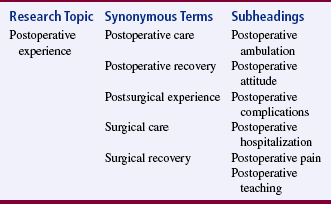
These databases have a thesaurus that the researcher, as well as anyone who reads the article, can use as keyword search terms. By logging on to the database, you can access the thesaurus to select relevant terms. The formal subject terms included in the thesaurus may encompass a number of the terms that you have identified and allow you to expand your search to obtain more references or to focus your search to be more specific to your interest. This expansion or focus occurs because someone who has already read the articles has grouped all citations with similar concepts according to similar terms or concepts. For example, depending on the database, the researcher may not have to worry whether teens, teenagers, youth, adolescents, or adolescence must be searched individually, because it is likely that a search for one term will identify all. A simple way to begin identifying a database’s standardized subject terms is to display a few useful full records found by using keywords. The records are the descriptions of the articles, not the articles themselves. Examine the terminology used to describe these articles, and use the terms in additional refined searches. Frequently, word processing programs, dictionaries, and encyclopedias are helpful in identifying synonymous terms and subheadings. A combination of both keywords and formal subjects most often retrieves better search results. Some of the synonymous terms and subheadings for the research topic of postoperative experience are outlined in Table 6-2.
Truncating words can allow you to locate more citations related to that term. For example, authors might have used intervene, intervenes, intervened, intervening, intervention, or intervenor. To capture all of these terms, you can use a truncated term in your search (the form depends on the rule of the search engine being used), such as interven, interven*, or interven$. Do not truncate words to fewer than four letters; you will get far too many unwanted citations.
Pay attention to variant spellings. You may need to know, for example, that orthopedic may also be spelled orthopaedic. Consider irregular plurals, such as woman and women.
If an author is cited frequently, you can perform a search using the author’s name. In this case, you should identify the name as an author term, not a keyword term. Recognize that some databases list authors only under first and middle initials, whereas others use full first names. Identifying and using citations to seminal studies in various citation indexes or full-text databases can lead you to other, more current works that have also used the seminal studies as references. You may need to search using the full-text, free keyword, or cited references options if you are trying to locate more current references to a frequently referenced known work. Web of Knowledge, a database developed from the Science Citation Index and the Social Science Citation Index, focuses on the relationships based on these citations. Several other databases, depending on the vendor, may also have a Cited Search function. You may also know of or discover particular journals that are key to your field of research. If so, you may wish to use the journal title as a search term.
Add your selected search terms to your written search plan. As you search, add other terms that you discover from the references you locate. For each search, record (1) the name of the database you used, (2) the date you performed the search, (3) your exact search strategy, (4) the number of articles found, and (5) the percentage of relevant articles. You can develop a table to record this information from multiple search strategies, as shown in Table 6-3. Save the results of each search on your computer’s hard disk, a memory stick (flash disk), or a CD-ROM for later reference; in your written search record, document the file name of the search results.

Systematically Record References
The bibliographical information on a source should be recorded in a systematic manner, according to the format that you will use in the reference list. Many journals and academic institutions use the format developed by the American Psychological Association (APA) (2001). The reference lists in this text are presented in APA format. Computerized lists of sources usually contain complete citations for references and should be saved electronically to access complete reference citations. The editors of the APA publication manual are currently reevaluating the APA format for electronic resources. Many technological changes have occurred since the manual was published in 2001. These changes, which include some nonobvious ones like the ability of a library to link from a citation in one database to the full-text article in a totally different database and the cessation of the print Dissertation Abstracts, have created a need for a technical revision in APA formatting of electronic references. A formal supplement to the manual has been released, and a revision may be considered.
Sources that will be cited in a paper or recorded in a reference list should be cross-checked two or three times to prevent errors. Damrosch and Damrosch (1996) have identified some of the common errors that authors make when applying the APA format, and they provide guidelines for how to avoid them. The sources cited in the reference list should follow the correct format for print and online full-text versions.
Print Version
Nichol, L. H. (2003). A practical way to create a library in a bibliography database manager: Using electronic sources to make it easy. CIN: Computers, Informatics, Nursing, 21(1), 48–54.
Online Full-Text Version
Retrieved May 28, 2004, from OVID database, CINAHL, item 22431086.
One problem still not resolved is directly quoting from online full-text articles. Typically, APA stipulates that at the end of a direct quote, the author, year, and page number(s) be cited, allowing the reader to easily find the citation in the original work. Identifying the page number is not possible with an online full-text article that is provided in search engines using hypertext markup language (HTML), because the page numbers are not the same as in the original text. It is possible if the text is provided in portable document format (PDF). APA (2001) has suggested several possibilities for addressing this problem, one of which is to count the number of paragraphs from the beginning of the article to the place of the direct quote. However, none of the proposed strategies has been commonly accepted as a standard. In this text, we have chosen to list the author’s (or authors’) last name(s) and the year, omitting the page numbers. If the online text was retrieved from CINAHL, we have indicated this, allowing easy access to the cited article.
Use Reference Management Software
Reference management software can make tracking the references you have obtained through your searches considerably easier. You can use such software to conduct searches and to store the information on all search fields for each reference obtained in a search, including the abstract. Once you have done so, all of the needed citation information and the abstract are readily available to you electronically when you write the literature review. As you read the articles, you can also insert comments into the reference file about each one.
Reference management software has been developed to interface directly with the most commonly used word processing software to organize the reference information using whatever citation style you stipulate. You can insert citations into your paper with just a keystroke or two. The three most commonly used software packages, along with websites that contain information about them, are as follows:
• ProCite (www.procite.com)
• EndNote (www.endnoteweb.com) operates from the Web.
• RefWorks (www.refworks.com) operates from the Web and can be accessed free to some universities’ affiliates depending on the license.
Locate Relevant Literature
Within each database, initiate your search of relevant literature by performing a separate search of each keyword you have identified. Search engines are unforgiving of misspellings, so watch your spelling carefully. Most databases allow you to indicate quickly where in the database records you wish to search for the term—in the article titles, journal names, keywords, formal subject headings, citation lists, or full texts of the articles. The most recent citations are usually listed first. You may examine the earliest citations first by changing the order of citations.
Most databases provide abstracts of the articles in which the term is cited, allowing you to get some sense of their content so you may judge whether the information is useful in relation to your selected topic. If you find the information to be an important reference, save it to a file.
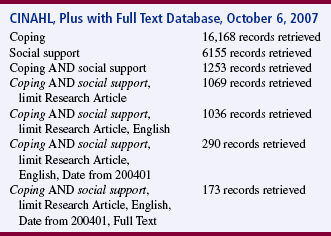
At this point in the process, do not try to examine all of the citations listed. Look instead at the number of citations (or “hits”) that the search found. In some cases, you may have obtained several thousand hits—far too many to examine. For example, on October 6, 2007, a search of CINAHL using the keyword coping yielded 16,168 hits. The key term social support yielded 6155 hits (Table 6-4).
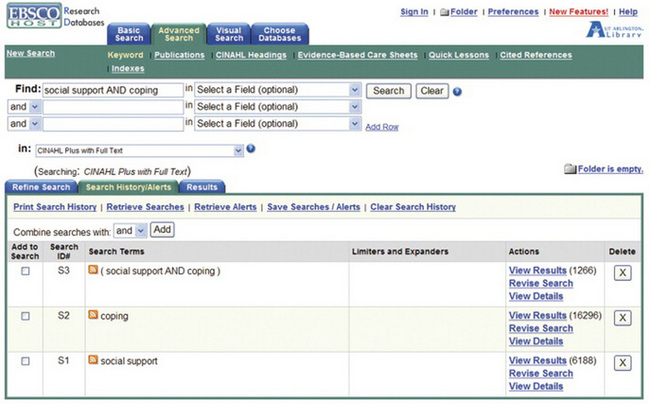
After you have performed a search, save it as a file, record the number of citations, and proceed to the next keyword. An easy way to do this is to print the search history. The search history usually has the database name noted somewhere, and the printout may have the date on it (Figure 6-1). When you have completed this activity, you will have some sense of the extent of available literature in your area of interest. At this point, you have the information you need to plan more complex searches.
Performing Complex Searches
A complex search of the literature combines two or more concepts or synonyms in one search. You can also select specified areas or fields of a database record, such as cited references or instrumentation, as a complex search. Determining which of the concepts or synonyms to combine may be based on the results of your previous searches or performed for theoretical reasons. The method of performing more complex searches varies with the bibliographical database, so when you use a particular database for the first time, look for instructions, examine the refine or advanced search options, and consider consulting with a librarian. Do a simple review of the database layout and features first. Once you have an idea of how useful a resource may be, then start refining and including additional concepts and use the features. It can be difficult to determine the cause of little or no results without systematic refinement of simple to more complex searches.
There are several ways to arrange terms in a database search phrase or phrases. The three most common ways are by using (1) Boolean, (2) locational (field labels), and (3) positional operators. Operators permit you to group ideas, select places to search in a database record, and show relationships within a database record, sentence, or paragraph. Examine the Help screen carefully to determine whether the operators you want to use are available and how they are used.
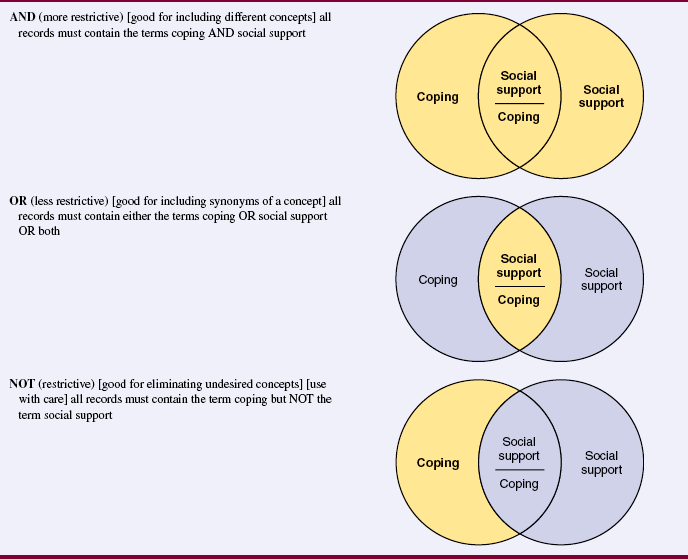
The Boolean operators are the three words AND, OR, and NOT. Often they must be capitalized. The Boolean operators AND and NOT are used with your identified concepts. Use AND when you want to search for the presence of two or more terms in the same citation. Use NOT when you want to search for one idea but not another in the same citation. NOT is rarely used because it is too easy to lose good citations. The Boolean operator OR is most useful with synonymous terms or concepts. Use OR when you want to search for the presence of any of a group of terms in the same search (Table 6-5).
Locational operators (field labels) identify terms in specific areas or fields of a record. These fields may be parts of the simple citation, such as the article title, author, and journal name, or they may be from additional fields provided by the database, such as subject headings, abstracts, cited references, publication type notes, instruments used, and even the entire article. In some databases, these specific fields can be selected using a drop-down menu in the database input area. In other databases, specific coding can be used to do the same thing. Do not assume that the entire article is being searched when using the default search; the default is usually looking for your terms in the title, abstract, and/or subject fields. Common formats for locational searches use the database field codes. Each of the following examples shows two ways to perform the same type of search, depending on the specific database being used:
• Coping in ab or coping ab: Find the word coping in the abstract.
• Orem in rf or Orem rf: Find the name Orem in the cited references.
• ENABL in tx or ENABL tx: Find the program ENABL anywhere in the full text.
Positional operators are used to look for requested terms within certain distances of one another. Availability and phrasing of positional operators are highly dependent on the database search software. Common positional operators are NEAR, WITH, and ADJ; they also are often required to be capitalized and may have numbers associated with them. A positional operator is most useful in records with a large amount of information, such as those with full-text articles attached, and is often used with locational operators, in either an implied way or explicitly. For example, ADJ is an abbreviation for adjacent; it specifies that one term must be adjacent to another, in any order. ADJ2 commands that there must be no more than two intervening words between the search terms. NEAR usually defines the specific order of the terms; the command term1 NEAR1 term2 requires that the first term occur first and within two words of the second term. WITH often indicates that the terms must be within the same sentence, paragraph, or region (such as subject headings) of the record.
In highly textual records such as those with abstracts or entire articles, using truncation in keyword searches yields good results. Truncation symbols are also database defined and may have numbers associated with them. Common truncation symbols include !, +, $, *, ?, and #. They allow you to enter parts of words as the search phrase, so that the search engine locates all occurrences of that part of the word with additional letters attached. For example, Catheter$ can retrieve catheter, catheters, catheterize, catheterization, and so on. If the base of the term is very short, just a few letters, consider a limited truncation by using an associated number. For example: Pet$1 can retrieve up to one character more, for example, pet and pets but not petard.
There is no standardization across database vendors for the format, or even the names of these operators and capabilities. For example, truncation symbols may be called wildcards. Most of these features are available in most databases but it can be difficult to determine the language, form, and style to be able to use them. Knowing that the features exist is the first step in locating the necessary help screens in the database you are using.
Many of these various operators are quickly accessible in front of the database software, but others may require further exploration of the Help screens. Different search engines (software) may require different means of structuring your terms so that the software will perform the search in the way you conceive of it. For example, in CINAHL and using EBSCO Host software, you can initiate a Boolean search by entering both terms in the same search. In July 2007, a search in CINAHL for coping and social support yielded 1223 hits.
In some bibliographical databases, the term AND is used to combine terms. In some databases, the word must be in uppercase. Sometimes quotation marks must be placed around the concepts—for example, “coping” and “social support.” In others, just typing coping and social support will find the references you seek. Combining concepts in some databases is done by adding a plus sign (+) before each term you wish to include. The search terms would appear as follows: +coping +social support. There must be no space between the + and the term following it, but there must be a space after each term listed. These search methods find references in which both (all listed) terms appear in the same article.
In some databases, you can use the positional term NEAR to indicate that the two words you have selected must be near each other rather than just appear in the same article—for example, coping NEAR social support. The term OR can be used to expand a search. For example, you might wish to search with the phrase intervention OR treatment; in this case, if either term is used in an article or paper, it will be listed.
Searches for some topics may reveal that many hits are not useful because the search term you have selected also includes another term that is of no interest to you. For example, you may want to examine studies of coping but not those discussing coping in relation to support. To eliminate references with the term support, use coping NOT support as your search phrase.
A number of other complex operations can be used to search databases, but the search methods described here will get you started. Look for instructions about search options in the database you are using. Some databases provide an advanced search option in which separate boxes are available for including multiple terms. For example, you might wish to include an author’s last name, one or more key terms, and a journal title in a single search.
Limiting Your Search
You can use several strategies to limit your search if, after performing Boolean searches, you continue to get too many hits. The limits you can impose vary with the database. In CINAHL, for example, you may limit your search to English-language articles. You can also limit the years of your search. For example, you might choose to limit the search to articles published in the past 10 years. Searches can be limited to find only papers that are research, are reviews, are published in consumer health journals, include abstracts, or are available in full text.
When the combined search for coping and social support, described in the previous section, was limited to research papers in English, there were 1036 hits. Limiting the search to research papers in English published between 2004 and 2007 yielded 290 hits. Limiting the search to research papers in English with full text available yielded 173 hits. Examining 1036 hits is possible but will require considerable time, and if you needed only the most recent studies, you might wish to examine only those. If your interest and time are limited, you might choose to obtain only the 173 hits available in full text (see Table 6-5). Use caution in making this decision; you may, in doing this, fail to obtain some of the most relevant papers on your topic. Exercising the limit to full-text option may result in access to only those items available in that particular database distributed by that particular vendor. Many libraries have a variety of databases distributed by different vendors. Limiting your search to full-text articles can eliminate links from one resource to full text in another (see Table 6-5). However, overall the number of full-text articles available increases yearly as more journals provide full text.
From the titles, you can select (by clicking the box to the left of the reference in the list of citations, OVID software) the hits that seem most relevant to your topic. You can then either print or save to a file the citations you have selected. Saving each citation to a file and then printing it with a word processing program takes considerably less paper than trying to print directly from the database. Consider including the database name, search strategy, and date of search as part of the printout as a record of what terms were effective, where they were effective, and when they were effective. You may wish to select the full-text option for hits with full text available; you can then either print these papers or save them to files for printing or reading later on the computer screen.
Selecting Search Fields
Search fields indicate the various pieces of information provided about an article by the bibliographical database. The fields vary with the bibliographical database. In CINAHL, by selecting Search Fields at the top of the search page, you can indicate the search fields available in CINAHL you wish listed for the references you select. The following list explains the search fields available for CINAHL:
• Accession Number. The number assigned to the citation when it was entered into the CINAHL database.
• Special Fields Contained. A list of the special fields available for a particular citation. Special fields include abstracts and cited references.
• Authors. The names of the authors, last name first, then initials of first names. Author names are in blue and underlined. The underlining indicates that clicking on the name will result in a search listing all of the citations in the database in which that individual is an author. This option allows you to identify other publications of authors who are central to building the body of knowledge about the topic you have elected to study.
• Institution. The institution at which each author was affiliated at the time the article was published. This information might be useful if you wished to contact the author.
• Title. The title of the article.
• Source. The journal title, volume number, issue, page numbers, year, month, and number of references.
• Abbreviated Source. An abbreviated version of the journal title, volume number, issue, page numbers, year, month, and number of references.
• Document Delivery. The National Library of Medicine (NLM) serial identifier number. This number is useful if you plan to request delivery of the document by fax, e-mail, or postal delivery. In many cases, there is a rather large fee for this service. Contact a library for interlibrary loan arrangements, which may be free or have a nominal cost.
• Journal Subset. The categories to which the journal has been assigned. For example, the journal may be classified as a core nursing journal, a nursing journal, a peer-reviewed journal, or a U.S. journal.
• Special Interest Category. The categories of specialization to which the journal has been assigned. For example, the journal may be classified in the category Oncologic Care.
• CINAHL Subject Headings. The keywords from the CINAHL thesaurus that have been assigned to the article. Professional indexers who have read the article have made these assignments. Examination of these subject headings in the references you have obtained in a search can suggest additional keywords for your keyword list.
• Instrumentation. A list of the measurement instruments used in the study.
• Abstract. An abstract of the study.
• ISSN. The International Standard Serial Number, an identifier number for the journal.
• Publication Type. The type of article, for example, Journal Article, Research Journal Article, Dissertation; also indicates the presence of tables, graphs, and charts.
• Language. The language in which the article is written. In many cases, articles that are not in English have English abstracts.
• Entry Month. The month in which the citation was entered in the CINAHL database.
• Cited References. A list of full references for all citations in the paper. These references can be valuable because you can use them to cross-check the completeness of your computer searches.
To accomplish a cross-check using the database’s Cited References list, compare the list with the citations you have obtained from your searches. This is easy to do if you have used reference management software. In many cases, you will find “treasures” you would have missed if you had relied only on the computer search. Some of the references may not be journals or books listed in the databases that you have searched and may provide clues to other databases containing additional useful sources. These references may also suggest new keywords for another computer search in the databases you have been using.
Saved Searches and Alerts
If you are working on a research project in which the literature review may take months or are engaged in a field of study that will interest you for years, you might want to repeat the same search regularly. Many databases permit you to create an account where you can save your search strategy so you can redo the same search with just a few clicks and without having to manually enter the entire strategy again. You might want to have just the new updates of a search strategy sent to you automatically by e-mail without having to redo the entire search, even though this redo now entails just a few clicks. These Saved Search and Alert features may be available in your favorite databases. However, review your saved and alert strategies with some regularity to ensure you are obtaining what you really desire. Many journals also permit a table of contents to be sent to you automatically when new issues come out. Examine the database or journal home page help screens to determine how to create and use these features.
Searching Electronic Journals
A number of nursing journals are published only in electronic form. Because of the high costs of publishing and distributing a printed journal, a publishing company risks losing money unless there is a large market for the journal. Most of the electronic journals are targeted to relatively small specialty audiences. These journals may have more current information on your topic than you will find in traditional journals, because articles submitted by authors are reviewed and published within 3 to 4 months; for articles submitted to printed journals, the time from submission to publication is 1 to 2 years. Many electronic journals have been established at universities by faculty members interested in a particular specialty area. In some cases, you may have to subscribe to the online journal to gain access to the articles. Some electronic journals are listed in available bibliographical databases, and you can access full-text articles from an electronic journal through the database. However, many electronic journals are not yet in the bibliographical databases or may not be in the database you are using. Ingenta (www.ingenta.com) is a commercial website that allows you to search thousands of online journals from many disciplines.
To obtain relevant articles from an electronic journal, locate the journal on the Internet and scan the titles of articles published. Many libraries have contracts with vendors that enable their affiliated users to have off-campus access to some of these journals and databases. Some contracts specify that nonaffiliated users may use the resources only within the library. Other contracts require that all use of the resources must occur in the library, specified buildings, or specific computers. A list of the current electronic nursing journals is available at www.4nursingjournals.com.
Many libraries provide lists of the electronic journals available to their affiliated users. You should also examine the lists. If you are affiliated with the library, you may be able to obtain articles easily.
Searching the Internet/World Wide Web (www)
Although it is unlikely you will find studies relevant to your topic by searching the World Wide Web, you may find information relevant to the background, significance, framework, design, methods of measurement, and statistical procedures for your study. One advantage of information obtained from the Web is that it is likely to be more current than material you find in books. One disadvantage is that the information is uneven in terms of accuracy. There is no screening process for information placed on the Web. Thus, you find a considerable amount of misinformation, as well as some “gems” you might not find elsewhere. It is important to check the source of any information you obtain from the Web so that you can judge its validity. Use a protocol to evaluate a Web resource similar to that with which you would judge the validity of a journal article; consider who wrote the article and the author’s qualifications, where was it published (a quality journal or .gov, .com, .org), when was it created or updated, the appropriate attribution of ideas and facts, and so on. Occasionally you might discover a significant resource on the Web that is available at a cost. Contact your library to see if the resource is available at your institution or may be obtained through Interlibrary Loan or other services at a much reduced or no cost to you.
Various search engines are available for conducting Web searches. Search engines vary in (1) the approach used to search the Web, (2) the extent of Web coverage (most do not cover the entire Web, so you may need to use more than one engine), (3) the frequency with which they update the websites indexed by the search engine, and (4) ease of use. New search engines appear on the scene almost daily, so identifying the “best” search engine in this text is not particularly useful. Many university libraries provide a list of good search engines for your use.
Complex searches may be performed with search engines. The search methods vary with the search engine. Check the instructions for the search engine you are using. These instructions are usually available on the Advanced Search or Help pages. Various engines use the following terms to conduct complex searches:
• NEAR (used to narrow the search to only those sites in which two words are close to each other on the page)
Conceptually, techniques used in bibliographical database searching and Web searching do not differ a lot. Terminology and the specifics of ways to search may be found on the appropriate Help screens. When you find a promising site, you can store its location in your Web browser (called “Favorites” in Internet Explorer). Remember, however, that if you use a website as a reference in your bibliography, you will need to note the date you retrieved it and the address (uniform resource locator [URL]) it had when you viewed it, which are required for proper citation. Storing a website’s address in your browser allows you to return to the website easily to check information. Also, websites are frequently updated, and you can check for new information. Sometimes clicking on a link (underlined or highlighted name) on one website will send you to another website with helpful information. Following these links, referred to as surfing the Web, is an important part of a Web search. One problem you may encounter in surfing the Web is information overload; you may find too much information and will need to be selective about what you retrieve.
Although both Internet Explorer and Mozilla Firefox store a history of the websites you have visited as you move from one to another, it is wise to store their locations in your browser to avoid having to retrace your steps through the links. Also, websites are often changed or deleted, so you may wish to save a particularly useful Web page as a file. You may save the text, a graphic, or both from the Web.
Metasearchers offer relatively new approaches to searching the Web. These programs use multiple search engines to perform a search, enabling a single search to cover more of the Web. One disadvantage of metasearchers is that you cannot reliably use Boolean search methods with them. As of the writing of this chapter, our favorite metasearcher is Google, which can be found at www.google.com. Google uses an innovative strategy for searching that increases the number of hits on a topic and identifies documents from a variety of formats beyond html.
Finding Every Relevant Source: What It Takes
It is rarely, if ever, possible to identify every relevant source in the literature. The most extensive retrievals of literature are probably the funded literature review projects focused on defining evidence-based practice or developing clinical practice guidelines. In these projects, a literature review coordinator manages the literature review process. The project employs several full-time, experienced, professional librarians as literature searchers. For these projects, at least two preliminary computerized literature searches are performed; then a comprehensive search is conducted that may encompass material not included in electronic databases, including unpublished sources; finally, periodic searches are performed to update the material. The process requires at least 1 or 2 years of extensive work (Auston et al., 1992). When these extensive literature reviews are completed, the results are published so that you may have access to them and to the citations from the review, either on the World Wide Web (the Web) or in journal articles.
READING AND CRITIQUING SOURCES
Reading and critiquing sources promotes understanding of the current knowledge of a research problem. It involves skimming, comprehending, analyzing, and synthesizing content from sources. Skills in reading and critiquing sources are essential to the development of a high-quality literature review. Many projects require a review of the literature and a summary of current knowledge; examples are a project to use research findings in practice, a research proposal, and a research report. This section focuses mainly on reading skills, with a brief introduction to the critiquing process.
Skimming Sources
Skimming a source is quickly reviewing a source to gain a broad overview of its content. You would probably read the title, the author’s name, and an abstract or introduction for the source. Then you would read the major headings and sometimes one or two sentences under each heading. Finally, you would review the conclusion or summary. Skimming enables you to make a preliminary judgment about the value of a source and to determine whether it is a primary or secondary source. Secondary sources are reviewed and used to locate cited primary sources, but they are seldom cited in a research proposal or report.
Comprehending Sources
Comprehending a source requires that you read all of it carefully. Focus on understanding major concepts and the logical flow of ideas within the source. Highlight the content you consider important; you might even want to record its ideas in the margins. Notes might be recorded on photocopies of articles, indicating where the information will be used in developing a research proposal. It is also relatively easy, with just a little practice, to copy and paste salient phrases from digital copies, as well as to record these same types of notes onto documents to accompany a photocopy or into your reference management software user notes.
The kind of information you highlight or note in the margins of a source depends on the type of study or source. The information highlighted on theoretical sources might include relevant concepts, definitions of those concepts, and relationships among them. The notes recorded in the margins of empirical literature might include relevant information about the researcher, such as (1) whether this is a critical or major researcher of a selected problem and (2) other studies this individual has conducted. For a research article, the research problem, purpose, framework, major variables, study design, sample size, data collection, analysis techniques, and findings are usually highlighted. You may wish to record quotations (including page numbers) that might be used in a review of literature section. The decision to paraphrase these quotes can be made later.
You might also record creative ideas about content that develop while you are reading a source. At this point, you will identify relevant categories for sorting and organizing sources. These categories will ultimately guide you in writing the review of literature section, and some may even be major headings in this section.
Analyzing Sources
Through analysis, you can determine the value of a source for a particular study. Analysis must take place in two stages. The first stage involves the critique of individual studies. The process of critiquing individual studies, including the steps of comprehension, comparison, analysis, evaluation, and conceptual clustering, is detailed in Chapter 26. During the critique, relevant content in sources is clearly identified, and sources are sorted into a sophisticated system of categories.
Pinch (1995) has developed a table format, which we have modified by adding two columns, that is useful in sorting information from studies into categories for analysis (Table 6-6). Conducting an analysis of sources to be used in a research proposal requires some knowledge of the subject to be critiqued, some knowledge of the research process, and the ability to exercise judgment in evaluation (Fleming & Hayter, 1974; Pinch, 1995). However, the critique of individual studies is only the first step in developing an adequate review of the literature. Any written literature review that simply critiques individual studies paragraph by paragraph is inadequate.
TABLE 6-6
Example of Literature Review Summary Table
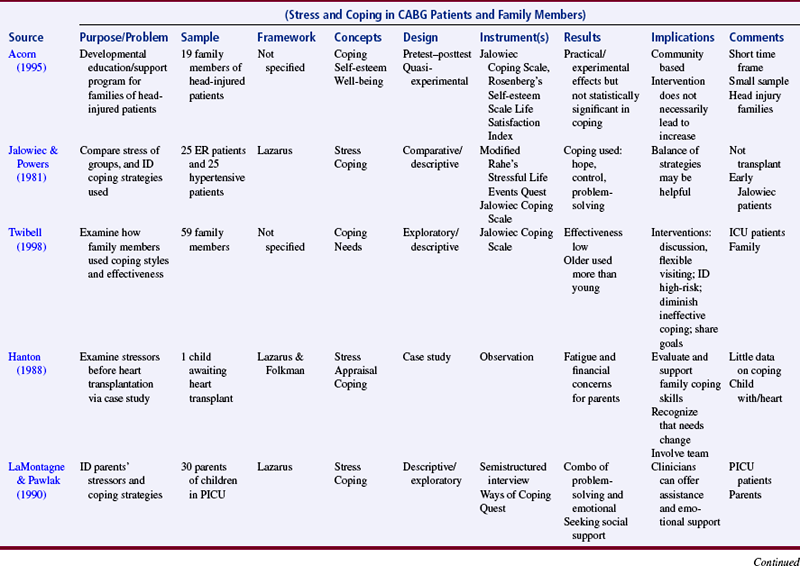
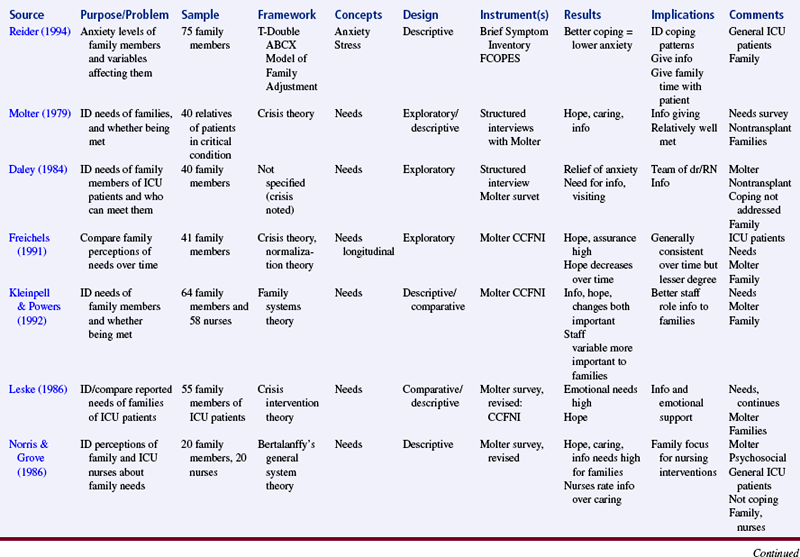
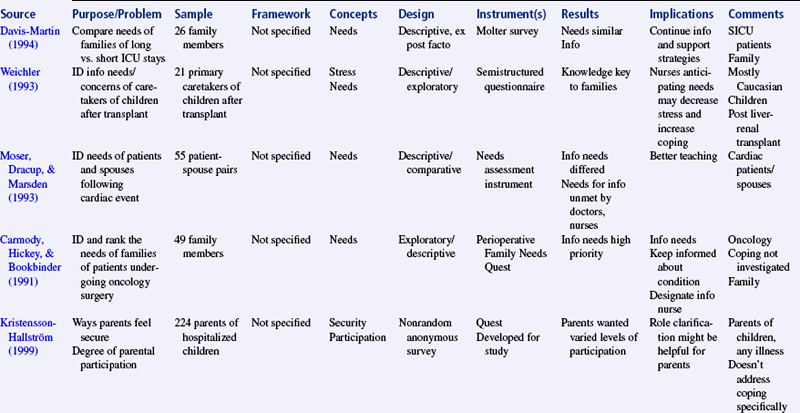
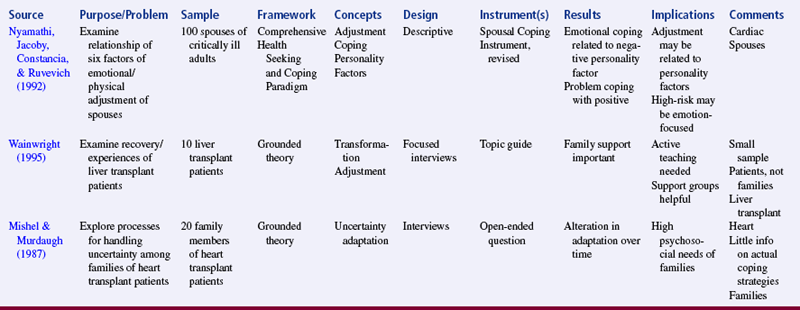
CABG, Coronary artery bypass grafting; CCFNI, critical care family needs inventory; dr, doctor; ER, emergency room; eval, evaluate; ICU, intensive care unit; ID, identify; info, information; PICU, pediatric intensive care unit; Quest, Questionnaire; RN, registered nurse; SICU, surgical intensive care unit.
Note: Example provided to illustrate structure of table references not included in reference list.
Modified by graduate student Molly O’Brien, from Pinch, W. J. (1995). Synthesis: Implement a complex process. Nurse Educator, 20(1): 34–40.
The second stage of analysis involves making comparisons among studies. This analysis allows you to critique the existing body of knowledge in relation to the research problem. You will be able to determine (1) theoretical formulations that have been used to explain how the variables in the problem influence one another, (2) what methodologies have been used to study the problem, (3) the methodological flaws in previous studies, (4) what is known about the problem, and (5) what the most critical gaps in the knowledge base are. The information gathered by using the table format shown in Table 6-6 can be useful in making these comparisons. Various studies addressing a research problem have approached the examination of the problem from different perspectives. They may have organized the study from different theoretical perspectives, asked different questions related to the problem, selected different variables, or used different designs. As Galvan (1999, p. 3) so wisely pointed out:
Due to the fact that empirical research provides only approximations and degrees of evidence on research problems that are necessarily limited in scope, creating a synthesis is like trying to put together a jigsaw puzzle, knowing in advance that most of the pieces are missing and that many of the available pieces are not fully formed.
Sometimes, findings from different studies conflict, leaving understanding in that area unclear and pointing to the need for further research with improved methodologies. As Galvan (1999, p. 3) has suggested, “You may soon find yourself acting like a juror, deliberating about which researchers seem to have the most cohesive and logical arguments, which ones have the strongest evidence and so on.” O’Connor (1992) has developed a strategy for using graphing methods to visually indicate the linkage of studies. Lines are drawn from a study to all of the studies cited in it, using a time line to illustrate the development of ideas. This process is repeated until all the studies cited have been mapped.
Synthesizing Sources
Synthesis of sources involves clarifying the meaning obtained from the sources as a whole. Through synthesis, one can cluster and interrelate ideas from several sources to form a gestalt. Rather than using direct quotes from an author, you should paraphrase his or her ideas. Paraphrasing involves expressing the ideas clearly and in your own words. The meanings of these sources are then connected to the proposed study. Last, the meanings obtained from all sources are combined, or clustered, to determine the current knowledge of the research problem (Pinch, 1995). Synthesis is the basis for developing the review of literature section for a research proposal, report, or evidence-based project.
Becker (1986) has suggested that there is a drawback to reviewing the literature; it can “deform” the position you wish to take about the research topic and the direction further research should take:
Suppose there is real literature on your subject, the result of years of normal science or what, by extension, we could call normal scholarship. Everyone who works on the topic agrees on the kinds of questions to ask and the kinds of answers they will accept. If you want to write about the topic, or even use that subject matter as the material for a new topic, you will probably have to deal with the old way even though you think it quite foreign to your interests. If you take the old way too seriously, you can deform the argument you want to make, bend it out of shape in order to make it fit into the dominant approach. What I mean by bending your argument out of shape is this. What you want to say has a certain logic that flows from the chain of choices you made as you did the work. If the logic of your argument is the same as the logic of the dominant approach to the topic, you have no problem. But suppose it isn’t. What you want to say starts from different premises, addresses different questions, recognizes a different kind of answer as appropriate. When you try to confront the dominant approach to this material, you start to translate your argument into its terms. Your argument will not make the kind of sense it made in its own terms; it will sound weak and disjointed and will appear ad hoc. It cannot look its best playing an opponent’s game. And that phrasing puts the point badly, because what’s involved is not a contest between approaches, after all, but a search for a good way to understand the world. The understanding you’re trying to convey will lose its coherence if it is put in terms that grow out of a different understanding.
If, on the other hand, you translate the dominant argument into your terms, you will not give it a fair shake, for much the same reasons. When you translate from one way of analyzing a problem into another, there is a good chance that the approaches are, as Kuhn (1962) suggested, incommensurable. Insofar as they address different questions, the approaches have very little to do with one another. There is nothing to translate. They are simply not talking about the same things.… A serious scholar ought routinely to inspect competing ways of talking about the same subject matter. The feeling that you can’t say what you mean in the language you are using will warn you that the literature is crowding you.… Use the literature, don’t let it use you. (Becker, 1986, pp. 146–149)
WRITING THE REVIEW OF LITERATURE
A thorough, organized literature review facilitates the development of a research proposal. Students frequently ask how long the literature review should be. Unfortunately, there is no way for an instructor to answer this question. The length of the review varies considerably according to the extent of research that has been conducted in the area. In a relatively new area of research, you may find only two or three previous studies, whereas in an established field of research, such as that of coping and social support, a vast quantity of literature exists. You should have two or three studies that include information on each of your variables. These may be the same studies but in all likelihood will not be.
Sorting Your Sources
Relevant sources (theoretical and empirical) are organized for inclusion in the different chapters of the research proposal. The sources to be included in the review of literature chapter are organized to reflect the current knowledge about the research problem. Those sources that provide background and significance for the study are included in the introduction chapter. Certain theoretical sources establish the framework for the study. Other relevant sources become the basis for defining research variables and identifying assumptions and limitations. Content from methodologically strong studies is used to direct the development of the research design, guide the selection of instruments, influence data collection and analysis, and provide a basis for interpretation of findings. Usually, at this point, a researcher is beginning to get a complete picture of his or her study and is excited about its potential. The researcher commonly feels confident about his or her knowledge of the research problem and ability to make the study a reality.
Developing the Written Review
The purpose of the written literature review is to establish a context for your study. The literature review for a study has four major sections: (1) the introduction, (2) a discussion of theoretical literature, (3) a discussion of empirical literature, and (4) a summary.
Introduction
The introduction to the literature review indicates the focus or purpose of the study, identifies the purpose of the literature review, and presents the organizational structure of the review. You should make clear in this section what you will and will not be covering. If you are taking a particular position or developing a logical argument for a particular perspective on the basis of the literature, make this position clear in the introduction. This section should be brief and catch the interest of the reader (Galvan, 1999).
Discussion of Theoretical Literature
The theoretical literature section contains concept analyses, models, theories, and conceptual frameworks that support the research purpose. Concepts, definitions of concepts, relationships among concepts, and assumptions are presented and analyzed to build a theoretical knowledge base for the study. This section of the literature review is sometimes used to present the framework for the study and may include a conceptual map that synthesizes the theoretical literature (see Chapter 7 for more detail on developing frameworks).
Discussion of Empirical Literature
The presentation of empirical literature should be organized by concepts or organizing topics. Although in the past, for each study reviewed, the researcher was expected to present the purpose, sample size, design, and specific findings with a scholarly but brief critique of the study’s strengths and weaknesses, this approach is expected less commonly now. Developing tables such as Table 6-7 and Table 6-8 can be a useful way for you to organize this information as preparation for writing your review.
TABLE 6-7
Synthesizing Studies to Generate a Review of Literature
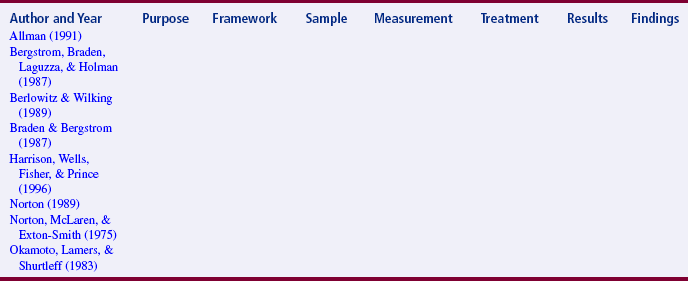
From Burns N., & Grove, S. K. (2007). Understanding Nursing Research (4th ed.). Philadelphia: Saunders, p. 154.
TABLE 6-8
Comparison and Contrast Study Findings on the Prediction and Prevention of Pressure Ulcers

From Burns, N., & Grove, S. K. (2007). Understanding Nursing Research (4th ed.). Philadelphia: Saunders, p. 155.
Currently, literature reviews tend to focus on synthesis of studies, with a critique of the strengths and weaknesses of the overall body of knowledge rather than a detailed presentation and critique of each study. This synthesis may be organized by concepts or variables that are the focus of the study. The findings from the studies should logically build on each other so that the reader can see how the body of knowledge in the research area evolved.
Evidence from multiple studies is pooled to reveal the current state of knowledge in relation to a particular concept or study focus (topic area). Conflicting findings and areas of uncertainty are explored. Similarities and differences in the studies should be explored. Gaps and areas needing more research are discussed. A summary of findings in the topic area is presented, along with inferences, generalizations, and conclusions you have drawn from your review of the literature. A conclusion is a statement about the state of knowledge in relation to the topic area. This should include a discussion of the strength of evidence available for each conclusion.
Ethical issues must be considered in your presentation of sources. The content from sources should be presented honestly, not distorted to support the selected problem. Researchers frequently read a study and wish that the author had studied a slightly different problem or that the study had been designed or conducted differently. However, they must recognize their own opinions and must be objective in presenting information.
The defects of a study need to be addressed, but it is not necessary to be highly critical of another researcher’s work. The criticisms must focus on the content that is in some way relevant to the proposed study and to be stated as possible or plausible explanations, so that they are more neutral and scholarly than negative and blaming.
Authors’ works must be accurately documented so the authors receive credit for their publications. APA requires that the reference list contain only those sources that have been cited in the development of the proposal or report.
Summary
The summary consists of a concise presentation of the current knowledge base for the research problem. Other literature reviews conducted in relation to your field of research should be discussed. The gaps in the knowledge base are identified, with a discussion of how the proposed study will contribute to the development of knowledge in the defined field of research. A critique of the adequacy of methodologies used in the studies reviewed should be presented, along with recommendations for improving the methodologies in future studies (Galvan, 1999). The summary concludes with a statement of how your study will contribute to the body of knowledge in this field of research.
Checking References
All references used in the literature review should be carefully checked for accuracy and completeness. Anyone reviewing the literature has at some time been frustrated by inaccurate references in publications. Foreman and Kirchhoff (1987) studied the accuracy of references in 17 nursing journals; 65 of the inaccurate references were from clinical journals and 47 were from nonclinical journals. The errors were classified as major (preventing retrieval of the source) or minor (not preventing retrieval). Errors occurred more frequently in clinical journals (38.4%) than in nonclinical journals (21.3%). Clinical references also had a 4.5% incidence of major errors, whereas the nonclinical references had no major errors.
To prevent these errors, check all the citations within the text of your literature review and each citation in your reference list. Typing or keyboarding errors may result in inaccurate information. You may omit some information, planning to complete the reference later, and then forget to do so. Downloading citations from a database directly into a reference management system and using the system’s manuscript formatting functions reduces some errors but does not eliminate all of them. Use your knowledge and skills to enhance your technology use; relying on technology alone will not create a quality manuscript.
The following reference citation errors are common in research studies:
• No citation is listed for a direct quotation.
• The citation for a direct quotation has the author’s name and year, but no page number.
• The author’s name is spelled differently in the text and in the reference list.
• The year of a citation is different in the text and in the reference list.
• The citation in the reference list is incomplete.
• A study is cited in the text for which there is no citation in the reference list.
• A citation appears in the reference list for which there is no citation in the text.
In revising your text, you may rearrange or renumber citations, resulting in inaccuracies. Biancuzzo (1997) described this sort of problem in one of her publications:
My own article (Biancuzzo, 1991) said “… although epidural anesthesia affects sensory neurons, motor neurons are not completely blocked.16” After publication, I was horrified to see that citation #16 was entitled “Maternal positions for childbirth: A historical review of nursing care practices.” The correct citation should have been #15 entitled, “The influence of continuous epidural bupivacaine analgesia on the second stage of labor and method of delivery in nulliparous women.” (p. 1)
A similar problem can occur when you cite several publications written by the same author. In this case, it is easy to reference the right author but the wrong source.
To detect these easily made errors, check your references immediately before completing your paper. The most accurate check involves comparing each reference with the original journal article or online with CINAHL or other bibliographical databases.
EXAMPLE OF A LITERATURE REVIEW
A literature review from an actual published descriptive study is presented here to reinforce the points that were addressed in this chapter. The study focuses on “validation of oxygen saturation monitoring in neonates” (Shiao & Ou, 2007, pp. 168–178).
Note: this example is more brief than proposals will be because of space limitations in a textbook. The critique of reviews is presented in Chapter 26.
INTEGRATIVE REVIEWS
Integrative reviews are a type of secondary source that may be important to a review of the literature. Integrative reviews are conducted to identify, analyze, and synthesize the results from independent studies to determine the current knowledge (what is known and not known) in a particular area (Beyea & Nicoll, 1998; Ganong, 1987; Smith & Stullenbarger, 1991). Such a review contains a comprehensive list of references and summarizes empirical literature for selected topics (Cooper, 1984). In some cases, an integrative review is built around one or more theories used in the field of research. Review articles are primary sources in terms of the author’s synthesis of the literature; however, they are secondary sources in terms of the author’s discussion of previous authors’ works. To use this information, you need to turn to the primary source of each author’s work. For some research problems, you will find policy papers, standards of practice, or proposed legislation that may be important to include as part of the literature review. Clinical papers may be important for addressing the background and significance of the problem, but they should not be included in the review of literature. Integrative reviews are particularly important for examining the strength of evidence available to guide clinical practice.
An example of a source that provides integrative reviews is the Annual Review of Nursing Research, first published in 1983 (Werley & Fitzpatrick). The volumes of this publication, which continue to be published annually, contain excellent and thorough integrative reviews of research in the areas of nursing practice, nursing care delivery, nursing education, and the profession of nursing. Integrative reviews have also been published in a variety of clinical and research journals.
Worldviews on Evidence-Based Nursing (at www.nursingsociety.org/Publications/Journals/Pages/worldviews.aspx) is published by Sigma Theta Tau as both a print and an online publication. It is a quarterly, peer-reviewed, evidence-based nursing journal and information resource that provides knowledge synthesis articles with best practice applications and recommendations for clinical practice, and a forum that encourages readers to engage in an ongoing dialogue on critical issues and questions in evidence-based nursing. Subscription to the journal is required to access the online journal.
The Oncology Nursing Forum provides syntheses of oncology studies at ONS (Oncology Nursing Society) online at http://ons.metapress.com/home/main.mpx. The University of Texas Health Science Center at San Antonio School of Nursing has developed the Academic Center for Evidence Based Practice (ACE) at www.acestar.uthscsa.edu.
Metasynthesis
Integrative reviews of qualitative research, or metasyntheses, are beginning to appear in the literature and will provide an important dimension to the synthesis of knowledge. Sandelowski, Docherty, and Emden (1997, p. 366) defined metasynthesis as “the theories, grand narratives, generalizations, or interpretive translations produced from the integration or comparison of findings from qualitative studies.” One difficulty is locating qualitative studies, which is more difficult than locating quantitative studies in the literature databases. Flemming and Briggs (2006) provided some strategies. Because metasynthesis is relatively new, systematic approaches to synthesizing qualitative studies is in early stages of development. A number of authors cite Noblit and Hare (1988) as the basis of their methodology for metasynthesis. Other sources cited include Estabrooks, Field, and Morse (1994); Finfgeld (2003); Jensen and Allen (1996); Kearney (2001); Kirkevold (1997); McCormick, Rodney, and Varcoe (2003); Morse, (2001); Patterson and Thorne (2003); Patterson, Thorne, Canam, and Jillings (2001); Ritzer (1992); Sandelowski (2006); Sandelowski and Barroso (2003a, 2000b); Sandelowski et al. (1997); Sandelowski, Barroso, and Voils (2007); Sherwood (1999); Thorne (1998); Thorne and Paterson (2002); Thorne, Jensen, Kearney, Noblit, and Sandelowski (2004); and Zhao (1991). Some authors are pooling strategies recommended by several sources. Others are developing their own methods. A metasynthesis is given here to demonstrate the methods used.
Coffey (2006) described her metasynthesis as follows:
The purpose of this study was to create a comprehensive chronicle of the phenomena of parenting a child with a chronic illness. This accumulated body of knowledge is presented from the parents’ point of view as they care for a child with a chronic illness.
Procedure. To begin the procedure, a review of the literature was done using the following resources, including online databases such as CINAHL, ERIC, Psyclit, Sociological Abstracts, PubMed, and Dissertation Abstracts. These databases were searched for the time period between 1960 and the present. Studies from all years were reviewed; however, the studies chosen were published between 1989 and 2000. The key words used in the search were chronic illness, pediatrics, parenting, and qualitative study. The key work choice narrowed the search and eliminated studies that did not mention mother and father in the findings. There were several qualitative studies found in the inquiry. In addition, the query produced numerous quantitative studies and topical articles, as well as two triangulated studies that had a descriptive phenomenological component.
Sample. The criteria for inclusion into the studies were (a) the focus of the study was parenting a child with chronic illness; (b) the studies included both mother and father and may have mentioned family life; however, that was not the focus of the criteria; and (c) the research design was qualitative or had a qualitative component.
Articles identified as qualitative research were reviewed. All methods of qualitative research were included in the study. Nine of the 11 designs were exclusively qualitative. Two of the studies were triangulated. The qualitative studies represented several different methods. There were three grounded theory studies, three phenomenological studies, one secondary analysis, two triangulation, and two descriptive qualitative studies.
The literature search yielded 11 studies to be included in the metasynthesis. During the course of the search, it was noted that there is a plethora of quantitative studies and topical articles on parenting and chronic illness. The articles chosen were all from nursing journals, although three studies had second authors from disciplines that included child life, medicine, and human development.…
The 11 studies chosen were conducted in four different countries. Five of the studies were conducted in the United States, one in Japan, one in Germany, and four in Canada. The studies involved 533 participants, with 140 of those clearly identified as fathers. The remainder of the participants were identified as mothers, with the exception of five families from one study with no indication of the parental role of the participants. The age of the children ranged from birth to 22 years of age. One study using older children was retrospective and asked the parents to reflect on parenting when the child was younger.
Data analysis. The approach used for this metasynthesis on parenting children with chronic illness was based onNoblit & Hare’s method (1988) found in their book Metaethnography: Synthesizing Qualitative Studies. The approach consists of seven phases as listed below.
Getting started and deciding on a phenomenon of study. The researcher chose parenting of a child with chronic illness as the area of interest.
Deciding what qualitative studies are relevant to the initial interest. The researcher reviewed over 30 studies to narrow the selection based on inclusion criteria stated earlier.
Reading the qualitative studies. Each study was read and reread to identify key metaphors, themes, or concepts. Detailed notes were kept on these themes, concepts, and metaphors.
Determining how the studies are related to each other. In this phase, the synthesizer made a list of the key metaphors in each study and their relations to each other. The term “metaphor” referred to themes, concepts, or phrases. Three different assumptions can be made about the relationships between the studies to be synthesized. These key assumptions are “(1) the accounts are directly comparable as reciprocal translations; (2) the accounts stand in relative opposition to each other and are essentially refutational; or (3) the studies taken together present a line of argument rather than a reciprocal or refutational translation”(Noblit & Hare, 1988, p. 27). In this metasynthesis, the synthesis took the form of reciprocal translations because the studies were about similar themes. With reciprocal translations, each study is translated into the metaphors of the others and vice versa.
Translating the studies into one another. As Noblit & Hare (1988) explained, “Translations are especially unique syntheses, because they protect the particular, respect holism, and enable comparison. An adequate translation maintains the central metaphors and/or concepts of each account in their relation to other key metaphors or concepts in that account.” (p. 28).
Synthesizing translations. This involves creating a whole as something more than the individual parts imply. The translations as a group are one level of a metasynthesis. Next, the translations can be compared to decide if the same metaphors/themes or concepts can be encompassed into those of others. This is a second level of synthesis. At this point, the study was reviewed by an expert in qualitative research as a check in the analytic process.
Expressing the synthesis through the written word, plays, art, videos, or music. The preface to the book written by Noblit & Hare includes the following poignant quotation: “When we synthesize, we give meaning to the set of studies under consideration. We interpret them in a fashion similar to an ethnographer interpreting a culture” (1988, p. 7).
The qualitative researcher must enter this endeavour well aware of the responsibility to clearly synthesize the information and present it for the reader to make sense of the phenomena. In the metasynthesis, each parent’s words coalesce to provide the practitioner insight into the life of parenting a child with chronic illness. (Coffey, 2006, pp. 51–53).
Table 6-9 shows the themes extracted during the analysis. Using this table, how would you synthesize the information?
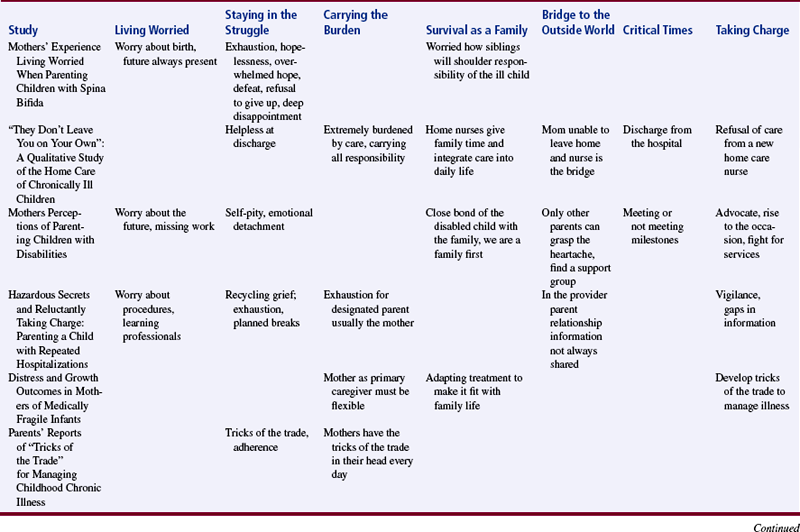
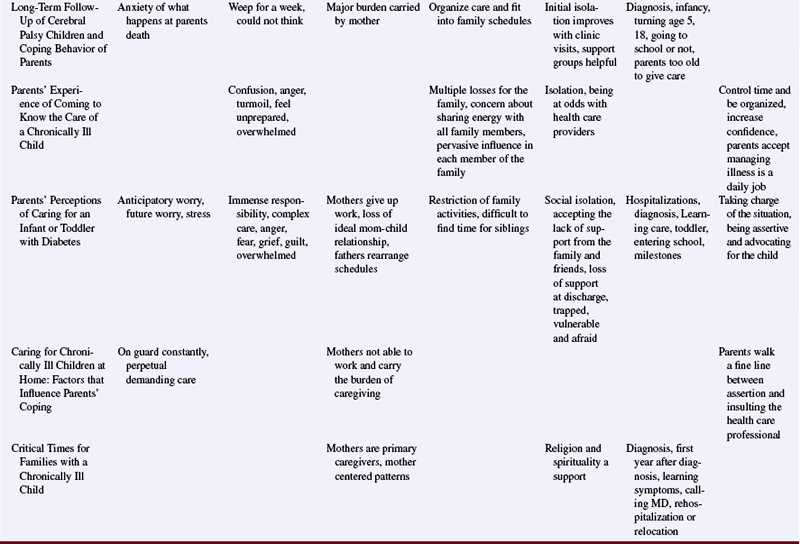
Meta-Analysis
Meta-analysis involves merging findings from many studies that have examined the same phenomenon. The design uses specific statistical analyses to determine the overall findings from a combined examination of reports of statistical findings of each study. The statistical values used include the means and standard deviations for each group in the study. One of the outcomes of a meta-analysis is the estimation of a population effect size for the topic under study. Because studies seldom have exactly the same focus, conclusions are never absolute but do give some sense of unity to knowledge within that area (O’Flynn, 1982).
One problem that researchers constantly encounter in meta-analyses is that the studies being examined are inconsistent in design quality. However, researchers conducting meta-analyses have not successfully identified a generally acceptable means to measure the research quality of studies. Brown (1991) proposed a research quality scoring method to accomplish this important task. Another problem with meta-analyses is that basic research information is often missing from research reports. Calculating effect sizes requires means and standard deviations in each study for both experimental and control groups. In addition, the beginning sample size must be reported, as well as the sample size at the time of the posttest. Often, the treatment has been poorly described, making it difficult to determine the most effective treatments (Brown, 1991).
Lee, Soeken, and Picot (2007) conducted a meta-analysis of the effectiveness of intervention in improving the mental health of informal stroke caregivers. The following describes the study:
In this meta-analysis, mental health was defined as a psychological state as measured by the Short Form Health Survey (SF-36).… The specific outcome was the difference in the SF-36 mental health score between the experimental group and the control group. The independent variable included any type of intervention that was implemented for informal stroke caregivers to improve their mental health.
Searches were performed using MEDLINE (1966–2005) and Cumulative Index for Nursing and Allied Health Literature (CINAHL, 1982–2005) computerized databases. The searches were limited to articles published in the English language using combinations of the keywords caregiving, stroke caregiver, stroke caregiving, control group, and interventions. For the keyword search, the author wanted to identify experimental studies with stroke caregivers. The database searches of MEDLINE and CINAHL revealed a total of 30 articles. A citation search of the Social Sciences Citation Index and Science Citation Index yielded one additional article for inclusion. In addition, the Cochrane library search to find additional studies resulted in the same finding as that found in the computerized database searches. Unpublished studies were not included in this meta-analysis because they have not undergone peer review.
Abstracts of the 31 studies identified through the search were independently reviewed by the first author for inclusion in this meta-analysis. The inclusion criteria were (a) sample included informal caregivers of stroke patients; (b) intervention for stroke caregivers to improve their mental health; (c) outcome variables include the SF-36; (d) quantitative study; and (e) use of a comparison group on the outcome measure. From the 31 abstracts, only 11 articles met the inclusion criteria.
Based on a review of the 11 studies, 7 articles were excluded for various reasons including: (a) using the SF-36 outcome, but not reporting the data (Dennis, O’Rourke, Slattery, Staniforth, & Warlow, 1997; Printz-Feddersen, 1990); (b) inadequate descriptive statistics (Grant, 1999); (c) not presenting caregivers’ data in results section (Forster & Young, 1996; Lincoln, Francis, Lilley, Sharma, & Summerfield, 2003; Mayo et al., 2000); and (d) only reporting qualitative data (Stewart, Doble, Hart, Langille, & MacPherson, 1998). Finally, 4 studies were retained for this meta-analysis.
After initially reviewing the four studies to be included in this meta-analysis, variables were selected for inclusion in the codebook. Coded were: first author, year, design, number of subjects in each group (experimental and control), intervention characteristics, theoretical background for the intervention, intervention period, setting, data collection period, attrition rate, and statistical results. The first author and a second coder independently extracted data from all four studies. Coder agreement was initially 95.8%. Coders then reviewed items for which there was lack of agreement. After discussion, consensus was reached on all items. The data extracted were entered into an EXCEL file.
For the quality rating, several items were selected from a quality measure previously used bySoeken and colleagues (2003). These items assessed study aim, randomization, blinding, attrition, statistical testing, and discussion section. Using this quality rating scale, the range of total quality points is 0 to 16. Because all the studies used a randomized design, and treatment personnel conducted the interventions, the quality assessment scale specifically addressed blinding of caregivers, treatment personnel, or data collector. Studies with scores of 0 to 9 were considered low quality and those with scores 10 to 16 were considered high quality.
All studies were assessed for quality by two independent raters. The agreement rate between the two raters was 90%. Following discussion, the raters reached consensus for all items. Quality scores for four studies ranged from 9–13. One study was rated low quality because no one was blinded (Van den Heuval et al., 2002).The remaining three were rated high quality (Grant, Elliot, Warver, Bartolucci, & Giger, 2002; Mant, Carter, Wade, & Winner, 2000; Rodgers et al., 1999).
An effect size (d) was calculated for each of the individual studies converting the reported statistics into the standardized effect size. The raw effect sizes were weighted for study sample size because raw effect sizes from studies with small samples are prone to overestimate the population effect size (Shadish & Haddock, 1994). An overall mean weighted effect size for the four studies was calculated. Additionally, 95% confidence intervals were calculated for each effect size.
To assess sensitivity of the results, mean weighted effect sizes were computed by study quality rating. Subgroup analyses examined differences regarding types of intervention (education/support), presence of a theoretical background for creating the intervention (yes/no), and study setting (Europe/United States). Finally, potential publication bias was assessed using the fail-safe N.
The four study samples included 718 individuals with a large proportion of women (71.7%). The mean age of the subjects was 61.1 years. All of the studies used randomized controlled designs…
Effect sizes and 95% confidence intervals for each individual study and for the overall mean weighted effect size (MWES) were calculated. Effect sizes ranged from 0 to 0.92. The four studies had varied effect with an overall MWES of 0.277 (p < 0.001) with a 95% CI from 0.118 to 0.435 (N = 718). Thus, across the four studies the results indicate that the intervention was effective in improving the mental health of informal stroke caregivers. (Lee, Soeken, & Picot, 2007, pp. 344–348)
Table 6-10 summarizes the sample studies in the Lee et al. (2007) study.
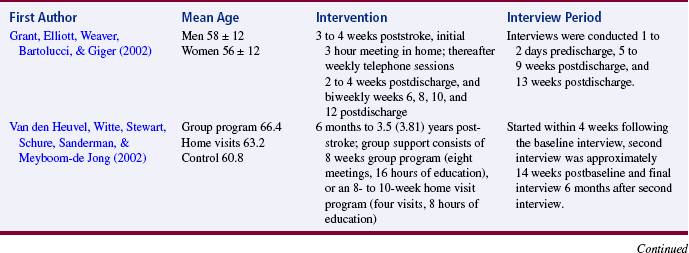
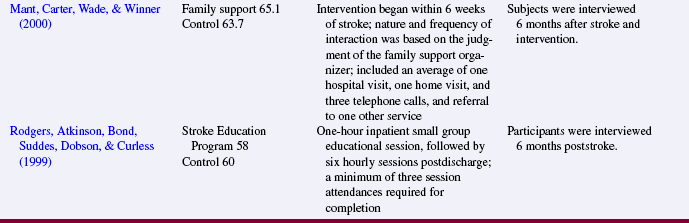
SUMMARY
• Reviewing the existing literature related to your study is a critical step in the research process.
• The three major stages of a literature review delineated here are searching the literature, reading the literature, and writing the literature review.
• The literature consists of all written sources relevant to the topic you have selected.
• Two types of literature are predominantly used in the review of literature for research: theoretical and empirical.
• Theoretical literature includes concept analyses, models, theories, and conceptual frameworks that support a selected research problem and purpose.
• Empirical literature includes relevant studies in journals and books, as well as unpublished studies, such as master’s theses and doctoral dissertations.
• Reading and critiquing sources promotes understanding of the current knowledge of a research problem and involves skimming, comprehending, analyzing, and synthesizing content from sources.
• A thorough, organized literature review facilitates the development of a research proposal.
• The literature review for a study has four major sections: the introduction, a discussion of theoretical literature, a discussion of empirical literature, and a summary.
Acorn, S. Assisting families of head-injured survivors through a family support programme. Journal of Advanced Nursing. 1995;21(5):872–877.
Allman, R.M. Pressure ulcers among bedridden hospitalized elderly. Division of Gerontology/Geriatrics, University of Alabama at Birmingham, 1991. Unpublished data compiled
American Psychological Association (APA). Publication manual of the American Psychological Association, (5th ed.). Washington, DC: Author, 2001.
Asian Institute of Technology, Center for Language and Educational Technology Writing and research: The literature review, 2000. Retrieved February 25, 2000, from www.languages.ait.ac.th/el21open.htm.
Askin, D.F. Interpretation of neonatal blood gases, part II: disorders of acid-base balance. Neonatal Network. 1997;16(6):23–29.
Auston, I., Cahn, M.A., Selden, C.R. Literature search methods for the development of clinical practice guidelines. National Library of Medicine, Office of Health Services Research Information. Retrieved February 25, 2000, from www.nlm.nih.gov/nichsr/litsrch.html, 1992.
Barker, S.J., Tremper, K.K., Hyatt, J. Effects of methemoglobinemia on pulse oximetry and mixed venous oximetry. Anesthesiology. 1989;70(1):112–117.
Becker, H.S. Writing for social scientists: How to start and finish your thesis, book, or article. Chicago: University of Chicago Press, 1986.
Bergstrom, N., Braden, B.J., Laguzza, A., Holman, V. The Braden Scale for predicting pressure sore risk. Nursing Research. 1987;36(4):205–210.
Berlowitz, D.R., Wilking, S.V. Risk factors for pressure sores: A comparison of cross-sectional and cohort-derived data. Journal of the American Geriatric Society. 1989;37(11):1043–1050.
Beyea, S., Nicoll, L.H. Writing an integrative review. AORN Journal. 1998;67(4):877–880.
Biancuzzo, M. Does the hands-and-knees posture help to rotate the occiput posterior fetus? Birth. 1991;18(1):40–47.
Biancuzzo, M. Checking references: Tips for reviewers. Nurse Author & Editor. 1997;7(3):1–3.
Blaisdell, C.J., Goodman, S., Clark, K., Casella, J.F., Loughlin, G.M. Pulse oximetry is a poor predictor of hypoxemia in stable children with sickle cell disease. Archives of Pediatric Adolescent Medicine. 2000;154(9):900–903.
Braden, B., Bergstrom, N. A conceptual schema for the study of the etiology of pressure sores. Rehabilitation Nursing. 1987;12(1):8–12.
Brown, S.A. Measurement of quality of primary studies for meta-analysis. Nursing Research. 1991;40(6):352–355.
Bucher, H.U., Fanconi, S., Beeckert, P., Duc, G. Hyperoxemia in newborn infants: detection by pulse oximetry. Pediatrics. 1989;84(2):226–230.
Bunn, H.F., Forger, B.G. Hemoglobin: Molecular, genetic and clinical aspects. W.B. Saunders: Philadelphia, 1986.
Carmody, S., Hickey, P., Bookbinder, M. Perioperative needs of families: Results of a survey. AORN Journal. 1991;54(3):561–567.
Carter, B.G., Carlin, J.B., Tibballs, J., Mead, H., Hichmann, M., Osborne, A. Accuracy of two pulse oximeters at low arterial hemoglobin-oxygen saturation. Critical Care Medicine. 1998;26(6):1128–1133.
Coffey, J.S. Parenting a child with chronic illness: A metasynthesis. Pediatric Nursing. 2006;32(1):51–59.
Collins, E.G., White-Williams, C., Jalowiec, A. Spouse stressors while awaiting heart transplantation. Heart & Lung: Journal of Acute & Critical Care. 1996;25(1):4–13.
Comber, J.T., Lopez, B.L. Evaluation of pulse oximetry in sickle cell anemia patients presenting to the emergency department in acute vasocclusive crisis. American Journal of Emergency Medicine. 1996;14(1):16–18.
Cooper, H.M. The integrative research review: A systematic approach. Sage: Beverly Hills, CA, 1984.
Daley, L. The perceived immediate needs of families with relatives in the intensive care setting. Heart & Lung. 1984;13(3):231–237.
Damrosch, S., Damrosch, G.D. Methodology corner. Avoiding common mistakes in APA style: The briefest of guidelines. Nursing Research. 1996;45(6):331–333.
Davis-Martin, S. Perceived needs of families of long-term critical care patients: A brief report. Heart & Lung. 1994;23(6):515–518.
Dehalleux, V., Truttmann, A., Gagnon, C., Bard, H. The effect of blood transfusion on the hemoglobin oxygen dissociation curve of very early preterm infants during the first week of life. Seminars in Perinatology. 2002;26(6):411–415.
Dennis, M., O’Rourke, S., Slattery, J., Staniforth, T., Warlow, C. Evaluation of a stroke family care worker: Results of a randomised controlled trial. British Medical Journal. 1977;314(7087):1071–1076.
Estabrooks, C.A., Field, P.A., Morse, J.M. Aggregating qualitative findings: An approach to theory development. Qualitative Health Research. 1994;4(4):503–511.
Finfgeld, D.L. Metasynthesis: The state of the art-so far. Qualitative Health Research. 2003;13(7):893–904.
Fleming, J.W., Hayter, J. Reading research reports critically. Nursing Outlook. 1974;22(3):172–175.
Flemming, K., Briggs, M. Electronic searching to locate qualitative research: Evaluation of three strategies. Journal of Advanced Nursing. 2006;57(1):95–100.
Foreman, M.D., Kirchhoff, K.T. Accuracy of references in nursing journals. Research in Nursing & Health. 1987;10(3):177–183.
Forster, A., Young, J. Specialist nurse support for patients with stroke in the community: A randomised controlled trial. British Medical Journal. 1996;312(7047):1642–1646.
Freichels, T.A. Needs of family members of patients in the intensive care unit over time. Critical Care Nursing Quarterly. 1991;14(3):16–29.
Galvan, J.L. Writing literature reviews. Pyrczak: Los Angeles, 1999.
Ganong, L.H. Integrative reviews of nursing research. Research in Nursing & Health. 1987;10(1):1–11.
Gilliss, C.L. Reducing family stress during and after coronary artery bypass surgery… the patient-spouse pair. Nursing Clinics of North America. 1984;19(1):103–112.
Grant, J.S. Social problem-solving partnerships with family caregivers. Rehabilitation Nursing. 1999;24(6):254–260.
Grant, J.S., Elliott, T.R., Weaver, M., Bartolucci, A.A., Giger, J.N. Telephone intervention with family caregivers of stroke survivors after rehabilitation. Stroke. 2002;33(8):2060–2065.
Grossbach, I. Case studies in pulse oximetry monitoring. Critical Care Nurse. 1993;13(4):63–65.
Hampson, N.B. Pulse oximetry in severe carbon monoxide poisoning. Chest. 1998;114(4):1036–1041.
Haney, M., Tait, A.R., Tremper, K.K. Effect of carboxyhemoglobin on the accuracy of mixed venous oximetry monitors in dogs. Critical Care Medicine. 1994;22(7):1181–1185.
Hanton, L.B. Caring for children awaiting heart transplantation: Psychosocial implications. Pediatric Nursing. 1988;24(3):214–218.
Harris, A.P., Sendak, M.J., Donham, R.T., Thomas, M., Duncan, D. Absorption characteristics of human fetal hemoglobin at wavelengths used in pulse oximetry. Journal of Clinical Monitoring. 1988;4(3):175–177.
Harrison, M.B., Wells, G., Fisher, A., Prince, M. Practice guidelines for the prediction and prevention of pressure ulcers: Evaluating the evidence. Applied Nursing Research. 1996;9(1):9–17.
Hirschl, R.B., Palmer, P., Heiss, K.F., Hultquist, K., Fazzalari, F., Barlett, R.H. Evaluation of the right arterial venous oxygen saturation as a physiologic monitor in a neonatal model. Journal of Pediatric Surgery. 1993;28(7):901–905.
Hohl, R.J., Sherburne, A.R., Feeley, J.E., Huisman, T.H., Burns, C.P. Low pulse oximeter-measured hemoglobin oxygen saturation with haemoglobin Cheverly. American Journal of Haematology. 1998;59(3):181–184.
Imai, K., Tientadakul, P., Opartkiattikul, N., Luenee, P., Winichagoon, P., Svasti, J., et al. Detection of haemoglobin variants and inference of their functional properties using complete oxygen dissociation curve measurements. British Journal of Haematology. 2001;112(2):483–487.
Jalowiec, A., Powers, M.J. Stress and coping in hypertensive and emergency room patients. Nursing Research. 1981;30(1):10–15.
James, L., Greenough, A., Naik, S. The effect of blood transfusion on oxygenation in premature ventilated neonates. European Journal of Pediatrics. 1997;156(2):139–141.
Jensen, L.A., Allen, M.N. Metasynthesis of qualitative findings. Qualitative Health Research. 1996;6(4):553–560.
Kearney, M.H. New directions in grounded formal theory. In: Schreiber R., Stern P.N., eds. Using grounded theory in nursing. New York: Springer; 2001:227–246.
Kirkevold, M. Integrative nursing research: An important strategy to further the development of nursing science and nursing practice. Journal of Advanced Nursing. 1997;25(5):977–984.
Kleinpell, R.M., Powers, M.J. Needs of family members of intensive care unit patients. Applied Nursing Research. 1992;5(1):2–8.
Koskinen, L.K., Lahtela, J.T., Koivula, T.A. Fetal hemoglobin in diabetic patients. Diabetic Care. 1994;17(8):828–831.
Kristensson-Hallström, I. Strategies for feeling secure influence parents’ participation in care. Journal of Clinical Nursing. 1999;8(5):586–592.
Krzeminski, A. How is fetal hemoglobin determined and corrected for in the OSM3, the ABL510, and the ABL 520? Copenhagen, Denmark: Radiometer, 1992. Info No. 1992-4-1-4
Kubler-Ross, E. On death and dying. New York: Macmillan, 1969.
Kuhn, T. The structure of scientific revolutions, (2nd ed.). Chicago: University of Chicago Press, 1962.
LaMontagne, I.L., Pawlak, R. Stress and coping of parents of children in a pediatric intensive care unit. Heart & Lung. 1990;19(4):416–421.
Lawrence, J., Levy, L. Comparing the self-described searching knowledge of first-year medical and dental students before and after a MEDLINE class. Medical Reference Services Quarterly. 2004;23(1):73–81.
Lee, J., Soeken, K., Picot, S.J. A meta-analysis of interventions for informal stroke caregivers. Western Journal of Nursing Research. 2007;29(3):344–356.
Leske, J.S. Needs of relatives of critically ill patients: A follow-up. Heart & Lung. 1986;15(2):189–193.
Lincoln, M.B., Francis, V.M., Lilley, S.A., Sharma, J.C., Summerfield, M. Evaluation of a stroke family support organiser: A randomized controlled trial. Stroke. 2003;34(1):116–121.
Mant, J., Carter, J., Wade, D.T., Winner, S. Family support for stroke: A randomised controlled trial. Lancet. 2000;356(9232):808–813.
Marchette, L. Research: The literature review process. Perioperative Nursing Quarterly. 1985;1(4):69–76.
Mayo, N.E., Wood-Dauphinee, S., Cote, R., Gayton, D., Carlton, J., Buttery, J., et al. There’s no place like home: An evaluation of early supported discharge for stroke. Stroke. 2000;31(5):1016–1023.
McCormick, J., Rodney, P., Varcoe, C. Reinterpretations across studies: An approach to meta-analysis. Qualitative Health Research. 2003;13(7):933–944.
Meats, E., Brassey, J., Heneghan, C., Glasziou, P. Using the Turning Research into Practice (TRIP) database: how do clinicians really search? Journal of the Medical Library Association. 2007;95(2):156–163.
Mishel, M.H., Murdaugh, C.L. Family adjustment to heart transplantation: Redesigning the dream. Nursing Research. 1987;36(6):332–338.
Molter, N.C. Needs of relatives of critically ill patient. Heart & Lung. 1979;8(2):332–339.
Moore, J.M., Nahlenl, B., Ofulla, A.V., Caba, J., Ayisi, J., Oloo, A., et al. A simple perfusion technique for isolation of maternal intervillous blood mononuclear cells from human placentae. Journal of Immunological Methods. 1997;209(1):93–104.
Morse, J.M. Qualitative verification: Building evidence by extending basic findings. In: Morse J., Swanson J., Kuzel A., eds. The nature of qualitative evidence. Thousand Oaks, CA: Sage; 2001:203–220.
Moser, D.K., Dracup, K.A., Marsden, C. Needs of recovering cardiac patients and their spouses: Compared views. International Journal of Nursing Studies. 1993;30(2):105–114.
Moyle, J.T. Uses and abuses of pulse oximetry. Archives of Diseases in Childhood. 1996;74(1):77–80.
Munhall, P.L. Nursing research: A qualitative perspective, (4th ed.). Sudbury, MA: Jones & Bartlett, 2006.
Nakanishi, M., Yoshioka, T., Okano, Y., Nishimura, T. Continuous Fick cardiac output measurement during exercise by monitoring of mixed venous oxygen saturation and oxygen uptake. Chest. 1993;104(2):419–426.
Nemeto, S., Aoki, M., Dehua, C., Imai, Y. Free haemoglobin impairs cardiac function in neonatal rabbit heart. Annals of Thoracic Surgery. 2000;69(5):1484–1489.
Noblit, G.W., Hare, R.D. Meta-ethnography: Synthesizing qualitative studies. Newbury Park, CA: Sage, 1988.
Nolan, M.T., Cupples, S.A., Brown, M., Pierce, L., Lepley, D., Ohler, L. Perceived stress and coping strategies among families of cardiac transplant candidates during the organ waiting period. Heart & Lung. 1992;21(6):540–547.
Norris, L., Grove, S.K. Investigation of selected psychosocial needs of family members of critically ill adult patients. Heart & Lung. 1986;15(2):194–199.
Norton, D. Calculating the risk: Reflections on the Norton Scale. Decubitus. 1989;2(3):24–31.
Norton, D., McLaren, R., Exton-Smith, A.N. An investigation of geriatric nursing problems in hospital. London: Churchill Livingstone, 1975.
Nyamathi, A., Jacoby, A., Constancia, P., Ruvevich, S. Coping and adjustment of spouses of critically ill patients with cardiac disease. Heart & Lung. 1992;21(2):160–166.
O’Connor, S.E. Network theory: A systematic method for literature review. Nurse Education Today. 1992;12(1):44–50.
O’Connor, T.A., Hall, R.T. Mixed venous oxygenation in critically ill neonates. Critical Care Medicine. 1994;22(2):343–346.
O’Flynn, A.I. Meta-analysis. Nursing Research. 1982;31(5):314–316.
Okamoto, G.A., Lamers, J.V., Shurtleff, D.B. Skin breakdown in patients with myelomeningocele. Archives of Physical Medicine Rehabilitation. 1983;64(1):20–23.
Paterson, B.L., Thorne, S. The potential of meta- synthesis for nursing care effectiveness research. Canadian Journal of Nursing Research. 2003;35(3):39–43.
Paterson, B.L., Thorne, S.E., Canam, C., Jillings, C. Meta-study of qualitative health research. A practical guide to meta-analysis and meta-synthesis. Thousand Oaks, CA: Sage, 2001.
Peters, A., Rohloff, D., Kohlmann, T., Renner, F., Jantschek, G., Kerner, W., et al. Fetal hemoglobin in starvation ketosis of young women. Blood. 1998;91(2):691–694.
Pianosi, P., Charge, T.D., Esseltine, D.W., Coates, A.L. Pulse oximetry in sickle cell disease. Archives of Disabled Children. 1993;68(6):735–738.
Pinch, W.J. Synthesis: Implementing a complex process. Nurse Educator. 1995;20(1):34–40.
Poets, C.F. Assessing oxygenation in healthy infants. Journal of Pediatrics. 1999;135(5):541–543.
Poets, C.F., Southall, D.P. Non-invasive monitoring of oxygenation in infants and children: practical considerations and areas of concern. Pediatrics. 1994;93(5):737–746.
Poets, C.F., Wilken, M., Seidenberg, J., Southhall, D.P., van der Hardt, H. Reliability of a pulse oximeter in the detection of hyperoxemia. Journal of Pediatrics. 1993;122(1):87–90.
Porter, R., Krout, L., Parks, V., Gibbs, S., Luers, E., Gould, M., et al. Perceived stress and coping strategies among cardiac transplant patients during the organ waiting period. Heart & Lung. 1992;21(3):292.
Printz-Feddersen, V. Group process effect on caregiver burden. Journal of Neuroscience Nursing. 1990;22(3):164–168.
Rajadurai, V.S., Walker, A.M., Yu, V.Y., Oates, A. Effect of fetal haemoglobin on the accuracy of pulse oximetry in preterm infants. Journal of Paediatric Child Health. 1992;28(1):43–46.
Rausch-Madison, S., Mohsenifar, Z. Methodologic problems encountered with cooximetry in methemoglobinemia. American Journal of Medical Science. 1997;314(3):203–206.
Reider, J.A. Anxiety during critical illness of a family member. DCCN: Dimensions of Critical Care Nursing. 1994;13(5):272–279.
Ritzer, G. Metatheorizing in sociology: Explaining the coming of age. In: Ritzer G., ed. Metatheorizing. Newbury Park, CA: Sage; 1992:7–26.
Rochette, J., Craig, J.E., Thein, S.L. Fetal haemoglobin levels in adults. Blood Review. 1994;8(4):213–224.
Rodgers, H., Atkinson, C., Bond, S., Suddes, M., Dobson, R., Curless, R. Randomized controlled trial of a comprehensive stroke education program for patients and caregivers. Stroke. 1999;30(12):2585–2591.
Samura, O., Peril, B., Sohda, S., Johnson, K.L., Sekizawa, A., Falco, V.M., et al. Female fetal cells in maternal blood: Use of DNA polymorphism to prove origin. Human Genetics. 2000;107(1):28–32.
Sandelowski, M. “Meta-Jeopardy”: The crisis of representation in qualitative metasynthesis. Nursing Outlook. 2006;54(1):10–16.
Sandelowski, M., Barroso, J. Classifying the findings in qualitative studies. Qualitative Health Research. 2003;13(7):905–923.
Sandelowski, M., Barroso, J. Creating meta-summaries of qualitative findings. Nursing Research. 2003;52(4):226–231.
Sandelowski, M., Barroso, J., Voils, C.I. Using qualitative metasummary to synthesize qualitative and quantitative descriptive findings. Research in Nursing & Health. 2007;30(1):99–111.
Sandelowski, M., Docherty, S., Emden, C. Focus on qualitative methods. Qualitative metasynthesis: Issues and techniques. Research in Nursing & Health. 1997;20(4):365–371.
Severinghaus, J.W., Naifeh, K.H., Koh, S.O. Errors in 14 pulse oximeters during profound hypoxia. Journal of Clinical Monitoring. 1989;5(2):72–81.
Shadish, W.R., Haddock, C.K., Combining estimates of effect size. Cooper H.M., Hedges L.V., eds. The handbook of research synthesis. Russell Sage Foundation: New York, 1994:xvi, 573.
Sherwood, G.D. Meta-synthesis: Merging qualitative studies to develop nursing knowledge. International Journal for Human Caring. 1999;3(1):37–42.
Shiao, S.P.K. Desaturation events in neonates during mechanical ventilation. Critical Care Nursing Quarterly. 2002;24(4):14–29.
Shiao, S.P.K. Functional versus fractional oxygen saturation readings: Bias and agreement using simulated solutions and adult blood. Biological Research for Nursing. 2002;2(3):210–221.
Shiao, S.P.K. Accurate measurements of oxygen saturation in neonates: Paired arterial and venous blood analyses. Newborn Infant Nursing Review. 2005;5(4):170–178.
Shiao, S.P.K., Ou, C.N. Validation of oxygen saturation monitoring in neonates. American Journal of Critical Care. 2007;16(2):168–178.
Shiri, A., Revie, C. Query expansion behavior within a thesaurus-enhanced search environment: A user-centered evaluation. Journal of the American Society for Information Science & Technology. 2006;57(4):462–478.
Siggaard-Anderson, O., Gothgen, I.H., Oxygen and acid-base parameters of arterial and mixed venous blood, relevant versus redundant. Acta Anaesthesiology, Suppl. 107. 1995:21–27.
Smatlak, P., Knebel, A.R. Clinical evaluation of non-invasive monitoring of oxygen saturation in critically ill patients. American Journal of Critical Care. 1998;7(5):370–373.
Smith, M.C., Stullenbarger, E. A prototype for integrative review and meta-analysis for nursing research. Journal of Advanced Nursing. 1991;16(11):1272–1283.
Soeken, K.L., Sripusanapan, A. Assessing publication bias in meta-analysis. Nursing Research. 2003;52(1):57–60.
Stewart, M.J., Doble, S., Hart, G., Langille, L., MacPherson, K. Peer visitor support for family caregivers of seniors with stroke. Canadian Journal of Nursing Research. 1998;30(2):87–117.
Thorne, S. Ethical and representational issues in qualitative secondary analysis. Qualitative Health Research. 1998;8(4):547–555.
Thorne, S., Jensen, L., Kearney, M.H., Noblit, G., Sandelowski, M. Qualitative metasynthesis: Reflections on methodological orientation and ideological agenda. Qualitative Health Research. 2004;14(10):1342–1365.
Thorne, S., Paterson, B. Two decades of insider research: What we know and don’t know about chronic illness experience. Annual Review of Nursing Research. 2002;18:3–25.
Trivedi, N.S., Ghouri, A.F., Lai, E., Shah, N.K., Barker, S.J. Pulse oximeter performance during desaturation and resaturation: A comparison of seven models. Journal of Clinical Anesthesia. 1997;9(3):184–188.
Trivedi, N.S., Ghouri, A.F., Shah, N.K., Lai, E., Barker, S.J. Effects of motion, ambient light, and hypoperfusion on pulse oximeter function. Journal of Clinical Anesthesia. 1997;9(3):179–183.
Twibell, R.S. Family coping during critical illness. Dimensions of Critical Care Nursing. 1998;17(2):100–112.
Union Institute Research Engine. What is a literature review? Retrieved February 25, 2000, from www.tui.edu/current/phd/first/lr.asp, 1999.
Vadolas, J., Wardan, H., Orford, M., Williamson, R., Ioannou, P.A. Cellular genomic reporter assays for screening and evaluation of inducers of fetal hemoglobin. Human Molecular Genetics. 2004;13(2):223–233.
Van den Heuvel, E.T., Witte, L.P., Stewart, R.E., Schure, L.M., Sanderman, R., Meyboom-de Jong, B. Long-term effects of a group support program and an individual support program for informal caregivers of stroke patients: Which caregivers benefit the most? Patient Education & Counseling. 2002;47(4):291–299.
Voepel-Lewis, T., Ketefian, S., Starr, A., White, M.J. Stress, coping, and quality of life in family members of kidney transplant recipients. ANNA Journal. 1990;17(6):427–431.
Wainwright, S.P. The transformational experience of liver transplantation. Journal of Advanced Nursing. 1995;22(6):1068–1076.
Weichler, N.K. Caretakers’ informational needs after their children’s renal or liver transplant. ANNA Journal. 1993;20(2):135–140. 146
Werley, H., Fitzpatrick, J., Annual review of nursing research, Vol. I. New York: Springer, 1983.
White, K.M. Completing the hemodynamic picture: Svo2. Heart & Lung. 1985;14(3):272–280.
Whyte, R.K., Jangaard, K.A., Dooley, K.C., From oxygen content to pulse oximetry: Completing the picture in the newborn. Acta Anaesthesiology Scandinavia, Suppl. 107. 1995:95–100.
Wimberly, P.D., Oxygen monitoring in the newborn. Scandinavian Journal of Clinical Laboratory Investigation, Suppl. 214. 1993:127–130.
Wimberly, P.D., Siggaard-Anderson, O., Fogh-Anderson, N., Accurate measurement of haemoglobin oxygen saturation, and fraction of carboxyhemoglobin and methemoglobin in fetal blood using Radiometer OSM3: Corrections for fetal haemoglobin fraction and pH. Scandinavian Journal of Clinical Laboratory Investigation, Suppl. 203. 1990:235–239.
Yelderman, M., New, W. Evaluation of pulse oximetry. Anesthesiology. 1985;59(4):349–352.
Zhao, S. Metatheory, metamethod, meta-data-analysis: What, why, and how? Sociological Perspectives. 1991;34(3):377–390.