The symptoms associated with a cystocele include urinary frequency and urgency, difficulty in emptying the bladder, cystitis, and a painful bearing-down sensation in the perineal area. Urinary stress incontinence may also be associated with the presence of a cystocele. The symptoms associated with a rectocele include perineal pain and difficulty with defecation. There may be a feeling of incomplete rectal emptying, constipation, painful intercourse, and aching or pressure after a bowel movement. If the rectocele becomes large enough to trap feces, manual pressure applied to the vaginal wall may be necessary in order to complete a bowel movement without excessive straining (a practice called splinting, or stenting, which is usually an indication of the need for corrective surgery).
Primary symptoms resulting from uterine prolapse are backache, perineal pain, a sense of “heaviness” in the vaginal area, a perceived “lump” at the vaginal opening (third-degree prolapse), and irritation and excoriation of the exposed mucous membranes of the cervix and vagina, especially from sexual intercourse and from wiping after toileting. Symptoms may be relieved by lying down and are aggravated by prolonged standing, walking, coughing, or straining. Urinary incontinence is also a common problem as a result of uterine prolapse.
The diagnosis of these disorders is primarily derived from observation and the pelvic examination. A uterine prolapse is graded as first, second, or third degree, depending on how far the uterus protrudes through the introitus. A first-degree prolapse is marked by some descent, but the cervix has not reached the introitus. A second-degree prolapse is marked by the cervix as part of the uterus having descended through the introitus. A third-degree prolapse is manifested by the entire uterus protruding through the vaginal opening.
At one time, corrective surgery was the first treatment option, but pelvic floor rehabilitation has become the standard treatment of choice. Rehabilitation includes pelvic floor strengthening exercises and muscle reeducation, postural education, biofeedback, and electrical stimulation. Surgery remains a management tool for these disorders and may be required, especially with second-and third-degree uterine prolapse. Vaginal hysterectomy, vesicourethral suspension, and abdominal hysterectomy are possible surgical approaches, depending on the diagnosis. Strengthening of the pelvic floor should be incorporated into the postoperative rehabilitation program as well.
Lifestyle changes, such as adequate hydration, fiber intake, developing regular bowel habits, and regular exercise, for constipation are often effective for rectocele. HRT may be used to help maintain the elasticity of the pelvic floor muscles.
Most breast lumps are benign or noncancerous and include fluid-filled cysts, fibrous tumors called fibroadenomas, fatty tumors called lipomas, and benign breast disease (formerly called fibrocystic breast disease) characterized by lumpy, tender breasts. Cancerous tumors of the breast cannot be distinguished from benign lesions so that all lumps of any kind must be medically evaluated.
Benign breast disease or mammary dysplasia (formerly fibrocystic breast disease) is a term used to describe a number of benign breast irregularities. The preferred clinical term for fibrocystic breasts is tissue nodularity, which is felt on palpation. Only the pathologist can confirm whether the tissue has fibrocystic characteristics.199
The constellation of morphologic changes can include cystic dilation of terminal ducts, a relative increase in the fibrous stroma, and proliferation of the terminal duct epithelial elements. Fibroadenoma is the most common benign neoplasm of the breast. Epithelial and stromal elements that arise from the terminal duct lobular unit make up the tumor.
The following six diagnostic categories of benign breast disease are based on symptoms and physical findings182a:
Benign breast disease and fibroadenomas make up the majority of benign breast neoplasms. Benign breast disease is the single most common breast disorder occurring in about half of all women and peaking between ages 40 and 44 years. This condition accounts for more than one-half of all surgical procedures on the female breast.
The risk factors for developing breast cancer (see next section) also apply to the development of this condition. Fibroadenomas occur most commonly in premenopausal women (33/100,000 woman-years), with peak incidence between 20 to 29 years. Noncalcified fibroadenomas of the breast are not unusual in postmenopausal women and may simulate a carcinoma.141
The cause of benign breast disease and fibroadenoma is unknown. Fibroadenomas appear to be estrogen-induced or estrogen-sensitive, stimulated by pregnancy and lactation, and usually regressing after menopause. The changes typically involve the terminal ducts and surrounding stroma and can be proliferative or nonproliferative. Nonproliferative tissue nodularity is generalized, occurring in multiple areas of both breasts. A majority of the time these cystic changes are minimal and do not result in a discrete mass, although cysts up to 5 cm can develop.
Nodularity occurs bilaterally and presents as regular, firm, mobile nodules that feel rubbery, like small water balloons. Pain, tenderness, or discomfort may be described in a cyclical fashion or just before menses as the breast tissue responds to hormonal changes and the nodules enlarge.
Fibroadenomas are typically solitary lesions and are 2 to 4 cm in size when first detected. A typical fibroadenoma is a nontender, round, firm, and discrete mass. This round and rubbery lesion is sharply demarcated from surrounding breast tissue and as a result moves freely within the surrounding tissue. These cysts can fluctuate in size with rapid appearance or disappearance. Masses associated with breast nodularity may or may not be painful. The tenderness may become evident during the premenstrual phase of the cycle when the cysts tend to enlarge.
Diagnosis of these benign lesions is based on physical examination, mammography, and biopsy. Because benign disease and fibroadenoma are often indistinguishable from carcinomas, biopsy is often used to confirm the diagnosis. More advanced ultrasonography now allows for the differentiation of cystic (fluid-filled) masses from solid masses. The presence of nodularities does not predispose a woman to cancer but may make diagnosis of cancerous lumps more difficult.
Treatment for these conditions is often palliative and includes aspirin, mild analgesics, and local heat or cold. Dietary changes are often recommended such as avoiding coffee, colas, chocolate, and tea (foods and drinks that contain xanthines). Women are encouraged to wear a brassiere that provides adequate support. For women in severe pain, danazol may be given. Surgery is performed if a suspicious mass that is deemed not to be malignant on cytologic examination does not resolve over several months.
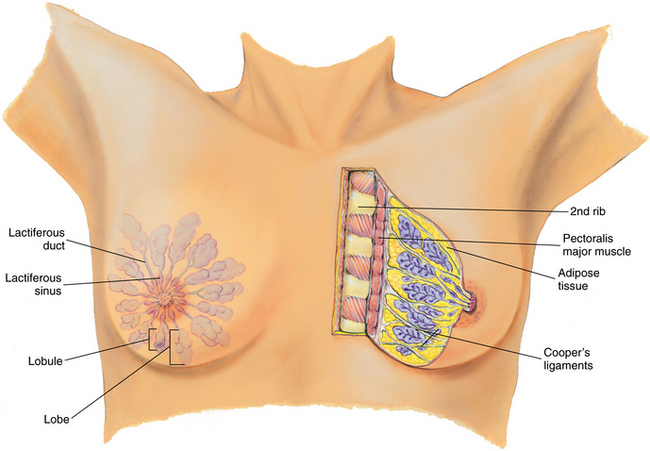
Breast cancer is the most common malignancy of females in the United States and accounts for one-third of all cancers diagnosed in American women. Breast cancer begins in the lobules (20%), which are the milkproducing glands of the breast, or in the ducts (80%), which bring the milk to the nipple (Fig. 20-11). Most breast carcinomas are adenocarcinomas originating in the single layer of epithelial cells that line the ductal and lobular systems of all milk ducts.

Figure 20-11 Breast anatomy. The breast is composed of glandular tissue; fibrous tissue, including suspensory ligaments; and adipose tissue. Glandular tissue contains 15 to 20 lobes radiating from the nipple and composed of lobules. Within each lobe are clusters of alveoli that produce milk. Each lobe is embedded in adipose tissue and empties into a lactiferous duct. There are 15 to 20 lactiferous ducts that form a collecting duct system converging toward the nipple. These ducts form ampullae or lactiferous sinuses behind the nipple, which are reservoirs for storing milk. The lobules and ducts are surrounded by fatty and connective tissue, nerves, blood vessels, and lymphatic vessels. The suspensory ligaments (Cooper’s ligaments) are fibrous bands extending vertically from the surface attaching to the chest wall muscle. These support the breast tissue and become contracted in cancer of the breast, producing pits or dimples in the overlying skin. (From Jarvis C: Physical examination and health assessment, ed 4, Philadelphia, 2004, WB Saunders.)
Not all breast cancers are the same; different characteristics in gene expression profiles result in differential clinical behavior. Gene profiling assays aid in documenting different subtypes of breast cancer.153 For now, clinical practice recognizes six types of breast cancer: (1) ductal CIS (DCIS); (2) invasive (infiltrating) ductal carcinoma (IDC); (3) invasive (infiltrating) lobular carcinoma; (4) medullary, tubular, and mucinous carcinoma; (5) inflammatory breast cancer (IBC); and (6) Paget’s disease of the breast.
DCIS (sometimes called intraductal cancer), the most common type of in situ cancer, occurs in 20% to 30% of newly diagnosed breast cancer cases and develops at several points along a duct, appearing as a cluster of calcifications or white flecks on a mammogram. DCIS accounts for about 10% of breast cancers in men. This is a precancerous change in breast tissue (abnormal but not malignant cells and highly curable) with a broad continuum from slow-growing cells with little potential to be transformed into cancer to life-threatening aggressive types of cancer that will invade the duct wall and grow beyond it.
IDC is the most common of the invasive breast cancers, beginning in a duct, breaking through the duct wall, and invading fatty tissue of the breast with further metastasis possible via lymphatic invasion. IDC is usually detected as a mass on a mammogram or as a palpable lump during a breast examination. From 80% to 90% of breast cancer cases in men are caused by IDC.
Invasive lobular carcinoma makes up 10% to 15% of invasive cancers. This type grows through the wall of the lobule and spreads via the lymphatic or circulatory system.
Medullary, tubular, and mucinous carcinomas are less common types of ductal carcinoma, together accounting for less than 10% of breast cancers. Medullary carcinoma and tubular carcinoma are both invasive but have better outcomes than invasive ductal or invasive lobular carcinomas.
IBC, a less common form of invasive ductal cancer, is a rare and very aggressive form of breast cancer that presents much like an infection with warmth, redness of the skin, and lymphatic blockage. It is often missed or misdiagnosed as a breast infection because of its appearance and because there may not be a distinct lump or tumor; it is not usually detected by ultrasound or mammography. Although most common in young women, it has been reported in men as well. When the symptoms last longer than a week after starting antibiotics for a breast “infection,” then a biopsy is strongly recommended.
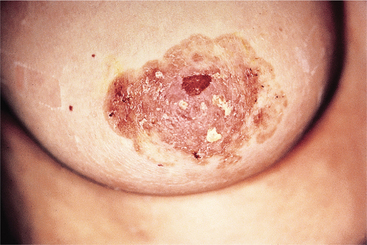
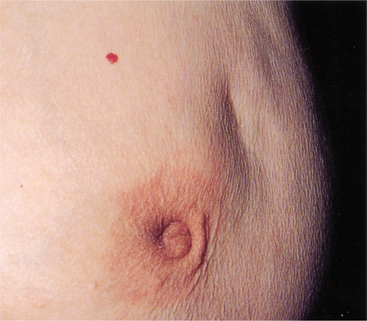
Paget’s disease of the breast is a rare form of ductal carcinoma arising in the ducts near the nipple, with itching, redness and flaking of the nipple, and occasionally bleeding (Fig. 20-12).125 This condition occurs in conjunction with a ductal adenocarcinoma of the breast, which has frequently metastasized to the axillary lymph nodes.

Figure 20-12 Paget’s disease of the breast. An erythematous plaque surrounds the nipple. (From Bolognia JL: Dermatology, St. Louis, 2003, Mosby.)
Breast cancer appears biologically similar in both genders, although it is often diagnosed at later stages in older men. Men and women develop the same types of breast cancer, although lobular carcinoma is rare in men because of the absence of lobules in the male breast. Most breast cancers in men are carcinomas, most commonly IDC.
In recent years the statistical picture of breast cancer has brightened, thanks to early detection and advances in treatment. More tumors are found at an earlier stage. This fact, combined with a slowing in the rise in incidence, has dropped the death rate. Even so, breast carcinomas still account for approximately 30% of all the female cancers in the United States. In addition, breast cancer is the number two cause of female cancer deaths in the United States, second only to lung cancer.
Estimated new breast cancer cases in 2007 were 2030 (up from 1500 in the year 2002) for men and 178,480 for women (down from 203,500 in 2002). Approximately 450 men and 40,460 women died as a result of breast cancer in 2007.148 This is up from 400 for men and 39,600 for women in 2002.
The cumulative lifetime risk of developing breast cancer for white women in the United States is 1 in 8 based on a woman living 95+ years, but it should be kept in mind that a woman’s risk at age 25 years is 1 in 21,441, with increasing risk as she ages.91
Approximately 70% of all breast cancer occurs in women over age 50 years. Demographics suggest that in the next 2 decades, women over the age of 65 years will become the most prevalent patient cohort in the breast cancer population. The number of complicating comorbidities will likely be a complicating factor in the diagnosis and treatment in this age group.133
Female breast cancer incidence rates vary by race and ethnicity. Cases remain highest in white women followed by African Americans. Incidence of breast cancer in African Americans has stabilized for women age 50 years and older and decreasing for women younger than 50 years. Death rates in African-American women remain 37% higher than in whites, despite lower incidence rates.284
According to a new analysis of breast cancer rates, overall breast cancer rates may be decreasing, possibly as a result of the decline in use of HRT. For women of all ages and all breast cancer types, the incidence of breast cancer dropped by 7% in 2003. This is the first reported decrease in incidence since 1980, possibly reflecting the saturation of mammography utilization and reduction in the use of HRT.148
One proposed possibility for the decline in breast cancer incidence rates in younger (premenopausal) women is the increasing prevalence of obesity. The mechanism is thought to be through anovulatory menstrual cycles and lower levels of circulating steroid hormones.284
The cause of breast cancer is unknown, although there are some genetic bases, expression of which will vary in different ethnic groups. A known genetic mutation in two genes, BRCA1 and BRCA2 (the “breast cancer” genes), has been identified and may be responsible for most inherited cancers (accounting for 10% of all cases).
BRCA1 and BRCA2 are tumor suppressor genes. Everyone has two copies of each gene, and when working properly, they produce proteins that keep cell growth in check. Mutations can render these genes inactive, increasing the risk for developing breast, ovarian, and certain other cancers.
Female gender, age, ethnicity, family history, medical history, menstrual history (early onset of menstruation with greater exposure to estrogen), nulliparity or infertility (greater number of menstrual cycles with hormonal exposures), and geography are all factors linked to breast cancer (Box 20-6).
Gender and Hormone Exposure.: Gender (female) is the most significant risk factor associated with this disease. Although women have many more breast cells than men, the primary reason they develop breast cancer more often is because breast cells are constantly exposed to the growth-promoting effects of the female hormones estrogen and progesterone. New evidence indicates that estrogen exposures throughout life including in utero may have an effect on breast cancer risk. Over half of all women diagnosed with breast cancer will have estrogen receptor–positive (ER-positive), lymph node–negative breast cancer.229 Tumors that are ER-positive have estrogen receptors and are stimulated to grow by estrogen. Tumors that do not have estrogen receptors are called ER-negative and are not influenced by the hormone.
Previous history of first-generation hormonal contraceptive use (higher dose formulations before 1975) and recent (last 5 years) prolonged use of combined HRT have been linked with increased risk of breast cancer, often found at a more advanced stage.
The established role of estrogen in the development and progression of breast cancer raises questions concerning a potential contribution from the many chemicals in the environment with estrogenic activity that can enter the human breast. A range of organochlorine pesticides and polychlorinated biphenyls possess estrogen-mimicking properties that have been measured in human breast adipose tissue and in human milk. These may enter the breast from contamination of food, water, and air.65
Fewer than 1% of breast cancers occur in males. In men, age (>60 years) and heredity are the most common risk factors, but more than one-half have no known risk factors. Other factors associated with an increased risk of breast cancer in men include chest radiation exposure, liver disease, treatment with estrogen, treatment with immunosuppressants after organ transplantation, BRCA2 gene mutations, Klinefelter’s syndrome, history of benign breast disease or gynecomastia, and history of testicular pathology.
Weight Gain and Obesity.: Many studies show that weight gain is a risk factor for breast cancer, especially for women after menopause. The ACS reports that women who gain 20 to 30 lb (or more) during adulthood (after age 18) are 40% more likely to develop breast cancer after menopause compared with women who gain no more than 5 lb and compared to women who have been overweight since childhood.9,79
Estrogen stored in fat keeps the hormone circulating even when ovarian production stops at menopause. There is evidence to suggest think that fat cells in different parts of the body metabolize differently. For example, excess fat in the waist area may affect risk more than the same amount of fat in the hips and thighs. Obesity at the time of diagnosis is also thought to be significant as a poor prognostic factor.43
Age.: Age is the second most significant risk factor; the incidence of breast cancer increases with advancing age. For example, the 10-year risk of developing breast cancer jumps from 1 in 48 at age 40 years to 1 in 26 at age 60 years. The median and mean ages of women with breast cancer are between 60 and 61 years. Women with a personal or family history (personal history of breast, ovarian, or uterine cancer or family history of breast cancer among first-degree relatives) have a significantly increased risk of developing breast cancer.
Personal or Family History and Heredity.: A personal history of breast cancer in one breast increases a woman’s risk of developing a new cancer in the other breast or in another part of the same breast threefold to fourfold. This is not the same as a cancer recurrence of the first cancer. About 5% to 10% of breast cancer cases are hereditary as a result of gene mutations, most commonly affecting the BRCA1 and BRCA2 genes. Normally, these genes help prevent cancer by making proteins that keep cells from growing abnormally. Inheriting either mutated gene from a parent increases the risk of breast cancer.52
Women with an inherited BRCA1 or BRCA2 mutation have up to an 80% chance of developing breast cancer during their lifetime and at a younger age than women who do not have these gene mutations. Women with these inherited mutations are also at increased risk for developing ovarian cancer. Other genes that might also lead to inherited breast cancer (e.g., ataxia-telangiectasia mutation [ATM] and CHEK2 gene) are under investigation.9
Although only a small percentage of breast cancer cases are hereditary, about 20% to 30% of women with breast cancer have a family member with this disease. Having one first-degree relative with breast cancer doubles a woman’s risk; breast cancer in two or more first-degree relatives (mother, sister, daughter) increases the risk fivefold.9
Breast cancer before age 50 years in a relative on either side of the family also increases the risk; the risk is higher if the mother or sister has a history of breast cancer. Although the exact risk is not known, women with a family history of breast cancer in a father or brother also have an increased risk of breast cancer.9
In addition, a history of benign breast disease, when accompanied by proliferative changes, papillomatosis, or atypical epithelial hyperplasia, increases the risk of cancer. Even with all these potential risk factors, the majority of women with breast cancer do not have any apparent risk factors.
Race/Ethnicity.: White women are slightly more likely to develop breast cancer than are African-American women but African-American women are more likely to die of this cancer, possibly because of more aggressive tumors in African-American women. Black men are at almost twice the risk of white men. Asian, Hispanic, and Native American women have a lower risk of developing and dying from breast cancer.9
Ashkenazi Jews who have a mutation in either BRCA gene have an 80% risk of developing breast cancer by age 80 years. This is compared to a 13% risk for the average 80-year old woman who does not have an Ashkenazi heritage.
Alcohol.: Alcohol intake is also associated with an increase in risk, particularly for women whose intake of folate is low.17 Folate is a vitamin that helps prevent birth defects and has been linked to cancer prevention. The exact mechanism between alcohol consumption and breast cancer remains unknown, but alcohol may interfere with the body’s ability to use folate.176
It is also possible some individuals are more susceptible to the harmful effects of alcohol intake because of differences in alcohol metabolism. How much daily alcohol makes the difference remains under investigation; for now, research overwhelmingly agrees that risk increases with the amount of alcohol consumed and that even moderate alcohol consumption (two drinks or 20 g/day) increases breast cancer risk by at least 1.5 times.301,339
Factors in Question.: Scientists thus far have been unable to establish a direct link between breast cancer and tobacco smoke; electromagnetic fields; silicone breast implants; abortion or miscarriage23,32,299; work at night; or the chemicals used in pesticides, plastics, herbicides, or hair colorings.9,125,230 The role of estrogenic chemicals applied as antiperspirants, deodorants, or cosmetics to the underarm and breast areas remains hotly debated. Evidence in support of a functional role for the combined interactions of cosmetic chemicals with environmental estrogens, pharmacologic estrogens, phytoestrogens, and physiologic estrogens has been presented63,65 along with evidence to refute the role of antiperspirants in breast cancer.208
Although scientists have found chemicals from antiperspirants and deodorants in breast tumors, the concentrations were far lower than the amount of estrogen naturally circulating in the body. The chemicals may be present in normal breast tissue, too, but this has not been studied yet.64
Breast cancer is the most common solid tumor among women treated for Hodgkin’s disease. Radiotherapy of the mediastinum has been implicated. The secondary cancer risk to females seems to increase 10 years after the initial diagnosis and treatment of Hodgkin’s disease. Whereas there is a fifteenfold increase in risk for a second malignancy, the risk of breast cancer for females who had childhood Hodgkin’s disease is 45 times greater than for those who did not have childhood Hodgkin’s.266,300
The pathogenesis of breast cancer is unknown, but estrogen is believed to be a key factor in promoting (rather than initiating) breast cancer. It may not trigger the series of genetic changes that are required to transform normal breast cells into malignant ones, but it may spur the proliferation of transformed cells, increasing the likelihood that they will develop into cancer. The development of invasive breast cancer involves epithelial hyperplasia, premalignant change, in situ carcinoma, and invasive carcinoma.
These progressive alterations in the structure of the mammary epithelium are accompanied by a reorganization in the composition of the epithelial, periductal, and stromal extracellular matrix (ECM). This observation is important because ECM proteins (elastin, collagens, proteoglycans, and glycoproteins) not only provide a physical support for cells within developing and mature tissues but also act as an informational system.
These proteins detect and coordinate signals originating from the tissue microenvironment and adjacent cells. Networks of ECM interact with transmembrane receptors called integrins to transmit signals from the ECM to the cell interior. It is hypothesized that modifications in the mammary ECM that occur during tumor formation or a failure to respond appropriately to the preexisting ECM may result in aberrant cell behavior. Studies show that changes in cell adhesion play a major part in the development and progression of breast cancer.150
Biologists collecting and recording salivary estrogen levels have recognized patterns of low feminine fertility correlated with famine. Estrogen samples from the mouths of hungry women are found to be about one-half of estrogen levels in the saliva of well-nourished women, a difference that can account for the drop in pregnancy rate in lean women.
Improved nutrition in developed countries, such as the United States, has led to increased exposure to estrogen over a lifetime. This variable combined with the resulting earlier age of menarche, delayed and decreased childbearing, increased prevalence of obesity, and the increase in exposure to environmental toxins all may contribute to more and prolonged estrogen exposure, possibly resulting in genetic mutations, loss of suppressor genes, and cell proliferation or cell growth.
An older but still unproved theory is the environmental exposure hypothesis that prolonged and cumulative exposure to hormonally active synthetic chemicals contributes to the rising incidence of breast cancer. Synthetic chemicals may do this directly by acting as estrogen, altering the way the body produces or metabolizes estrogen; they can work bifunctionally, through genetic or hormonal paths, depending on the periods and extent of exposure.69
Prenatal exposure to estrogens may predispose a woman to breast cancer later in life through an “imprinting” process that sensitizes her to estrogen exposure. One way that synthetic chemicals may increase breast cancer risk is to alter the way the body processes its own estrogen. This theory is the basis for the use of indoles (phytochemicals found in vegetables) shown to reduce cancer risk.
Most carcinomas develop in the glandular epithelium of the terminal duct lobular unit. In the normal breast, the milk ducts and lobules are neatly lined with epithelial cells. Over time, some extra (noncancerous) cells may grow within the duct (hyperplasia) and begin to look odd (atypia); this condition is atypical ductal hyperplasia.
When cancer cells multiply but remain contained within the duct, the condition is called DCIS. A stromal invasion by malignant cells usually results in fibroblastic proliferation. A palpable mass within the breast tissue will typically develop. IDC occurs when cancer cells break through the duct wall and enter other tissues.
Breast cancer has a propensity for metastases to the bone, possibly related to a small protein found in the bone marrow (osteonectin) that both attracts breast (and prostate) cancer cells to bone and once attracted, stimulates the cells to invade the bone. Researchers suggest that metastasis of breast cancer cells to the bone is mediated by the ability of osteonectin to promote migration, protease activity, and invasion.146
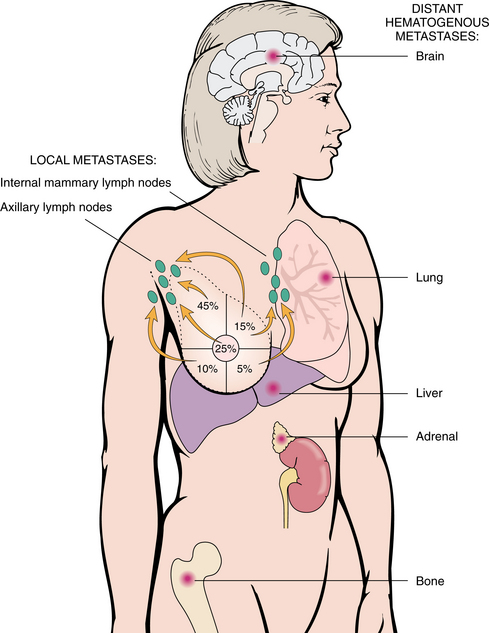
The most common initial presenting sign of breast cancer is a palpable lump or nodule. Approximately 90% of breast masses are discovered by the woman herself; for men, the lump is usually in the center behind the areola and for women, either centrally behind the areola or in the upper, outer quadrant, although neoplasm can occur anywhere in the breast tissue (Fig. 20-13).

Figure 20-13 The distribution of breast carcinoma and the pathway of lymphatic metastases. Most tumors in women are found in the upper lateral quadrant and behind the nipple (areola) and for men, behind the nipple. (From Damjanov I: Pathology for the health-related professions, ed 3, Philadelphia, 2006, Saunders.)
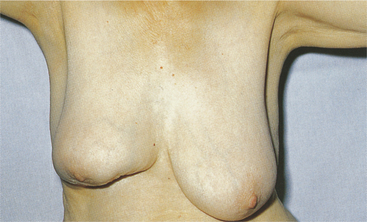
The mass tends to be firm and irregular if it is a carcinoma versus smooth and rubbery if it is benign. The mass is typically not painful if it is cancer. Fixation of the breast to the underlying pectoral muscles and chest wall can cause significant asymmetry (Fig. 20-14).

Figure 20-14 Fixation. Asymmetry, distortion, or decreased motility is observed in the woman’s right breast as she lifts her arms. As cancer becomes invasive, fibrosis can fix the breast to the underlying pectoral muscle. Although at first glance, it looks as if the woman’s left breast is enlarged compared to the right, in fact, the woman’s right breast is held against the chest wall. (From Mansel R: Color atlas of breast diseases, London, 1995, Mosby.)
Other manifestations include a change in breast contour or texture, nipple discharge and retraction or inversion, local skin dimpling (Fig. 20-15), erythema, and a local rash or ulceration. Lymphadenopathy may also be the initial presentation of this disease. Most local breast cancer recurrence occurs along the incision line.

Figure 20-15 Dimpling. The shallow dimple above and slightly to the right of the nipple as viewed in this photograph shows signs of skin retraction or skin tethering. Cancer causes fibrosis, which contracts the suspensory ligaments of the breast, resulting in this clinical change in the breast tissue. The dimpling may be visible at rest, with compression, or with lifting of the arms. The fibrosis can also pull the nipple as seen by the distortion of the areola here. (From Evans AJ: Atlas of breast disease management: 50 illustrative cases, Philadelphia, 1998, WB Saunders.)
IBC is characterized by one breast becoming larger than the other. Warmth, redness, swelling, itching, pain, skin dimpling called peau d’orange, and nipple changes (e.g., retraction or flattening) are just some of the many symptoms of IBC. Some women report it looks like a bug bite on their breast. They may also report a bruise on the breast that does not go away.
Local metastases by direct extension of the primary disease site may involve the chest wall, ribs, pleura, pulmonary parenchyma, or bronchi and may erode the first and second ribs and associated vertebrae.200 Symptoms associated with metastases can include upper extremity edema, bone pain, jaundice, or weight loss. These findings are rarely the initial complaint.
If not diagnosed and treated early, the cancer can spread to the regional lymph nodes, including the axillary, internal mammary, and supraclavicular nodes. As the disease progresses, the cancer commonly spreads to the lungs, liver, bone, adrenals, skin, and brain.
Signs and symptoms of the affected system may be the first clinical indication of a problem. For example, lung lesions may present as vague, aching chest pain, hemoptysis, or unexplained dyspnea. Metastases to the liver may present as fatigue, jaundice, CTS, or skin changes.
Bone metastases is especially common affecting the vertebrae, pelvis, ribs, hip, femur, and humerus (see Table 9-2); metastatic spread from breast cancer rarely presents in locations below the elbows and knees. Bone pain and fracture are the most common symptoms of bone metastases.
A rare neurologic paraneoplastic syndrome associated with breast cancer in women called stiff-man syndrome has been reported with increasing frequency.145,232,245 Paraneoplastic stiff-person syndrome is characterized by progressive symptoms of neuropathy or myelopathy with increased muscle tone and rigidity in the spine and lower extremities, especially the ankle dorsiflexors with loss of ankle motion. See further discussion on Paraneoplastic Syndrome in Chapter 9.218
Healthy People 2010 has identified the reduction of the breast cancer death rate by 20% as its primary objective related to breast cancer. The ACS’s 2015 Challenge Goals and Nationwide Objectives include a reduction of 15% in the age-adjusted incidence rate of the disease and a 45% reduction in the age-adjusted mortality rate. By the year 2008, the ACS hopes that 90% of women 40 year of age or older will undergo breast cancer screening that is consistent with their guidelines.36,334 Additionally, by 2008, the ACS’s goal is to increase to 90% the portion of breast cancers diagnosed at a local stage or earlier.
Risk factor modification is advocated, including moderate-to-vigorous physical activity (45 to 60 minutes on 5 or more days per week), weight control and minimal lifetime weight gain, alcohol restriction (avoid alcohol if at high risk for breast cancer), and chemopreventive agents to reduce exposure to estrogen.
Controlling weight, anytime after age 18 but especially in middle age, may help in preventing breast cancer, the recurrence of breast cancer, and death from breast cancer.43 Fat tissue contains an enzyme that converts adrenal gland hormones to estrogen. The extra estrogen in overweight women acts as a nutrient and aids the growth of precancerous or abnormal cancerous cells in the breast.
Data from the Nurses’ Health Study show a clear benefit for postmenopausal women from engaging in some form of exercise. Postmenopausal women who get at least 1 hour of physical activity per day are 15% to 20% less likely to develop breast cancer than sedentary women.258
Restricting alcohol is a proven risk reducer. Excess risk of breast cancer associated with alcohol consumption may be reduced by adequate folate intake.17,340 The effects of diet and nutrition (low fat and rich in fruits and vegetables) remain under investigation.
Evidence to support a link between antiperspirants or deodorants and breast cancer remains controversial. Many women choose to avoid these products as a means of preventing breast cancer until proved otherwise.
Other preventive steps may include exposure to the sun needed by the skin to manufacture vitamin D and increased vitamin D intake (food or supplementation).149 Vitamin D receptor (VDR) in mammary cells has a role in signaling proliferation, differentiation, and survival of normal mammary epithelial cells. However, whether calcium or vitamin D intake modifies risk by genotype has not been fully investigated.37,197
Prophylactic mastectomy (also referred to as risk-reduction mastectomy) for women with a BRCA1 or BRCA2 mutation and positive family history has proved extremely effective, but there is still a risk of breast cancer even after any kind of mastectomy. There is a need for research to better guide high-risk women in the decision-making process.179,290 Numerous reputable books are available on the trade market specifically addressing ways to reduce risk and prevent breast cancer.
The hallmark of effective intervention in cases of breast cancer is early detection using a combination of three tools: monthly self-breast examination (SBE), clinical breast examination (CBE), and mammography (Box 20-7). Women should start examining their breasts in their twenties so they are comfortable doing it and familiar with the way their breasts feel from month to month. The same is true for women with breast implants. Additional mammogram screening, called an implant displacement view, may be requested.
The ACS makes the following screening recommendations for asymptomatic women at average risk: beginning at age 20, CBE and counseling to raise awareness of breast symptoms; for women ages 20 to 39 years, a CBE every 3 years and annual mammogram after age 40 years.
The ACS no longer recommends that all women conduct regular SBE, but women should be informed about the potential benefits and limitations associated with SBE.285 This change in the recommendation came about as a result of a large study of female factory workers in China (referred to as the Shanghai Study). The women were taught how to do SBE with follow-up to see if the number of deaths from breast cancer was reduced. Although the rate of breast cancer was not reduced, the authors of the study clearly note that the women were not asked if or how often they performed the SBE. Without the availability of mammography, when women did find a cancerous lump, the cancer was more advanced with a much worse prognosis.304
There is still much controversy over the methodology and results of this study. Many experts still advocate monthly SBE performed 1 week after the cessation of bleeding from the menstrual cycle or in the postmenopausal woman consistently perhaps on the same day each month. The American College of Obstetricians and Gynecologists (ACOG) advocates performing BSE as one way to increase a woman’s breast cancer awareness. If a woman chooses to perform BSE, she should learn the correct procedure from a qualified health care professional (including physical therapists)106,107 who can evaluate her technique.
One of the striking changes in the presentation of breast cancer in the United States over the past 25 years is the reduction in the size of lumps discovered by women themselves.123 There is also case-control evidence that excellent BSE may reduce mortality.127 For a discussion of the relative merits and disadvantages of the study, see the American Cancer Center News Center: Do breast self-exams make a difference? available at http://www.cancer.org/docroot/nws/content/nws_1_1x_do_breast_self-exams_make_a_difference.asp. The Susan G. Komen Foundation also offers step-by-step BSE instructions in English and Spanish (see www.komen.org/bse).
Screening mammography can reduce mortality from breast cancer by approximately 20% to 35% in women aged 50 to 69 years and approximately 20% in women aged 40 to 49 years.81,92 Approximately 11% of all mammography studies are abnormal and 3% of those “abnormals” are actually diagnosed as breast cancer.162
The term screening mammography implies the mammogram is done when there is no palpable lump or anything else indicating cancer. Until 1997 the ACS recommended the first screening mammogram by age 40 years, whereas the National Cancer Institute stopped advocating routine mammograms for women between the ages of 40 and 50 years227; and in the rest of the world, screening mammograms were not recommended until age 50 years.
Much controversy and debate centered around screening mammography for this particular age group (40 to 49 years); but in 1997, based on data presented at the NIH conference on breast cancer screening establishing the effectiveness of mammography in women younger than 50 years, the NIH began recommending breast cancer screening to women in their forties.227,286
Organizations, including the American Medical Association (AMA), ACOG, and the ACS, support mammography screening beginning at age 40 years, although these groups vary in their recommendations regarding intervals for rescreening.265 The U.S. Preventive Services Task Force, an independent panel of private-sector experts in prevention and primary care, recommends that women aged 40 years and older be screened for breast cancer with mammograms every 1 to 2 years.311a
At present, data are insufficient to recommend a specific surveillance strategy for high-risk women. Earlier initiation of screening, screening at shorter intervals, and screening with additional modalities, such as ultrasound and MRI, may be advised.285
The cost-effectiveness and efficacy of screening mammography in women age 70 years and older have come under examination. It has been suggested that the small gain in life expectancy is a variable that must be factored in when a woman decides about screening.163
Some experts suggest that screening, including mammography, should be continued as long the woman’s life expectancy is more than 5 years. The challenge remains for the physician to accurately estimate and older person’s life expectancy based on individual health status, including concomitant comorbidity.133
Inherited mutations of BRCA1 and BRCA2 do increase the lifetime risk of breast (and ovarian) cancer, but genetic testing is not advised for everyone. Having an inherited gene mutation does not mean breast cancer is inevitable. Women who have a positive family history of breast cancer before the age of 40 years should seek genetic counseling. Testing may be advised for anyone with a family history described previously in the section on Risk Factors for this disease.
There are many considerations when considering genetic testing. A negative test for a mutation may be dif ficult to interpret if the family history is unknown. Coping with the results if they are positive and weighing all the options can be challenging. Although most states have genetic privacy laws to prevent discrimination by health insurers, the guidelines do not always apply to life or disability insurance. Testing is done by a simple blood test, but the test may be expensive and is not always covered by insurance.
Clinical examination, mammography, and ultrasonography are all used to detect breast abnormalities. Tissue biopsy is the standard for a definitive diagnosis, and sentinel lymph node mapping to identify micrometastases has become standard practice to identify and remove only the first node or nodes that cancer cells reach after leaving the breast. This eliminates unnecessary dissection (see discussion of biopsy technique in the section on Diagnosis in Chapter 9). Only women whose sentinel nodes indicate the spread of cancer will need to undergo more extensive biopsy.
As mentioned, mammography is an important tool for the detection of a lesion before the mass (cancerous or benign) is large enough to be palpable but is not a substitute for biopsy because by itself it is not diagnostic and it may not detect cancer in very dense breast tissue.
Digital Mammography.: Updated technology, such as digital mammography (computerized x-rays), may improve early detection of breast cancer. With the added capability of transmitting results electronically to specialists worldwide for consultation, this technology may reduce further misdiagnosis and unnecessary surgery. Mammography does not detect all breast cancers, and it cannot distinguish well among the various kinds of breast cancer. A more precise, noninvasive screening technique that does not involve the use of radiation is the ultimate goal of investigators developing improved breast cancer screening. Breast cancer can remain dormant for years before becoming clinically apparent, so long-term follow-up is mandatory for all women, especially anyone with a previous history of breast cancer.35
Ductal lavage is another new method to detect early changes in ductal cells for women at high risk for developing breast cancer. Epithelial cells that line the ductal and lobular system of all milk ducts are collected using a microcatheter inserted into the milk ducts through the nipple surface. Results of this test may be able to diagnose abnormal ductal cells before cancer becomes evident on a mammogram or in a physical examination.72,86
Magnetic Resonance Imaging.: Scientists are adapting MRI and positron emission tomography (PET) scanning, two imaging technologies that are good at distinguishing malignant from benign tissue, for use in breast cancer diagnosis (staging), although these remain too costly to use in general screening programs. MRI scans do find cancers that mammograms miss, especially in high-risk women, perhaps because breast cancer occurs in these women at a younger age when breast tissue is denser. About 3% of new cases of breast cancer have malignant tumors in the contralateral breast that can only be detected by MRI. The cost of MRI prohibits its use as a screening tool, but it is cost-effective and recommended for use to improve the detection of cancer in women already diagnosed.177a
New guidelines from the ACS recommend MRI scans and mammograms once a year starting at age 30 for high-risk women. High risk is defined as a 20% to 25% or higher chance of developing breast cancer over the course of a lifetime. The average lifetime risk for women in the United States is 12% to 13%.
The high-risk group includes women who had radiation treatment to the chest between ages 10 and 30 years (e.g., for Hodgkin’s disease); women who are prone to breast cancer because of the presence of genetic mutations, such as BRCA1 or BRCA2; or those whose mothers, sisters, or daughters carry those mutations.
Ultrasound.: Ultrasonography is primarily used to differentiate a cystic from a solid lesion. Real-time elastography (elastogram), an experimental ultrasound technique, is on the horizon. This technology distinguishes harmless lumps from malignancy and provides results in minutes. The technique was pioneered at the University of Texas Medical School at Houston in the 1990s.98
Ultrasound elastography is capable of imaging tissue strain even before tissue stiffness associated with pathologic change occurs. Some areas that appear as shadows on sonograms show up as discrete masses on elastograms. The technique may be able to replace tissue biopsy in the diagnostic process.303,323
The protein (oncogene) c-erbB-2, also known as HER2/neu, is a prognostic breast cancer marker assayed in tissue biopsy specimens from women diagnosed with malignant tumors. Current studies suggest that soluble fragments of this oncogene may be released from the cell surface and become detectable in the saliva of men and women with the recurrence of breast cancer.294 Other biomarkers are under investigation, including one ECM component called tenascin-C. Expression of this large glycoprotein is suppressed in the normal adult mammary gland but is induced in breast cancer and is present in preinvasive cancer, as well as invasive breast cancer.104 Researchers are investigating the use of minimally invasive tests to seek out biologic markers in blood or other fluids before a tumor develops.
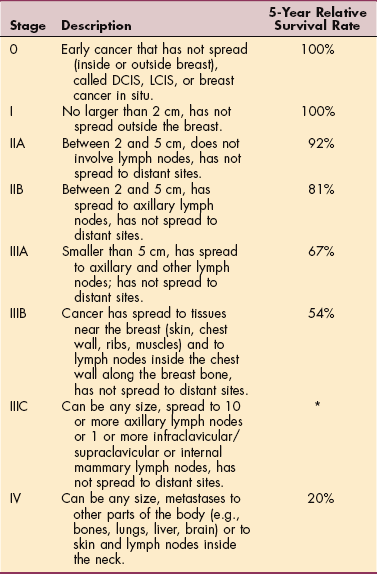
Once the diagnosis is established, the clinical stage is ascertained in order to determine optimal management, including selection of candidates for adjuvant systemic therapies (Table 20-3). Staging is done most often using sentinel lymph node biopsy (SLNB), which consists of the removal of one to three nodes; the removal of more than three nodes is considered a dissection.
Table 20-3
Stages of Breast Cancer and Prognosis

DCIS, Ductal carcinoma in situ; LCIS, lobular carcinoma in situ.
*Survival rates for IIIC breast cancer are unavailable; this stage was only defined a few years ago.
Data from American Cancer Society and the Health Alliance Cancer Services, 2007.
Stage 0 (preinvasive cancer), referred to as in situ, means that the cancer remains “in place” and has not spread from its point of origin. Stage I disease is marked by a tumor 2 cm in size or smaller. Stage II disease is marked by a tumor between 2 and 5 cm in size without nodal metastases or a tumor less than 5 cm with homolateral axillary lymphatic metastases (the nodes are movable). A tumor larger than 5 cm is classified as stage III, as is a tumor fixed to the pectoral muscle or fascia or if the diseased axillary lymph nodes are fixed to adjacent tissues. Stage IV disease is a tumor fixed to the chest wall or skin or any tumor with metastases to the homolateral infraclavicular or supraclavicular nodes, with upper extremity edema, or with any distant metastasis.
The TNM classification of breast cancer has been revised and changed considerably, based on important developments that have occurred in breast cancer diagnosis and management. For example, the average size of breast tumors when first detected has decreased significantly. Immunohistochemical (IHC) staging and molecular biology techniques (e.g., reverse-transcriptase polymerase chain reaction [RT-PCR]), increasing knowledge of the importance of total positive axillary lymph nodes, and new information about clinical outcomes associated with metastases have led to greater refinement in TNM staging.283
Once the diagnosis of breast cancer is made, most of the treatment is the same for men as for women. The treatment plan depends on the type of cancer, stage at diagnosis (early or advanced), hormonal sensitivity (ER-positive or progesterone receptor–positive [PR-positive]), and presence of the growth-promoting protein Her-2/Neu, which appears to produce tamoxifen resistance. Treatment options include surgery, chemotherapy, radiation therapy, and hormonal manipulation.
The NCCN publishes an annual update of its original 1996 NCCN Breast Cancer Treatment Guidelines. The Guidelines address the treatment of all stages of breast cancer. With constant changes in the adjuvant therapy for breast cancer, a supplement to the Guidelines from the NCCN Breast Cancer Adjuvant Therapy Task Force is available.42
Radical mastectomy was the most commonly employed procedure until the 1970s. This technique included removal of the entire breast, pectoral muscles, axillary lymph nodes, and some additional skin. Postsurgical problems included lymphedema, restricted shoulder mobility, impaired muscle function, and paresthesia.
Likewise, axillary node dissection is no longer performed routinely since it has been shown that the therapeutic benefit of a complete dissection has no effect on survival rate or risk of metastasis but only local control of the tumor. Instead, intraoperative lymphatic mapping and sentinel lymph node dissection are replacing complete lymph node dissection as the preferred procedure for the management of early-stage disease.137
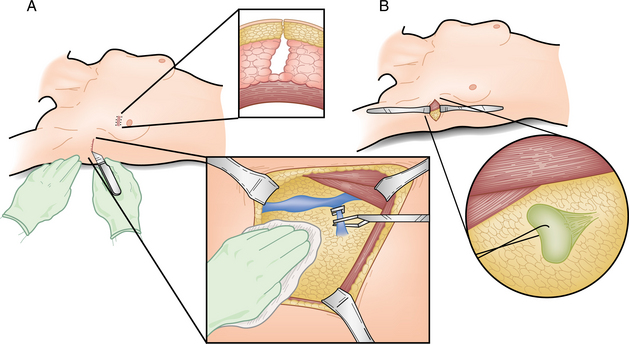
More recent treatment recommendations for women with stage I or II breast cancer include breast-conserving surgery (BCT), or lumpectomy to remove only the tumor and a surrounding margin of normal tissue with preservation of the breast, and radiation therapy (Fig. 20-16). Lumpectomy may be an option for women with larger tumors who have neoadjuvant chemotherapy (before surgery) to shrink the tumor.

Figure 20-16 Breast-conserving therapy (BCT). A, Incisions to remove malignant tumors are made directly over the tumor without tunneling. A transverse incision in the low axilla is used for either the sentinel node biopsy or the axillary dissection. The inset shows the excision cavity of the lumpectomy; no attempt is made to approximate the sides of the cavity, which will fill with serous fluid and gradually shrink. B, In the sentinel node biopsy, a similar transverse incision is made and extended through the clavipectoral fascia and the true axilla entered. The sentinel node is located by virtue of its staining with dye or radioactivity, or both, and dissected free as a single specimen. (From Townsend CM: Sabiston textbook of surgery, ed 17, Philadelphia, 2004, WB Saunders.)
Up to 50% of women with early breast cancer in the United States are now treated with BCT. In some geographic areas, modified radical mastectomy, which spares the pectoralis major muscle, is also a commonly used procedure with the primary advantage being avoidance of radiation therapy. However, radiotherapy, now an integral part of BCT, should not be withheld.95,138
BCT may not be appropriate for women whose breasts are so small a simple lumpectomy would be too disfiguring, making a simple mastectomy the more feasible option. Breast conservation is not appropriate when there are multiple areas of cancer, a tumor too large to excise, and previous history of radiation to the breast.199a
Mastectomy is usually reserved for women with more extensive disease; although the surgeon may recommend mastectomy for some women with early breast cancer if, for example, cancer is found in more than one location in the breast. Some women choose mastectomy to avoid radiation or for greater peace of mind.
Breast reconstruction with an implant is an option for women who have mastectomies. This is a two-stage process; first, a balloonlike tissue expander is placed under the chest wall muscle. Every 2 or 3 weeks for several months, saline is injected into the expander to gradually stretch the overlying chest wall muscles and skin.
The expander is replaced in a second surgery with a permanent saline implant. Although silicone implants were banned in 1992, after reviewing years of evidence and research concerning silicone gel-filled breast implants, the Institute of Medicine (IOM) has not found any increased risk of adverse health outcomes. The use of silicone-based implants has been reinstated once again.
Silicone breast implants may be contraindicated or used with caution in women with existing malignant or premalignant cancer of the breast. Silicone gel-filled breast implants have not been clinically tested in women who have had radiation to the breast after implantation. For a complete discussion of this topic, the reader is referred to the IOM’s publications.144,144a
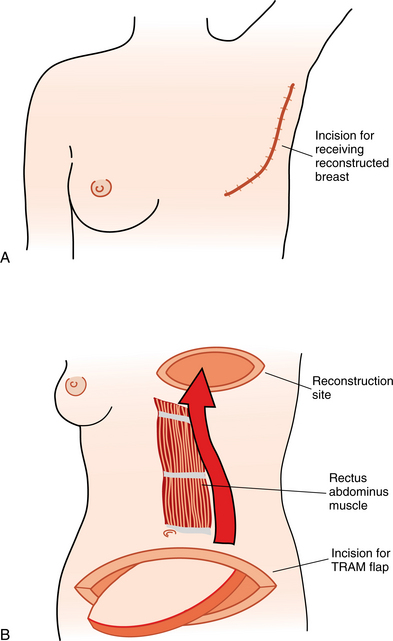
Alternately, muscle-flap procedures use tissue from the back or abdomen to either form a breast or create a pocket for an implant. The most popular flap procedures are the latissimus dorsi (back) flap, the transverse rectus abdominis muscle (TRAM) flap (Fig. 20-17), and the free flap. Free flaps use little or no muscle; a plastic surgeon trained in microvascular technique is needed for this procedure.

Figure 20-17 Transverse rectus abdominis myocutaneous (TRAM) flap. A, After mastectomy of the involved breast, (B) a breast is reconstructed using the lower abdominal skin and fatty tissue. In a pedicled TRAM, the tissue’s own blood supply remains attached and the lower abdominal tissue is rotated into position on the chest. The tissue is tunneled under the skin to the chest area, where it is brought through the mastectomy incision. The reconstructed tissue is shaped to form a matching breast and placed in the mastectomy skin pocket. A free TRAM flap refers to using skin and tissue that are completely disconnected from their own blood supply, moved from the abdomen to the new site, and then reconnected to different blood vessels. A nipple and areola can be tattooed on later after healing has taken place.
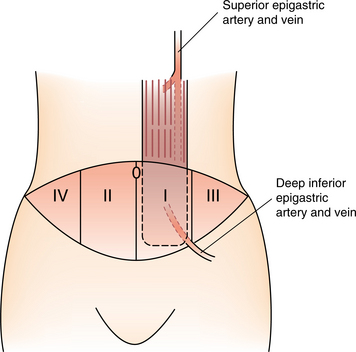
More recently a new procedure, the deep inferior epigastric perforator (DIEP) flap, uses skin and fatty tissue from the abdomen to reconstruct the breast without sacrificing the underlying abdominal muscles. Blood vessels (deep inferior epigastric artery) harvested to supply the new breast tissue do not travel within the abdominal muscles. Less disruption of the abdominal tissue results in far fewer abdominal impairments.47,109,110
A similar procedure, the gluteal artery perforator (GAP) flap, allows transfer of tissue from the buttock, also with minimal donor-site morbidity. Like the DIEP, the superficial inferior epigastric artery (SIEA) flap transfers the same tissue from the abdomen to the chest for breast reconstruction as the TRAM flap without sacrificing the rectus muscle or fascia (Fig. 20-18).109,110

Figure 20-18 Vascular territories of the abdominal wall provided by unilateral transverse rectus abdominis myocutaneous (TRAM) flap. Studies show that the most reliable cutaneous portion is directly overlying muscle zone I, followed by zones III, II, and IV, respectively. A deep inferior epigastric perforator flap (DIEP) is an alternative procedure to the TRAM. The rectus abdominis muscle is dissected to harvest the blood vessels, but the muscle is preserved because no muscle or overlying muscle fascia is used. The DIEP flap relies on blood vessels that perforate the rectus abdominis muscle (e.g., deep inferior epigastric artery and vein). (From Townsend CM: Sabiston textbook of surgery, ed 17, Philadelphia, 2004, WB Saunders.)
After surgery, the treatment plan may include radiation therapy, chemotherapy, hormone therapy, or a combination of these approaches. Chemotherapy is used when a tumor is larger than 1 cm or when smaller tumors have spread to the lymph nodes. The primary objective of these treatments is to reduce the odds of occult metastases developing into disease.
Women with harder to treat ERnegative breast tumors benefit much more from chemotherapy than do women with ER-positive tumors. Almost all women with ER-negative breast tumors should receive chemotherapy, whereas women with ER-positive tumors are better served by hormonal therapy; chemotherapy adds little additional improvement for ER-positive women.25
Increased disease-free survival time after combination chemotherapy has been noted consistently in premenopausal women with metastases to the axillary lymph nodes. Combination chemotherapy combines two or more drugs and is given in multiple courses over 3 to 6 months. The addition of hormone therapy or ovarian ablation for premenopausal women to stop estrogen production is more effective than chemotherapy alone in women whose tumors contain estrogen receptors.
The majority of women with early-stage breast cancer are advised to receive chemotherapy in addition to radiation and hormonal therapy, yet research has not demonstrated that chemotherapy benefits everyone equally. The development of molecular profiling tests (a technique that examines many genes simultaneously) may be able to spare women unnecessary treatment if chemotherapy is not likely to be of benefit to them.153,207
Gene Profiling.: Testing, or Trial Assigning IndividuaLized Options for Treatment (TAILORx), is underway to determine the most effective current approach to cancer treatment with the fewest side effects for women with early-stage breast cancer using gene profiling assays. Two such diagnostic tests now available for gauging a woman’s risk of breast cancer recurrence are Oncotype DX and MammaPrint gene profiling tests.
The Oncotype DX test can be performed in women of all ages with early-stage node-negative, ER-positive tumors. The MammaPrint assay is used only for women 55 years or younger who have early ER-positive or ER-negative tumors. Using this test to obtain characteristic genetic information, called a genetic signature, about the tumor can predict rate of metastasis and disease-free survival.
Researchers have found that women classified as high risk by the Oncotype DX test gain substantially from chemotherapy with a 90% 10-year disease-free survival rate when treated with chemotherapy compared to 65% with tamoxifen alone.237 Neither test is intended for use in women with either carcinoma in situ (precancerous) or metastatic breast cancer; the tests are not 100% accurate or fool-proof.
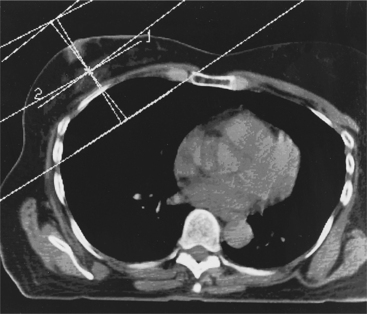
Most women receive radiation therapy after a lumpectomy to eradicate any cancer cells that may remain in the affected breast or nearby lymph nodes. Usually, radiation is delivered to the whole breast once a day, 5 days a week, for about 6 weeks (Fig. 20-19).

Figure 20-19 The standard radiation field configuration for breast cancer. Two tangentially directed fields encompass the breast with a minimal amount of underlying lung tissue. The contralateral breast and all of the critical structures are avoided. (From Abeloff MD: Clinical oncology, ed 3, Philadelphia, 2004, Churchill Livingstone.)
Software algorithms used to produce discriminating radiation fields conform the radiation to the breast, chest wall, and/or regional lymph nodes to achieve a homog- enous dose to the breast and decrease or avoid doses to the ribs, lung, and heart. This technology has allowed greater adaptation to a variety of breast and chest wall shapes.35
Women who have a mastectomy may also be treated with radiation if the tumor is more than 8 cm or if the tumor is close to the rib cage or chest wall, or if there were many positive axillary lymph nodes.
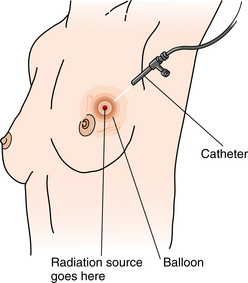
The use of partial-breast radiation to target the tissue immediately around the tumor where cancer is most likely to recur is on the rise. Radiation beams can be targeted at the tumor site instead of the breast, cutting down the usual 6-week treatment to 5 days (Fig. 20-20). Studies are underway to determine who is the best candidate for this treatment and what treatment protocol works best. A 1-day method that permanently implants radiation seeds inside the breast to kill stray cancer cells is also in use. The pellets emit radiation for about 2 months until they run out; the implant remains under the skin with no further effects.158,244

Figure 20-20 Balloon brachytherapy. The MammoSite device approved for partial breast radiation in the treatment of early-stage breast cancer. A single-balloon catheter is inserted in the breast to deliver a site-specific, prescribed dose of radiation. The deflated balloon is placed inside the lumpectomy cavity (the space left after the tumor is removed). A tiny radioactive source (seed) is placed within the balloon by a computer-controlled machine. Because the radiation source is inside the balloon, radiation is delivered to the area of the breast where cancer is most likely to recur. Radiation exposure to the rest of the breast, skin, ribs, lungs, and heart is minimized. Once it has emitted the prescribed dose of radiation, the source is removed. When used as primary therapy (i.e., the only form of radiation after a lumpectomy) treatments are twice a day for up to 5 days. The applicator shaft, a tube connected to the balloon, remains outside the breast. After 10 sessions in 5 days, the balloon is deflated and the catheter is then removed.
In 1998, breast cancer was the most common indication for stem cell transplant in North America, accounting for nearly one-third of all transplants. However, subsequent reports have concluded that high-dose chemotherapy plus autologous bone marrow transplantation does not improve survival in women with metastatic breast cancer.24,288 Thus a gentler approach using trastuzumab (Herceptin) was developed with better outcomes and fewer side effects.
Knowing that estrogen promotes the growth of ER-positive breast cancers, several methods are used to block the effect of estrogen or to lower estrogen levels. Antiestrogens prevent estrogen from causing the growth of cancer cells by binding directly to and blocking the estrogen receptor. Hormonal therapies, such as tamoxifen and the newer aromatase inhibitors, help prevent the growth, spread, or recurrence of ER-positive tumors by preventing estrogen from reaching them. Women with ER-positive tumors may benefit from hormonal therapy without needing chemotherapy. Hormonal therapy does not work against ER-negative tumors.
Tamoxifen (Nolvadex) has been the definitive standard of antiestrogen hormonal therapies for the last 30 years because of its documented efficacy in preventing ER-positive breast cancers from coming back and its reasonable safety profile. Tamoxifen prevents estrogen from entering cells, whereas some newer antiestrogens, such as fulvestrant (Faslodex), work by reducing the number of estrogen receptors. Tamoxifen is typically used as a chemopreventive agent to reduce the risk of recurrence. It is administered for 5 years after surgery for premenopausal and postmenopausal women with early-stage breast cancer. It has a proven track record when administered postoperatively in stages I and II disease of a 50% or more reduction of invasive and noninvasive breast cancer in all age groups and all categories of estrogen-sensitive breast cancer.
Tamoxifen is a preferred drug used to prevent breast cancer recurrence in premenopausal women. Some women over age 70 years with ER-positive breast cancer who choose hormonal therapy may be able to avoid radiation therapy after lumpectomy. Tamoxifen is used to reduce the risk that the tumor will recur locally or metastasize after the woman has completed local surgical and/or radiation treatment. It is also used to treat metastatic breast cancer. There are some disadvantages to this treatment such as cancer resistance and toxicities (e.g., endometrial carcinoma, thromboembolism, hot flashes, and vaginal/urinary symptoms).188
One major drawback to the use of tamoxifen is the increased rate of endometrial cancer. Weight gain is a significant side effect for some women. Giving the drug for more than 5 years failed to enhance its effect; more studies are under way to determine the optimal duration of tamoxifen administration, especially in relation to the concomitant development of endometrial cancer in some women.
Tamoxifen does not appear to benefit women with tumors that can grow without estrogen and progesterone as they are unresponsive to hormonal blockers. More study is needed to develop chemotherapeutic agents that target progesterone receptors similar to how tamoxifen is used to treat ER-positive tumors by blocking the estrogen pathway.
The use of raloxifene, a SERM drug approved for women at risk of osteoporosis that shows promise in breast cancer prevention, is also under investigation. Like tamoxifen, raloxifene blocks the effect of estrogen on breast tissue and breast cancer. Initial results of the Study of Tamoxifen and Raloxifene (STAR) showed that raloxifene works as well as tamoxifen with the added benefit of fewer uterine cancers and fewer overall serious side effects (e.g., cataracts, deep vein thrombosis, or pulmonary embolism).175,228,318
A large number of other chemopreventive agents under investigation include other SERMs, cyclooxygenase-2 inhibitors, aromatase inactivators/Gn-RH agonists, isoflavones, and vitamin D derivatives.87,179 Aromatase inhibitors (AIs) are a new class of endocrine agents that block an enzyme necessary to convert other hormones to estrogen in the breast. AIs cannot stop the ovaries of premenopausal women from making estrogen, so they are only effective in postmenopausal women.
Third-generation drugs (e.g., letrozole [Femara], anastrozole [Arimidex], and exemestane [Aromasin]) in this group have also been approved for first-line treatment based on studies that show at least a 90% estrogen suppression effect. Some researchers are investigating the use of several aromatase inhibitors in women with mild symptoms and slow disease progression.33,297 Exemestane after tamoxifen reduces breast cancer recurrence by about half.188
Trastuzumab (Herceptin) is highly effective in treating breast tumors that produce too much HER2, a protein that spurs the growth of cancer cells. Herceptin is a humanized IgG monoclonal antibody, and the first biologic therapy approved for use that attacks cancer at its genetic roots. It targets a defective growth-promoting oncogene, known as HER2/neu, found in about 30% of women with aggressive breast cancer.
HER2/neu is a protein that often appears on the surface of breast cancer cells. HER2-positive tumors are like a car with the accelerator stuck to the floor with constant signaling to grow contributing to cell proliferation. After the antibody attaches to the protein, it is taken into the cell, where it interferes with basic cell function and eventually kills the cells but spares other fast-growing cells. HER2-positive breast cancers are more aggressive and less likely to respond to conventional therapies.
When administered to women with metastatic breast cancer along with standard chemotherapy, trastuzumab delays the progression of the disease for several months and produces a greater regression in existing tumors without additional side effects. Unfortunately, Herceptin eventually stops working for many women with advanced breast cancer. Its use also has been linked with heart failure and is not recommended for women with impaired heart function.
There is another drug, lapatinib (Tykerb) under investigation that targets tumors without killing healthy cells. Like Herceptin, Tykerb targets the protein HER2/neu. Herceptin blocks the protein on the cell surface; Tykerb blocks it inside the cell and blocks another abnormal protein as well.102
Bevacizumab (Avastin), a targeted drug that cuts off the blood supply to cancer cells, has been approved to treat advanced colorectal cancer and may be helpful in late-stage breast cancer when given in combination with paclitaxel (Taxol). At the time of this writing, Avastin had not yet been approved by the FDA for use in breast cancer. All of these targeted drugs are very expensive (up to $100,000 per year).
The role of cannabis (specifically, δ9-tetrahydrocannabinol [THC] in marijuana) in the treatment of breast cancer is also under investigation. Studies in mice have shown an inhibition of breast cancer when exposed to THC.180 THC exhibits antitumor effects on various cancer cell types, but its use in chemotherapy is limited by its psychotropic activity.
Uncertainties remain about how to treat node-negative women, particularly when the tumor is small; how to treat DCIS; who should receive preoperative systemic therapy; and who should be given tamoxifen. Despite these unresolved issues, medical advances have saved the lives of many people and will continue to progress with further reduction in morbidity and mortality.
Prognosis is dependent on when the lump is discovered, how large it is, and the involvement of lymph nodes. This is true for men and women, although some studies have found lower survival rates for men with advanced breast cancer. This may be the result of older age, coexisting diseases, and lower life expectancy of men at the time of diagnosis. When cancer stage and grade are matched, survival rates for men and women with breast cancer are equal.
The presence of three or more comorbid conditions has been associated with a fourfold higher rate of all- cause mortality at 3 years for women compared to women with primary breast cancer with no comorbid conditions. Similar comparisons have not been made for men.269
Cancer prognosis and risk of recurrence is dependent on the age of the client, stage of disease, menopausal status, race/ethnicity (blacks and Hispanics are often diagnosed at later stages), activity level (sedentary has a poorer prognosis), and body mass index (BMI; risk is increased when BMI is greater than 30).
The status of the axillary nodes is an important prognostic factor in breast cancer and determines the selection of treatment. Breast tumors that lack estrogen responsiveness have had a poor prognosis because of the cancer’s poor response to current treatment available.174 However, for the 70,000 U.S. women diagnosed each year with nonhormonal cancer, advances in conventional IV chemotherapy have improved survival rates.25
Pathologic characteristics of the primary tumor are also prognostic (e.g., high grade, aneuploid DNA content, presence of tumor necrosis factor [TNF], negative estrogen (ER-negative and PR levels, and Her2/neu overexpression).198 Newer findings offer more evidence that a tumor’s “personality characteristics” are more important than size and how much the cancer has spread. Whether the tumor is fueled by estrogen is also a factor in how fast it grows and spreads, affecting outcomes.
If detected early before metastases, breast cancer is curable. There has been a reduction in mortality of 1% to 2% annually in the United States and other industrialized countries, possibly related to changes in lifestyle (e.g., diet, exercise, and reproductive behavior), early diagnosis, and improved success of treatment.71 More than one-half of all cases reported are diagnosed as stage 0 or I disease.
The 5-year survival rate for localized tumors is 92%; survival rate drops considerably if there is nodal involvement; and metastatic disease is incurable and results in an overwhelming death rate.112 Ten-year survival rate for stage I disease is 85%, for stage II 66%, for stage III 36%, and for stage IV 7%.28
Negative prognostic indicators for bone metastases include aggressive nature of primary lesion (i.e., advanced breast cancer that is poorly differentiated), lytic or multiple bone lesions, metastases to multiple systems, high tumor markers, overall poor health of the individual, and a short period of cancer-free status.200
Advancements in technology make early detection possible with a higher survival rate; even so, more than 40,000 women died from this disease in the last year. Many women experience secondary complications of the disease and its treatments, including decreased quality of life, weight gain, sleep disturbances, poor body image, fatigue, increased risk for osteoporosis, cardiovascular disease, premature menopause, and lymphedema.26
Breast cancer recurs in 20% to 25% of women deemed by current tests to be at low risk. The probability of recurrence is higher with histologically positive axillary nodes and increases with each additional positive node. Other risk factors for recurrent disease include premenopausal status, estrogen status, tumor size (>2 cm), high grade, and other histopathology.1
Despite treatment with chemopreventive drugs like tamoxifen, some women have recurrences because the cancer cells develop resistance to the drug. It may be possible to switch from one drug to another to increase the odds of long-term survival for women at risk for recurrence. Herceptin has been shown to cut the risk of relapse by 50% for women with aggressive breast cancer when used in the early stages of disease.243,260
Patterns of recurrence and metastases are similar for men and women, usually occurring within 2 years of the initial diagnosis and treatment. For example, DCIS in stage 0 at the time of diagnosis is usually considered cured after treatment. Even though the highest risk of recurrence is in the first 2 years, small stage I cancers can reappear years later in a more lethal form. Stage IV breast cancer has the poorest prognosis; tumors have spread to other parts of the body.
Molecular profiling studying the genetic characteristics of breast cancer will help identify women at greatest risk of breast cancer recurrence. Genomic testing will help identify women as low-, medium-, or high-risk of cancer recurrence with a high degree of accuracy. Treatment and surveillance for these individuals will likely be more aggressive. Microarray technology may make it possible to examine the genomic profile of the primary tumor, identify the presence of micrometastatic cells, and determine the best drug to elicit a positive response based on pharmacogenetic data.116,142
Men are less likely than women to develop cancer in the opposite breast, but recurrence of cancer does happen. Local recurrence is treated with surgical excision or radiotherapy combined with chemotherapy, especially if hormonal therapy has failed. A key to recognizing women whose cancer is most likely to recur might be a tumor-suppressing protein called maspin, produced by cells in the breast and an effective inhibitor of angiogenesis. Women who have high levels of maspin in the bone marrow tend to remain disease-free for 2 years, whereas those with low concentrations are more likely to have a recurrence.184,338 The most powerful predictor of recurrence remains whether or not the cancer has spread to the lymph nodes, although 20% of women whose nodes are clear still relapse.
New drugs on the market, such as letrozole (Femara) an anti-aromatase agent, have also been found to reduce the risk of relapse in older or postmenopausal women. Letrozole, like tamoxifen, works by interfering with estrogen. Whereas tamoxifen blocks estrogen receptors on the cells, letrozole inhibits the creation of estrogen.
1. Abeloff, M.D. Clinical oncology, ed 3. Philadelphia: Churchill Livingstone, 2004.
2. Adams-Campbell, L.L., Rosenberg, L., Rao, R.S., et al. Strenuous physical activity and breast cancer risk in African-American women. J Natl Med Assoc. 2001;93(7-8):267–275.
2a. Alderman, A.K., Hawley, S.T., Waljee, J., et al. Correlates of referral practices of general surgeons to plastic surgeons for mastectomy reconstruction. Cancer. 2007;109(9):1715–1720.
3. Agel, J., Arendt, E.A., Bershadsky, B. Anterior cruciate ligament injury in national collegiate athletic association basketball and soccer: a 13-year review. Am J Sports Med. 2005;33(4):524–530.
4. Agel, J., Bershadsky, B., Arendt, E.A. Hormonal therapy: ACL and ankle injury. Med Sci Sports Exerc. 2006;38(1):7–12.
5. Ahmed, R.L. Randomized controlled trial of weight training and lymphedema in breast cancer survivors. J Clin Oncol. 2006;24(18):1–8.
6. Aiello, E.J., Yasui, Y., Tworoger, S.S., et al. Effect of a yearlong, moderate-intensity exercise intervention on the occurrence and severity of menopause symptoms in postmenopausal women. Menopause. 2004;11(4):372–374.
7. Allina A: Personal communication. Program director: National Women’s Health Network. Washington, DC, 2006. For more information, see the NWHN website http://www.nwhn.org
8. Amant, F. Endometrial cancer. Lancet. 2005;366:491–505.
9. American Cancer Society (ACS): What are the risk factors for breast cancer? Revised September 2006. Available on-line at http://www.cancer.org/docroot/CRI/content/CRI 2 4 2X What are the risk factors for breast cancer 5.asp?sitearea=. Accessed March 6, 2007.
10. Androwski, M.A., Curran, S.L., Carpenter, J.S., et al. Rheumatoid symptoms following breast cancer treatment: a controlled comparison. J Pain Symptom Manage. 1999;18(2):85–94.
11. Arendt, E.A. Common musculoskeletal injuries in women. Phys Sportsmed. 1996;24:39–47.
12. Arendt, E.A., Bershadsky, B., Agel, J. Periodicity of noncontact anterior cruciate ligament injuries during the menstrual cycle. J Gen Specific Med. 2002;5(2):19–26.
13. Arkkila, P.E., Kantola, I.M., Viikari, J.S., et al. Shoulder capsulitis in type I and II diabetic patients. Ann Rheum dis. 1996;55:907–914.
14. Armstrong, DK, Brady. Intraperitoneal therapy for ovarian cancer: a treatment ready for prime time. J Clin Oncol. 2006;24:4531–4533.
15. Atroshi, I., Gummesson, C., Johnsson, R., et al. Prevalence of carpal tunnel syndrome in a general population. JAMA. 1999;282:153–158.
16. Aubuchon, M., Santoro, N. Lessons learned from the WHI: HRT requires a cautious and individualized approach. Geriatrics. 2004;59(11):22–26.
17. Baglietto, L. Does dietary folate intake modify effect of alcohol consumption on breast cancer risk? Prospective cohort study. BMJ. 2005;331:807.
18. Ballweg, M.L. Endometriosis: the complete reference for taking charge of your health. New York: McGraw-Hill, 2003.
19. Barakat, R.R. Contemporary issues in the management of endometrial cancer. CA Cancer J Clin. 1998;48(5):299–314.
20. Becker, H. Menopausal experiences and hormone replacement therapy use among women with physical impairments. Womens Health Issues. 2002;12(4):212–219.
21. Beitz, R., Dören, M. Physical activity and postmenopausal health. J Br Menopause Soc. 2004;10(2):70–74.
22. Bell, M.C., Crowley-Nowick, P., Bradlow, H.L., et al. Placebo-controlled trial of indole-3-carbinol in the treatment of CIN. Gynecol Oncol. 2000;78(2):123–129.
23. Beral, V. Breast cancer and abortion: collaborative reanalysis of data from 53 epidemiological studies, including 83,000 women with breast cancer from 16 countries. Lancet. 2004;363(9414):1007–1016.
24. Bergh, J. Where next with stem-cell-supported high-dose therapy for breast cancer? Lancet. 2000;355(9308):944–945.
25. Berry, D.A. Estrogen-receptor status and outcomes of modern chemotherapy for patients with node-positive breast cancer. JAMA. 2006;295(14):1658–1667.
26. Bicego, D., Brown, K., Ruddick, M., et al. Exercise for women with or at risk for breast cancer-related lymphedema. Phys Ther. 2006;86(10):1398–1405.
27. Bland, J.D. The relationship of obesity, age, and carpal tunnel syndrome: more complex than was thought? Muscle Nerve. 2005;32(4):527–532.
28. Bland, K.I., Menck, H.R., Scott-Conner, C.E., et al. The National Cancer Data Base 10-year survey of breast cancer treatment at hospitals in the United States. Cancer. 1998;83:1262–1273.
29. Bleeker, M.C. Condom use promotes regression of human papillomavirus-associated penile lesions in male sexual partners of women with cervical intraepithelial neoplasia. Int J Cancer. 2003;197(5):804–810.
30. Boyko, E.J., Fihn, S.D., Scholes, D., et al. Risk of urinary tract infection and asymptomatic bacteriuria among diabetic and nondiabetic postmenopausal women. Am J Epidemiol. 2005;161(6):557–564.
31. Breslow, R.A., Ballard-Barbash, R., Munoz, K., et al. Long-term recreational physical activity and breast cancer in the National Health and Nutrition Examination Survey I epidemiologic follow-up study. Cancer Epidemiol Biomarkers Prev. 2001;10(7):805–808.
32. Brewster, D.H. Risk of breast cancer after miscarriage or induced abortion. J Epidemiol Comm Health. 2005;59(4):283–287.
33. Brueggemeier, R.W. Update on the use of aromatase inhibitors in breast cancer. Expert Opin Pharmacother. 2006;7(14):1919–1930.
34. Bulgen, D.Y., Binder, A., Hazleman, B.L., et al. Immunological studies in frozen shoulder. J Rheumatol. 1982;9:893–898.
35. Bussi, M.K. Advances in radiation therapy: conventional to 3D, to IMRT, to 4D, and beyond. CA Cancer J Clin. 2005;55(2):117–134.
36. Byers, T., Mouchawar, J., Marks, J., et al. The American Cancer Society challenge goals. How far can cancer rates decline in the U.S. by the year 2015? Cancer. 1999;86:715–727.
37. Byrne, B., Welsh, J. Identification of novel mediators of Vitamin D signaling and 1,25 (OH) 2(D)(3) resistance in mammary cells. J Steroid Biochem Mol Biol. 2007;103(3-5):703–707.
38. Callister, L.C. Perinatal loss: a family perspective. J Perinat Neonatal Nurs. 2006;20(3):227–234.
39. Canavan, T.P., Doshi, N.R. Endometrial cancer. Am Fam Physician. 1999;59(11):3069–3077.
40. Capasso, P. Endovascular treatment of varicoceles and utero-ovarian varices. J Radiol. 2000;81(suppl):1115–1124.
41. Carati, C.J. Treatment of postmastectomy lymphedema with low-level laser therapy: a double blind, placebo-controlled trial. Cancer. 2003;98(6):1114–1122.
42. Carlson, R.W., Brown, E., Burstein, H.J., et al. NCCN Task Force Report: Adjuvant therapy for breast cancer. J Natil Compr Canc Netw. 2006;1(suppl):1–26.
43. Carmichael, A.R. Obesity and prognosis of breast cancer. Obes Rev. 2006;7(4):333–340.
44. Carpenter, J.S., Sloan, P., Andrykowski, M.A., et al. Risk factors after mastectomy/lumpectomy. Cancer Pract. 1999;7(2):66–70.
45. Castelo-Branco, C., Rostro, F. Management of menopause. Minerva Ginecol. 2006;58(2):137–152.
46. Cauley, J.A., Gutai, J.P., Kuller, L.H., et al. The epidemiology of serum sex hormones in postmenopausal women. Am J Epidemiol. 1989;129:1120–1131.
47. Center for Microsurgical Breast Reconstruction. Available on-line at www.diepflap.com Accessed December 15, 2006.
48. Centers for Disease Control and Prevention (CDC): Policy guidelines for prevention and management of pelvic inflammatory disease (PID) (1991). Available on-line at: www.cdc.gov Accessed March 15, 2007.
49. Centers for Disease Control and Prevention. Sexually transmitted disease surveillance: 2004. U.S. Department of Health and Human Services, 2007.
50. Chan, J.K. HPV infection and number of lifetime sexual partners are strong predictors for ’natural’ regression of CIN 2 and 3. Br J Cancer. 2003;89(6):1062–1066.
51. Chandra, A. Percentage of females aged 15-44 years ever treated for pelvic inflammatory disease (PID), by selected characteristics. National survey of family growth, United States, 2002. MMWR. 2006;55(43):1178.
52. Chang-Claude, J. Inherited genetic susceptibility to breast cancer. IARC Sci Publ. 2001;154:177–190.
53. Chiaffarino, F., Parazzini, F., La Vecchia, C., et al. Diet and uterine myomas. Obstet Gynecol. 1999;94(3):395–398.
54. Chrousos, G.P., Torpy, D.J., Gold, P.W. Interactions between the hypothalamic-pituitary-adrenal axis and the female reproductive system: clinical implications. Ann Intern Med. 1998;129(3):229–240.
55. Cohen, L.S. Diagnosis and management of mood disorders during menopausal transition. Am J Med. 2005;118(12 suppl 2):93–97.
56. Cohen, L.S. Risk for new onset of depression during the menopausal transition: the Harvard study of moods and cycles. Arch Gen Psychiatry. 2006;63(4):385–390.
57. Colleoni, M. Identifying breast cancer patients at high risk for bone metastases. J Clin Oncol. 2000;18:3925–3935.
58. Copeland, J.L., Chu, S.Y., Tremblay, M.S. Aging, physical activity, and hormones in women-a review. J Aging Phys Act. 2004;12:101–116.
59. Crilly, R.G., Delaguerriere-Richardson, L.D., Roth, J.H. Postural instability and Colles’fracture. Age Aging. 1987;16:133–138.
60. Cushman, M. Estrogen plus progestin and risk of venous thrombosis. JAMA. 2004;292(13):1573–1580.
61. Dahan THM, Roy A: Adhesive capsulitis, EMedicine Posted April 8, 2005. Available on-line at http://www.emedicine.comm/pmr/topic8.htm. Accessed on March 16, 2006.
62. D’Amelio, R., Farris, M., Grande, S., et al. Association between polycystic ovary and fibrocystic breast disease. Gynecol Obstet Invest. 2001;51(2):134–137.
63. Darbre, P.D. Aluminum, antiperspirants, and breast cancer. J Inorg Biochem. 2005;99(9):1912–1919.
64. Darbre, P.D. Concentrations of parabens in human breast tumours. J Appl Toxicol. 2004;24(1):5–13.
65. Darbre, P.D. Environmental oestrogens, cosmetics, and breast cancer. Best Pract Res Clin Endocrinol Metab. 2006;20(1):121–143.
66. Dargent, D., Martin, X., Mathevet, P. Laparoscopic assessment of the sentinel lymph node in early stage cervical cancer. Gynecol Oncol. 2000;79(3):411–415.
67. Dasgupta, A., Rehman, H.U. Neuroendocrinology of menopause. Minerva Ginecol. 2006;58(1):25–33.
68. Davis, C.M. Complementary therapies in rehabilitation: evidence for efficacy in therapy, prevention, and wellness. Thorofare, NJ: Slack Inc., 2003.
69. Davis, D.L., Telang, N.T., Osborne, M.P., et al. Medical hypothesis: bifunctional genetic-hormonal pathways to breast cancer. Environ Health Perspect. 1997;105:571–576.
70. Deevey, S. Endometriosis: internet resources. Medical Ref Serv Quart. 2005;24(1):67–77.
71. Del Turco, M.R. Breast cancer update: encouraging trends. CA Cancer J Clin. 1999;49(3):135–137.
72. Dooley, W.C., Veronesi, U., Elledge, R., et al. Detection of premalignant and malignant breast cells by ductal lavage. Obstet Gynecol. 2001;97(suppl):2.
73. Dorman, J.S., Steenkiste, A.R., Foley, T.P., et al. Menopause in type 1 diabetic women: is it premature? Diabetes. 2001;50(8):1857–1862.
74. Dormire, S.L. Menopause healthcare for women with physical disabilities. Nurse Pract. 2006;31(6):42–50.
75. Dorn, J. Lifetime physical activity and breast cancer risk in pre-and postmenopausal women. Med Sci Sports Exerc. 2003;35(2):278–285.
76. Drouin, J.S. Effects of aerobic exercise training on peak aerobic capacity, fatigue, and psychological factors during radiation for breast cancer. Rehab Oncol. 2005;23(1):11–17.
77. Dunaif, A., Thomas, A. Current concepts in polycystic ovary syndrome. Annu Rev Med. 2001;52:401–409.
78. Dunne, E.F. Prevalence of HPV infection among females in the United States. JAMA. 2007;297(8):813–819.
79. Eliassen, A.H. Adult weight change and risk of postmenopausal breast cancer. JAMA. 2006;296(2):193–201.
80. Ellerbrock, T.V., Chiasson, M.A., Bush, T.J., et al. Incidence of cervical squamous intraepithelial lesions in HIB-infected women. JAMA. 2000;283(8):1031–1037.
81. Elmore, J.G. Screening for breast cancer. JAMA. 2005;293:1245–1256.
82. Eltabbakh, G.H., Awtrey, C.S. Current treatment for ovarian cancer. Expert Opin Pharmacother. 2001;2(1):109–124.
83. Endometriosis Association: Treatment options (2007). Available on-line http://www.endometriosisassn.org Accessed March 8, 2007.
84. Epstein, R.J. Primary prevention of human papillomavirus-dependent neoplasia: no condom, no sex. Eur J Cancer. 2005;41(17):2595–2600.
85. Ericksen, J.J., Bean, J.F., Kiely, D.K., et al. Does gynecologic surgery contribute to low back problems later in life? An analysis of the women’s health and aging study. APMR. 2006;87(2):172–176.
86. Evron, E., Dooley, W.C., Umbricht, C.B., et al. Detection of breast cancer cells in ductal lavage fluid by methylation-specific PCR. Lancet. 2001;357(9265):1335–1336.
87. Fabian, C.J. Breast cancer chemoprevention: beyond tamoxifen. Breast Cancer Res. 2001;3(2):99–103.
88. Fagan, A. Bone metastases in breast cancer. Rehab Oncol. 2004;22(3):23–26.
89. Farmer, M.E., White, L.R., Brody, J.A., et al. Race and sex differences in hip fracture incidence. Am J Public Health. 1984;74:1374–1380.
90. Feltman B: Query posted on the APTA Oncology Section List Serve, February 2, 2007.
91. Feuer, E.J. The lifetime risk of developing breast cancer. J Natl Cancer Inst. 1993;85:892–896.
92. Fletcher, S.W., Elmore, J.G. Mammographic screening for breast cancer. N Engl J Med. 2003;348:1672–1680.
93. Flew, T.J. Wound drainage following radical mastectomy: the effect of restriction of shoulder movement. Br J Surg. 1979;66:302–305.
94. Frei, K.A., Kinkel, K. Staging endometrial cancer: role of magnetic resonance imaging. J Magn Reson Imaging. 2001;13(6):850–855.
95. Fyles, A.W. Tamoxifen with or without breast irradiation in women 50 years of age or older with early breast cancer. N Engl J Med. 2004;351:963–970.
96. Gabriel, S.E., Woods, J.E., O’Fallon, W.M., et al. Complications leading to surgery after breast implantation. N Engl J Med. 1997;336(10):718–719.
97. Garnero, P., Sornay-Rendu, E., Arlot, M., et al. Association between spine disc degeneration and type II collagen degradation in postmenopausal women: the OFELY study. Arthritis Rheum. 2004;50:313–344.
98. Garra, B.S., Cespedes, E.I., Ophir, J., et al. Elastography of breast lesions: initial clinical results. Radiology. 1997;202(1):79–86.
99. Garuti, G., De Giorgi, O., Sambruni, I., et al. Prognostic significance of hysteroscopic imaging in endometrial adenocarcinoma. Gynecol Oncol. 2001;81(3):408–413.
100. Geoghegan, J.M., Clark, D.I., Bainbridge, L.C., et al. Risk factors in carpal tunnel syndrome. J Hand Surg. 2004;29(4):315–320.
101. Gerber, L., Augustine, E. Rehabilitation management: restoring fitness and return to functional activity. In: Harris J., Lippman M., Morrow M., et al, eds. Diseases of the breast. Philadelphia: Lippincott, Williams & Wilkins, 2000.
102. Geyer MD: Lapatinib trastuzumab resistant breast cancer. Paper presented at the American Society of Clinical Oncology, Atlanta, GA, June 2-6, 2006
103. Giudice, L.C., Kao, L.C. Endometriosis. Lancet. 2004;364(9447):1789–1799.
104. Goepeol, C., Buchmann, J., Schultka, R., et al. Tenascin-a marker for the malignant potential of preinvasive breast cancers. Gynecol Oncol. 2000;79:372–378.
104a. Goff, B.A. Development of an ovarian cancer symptom index: possibilities for earlier detection. Cancer. 2007;109(2):221–227.
105. Goldfarb, C.A., Kiefhaber, T.R., Stern, P.J., et al. The relationship between basal joint arthritis and carpal tunnel syndrome: an MRI pilot study. J Hand Surg. 2003;28A(1):21–27.
106. Goodman, C.C., McGarvey, C.L. The role of the physical therapist in primary care and cancer screening: integrating clinical breast examination (CBE) in the upper quadrant examination. Rehab Oncol. 2003;21(2):4–11.
107. Goodman, C.C., Snyder, T.E. Differential diagnosis for physical therapists: screening for referral, ed 4. Philadelphia: WB Saunders, 2007.
108. Goodrow, G.J., L’Hommedieu, G.D., Gannon, B., et al. Predictors of worsening insulin sensitivity in postmenopausal women. Am J Obstet Gynecol. 2006;194(2):355–361.
109. Granzow, J.W., Levine, J.L., Allen, R.J. Breast reconstruction using perforator flaps. J Surg Oncol. 2006;94(6):441–454.
110. Granzow, J.W., Levine, J.L., Allen, R.J. Breast reconstruction with the deep inferior epigastric perforator flap: history and an update on current technique. Plast Reconstr Aesthet Surg. 2006;59(6):571–579.
110a. Gray, R.J. Sentinel lymph node metastases detected by immunohistochemistry only do not mandate axillary lymph node dissection in breast cancer. Ann Surg Oncol. 2004;11(12):1056–1060.
111. Green, J.S., Stanforth, P.R., Gagnon, J., et al. Menopause, estrogen, and training effects on exercise hemodynamics: the HERITAGE study. Med Sci Sports Exerc. 2002;34(1):74–82.
112. Greenberg, P.A., Hortobagyi, G.N., Smith, T.L., et al. Long-term follow-up of patients with complete remission following combination chemotherapy for metastatic breast cancer. J Clin Oncol. 1996;14:2197–2205.
113. Greeves, J.P., Cable, N.T., Luckas, M.J.M., et al. Effects of acute changes in oestrogen on muscle function of the first dorsal interosseous muscle in humans. J Physiol. 1997;500:265–270.
114. Griffin, L.Y., Garrick, J.G. Women’s musculoskeletal health: updates for the new millennium. Clin Orthop Relat Res. 2000;32:3–322.
115. Grodstein, F. Hormone therapy and coronary heart disease: the role of time since menopause and age at hormone initiation. J Womens Health. 2006;15(1):35–44.
116. Gruvberger-Saal, S.K. Microarrays in breast cancer research and clinical practice-the future lies ahead. Endocr Relat Cancer. 2006;13(4):1017–1031.
117. Gutman, H., Kersz, T., Barzilai, T., et al. Achievements of physical therapy in patients after modified radical mastectomy compared with quadrantectomy, axillary dissection, and radiation for carcinoma of the breast. Arch Surg. 1990;125(3):389–391.
118. Hack, T.F., Cohen, L., Katz, J., et al. Physical and psychological morbidity after axillary lymph node dissection for breast cancer. J Clin Oncol. 1999;17:143–149.
119. Haggerty, C.L. Epidemiology, pathogenesis, and treatment of pelvic inflammatory disease. Expert Rev Anti Infect Ther. 2006;4(2):235–247.
120. Hannafin, J.A., Chiaia, T.A. Adhesive capsulitis: a treatment approach. Clin Ortho Relat Res. 2000;32:95–109.
121. Harmon, S.M. KEEPS: The Kronos Early Estrogen Prevention Study. Climacteric. 2005;8(1):3–12.
121a. Harper, D.M. HPV Vaccine study group. Sustained efficacy up to 4.5 years of a bivalent L1 virus-like particle vaccine against human papillomavirus controlled trial. Lancet. 2006;367(9518):1247–1255.
122. Harris, E.E. Late cardiac mortality and morbidity in early-stage breast cancer patients after breast-conservation treatment. J Clin Oncol. 2006;24(25):4100–4106.
123. Harris, R. Routinely teaching breast self-examination is dead. What does this mean? J Natl Cancer Inst. 2002;94(19):1420–1421.
124. Harris-Love, M.O. Unpublished data. Bethesda, MD: National Institutes of Health, 2006.
125. Harvard Womens Health Watch. Breast cancer update, part I. Harvard Womens Health Watch. 2000;8(2):3–5.
126. Harvard Womens Health Watch. Progress report on ovarian cancer. Harvard Womens Health Watch. 2000;11(9):2–4.
127. Harvey, B.J. Effect of breast self-examination techniques on the risk of death from breast cancer. CMAJ. 1997;157:1205–1212.
128. Hemminki, K., Dong, C. Cancer in husbands of cervical cancer patients. Epidemiology. 2000;11(3):347–349.
129. Hides, J.A., Richardson, C.A., Jull, G.A. Multifidus muscle recovery is not automatic after resolution of acute, first-episode low back pain. Spine. 1996;21:2763–2769.
130. Hofvind, S.S., Thoresen, S.O. Physical activity and breast cancer. Tidsskr Nor Laegeforen. 2001;121(16):1892–1895.
131. Ho, K.Y., Evans, W.S., Blizzard, R.M., et al. Effects of sex and age on the 24-hour profile of growth hormone secretion in man importance of endogenous estradiol concentrations. J Clin Endocrinol Metab. 1987;64:51–58.
132. Hogewoning, C.J. Condom use promotes regression of human papillomavirus-associated penile lesions in male sexual partners of women with cervical intraepithelial neoplasia. Int J Cancer. 2003;107(5):811–816.
133. Holmes, C.E., Muss, H.B. Diagnosis and treatment of breast cancer in the elderly. CA Cancer J Clin. 2003;53(4):227–244.
134. Holmes, M.D. Physical activity and survival after breast cancer diagnosis. JAMA. 2005;293(20):2479–2486.
135. Holte, J. Polycystic ovary syndrome and insulin resistance: thrifty genes struggling with over-feeding and sedentary life style? J Endocrinol Invest. 1998;21(9):589–601.
136. Hornstein, M.D., Thomas, P.P., Sober, A.J., et al. Association between endometriosis, dysplastic nevi, and history of melanoma in women of reproductive age. Hum Reprod. 1997;12(1):143–145.
137. Hsueh, E.C., Hansen, N., Giuliano, A.E. Intraoperative lymphatic mapping and sentinel lymph node dissection in breast cancer. CA Cancer J Clin. 2000;50(5):279–291.
138. Hughes, K.S. Lumpectomy plus tamoxifen with or without irradiation in women 70 years of age or older with early breast cancer. N Engl J Med. 2004;351:971–977.
139. Hulme, J. Beyond Kegels. Missoula, MT: Phoenix Publishing, 1999.
140. Hung, L.K., Wu, H.T., Leung, P.C. Low BMD is a risk factor for low-energy Colles’ fractures in women before and after menopause. Clin Orthop Relat Res. 2005;435:219–225.
141. Hunter, T.B., Roberts, C.C., Hunt, K.R., et al. Occurrence of fibroadenomas in postmenopausal women referred for breast biopsy. J Am Geriatr Soc. 1996;44(1):61–64.
142. Ignatiadis, M. Predicting risk of breast cancer recurrence using gene-expression profiling. Pharmacogenomics. 2007;8(1):101–111.
143. Impello, R.F., Crane, J. Musculoskeletal intervention for postmastectomy complications. Phys Ther Case Rep. 2000;3(1):22–25.
144. Institute of Medicine (IOM) Information for women about the safety of silicone breast implants. Washington, DC: National Academies Press; 2000. Available on-line at http://www.nap.edu/books/0309065933/html/ Accessed March 10, 2007.
144a. Institute of Medicine (IOM): Safety of silicone breast implants. June 1999. Available online at http://www.iom.edu/CMS/3793/5638.aspx Accessed March 10, 2007.
145. Iwata, T. Thymectomy for paraneoplastic stiff-person syndrome associated with invasive thymoma. J Thorac Cardiovasc Surg. 2006;132(1):196–197.
146. Jacob, K., Webber, M., Benayahu, D., et al. Osteonectin promotes prostate cancer cell migration and invasion: a possible mechanism for metastasis to bone. Cancer Res. 1999;59(17):4453–4457.
147. Janicek, M.F., Averette, H.E. Cervical cancer: prevention, diagnosis, and therapeutics. CA Cancer J Clin. 2001;51(2):92–118.
148. Jemal, A. Cancer statistics, 2007. CA Cancer J Clin. 2007;57(1):43–67.
149. John, E.M., Schwartz, G.G., Dreon, D.M., et al. Vitamin D and breast cancer risk: NHANES I Epidemiologic follow-up study, 1971-1975 to 1992. National Health and Nutrition Examination Survey. Cancer Epidemiol Biomarkers Prev. 1999;8(5):399–406.
150. Jones, P.L. Extracellular matrix and tenascin-C in pathogenesis of breast cancer. Lancet. 2001;357:1992–1994.
151. Kahn, J.A. Mediators of the association between age of first sexual intercourse and subsequent human papillomavirus infection. Pediatrics. 2002;109(1):E5.
152. Kahn, J.A. Vaccination as a prevention strategy for human papillomavirus-related diseases. J Adolesc Health. 2005;37(6 suppl):10–16.
153. Kaklamani, V. A genetic signature can predict prognosis and response to therapy in breast cancer: Oncotype DX. Expert Rev Mol Diagn. 2006;6(6):803–809.
154. Kalpakjian, C.Z., Tate, D.G., Quint, E.H., Women with polio: menopause, late effects, life satisfaction and emotional distress. Postpolio Health. 2004;20(1). Available on-line at http://www.post-polio.org/Women%20with%20Polio%20and%20Menopause%20-%20Final%20Report%20in%20PDF.pdf. Accessed May 9, 2006.
155. Kanterewicz, E. Association between Colles’ fracture and low bone mass: age-based differences in postmenopausal women. Osteoporosis Int. 2002;13(10):824–828.
156. Karki, A., Simonen, R., Malkia, E., et al. Impairments, activity limitations and participation restrictions 6 and 12 months after breast cancer operation. J Rehabil Med. 2005;37(3):180–188.
157. Katz, J.N., Simmons, B.P. Carpal Tunnel Syndrome. N Engl J Med. 2002;346:1807–1812.
158. Keller, B. A permanent breast seed implant as partial breast radiation therapy for early-stage patients. Int J Radiat Oncol Biol Phys. 2005;62(2):358–365.
159. Kemmler, W., Von Stengel, S., Weineck, J., et al. Exercise effects on menopausal risk factors of early postmenopausal women: 3-year Erlangen fitness osteoporosis prevention study results. Med Sci Sports Exerc. 2005;37(2):194–203.
160. Kendrick, J.S., Atrash, H.K., Strauss, L.T., et al. Vaginal douching and the risk of ectopic pregnancy among black women. Am J Obstet Gynecol. 1997;176(5):991–997.
161. Kepics J: Physical therapy treatment of axillary web syndrome after breast cancer treatment. National Lymphedema Network conference, Reno, NV, 2004.
162. Kerlikowske, K. Evaluation of abnormal mammography results and palpable breast abnormalities. Ann Intern Med. 2003;139:274–284.
163. Kerlikowske, K., Salzmann, P., Phillips, K.A., et al. Continuing screening mammography in women aged 70 to 79 years: impact on life expectancy and cost-effectiveness. JAMA. 1999;282(22):2156–2163.
164. Kerwin, G., Williams, C.S., Seiller, J.G., III. The pathophysiology of carpal tunnel syndrome. Hand Clin. 1996;12:243–251.
165. Khoo, C.L., Perera, M. Diabetes and the menopause. J Br Menopause Soc. 2005;11(1):6–11.
166. Kirk, J.A., Ansell, B.M., Bywaters, E.G.L. The hypermobility syndrome: musculoskeletal complaints associated with generalized joint hypermobility. Ann Rheum Dis. 1967;26:419–425.
167. Kirshbaum, M.N. A review of the benefits of whole body exercise during and after treatment for breast cancer. J Clin Nurs. 2007;16(1):104–121.
168. Knight, C.D. Prevention of seromas in mastectomy wounds. The effect of shoulder immobilization. Arch Surg. 1995;130:99–101.
169. Kovacs, G., Wood, C. The current status of polycystic ovary syndrome. Aust NZ J Obstet Gynaecol. 2001;41(1):65–68.
170. Kozempel, J. Abdominal-wall recovery following TRAM flap surgery. Rehab Oncol. 2003;21(1):10–16.
171. Kriebs, J.M. Ectopic pregnancy. J Midwifery Womens Health. 2006;51(6):431–439.
172. Kudchadkar, R. Aromastase inhibitors as adjuvant therapy for postmenopausal patients with early stage breast cancer. CA Cancer J Clin. 2005;55(3):145–163.
173. Kushi, L.H., Kwan, M.L., Lee, M.M., et al. Lifestyle factors and survival in women with breast cancer. J Nutr. 2007;137(suppl):236–242.
174. Kuukasjarvi, T., Kononen, J., Helin, H., et al. Loss of estrogen receptor in recurrent breast cancer is associated with poor response to endocrine therapy. J Clin Oncol. 1996;14:2584–2589.
175. Land, S.R., Wickerham, D.L., Costantino, J.P., et al. Patient-reported symptoms and quality of life during treatment with tamoxifen or raloxifene for breast cancer prevention: the NSABP Study of Tamoxifen and Raloxifene (STAR) P-2 trial. JAMA. 2006;295(23):2742–2751.
176. Larsson, S.C. Folate and risk of breast cancer: a meta-analysis. J Natl Cancer Inst. 2007;99(1):64–76.
177. Legro, R.S. Diabetes prevalence and risk factors in polycystic ovary syndrome. Obstet Gynecol Clin North Am. 2001;28(1):99–109.
177a. Lehman, C.D. MRI evaluation of the contralateral breast in women with recently diagnosed breast cancer. N Engl J Med. 2007;356:1295–1303.
178. Leidenius, M., Lappanen, E., Krogerus, L., et al. Motion restriction and axillary web syndrome after sentinel lymph node biopsy and axillary clearance in breast cancer. Am J Surg. 2003;185:127–130.
179. Leris, C., Mokbel, K. The prevention of breast cancer: an overview. Curr Med Res Opin. 2001;16(4):252–257.
180. Ligresti, A. Antitumor activity of plant cannabinoids with emphasis on the effect of cannabidiol on human breast carcinoma. J Pharmacol Exp Ther. 2006;318(3):1375–1387.
181. Lin, J.T., Lachmann, E., Nagler, W. Paraneoplastic cerebellar degeneration as the first manifestation of cancer. J Womens Health Gen Based Med. 2001;10(5):495–502.
182. Lotze, M.T. Early versus delayed shoulder motion following axillary dissection: a randomized prospective study. Ann Surg. 1981;193:288–295.
182a. Love, S. Dr. Susan Love’s breast book, ed 4. Cambridge, MA: Da Capo Lifelong Books, 2005.
183. Lundberg, B.J. The frozen shoulder. Clinical and radiological observations. The effect of manipulation under general anesthesia. Structure and glycosaminoglycan content of the joint capsule. Acta Orthop Scand (suppl). 1969;119:1–59.
184. Maass, N., Hojo, T., Rosel, F., et al. Down regulation of the tumor suppressor gene maspin in breast carcinoma is associated with a higher risk of distant metastasis. Clin Biochem. 2001;34(4):303–307.
185. Maleux, G., Stockx, L., Wilms, G., et al. Ovarian vein embolization for the treatment of pelvic congestion syndrome: long-term technical and clinical results. J Vasc Interv Radiol. 2000;11(7):859–864.
186. Malicky, E.S., Kostic, K.J., Jacob, J.H. Endometrial carcinoma presenting with an isolated osseous metastasis: a case report and review of the literature. Eur J Gynaecol Oncol. 1997;18(6):492–494.
187. Malur, S., Krause, N., Kohler, C., et al. Sentinel lymph node detection in patients with cervical cancer. Gynecol Oncol. 2001;80(2):254–257.
188. Mamounas TP: Hormonal therapy for the treatment of early breast cancer: current standards and new directions. Presented at the 29th Annual San Antonio Breast Cancer Symposium, San Antonio, TX, December 18, 2006.
189. Manson, J.E., Bassuk, S.S., Harman, S.M., et al. Postmenopausal hormone therapy: new questions and the case for new clinical trials. Menopause. 2006;13(1):139–147.
190. Markes, M. Exercise for women receiving adjuvant therapy for breast cancer. Cochrane Database Syst Rev. 4(CD0051), 2006.
191. Marrazzo, J.M. Genital human papillomavirus infection in women who have sex with women: a review. Am J Obstet Gynecol. 2000;183(3):770–774.
192. Marrazzo, J.M. Papanicolaou test screening and prevalence of genital human papillomavirus among women who have sex with women. J Low Gen Tract Dis. 2002;6(1):61–62.
193. Marrazzo, J.M. Sexual practices, risk perception, and knowledge of sexually transmitted disease risk among lesbian and bisexual women. Perspect Sex Reprod Health. 2005;37(1):6–12.
194. Marshall, K. Polycystic ovary syndrome: clinical considerations. Altern Med Rev. 2001;6(3):272–292.
195. McClure, S.K., Adams, J.E., Dahm, D.L. Common musculoskeletal disorders in women. Mayo Clin Proc. 2005;80:796–802.
196. McCredie, M.R.E. Prevalence of self-reported arm morbidity following treatment for breast cancer in the Australian breast cancer family study. Breast. 2001;10:515–522.
197. McCullough, M.L. Vitamin D pathway gene polymorphisms, diet, and risk of postmenopausal breast cancer. Breast Cancer Res. 2007;9(1):R9.
198. McDonald, J., Haller, D., Mayer, R. Manual of oncologic therapeutics, ed 3. Philadelphia: JB Lippincott, 1995.
199. McGarvey CL: Personal communication, 2007.
199a. McGarvey, C.L. Staging and management of patients with breast cancer. Baltimore, MD: Norton School of Lymphatic Therapy, 2004. [June 12-13].
200. McGarvey, C.L., Gergich, N.L., Soballe, P., et al. A case report: breast cancer metastasis and implications of bony metastasis on activity and ambulation. Rehab Oncol. 2006;24(1):4–17.
201. Megens, A., Harris, S.R. Physical therapist management of lymphedema following treatment for breast cancer: a critical review of its effectiveness. Phys Ther. 1998;78(12):1302–1311.
202. Mengiardi, B., Pfirrmann, C.W., Gerber, C., et al. Frozen shoulder: MR arthrographic findings. Radiology. 2004;222(2):486–492.
203. Menon, D.V., Vongpatanasin, W. Effects of transdermal estrogen replacement therapy on cardiovascular risk factors. Treat Endocrinol. 2006;5(1):37–51.
204. Mercuro, G., Saiu, F., Deidda, M., et al. Impairment of physical exercise capacity in healthy postmenopausal women. Am Heart J. 2006;151(4):923–927.
205. Miller LT: Personal communication, Breast Cancer Physical Therapy Center, 2006, Philadelphia.
206. Mills, D.S., Vernon, M.W. Endometriosis: healing through nutrition. New York: Thorsons Element (Harper Collins), 2002.
207. Mina, L. Predicting response to primary chemotherapy: gene expression profiling of paraffin-embedded core biopsy tissue. Breast Cancer Res Treat. 2006;103(2):197–208.
208. Mirick, D.K. Antiperspirant use and the risk of breast cancer. J Natl Cancer Inst. 2002;94(20):1578–1580.
209. Mirzaiinjmabadi, K., Anderson, D., Barnes, M. The relationship between exercise, body mass index, and menopausal symptoms in midlife Australian women. Int J Nurs Pract. 2006;12(1):28–34.
210. Moalli, P.A., Talerico, L.C., Sung, V.W., et al. Impact of menopause on collagen subtypes in the arcus tendineus fasciae pelvis. Am J Obstet Gynecol. 2004;190:620–627.
211. Moghtaderi, A., Izadi, S., Sharafadinzadeh, N. An evaluation of gender, body mass index, wrist circumference and wrist ratio as independent risk factors for carpal tunnel syndrome. Acta Neuro Scand. 2005;112(6):375–379.
212. Morehead, K., Sack, K.E. Osteoarthritis: what therapies for this disease of many causes? Postgrad Med. 2003;114:11–17.
213. Mortality and Morbidity Weekly Report. Quadrivalent human papillomavirus vaccine. MMWR. 2007;56:1–24. [(early release)].
214. Moseley, A.L., Carati, C.J., Piller, N.B. A systematic review of common conservative therapies for arm lymphoedema secondary to breast cancer treatment. Ann Oncol. 2006;18(4):639–646.
215. Moskovitz, A.H., Anderson, B.O., Yeung, R.S., et al. Axillary web syndrome after axillary dissection. Am J Surg. 2001;181:434–439.
216. Mouritzen, U., Christgau, S., Lehmann, H.J., et al. Cartilage turnover assessed with a newly developed assay measuring collagen type II degradation products: influence of age, sex, menopause, hormone replacement therapy, and body mass index. Ann Rheum Dis. 2003;62:332–336.
217. Moysich, K.B., Mettlin, C., Piver, M.S., et al. Regular use of analgesic drugs and ovarian cancer risk. Cancer Epidemiol Biomarkers Prev. 2001;10(8):903–906.
218. Murinson, B. Stiff-person syndrome. Neurologist. 2004;10(3):131–137.
219. Narod, S.A., Risch, H., Moslehi, R., et al. Oral contraceptives and the risk of hereditary ovarian cancer. N Engl J Med. 1998;339(7):424–428.
220. Nathan, P.A. Effects of an aerobic exercise program on median nerve conduction and symptoms associated with carpal tunnel syndrome (letter to the editor). J Occup Environ Med. 2002;44(4):303–305.
221. Nathan, P.A., Istvan, J.A., Meadows, K.D. A longitudinal study of predictors of research-defined carpal tunnel syndrome in industrial workers: findings at 17 years. J Hand Surg. 2005;30B(6):593–598.
222. Nathan, P.A., Keniston, R.C. Carpal tunnel syndrome and its relationship to general physical condition. Hand Clin. 1993;9:253–261.
223. Nathan, P.A., Keniston, R.C., Myers, L.D., et al. Obesity as a risk factor for slowing of sensory conduction or the median nerve in industry: a cross-sectional and longitudinal study involving 429 workers. J Occup Med. 1992;34:39–382.
224. Nathan, P.A., Meadows, K.D., Istvan, J.A. Predictors of carpal tunnel syndrome: an 11-year study of industrial workers. J Hand Surg. 2002;27A(4):644–651.
225. Nathan, P.A., Wilcox, A., Emerick, P.S., et al. Effects of an aerobic exercise program on median nerve conduction and symptoms associated with carpal tunnel syndrome. J Occup Environ Med. 2001;43(10):840–843.
226. National Comprehensive Cancer Network: Clinical practice guidelines: ovarian cancer. V.1.2007, Available on-line at: http://www.nccn.org Accessed March 8, 2007.
227. National Institutes of Health (NIH) Consensus Statement. Breast cancer screening for women ages 40-49, NIH. Consensus Statement. 1997;15(1):1–35.
228. National Institutes of Health (NIH): NIH news. Initial results of the Study of Tamoxifen and Raloxifene (STAR) released. Available on-line at http://www.nih.gov/news/pr/apr2006/nci-17.htm Accessed November 7, 2006.
229. National Institutes of Health (NIH): Personalized treatment trial for breast cancer launched (news release May 23, 2006), NIH News, National Cancer Institute. Available on-line at http://www.cancer.gov/ Accessed February 6, 2007.
230. Nelson, N. Institute of Medicine finds no link between breast implants and disease. J Natl Cancer Inst. 1999;91(14):1191.
231. Newport, M.L. Upper extremity disorders in women. Clin Ortho Relat Res. 2000;372:85–94.
232. Nguyen-Huu, B.K. Antiamphiphysin-positive stiff-person syndrome associated with small cell lung cancer. Mov Disord. 2006;21(8):1285–1287.
233. Norman, R.J., Clark, A.M. Obesity and reproductive disorders: a review. Reprod Fertil Dev. 1998;10(1):55–63.
234. Ollonen, P., Lehtonen, J., Eskelinen, M. Coping and defending as risk factors for breast cancer in patients with breast disease. Anticancer Res. 2005;25(6C):4623–4630.
235. O’Sullivan, P., Twomey, L.T., Allison, G.T. Evaluation of specific stabilizing exercise in the treatment of chronic low back pain with radiologic diagnosis of spondylolysis or spondylolisthesis. Spine. 1997;22:2959–2967.
236. Owen, R.A., Melton, L.F., Johnson, K.A., et al. Incidence of Colles’ fracture in a North American community. Am J Public Health. 1982;72:605–613.
237. Paik, S. A multigene assay to predict recurrence of tamoxifen-treated, node-negative breast cancer. N Engl J Med. 2004;351(27):2817–2826.
238. Pamuk, O.N., Cakir, N. The variation in chronic widespread pain and other symptoms in fibromyalgia patients. The effects of menses and menopause. Clin Exp Rheumatol. 2005;23(6):778–782.
239. Patel, A.V. Lifetime recreational exercise activity and risk of breast carcinoma in situ. Cancer. 2003;98(10):2161–2169.
240. Pellegrini, V.D. Osteoarthritis of the thumb trapeziometacarpal joint: A study of the pathophysiology of articular degeneration. J Hand Surg. 1991;16A:967–974.
241. Pfalzer C, McGarvey CL, Gergich NL, et al.: Validation of an Upper Limb Lift Test in women with breast cancer: a pilot study (abstract). Presented at APTA Combined Sections, San Diego, February, 2006.
242. Phillips, S.K., Rook, K.M., Siddle, N.C., et al. Muscle weakness in women occurs at an earlier age than in men, but strength is preserved by hormone replacement therapy. Clin Sci. 1993;84:95–98.
243. Piccart-Gebhart, M.J., Procter, M., Leyland-Jones, B., et al. Trastuzumab after adjuvant chemotherapy in HER2-positive breast cancer. N Engl J Med. 2005;353:1659–1672.
244. Pignol, J.P. First report of a permanent breast (103) Pd seed implant as adjuvant radiation treatment for early-stage breast cancer. Int J Radiat Oncol Biol Phys. 2005;64(1):176–181.
245. Pittock, S.J. Amphiphysin autoimmunity: paraneoplastic accompaniments. Ann Neurol. 2005;58(1):96–107.
246. Reedijk, M., Boerner, S., Ghazarian, D., et al. A case of axillary web syndrome with subcutaneous nodules following axillary surgery. Breast. 2006;15(3):411–413.
247. Rezende, L.F., Franco, R.L., Gurgel, M.S.C. Axillary web syndrome: practical implications. The Breast Journal. 2005;11(6):531.
248. Rhodes, R.E., Courneya, K.S. Relationships between personality, an extended theory of planned behavior model and exercise behavior. Br J Health Psychol. 2003;8(1):19–36.
249. Rhodes, R.E., Courneya, K.S., Bobick, T.M. Personality and exercise participation across the breast cancer experience. Psychooncology. 2001;10(5):380–388.
250. Rich N: Menopause and musculoskeletal problems. APTA Combined Sections Meeting. San Diego, February 3, 2006.
251. Ries, L.A.G., Eisner, M.P., Kosary, C.L., et al. SEER cancer statistics review, 1973-1997. Bethesda, MD: National Cancer Institute, 2000.
252. Rinehart Ayres ME: Adherence: considerations for exercise programs. Combined Sections Meeting, Boston, February 14-18, 2007.
253. Rizk, T.E., Pinals, R.S. Frozen Shoulder. Semin Arthritis Rheum. 1982;11:440–452.
254. Robb-Nicholson, C. CA-125 for ovarian cancer screening. Harvard Womens Health Watch. 2001;11(8):8.
255. Robb-Nicholson, C. Women’s health initiative: not over yet. Harvard Womens Health Watch. 2006;13(9):1–3.
256. Roberts, S.S. Living through menopause. Women go through many transitions in their lives, and diabetes affects how they experience a lot of them. Menopause is no exception. Diabetes Forecast. 2006;59(5):66–67.
257. Rockhill, B., Spiegelman, D., Byrne, C., et al. Validation of the Gail et al: model of breast cancer risk prediction and implications for chemoprevention. J Natl Cancer Inst. 2001;93(5):358–366.
258. Rockhill, B., Willett, W.C., Hunter, D.J., et al. A prospective study of recreational physical activity and breast cancer risk. Arch Intern Med. 1999;159(19):2290–2296.
259. Rojas-Espaillat, L.A., Rose, P.G. Management of locally advanced cervical cancer. Curr Opin Oncol. 2005;17(5):485–492.
260. Romond, E.H., Perez, E.A., Bryant, J., et al. Trastuzumab plus adjuvant chemotherapy for operable HER2-positive breast cancer. N Engl J Med. 2005;353:1673–1684.
261. Roodman, G.D. Mechanisms of bone metastasis. N Engl J Med. 2004;350:1655–1664.
262. Rozenblit, A.M., Ricci, Z.J., Tuvia, J., et al. Incompetent and dilated ovarian veins: a common CT finding in asymptomatic parous women. Am J Roentgenol. 2001;176(1):119–122.
263. Rubin, S.C. Chemoprevention of hereditary ovarian cancer. N Engl J Med. 1998;339(7):469–471.
264. Rudman, D., Feller, A.G., Nagraj, H.S., et al. Effects of human growth hormone in men over 60 years old. N Engl J Med. 1990;323:1–6.
265. Ryerson, A.B. Use of mammograms among women aged >40 years-United States, 2000-2005. MMWR. 2006;56(03):49–51.
266. Sanna, G. Breast cancer in Hodgkin’s disease and non-Hodgkin’s lymphoma survivors. Ann Oncol. 2006;18(2):288–292.
267. Santoro, N. The menopausal transition. Am J Med. 2005;118(suppl 2):8–13.
268. Saslow, D. American Cancer Society Guideline for Human Papillomavirus (HPV) vaccine use to prevent cervical cancer and its precursors. CA Cancer J Clin. 2007;57(1):7–28.
269. Satariano, W.A. The effect of comorbidity on 3-year survival of women with primary breast cancer. Ann Intern Med. 1994;120:104–110.
270. Sato, S., Yokoyama, Y., Sakamoto, T., et al. Usefulness of mass screening for ovarian carcinoma using transvaginal ultrasonography. Cancer. 2000;89(3):582–588.
271. Scarlat, M.M., Goldberg, B.A., Harryman, D.T., II. Frozen shoulder in diabetic patients: handle with care. J Musculoskel Med. 2000;17:484–498.
272. Schmitz, K.H. Safety and efficacy of weight training in recent breast cancer survivors to alter body composition, insulin, and insulin-like growth factor axis protein. Cancer Epidem Biomark Prev. 2005;14(7):1672–1680.
273. Schover, L.R. Sexuality and fertility after cancer. New York: John Wiley & Sons, 1997.
274. Schwartz, A.L., Mori, M., Gao, R., et al. Exercise reduces daily fatigue in women with breast cancer receiving chemotherapy. Med Sci Sports Exerc. 2001;33(5):718–723.
275. Scialli, A.R. Tampons, dioxins, and endometriosis. Reprod Toxicol. 2001;15(3):231–238.
275a. Scuteri, A., Bos, A.J., Brant, L.J., et al. Hormone replacement therapy and longitudinal changes in blood pressure in postmenopausal women. Ann Intern Med. 2001;135:229–238.
276. Segal, R., Evans, W., Johnson, D., et al. Structured exercise improves physical functioning in women with Stages I and II breast cancer: results of a randomized controlled trial. J Clin Oncol. 2001;19(3):657–665.
277. Selber, J.C. Risk factors and complications in free TRAM flap breast reconstruction. Ann Plast Surg. 2006;56(5):492–497.
278. Sgarabotto, M.I., Baldini, M., Dei Cas, A. Effects of raloxifene and continuous combined hormone therapy on haemostasis variables: a multicenter, randomized, double-blind study. Throm Res. 2007;119(1):85–91.
278a. Shamley, D.R., Srinanaganathan, R., Weatherall, R., et al. Changes in shoulder muscle size and activity following treatment for breast cancer. Breast Cancer Res Treat. 2007;106(1):19–27.
279. Shingleton, H.M., Patrick, R.L., Johnston, W.W., et al. Current status of the Papanicolaou smear. CA Cancer J Clin. 1995;45:305–320.
280. Silman, A.J. Risk factors for Colles’ fracture in men and women: results from the European Prospective Osteoporosis Study. Osteoporosis Int. 2003;14(3):213–218.
281. Simon, B., et al. Preserving fertility after cancer. CA Cancer J Clin. 2005;55(4):211–228.
282. Simonite, V. Delayed versus immediate exercises following surgery for breast cancer: a systematic review. Breast Cancer Res Treat. 2005;90:263–271.
283. Singletary, S.E., Connolly, J.L. Breast cancer staging: working with the sixth edition of the AJCC Cancer Staging Manual. CA Cancer J Clin. 2006;56(1):37–47.
284. Smigal, C. Trends in breast cancer by race and ethnicity: update 2006. CA Cancer J Clin. 2006;56(3):168–183.
285. Smith, R.A. American Cancer Society guidelines for the early detection of cancer, 2006. CA Cancer J Clin. 2006;56(1):11–15.
286. Smith, R.A. Breast cancer screening among women younger than age 50: a current assessment of the issues, CA. Cancer J Clin. 2000;50(5):312–336.
287. Smith, W.C., Bourne, D., Squair, J., et al. A retrospective cohort study of post mastectomy pain syndrome. Pain. 1999;83(1):91–95.
288. Staudtmauer, E.A., O’Neill, A., Goldstein, L.J., et al. Conventional-dose chemotherapy compared with high-dose chemotherapy plus autologous hematopoietic stem-cell transplantation for metastatic breast cancer: Philadelphia Bone Marrow Transplant Group. N Engl J Med. 2000;342(15):1069–1076.
289. Steege, JF, Metzger, DA, Levy, BS. Chronic pelvic pain: an integrated approach. Philadelphia: WB Saunders, 1998.
290. Stefanek, M., Nelson, W. Risk-reduction mastectomy: clinical issues and research needs. J Natl Cancer Inst. 2001;93(17):1297.
291. Stern, R.C., Dash, R., Bentley, R.C., et al. Malignancy in endometriosis: frequency and comparison of ovarian and extraovarian types. Int J Gynecol Pathol. 2001;20(2):133–139.
292. Sternfeld, B. Menopause, physical activity, and body composition/fat distribution in midlife women. Med Sci Sports Exerc. 2005;37(7):1195–1202.
293. Sternfeld, B., Bhat, A.K., Wang, H., et al. Menopause, physical activity, and body composition/fat distribution in midlife women. Med Sci Sports Exerc. 2005;37(7):1195–1202.
294. Streckfus, C., Bigler, L., Dellinger, T., et al. Reliability assessment of soluble c-erb-2 concentrations in the saliva of healthy women and men. Oral Surg Oral Med Oral Pathol Oral Radiol Endod. 2001;91(2):174–179.
295. Stubblefield, M.D., Custodio, C.M. Upper-extremity pain disorders in breast cancer. Arch Phys Med Rehabil. 2006;87(suppl 1):96–101.
296. Stuge, B., Laerum, E., Kirkesola, G., et al. The efficacy of a treatment program focusing on specific stabilizing exercises for pelvic girdle pain after pregnancy. Spine. 2004;29:351–359.
297. Su, B. Synthesis and biological evaluation of selective aromatase expression regulators in breast cancer cells. J Med Chem. 2007. [(Epub ahead of print)].
298. Taffe, D.R., Marcus, R. Musculoskeletal health and the older adult. J Rehabil Res Dev. 2000;3:245–254.
299. Tang, M.T., Weiss, N.S., Malone, K.E. Induced abortion in relation to breast cancer among parous women: a birth certificate registry study. Epidemiology. 2000;11(2):177–180.
300. Taylor, A.J. Risk of breast cancer in female survivors of childhood Hodgkin’s disease in Britain: a population-based study. Int J Cancer. 2007;120(2):384–391.
301. Terry, M.B. Alcohol metabolism, alcohol intake, and breast cancer risk: a sister-set analysis using the Breast Cancer Family Registry. Breast Cancer Res Treat. 2007. [(Epub ahead of print)].
302. Terry, P., Baron, J.A., Weiderpass, E., et al. Lifestyle and endometrial cancer risk: a cohort study from the Swedish Twin Registry. Int J Cancer. 1999;82(1):38–42.
303. Thomas, A., Fischer, T., Frey, H., et al. Real-time elastography-an advanced method of ultrasound: first results in 108 patients with breast lesions. Ultrasound Obstet Gynecol. 2006;28(3):335–340.
304. Thomas, D.B. Randomized trial of breast self-examination in Shanghai: final results. J Natl Cancer Inst. 2002;94(19):1445–1457.
305. Thompson, J.F., Roberts, C.L., Currie, M., et al. Prevalence and persistence of health problems after childbirth. Birth. 2002;29:83–94.
306. Thune, I., Brenn, T., Lund, E., et al. Physical activity and the risk of breast cancer. N Engl J Med. 1997;336(18):1269–1275.
307. Thune, I., Furberg, A.S. Physical activity and cancer risk: dose-response and cancer, all sites and site-specific. Med Sci Sports Exerc. 2001;33(suppl):530–550.
308. Tiidus, P.M. Can oestrogen influence skeletal muscle damage, inflammation, and repair? Br J Sports Med. 2005;39(5):251–253.
309. Tiidus, P.M. Influence of estrogen on skeletal muscle damage, inflammation, and repair. Exerc Sport Sci Rev. 2003;31(1):40–44.
310. Tworoger, S.S., Yasui, Vitiello, M.V., et al. Effects of a yearlong moderate-intensity exercise and a stretching intervention on sleep quality in postmenopausal women. Sleep. 2003;26(7):830–836.
311. United States Department of Labor, Bureau of Labor Statistics: Annual survey of occupational injuries and illnesses. Number of nonfatal occupational injuries and illnesses involving days away from work for three selected nature of injury or illness categories by selected worker and case commentaries, 1999. Available on-line at http://stats.bis.gov/special.requests/ocwc/oshwc/osh/case/ostb0909.pdf
311a. U.S. Preventive Services Task Force (USPSTF). Screening for breast cancer: recommendations and rationale. Ann Intern Med. 2002;137(1):344–346.
312. Vad, V.B., Hannafin, J.A. Frozen shoulder in women: evaluation and management. J Musculoskel Med. 2000;1:13–28.
313. Van Voorhis, B.J. Genitourinary symptoms in the menopausal transition. Am J Med. 2005;118(12 suppl 2):47–53.
314. Vandenakker, C.B. Menopause and aging with disability. Phys Med Rehabil Clin North Am. 2001;12(1):133–151.
315. Vernon MW: What can we do for the pain and infertility of endometriosis? Presentation at Combined Sections Meeting, New Orleans, February 3, 2000.
316. Vgontzas, A.N., Legro, R.S., Bixler, E.O., et al. Polycystic ovary syndrome is associated with obstructive sleep apnea and daytime sleepiness: role of insulin resistance. J Clin Endocrinol Metab. 2001;86(2):517–520.
317. Villa, L.L., Costa, R.L., Petta, C.A., et al. Prophylactic quadrivalent human papillomavirus (types 6, 11, 16, and 18) L1 virus-like particle vaccine in young women: a randomized double-blind placebo-controlled multicenter phase II efficacy trial. Lancet Oncol. 2005;6(5):256–257.
318. Vogel, V.G., Costantino, J.P., Wickerham, D.L., et al. Effects of tamoxifen vs raloxifene on the risk of developing invasive breast cancer and other disease outcomes: the NSABP Study of Tamoxifen and Raloxifene (STAR) P-2 trial. JAMA. 2006;295(23):2727–2741.
319. Wallace, K. Female pelvic floor functions, dysfunctions, and behavioral approaches to treatment. Clin Sports Med. 1994;13(2):459–481.
320. Wallace, K. Hypertonus dysfunction of the pelvic floor. In Wilder E., ed.: The gynecologic manual, ed 2, Alexandria, VA: American Physical Therapy Association, 2002.
321. Warren, M.P., Perlroth, N.E. The effects of intense exercise on the female reproductive system. J Endocrinol. 2001;170(1):3–11.
322. Warren, M.P., Stiehl, A.L. Exercise and female adolescents: effects on the reproductive and skeletal systems. J Am Med Womens Assoc. 1999;54(3):115–120. [138].
323. Weinstein, S.P., Conant, E.F., Sehgal, C. Technical advances in breast ultrasound imaging. Semin Ultrasound CT MR. 2006;27(4):273–283.
324. Welner, S.L. Maximizing health in menopausal women with disabilities. Menopause. 2002;9(3):208–219.
325. Wenzel, L.B. Health-related quality of life during and after intraperitoneal versus intravenous chemotherapy for optimally debulked ovarian cancer: a Gynecologic Oncology Group Study. J Clin Oncol. 2007;25(4):437–443.
326. Werness, B.A., Parvatiyar, P., Ramus, S.J., et al. Ovarian carcinoma in situ with germline BRCA1 mutation and loss of heterozygosity at BRCA1 and TP53. J Natl Cancer Inst. 2000;92(13):1088–1091.
327. Whitehead, M. Hormone replacement therapy with estradiol and drospirenone: an overview of the clinical data. J Br Menopause Soc. 2006;12(suppl 1):4–7.
328. Whitehead, M., Godfrey, V. Hormone replacement therapy: your questions answered. New York: Churchill Livingstone, 1992.
329. Wilder, E. The gynecologic manual. ed 2. Alexandria, WA: Women’s Health Section of the American Physical Therapy Association (APTA); 2002. Available on-line at http://www.womenshealthapta.org
330. Wilmore, J.H. Alterations in strength, body composition and anthropometric measurements consequent to a 10-week weight training program. Med Sci Sports. 1974;6:133–138.
331. Wluka, A.E. Menopause, estrogens, and arthritis. Maturitas. 2000;35(3):183–199.
332. Wohlegthan, J.R. Frozen shoulder in hyperthyroidism. Arthritis Rheum. 1987;30:936–939.
333. Women’s Health Initiative (WHI): Findings from the WHI Postmenopausal Hormone Therapy Trials. Available on the National Institutes of Health’s Heart, Lung, and Blood Institute web site: http://www.nhlbi.nih.gov/whi Accessed on-line May 5, 2006.
334. Woolam, G.L. Cancer: where we are now; goals for 2015. J Surg Oncol. 2000;75(3):155–156.
335. Wyrick, S.L., Waltke, L.J., Ng, A.V. Physical therapy may promote resolution of lymphatic cording in breast cancer survivors. Rehab Oncol. 2006;24(1):29–34.
336. Yokoyama, Y., Dhanabal, M., Griffioen, A.W., et al. Synergy between angiostatin and endostatin: inhibition of ovarian cancer growth. Cancer Res. 2000;60(8):2190–2196.
337. Yuan, F., Chen, D.Z., Liu, K., et al. Anti-estrogenic activities of indole-3-carbinol in cervical cells: implication for prevention of cervical cancer. Anticancer Res. 1999;19(3A):1673–1680.
338. Zhang, M., Volpert, O., Shi, Y.H., et al. Maspin is an angiogenesis inhibitor. Nat Med. 2000;6(2):196–199.
339. Zhang, S.M. Alcohol consumption and breast cancer risk in the Women’s Health Study. Am J Epidemiol. 2007;165(6):667–676.
340. Zhang, S., Hunter, D.J., Hankinson, S.E., et al. A prospective study of folate intake and the risk of breast cancer. JAMA. 1999;281(17):1632–1637.
341. Zondervan, K.T., Cardon, L.R., Kennedy, S.H. The genetic basis of endometriosis. Curr Opin Obstet Gynecol. 2001;13(3):309–314.