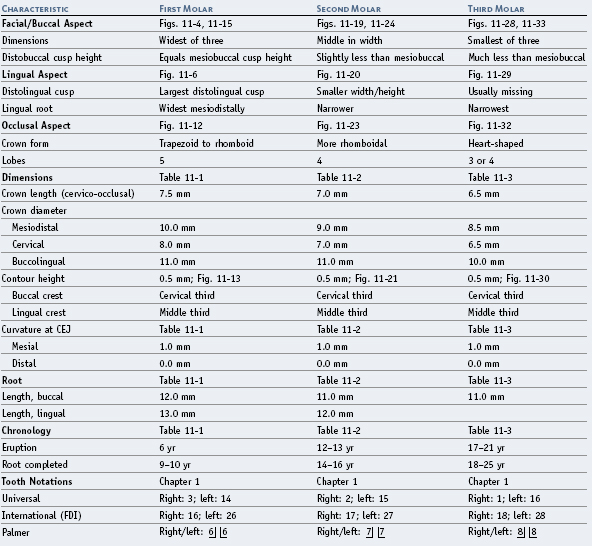
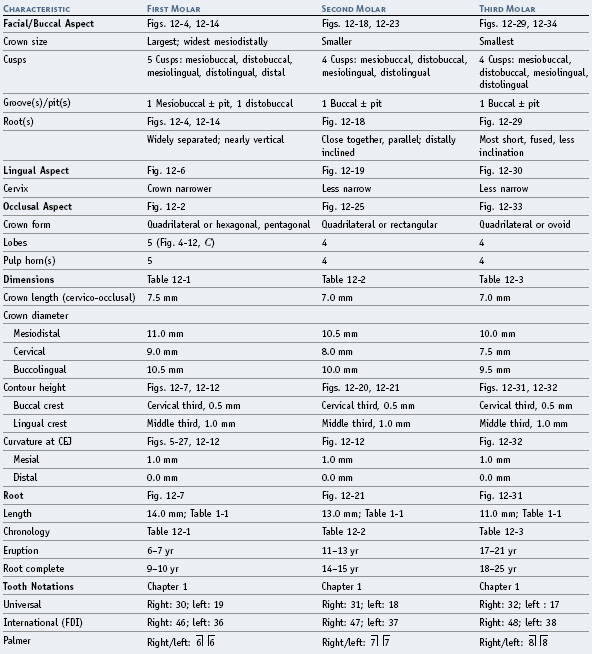
Appendix B Tooth Traits of the Permanent Dentition
Appendix B includes tables listing important traits and characteristics of the teeth in the permanent dentition. The tables can be used in conjunction with the illustrations in Appendix A to note differences and similarities in tooth morphology. Tooth notation systems, dimensions, position of proximal contacts, heights of contour, curvature of the cementoenamel junction, and features of various profile, incisal, and occlusal views are summarized to facilitate the study of dental anatomy.
Table 1 Maxillary Incisors: Type Traits and Other Characteristics
| Central Incisor | Lateral Incisor | |
|---|---|---|
| Facial/Labial Aspect | Fig. 6-9 | Fig. 6-19 |
| Proximal contacts | Cervico-incisal location | — |
| Mesial | Incisal third | Junction incisal/middle thirds |
| Distal | Junction incisal/middle thirds | Middle third |
| Mesioincisal angle | Sharp right angle | Slightly rounded |
| Distoincisal angle | Slightly rounded | Distinctly rounded |
| Mesial profile | Straight | Slightly rounded |
| Distal profile | Nearly round | Distinctly rounded |
| Mesiodistal width | Comparatively wide | Comparatively narrow |
| Pulp horn(s) | 3 (facial view) | Usually 2 (facial view) |
| Lobes | 4 (Fig. 4-12, A) | 4 |
| Lingual Aspect | Fig. 6-3 | Fig. 6-14 |
| Marginal ridges | Moderate | More prominent |
| Cingulum | Moderately pronounced | More prominent |
| Fossa | Moderately deep | Deep |
| Incisal Aspect | Fig. 6-11 | Fig. 6-18 |
| Outline | Triangular | Ovoid |
| Labial | Slightly convex | More convex |
| Dimensions | Table 6-1 | Table 6-2 |
| Crown length (cervico-incisal) | 10.5 mm | 9 mm |
| Crown diameter | ||
| Mesiodistal | 8.5 mm | 6.5 mm |
| Cervical | 7.0 mm | 5.0 mm |
| Labiolingual | 7.0 mm | 6.0 mm |
| Contour height | 0.5 mm; Fig. 6-4Fig. 6-5 | 0.5 mm; Fig. 6-13 |
| Facial/lingual | Both cervical third | Both cervical third |
| Curvature at CEJ | Table 6-1 | Table 6-2 |
| Mesial | 3.5 mm | 3.0 mm |
| Distal | 2.5 mm | 2.0 mm |
| Root | Fig. 6-3Fig. 6-5Fig. 6-9Fig. 6-10 | Figs. 6-13Fig. 6-19Fig. 6-20 |
| Length | 13.0 mm | 13.0 mm |
| Pulp canal(s) | 1 | Less frequent apical accessory canals |
| Chronology | Table 2-3Table 6-1 | Table 2-3Table 6-2 |
| Eruption | 7–8 yr | 8–9 yr |
| Root completed | 10 yr | 11 yr |
| Tooth Notations | Chapter 1 | Chapter 1 |
| Universal | Right: 8; left: 9 | Right: 7; left: 10 |
| International (FDI) | Right: 11; left: 21 | Right: 12; left: 22 |
| Palmer | Right/left: 
 |
Right/left: 
 |
Table 2 Mandibular Incisors: Type Traits and Other Characteristics
| Central Incisor | Lateral Incisor | |
|---|---|---|
| Facial/Labial Aspect | Fig. 7-2Fig. 7-9 | Fig. 7-13Fig. 7-19 |
| Symmetry | Symmetrical bilaterally | Asymmetrical |
| Proximal contacts | Fig. 5-8, A | Fig. 5-8, B |
| Mesial | Incisal third | Incisal third |
| Distal | Incisal third | Incisal third |
| Mesioincisal angles | Sharp right angles | Some rounding |
| Distoincisal angles | Sharp right angles | More rounded than mesioincisal angle |
| Curvature at CEJ | Fig. 5-27, Table 7-1 | Table 7-2 |
| Mesial | 3.0 mm | 3.0 mm |
| Distal | 2.0 mm | 2.0 mm |
| Incisal Aspect | Fig. 7-11 | Fig. 7-18 |
| Incisal edge (ridge) | Right angle to line bisecting cingulum | Distolingual twist to line bisecting cingulum |
| Pulp horn(s) | 1 or 0 | Variable; more prominent |
| Lobes | 4 | 4 |
| Dimensions | Table 7-1 | Table 7-2 |
| Crown length (cervico-incisal) | 9.0 mm | 9.5 mm |
| Crown diameter | ||
| Mesiodistal | 5 mm | 5.5 mm |
| Cervical | 3.5 mm | 4.0 mm |
| Labiolingual | 6.0 mm | 6.5 mm |
| Contour height | Less than 0.5 mm; Fig. 7-7 | Less than 0.5 mm |
| Facial/lingual | Both cervical third | Both cervical third |
| Root | ||
| Dimensions | Table 7-1 | Table 7-2 |
| Length | 12.5 mm | 14.0 mm |
| Pulp (root) canal(s) | Usually 1; 2 possible | 1 |
| Chronology | Table 7-1 | Table 7-2 |
| Eruption | 6–7 yr | 7–8 yr |
| Root completed | 9 yr | 10 yr |
| Tooth Notations | Chapter 1 | Chapter 1 |
| Universal | Right: 25; left: 24 | Right: 26; left: 23 |
| International (FDI) | Right: 41; left: 31 | Right: 42; left: 32 |
| Palmer | Right/left: 
 |
Right/left: 
 |
Table 3 Maxillary and Mandibular Incisors: Arch Traits and Other Characteristics
| Maxillary Incisors | Mandibular Incisors |
|---|---|
| Central incisor wider than lateral incisor | Lateral incisor wider than central incisor |
| Wider than mandibular central incisor | Narrowest of incisor class |
| Marginal ridges and cingulum more prominent | Marginal ridges and cingulum not prominent |
| Lingual fossa pronounced, often with a lingual pit | Lingual fossa shallow without grooves or pits |
| Crown width greater mesiodistally than labiolingually | Crown width greater labiolingually than mesiodistally |
| Roots rounded in cross section | Roots thin mesiodistally |
| Incisal edge labial to root axis | Incisal edge lingual to root axis |
Table 4 Canines: Type and Arch Traits and Other Characteristics
| Maxillary Canine | Mandibular Canine | |
|---|---|---|
| Facial/Labial Aspect | ||
| Proximal contacts | Fig. 5-8, C | Fig. 5-7, C |
| Mesial | Junction incisal/middle thirds | Incisal third |
| Distal | Middle third | Middle third |
| Mesial Aspect | Wider faciolingually | Narrower, longer |
| Lingual Aspect | Deeper lingual fossae | Flat lingual surface |
| Marginal ridges | Pronounced; 2 fossae | Parallel or slightly converging |
| Cingulum | Large, centered mesiodistally | Smaller, may be off center distally |
| Lingual pits, grooves | Common | None |
| Incisal Aspect | Marked asymmetry of mesial/distal halves | Less symmetry; distal cusp ridge rotated |
| Incisal/Proximal Aspects | Cusp tip may be at or labial to root axis line | Cusp tip lingual to root axis line |
| Dimensions | ||
| Mesiodistal | 7.5 mm | 7.0 mm |
| Labiolingual | 8.0 mm | 7.5 mm |
| Curvature at CEJ | 2.5 mm (mesial) | 1.0 mm (distal) |
| Incisal-cervical | 10.0 mm | 11.0 mm |
| Contour height | 0.5 mm | Less than 0.5 mm |
| Facial/lingual | Both cervical third | Both cervical third |
| Pulp horn(s) | 1 | 1 |
| Lobes | 4 | 4 |
| Root | ||
| Terminal (number) | 1 | Maybe 2 (Fig. 8-24) |
| Length | 17 mm | 16 mm |
| Chronology | Table 8-1 | Table 8-2 |
| Eruption | 11–12 yr | 9–10 yr |
| Root completed | 13–15 yr | 12–14 yr |
| Tooth Notations | Chapter 1 | Chapter 1 |
| Universal | Right: 6; left: 11 | Right: 27; left: 22 |
| International (FDI) | Right: 13; left: 23 | Right: 43; left: 33 |
| Palmer | Right/left: 
 |
Right/left: 
 |
Table 5 Maxillary Premolars: Type Traits and Other Characteristics
| First Premolar | Second Premolar | |
|---|---|---|
| Facial/Buccal Aspect | ||
| Proximal contacts | Mesial/distal: middle third | Mesial/distal: middle third |
| Shoulders | Prominent | Narrow |
| Buccal cusp | Tipped more to distal | Not tipped |
| Cusp ridges | Longer mesial ridge | Similar |
| Cusp size, height | Slightly wider, longer | Shorter |
| Lingual Aspect | Buccal profile visible | Profile not visible |
| Mesial Aspect | ||
| Mesiomarginal groove | Crosses marginal ridge | Does not cross ridge |
| Mesial concavity | Present | Not present |
| Mesial root depression | Present | Present |
| Occlusal Aspect | Fig. 9-6 | Fig. 9-21 |
| Profile | Hexagonal | Ovoid |
| Central groove | Long | Short |
| Supplemental groves | Usually not present | Many; often present |
| Lobes | 4 | 4 |
| Pulp horn(s) | 2 | 2 |
| Dimensions | Table 9-1 | Table 9-2 |
| Cervico-occlusal | 8.5 mm | 8.5 mm |
| Crown diameter | ||
| Mesiodistal | 7.0 mm | 7.0 mm |
| Cervical | 5.0 mm | 5.0 mm |
| Buccolingual | 9.0 mm | 9.0 mm |
| Contour height | Fig. 9-5 | Fig. 9-19 |
| Facial/buccal crest | Cervical third | Cervical third |
| Lingual | Middle third | Middle third |
| Curvature at CEJ | Fig. 9-4Fig. 9-5 | |
| Mesial | 1.0 mm | 1.0 mm |
| Distal | 0.0 mm | 0.0 mm |
| Root | ||
| Length of root | 14.0 mm | 14.0 mm |
| Grooves | Distinct, longitudinal | No distinct grooves |
| Number of roots | Usually 2 | 1 root |
| Pulp canal(s) | Often 2 | Usually 1 |
| Chronology | Table 9-1 | Table 9-2 |
| Eruption | 10–11 yr | 10–12 yr |
| Root completed | 12–13 yr | 12–14 yr |
| Tooth Notations | Chapter 1 | Chapter 1 |
| Universal | Right, 5; left, 12 | Right, 4; left, 13 |
| International (FDI) | Right, 14; left, 24 | Right, 15: left, 25 |
| Palmer | Right/left: 
 |
Right/left: 
 |
Table 6 Mandibular Premolars: Type Traits and Other Characteristics
| First Premolar | Second Premolar | |
|---|---|---|
| Facial/Buccal Aspect | Fig. 10-2Fig. 10-9 | Fig. 10-13Fig. 10-18 |
| Proximal contacts | Fig. 5-7 | Fig. 5-7 |
| Cervico-occlusal | Mesial/distal: middle third | Mesial/distal: middle third |
| Form | Asymmetrical | Bilaterally symmetrical |
| Lingual Aspect | Fig. 10-3 | Fig. 10-14 |
| Buccal profile | All buccal profile seen | None seen |
| Cusp height | Lingual less than buccal | Buccal/lingual cusps nearly equal |
| Mesial Aspect | Fig. 10-1 | Fig. 10-15 |
| Occlusal plane | Tilted lingually | Essentially horizontal |
| Transverse ridge or buccal triangular ridge | Transverse ridge present (Fig. 10-1) | No transverse ridge present (Fig. 10-17) |
| Occlusal Aspect | Fig. 10-6Fig. 10-11 | Fig. 10-17 |
| Outline form | Diamond-shaped | Square |
| Cusps | 2 (Fig. 10-1) | 2 or 3 (Fig. 10-20) |
| Lobes | 4 | 4 or 5 |
| Dimensions | Table 10-1 | Table 10-2 |
| Crown length (cervico-occlusal) | 8.5 mm | 8.0 mm |
| Crown diameter | ||
| Mesiodistal | 7.0 mm | 7.0 mm |
| Cervical | 5.0 mm | 5.0 mm |
| Buccolingual | 7.5 mm | 8.0 mm |
| Contour height | Fig. 5-27Fig. 10-4 | Fig. 10-16 |
| Facial | Cervical third | Middle third |
| Lingual | Middle third | Middle third |
| Curvature at CEJ | Table 10-1 (cervical line) | Table 10-2 |
| Mesial | 1.0 mm | 1.0 mm |
| Distal | 0.0 mm | 0.0 mm |
| Root | Table 10-1 | Table 10-2 |
| Length | 14.0 mm | 14.5 mm |
| Pulp canal(s) | 1 | 1 |
| Pulp horn(s) | 1 | 2 |
| Chronology | Table 2-3; Table 10-1 | Table 2-3; Table 10-2 |
| Eruption | 10–12 yr | 11–12 yr |
| Root completed | 12–13 yr | 13–14 yr |
| Tooth Notations | Chapter 1 | Chapter 1 |
| Universal | Right: 28; left: 21 | Right: 29; left: 20 |
| International (FDI) | Right: 44; left: 34 | Right: 45; left: 35 |
| Palmer | Right/left: 
 |
Right/left: 
 |
Table 7 Premolars: Arch Traits and Other Characteristics
| Maxillary Premolars | Mandibular Premolars |
|---|---|
| Facial/Buccal Aspect:Fig. 4-16 | |
| Crowns are trapezoidal* | Crowns are trapezoidal |
| Mesial Aspect:Fig. 4-16 | |
| Crowns are trapezoidal | Crowns are rhomboidal† |
| Buccal and lingual cusps are almost equal in height | Lingual cusps comparatively much shorter than maxillary lingual cusps Lingual cusp tips may be lingual to the root |
| Two major cusps of almost equal size and prominence | Buccal and lingual cusps of uneven height and prominence |
* A trapezoid is a four-sided plane figure having two sides parallel.
† A rhomboid is an oblique-angled parallelogram with only the opposite sides equal.