Gynecologic disorders which can cause infertility
Diseases and Disorders which Cause or Contribute to Infertility
Part 1 – Endometriosis, Pelvic Inflammatory Disease, Fibroids and Polyps
Treatment with Western Medicine
TCM Treatment of Endometriosis
Part 2 – Ovulatory Disorders and Polycystic Ovarian Syndrome
Introduction
In Chinese medicine clinics in the West, many, if not most, patients will arrive having already had some investigations and sporting a diagnostic label or two. For the TCM doctor, these labels are interesting: they will tell some details about the disorder and perhaps, some idea about prognosis. But the treatment offered by the TCM doctor will be decided largely on the basis of a completely different sort of label, i.e., that determined using Bian Zheng or pattern differentiation according to Chinese medicine diagnostic principles. Keeping this in mind, we now examine some of the labels women bring to an infertility clinic and how they might be reconfigured in the framework of Chinese medicine. All treatments suggested are based on (or modified from) those used in the Jiangsu Province TCM Hospital1 or other published sources and are intended to be guides only.
Diseases and Disorders which Cause or Contribute to Infertility
Endometriosis: Endometriosis is a complex disorder which causes disturbing symptoms and can affect fertility in myriad ways from obstruction of the ovaries and tubes, to impaired oocyte development to dysfunction in the uterine lining hindering implantation and normal placenta development. However, unlike the disorders discussed in Part 2 of this Chapter, amenorrhea or polycystic ovary syndrome (PCOS), the ovaries are usually functioning and ovulation is regular most of the time.
This disorder typically involves stagnation of Blood in conjunction with other pathologies. Deficiency of Kidney Yang is often involved, especially if there is also infertility. TCM treatment will follow the menstrual cycle in the fashion discussed in Chapter 4 but more attention is paid to clearing Blood stasis and breaking up masses during the period, moving qi and Blood at ovulation and fortifying the Kidney yang. If there is such severe stagnation that a pregnancy is impossible, then treatment will focus on clearing the stagnation and reducing inflammation throughout the entire menstrual cycle while attempts at conception are postponed.
Inflammation of Pelvic Organs (Pelvic Inflammatory Disease, Endometritis, Salpingitis): While not so common in their acute presentations (which are best treated with antibiotics), subtle or chronic manifestations of infection and inflammation of reproductive organs can present in the Chinese medicine fertility clinic. It is important that these are resolved before conception is attempted.
Infections and inflammation are commonly described as Damp-Heat in Chinese medicine. Chronic or persistent Damp-Heat in the lower Jiao can impair fertility by creating an environment that is not conducive to sperm survival, good egg quality, smooth transport of the embryo or endometrial health and implantation. Chronic cases respond well to acupuncture and herbal therapy, which clears Damp and Heat and supports Kidney function.
Disorders of Ovulation: Part 2 of this chapter covers many of the different reasons that a woman might not be falling pregnant due to ovary dysfunction. She may ovulate very infrequently (oligomenorrhea) or not very well (luteal phase defect). She may not ovulate at all (amenorrhea) due to resistant ovaries or premature menopause or primary ovarian failure.
Many cases of irregular ovulation are related to Kidney Yin and Yang imbalance and the best way to approach treatment of these is promoting the natural trends in the cycle, as we have discussed in Chapter 4. Where there is no ovulation, it may be necessary to purge or resolve a pathogenic factor, or strongly boost Kidney Jing.
Polycystic Ovary Syndrome: This is one type of ovulation disorder and those women with this syndrome who are having difficulty conceiving usually have some disruption to the function of the Chong and Ren channels. The menstrual cycle is often irregular or infrequent and treatment attempting to follow the usual movements of Kidney Yin and Yang in the follicular and luteal phases is not so easy. The obstruction to the Chong and Ren can arise from accumulation of Phlegm-Damp, or stagnation of Qi. Either may or may not be associated with Kidney deficiency but where there is infertility, Kidneys are likely to be involved. Our treatment will focus on achieving ovulation – this may require clearing Phlegm-Damp and building Yin and Blood all together initially; then, as signs of ovulation develop, Kidney Yang will be strongly boosted to promote successful ovulation. Or we may need to re-establish the circulation of Qi and Blood in the Chong and Ren at the same time as building Kidney Jing. We shall discuss the many different ways to view and apply treatment to this syndrome in Part 2 this chapter.
Tubal Blockage: This cause of infertility will be discussed in Chapter 6. Doctors in China, in the absence of advanced surgical methods and affordable IVF (in vitro fertilization) technology, have devised ingenious methods for trying to unblock fallopian tubes. The blockage is regarded as a stagnation of Qi and Blood, and treatment includes flushing the tubes with saline and herbal solutions, introducing herbal decoctions per rectum, electrotherapy on the abdomen, various other physiotherapeutic manipulations and, of course, acupuncture. Where the technology exists, microsurgery and IVF procedures offer a good chance of pregnancy in women with blocked tubes.
Part 1
Endometriosis, Pelvic Inflammatory Disease, Fibroids and Polyps
Endometriosis
Endometriosis is a not an uncommon diagnosis in recent times. This is due in part to the increasing frequency with which diagnostic surgery is carried out but also to deferred child-bearing and to increasing levels of environmental pollutants. The disease is defined by the presence of endometrial tissue somewhere in the pelvic cavity but outside the uterus. Rarely, endometrial tissue can be found in other locations in the body. Adenomyosis is the term used for endometrial tissue appearing in the myometrium (muscle layer) of the uterine wall.
Endometriosis affects approximately 6–7% of all females, 30–40% of whom are infertile. This is two to three times the rate of infertility in the general population. A quarter of the women attending IVF clinics have endometriosis. There is likely a genetic component since patients with an affected mother or siblings are more likely to have severe endometriosis than those without affected relatives. Magnetic resonance imaging (MRI) has revealed a high correlation between endometriosis and adenomyosis in first-degree relatives.2
The most widely held theory, retrograde menstruation, states that endometriosis occurs when endometrial fragments pass through the fallopian tubes during menstruation and attach to nearby pelvic structures and grow.
Endometrial cells are seen in peritoneal fluid in all women at the time of menses, so it might be expected that endometriosis should develop in all these women. The fact that only some women develop the disease may have something to do with impaired immune surveillance. Immunologic changes have been demonstrated in women with endometriosis, however, researchers are uncertain whether these immunologic findings are responsible for the endometriosis or are a result of the inflammation caused by it. Doctors of Chinese medicine relate impaired immune surveillance to Kidney Yang deficiency, which as we shall see later is an important factor in the etiology of the disease.
Under the influence of menstrual cycle hormones, each month the displaced endometrial tissue grows and sheds blood at the time of menses. Instead of flowing harmlessly outside the body, however, the internal bleeding wreaks havoc in the abdominal cavity.
The resulting inflammation leads to the formation of adhesions which attach to and distort the tubes, ovaries, uterus and other pelvic organs.
To date, laparoscopy is the most reliable way to diagnose endometriosis. During this procedure, the surgeon is able to look inside the pelvic region and see exactly what is there. What the surgeon sees if endometriosis is present is patches (from tiny pinpricks which are hard to see to large lumps which can distort organs in the pelvis) of endometrial tissue. These are commonly located on the back of the uterus, on the tubes, around the ovaries (or as a cyst inside the ovary), on the ligaments which hold the uterus in place or on the bowel or bladder.
Patches of endometrial tissue can be of different appearance, and exhibit different behavior:
• Brown or pigmented endometriosis appears as small dark brown spots. The blood lost from this endometrial tissue during the time of menstruation has nowhere to go and gets trapped and may cause pain, depending on the site of implantation. The old dried blood then gives these spots a dark brown appearance. These peritoneal lesions are most active when they are superficial and hemorrhagic and become less active over time as dead and fibrotic tissue forms.
• Chocolate cyst is the name given to endometriosis which forms a cyst in the ovary. The blood from this tissue is encapsulated in a cyst and becomes thick and dark brown and appears like chocolate.
• Pale pink, white or non-pigmented endometriosis looks like pale lesions on the surface of different parts of the pelvic cavity. These lesions have not yet become brown because they have not developed far enough to bleed, but they seem to be active in secreting substances which inhibit conception. They may also be more active in producing prostaglandins and be associated with more pain than older lesions. It can take 7–10 years for these lesions to become red and then dark as they age and become fibrotic.
Endometriosis tissue not only varies in its appearance but also in how deeply it attaches to the membrane covering the pelvic cavity and the organs. This too influences its effect on the body:
The Clinical Picture
Endometriosis is a condition which has puzzled doctors for a long time – it is associated with pelvic pain during periods and at other times, pain during intercourse, bowel symptoms, spotting before periods and infertility. But not always so – there are many cases of severe endometriosis discovered by accident during investigation or surgery for something else, or during a hysterectomy, which have never contributed to any difficulty with periods or with conceiving. On the other hand, severe dysmenorrhea and great difficulty falling pregnant are sometimes seen to be associated with almost insignificant amounts of endometriosis seen on laparoscopy. For nearly one-third of endometriosis patients the only symptom is infertility. Premenstrual spotting occurs in the majority of endometriosis cases.
Endometriosis and Infertility
In this text, we are particularly interested in how this disorder reduces fertility. We are aware of several different mechanisms whereby endometriosis might hinder conception; very likely this is still only part of the story.
Distortion of the Position of Tubes or Ovaries
If there is a significant amount of endometriosis in an inconvenient place, near the fallopian tubes or ovaries for example, it is not difficult to see how the distortions it causes could prevent conceptions by preventing the egg and the sperm meeting. Over time, the fallopian tubes may become inflamed and blocked by adhesions. Thus, ectopic pregnancies are more common in women with endometriosis. Even mild endometriosis is associated in most cases with peri-ovarian adhesions which may interfere with ovulation or transport of the egg between ovary and fallopian tube.3
Immune Dysfunction
Endometriosis is characterized by a low-grade inflammation in the pelvis, which manifests as an increase in peritoneal fluid, increased number of macrophages and their secretions, i.e. prostaglandins, proteolytic enzymes and cytokines.4
Macrophages are large cells which mop up cellular debris and bacteria and other foreign material; one of their jobs is to kill off sperm that swim all the way out of the tubes and into the abdomen. When there is endometriosis present, there are increased numbers of macrophages5 which become more active and go on their seek and destroy missions with great vigor. Unfortunately, these vigilantes can enter the fallopian tubes and pick off sperm before they have had a chance to meet the egg. In women with partners who have poor sperm counts, this can be quite disastrous, leaving no sperm at all to fertilize the egg. Additionally, the cytokines which macrophages produce are toxic to sperm affecting their mobility and ability to fertilize the egg, providing yet another impediment to fertility.6,7 Cytokines and chemokines such as tumor necrosis factor-alpha, and interleukins IL-1, IL-6, IL-8, etc. contribute to the pathogenesis of endometriosis by enhancing attachment, angiogenesis and/or proliferation of ectopic endometrial tissues in the pelvis.8
The disease is further characterized by impaired T-cell mediated cytotoxicity, natural killer (NK) cell activity and B-cell function.
Production of Secretions which Obstruct Fallopian Tubes
The type of endometriosis that sits superficially on the membrane surrounding the pelvic structures has been shown to have glands similar to that found in the endometrium. These glands secrete mucus. This mucus can coat the fimbriae or the ovary, preventing the transfer of the egg to the tube. Such a phenomenon has been observed in animal studies.9
Increased Prostaglandin Production
Endometriosis is associated with increased levels of prostaglandins (PGE2 and PGF), which may have a deleterious effect on the patency and flexibility of the fallopian tubes. Muscular contractions of the uterus are also increased causing pain and possibly interfering with implantation.10
LUFS and Low Progesterone
Endometriosis is associated with a higher incidence of the ovulatory disturbance called luteinized unruptured follicle syndrome (LUFS) and lower progesterone levels in the luteal phase.
Things can go awry just before ovulation if luteinizing hormone (LH) levels are less than adequate. A developing follicle may respond to the extent that it forms a corpus luteum and produces progesterone but there is not enough LH to soften the follicle casing and allow the release of a mature egg. A luteinized unruptured follicle (or LUF) is formed. The amount of progesterone this LUF produces is often less than usual and for fewer days, and is the basis of an inadequate luteal phase or luteal phase defect. Obviously, conception is impossible in such cycles since there is no egg released, and even if there were, the progesterone support is such that implantation and development of an embryo is unlikely. It is estimated that endometriosis results in anovulation in up to 20% of cycles of some patients.
Endometrial Changes and Reduced Implantation Rates
Although appearing histologically normal, the endometrium and inner myometrium (the junctional zone) in women with endometriosis and adenomyosis show marked functional disturbances. The lining has aberrant responses to ovarian hormones such that factors important for implantation are affected.10,11 Implantation and placentation involve deep invasion of the junctional zone and it may be the failure to do this properly that accounts for the increase in premature births and other adverse pregnancy outcomes seen in women with endometriosis.12
Disruption in the deepest layer of the endometrium may also explain functional abnormalities such as hyperperistalsis, dysperistalsis and inordinate smooth muscle proliferation associated with endometriosis and adenomyosis which can affect the way sperm are transported.13
Other studies have suggested that there are disruptions to shedding of the uterine lining during menstruation in endometriosis sufferers, which leads to abnormalities in the uterine lining in the subsequent luteal phase.14
All of the above possibly contribute to the observed reduced embryo implantation rate.15
Reduced Oocyte Quality
Studies with IVF patients receiving donor eggs have shown that success rates were reduced when the oocytes were from women with endometriosis indicating that the disease affected in some way the quality of the donated oocytes.16
Ovarian Reserve may be Lower in Endometriosis
Studies on infertile women with mild or minimal endometriosis show reduced ovarian reserve (measured by AMH). Whether this is an association or a cause is not known.17 Surgical removal of endometriomas can also have a deleterious effect on ovarian reserve (measured by AMH).18
Treatment with Western Medicine
Surgery is used to de-bulk severe endometriosis. If it is successfully removed, leaving undamaged tubes and ovaries, then chances of conception may increase dramatically in the months following the surgery, especially if endometriosis was the only cause of the infertility.
If endometriosis is mild and in its early stages, it may be difficult to find and remove all the small non-pigmented lesions. The substances produced by such lesions which interfere with the meeting of egg and sperm and possibly disrupt implantation, continue to be made.
While surgery is the preferred medical option for endometriosis patients trying to conceive, there are a number of different drug regimens which, at different times and in different clinics, have gained popularity. The strategy behind all of them is to prevent ovulation and the flux of hormones associated with a normal menstrual cycle. This is achieved by using drugs which mimic pregnancy – progestogens like Provera (medroxyprogesterone acetate) or Duphaston (dydrogesterone) – or induce temporary menopause – testosterone derivatives such as Danocrine or Danazol or gonadotrophin-releasing hormone (GnRH) analogs such as Zoladex (goserelin) or Synarel (nafarelin) – or by using the oral contraceptive pill continuously. In all cases, the menstrual cycle is halted. Some of these drug regimens produce a wide range of side-effects and are not easily tolerated by all women. The length of treatment varies from 3 to 9 months or more and if it is successful, the endometriosis is ‘starved’ into shrinking or disappearing. Women are usually encouraged to try to fall pregnant soon after their cycle resumes on the cessation of the drug treatment.
IVF procedures, wherein the meeting of the eggs and the sperm is arranged outside the body, neatly circumnavigate some of the troublesome ways that endometriosis exerts its influence. In cases where mild endometriosis meets a low sperm count, IVF can greatly improve a couple’s chances of having a baby. However, endometriosis patients have poorer IVF outcome in terms of reduced pregnancy rate per cycle, reduced pregnancy rate per transfer and reduced implantation rate when compared with women doing IVF for other reasons.16 It is thought that abnormalities of the uterine lining in endometriosis patients can also negatively impact IVF outcomes.15,19 The risk of pre-term birth is increased in endometriosis patients who do IVF.20
TCM Treatment of Endometriosis
But is there another way to view the treatment of this disease? A way that does not just remove or shrink the manifestations of the imbalance that allowed it to occur but tries to address that imbalance or underlying pathology itself? And if that could be corrected, may be the lesions (especially the pink or superficial type), might become innocuous and no longer produce mucus or attract and activate macrophages. I don’t know if Chinese medicine can claim to change the nature and troublesome behavior of the endometriosis lesions but if the basic and underlying imbalance (as the TCM doctor understands it) is addressed, then symptoms and fertility can certainly improve.
Diagnosing Endometriosis
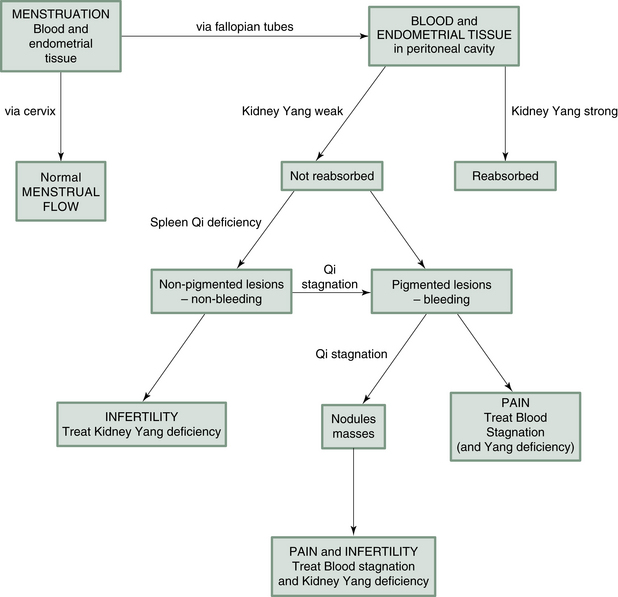
Endometriosis, as you may have gathered, is a multifarious type of disorder which can manifest in many guises. Sometimes, there are no bothersome symptoms at all. Often there is period pain and sometimes there is also pain with intercourse. Infertility is involved in some cases and not in others. And the ways that endometriosis contributes to infertility is at many different levels, the quality of the eggs, the integrity of the uterine lining, the way the tubes and uterus move, the distortion of tubes or ovaries or the inflammation and over-activity of the immune system. Any diagnosis a Chinese medicine doctor comes up with, should keep in mind all these possibilities. Figure 5.1 outlines some of the etiologic relationships relevant to the development of endometriosis.
There are some characteristic signs that are recognized by doctors working in infertility clinics in China, which will alert them to the possible presence of endometriosis. These are distinctive patterns on the basal body temperature (BBT) charts (see below) and spotting before periods, which is also recognized by Western doctors as strongly indicative of endometriosis. These two signs, together with some of the clinical symptoms mentioned earlier – especially period pain getting worse with age and accompanied by a bearing-down sensation in the abdomen or palpation of nodules along the sacrospinal ligament – constitute as definite a diagnosis of endometriosis that a doctor working in China without a laparoscope can reach.
It must then be remembered that to a TCM doctor, the unique and individual presentation of each patient is what will determine the appropriate treatment.
BBT Patterns
You will recall from our discussions in Chapter 3 that the typical BBT chart has a low phase, which begins at (or just prior to) the beginning of the period, and a high phase, which begins at ovulation and persists until the next period. The two changes to this pattern which can suggest endometriosis are:
• The temperature does not drop very much when the period comes, or if it does drop it may start to go up again after 1 or 2 days. These patterns indicate that the switch to Yin from Yang has not been on time or complete. One of the factors that both signifies and contributes to the switch from Yang to Yin is the loss of blood and therefore body heat to the outside. In the case of endometriosis, which involves significant bleeding inside the pelvic cavity or in the ovary (if there is an endometrioma) which cannot escape the body, one of the conditions of switching Yin to Yang is not met and the temperature will not drop convincingly (see Ch. 3).
• The temperature of the high phase may rise very slowly after ovulation, or may not rise enough or may fall again after only a few days. These patterns all indicate inadequate Kidney Yang function (see Ch. 3).
Strategies for Treating Endometriosis
The emphasis of TCM treatment for endometriosis usually involves clearing Blood stagnation. Endometriosis is a Western medical label not a TCM one, but the scientific medical understanding of this disease has contributed to the notion that this is a disease characterized by blood being where it shouldn’t and unable to escape the body, i.e., what we call Blood stasis. Symptoms such as severe stabbing period pain, clotty menstrual flow and palpable nodules or masses in the abdomen verify the diagnosis of stagnant Blood.
The mark of a skilful doctor is to keep close sight of exactly what requires changing, maintaining awareness of the constellation in which it appears. In the case of endometriosis the central part of the picture is the lesion which can manifest in various guises:
Table 5.1 lists the theoretical relationship between these different types of lesions and their treatment principles.
Table 5.1
The theoretical relationship between different types of endometriosis lesions and the appropriate treatment principles
| Type of lesion (Zheng Jia) | Action | Treatment |
| Non-pigmented lesions | Produce secretions which may clog the fimbrial end of fallopian tube and cause infertility | Boost Kidney Yang and invigorate Spleen Qi to remove Phlegm-Damp (or Damp-Heat) |
| Pigmented lesions | Cause pain, bleeding and inflammation in pelvic cavity and infertility | Resolve Blood stagnation and inflammation with Blood regulating and Damp-Heat clearing herbs and boost Kidney Yang to promote dispersal of stagnation. |
| Cysts, nodules and masses | Cause pain, inflammation and infertility due to distortion of tubes or ovaries | Resolve Blood stagnation with Blood breaking herbs, clear Damp-Heat and boost Kidney Yang to promote dispersal of stagnation. |
Treatment to target implants of endometriosis (Zheng Jia, or masses, in TCM) involves the use of heavy handed ‘Blood busting’ herbs and those that reduce inflammation by clearing Damp and Heat. Table 5.2 lists some of these herbs and substances. (See also Appendix 2.)
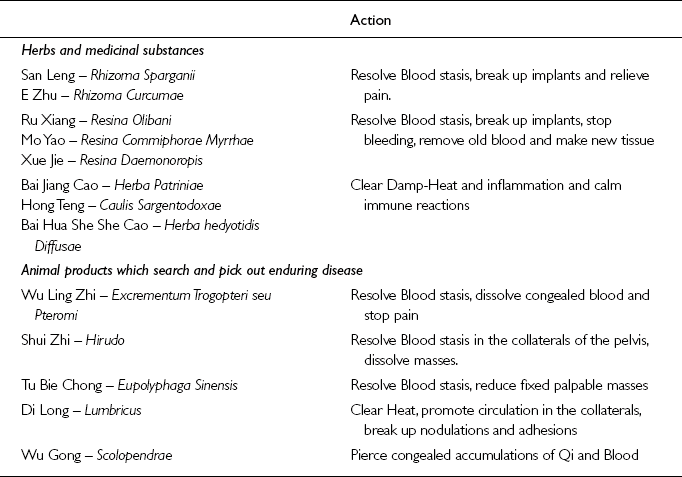
We can incorporate these substances in potent formulas designed to break down endometriosis tissue. Such formulas are only used short term, and often just at or near the time of greatest pain, usually the period. Some of these animal products are toxic and are used in small doses for a specific time for a specific purpose. Wu Ling Zhi, however, is one substance that can be used in the longer term and in women of weak constitutions with Blood stasis. We shall see the use of some of these substances in formulas used during the period.
Treating Infertility Associated with Endometriosis
Most of our discussion of treatment will however be somewhat broader than a narrow focus on breaking down endometriosis tissue. As Western medical researchers discovered more about this disease, so did TCM doctors, who developed their treatment protocols of infertility caused by endometriosis, in different directions. For example, in the infertility clinics in China, doctors found that more pregnancies resulted if treatment of women with endometriosis targeted the Kidneys, with removal of Blood stasis only when and if necessary. Of course, this dovetails neatly with the discovery that some endometriosis lesions contain no extravasated blood at all and that such tissue can produce secretions which clog up the system – Phlegm-Damp we call it in TCM. Treatment which boosts Kidney Yang is generally rather effective at clearing such Phlegm-Damp.
A patient presenting to a TCM clinic with endometriosis will be diagnosed according to her main symptoms and her constitution. When treatment is prescribed as part of an infertility treatment, the doctor will be particularly mindful of reinforcing Kidney Yang and resolving Blood stagnation. Liver Qi stagnation and Spleen Qi deficiency may also contribute and some cases of endometriosis will exhibit elements of Heat or Cold or Damp. To understand the part that Blood stagnation plays it is necessary to explore further our understanding of the way endometriosis is formed and how we relate this to TCM concepts (Fig. 5.1).
Our knowledge about the anatomy and behavior of endometriosis is still limited and so some of these ideas may change or be expanded in the future.
We do know that menstrual blood travels not only downwards from the uterus and out through the cervix but also upwards through the fallopian tubes and out into the peritoneal cavity (retrograde menstruation). This small quantity of blood carries with it bits of discarded endometrium. Women with strong uterine cramps (due to Liver Qi stagnation) are more likely to lose more menstrual flow upwards through the tubes. The blood and the tissue will either be reabsorbed, or will remain and establish itself somewhere in the pelvic cavity. If Kidney Yang is strong, then movement of Qi in the pelvis will mobilize the menstrual debris, which should not be there, and it will be efficiently reabsorbed. A weakness of Kidney Yang, on the other hand, will allow the accumulation of blood and tissue such that it stagnates and creates the basis for Zheng Jia or masses to develop.
The bits of endometriosis tissue which develop in the pelvic cavity will be either non-pigmented (i.e., not bleeding) or pigmented because they contain blood vessels. The non-pigmented lesions can develop into the pigmented ones if they develop the blood vessels and start to bleed during the menstrual phase. The non-pigmented types of endometriosis are associated with infertility for reasons not yet fully understood but possibly because they produce secretions which coat the fimbrial ends of the tubes. The treatment which will most directly address this type of endometriosis is one which will strengthen the Kidney Yang and clear Phlegm-Damp. The development of the non-pigmented types of endometriosis is probably facilitated in Spleen Qi-deficient individuals. In this case, treatment must also address the Spleen Qi to facilitate removal of Damp.
The pigmented endometriosis, containing tissue which responds to the hormonal changes, which makes the uterine lining bleed, is the type more likely to cause pain, especially if it is implanted more deeply than just the surface of the peritoneum. Removal of this type of lesion requires the use of Blood-moving herbs and Kidney Yang tonic herbs. The pigmented lesions, especially under the influence of Qi stagnation, can form substantial Zheng Jia in the form of nodules and masses and scar tissue. In these cases, there may be both pain and infertility: the latter may be absolute if the masses have damaged or obstructed the tubes. Treatment calls for the use of strong Blood-‘breaking’ herbs backed up with Kidney Yang tonics. Table 5.1 charts these relationships.
The skilful approach to treatment is to appropriately target that lesion with unerring aim – whether with a scalpel, laser or acupuncture treatment or strong eliminating herbs to push out or break up obstructions or with gentle herbs to coax hormone levels to balance – and apply these precise arrows in a context of supports: supports for the Kidney Qi, the Spleen Qi, the Liver Qi or whatever it is an individual patient needs. If the ultimate aim is to push the endometriosis to one side to allow pregnancy to occur, then the ovaries, the follicles and eggs and the endometrium must become the central focus of the treatment plan. Maintaining treatment focus on the menstrual cycle at the same time as clearing the endometriosis lesions will bring greater clinical success and increase fertility.
You may remember from Chapter 4, that following and promoting the natural rhythms of the normal menstrual cycle is the basis of all fertility treatments. Thus, Kidney Yin and Blood are nourished in the first part of the cycle after the period and Kidney Yang is supported during the second half of the cycle.
The treatment of endometriosis as a cause of infertility does not differ from this principle but will place emphasis on certain key factors. First, particular emphasis will be placed on building Kidney Yang, since this is one of the causative factors. Strong Kidney Yang tonics will be applied during the luteal phase and the previous (follicular) phase will be primed appropriately to support the growth of Yang. Remember that Kidney Yang is usually built out of a Yin, Blood or Qi base, depending on the body constitution and the pathologic condition of each patient.
Second, if there are signs of stagnant Blood, such as severe period pain with clotty flow, palpable nodules or masses or laparoscopic evidence of bleeding endometriosis tissue in the abdomen, then Blood-regulating treatments will be employed. If treatment is following the natural rhythm of the cycle, then the time to use these herbs is during the period or around ovulation time. Depending on the degree of stagnation, i.e., whether the endometriosis is just small brown dots on the surfaces in the pelvic cavity or whether it is large substantial masses or endometriomas, we will use herbs which gently move the stagnant Blood or herbs which strongly break up Blood stasis (see Table 5.2 and Appendix 2).
Referring to Figure 5.1, you will see there are a number of places where Qi stagnation contributes to the formation of endometriosis. Any prolonged Qi stagnation will of course eventually lead to Blood stagnation because the Qi can no longer lead the Blood adequately. And Liver Qi stagnation, having its roots in emotional stress, is commonly involved. Qi-regulating herbs play an important part in prescriptions which treat endometriosis.
Similarly, Spleen Qi deficiency is frequently a component of Kidney Yang deficiency syndromes. It is the Spleen Qi deficiency which leads to the dragging-down sensation some women experience in the abdomen during the period and may contribute to the heavy bleeding or premenstrual spotting. When Kidney Yang is deficient, and especially when Kidney Yang and Spleen Qi are both deficient, then Damp accumulation will be a problem. Treatment will therefore often include herbs and acupuncture points which clear Phlegm-Damp and invigorate Spleen Qi. Where Damp obstructions persist, Damp-Heat may form, in which case stronger Heat clearing herbs will be necessary.
Whereas TCM treatment follows and corrects any disturbances of the menstrual cycle caused by endometriosis, Western medicine takes the opposite approach. It stops the cycle completely with the use of hormones which trick the body into thinking it is pregnant or menopausal. When the course of treatment is completed, endometriosis is reduced but frequently reoccurs over the next few months. This is because the cause has not been addressed, only the obvious manifestations. The TCM doctor endeavors to locate the original imbalance which allowed the endometriosis to develop in the first place (namely the Kidney Yang deficiency, Spleen Qi deficiency or Liver Qi stagnation) and to treat that, together with the outward manifestations (stagnant Blood, Phlegm-Damp and Damp-Heat); however, that is not to say that the TCM doctor necessarily has greater success than the Western doctor and his drugs. Endometriosis is a difficult disease to treat in any modality, but if the patient is prepared to pursue TCM treatment over 6–12 months the results are generally very encouraging.
TCM treatment of infertility caused by endometriosis begins at the start of a cycle, i.e., it begins with the maturing of a new egg and the growth of new uterine lining as the period is ending, usually around Day 4 of the new cycle. Our aim, of course, is to reduce or clear the manifestations (the endometrial implants and masses) of the disease, the ‘Biao’ in TCM. But this can only be done effectively and completely by treating the ‘Ben’ or the underlying imbalance itself which requires attention to all aspects and functions of the reproductive system during the menstrual cycle. This approach to treatment is especially important if improved fertility is the desired outcome. Treatment of a woman with endometriosis who has no desire to fall pregnant or has already borne children does not need to adhere so strictly to a monthly regimen, although in the opinion of many TCM doctors it is a superior approach.
It is useful to review the guiding formulas and acupuncture protocols for each stage of the cycle, which were presented in Chapter 4:
Herbs and acupuncture points to specifically address the endometriosis can be added at different stages.
Post-menstruation
At this time, our main aim is to build the Blood and reinforce the Yin. Treatment at this time is particularly important for fertility but is not always so important in a woman who is not trying to become pregnant. The protocols suggested for the stages which follow (ovulation and the luteal phases), however, are considered important in the treatment of endometriosis even if pregnancy is not desired.
In the case of severe endometriosis in which the Blood stagnation is pronounced, Blood-regulating herbs can be added at the early phase of the cycle. However, great caution must be applied at this delicate (for the Yin) stage. Unless the woman’s constitution is very strong, there is the risk of damaging Yin with strong Blood movers. Better results are to be obtained by holding them until a later stage of the cycle (i.e., nearer to the period) or until the woman’s constitution can be improved. In many cases, however, some mild Blood-regulating herbs (see below) can be safely introduced. If the case of endometriosis involves the type of lesion that does not cause internal bleeding and the main problem is infertility rather than symptoms of Blood stagnation, then treatment will focus simply on following the Yin and Yang stages of the cycle. No additional Blood-moving herbs above those added routinely at ovulation and period time are required although herbs, which clear Damp may be needed.
Herbal Formula: Guiding formula applied from Day 4 of menstrual cycle:
Gui Shao Di Huang Tang (Angelica Peonia Rehmannia decoction)
| Shu Di | 12 g | Radix Rehmanniae Glutinosae Conquitae |
| Shan Yao | 9 g | Radix Dioscorea Oppositae |
| Shan Zhu Yu | 9 g | Fructus Corni Officinalis |
| Fu Ling | 9 g | Sclerotium Poriae Cocos |
| Mu Dan Pi | 9 g | Cortex Moutan Radicis |
| Ze Xie | 12 g | Rhizoma Alismatis |
| Dang Gui | 9 g | Radix Angelicae Sinensis |
| Bai Shao | 9 g | Radix Paeoniae Lactiflorae |
This is the guiding formula recommended for use in the post-menstrual phase in Chapter 4 and is discussed there.
Modifications: Where Kidney Yang deficiency is present, add Yang tonics:
| Tu Si Zi | 9 g | Semen Cuscatae |
| Rou Cong Rong | 9 g | Herba Cistanches |
With Blood stagnation, choose from:
| Dan shen | 12 g | Radix Salviae Miltiorrhizae |
| Chi Shao | 9 g | Radix Paeoniae Rubra |
| Mu Dan Pi | 9 g | Cortex Moutan Radicis |
| (Sheng) Shan Zha | 15 g | Fructus Crataegi |
| Mo Yao | 3 g | Resina Commiphorae Myrrhae |
| Hong Teng | 6 g | Caulis Sargentodoxae |
| Bai Jiang Cao | 6 g | Herba cum Radix Patriniae |
| Lian Qiao | 6 g | Fructus Forsythiae Suspensae |
| Bai Zhu | 9 g | Rhizoma Atractylodis Macrocephalae |
| Cang Zhu | 9 g | Rhizoma Atractylodes |
Acupuncture Points: A selection from the following points creates a basic formula which addresses the requirements of the post-menstrual phase (Table 5.3). Other points can of course be added, according to the individual patient’s need at the time:
Table 5.3
Acupuncture pointsa used in the treatment of infertility related to endometriosis: post-menstruation phase
| Treatment goal | Acupuncture points |
| To program the Chong and Ren vessels early in the cycle | KI-13 and Ren-7 |
| To move stagnant Blood in the Chong vessel and Uterus | KI-14 and 18, ST-30 |
| To clear stagnant Blood in the abdomen | Ren-3 |
| To reinforce the Kidney Yin | Ren-4 and SP-6 |
| To support the Blood and Yin at the same time as clearing stagnation from the abdomen | LIV-8 |
| To encourage Spleen and Stomach function in making more Blood to replace that lost during the period | Ren-12 |
aPoints are reinforced unless they are addressing stagnation, in which case they may be reduced.
| KI-13 | Qixue |
| Ren-7 | Yinjiao |
| KI-14 | Siman |
| KI-18 | Shiguan |
| Ren-3 | Zhongji |
| Ren-4 | Guanyuan |
| SP-6 | Sanyinjiao |
| LIV-8 | Ququan |
| Ren-12 | Zhongwan |
| ST-30 | Qichong |
It is during this part of the cycle that we are mindful of the follicular environment and oocyte quality. We know that endometriosis can affect the quality of the follicular fluid, particularly in terms of levels of elevated inflammatory cytokines.21
This may be the reason that oocyte or egg quality is diminished in endometriosis sufferers. Chinese herbs have been shown to reduce these levels in follicular fluid of IVF patients with endometriosis. Women who took herbs which addressed Blood stasis and cleared Heat for 3 weeks showed significantly reduced levels of TNF and IL 6 in the follicular fluid at the time of egg collection. Thus focusing on boosting Kidney function to maximize ovary function, and resolving stasis and clearing Heat (or Damp-Heat) is a useful way to improve the environment of the growing oocyte, and thereby its quality.22
Using acupuncture to synchronize the activity of the Chong and the Ren channels at this important phase, may help the follicles develop normally and help to avoid the heterogeneous follicular cohort development seen in some endometriosis patients.
During this phase, the uterine lining is developing and because we know that uterine environment is affected in endometriosis patients in a way that reduces implantation success (discussed above), the addition of small amounts of herbs which help to circulate blood and build tissue are useful. A foundation of Kidney Yin is required before the Blood can build.
Ovulation
If ovulation is associated with pain, as it is in many endometriosis sufferers, then we shall focus more pointedly now on dispelling any Blood stagnation and/or resolving masses if necessary. Caution must still be applied: in less robust women, very strong Blood breakers can upset the sensitive process of switching Yin to Yang, and therefore the process of ovulation itself. Acupuncture can be very helpful in encouraging the movement of Qi and Blood at this time. At the junction of Yin and Yang, attention must be paid to the rise of Yang, and strong Yang tonics must be employed now to ensure its rapid increase if the endometriosis is to be resolved. If Yang does not rise sharply at this point and the Qi and Blood do not move well, then the egg may not be released (as in luteinized unruptured follicle syndromes, or LUFS), or the tube may not successfully capture it or the luteal phase may be inadequate.
You may remember from Chapter 4, that a typical guiding formula to use at this time is the ovulation formula Bu Shen Cu Pai Luan Tang (below) or Wen Yang Hua Yu Fang (below) both of which reinforce Kidney Qi while moving Qi and Blood. When we are treating endometriosis we will add more Blood-moving and Kidney Yang tonic herbs.
If there is severe Blood stasis, then we need to resolve this but in most cases we reserve the Blood-breaking herbs until another time in the cycle if we want to safeguard the Kidney Yin and Yang and potential fertility. Herbs such as San Leng and E Zhu are usually too strong to use at this time unless there are significant and substantial masses or cysts which must be addressed.
Herbal Formula: Where Kidney Yang deficiency is predominant, use:
Wen Yang Hua Yu Fang (Warm Yang and Transform Stasis formula) modified
| Gui Zhi | 9 g | Ramulus Cinnamomi Cassiae |
| Hong Hua | 6 g | Flos Carthami Tinctorii |
| Dang Gui | 9 g | Radix Angelicae Sinensis |
| Chuan Xiong | 6 g | Radix Ligustici Wallichii |
| Chuan Niu Xi | 9 g | Radix Cyathulae |
| Ji Xue Teng | 15 g | Radix et Caulis Jixueteng |
| Xiang Fu | 9 g | Rhizoma Cyperi Rotundi |
| Huang Qi | 9 g | Radix Astragali Membranacei |
| Fu Ling | 9 g | Sclerotium Poriae Cocos |
| Yin Yang Huo | 9 g | Herba Epimedii |
| Shu Di | 9 g | Radix Rehmanniae Glutinosae Conquitae |
| Zhi Fu Zi∗ | 6 g | Radix Aconiti Charmichaeli Praeparata |
This formula is described in Chapter 4, although in this case Chuan Niu Xi is used instead of Huai Niu Xi to further reinforce the Blood-moving action of the formula, Xiang Fu is used to promote Qi movement and Huang Qi and Fu Ling are added to support the Spleen and clear Damp.
Where Blood stagnation is present, but not severe, use:
Bu Shen Cu Pai Luan Tang (Reinforce Kidney Ovulation formula) modified
| Dang Gui | 9 g | Radix Angelicae Sinensis |
| Chi Shao | 9 g | Radix Paeoniae Rubra |
| Bai Shao | 9 g | Radix Paeoniae Lactiflorae |
| Shan Yao | 9 g | Radix Dioscorea Oppositae |
| Shu Di | 9 g | Radix Rehmanniae Glutinosae Conquitae |
| Nu Zhen Zi | 9 g | Fructus Ligustri Lucidi |
| Mu Dan Pi | 9 g | Cortex Moutan Radicis |
| Fu Ling | 9 g | Sclerotium Poriae Cocos |
| Xiang Fu | 9 g | Rhizoma Cyperi Rotundi |
| Huang Qi | 9 g | Radix Astragali Membranacei |
| Xu Duan | 9 g | Radix Dipsaci |
| Tu Si Zi | 9 g | Semen Cuscatae |
| Wu Ling Zhi | 9 g | Excrementum Trogopterori |
| Hong Hua | 6 g | Flos Carthami Tinctorii |
This formula is described in Chapter 4. Here we have added Xiang Fu and Huang Qi to reinforce Qi movement and support circulation of Blood.
If more Blood-moving agents are required, add to either formula:
| (Sheng) Shan Zha | 9 g | Fructus Crataegi |
| Dan Shen | 9 g | Radix Salviae Miltiorrhizae |
For inflammation or Damp-Heat add:
| Hong Teng | 9 g | Caulis Sargentodoxae |
| Bai Jiang Cao | 6 g | Herba cum Radix Patriniae |
Where there are abdominal masses and the patient is strong, then add to Cu Pai Luan Tang or Bu Shen Cu Pai Luan Tang or Wen Yang Hua Yu Fang or Wen Yang Hua Tan Fang the following for a few days only:
| San Leng | 6 g | Rhizoma Sparganii |
| E Zhu | 6 g | Rhizoma Curcumae Zedoariae |
In some cases, it will be important to add more herbs that clear Liver Qi stagnation to encourage good flexibility of the fallopian tube. Spleen Qi tonic herbs and Damp-clearing herbs can be added to reduce any mucus obstructions which may be produced by endometrial implants and collected around the fimbriae or in the tube, e.g.
| Cang Zhu | 9 g | Rhizoma Atractylodes |
| Qing Pi | 6 g | Pericarpium Citri Reticulatae Viridae |
| Zhi Ke | 6 g | Fructus Citri seu Ponciri |
Acupuncture Points: Treatments applied at this time require a selection of points which keep Liver Qi patent in the tubes and abdomen, help move Qi and Blood, clear Damp and calm the spirit (Table 5.4). For example:
Table 5.4
Acupuncture pointsa used in the treatment of infertility related to endometriosis: ovulation phase
| Treatment goal | Acupuncture points |
| To regulate Liver Qi in the abdomen | LIV-3, LIV-5 |
| To regulate Liver Qi in the Uterus | LIV-11 |
| To ensure that the movement of Qi in the fallopian tubes and the ovaries is not obstructed | ST-29 and Abdomen Zigong |
| To regulate Qi and Blood, especially if there is pain or evidence of abdominal masses | SP-12 and SP-13 |
| To regulate the Qi in the Liver, Spleen and Kidney channels as well as the Bao vessel and Bao channel | SP-6 |
| To regulate Qi in the Chong and Ren vessels | KI-8 |
| To regulate Qi in the Chong vessel | SP-4 |
| To calm the Shen, regulate Bao vessel | KI-4, PC-6 and HE-7 |
aEven method is used or reducing method where there is pain.
| LIV-3 | Taichong |
| LIV-11 | Yinlian |
| LIV-5 | Ligou |
| ST-29 | Guilai |
| Abdomen Zigong | |
| SP-12 | Chongmen |
| SP-13 | Fushe |
| SP-6 | Sanyinjiao |
| SP-4 | Gongsun |
| KI-4 | Dazhong |
| KI-8 | Jiaoxin |
| PC-6 | Neiguan |
| HE-7 | Shenmen |
Smooth movement of Liver Qi, removal of obstructing Blood or Damp stasis and the correct development of Kidney Yin into Kidney Yang, should ensure that ovulation happens and the egg passes unhindered into the tube. A problem in any one of these areas can cause ovulation to be delayed or not occur, e.g., as in LUFS.
Post-ovulation
After ovulation, the aim is to maintain good Yang levels and also to address Spleen Qi deficiency and Damp if that is part of the constitutional picture. Remember that the clinical approach in the second phase of the cycle is to:
These approaches depend on the body constitution and the pathologic condition. In the case of endometriosis, promoting Qi to build Yang is the most commonly used approach.
Herbal Formula: The formula of choice is:
Jian Gu Tang modified (Strengthen and Consolidate decoction) modified
| Dang Shen | 9 g | Radix Codonopsis Pilulosae |
| Bai Zhu | 9 g | Rhizoma Atractylodis Macrocephalae |
| Cang Zhu | 9 g | Rhizoma Atractylodes |
| Shan Yao | 9 g | Radix Dioscorea Oppositae |
| Yi Yi Ren | 15 g | Semen Coicis Lachryma-jobi |
| Tu Si Zi | 9 g | Semen Cuscatae |
| Ba Ji Tian | 9 g | Radix Morindae Officinalis |
| Lu Jiao Pian | 9 g | Cornu Cervi Parvum |
| Xiang Fu | 9 g | Rhizoma Cyperi Rotundi |
This formula is described in Chapter 4. In this case, we have once again added Xiang Fu, to prevent Qi stagnation and Cang Zhu to address Damp accumulation.
To the guiding formula, we may add a couple of Blood-moving herbs where there is Blood stasis. Again, gentler Blood-regulating herbs such as:
| Wu Ling Zhi | 9 g | Excrementum Trogopterori |
| Dan Shen | 9 g | Radix Salviae Miltiorrhizae |
| (Sheng) Shan Zha | 9 g | Fructus Crataegi |
are the herbs of choice because they will not consume Kidney Yang and are safe to use in the short term (in the presence of Blood stasis) if there is a conception.
If the woman is Blood or Yin deficient, a different base formula can be chosen to reinforce Kidney Yang (see Ch. 4).
Acupuncture Points: The following points are used (and see Table 5.5):
| Ren-4 | Guanyuan |
| KI-3 | Taixi |
| ST-29 | Guilai |
| BL-23 | Shenshu |
| PC-7 | Daling |
| LIV-2 | Xingjian |
| SP-1 | Yinbai |
| HE-7 | Shenmen |
Watch for improvements in the luteal phase on the BBT charts. If the luteal phase is maintained well, i.e., the temperature is high and stable for at least 12 or 13 days, then we can be sure that the endometriosis will not be developing. It is in the next phase, the period, that Blood can be moved strongly and endometrial implants reduced.
Table 5.5
Acupuncture pointsa used in the treatment of infertility related to endometriosis: post-ovulation phase
| Treatment goal | Acupuncture points |
| To maintain Kidney Yang | Ren-4, KI-3 and BL-23 |
| To ensure Heat from the Yang tonic herbs does not affect the Liver and Heart | LIV-2, PC-7 and HE-7 |
| To encourage unfettered transport of the egg/embryo in the fallopian tube in the early part of the luteal phase | ST-29 with moxa |
| To prevent spotting before the period | SP-1 with moxa |
Chinese herbs have been shown to improve the immune milieu of the endometrium of patients with endometriosis, reducing antigenic and antibody markers.23
It is our hope that such improvements can reduce the risks of immune rejection and increase the chance of successful implantation. It is also our hope that our treatment will suppress prostaglandin levels such that contractility of the uterine wall is reduced and it can remain quiescent at this time. Some of the treatment we applied at other times of the cycle, in particular promotion of Blood circulation during the menstrual phase and the post menstrual phase, aimed at encouraging the formation of a well ordered endometrium. During this post-ovulation phase we continue to support function of the endometrium, and by boosting Kidney Yang promote its secretory function and facilitate successful implantation.
The Menstrual Period
Where pregnancy is being attempted, treatment to strongly move Blood stagnation must wait until the first signs of a period or the BBT drops (sometimes the temperature drops a day or even two before the period) or there is a confirmed negative pregnancy test. Some tests are sensitive enough to diagnose pregnancy just 10 days after ovulation; these are particularly useful when we want to apply strong Blood-moving treatments before the period but want to exclude a pregnancy first. If there is no pregnancy being attempted (or possible) then herbs or acupuncture points that promote menstrual flow can be commenced well before the period (1 week before). While we used great caution in applying Blood-breaking herbs at other times of the cycle, now we can use them enthusiastically to help remove masses during this phase when endometrial tissue (both inside the uterus and out) is breaking down.
Herbal Formula: This is just one example of a formula used during the menstrual flow with the aim of clearing Blood stasis and stopping pain:
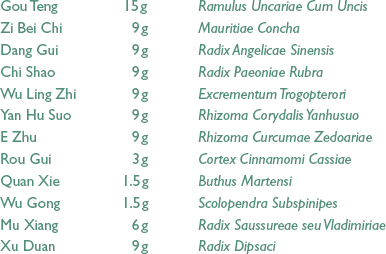
This formula targets the endometriosis lesions and the resulting pain directly by breaking up and moving Blood stasis. The first two herbs relieve spasms and calm the mind – reflecting an ancient wisdom, recently paid much heed by modern medicine, that the degree of pain experienced is influenced greatly by the mind (Liver and Heart in TCM). The other herbs all move Blood, and in the case of Xu Duan support Kidney Yang. Some of these (Yan Hu Suo, Quan Xie, Wu Gong) have been shown to reduce prostaglandin levels and relieve pelvic pain.
If the patient’s constitution is strong, and there are masses to be reduced we can further augment the Blood breaking capacity of this formula.
A few of the herbs chosen from the list below (or Table 5.2) may be added as required.
| San Leng | 9 g | Rhizoma Sparganii |
| Shui Zhi | 1.5 g | Hirudo seu Whitmaiae powder |
| Di Long | 6 g | Lumbricus |
| Tu Bie Chong | 6 g | Eupolyphaga Sinensis |
| Hong Teng | 9 g | Caulis Sargentodoxae |
| Bai Jiang Cao | 9 g | Herba Patriniae |
| Bai Hua She She Cao | 15 g | Herba hedyotidis Diffusae |
| Ru Xiang | 3 g | Resina Olibani |
| Mo Yao | 3 g | Resina Commiphorae Myrrhae |
| Xue Jie | 3 g | Resina Daemonoropis |
San Leng and E Zhu are commonly used when there are masses to reduce: they invigorate both Qi and Blood. Di Long is a substance which is useful for loosening adhesions in the pelvic cavity and Shui Zhi strongly dissolves masses. Hong Teng, Bai Jiang Cao, or Bai Hua She She Cao may be added to a prescription when the Blood stagnation is complicated with Damp-Heat. Addition of small doses of a resin is useful to aid efficient deconstruction of the endometrial lining so it can be reconstructed correctly.
Animal substances have strong tastes and odors and are often more easily tolerated in powdered or capsulated form rather than in decoctions.
Acupuncture Points: To move Blood strongly if there are masses or signs of stagnation, choose from the following points (and see Table 5.6):
Table 5.6
Acupuncture pointsa used in the treatment of infertility related to endometriosis: menstrual phase
| Treatment goal | Acupuncture points |
| To move the Qi and Blood locally (choose points according to areas of pain or where masses can be palpated) | ST-28 and ST-29, SP-12 and SP-13 and KI-14 |
| To promote discharge of menstrual blood | SP-6 and CO-4 |
| To remove obstructions to the flow | SP-8 |
| To dispel Blood stagnation but at the same time control heavy blood loss | SP-10 |
| To move and support the Qi to control blood flow | Ren-6 |
| To move stagnation of Blood and relieve back pain | BL-31–34, BL-26, BL-28, BL-22 or Shiqizhui-Xia |
| To disperse Liver Qi stagnation and facilitate reduction in abdomen masses | LIV-2, LIV-8 |
| To move Liver Qi and calm the mind, and promote unfettered menstrual flow | PC-5 |
aAll points can be reduced. Electro-acupuncture is applicable if pain is severe, using abdomen points ST-29 connected to ST-28 or Ah Shi point on same side.
| ST-28 | Shuidao |
| ST-29 | Guilai |
| SP-12 | Chongmen |
| SP-13 | Fushe |
| KI-14 | Siman |
| SP-8 | Diji |
| SP-6 | Sanyinjiao |
| SP-10 | Xuehai |
| Ren-6 | Qihai |
| BL-31–34 | Baliao |
| BL-26 | Guanyuanshu |
| BL-28 | Pangguanshu |
| BL-22 | Sanjiaoshu |
| Shiqizhuixia | |
| LIV-2 | Xingjian |
| LIV-8 | Ququan |
| CO-4 | Hegu |
| PC-5 | Jianshi |
If the treatment is successful, there will gradually be a lessening of the period pain, and the period flow should become smooth and fresh red without clots. Initially, however, the action of the Blood-breaking herbs may provoke more large clots in the menstrual flow. A key sign of good progress is the reduction of premenstrual spotting, reflecting a reduction in the extent of stagnant Blood remaining inside the pelvis.
A Simpler Approach
Sometimes the patient with endometriosis cannot attend the clinic regularly for treatment or finds the regimen described above complex and difficult to follow. Some practitioners may find this the case too, though where practicable following the four menstrual phases as closely as possible when prescribing is ideal. Additionally, there are cases where it is advisable to take a more focused approach attacking the endometriosis itself and leave attempts to conceive aside temporarily. For example, there may be diagnosed endometriosis which has not been able to be removed effectively by surgery, or it is growing back after surgery, or your patient wants to avoid surgery, in which case she should be advised to stop trying to conceive for 2 or 3 months and take strong herbs to try and reduce the lesions.
A formula which focuses on the endometriosis itself will incorporate several of the strong Blood breaking and Damp-Heat clearing herbs we mentioned in Table 5.2.
But if your patient is going to take such a formula for weeks or months, then some herbs to protect the Qi and Blood and Yin and Yang will be required. One example of such a formula is Hua Yu Li Shi Tang (Transform Blood Stasis and Resolve Damp decoction), which we have modified and expanded below.
Hua Yu Li Shi Tang (Transform Blood Stasis and Resolve Damp decoction) modified
| San Leng | 12 g | Rhizoma Sparganii |
| E Zhu | 12 g | Rhizoma Curcumae Zedoariae |
| Pu Huang | 9 g | Pollen Typhae |
| Wu Ling Zhi | 9 g | Excrementum Trogopterori |
| (Sheng) Shan Zha | 9 g | Fructus Crataegi |
| (Zhi) Da Huang | 6 g | Rhizoma Rhei |
| Tu Bie Chong | 6 g | Eupolyphagae seu Opisthoplatiae |
| Mo Yao | 3 g | Resina Commiphorae Myrrhae |
| Dang Gui | 9 g | Radix Angelicae Sinensis |
| Dan Shen | 9 g | Radix Salviae Miltiorrhizae |
| Bai Jiang Cao | 9 g | Herba cun radice Patriniae |
| Lian Qiao | 6 g | Fructus Forsythiae Suspensae |
| Hong Teng | 9 g | Caulis Sargentodoxae |
| Xu Duan | 9 g | Radix Dipsaci |
| Yin Yang Huo | 9 g | Herba Epimedii |
| Gui Zhi | 6 g | Ramulus Cinnamomi |
| Tai Zi Shen | 12 g | Radix Pseudostellariae |
The main thrust of this formula is to break up accumulations of stagnant Blood (the first 10 herbs) and to clear Damp-Heat (next three herbs) to reduce inflammation. Additional supports for the Kidney Yang and the Qi (final four herbs) aim to ensure that new endometriosis lesions will not form.
This formula can be used in many ways. In a strong patient, it can be used continuously for some weeks or months (although Tu Bie Chong should be removed if it is used for more than a few weeks). Alternatively, it can be used before and during the period and another more nourishing formula used in the follicular phase. If your patient wants to start trying to conceive again, and is doing well with this sort of formula, then it can be taken until ovulation and then switching to the post ovulation formula described above. Close observation of the BBT chart or ovulation signs are necessary to ensure that the strong Blood breaking herbs are not de-railing ovulation. It is only in robust women with significant stagnation that such an approach is taken.
If a slightly gentler approach is needed, for an endometriosis patient who is not so robust, and not attempting to conceive, then the following formula can be used.
Ge Xia Zhu Yu tang (Remove Stasis from Below the Diaphragm decoction) and Bu Shen Qu Yu Fang (Supplement Kidney and Dispel Blood Stasis formula) modified
| Yin Yang Huo | 9 g | Herba Epimedii |
| Xu Duan | 9 g | Radix Dipsaci |
| Tu Si Zi | 9 g | Semen Cuscatae |
| Gou Qi Zi | 9 g | Fructus Lycii |
| Huang Qi | 9 g | Radix Astragali |
| Dang Gui | 9 g | Radix Angelicae Sinensis |
| Ze Lan | 12 g | Herba Lycopi |
| Dan Shen | 9 g | Radix Salviae Miltiorrhizae |
| San Qi | 6 g | Radix Notoginseng |
| Yan Hu Suo | 9 g | Rhizoma Corydalis |
| Wu Ling Zhi | 9 g | Excrementum Trogopterori |
| Niu Xi | 9 g | Radix Achyranthis Bidentatae |
| Rou Gui | 3 g | Cortex Cinnamomi |
| Tao Ren | 6 g | Semen Persica |
| Hong Hua | 6 g | Flos Carthami Tinctorii |
| Xiang Fu | 9 g | Rhizoma Cyperi Rotundi |
| Cu San Leng | 9 g | Rhizoma Sparganii |
| E Zhu | 6 g | Rhizoma Curcumae Zedoariae |
This formula can be applied in much the same way as the one described above.
While this formula still employs many Blood stasis removing herbs (Cu San Leng, E Zhu, Dang Gui, Ze Lan, Dan Shen, San Qi, Yan Hu Suo, Wu Ling Zhi, Niu Xi, Tao Ren) it avoids the stronger animal products and toxic heat clearing herbs. In this formula more emphasis is placed on supporting the Kidneys and warming the Kidney Yang (Rou Gui, Yin Yang Huo, Xu Duan, Tu Si Zi, Gou Qi Zi, Huang Qi) than in the previous one.
In many clinics in China, herbal decoctions are used per rectum (PR) rather than orally if there are large and bulky implants of endometriosis. This technique is described in greater detail when we discuss pelvic infections and blocked tubes later. It is not a technique which has yet gained favor in the West, although its effectiveness is well documented in the Chinese medical literature. When acupuncture and herbal medicine become a more integral part of our hospital clinics, then administration of PR herbal medicine becomes a more practical option for treatment.
Research and General Comments
Much research is done in China investigating the specific action of herbs on endometriosis – too extensive to describe here in detail but typically they show that treatment with Chinese medicine can help symptoms of endometriosis and reduce blood markers of inflammation. We mentioned a couple of specific observations that have been made on the effect of herbs on follicle and endometrium quality above.
In general, the use of formulas that clear Blood stasis (and modified for each patient) will, over a 3-month period, reduce symptoms and markers of endometriosis, namely, pain relief and reduction of prostaglandin levels and increases in Beta endorphin levels.24
Programs comparing the use of acupuncture and herbal treatment with hormonal treatment for endometriosis have demonstrated superior results for the former in many aspects of clinical presentation and concurrent reduction of prostaglandins PGE2 and PGF2.25
Individual herbs, such as Dang Gui, Bai Shao, Yan Hu Suo, Mo Yao, Ru Xiang, Jiang Huang, E Zhu, Fu Ling, Huang Qin are just some of those that have shown an ability to reduce inflammation and cytokine levels in laboratory and animal studies.26
We said at the beginning of this chapter that endometriosis was a Western medical label and not a Chinese medicine one. Similarly cytokines, inflammation and prostaglandins are Western terms. We cannot see or feel raised levels of cytokines in the follicular fluid, or prostaglandins in the blood, or mucus secreted by endometriotic lesions near the tubes, or disordered implantation sites in the endometrium or inflammation and adhesions in the pelvis but we know that these are all physiologic manifestations of endometriosis. We are also starting to discover through research, that appropriate application of Chinese medicine can change these subtle signs as well as the more obviously assessable ones such as pain and infertility. Thus, even though an endometriosis patient might not manifest strong symptoms or signs of Damp-Heat or Blood stasis, if there is a history of long-term endometriosis (and by the time the patient comes to the acupuncture clinic this is usually the case), then it is appropriate to assume some degree of these pathologic states exist, and you should use herbs or acupuncture points accordingly. However, because treatment of endometriosis is long term, matching the treatment to the patient’s constitution correctly is particularly important. For example, even if a patient has severe widespread endometriosis and adhesions, strong Blood moving treatment cannot be applied long term if she is very Blood and Qi deficient. Similarly, even if we assume there must be significant inflammation in the pelvis, because of the long history and extent of the endometriosis, we cannot just give unmodified and strong Damp-Heat clearing treatment to someone who is very Yang deficient. Rather, addition of herbs which we know can reduce inflammation (or levels of cytokines or prostaglandins), or can break up Blood stagnation can be added at certain times of the cycle in judicious amounts to a larger formula. And at certain times, more single pointed formulas can be given that target the lesion primarily for a short carefully chosen time.
CASE HISTORY – TERRI
Terri (35) had been trying to fall pregnant for 2½ years. She had been given every test. The blood tests showed that her hormone levels were normal; an X-ray of her tubes showed no abnormality; and her husband’s sperm passed all the tests. But her periods were heavy and very painful and it was this plus the premenstrual spotting and stinging pain in her lower back which made endometriosis a suspect.
And, as expected, a laparoscopy revealed moderate endometriosis, which was removed during the surgery. However, 6 months later, she was still not pregnant and although her periods had been lighter and less painful after surgery, the pain was starting to return. Premenstrual irritability and breast swelling and soreness bothered her considerably. Her menstrual cycle was long, she experienced spotting at Day 16 or 17, and she saw little fertile mucus. Her BBT chart (Fig. 5.2) showed a long, slightly erratic follicular phase and a small rise to the luteal phase temperatures.
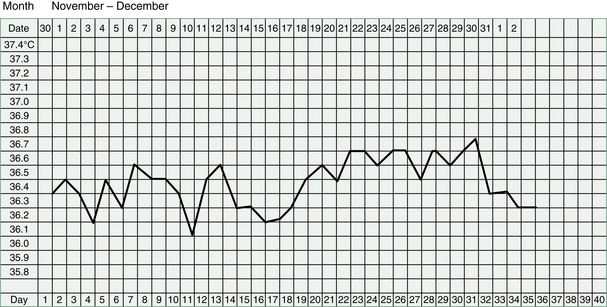
Figure 5.2 Case history – Terri. This chart shows an erratic follicular phase and luteal phase temperatures not much elevated over follicular values.
Her digestion was poor, with a tendency to bloating and constipation. Her tongue was fluted and had a white coat and her pulse felt wiry.
Terri’s diagnosis included a bit of everything. The delayed ovulation and the lack of fertile mucus indicate Kidney Yin deficiency, whereas the back pain and poor luteal phase on the BBT chart indicate Kidney Yang deficiency. The Blood stagnation component had been largely removed by the surgery but to prevent it returning, Kidney Yang needed to be boosted quickly. She tended to Spleen deficiency and suffered Liver Qi stagnation symptoms pre-menstrually.
In the clinic, we needed to reinforce Kidney Yin to produce Kidney Yang, to invigorate Spleen Qi and to regulate Liver Qi. Unlike the case of Cecily (above), Terri was trying to fall pregnant, so our treatment needed to carefully follow her menstrual cycle to maximize chances of conception. Her treatment began at the beginning of a cycle just after her period. Our focus would be on Kidney Yin and Blood at this time of the month and on the Kidney Yang and Liver Qi later in the month.
| Dang Gui | 9 g | Radix Angelicae Sinensis |
| Bai Shao | 9 g | Radix Paeoniae Lactiflorae |
| Shu Di | 9 g | Radix Rehmanniae Glutinosae Conquitae |
| Chuan Xiong | 6 g | Radix Ligustici Wallichii |
| Tao Ren | 6 g | Semen Persicae |
| Shan Zhu Yu | 9 g | Fructus Corni Officinalis |
| Shan Yao | 9 g | Radix Dioscorea Oppositae |
| Bai Zhu | 12 g | Rhizoma Atractylodis Macrocephalae |
| Chai Hu | 6 g | Radix Bupleuri |
| Suan Zao Ren | 12 g | Semen Ziziphi Spinosae |
| Tu Si Zi | 9 g | Semen Cuscatae |
Acupuncture points: Ren-6, Ren-4, SP-6, PC-6, LIV-5
After just 1 week taking the above herbs, she produced more fertile mucus than ever before – also a day or two earlier than usual. The herbs were then changed to boost Kidney Yang further:
| Tu Si Zi | 15 g | Semen Cuscatae |
| Yin Yang Huo | 9 g | Herba Epimedii |
| Xu Duan | 12 g | Radix Dipsaci |
| Bai Zhu | 12 g | Rhizoma Atractylodis Macrocephalae |
| Dang Shen | 9 g | Radix Codonopsis Pilulosae |
| Fu Ling | 9 g | Sclerotium Poriae Cocos |
| Xiang Fu | 9 g | Rhizoma Cyperi Rotundi |
| Chuan Niu Xi | 9 g | Radix Cyathulae |
We planned her next cycle in a similar sequence: stronger Blood-regulating herbs to be taken during the period followed by Kidney Yin and Yang tonics at the right time. But we didn’t have the opportunity – she fell pregnant immediately. Clearly in the absence of Blood stagnation (removed by the surgery), all the Kidney energy needed, was a little help.
Pelvic Inflammatory Disease
Pelvic inflammatory disease or PID describes inflammation, usually from infection, of the reproductive organs. It can be acute, or long term and chronic. When the infection or inflammation is in the uterus, it is called endometritis. This can cause infertility by disrupting implantation. When the infection is in the fallopian tubes, it is called salpingitis; this causes infertility because the tubes cannot transport egg or sperm due to the inflammation, scarring or fluid accumulation in the tubes (this latter is called hydrosalpinx). Fertility is also decreased because abdomen pain does not predispose to frequent sexual intercourse.
The disease may follow certain procedures, such as insertion of IUDs (intrauterine devices) or curettage of the uterus, or it may be sexually transmitted.
When the condition is acute, there is evidence of severe infection (usually by chlamydial, gonorrheal or streptococcal bacteria) manifesting in symptoms such as fever, purulent discharge from the vagina, dysuria, lower back pain and abdomen pain. Such acute infection must be treated with aggressive antibiotic treatment as rapidly as possible to try and save the tubes from permanent damage and conserve fertility. Usually, intravenous antibiotics are given in hospital.
Chronic PID is an insidious disease which can be unresponsive to antibiotic treatment. Sometimes, it develops from acute PID if it is not treated adequately and sometimes there are no symptoms or only mild intermittent symptoms of lower back and abdomen pain accompanied by a feeling of fatigue or malaise. Microorganisms T-strain mycoplasma (Ureaplasma) and Candida have been implicated in some cases of chronic PID, as has untreated Chlamydia. In the case of chronic PID, treatment with Chinese medicine often offers good resolution and restores fertility.
TCM Analysis of Pelvic Inflammatory Disease
According to TCM the cause of acute PID is invasion of Damp-Heat. Because antibiotic therapy clears Damp-Heat rapidly, it is the treatment of choice in this case where fertility is greatly at risk.
The symptoms of chronic PID develop when acute Damp-Heat is not thoroughly resolved, or when Liver Qi stagnation slows up fluid metabolism such that low-grade Damp-Heat develops. In other words, the vitality and health of the pelvic tissues are compromised due to sluggish metabolism and low-grade infections can more easily become established.
The pathology of chronic PID is complex because it is a mixture of excess pathogens and a deficient body condition. Chronic PID only develops when there is some weakness in the body’s constitution. Typically, the weakness is in the Spleen, Kidney, or Liver or a combination of any of these.
Liver Qi is especially important in pelvic pathologies, particularly those of the tubes, because this is where the Liver channel travels. If the Liver Qi is weak and easily obstructed, then Qi, Blood and Body Fluids can stagnate and Phlegm-Damp can accumulate. The Kidney and the Spleen are important in the production of adequate Qi and Blood, so that the Liver does not become weak and allow such stagnation in the pelvis. The Kidney and Spleen also play an important role in maintaining good control of fluids and avoiding accumulation of Phlegm-Damp.
Laid on top of weaknesses in the Kidney, Spleen, or Liver are pathologic influences which then create the symptoms of PID. The pathogens involved are:
The ways these pathogens can combine with the underlying weakness are many and various. The more common clinical presentations are Spleen deficiency with Damp, Kidney deficiency with Blood stasis, or Liver Blood deficiency with stagnation of Qi.
The channels of the abdomen, particularly the Chong and Ren vessels, are disrupted by these imbalances and infertility can result. If the doctor is skilful and can correctly untangle the various aspects of the disease to make the right diagnosis and apply the correct treatment, then good results from TCM treatment can be expected.
Treatment of Pelvic Inflammatory Disease
Because we are looking at a disease which contains Ben and Biao factors, i.e., an underlying weakness (Ben) and an overlaying pathology (Biao) – then the doctor must decide on which is to be addressed first. If the PID is chronic, the underlying weakness is of paramount importance. If the condition of the woman is not so weak and the manifestations of the PID are strong, e.g., significant pain, then treatment of the Biao may take priority.
Treating the Biao
Herbal Formula: A formula which can be used to address all the common Biao of PID – namely, Damp-Heat, stagnation of Qi or Blood – is the following:
Fu Fang Hong Teng Bai Jiang San (Sargentodoxae Patriniae Compound powder)
| Dang Gui | 9 g | Radix Angelicae Sinensis |
| Chi Shao | 9 g | Radix Paeoniae Rubra |
| Bai Shao | 9 g | Radix Paeoniae Lactiflorae |
| Hong Teng | 15 g | Caulis Sargentodoxae |
| Bai Jiang Cao | 15 g | Herba cum radice Patriniae |
| (Sheng) Shan Zha | 12 g | Fructus Crataegi |
| Yan Hu Suo | 9 g | Rhizoma Corydalis Yanhusuo |
| Chai Hu | 6 g | Radix Bupleuri |
| Chen Pi | 6 g | Pericarpium Citri Reticulate |
| Mu Xiang | 6 g | Radix Saussureae seu Vladimiriae |
| Yi Yi Ren | 15 g | Semen Coicis Lachryma-jobi |
| Sang Ji Sheng | 12 g | Ramulus Sangjisheng |
This formula addresses pain and internal sepsis. Hong Teng and Bai Jiang Cao clear Damp-Heat and have proven antibiotic and anti-inflammatory effects. Yan Hu Suo and Shan Zha together with Chi Shao and Dang Gui move Blood stasis to relieve pain. Additionally, Mu Xiang, Chai Hu and Chen Pi help relieve pain by moving stagnant Qi. Bai Shao, with its ability to soothe the Liver Qi, reduces abdominal pain. Finally, Yi Yi Ren and Sang Ji Sheng clear any Damp which may have accumulated. If the abdomen pain is worse for cold and better for heat, then add:
| Rou Gui | 3 g | Cortex Cinnamomi Cassiae |
| Ai Ye | 6 g | Folium Artemisiae |
If there are palpable masses, add:
| San Leng | 9 g | Rhizoma Sparganii |
| E Zhu | 9 g | Rhizoma Curcumae Zedoariae |
| Tu Bie Chong | 6 g | Eupolyphagae seu Opisthoplatiae |
If diarrhea or loose stools develop, then remove Dang Gui and add:
| Sha Ren | 6 g | Fructus seu Semen Amomi |
| Bai Zhu | 9 g | Rhizoma Atractylodis Macrocephalae |
Thus, this formula addresses most of the manifestations of PID but it must be used with great caution if there is Spleen, Kidney, or Liver weakness.
Acupuncture Points: Points may be chosen to relieve pain and clear Damp-Heat (Table 5.7). Choose from the following points to construct a treatment or add points chosen from this list to point prescriptions in the following section describing treatment for the underlying condition (Ben):
Table 5.7
Acupuncture pointsa used in the treatment of acute PID
| Treatment goal | Acupuncture points |
| To regulate Qi to relieve abdomen pain | KI-14, Ren-5, SP-12, SP-13, ST-25 and LIV-4 |
| To move the Qi to clear Damp-Heat from the lower Jiao | GB-26, GB-27 and GB-28 (on the Dai vessel) |
| To clear Damp-Heat from the Lower Jiao | KI-10, SP-9, LIV-5, LIV-8, Ren-3 |
aUse reducing technique. Deep needling on the abdomen may be appropriate.
| KI-14 | Siman |
| Ren-5 | Shimen |
| SP-12 | Chongmen |
| SP-13 | Fushe |
| ST-25 | Tianshu |
| LIV-4 | Zhongfeng |
| Ren-3 | Zhongji |
| GB-26 | Daimai |
| GB-27 | Wushu |
| GB-28 | Weidao |
| KI-10 | Yingu |
| SP-9 | Yinlingquan |
| LIV-5 | Ligou |
| LIV-8 | Ququan |
Treating the Ben
If the Damp-Heat and pain are not so severe, then it is appropriate to address the underlying condition immediately. This is especially so when we want to recover fertility as quickly as possible.
Liver Qi stagnation predominant: This diagnosis will be made for a clinical picture including abdomen discomfort, breast soreness, irritability and moodiness.
Herbal Formula: The formula of choice is:
Xiao Yao San plus Jin Ling Zi San (Free and Easy powder with Gold Bell powder) modified
| Chai Hu | 9 g | Radix Bupleuri |
| Bai Zhu | 12 g | Rhizoma Atractylodis Macrocephalae |
| Dang Gui | 9 g | Radix Angelicae Sinensis |
| Bai Shao | 15 g | Radix Paeoniae Lactiflorae |
| Fu Ling | 15 g | Sclerotium Poriae Cocos |
| Gan Cao | 3 g | Radix Glycyrrhizae Uralensis |
| Sheng Jiang | 3 g | Rhizoma Zingiberis Officinalis Recens |
| Bo He | 3 g | Herba Menthae |
| Chuan Lian Zi | 9 g | Fructus Meliae Toosendan |
| Yan Hu Suo | 9 g | Rhizoma Corydalis Yanhusuo |
| Ju He | 12 g | Semen Citri Reticulatae |
Chai Hu, Chuan Lian Zi, and Ju He are the main ingredients to address Liver Qi stagnation. Ju He is particularly indicated for lateral abdomen pain. Yan Hu Suo backs up this action by regulating any Blood stagnation which may have developed. The remaining herbs, constituents of Xiao Yao San, safeguard Spleen Qi.
If Spleen and Stomach function are affected by the Liver Qi stagnation, add:
| Dang Shen | 9 g | Radix Codonopsis Pilulosae |
| Mu Xiang | 9 g | Radix Saussureae seu Vladimiriae |
| Chen Pi | 3 g | Pericarpium Citri Reticulate |
| Bai Jiang Cao | 12 g | Herba cum Radice Patriniae |
Acupuncture Points: Points (Table 5.8) are chosen from:
Table 5.8
Acupuncture pointsa used in the treatment of PID with Liver Qi stagnation
| Treatment goal | Acupuncture points |
| To regulate Qi in the Liver channel | LIV-3 and LIV-5, GB-34 |
| To regulate Qi in the abdomen | Ren-6 |
| Local points to regulate Qi and relieve pain | ST-26 and GB-28 |
| LIV-3 | Taichong |
| LIV-5 | Ligou |
| GB-34 | Yanglingquan |
| Ren-6 | Qihai |
| ST-26 | Wailing |
| GB-28 | Weidao |
Spleen weakness predominant: This form of PID presents a clinical picture of dull dragging abdomen ache, sometimes felt in the sides, abdomen bloating, fatigue, poor appetite and sweet or carbohydrate cravings.
Herbal Formula: The formula of choice is:
Xiang Sha Liu Jun Zi Tang (Six Gentlemen decoction) modified
| Dang Shen | 12 g | Radix Codonopsis Pilulosae |
| Bai Zhu | 9 g | Rhizoma Atractylodis Macrocephalae |
| Fu Ling | 9 g | Sclerotium Poriae Cocos |
| Gan Cao (zhi) | 9 g | Radix Glycyrrhizae Uralensis |
| Chen Pi | 6 g | Pericarpium Citri Reticulate |
| Ban Xia | 12 g | Rhizoma Pinelliae |
| Mu Xiang | 6 g | Radix Saussureae seu Vladimiriae |
| Sha Ren | 6 g | Fructus seu Semen Amomi |
| Bai Jiang Cao | 15 g | Herba cum Radice Patriniae |
| Yi Yi Ren | 20 g | Semen Coicis Lachryma-jobi |
The emphasis of this formula is first to strengthen the Spleen with Dang Shen, Bai Zhu, and Gan Cao (zhi), while Fu Ling and Ban Xia clear any Damp which has accumulated as the result of Spleen weakness. Sha Ren, Mu Xiang, and Chen Pi ensure the Qi keeps moving and Bai Jiang Cao and Yi Yi Ren are added to clear Damp and Heat. Bai Jiang Cao is safer to use than Hong Teng if Spleen Qi is weak.
If there are any signs of Blood stasis (pain becomes more pointed and severe), add:
| Yan Hu Suo | 9 g | Rhizoma Corydalis Yanhusuo |
If there is a lot of Damp evident (e.g., discharges), then more herbs can be added to dry the Damp:
| Huo Xiang | 9 g | Herba Agastaches seu Pogostei |
| Cang Zhu | 12 g | Rhizoma Atractylodes |
Acupuncture Points: Points (Table 5.9) are chosen from:
Table 5.9
Acupuncture pointsa used in the treatment of PID with Spleen deficiency
| Treatment goal | Acupuncture points |
| To support the function of Stomach and Spleen | Ren-6, Ren-12 and ST-36 |
| Local abdomen points which treat dragging down pain | Zigong and Tituo |
| To aid in clearing Damp | SP-5, SP-9 and GB-26 |
| Abdomen Zigong | |
| Tituo | |
| Ren-6 | Qihai |
| Ren-12 | Zhongwan |
| ST-36 | Zusanli |
| SP-5 | Shangqiu |
| SP-9 | Yinlingquan |
| GB-26 | Daimai |
Liver and Kidney deficiency predominant (complicated with Damp-Heat and Blood stagnation): The main symptoms of this type of PID are lower back pain, dizziness, mental restlessness, feeling hot in the evenings, some abdomen discomfort and vaginal discharge. There may be palpable masses or other signs of Blood stagnation such as clotty painful periods.
Primary aim of treatment is to reinforce Liver and Kidney Yin while still paying attention to Damp-Heat and Blood stagnation.
Herbal Formula: The formula of choice is:
Gui Shao Di Huang Tang (Angelica Peonia Rehmannia decoction) modified
| Shu Di | 9 g | Radix Rehmanniae Glutinosae Conquitae |
| Shan Yao | 9 g | Radix Dioscorea Oppositae |
| Shan Zhu Yu | 9 g | Fructus Corni Officinalis |
| Mu Dan Pi | 9 g | Cortex Moutan Radicis |
| Fu Ling | 15 g | Selerotium Poriae Cocos |
| Bai Shao | 9 g | Radix Paeoniae Lactiflorae |
| Dang Gui | 9 g | Radix Angelicae Sinensis |
| Bai Jiang Cao | 12 g | Herba cum Radice Patriniae |
| Chai Hu | 6 g | Radix Bupleuri |
| Yan Hu Suo | 6 g | Rhizoma Corydalis Yanhusuo |
| Xu Duan | 9 g | Radix Dipsaci |
| Sang Ji Sheng | 15 g | Ramulus Sang Ji Sheng |
This formula primarily supplements the Kidney and Liver Yin and the Blood, but with the addition of Bai Jiang Cao and Sang Ji Sheng it also clears Damp-Heat. Yan Hu Suo and Chai Hu supply additional impetus to move Qi and Blood, which may have become retarded by Damp. Kidney Yang is supported by Xu Duan.
If Kidney Yang deficiency is marked, add:
| Du Zhong | 12 g | Cortex Eucommiae Ulmoidis |
| Lu Jiao Pian | 9 g | Cornu Cervi Parvum |
Acupuncture Points: Points (Table 5.10) are chosen from:
Table 5.10
Acupuncture pointsa used in the treatment of PID with Liver and Kidney deficiency (and Damp-Heat and Blood stagnation complications)
| Treatment goal | Acupuncture points |
| To support the Kidneys and clear Damp-Heat | KI-7 and KI-10 |
| To reinforce the Kidneys and clear Yin-deficient Heat | KI-6 |
| To move stagnation and relieve abdomen pain | SP-12, SP-13 or ST-28 |
| To reinforce Kidneys | Ren-4 |
| To supplement Liver Yin and clear stagnation in the lower Jiao | LIV-8 |
| To reinforce Kidneys and clear Damp-Heat and relieve back pain | BL-23 and BL-28 |
aPoints are needled with even method or reducing method. Deep but cautious needling on the abdomen over sites of pain increases therapeutic effect.
| Ren-4 | Guanyuan |
| SP-12 | Chongmen |
| SP-13 | Fushe |
| ST-28 | Shuidao |
| KI-6 | Zhaohai |
| KI-7 | Fuliu |
| KI-10 | Yingu |
| LIV-8 | Ququan |
| BL-23 | Shenshu |
| BL-28 | Pangguanshu |
Pelvic inflammation and infection is not uncommon in China and they have done a number of clinical studies examining herbal remedies. Formulas which clear toxic heat and transform static Blood have been shown to effectively reduce symptoms in 90% of cases.27,28
Abdomen Masses
If there are palpable masses apparent in any of the above types of PID, then the patient is recommended to take appropriate patent medicines along with the main prescription. Because the constitution is weak in the case of chronic PID and the treatment will need to continue a long time, strong Blood-regulating treatment in the form of herbal decoctions is not advisable and most often pill or other preparations, such as the following, will be used:
Gui Zhi Fu Ling Wan (Ramulus Cinnamomi – Poria pill)
| Gui Zhi | Ramulus Cinnamomi Cassiae |
| Fu Ling | Sclerotium Poriae Cocos |
| Chi Shao | Radix Paeoniae Rubra |
| Mu Dan Pi | Cortex Moutan Radicis |
| Tao Ren | Semen Persicae |
This formula contains Blood moving and cooling herbs: Mu Dan Pi, Chi Shao and Tao Ren. Gui Zhi is added to assist these herbs in moving Blood and ensures their effect is not too cooling.
Where the stasis of Blood has been very long term, then a stronger formula may need to be employed to break up the congealed Blood. Again, the pill form will be used for long term use as it is less potent than decoction.
Da Huang Bie Chong Wan (Rheum Eupolyphaga pill)
| Da Huang | Rhizoma Rhei |
| Tu Bie Chong | Eupolyphagae seu Opisthoplatiae |
| Tao Ren | Semen Persicae |
| Gan Qi | Lacca Sinica Exsiccata |
| Qi Cao | Holotrichia |
| Shui Zhi | Hirudo seu Whitmaiae |
| Meng Chong | Tabanus Bivittatus |
| Huang Qin | Radix Scutellariae Baicalensis |
| Xing Ren | Semen Pruni Armeniacae |
| Sheng Di | Radix Rehmanniae Glutinosae |
| Bai Shao | Radix Paeoniae Lactiflorae |
| Gan Cao | Radix Glycyrrhizae Uralensis |
This formula contains many strong agents for breaking up long-term Blood stasis (such as Tu Bie Chong, Shui Zi and Meng Chong) and must be used with caution. It cools Heat in the Blood at the same time.
External Treatment
Herbal compresses can also be placed on the abdomen to help ease the pain of PID. The following herbal compress can be used:
| Qian Nian Jian | 6 g | Rhizoma Homalomenae Occultae |
| Hong Hua | 6 g | Flos Carthami Tinctorii |
| Mo Yao | 6 g | Myrrha |
| Bai Zhi | 6 g | Radix Angelicae |
| Xue Jie | 6 g | Sanguis Draconis |
| Xu Duan | 20 g | Radix Dipsaci |
| Dang Gui | 20 g | Radix Angelicae Sinensis |
| Fang Feng | 20 g | Radix Ledebouriellae Sesloidis |
| Sang Ji Sheng | 20 g | Ramulus Sangjisheng |
| Wu Jia Pi | 20 g | Cortex Acanthopanacis |
| Tou Gu Cao | 50 g | Herba Impatients Balsamina |
| Ai Ye | 50 g | Folium Artemisiae |
| Chi Shao | 20 g | Radix Paeoniae Rubra |
This mixture is ground into a powder and put in a bag, which is then steamed for 15 min. The bag is placed on the abdomen and left until it gets cold. This procedure can be repeated two or three times a day. The above amount can be used for 5 days before a new batch needs to be made up.
More formulas for treatment of abdomen masses are described in Volume 3 of the Clinical Handbook of Internal Medicine.29
In the case where discharge and itching of the vulva are associated with PID, then external washes or sitz baths can be helpful. Herbs which remove Damp-Heat and calm inflamed skin are boiled in a large pot of water for half an hour. This liquid is then transferred to a sitz bath. The genital and abdomen area is soaked by sitting in the bath for 15–20 min or while the solution is still hot. The following external wash can be used:
| Huang Bai | 15 g | Cortex Phellodendri |
| She Chuang Zi | 15 g | Fructus Cnidii Monnieri (in a muslin bag) |
| Bai Xian Pi | 15 g | Cortex Dictamni Dasycarpi |
| Ku Shen | 12 g | Radix Sophorae Flavescentis |
| Ai Ye | 12 g | Folium Artemisiae |
| Chuan Jiao | 1 g | Fructus Zanthoxyli Bungeani |
| Bian Xu | 15 g | Herba Polygone Avicularis |
Another approach, which is gaining favor in Chinese hospitals, is the use of herbal enemas in difficult cases of PID. Such an approach has been found to be particularly helpful for abdomen masses and for blockages in the tubes (see Ch. 6).
Fibroids and Polyps
These masses can be such that they impair implantation of an embryo or cause it to miscarry. They are discussed in Chapter 8. Often these masses will be dealt with by surgery if they are significant. Should a patient want to avoid surgery, then masses can be addressed with Chinese medicine29 but the length of treatment required is often not compatible with the desire to conceive in the near future.
Dysmenorrhea and PMS
Neither period pain nor premenstrual syndrome are causes or even direct contributing factors to female infertility; however, they can be useful diagnostic components in a clinical picture which includes infertility. That is, they reflect the imbalance which is also the cause of reduced fertility. Most often, they are clear pointers to some stagnation that, in the interests of fertility, must be resolved. Less often, they are pointers to deficiency. Dysmenorrhea and the symptoms of PMS often resolve rapidly when the protocols of Chapter 4 are followed. There may need to be special treatment emphasis on Liver and/or Blood stagnation (or Spleen Qi deficiency) in the luteal phase and Kidney or Blood deficiency in the follicular phase.
Part 2
Ovulatory Disorders and Polycystic Ovarian Syndrome
Amenorrhea and Disorders of Ovulation
A discussion of amenorrhea (no periods) and other disorders of ovulation returns us to an examination of events in the follicular phase (see Ch. 4). In the case of amenorrhea we are looking at the very extreme of the spectrum, i.e., ovulation is not just premature or delayed, it completely fails to occur. You will remember that problems occurring in the follicular phase leading to ovulation most often fall into the Kidney Yin deficient category. It is certainly so in many cases of amenorrhea. Sometimes, however, Kidney Yin is sufficient to develop the egg to some degree but the release of the egg (or its final preparation) is hampered by an obstruction of some kind. Such obstructions are called Phlegm-Damp, Qi or Blood stagnation in TCM and may actually manifest as cysts or tumors on the ovaries or pituitary.
Primary amenorrhea is the term used to describe no periods ever, i.e., puberty has never arrived. It occurs when there is no uterus and vagina or if the ovaries do not function. There are many reasons why ovaries might never start producing eggs or stop producing eggs. They are often quite complex clinical and physiologic pictures. If pregnancy is desired, Western medicine confronts the issue by trying direct stimulation of the pituitary or ovary in the hope of producing an egg or eggs that may then be fertilized directly in an IVF procedure. Chinese medicine approaches the problem by trying to reestablish a regular menstrual cycle. The latter is often much more difficult to achieve than the one-off ovulation that drugs can achieve. If conception is the only aim, then often these drugs will be the first choice. From the point of view of Chinese medicine this may not be such a good step to take. If a woman is not ovulating because she has a profound Kidney deficiency, then the eggs that the drugs stimulate may not be of such good quality (from a Jing perspective). However, if an obstruction (e.g., by Phlegm-Damp or Qi or Blood stagnation) is causing the lack of ovulation then drug treatment may be quite useful.
Western medicine describes a number of disorders which result in no or intermittent ovulation. We shall examine these disorders, and the usual treatment options and then analyze them from a TCM perspective.
Different Types of Ovulatory Dysfunction
Hypothalamic Anovulation
The hypothalamus fails to give the pituitary the messages necessary for ovulation in circumstances of weight loss, stress, narcotic drug use and extreme exercise like marathon or classical ballet training.
Treatment includes the use of ovulation-inducing drugs (see below) if conception is desired. If pregnancy is not desired, hormones such as those in combined oral contraceptive pills are prescribed to reduce symptoms related to estrogen shortage.
Hyperprolactinemia
High levels of prolactin are produced by the pituitary gland in certain circumstances, causing ovulation to be suppressed. This happens normally in pregnancy to prepare the breasts for lactation and persists while breast-feeding continues. High prolactin levels also occur in abnormal circumstances such as the presence of tumors on the pituitary gland or from the effects of drugs like tranquilizers, heroin, blood pressure medication or drugs for nausea. Treatment of pituitary tumors employs a drug called bromocriptine, which will shrink the tumor and usually allow pituitary function to return to normal.
Where levels of prolactin are elevated only slightly, ovulation may still occur but the corpus luteum function is diminished, causing inadequate progesterone production.
Premature Ovarian Failure (POF) and Resistant Ovary Syndrome
If the menstrual cycle ceases before age 40, it indicates a premature depletion of ovarian follicles. A biopsy taken from the ovary shows few or no follicles. The use of drugs to stimulate ovulation is pointless because there are too few follicles to stimulate. This disorder has a strong genetic component but can also be related to autoimmune conditions or infections or iatrogenic causes. It is sometimes called premature menopause. Women with POF are usually offered the option of donor oocytes should they want to conceive. Another and less common form of ovarian failure is called resistant ovary syndrome. Unlike the previous case, a biopsy of the ovary will reveal plenty of primordial follicles which appear dormant or unstimulated (and are unable to be stimulated by the drugs usually used to induce ovulation). It is thought there may be a receptor block on the surface of the ovary to FSH, or antibodies to FSH or LH that prevent the ovary from responding.
Drug treatment involves giving small amounts of estrogen for 4–6 weeks and at some time during this course progesterone will be added for 2 weeks. A small number of women with resistant ovaries respond to this approach and they will ovulate and conceive.
Tumors in the Ovaries or Adrenal or Pituitary Glands
Tumors in the ovary or adrenal gland, causing a disturbance to ovulation will usually require surgery. Tumors in the pituitary gland are usually discovered when high levels of serum prolactin are investigated, mentioned above.
Post-pill Amenorrhea
In a significant number of women, periods do not return after stopping the oral contraceptive pill. It is thought by gynecologists that one of the above described causes of amenorrhea has developed during the time the pill was being taken and that this is incidental to the effect of the pill. However, some doctors would relate the amenorrhea to the action of the pill (see PCOS, below). Many cases of post-pill amenorrhea resolve by themselves within a year, but where there is evidence of a tumor, medical treatment will be undertaken.
Drugs used to Induce Ovulation
To stir recalcitrant ovaries into action we can stimulate them directly with FSH, the hormone the pituitary produces to ripen follicles, or indirectly by making the pituitary make more FSH. Clomifene does the latter, whereas FSH drug preparations act directly on the ovary.
Clomifene
This drug, sold as Clomid or Serophene, blocks the negative feedback action of estrogen, so that the pituitary is tricked into producing a lot of FSH in an attempt to stimulate follicles. Clomifene is cheap and easier to administer than other ovulation-inducing drugs and so is usually the first drug tried. It is given for 5 consecutive days starting between Day 2 and Day 6 of the menstrual cycle. Where there is no menstrual cycle, a period is created by giving a course of a progestogen. The starting dose of clomifene is 50 mg/day, though this can be raised progressively in subsequent cycles to as much as 200 mg/day if necessary. If the action of the clomifene is successful, it will induce ovulation 9–15 days after the first day it is taken. Most patients ovulate in response to 50 or 100 mg/day and, if conception occurs, it will likely be in the first three ovulatory cycles.
Side-effects are common, especially at the higher doses. They are:
• irritability, mood disturbances
• lack of fertile mucus, vaginal dryness
From the fertility point of view, the useful stimulation of the follicles that the clomifene achieves is undone to some extent by the deleterious effect it has on the fertile mucus (which is dried up) and the endometrium (which becomes too thin). These unwanted side-effects mean that only 50% of patients who do ovulate successfully with clomifene will become pregnant, even with its continued use. Since some of these side-effects (like the thinning of the endometrium) appear to get worse with repeated clomifene cycles, it is not advisable to continue the drug for more than three cycles at a time. In addition, 20% of pregnancies achieved with the use of clomifene will miscarry, a high rate that may also be due to inadequate development of the endometrium or poor embryo quality.
FSH Preparations
The other way to induce ovulation is to bypass the pituitary gland and stimulate the ovaries directly using FSH. The drug form of FSH (Gonal-F, Puregon, Follistim) is a synthesized molecule using recombinant gene technology. It is given by subcutaneous injection every day for around 2 weeks. Once several follicles reach a mature size (around 2 cm diameter), then the FSH stimulation is stopped to allow all but one or two to undergo atresia (die) before a trigger injection is given to make the follicle release its egg. Intrauterine insemination (IUI) is often performed shortly after this.
If many eggs are desired for use in an IVF procedure (see Ch. 10), then larger doses of FSH are continued right up to the trigger injection and egg collection.
Because this treatment acts so directly on the follicles in the ovary, there is little in the way of natural feedback controls or brakes in the process and ultrasounds and blood tests must be used to monitor the response of the ovaries.
Treatment with FSH, while it can have side-effects, is successful in inducing ovulation in more than 90% of the cycles in which it is used. However, the viable pregnancy rate is only 5–25% per cycle, depending on the reason for the ovulatory disturbance in the first place. Miscarriage occurs in 12–30% of these pregnancies, a higher than normal rate, which may reflect defects of the luteal phase or the quality of the embryo.
hCG Preparations
Pregnyl, Novarel, and Profasi are preparations of human chorionic gonadotrophin (hCG) isolated from the urine of pregnant women. Ovidrel is a genetically manufactured product that is identical to the body’s hCG. These drugs do not stimulate follicle development but induce ovulation of follicles which have already been stimulated by other drugs. hCG preparations have a physiologic action similar to LH, i.e., they prepare the eggs and the follicles which encase them for ovulation. These drugs are used in IUI and IVF treatment cycles.
Bromocriptine
Bromocriptine (Parlodel) is given for the disorder hyperprolactinemia. It mimics the action of dopamine, the natural inhibitor of prolactin production, and thereby lowers prolactin levels to normal so ovulation can occur. The drug can cause side-effects in the beginning and if these continue it is given as a vaginal pessary rather than an oral medication to minimize its effect on the liver. Ovulation and conception usually occur soon after the administration of bromocriptine unless there are other factors influencing fertility.
Metformin
Metformin (Glucophage, Diaformin, Diabex) is used in the treatment of type 2 diabetes to control blood sugar levels. Such control of blood sugar has proved to be useful in women with polycystic ovary syndrome (PCOS), especially if they are overweight. Ovulation tends to occur more frequently in women with PCOS if they take metformin.
TCM Analysis of Drugs
TCM affords us an interesting perspective on drugs like clomifene – by examining and analyzing the effects it can have we can determine its action in an energetic sense. Clomifene is considered a ‘heating’ drug and it has been observed to be effective in increasing fertility in cases where there is Kidney Yang deficiency. However, infertility related to Kidney Yang deficiency often develops from or is accompanied by Kidney Yin deficiency. When there is pronounced Yin deficiency and internal Heat, then taking something as heating and drying as clomifene presents more of a risk. From the Chinese medicine point of view, the Yin damaging effects of the drug – namely, the hot flushes, the drying up of the fertile mucus, the thinning of the endometrium and the irritability – are quite worrying. In sensitive individuals, the Liver and Kidney Yin, which are so vital for fertility, can be damaged. At best, in such cases, it produces uncomfortable side-effects and at worst, it damages the ovaries so that they stop functioning altogether.
On the other hand, in a Yang-deficient woman, perhaps with Phlegm-Damp accumulation, its heating and drying effect can be most beneficial.
FSH Preparations
If we analyze what symptoms occur when these IVF drugs (Gonal-F, Follistim, Puregon) are used, we can see that the main side-effect is stagnation of the Liver Qi. Usually this is not severe; symptoms include abdomen swelling and tenderness, breast soreness and a feeling of irritability or emotional volatility.
hCG Preparations
The ovulation trigger – hCG (Pregnyl, Novarel, Profasi) – in assisted reproduction or IVF cycles is added to mimic the action of LH in releasing the egg from the follicle. This is the equivalent of adding a sudden dose of a Yang influence to switch the artificially manipulated cycle from its Yin phase to its Yang phase. At this point, pre-existing Qi stagnation can be greatly compounded. A worst case scenario sees the precipitation of a condition called ovarian hyperstimulation syndrome or OHSS (discussed in Ch. 9), which in its more severe manifestations is associated with abdomen pain and swelling, nausea, dizziness, headaches, and ascites, which are all signs of increasingly significant Liver Qi stagnation. This can further develop into Blood stagnation, resulting in embolism or into Liver Wind, causing stroke or fitting, both potentially life-threatening situations.
Bromocriptine
Once again the side-effects of Parlodel (bromocriptine) tell us which organ system it affects. If too much is given too quickly, then headaches, nausea, and dizziness can develop, indicating that the Liver Qi is disordered.
Metformin
This drug can damage Spleen function, causing diarrhea, bloating, flatulence and nausea in susceptible women. The concurrent use of Spleen tonic formulas can increase tolerance to the drug; however, where any digestive symptoms persist, then it is not advisable to continue the medication.
Knowing how a particular drug affects the balance of the body in an energetic sense gives the TCM doctor a good understanding of whether it is an appropriate drug treatment for any given patient. For example, women who are already quite Yin deficient with internal Heat must use clomifene with great caution. Likewise, women with a tendency to Liver Qi stagnation must be monitored even more carefully than usual if they are administered ovulation-inducing drugs such as Gonal-F, Follistim, Puregon with hCG triggers. Women with Spleen weakness may need to find alternatives to taking metformin.
TCM Analysis of Different Types of Ovulation Disorders and Amenorrhea
Lack of ability to produce eggs is related either to a Kidney or Blood deficiency or to an interruption somewhere in the hypothalamic-pituitary-ovarian axis caused by Heart or Liver Qi stagnation, Phlegm-Damp obstruction or Blood stagnation. These conditions were covered in detail in Chapter 4; we shall cover them again briefly as they pertain specifically to amenorrhea. Some TCM gynecology texts which collect information from many different sources and authors will list anywhere up to 9 or 10 different patterns of amenorrhea. Here, we shall discuss the basic patterns which underlie all the others and those which are seen most often in infertility clinics in China.
Amenorrhea related to deficiency includes Kidney Jing deficiency, Kidney Yin deficiency and Blood deficiency amenorrhea.
Kidney Jing Deficiency Amenorrhea
Kidney Jing or essence deficiency represents a congenital cause of primary amenorrhea, whereby the Tian Gui does not arrive and the Chong and the Ren vessels never function.
Kidney Jing deficiency can also contribute to secondary amenorrhea where, although there may be some Chong and Ren vessel foundation laid, the periods stop. Because the Jing is weak, an important component in the production of Blood from marrow is lacking. Thus there is insufficient Blood to fill the Chong vessel and menstruation ceases. The contribution of the Kidney Jing in the production of Blood is more important than the role of the Spleen and Stomach when we are considering this type of amenorrhea.
If periods never begin (primary amenorrhea) we would say that Kidney Jing is deficient and the Tian Gui never arrived. Other types of amenorrhea such as resistant ovary syndrome and some cases of premature menopause or primary ovulatory failure can also be related to Kidney Jing deficiency, especially if they occur at a young age. The problem in primary ovulatory failure and very premature menopause lies within the ovary itself, i.e., primordial follicles are not present, or what little was there has been depleted. In resistant ovary syndrome there are plenty of primordial follicles but they are resistant to the stimulation that normally turns them into functional follicles which produce ripe eggs. In the Chinese medicine view the Jing is deficient and the action of the Tian Gui is lacking. This is the reason so few women with resistant ovary syndrome have success with hormonal treatment. In these women, a very basic aspect of the Kidney Jing is lacking and the first stages of follicle growth and egg maturation are faulty, i.e., the Tian Gui is not functioning.
Treatment of severe Kidney Jing deficiency is unlikely to be successful. Even the amenorrhea resulting from the less severe forms of Kidney Jing deficiency are difficult to treat successfully although an attempt is worthwhile. To treat this condition, formulas which build Kidney Yin and Yang are often modified with the addition of animal products.
Herbal Formula: The formula of choice is:
Gui Shao Di Huang Tang modified (Angelica Peonia Rehmannia decoction)
| Dang Gui | 9 g | Radix Angelicae Sinensis |
| Bai Shao | 9 g | Radix Paeoniae Lactiflorae |
| Shu Di | 9 g | Radix Rehmanniae Glutinosae Conquitae |
| Shan Yao | 9 g | Radix Dioscorea Oppositae |
| Shan Zhu Yu | 9 g | Fructus Corni Officinalis |
| Mu Li | 9 g | Concha Ostreae |
| Yin Yang Huo | 9 g | Herba Epimedii |
| Lu Jiao Pian | 9 g | Cornu Cervi Parvum |
| Zi He Che∗ | 6 g | Placenta Hominis |
| Ren Shen | 6 g | Radix Ginseng |
This formula, which is based on the Kidney-strengthening formula Liu Wei Di Huang Tang, is modified by the addition of Zi He Che to strengthen the Jing and Yin Yang Huo and Lu Jiao Pian to boost Kidney Yang. Mu Li calms the mind and consolidates Yin, whereas Ren Shen invigorates the Qi and calms the mind. Gui Ban (Plastrum Testudinis), from a farmed source and with a CITES (Convention on International Trade of Endangered Species) certificate, is sometimes substituted for Mu Li.
If there appears to be any increase of estrogen (determined by blood tests, changes in vaginal discharge or breast or ovary sensations), then the protocol outlined below in the treatment of Kidney Yin deficiency amenorrhea can be followed.
Kidney Yin Deficiency Amenorrhea
This is the most common cause of amenorrhea (not related to PCOS). The Yin becomes deficient due to lifestyle factors or a constitutional tendency (see Ch. 2). Yin, as we know, is required for the eggs to ripen, the production of fertile mucus and to provide the precursor to making Blood in order to thicken and nourish the endometrium. Deficient Kidney Yin symptoms include infrequent or no periods, no fertile mucus, dizziness and lower back pain.
Where Yin deficiency gives rise to Heat, Heart- and Liver-Fire can develop. Both will exacerbate the Yin deficiency and compound the amenorrhea in their own way. Heart- and Liver-Fire, which can cause agitation, irritability and insomnia, can also dry the Blood so the endometrium cannot develop. Dryness also leads to constipation and thirst. Many cases of premature menopause fall into this category and it is the aggressive clearing of Heat which, if there are any follicles left, allows the ovary to function again, for a short time at least.
Another more rare expression of Heat from Yin deficiency is sometimes seen in cases of amenorrhea, and this is Kidney-Fire. This occurs in severe amenorrhea when the Yin and Blood are exhausted (possibly after postpartum hemorrhage or long-term illness). It is very difficult to recover the Yin at this point.
Kidney Yin deficiency will, with time, eventually lead to Kidney Yang weakness, since the two are so interdependent. Then there may be lassitude, vertigo, palpitations, blurred vision, lower back pain and edema accompanying the amenorrhea. This can represent an advanced condition which also can be difficult to treat successfully.
In addition to premature ovarian failure or menopause, Kidney Yin deficiency amenorrhea includes hypothalamic anovulation, (often provoked by weight loss or long-term illness) and some variations of polycystic ovary disease.
Treatment of Kidney Yin amenorrhea is little different from the treatment we described in Chapter 4, addressing Kidney Yin deficiency infertility. The only difference is that we don’t have a menstrual cycle to follow and so we attempt to create one.
Our first aim is to reinforce the Yin and nourish the Blood using, e.g., the same guiding formula we used in the post-menstrual phase when treating infertility: namely, Gui Shao Di Huang Tang. Where there is no menstrual cycle at all, this formula (or variations of it) will be used in the long term with the addition every 3 or 4 weeks of a group of herbs which boost the Kidney Yang and encourage movement of the Blood. Thus, we attempt to lay a foundation of Yin and Blood, then promote the transformation of Yin to Yang followed by movement of the Blood downwards. If there is no period after 2 or so weeks of taking the Kidney Yang and Blood-regulating herbs, then go back to the base formula for another 2 or 3 weeks before adding Yang tonics and Blood-moving herbs again. Treatment can continue like this for some months before any result is seen if the Yin deficiency is severe.
Herbal Formula: The formula of choice is:
Gui Shao Di Huang Tang (Angelica Peonia Rehmannia decoction)
| Dang Gui | 9 g | Radix Angelicae Sinensis |
| Bai Shao | 9 g | Radix Paeoniae Lactiflorae |
| Shu Di | 20 g | Radix Rehmanniae Glutinosae Conquitae |
| Shan Zhu Yu | 15 g | Fructus Corni Officinalis |
| Shan Yao | 12 g | Radix Dioscorea Oppositae |
| Fu Ling | 12 g | Sclerotium Poriae Cocos |
| Mu Dan Pi | 9 g | Cortex Moutan Radicis |
| Ze Xie | 12 g | Rhizoma Alismatis |
This formula (described in Ch. 4) nourishes the Blood as well as the Yin. Shu Di and Shan Zhu Yu in this case are used in high doses. Additional herbs which can be added after 3 or 4 weeks, if no signs of ovulation are apparent, are:
| Tu Si Zi | 9 g | Semen Cuscatae |
| Ba Ji Tian | 9 g | Radix Morindae Officinalis |
| Chuan Niu Xi | 9 g | Radix Cyathulae |
| Ze Lan | 9 g | Herba Lycopi Lucidi |
This becomes the formula Gui Shen Tang (Restoring the Kidneys decoction), which encourages the growth of Kidney Yang from Kidney Yin. Two Blood-regulating herbs are added because we hope to promote menstruation.
Where there is Heat, more time must be spent on clearing Heat and recovering Yin before the Yang tonics are added. If there is Yin-deficient Heat, we use another variation of the above base formula: namely, Zhi Bai Di Huang Tang (Anemarrhena Phellodendron Rehmannia decoction). To make this formula, add to Gui Shao Di Huang Tang:
| Zhi Mu | 9 g | Radix Anemarrhena |
| Huang Bai | 9 g | Cortex Phellodendri |
and delete Dang Gui and Bao Shao.
This formula will clear Kidney-Fire but if Heart-Fire is also evident with pronounced mental restlessness, then add Bai Zi Ren Wan.
Bai Zi Ren Wan (Biota pill) modified
| Bai Zi Ren | 9 g | Semen Biotae Orientalis |
| Dan Shen | 9 g | Radix Salviae Miltiorrhizae |
| Chuan Niu Xi | 9 g | Radix Cyathulae |
| Bai Shao | 9 g | Radix Paeoniae Lactiflorae |
| Ze Lan | 9 g | Herba Lycopi Lucidi |
| Xu Duan | 9 g | Radix Dipsaci |
It is hoped that the Bai Zi Ren and Dan Shen will have the effect of calming Heart-Fire for long enough to allow Yin to grow. Chuan Niu Xi and Ze Lan are included to prevent Blood stagnation in the Heart and promote menstruation. Xu Duan fortifies Kidney Yang but as soon as there is any sign of fertile mucus then more Kidney Yang tonic herbs will be added, e.g.:
| Ba Ji Tian | 9 g | Radix Morindae Officinalis |
| Tu Si Zi | 9 g | Semen Cuscatae |
In the case that Heart- and Liver-Fire are severe enough or long term enough to have dried the Blood, then Heat must be strongly drained before the Blood can be replenished. The usual approach in this sort of amenorrhea (where Heart-Fire is predominant) is to use the following formula:
San Huang Si Wu Tang (Three Yellows Four Substance decoction)
| Shu Di | 15 g | Radix Rehmanniae Glutinosae Conquitae |
| Dang Gui | 9 g | Radix Angelicae Sinensis |
| Chuan Xiong | 9 g | Radix Ligustici Wallichii |
| Chi Shao | 9 g | Radix Paeoniae Rubra |
| Da Huang | 6 g | Rhizoma Rhei |
| Huang Lian | 3 g | Rhizoma Coptidis |
| Huang Qin | 9 g | Radix Scutellariae Baicalensis |
Huang Lian, Huang Qin and Chi Shao clear Heat from the Heart and the Blood and purge it downwards with the help of Da Huang. Shu Di, Dang Gui and Chuan Xiong promote the building of new Blood.
Another formula that is preferred by some infertility specialists is based on Liang Ge San (which clears Heat strongly from the upper Jiao) and Si Wu Tang to make San He Yin.
San He Yin (Dissipate and Harmonize decoction)
| Da Huang | 9 g | Rhizoma Rhei |
| Mang Xiao | 9 g | Mirabilitum |
| Zhi Zi | 6 g | Fructus Gardeniae Jasminoidis |
| Huang Qin | 6 g | Radix Scutellariae Baicalensis |
| Lian Qiao | 12 g | Fructus Forsythiae Suspensae |
| Bo He | 6 g | Herba Menthae |
| Gan Cao | 6 g | Radix Glycyrrhizae Uralensis |
| Dang Gui | 9 g | Radix Angelicae Sinensis |
| Chuan Xiong | 6 g | Radix Ligustici Wallichii |
| Shu Di | 12 g | Radix Rehmanniae Glutinosae Conquitae |
| Chi Shao | 9 g | Radix Paeoniae Rubra |
The strategy behind this formula is the same as the one just described above but more cooling herbs are included (Mang Xiao, Zhi Zi, Lian Qiao, and Bo He). Thus, it clears marked internal Heat affecting the Heart. This is a strong treatment that can cause diarrhea and some intestinal discomfort. When the Heat is cleared, then Mai Wei Di Huang Tang is begun immediately to rescue and retain the Yin.
Mai Wei Di Huang Tang (Ophiopogon and Rehmannia decoction)
| Mai Dong | 12 g | Tuber Ophiopogonis |
| Wu Wei Zi | 9 g | Frucuts Schizandrae Chinensis |
| Shu Di | 20 g | Radix Rehmanniae Glutinosae Conquitae |
| Shan Zhu Yu | 15 g | Fructus Corni Officinalis |
| Shan Yao | 12 g | Radix Dioscorea Oppositae |
| Fu Ling | 12 g | Sclerotium Poriae Cocos |
| Mu Dan Pi | 9 g | Cortex Moutan Radicis |
| Ze Xie | 12 g | Rhizoma Alismatis |
This formula is another variation on Liu Wei Di Huang Tang (the often used Kidney Yin tonic formula), with the addition of Mai Dong and Wu Wei Zi to further strengthen and consolidate the Yin. Note the relatively large doses Shu Di and Shan Zhu Yu.
Then begins a careful watch for Yin signs (specifically more vaginal moisture or discharge) before Yang tonic herbs can be added to encourage ovulation. If the Yin has not been too badly damaged, then the removal of the Heat can have quite rapid results and ovulation quickly follows. If it doesn’t, Gui Shao Di Huang Tang or Mai Wei Di Huang Tang must be continued for many months.
Where Liver-Heat contributes to the Yin damage more than Heart-Fire does, we can use a different Heat-purging formula:
Yu Zhu San (Jade Candle powder)
| Da Huang | 9 g | Rhizoma Rhei |
| Mang Xiao | 9 g | Mirabilitum |
| Dang Gui | 9 g | Radix Angelicae Sinensis |
| Chi Shao | 9 g | Radix Paeoniae Rubra |
| Chuan Xiong | 6 g | Radix Ligustici Wallichii |
| Sheng Di | 15 g | Radix Rehmanniae Glutinosae |
| Gan Cao | 3 g | Radix Glycyrrhizae Uralensis |
Internal Heat is cleared with the use of Mang Xiao, Sheng Di and Chi Shao. It is expelled from the body with the help of Da Huang. Dang Gui and Chuan Xiong encourage the manufacture of more Blood. Once Heat is cleared, Liver and Kidney Yin can be nourished with Qi Ju Di Huang Tang, i.e., add to the guiding formula Gui Shao Di Huang Wan:
| Gou Qi Zi | 15 g | Fructus Lycii Chinensis |
| Ju Hua | 6 g | Flos Crysanthemi Morifolii |
and delete Dang Gui and Bai Shao.
When both Kidney Yin and Yang are very deficient, then add to the guiding formula Gui Shao Di Huang Wan, the patent medicine:
Ren Shen Lu Rong Wan (Ginseng Cornu Cervii pill)
| Ren Shen | Radix Ginseng |
| Du Zhong | Cortex Eucommiae Ulmoidis |
| Ba Ji Tian | Radix Morindae Officinalis |
| Huang Qi | Radix Astragali |
| Lu Rong | Cornu Cervi Parvum |
| Dang Gui | Radix Angelicae Sinensis |
| Huai Niu Xi | Radix Achyranthis Bidentate |
| Long Yan Rou | Arillus Euphoriae Longanae |
which further supports Qi, Blood and Kidney Yang.
Where there is definite and observable improvement in the Kidney Yin and it appears that ovulation is successfully being promoted, i.e., there is the appearance of fertile mucus, then a stronger approach to transforming Kidney Yin to Yang and moving Blood may be taken. For example, the formula Bu Shen Cu Pai Luan Tang (Ch. 4) can be taken to more strongly encourage ovulation. If ovulation does occur (the patient would need to be recording her BBT at this point to get this information), then the next formula is one which builds Kidney Yang (see Ch. 4).
Acupuncture Points: Reluctant ovulation is often treated by employing points that regulate the activity of the Chong and Ren vessels (Table 5.11). In the case of absolute amenorrhea where the Chong vessel is not filling at all treatment must consider Blood and Yin status as well. Where Yin and Blood are very deficient, then herbal medicines (and appropriate diet, and lifestyle, see Ch. 9) will be required to nourish these. Once that has been achieved, then acupuncture can promote the functioning of the Chong vessel.
Table 5.11
Acupuncture pointsa used in the treatment of amenorrhea due to Kidney deficiency
| Treatment goal | Acupuncture points |
| To support Kidney Yin | Ren-4 and SP-6 |
| To open the Chong vessel | SP-4 and PC-6, confluent and paired points for the Chong vessel |
| To regulate the Chong vessel and promote a menstrual cycle | KI-13, Ren-7 and ST-30 |
Use some or all of the following points (and see Table 5.11):
| SP-4 | Gongsun |
| PC-6 | Neiguan |
| KI-13 | Qixue |
| ST-30 | Qichong |
| Ren-7 | Yinjiao |
| Ren-4 | Guanyuan |
| SP-6 | Sanyinjiao |
Promoting ovulation: Some ovulatory disorders may be caused by a problem in the switch of activity from the Chong to the Ren vessel. The mildest expression of this scenario is the lack of synchronization sometimes seen between the production of fertile mucus and the release of the egg. More serious examples include some forms of ovarian dysfunction whereby the follicle ripens somewhat but does not release an egg (as in LUFS, see previous section on Endometriosis, and see PCOS, next section).
Acupuncture treatment requires precise timing to be successful. Using information obtained by careful observation by the patient of her own signs and symptoms can help to determine the maturity of the follicle in the ovary. Specifically, it is the cervical secretions which indicate the degree of ripeness of the follicle and its readiness to ovulate. Other subtle symptoms of abdomen tenderness or breast or nipple tenderness or mood changes can also alert the patient to the presence of a surge of estrogen, indicating the maturation of a follicle. Acupuncture points to regulate Chong and Ren vessel function and support Kidney Yin and Blood (see Ch. 4) can be applied for a time after a period. At the point where it appears that the Chong vessel is approaching fullness (i.e., the cervical secretions increase or the above symptoms are felt) then acupuncture to facilitate the switch to the Ren vessel should be used. Choose from the following (and see Table 5.12):
Table 5.12
Acupuncture pointsa used to promote ovulation
| Treatment goal | Acupuncture points |
| To open and regulate the Ren vessel | LU-7 and KI-6, confluent and paired points for the Ren vessel |
| To promote Ren vessel activity | Ren-1 and Ren-4 |
| To harmonize and regulate the Qi and Blood in the Ren and Chong vessels | KI-6 and KI-8 |
| To regulate Qi in the pelvis/ovaries | ST-29, LIV-5, Abdomen Zigong |
aEven technique is employed. Points in the abdomen should be needled deeply. Electric stimulation connecting abdomen points to other abdomen points or to leg points on the same side, can be added at a mild level of intensity at a frequency of 2–10 Hz.
| LU-7 | Lieque |
| KI-6 | Zhaohai |
| Ren-1 | Huiyin |
| Ren-4 | Guanyuan |
| KI-5 | Shuiquan |
| KI-8 | Jiaoxin |
| ST-29 | Guilai |
| LIV-5 | Ligou |
| Abdomen Zigong |
Some studies in China have indicated that acupuncture is most successful in inducing ovulation in women who have normal levels of estrogen and whose sympathetic nervous system is inhibited by the action of acupuncture. This latter is tested by needling CO-4 Hegu and PC-6 Neiguan for 30 min while the patient’s hand temperature is measured. An increase in hand temperature indicates the sympathetic nervous system has been inhibited, and this patient can expect a good outcome with acupuncture induction of ovulation.30
CASE HISTORY – MARY
Mary (36 years) had been trying to fall pregnant for 12 months before she saw me. She had been diagnosed with premature menopause. The blood test showed her FSH was very high and her estrogen low. Her menstrual cycle, which had always been erratic, was becoming even more infrequent. She felt anxious, agitated, irritable and depressed. Her sleep was very disturbed and she often felt flushed, hot, and thirsty. Headaches were a common feature. There was very little in the way of vaginal secretions and the dryness bothered her. When a period did come, the flow was very scanty and premenstrually she felt ‘ready to kill’. Mary began to record her basal body temperature (BBT) when she started trying to fall pregnant. Her charts (Fig. 5.3) revealed for the most part short or long anovulatory cycles, i.e., there was no biphasic pattern.
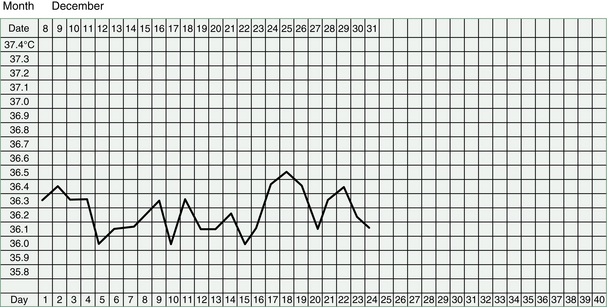
Her pulse was thready and rapid and her tongue was red and peeled, especially on the sides and the tip.
Here we have a mental picture of severe internal Heat affecting the Liver and Heart. The Heat arises as a result of Kidney Yin deficiency. In addition to giving rise to Liver-Fire (headaches, flushing, irritability) and Heart-Fire (insomnia, agitation, anxiety) the Yin deficiency is starting to cause dryness (vaginal dryness and thirst) and Blood deficiency (scanty periods, depression). A vicious circle is created as the internal Heat dries the Yin and the Blood, which of course allows more internal Heat to manifest. The more the Heat disturbs the Shen or the mind, the harder it is for Yin to recover and grow. To manage the headaches and the insomnia, clearly the Heat in the Liver and the Heart had to be cooled and Liver and Heart Yin had to be strengthened. To address the long and irregular cycles, the Kidney Yin had to be reinforced and the Liver Blood nourished. Purging the empty Heat in an attempt to recover and reactivate what Yin was left was a radical but necessary first step.
| Da Huang | 9 g | Rhizoma Rhei (boiled 10 min only) |
| Bo He | 9 g | Herba Menthae (boiled 5 min only) |
| Lian Qiao | 9 g | Fructus Forsythiae Suspensae |
| Sheng Di | 12 g | Radix Rehmanniae Glutinosae |
| Shan Yao | 9 g | Radix Dioscorea Oppositae |
| Shan Zhu Yu | 9 g | Fructus Corni Officinalis |
| Dang Gui | 9 g | Radix Angelicae Sinensis |
| Bai Shao | 9 g | Radix Paeoniae Lactiflorae |
| Mu Dan Pi | 9 g | Cortex Moutan Radicis |
| Dan Shen | 9 g | Radix Salviae Miltiorrhizae |
| Suan Zao Ren | 18 g | Semen Ziziphi Spinosae |
This formula seemed to do the trick – she immediately started sleeping better and the flushing and her thirst subsided and she felt emotionally much calmer. More significantly, the vaginal dryness improved and secretions returned quite quickly. After 2 days of the purging herbs she began to get diarrhea and we switched to another treatment (based on Mai Wei Di Huang Tang) to quickly capture and maintain the ground gained.
| Shan Yao | 9 g | Radix Dioscorea Oppositae |
| Shu Di | 15 g | Radix Rehmanniae Glutinosae Conquitae |
| Shan Zhu Yu | 15 g | Fructus Corni Officinalis |
| Mai Dong | 9 g | Tuber Ophiopogonis |
| Mu Dan Pi | 9 g | Cortex Moutan Radicis |
| Dan Shen | 9 g | Radix Salviae Miltiorrhizae |
| Fu Ling | 12 g | Sclerotium Poriae Cocos |
| Yi Yi Ren | 15 g | Semen Coicis Lachryma-jobi |
| Wu Wei Zi | 9 g | Fructus Schizandrae Chinensis |
| Suan Zao Ren | 18 g | Semen Ziziphi Spinosae |
With these herbs, the vaginal discharge began to thicken and get stretchy (i.e., she started producing fertile mucus) and her libido increased.
Because Mary had the feeling that something had changed markedly, she persuaded her gynecologist to take another blood test. The result of this was so different from those taken previously (namely, the levels of FSH were now in the normal range for the midcycle of an ovulatory cycle) that the diagnosis of premature menopause was retracted. Her estrogen levels, however, were still low and her LH was still a little elevated. It appeared that more nourishment of the Yin and Blood was needed to bring about an ovulation and a period. The following herbs were used, incorporating the principles of building, cooling and moving the Blood and calming the mind. By keeping the mind calm, it was hoped the Yin could build too.
| Shu Di | 12 g | Radix Rehmanniae Glutinosae Conquitae |
| Sheng Di | 9 g | Radix Rehmanniae Glutinosae |
| Bai Shao | 9 g | Radix Paeoniae Lactiflorae |
| Chi Shao | 9 g | Radix Paeoniae Rubra |
| Shan Yao | 9 g | Radix Dioscorea Oppositae |
| Shan Zhu Yu | 9 g | Fructus Corni Officinalis |
| Dan Shen | 9 g | Radix Salviae Miltiorrhizae |
| Fu Ling | 9 g | Sclerotium Poriae Cocos |
| Yi Yi Ren | 15 g | Semen Coicis Lachryma-jobi |
| Han Lian Cao | 9 g | Herba Ecliptae Prostratae |
| Suan Zao Ren | 18 g | Semen Ziziphi Spinosae |
| Huang Lian | 6 g | Rhizoma Coptidis |
After 3 weeks on this formula, she had her first period in 6 months. Her BBT chart looked a whole lot more promising, although the follicular phase still showed signs of lingering Heart-Fire and the short-lived luteal phase indicated her Kidney Yin was not strong enough to promote Kidney Yang (Fig. 5.4).
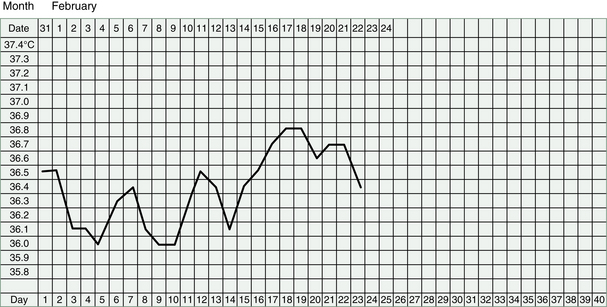
Figure 5.4 Case history – Mary. The short luteal phase indicates Kidney Yang deficiency. (from Kidney Yin deficiency)
From this point, we began a program of alternately reinforcing Kidney Yin and (when a basis of Yin was established) Kidney Yang, as described above. Her cycles were never regular or predictable but they did keep coming. Over the following 9 months Mary was deflected from her course occasionally to try fertility drugs but they upset her cycle more than they helped. So she stuck to the Chinese herbs, which eventually helped her to achieve two textbook perfect cycles; on the second of these she was pregnant (Fig. 5.5).
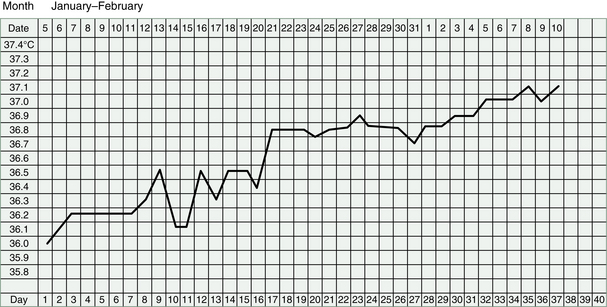
Figure 5.5 Case history – Mary. Once Mary’s BBT charts began to reliably show a typical ovulatory pattern, she quickly became pregnant.
Her large baby was born (not without drama) when she was 37. She tried in vain to have another baby for several years. Chinese herbs managed to keep her ovaries alive intermittently but by 39 years of age, her menopause seemed irreversible. She now takes hormone replacement therapy and is planning to adopt her next child.
Blood Deficiency Amenorrhea
When Blood deficiency causes ovulatory disturbance it is usually associated with Kidney Yin (and sometimes Kidney Jing) deficiency. In some cases, amenorrhea follows loss of large amounts of blood after hemorrhage (e.g., after termination of pregnancy, miscarriage or childbirth) or is a result of a severely compromised Spleen function. Such damage may occur to the Spleen if there is undue physical strain, e.g., young women training intensively in sport, long periods of overwork and/or under-nutrition, or after long-term illness.
Treatment principally focuses on diet, with an emphasis on iron-rich and other Blood-building foods (discussed in Ch. 12). A sensible balance between rest and exertion is advised. There are no absolutes here: it depends very much on the individual constitution. However, if it is lifestyle that has contributed to the loss of periods, then the inappropriate behavior must be rectified.