Assistive Technologies in the Context of Work
VOCATIONAL ACTIVITIES THAT CAN BE AIDED BY ASSISTIVE TECHNOLOGIES
Activities of Daily Living in the Context of Work
EVALUATION OF THE EMPLOYEE’S ABILITIES
CONTEXT FOR VOCATIONAL APPLICATIONS
HARD AND SOFT TECHNOLOGIES FOR VOCATIONAL SUCCESS
CASE STUDIES OF VOCATIONAL ASSISTIVE TECHNOLOGY
Accommodating an Employee With a Visual Impairment
Accommodating an Employee With a Motor Impairment
ACQUIRING TECHNOLOGY FOR THE WORKPLACE: ROLE OF THE ASSISTIVE TECHNOLOGY PRACTITIONER
IMPLEMENTING ASSISTIVE TECHNOLOGY IN THE WORKPLACE
EVALUATION OF ASSISTIVE TECHNOLOGY INTERVENTION IN THE WORKPLACE
On completing this chapter, you will be able to do the following:
1 Describe the vocational activities and related skills that can be aided by assistive technologies
2 Describe the influence of the physical, social, cultural, and institutional contexts on the use of assistive technologies in the workplace
3 Understand the role of the assistive technology practitioner in addressing the vocational goals of the person with a disability
4 Understand the unique attributes of the assessment and implementation of assistive technologies in the vocational setting
5 List the major assistive technologies that are used in vocational settings
6 Describe strategies for implementing assistive technologies in the workplace
7 Identify outcome measures that are useful to evaluate the outcome of assistive technology intervention in the workplace
Work is one of three basic performance areas (self-care, work and school, play and leisure) in which many individuals participate on a daily basis. As with the other performance areas, people with disabilities are confronted with barriers that make it difficult for them to participate in this important life role. Modifications to the work site and the provision of assistive technologies can help to eliminate some of these barriers and enable individuals with disabilities to carry out work-related functions. It is generally recognized that persons with disabilities have a significantly higher rate of unemployment than the general population does (Berthoud, 2006; Canadian Council on Social Development [CCSD]), 2002, 2004, 2005). Those individuals who gain employment often are in positions that do not use their full range of skills and they tend to be more highly represented in the lowest wage quartile (CCSD, 2005). Cornell University’s 2004 Disability Status Reports United States indicated that only 22.4% of persons with a disability were employed full-time on a year-round basis (Rehabilitation Research and Training Center on Disability Demographics and Statistics, 2005). An analysis of the Participation and Activity Limitation Survey (PALS) data in Canada showed that more persons with disabilities who were employed felt they needed access to technology (Cossette, 2002) and job modifications than environmental modifications to do their jobs (CCSD, 2005). This chapter focuses on the assessment and implementation process of providing assistive technology in the workplace. Elements of the human activity–assistive technology (HAAT) model physical, social, cultural, and institutional contexts that enable or pose barriers to the successful integration of an individual with a disability in the workplace are discussed.
The individuals served by vocational assistive technology are typically between 16 and 65 years of age and have wide-ranging physical, sensory, and cognitive disabilities. There are two primary populations of persons who need assistive technologies for access to employment. The first group includes individuals who have a disability at the time they seek employment. The disabilities typical in this population are spinal cord injury, arthritis, cerebral palsy, visual impairment, and hearing impairment. The second group includes individuals who sustain either a cumulative or a traumatic injury in the workplace and who wish to return to the workforce. Disabilities most commonly seen in the second population are musculoskeletal disorders (MSD) such as back injuries, carpal tunnel syndrome, tendonitis, and shoulder injuries. For both these populations, assistive technology is one of many tools that can be used to help people become employed or re-employed.
De Jonge, Scherer, and Rodger (2007) describe a process for introducing assistive technology in the workplace. This process is shown in Figure 16-1. The figure shows a process, without a defined starting point, for identifying the right technology, acquiring it, introducing it into the workplace, and maximizing its use. This process is based on consideration of the issues that affect the employee who uses assistive technology and also includes evaluation of the outcome. We will use the HAAT model as a basis for discussing some of the elements of this process described by de Jonge, Scherer, and Rodger, specifically identification of the right technology, maximizing the use of the assistive technology, client and outcome evaluation, and identification of issues that affect the use of assistive technology in the workplace.
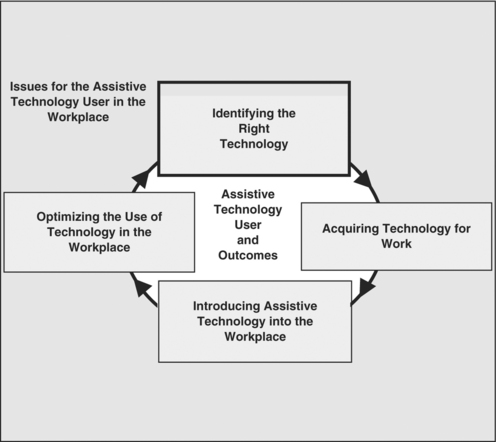
Figure 16-1 Stages of choosing and integrating technology into the workplace. (From de Jonge DM, Scherer MJ, Rodger SA: Assistive technology in the workplace, p. 84, St. Louis, 2007, Mosby.)
VOCATIONAL ACTIVITIES THAT CAN BE AIDED BY ASSISTIVE TECHNOLOGIES
The process of designing an assistive technology system was described in Chapter 2 and starts with defining the activities that characterize vocational endeavors. The HAAT model and the three activity outputs of communication, manipulation, and mobility provide a means to characterize vocational activities. In the following sections, each of the activity outputs is described in terms of work tasks that an individual may need to perform on the job. Identification of these tasks will then help us to define both the human skills and the assistive technologies required for successfully completing them. The fourth component of the HAAT model, the context, is used to identify the environmental considerations that influence assistive technology use in the workplace.
Box 16-1 identifies questions related to the person’s occupation and job tasks for the assistive technology practitioner (ATP) to ask during the assessment of an individual who needs accommodation in the workplace. It is important that the ATP ask as many questions as needed to get a clear picture of how the job is customarily performed. These questions include information regarding equipment used, equipment that may be available, and methods of performing the tasks. The ATP also observes the performance of the specific job tasks as appropriate.
Communication
Communication includes all the various information-handling activities in the workplace. Activities in this category include writing (pen/pencil or typing), reading, interacting with others in person, using a computer and keyboard, and using the telephone.
Interacting with others involves numerous skills, including oral motor skills required for speech; auditory function; cognitive skills, including receptive and expressive language; and social skills. Many of these skills are described in Chapter 3, and Chapter 11 describes the skills specifically needed to carry on a conversation. In some cases, individuals lacking these communication skills can use alternative modes of communication and an augmentative communication device. These devices are discussed in detail in Chapter 11.
A person with a disability may have trouble using the telephone to communicate as a result of deficits in communication, sensory, or motor skills. All aspects of telephone use may be problematic including difficulty with (1) dialing a number because of visual, cognitive, or motor impairments, (2) lifting and holding the receiver, and (3) speaking to and hearing the communication partner. A range of low- and high-tech options is available to assist with these activities. Reading requires motor, sensory, and cognitive skills. Many of the skills described in Chapter 15 for educational application apply in the workplace as well. The motor skills associated with positioning the reading material, turning pages, and handling materials (e.g., picking up a book, opening it, using an index, thumbing through pages) are necessary for use of print media. Chapter 7 discusses devices to aid in the motor tasks involved with reading printed materials. The motor tasks to operate a mouse and keyboard are important for electronic media (see Chapter 7).
Reading also requires sensory abilities such as visual field, visual acuity, and oculomotor function to scan text and recognize letters and words. If the individual lacks these capabilities because of a visual impairment, an alternative format in either tactile (braille) or auditory (speech) form can be used (see Chapters 8). Individuals who have hearing loss (including deafness) can make use of adaptations such as those discussed in Chapter 9. Basic literacy skills are also required for reading. The level is determined by the specific job requirements. For example, a job as a stock clerk may only require the reading of simple labels, whereas a job as a paralegal or an attorney requires a higher level of skill for the reading of complex legal documents. Assistive technology applications to aid individuals who have cognitive disabilities are discussed in Chapter 10.
Whether writing is accomplished by handwriting or typing, it requires motor, sensory, and cognitive skills. The use of pencil or pen and paper requires fine motor control to hold the pen or pencil and to produce letters. Chapter 15 describes the use of different types of writing (note taking, messaging, and formal writing) as they apply to educational settings. Many of the considerations in the workplace are the same. There are also many alternatives to handwriting for successful completion of writing tasks (see Chapters 7, 10, 11, and 15). These include assistance provided by a personal assistant, computer-aided writing using word processing, personal digital assistants that recognize handwriting on a screen and store it as text for editing, modified pens and pencils (e.g., enlarged grip or holder), and systems that recognize speech and translate it directly into text (automatic speech recognition).
Keyboard or mouse use is required for all data entry tasks, including writing. There are many alternatives to keyboard/mouse entry, including automatic speech recognition (see Chapter 7). Sensory skills for monitoring what is being written include visual, auditory, and tactile approaches, some using various types of assistive technologies. Cognitive and language skills for writing are described in Chapters 10 and 15.
Manipulation
The activity output of manipulation also includes a number of different tasks. In general, manipulative activities in the workplace are those that have anything to do with handling of material, which includes filing, sorting, assembling, lifting and moving objects such as books, documents, and equipment and using office machines such as copiers, adding machines, or fax machines. Besides requiring fine motor skills, these activities require sensory and cognitive skills. The ATP needs to follow the process identified in Chapter 2 and to analyze the activities required in an employment setting and describe these in terms of their motor, sensory, cognitive, and affective demands.
Mobility
The activity output of mobility is characterized by activities that involve personal movement to and from the work site and within the workplace. In considering these activities it is important to determine what movements are required of the individual to complete the job and, when the individual lacks these movements, what alternative methods are available.
Getting to work is a significant barrier for many individuals (Gillen, 2000; Rumrill, Schuyler and Longden, 1997; Zwerling et al, 2003). Arranging wheelchair-accessible public transportation often means booking pickup times with a range of an hour or more, booking far in advance, and paying additional fees for the accessible service. If private transportation is used, the cost of a modified vehicle (see Chapter 13) is much higher than that of a standard vehicle. Furthermore, finding a parking space at work that is accessible and close to the work site may also be a problem. Thus the options for transportation are significantly more challenging than for nondisabled workers.
Once at work, mobility and access in and around the work environment can be a challenge for some people with disabilities. Activities to consider are whether the person can enter and exit the building safely and in an emergency, open and close doors, and climb stairs. Sitting and standing requirements of the job also need to be considered. Sitting applies to the employee who requires seating technologies for postural control, tissue integrity, or comfort to be an effective employee (see Chapter 6). It is important that the employee has good postural alignment and postural support as needed to maximize function in the work environment, including the manipulation of objects and operation of assistive devices.
In addition to postural alignment and proper positioning, the employee needs to be free from pain while sitting and be able to perform pressure-relief activities if needed. Persons who have had a back injury may have difficulty maintaining a static position in either sitting or standing for any length of time because of pain or fatigue. They may require modifications to the work area that enable them to alternate between the two positions. Other individuals may have difficulty in coming to a standing position from sitting.
McNeal, Somerville, and Wilson (1999) conducted a study in which one of the purposes was to document the types of problems experienced by workers with spinal cord injury and workers with postpolio syndrome. The group of individuals with spinal cord injury reportedly had the greatest number of problems (39.8%) in the category of “using equipment/tools/furniture.” More than one third of these problems had to do with desks, including an inability to get up to the desk because of the wheelchair, inability to access items on the desk, or a workspace that was too limited.
Activities of Daily Living in the Context of Work
While an employee is at work, there are also a number of activities of daily living (ADLs) he or she may need to carry out. These activities may have unique requirements because they are being performed in the work setting. These activities include going to the bathroom, taking medications, and eating lunch or other meals. Accommodations for these activities can have as much of an influence as an accessible desk or workbench. If the workplace does not have accessible restrooms, then the worker who has a disability is at a significant disadvantage compared with fellow workers. If assistance for taking medications is not available, the worker may not be able to perform the tasks of the job.
Besides the requirements related to physical accessibility for completing these ADLs, time factors are also an issue. Some individuals may require additional time for toileting or eating. A flexible schedule with time off during the workday is needed. Issues of privacy and whether to ask coworkers for assistance also come into play. A final consideration relates to the level of fatigue a worker with a disability may experience. Some individuals may require a rest break during the day or a shortened work day to accommodate fatigue (Garcia, Laroche, and Barrette, 2002).
EVALUATION OF THE EMPLOYEE’S ABILITIES
The next step of the assistive technology system design process described in Chapter 2 is the identification of the client’s abilities. This evaluation of employee skills is obtained from a systematic assessment process. Chapter 4 describes both the essential information that must be obtained through an assessment process and the major approaches to service delivery in assistive technologies. The process for carrying out an assistive technology assessment for an individual with vocational needs follows the same general principles described in Chapter 4. Each assessment must be conducted on a case-by-case basis, with the first step being to define the problem. In defining the problem, it is essential to ask questions pertaining to the individual’s specific situation. It is then necessary to identify the individual’s skills and abilities and relate the information to the specific employment situation. The following case study points out some of the issues in assistive technology assessment for needs related to employment and illustrates the necessity for a team approach, including the employee, employer, and assessment team. It also illustrates the necessity to focus on need rather than on technology.
Background information available to the ATP before commencing a job site accommodation might include some of the following: physical capacity evaluation, functional capacity evaluation, workplace evaluations, and physician’s report. It is preferable that the assessment of the consumer’s technology needs and trials of the technology take place in the work setting in which it will be used. Simulation of the work tasks is an alternative when access to the workplace is not feasible.
In addition to assessing the physical and cognitive abilities of the employee, it is important to understand his emotional state. De Jonge, Scherer, and Rodger (2007) describe the discomfort that the participants of their study identified regarding asking for assistive technology. Participants were hesitant to ask for assistive technology because of the focus it brought to their disability. During an assessment, the ATP should uncover the meaning of assistive technology to the individual and what he or she is willing to accept (Gamble, Dowler, and Orsline, 2006; Lund and Nygard, 2003; Reimer-Reiss and Wacker, 2001). Further, it is important to determine whether the individual can advocate for himself or herself or whether he or she needs assistance to acquire the needed technology.
CONTEXT FOR VOCATIONAL APPLICATIONS
The context portion of the HAAT model describes the environment in which the activity is being performed. Chapter 2 defined the aspects of the context: physical, social, cultural, and institutional. It is critical that these aspects of context in the work setting are not ignored because each plays an important role in the ultimate effectiveness, or ineffectiveness, of an assistive technology system. This section examines each aspect of the context as it relates to vocational settings.
In Chapter 2 we described three levels of environmental interaction and accompanying factors that affect decisions related to assistive technology implementation: macrosystemic, mesosystemic, and microsystemic (Fougeyrollas and Gray, 1998). The macrosystemic level is associated with issues of society as a whole, which includes policies relating to assistive technology use and funding levels. Lack of funding is a barrier to assistive technology use in the workplace. The macrosystemic level will be discussed as part of the institutional environment. The mesosystemic level is the person’s local environment, which includes those places in the community where the individual lives and functions. For purposes of this chapter, the mesosystemic level we focus on is the workplace. This level includes the attitudes and policies of the employer, coworkers, and customers with whom the worker may come in contact. At the microsystemic level the analysis is of the immediate environment of the person, including such factors as the existence of specific assistive technologies. The ATP typically functions at this level when carrying out assessments, making recommendations, and supporting users of assistive technologies.
Physical Context
The HAAT model identifies the natural versus built environments and the physical parameters of noise, temperature, and light as elements of the physical context. These elements will now be considered in the vocational context.
Often discussions of assistive technologies in the vocational setting focus primarily on work that occurs in an office environment. Although the office is certainly a main setting for the application of assistive technology, considerations for designing the assistive technology system must also include its use outside of an office (e.g., travel to a client’s site or assistive technology use in an industrial or commercial setting). Office applications might indicate a system setup that is used predominantly in one place; applications outside the office need to be transferable across environments and may be influenced to a greater degree by the physical parameters named above.
Communication partners include coworkers, supervisors and supervisees, and clients or customers. Communication involves both giving and receiving information (Garcia et al, 2002; McNaughton, Light, and Groszyk, 2001). The communication may be written or oral and could be something that is prepared such as a presentation or spontaneous such as interacting with a client or in a meeting. Written communication technologies are likely to be used at a single workstation that specifically accommodates for the user’s abilities, although some components (e.g., a laptop computer) may travel with the user between work site and home or between client locations. Oral communication aids will move with the client so need to work across different environments. Chapter 11 discusses oral AAC applications across environments and Chapters 10 and 15 consider written communication in more depth.
Noise and light are the primary physical parameters that will affect the use of communication aids in the vocational context. Frequent mention has been made of the influence of ambient noise on the use of voice recognition technologies. Noise is also a consideration for the communication partner’s ability to understand the synthesized or digitized speech output of a speech-generating device voice or the speech of an individual with a voice impairment (Garcia et al, 2002). Noise will be an important consideration for an individual working in an open concept office, industrial, or commercial environment. Noise can be a significant factor for individuals who have hearing loss (see Chapter 9) and for workers who have attention disorder–like disabilities (see Chapter 10). Light is important when the worker uses a device in different environments and needs to read information from a screen. Intensity and color of ambient light can also have a major impact on workers who have visual impairments (see Chapter 8).
Mobility refers to travel to and from the work site and within the worksite. Safe and reliable access in, out, and within the worksite are key. Consideration should be given to the different areas within the work site that the worker needs to access, including the primary workstation (or office), washroom, and lunch area. A path of travel should be identified between different locations within the work site. Box 16-2 lists a number of questions that should be considered when evaluating mobility among key areas in the work environment.
Consideration of the natural and built environments needs to be made if the individual is traveling between different work sites, either moving from one building to another by using a personal mobility device or some form of vehicle. Climate considerations influence assistive technology system design when the user is traveling outside between home and work or work settings. For example, consideration should be given to the battery life of an electrically powered wheelchair. These were discussed in Chapter 12.
As identified earlier, manipulation demands include those involved with completion of work tasks and with ADLs that are completed at the work site. Once again, the ATP must identify the elements of the physical environment that facilitate these manipulation demands, such as lever-style faucet or door handles, and those that present barriers to use, such as heavy entrance doors. Technology exists to reduce the influence of most of these physical barriers and has been identified in an earlier chapter on manipulation (Chapter 14). It is frequently the social, cultural, and institutional contexts that limit the ability to improve the accessibility of the vocational environment.
Institutional Context
The institutional context is an important consideration for the provision of assistive technology in the workplace. Many jurisdictions have some form of legislation that prevents discrimination of persons with disabilities in the work setting and requires different degrees of accommodation. Some examples of legislation include (1) the Rehabilitation Act and the Americans with Disabilities Act (ADA) (United States), (2) Disability Discrimination Act of 1995 and 2005 (United Kingdom), (3), Disability Discrimination Act, 1992, and Amendment, 2002 (Australia), (4) Ontarians with Disabilities Act 2005 (Ontario, Canada), and (5) Disability Act 2005 (Ireland).
The ATP needs to be familiar with the legislation in his or her jurisdiction that regulates accommodation for persons with disabilities in the workplace. The following are some of the aspects of the legislation that are important to know. First, what is the definition of disability? Is the definition restrictive or inclusive? Inclusive definitions include physical, mental health, sensory, cognitive/intellectual, neurological, and behavioral diagnoses as well as chronic illnesses such as HIV/AIDS. An inclusive definition of disability also requires accommodations to be put in place from the time a progressive condition affects function.
The requirements for accommodation are an obvious part of the ATP’s knowledge acquisition. Most pieces of legislation identify modification of the job or the environment and the purchase and use of equipment or technology as reasonable accommodations. Further, the legislation often includes some statement about the degree of accommodation. For example, the ADA uses the language of a reasonable accommodation and least restrictive environment. This language suggests that the accommodations that are made in the workplace do not need to be the best or most appropriate fit for the employee. Rather, they are what it is reasonable to expect of the employer given the context. Obviously, this type of language can be broadly interpreted and can result in accommodations that do not fully support the employee’s needs in the workplace. Legislation also explicitly states that accommodations must be made when advertising a position, during the hiring process, and return to work situations, as well as the obvious accommodations required during the tenure of a person’s employment.
Who is required to make workplace accommodations is a third consideration. Often employers who employ a small number of employees (e.g., fewer than 15-20) are exempt from the legislation. Further, exceptions may be made if the necessary accommodations create an undue hardship (usually financial) for the employer. Accommodations are not universally made for every job. There is frequently a clause in legislation that states that the applicant or employee must be able to do the essential activities of a job. For example, marketing jobs require an employee to give oral presentations to clients. An employer can deny employment to an applicant who cannot communicate orally. However, the notion of an essential activity does not define how that activity is accomplished. So an applicant who uses a voice-output communication aid can give an oral presentation and is therefore able to complete an essential activity of the job.
Finally, the ATP should identify whether there is a legislated process for identifying, implementing, and funding workplace accommodations and an appeals process if either party is dissatisfied with recommended or implemented accommodations. The Rehabilitation Act and the ADA are key pieces of legislation in this area so will be considered in more detail here.
The Rehabilitation Act establishes several important principles. One of the most important of these is the concept of reasonable accommodation in employment (see Chapter 1). The act mandates that employers receiving federal funds accommodate the needs of employees who have disabilities. It specifically prohibits discrimination in employment solely on the basis of a disability. This law originally described both reasonable accommodation and least restrictive environment (LRE), a term relating to the degree of modification that is acceptable in a job.
As a result of the Rehabilitation Act of 1973, many employers made architectural changes to reduce barriers. These included installing elevators, placing ramps and curb cuts to accommodate wheelchair users, and adding voice and braille labels to signs (including elevators) to accommodate persons with visual impairment. Many of these efforts to achieve accommodation involved the use of assistive technologies.
The Rehabilitation Act Amendments of 1998, which are contained in the Workforce Investment Act of 1998 (Public Law [PL] 105-220), are the most recent amendments to the Rehabilitation Act. These amendments include several provisions involving assistive technologies. First the amendments require that each state include within its vocational rehabilitation plan a provision for assistive technology (referred to in PL 99-506 as rehabilitation engineering or technology and in PL 105-220 as rehabilitation technology).
This plan is the basis by which states receive federal funding for vocational rehabilitation, and there is a strong incentive to provide these technology-related services to ensure continuation of the transfer of federal funds for rehabilitation programs. The Rehabilitation Act also requires that provision for acquiring appropriate and necessary assistive technology devices and services be included in an Individual Written Rehabilitation Plan developed for the individual. For individuals who are eligible for services through state vocational rehabilitation programs, the Rehabilitation Act has excellent provisions for the inclusion of assistive technology in all phases of the rehabilitation process, from evaluation through placement in employment. In its analysis of assistive technology policy in employment, the National Council on Disability (NCOD, 2000) identified the following limitations in these provisions: (1) limits of funding for vocational rehabilitation and (2) implementation difficulties such as insufficient staff expertise with assistive technology and lack of service providers with this expertise.
Section 508 of the Rehabilitation Act is an important provision because it ensures access to “electronic office equipment” by persons with disabilities who work for the federal government. Because the federal government is such a large purchaser of computers and other office technology, any purchasing specifications it makes take on the role of informal standards affecting all manufacturers of equipment and therefore all employers who purchase that equipment. Persons who are blind or have low vision and those with difficulty in accessing the keyboard have benefited from standards derived as a result of Section 508, and several manufacturers have included features in the basic designs of their computer systems technology that increase access (see Chapter 7). The provisions cover access to electronic office equipment and electronic information services provided to the public by the federal government, which includes ensuring that end users with disabilities (1) have access to the same databases and application programs as other end users, (2) are supported in manipulating data and related information resources to attain equivalent results as other end users, and (3) can transmit and receive messages using the same telecommunication systems as other end users. As described in Chapter 1, the ADA is a federal civil rights law that is designed to prevent discrimination and enable individuals with disabilities to participate fully in all aspects of society. One fundamental principle of the ADA is that individuals with disabilities who want to work and are qualified to work must have an equal opportunity to work.
Under Title I of the ADA the employer is required to provide reasonable accommodation to qualified individuals with disabilities who are employees or applicants for employment unless to do so would cause undue hardship. A qualified individual with a disability has the skills, education, experience, or other requirements needed for the job and can perform the essential functions of the position with or without reasonable accommodation (Equal Employment Opportunity Commission [EEOC], 1996). The essential functions of a job are those job duties that are so fundamental to the position the individual holds or desires that he or she cannot do the job without performing them. An essential function of a nurse in a hospital would be to respond to a patient’s call for assistance. An essential function for a painter might be to lift a 5-gallon bucket of paint weighing 42 pounds. An essential function for a clerical worker might be to type 75 words per minute. It is the employer who determines the essential job functions.
There are many individuals with disabilities who can apply for and perform job duties without any reasonable accommodations. However, there are barriers in the workplace that prevent other individuals with disabilities from doing the same thing unless they are provided with some form of accommodation. These barriers may be physical in nature (such as facilities or equipment that are inaccessible), or they may be procedures or rules (such as rules regarding when work is performed, when breaks are taken, or how essential or marginal functions are achieved). Reasonable accommodation can remove these barriers. Reasonable accommodation is “making existing facilities used by employees readily accessible to and usable by individuals with disabilities” (ADA, 1990, Section [9] [A]). Reasonable accommodation is available to qualified applicants and employees with disabilities and must be provided regardless of whether the employee works part time or full time or is considered probationary. It is the responsibility of the individual with a disability to inform the employer that an accommodation is needed. The general types of reasonable accommodations that an employer may have to provide are illustrated in Box 16-3, along with examples of each type.
An accommodation is not required if the employer finds it would impose undue hardship on the operation of the employer’s business. Undue hardship is defined as an “action requiring significant difficulty or expense” (ADA, 1990, Section [10] [A]) when considered on a case-by-case basis. In determining whether an accommodation would impose an undue hardship, the nature and cost of the accommodation in relation to the size, resources, nature, and structure of the employer’s operation is considered. If the facility making the accommodation is part of a larger entity, the structure and overall resources of the larger organization are considered, as well as the financial and administrative relationship of the facility to the larger organization. Generally a larger employer with greater resources is expected to make accommodations requiring greater effort or expense than that required of a smaller employer with fewer resources. In situations where an accommodation would impose an undue hardship, the employer must try to identify an alternative accommodation that meets the employee’s need and does not impose a hardship. The individual with a disability should also be given the option of paying for the cost (or a portion thereof) of an accommodation that would create an undue hardship.
There are a number of modifications or adjustments that are not considered forms of reasonable accommodation. For example, the individual must be qualified for the position sought; there is no obligation to find a position for an applicant who is not qualified. An employer is not required to eliminate an essential function (i.e., a fundamental duty of the position). Although employers may have to provide reasonable accommodations to enable an employee with a disability to meet quality or quantity production standards, they are not required to lower standards that are applied uniformly to employees with and without disabilities. Glasses and hearing aids may be considered personal effects and are not included as reasonable accommodations, although there are exceptions and the ATP needs to explore whether these are covered.
There is a perception among employers that job accommodation is a complex and costly process (Driscoll, Rodger, and de Jonge, 2001; Langton and Ramseur, 2001; Peck and Kirkbride, 2001). To the contrary, most accommodations are simple, inexpensive, and can reduce Workers’ Compensation and other insurance costs (Job Accommodation Network [JAN], 2000). In addition, for qualifying small businesses, tax incentives are available to help cover the cost of providing accommodation. The JAN Web site provides information on the costs of different accommodations (http://www.jan.wvu.edu/).
In the United States and other countries, Social Security benefits provided to people with disabilities can act as a disincentive for people to work (Frieden, 1997). Often the income from jobs is only slightly more or the same as the benefits they receive. The loss of health care benefits is also a concern for individuals with disabilities once they become employed. People with disabilities want to work but frequently have difficulty trying to obtain health insurance when they leave the public health care system and enter the work force (NCOD, 2000). Because health care, including assistive technologies, is often a critically needed service, choosing between employment and health care does not take much in the way of deliberation. This issue is a significant barrier to participation in the work force by people with disabilities, and the ADA does not address it. The Work Incentives Improvement Act has the potential to provide better health care options for persons with disabilities wishing to work. This legislation gives states the option of allowing working-age adults with disabilities to “buy in to” Medicaid coverage if they leave the Supplemental Security Income program to work. However, depending on the state in which one lives and the assistive technology needs of the individual, the measures may be limited in improving access to assistive technology (NCOD, 2000). Because Medicaid coverage of assistive technology varies from state to state (see Chapter 5), a state’s decision to allow Medicaid buy-in may not result in improved access to assistive technology needed by individuals who wish to enter the work force (NCOD, 2000).
Social and Cultural Contexts
In the context portion of the HAAT model, we use social and cultural contexts to describe important aspects of both interaction and acceptance of assistive technologies. Social and cultural factors also include policies and attitudes toward technology and toward disability by employers and fellow employees. The social and cultural aspects of the context can be the most important for assistive technology use in a vocational setting (de Jonge, Scherer, and Rodger, 2007; Driscoll et al, 2001; Garcia et al, 2002; McNaughton et al, 2001; Peck and Kirkbride, 2001; Strobel et al, 2006). We need to examine the policies and attitudes of employers and employees, the types of relationships the person has with people at work, and how they affect interactions and use of assistive technology when considering the social and cultural contexts at work. These factors can impose barriers to successful assistive technology application.
The social context of the workplace includes the other people in the environment. These people include the employer or supervisor, employees, coworkers (both those who work closely with the individual and those with less frequent involvement), other workers at the job site, and clients or consumers. Their knowledge of disabilities and attitudes toward individuals with disabilities are a significant determinant of whether the person with a disability will be successful in the work setting. Knowledge of and willingness to provide workplace accommodations are further determinants of success in the workplace (Driscoll, Rodger, and de Jonge, 2001; Gamble, Dowler, and Orslene, 2006; Garcia et al, 2002; McNaughton et al, 2001; Strobel et al, 2006). Legislation that requires accommodations for persons with disabilities exists widely, but the support of others in the environment, particularly an employer or supervisor, is critical for these accommodations to enable the individual to complete job tasks.
As indicated in the introduction to this chapter, people with disabilities have a significantly higher rate of unemployment or underemployment than the general population. Some persons with disabilities report a lack of value of their capacity to contribute in a work setting. Frequently, this lack is seen when individuals with disabilities are asked to volunteer in a setting rather than being paid for their involvement. The perception of the person with a disability is that the employer or the representatives of an organization feel they are doing the individual a favor by providing the volunteer opportunity (King, Brown, and Smith, 2003). Individuals who are employed report prejudice and social barriers in the workplace (Chan et al, 2005).
Community participation by persons with disabilities has increased over the past decade. However, it is still typical for an employer to have little knowledge of the capacity of an individual with a disability and the role that technology and environmental modifications can play in enabling her contribution in the workplace. This lack of knowledge may result in the employer’s perception that the person with a disability is incapable of completing work tasks (Peck and Kirkbride, 2001). Consequently, he or she may be denied certain employment, given a job that does not use his or her abilities, or denied access to technology and modifications that would fully enable him or her in the workplace. A later section of this chapter will discuss introduction of technology into the workplace and we will discuss strategies for educating employers and advocating for appropriate modifications in the workplace.
De Jonge, Scherer, and Rodger (2007) describe a dilemma faced by employees with disabilities and their employers. Employers reported little knowledge about assistive technology that would be useful in the workplace and even less knowledge of the process involved in securing technology for the workplace. They made an assumption that the employee would have this knowledge. Although employees who had used assistive technology for a long time did have some of this information, it might not be specific to the work setting. Further, those employees with no assistive technology experience were often in the same position as their employers with respect to knowing how to access assistive technologies. Employees with disabilities reported feeling hesitant to ask for technology that would enable them to complete their job, mainly because of their concern that such requests would focus attention on their disabilities (de Jonge, Scherer, and Rodger, 2007). This dilemma led to a communication problem that prevented satisfactory assistive technology solutions for the workplace.
The workplace culture will influence the participation of an individual with a disability. A work setting that fosters collaboration and communication and accepts different ways of doing tasks will likely support the needs of an individual with a disability. Generally, employers have recognized the range of needs of their employees, such as the need for child day care, flexible work hours, and creative accommodations such as job sharing. Companies or organizations that recognize the needs of their employees are more likely to support the accommodations required of an individual with a disability. Employment situations that place a high value on productivity over other workplace behaviors or outcomes may be an integration challenge.
As described in Chapter 2, social influence on individuals is related to what is considered normal or expected, and individuals who have disabilities may be stigmatized because of their disability (Fougeyrollas, 1997). Unfortunately, the use of assistive technologies in the workplace can contribute to this labeling and lead to further isolation. In one study, some of the individuals surveyed reported that they deliberately tried to hide from their employer the fact that they were disabled or were having problems (McNeal, Somerville, and Wilson, 1999). Some were fearful that their employers would fire them if they learned about the problems related to the disability. This fear may prevent some individuals from requesting needed accommodations. The degree to which assistive technologies contribute to stigmatization differs (e.g., the stigma of a hearing aid as opposed to eyeglasses). Because the social context plays such a major role in assistive technology use in the workplace, it is important to consider the stigmatizing effect of any proposed workplace assistive technologies and to provide assistance to the worker in overcoming them, which may include awareness training for coworkers and strategies for assistive technology use by the worker.
As discussed earlier, most legislation related to discrimination of individuals with disabilities contains some language that provides employers with a way to avoid making workplace modifications (Peck and Kirkbride, 2001). Typically, the influence on the company’s bottom line is used as an excuse to avoid these modifications. If accommodations are considered to create financial hardship for the employer, they do not need to be made. This type of language recognizes only one side of the financial equation: the money initially spent to purchase technology or modify an environment. It does not recognize the contribution that the employee will make to the company, nor does it amortize the initial equipment expense over the length of time the technology may be used (often years). This corporate attitude is a significant barrier to full access to employment of individuals with disabilities, one that will require more than legislation to eliminate.
Marcia Scherer developed a series of assessments to help determine an appropriate fit between the individual, the environment, and technology. The Workplace Technology Device Predisposition Assessment (Scherer, 2005) is a short questionnaire completed by the employer and the employee. It assesses aspects of the technology and the employee’s and employer’s perspectives on training available to learn use of the technology, support for use of the technology, and perception of the person with a disability as a respected employee (Scherer, 2005). This assessment is a useful tool to help identify whether technology will be supported in the environment and as a way to bring the employee and employer together to discuss introduction and use of technology in the specific work environment.
In summary, the social context of the workplace includes many different people, with whom an employee interacts in different ways and frequencies. Advances in technology, both mainstream and for individuals with disabilities, can accommodate many workplace activities and minimize physical barriers in the environment. However, the knowledge and attitudes of others in the workplace, particularly those who make decisions about hiring and workload, have a greater influence on the ability of an individual with a disability to fully participate in employment. These two determinants need to be addressed when introducing technology into the work site.
HARD AND SOFT TECHNOLOGIES FOR VOCATIONAL SUCCESS
The fourth component of the HAAT model is hard and soft assistive technologies. There are many characteristics of assistive technologies discussed in Chapters 1 and 2. When considering a unique environment such as the vocational setting, some of these are more important than others. As described earlier, accommodation includes both hard and soft assistive technologies.
Assistive technologies can provide major benefits for individuals in vocational settings. A range of workplace accommodations can be made, from inexpensive to costly, hard technologies to soft technologies, and simple to complex. Postural support systems (see Chapter 6) allow the individual to be positioned for maximal participation in work activities. The use of special-purpose input methods or control interfaces (see Chapter 7) is often necessary for use of computers and other electronic devices. In many employment situations the computer (see Chapter 7) is a valuable tool. Augmentative communication systems (see Chapter 11) play a major role for individuals who have disabilities affecting speaking or writing. Mobility devices (see Chapter 12) allow a person with motor deficits to get in and around the workplace. Some assistive technologies (e.g., electronic aids to daily living and robotics; see Chapter 14) can provide assistance to employees who cannot independently manipulate materials or objects. Finally, employees who have sensory disabilities (visual or auditory) are aided by the technologies described in Chapter 8 and 9. The potential for achieving a positive vocational outcome using assistive technologies is great; however, reaching that potential requires careful planning to ensure that opportunities, not barriers, are created.
Strategies are also important to the success of assistive technology in the workplace. Simonds (2001) makes some suggestions of strategies that a person with a disability who uses assistive technology can use to attain employment. The ATP can impart these strategies to the applicant. Before going to a job interview or at the beginning of the interview, the applicant should inquire about the job’s requirements. The person should then be knowledgeable about his or her own capabilities, such as how many words per minute he or she can dictate or how fast he or she can read text with a screen reader. People who have range-of-motion deficits and use assistive devices to reach and grasp should know how far they can reach, how fast they can move, and how much weight they can lift. In some situations, such as with the use of speech-activated software, assistive technology may not only serve to level the playing field but may actually give the applicant a leg up on the competition because it enhances performance. Simonds also recommends that the applicant with a disability learn more than one version of whatever technology is available. If the applicant’s assistive technology solutions only work on certain systems or with specific hardware, the question of adaptability arises, which can complicate the hiring process. Finally, it is suggested that the applicant be accepting of any assistive technology used and view it as part of the hiring package. The assistive technology should be presented as a bonus where the employer not only gets the applicant but gets this great technology as well.
CASE STUDIES OF VOCATIONAL ASSISTIVE TECHNOLOGY APPLICATIONS
Now that we have identified some of the tools that appear in previous chapters for access to vocational activities, we use case studies to demonstrate how they are combined and applied to maximize the opportunities for employment by individuals who have disabilities.
Accommodating an Employee With a Visual Impairment
An individual with a visual impairment will require modifications that support the activities of way finding in the environment, location, and manipulation of objects and materials and perception of any information that is presented visually. Chapter 8 discussed assistive technology for use by individuals with a visual impairment. Table 16-1 lists a number of sample modifications for persons with visual impairment. Read the following case study and use the information found in this table and in Box 16-1 to develop a plan for the assessment process and make recommendations for accommodations.
TABLE 16-1
Sample Workplace Accommodations for Persons With Visual Impairment
| Job Activity | Workplace Accommodations |
| Communication: | Reduce glare by installing window coverings that allow for light adjustment and filtering |
| Writing | Increase lighting |
| Reading | Use nonglare lights with covers |
| Conversation | Use contrasting colors to define background and foreground (e.g., edge of steps and step surface, light switch plates, and walls) |
| Use tactile indicators, raised letters | |
| Use large print on a background with high contrast | |
| Use visual aids such as closed circuit televisions, magnifiers, large-print computer monitors, talking devices, refreshable braille display | |
| Provide isolated workspaces for workers who use assistive technologies with automatic speech recognition or speech synthesis | |
| Use color acetate sheets over print materials to increase contrast | |
| Take frequent breaks to rest eyes when fatigue is a factor | |
| Use optical character recognition to scan printed text and receive a synthetic speech output or save it to a computer | |
| Provide a qualified reader | |
| Manipulation | Use large-print labels on files and file folders |
| Filing/sorting | Provide magnification systems for assembly |
| Assembly | Enlarge print on office machines |
| Lifting | Provide talking office machines such as calculator, money sorter |
| Using office machines | |
| Mobility | Eliminate clutter and obstacles |
| Sitting | Eliminate low-profile furniture or move it out of the way |
| Standing | Provide rest room and room labels in alternative formats (e.g., braille or large print) |
| Walking | Have visual alerting signal devices in case of emergency |
| Climbing stairs | Allow the use of a service animal |
| Provide mobility and orientation training | |
| Mobility aid (cane, electronic aid, other) | |
| Install colored edges on stairs for improved color contrast | |
| Improve lighting in area | |
| Set up a traveling/evacuation partner | |
| Verbal landmark system | |
| Use public transportation or ride with coworker to get to work | |
| Activities of | Install bathroom grab bars of contrasting color from the wall |
| Daily Living | Provide refrigerator for food and/or medications |
| Toileting | |
| Eating lunch | |
| Taking medications |
Accommodating an Employee With a Motor Impairment
Throughout this chapter the importance of ensuring that the employee’s work site and workstation are fully accessible to the employee has been stressed. Because this area most often relates to individuals with motor impairments, these accommodations are described in this section.
A valuable resource for parameters on building or remodeling a work site to make it accessible is the ADA Accessibility Guidelines as Amended, 1998 (ADAAG). This document, which can be found on the Internet at http://www.access-board.gov/adaag/html/adaag.htm, specifies the technical requirements for accessibility to buildings and facilities by individuals with disabilities under the ADA of 1990. Another useful publication on modifying the workplace is The Workplace Workbook: An Illustrated Guide to Job Accommodations and Assistive Technology (Mueller, 1990). This book contains detailed descriptions with accompanying illustrations related to three workplace topics: the universal workplace; seating, storage, and workstations; and computers, information displays, communication devices, and controls.
There are office products, such as adjustable-height desks, filing systems, and carousels, that are commercially available to meet the accommodation needs of someone with a motor impairment. These modular workstation components can be assembled in configurations to meet a range of work-related needs of office employees with a disability. The modules can be controlled manually, by a motorized switch control, by computer, or by a computer-controlled robotic arm. Components are available that allow the individual to manipulate files, store and retrieve books, refer to reference materials, open mail, staple papers, and answer the telephone.
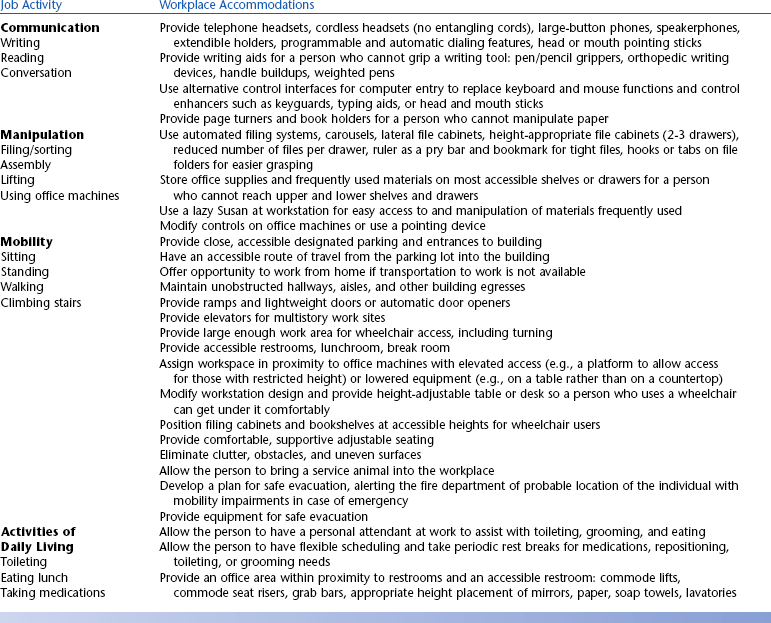
Accommodations to the workstation and other types of accommodations for persons with mobility impairments are listed in Table 16-2. Read the following case study and use the information found in this table and in Box 16-1 to develop a plan for the assessment process and make recommendations for accommodations.

ACQUIRING TECHNOLOGY FOR THE WORKPLACE: ROLE OF THE ASSISTIVE TECHNOLOGY PRACTITIONER
The discussion to this point in this chapter describes the process of and factors relevant to the recommendation of an assistive technology system for the workplace. The remainder of the chapter focuses on the process for obtaining the technology and determinants and strategies for successful implementation of technology in the workplace.
Making successful accommodations for an employee with a disability involves a multidisciplinary effort and collaboration among all involved parties. As with all other areas of assistive technology, the consumer is an integral part of the team. To achieve a successful outcome, it is necessary to seek the answers to accommodation questions and obtain input from the consumer. In addition to the consumer, the team may include a vocational rehabilitation counselor, a vocational evaluator, an employment specialist, therapy services, a rehabilitation engineer, the employer, and supervisors (if the person already has a job). Fellow employees may also be included as part of the team if a workstation is shared or if they will be involved in training. Depending on the status of the consumer’s employment and the nature of the disability, others who might be involved are a physician, a Workers’ Compensation representative, and a job coach or trainer. Box 16-4 lists the responsibilities of the ATP in vocational accommodation assessment and implementation.
The United States was among the first to enact legislation to protect the rights of persons with disabilities in various settings, including the workplace. The processes for providing vocational services are well established in this country so will be described in detail here. The ATP working in other countries must become familiar with the counterpart processes in their jurisdiction. Each state has an agency designated to provide vocational rehabilitation services to individuals with disabilities who have employment as a goal. These services can include counseling, evaluation, training, and job placement. The vocational rehabilitation agencies are funded by a combination of state and federal appropriations. (Contact information for each state’s vocational rehabilitation agency can be found at www.jan.wvu.edu/sbses/VOCREHAB.HTM). There are also private vocational rehabilitation agencies that provide similar services. The services that they provide are paid for on a fee-for-service basis by the consumer, the employer, or a third-party funding source such as Workers’ Compensation insurance.
The publicly funded vocational rehabilitation agencies all use a standard process of providing services to the consumer (Flynn and Clark, 1995). There is no set period in the vocational rehabilitation process in which assistive technology services occur. In fact, there are several points in this process in which assistive technology services can be incorporated (Langton and Hughes, 1992). A consumer receiving services from a vocational rehabilitation agency is assigned a vocational rehabilitation counselor. The role of the counselor is to assist the individual in identifying vocational goals and developing a plan to achieve those goals (Flynn and Clark, 1995). On a consumer’s referral to a vocational rehabilitation agency, the first task carried out is the development of the Individual Plan for Employment (IPE, formerly called an Individual Written Rehabilitation Plan [IWRP]) The purpose of the IPE, which is developed jointly by the vocational counselor and the consumer, is to set in place a plan to achieve the consumer’s employment objective. Items included in the IPE are shown in Box 16-5. Each IPE includes a statement of the consumer’s long-term rehabilitation goals based on the assessment for determining eligibility and vocational rehabilitation needs, including an assessment of career interests. To the greatest extent appropriate, the goals should include placement in integrated settings. The IPE also specifies services that are to be provided to the consumer to achieve the goals. In addition to assistive technology services, these services include occupational or physical therapy or speech-language pathology.
Some vocational rehabilitation agencies have ATPs on staff to provide services to their consumers. Other agencies obtain assistive technology services from an outside provider, either on a fee-for-service basis (where reimbursement is per hour of service provided) or through a contract (where x number of dollars are paid in exchange for evaluation and training of y number of consumers). In either situation it is the vocational rehabilitation counselor who can significantly affect the consumer’s success or failure in acquiring assistive technologies for work. Therefore it is important that vocational rehabilitation counselors are educated about the assistive technology services and devices that are available to meet employment needs.
IMPLEMENTING ASSISTIVE TECHNOLOGY IN THE WORKPLACE
Determinants of assistive technology abandonment that are recognized in other settings such as the home are also important considerations for the implementation of the technology in the workplace. Once the assessment process is complete and suitable technology has been identified, time should be spent to ensure that the assistive technology will work in the vocational setting and be acceptable to the employee, employer, and others in the environment. A trial period is recommended, using the technology for the required work tasks, to determine that it will meet the goals of the employee and employer (de Jonge et al, 2007; Driscoll et al, 2001).
The trial period helps determine that the assistive technology works within the specific vocational context and is transferable across other environments in which the employer is required to work or use the equipment. For example, a mobility device is frequently used in the home and work environments so should be compatible with both, particularly in those jurisdictions that only fund a single mobility device. A trial period will also identify whether modifications are needed to the technology or its set up. For example, use of the technology to complete required job tasks in the vocational environment will help the ATP determine whether the user and the equipment are properly positioned. Further, it will help identify issues related to the integration of the technology such as noise issues.
Training is important in the vocational context as it is in other contexts (Butterfield and Ramseur, 2004). Obviously, the user requires training on the set-up and use of the equipment. Other relevant people in the environment also need training on the equipment. Technical support is a key determinant of successful use of the technology. The assistive technology user, like other people who use equipment like computers, should not be expected to understand the underlying function of the technology. People responsible for providing technical support require training in how the assistive technology integrates with other technology in the environment so they can assist with trouble shooting as needed (McNaughton et al, 2001).
The initial step in designing the assistive technology system is consideration of required activities. Implementation of assistive technology in the workplace requires the ATP to analyze the employee’s use of recommended technology when completing required tasks with a view to optimizing his or her performance of those tasks (de Jonge et al, 2007). In addition to adjusting positioning of the person and their equipment, as mentioned above, the ATP may recommend modification of the activity, by eliminating some steps of the task, reorganizing the task, or substituting one means of completing an activity with another (Langton and Ramseur, 2001). For example, the ATP might recommend that an employee gather all the information needed to write a report at the start of the writing task rather than getting the information as it arises during the task. Helping the employee become more efficient with his or her work while using assistive technology increases the likelihood that the technology will be used successfully in the vocational setting.
Plans need to be in place to accommodate failure of the technology. Some individuals will have two different means of completing a task, for example, voice recognition or direct input for computer work. Redundancy here accomplishes three goals: first, the user has an alternative means of completing a task if they become fatigued; second, the user has different ways of accomplishing a task depending on the situation; and third, the user has a backup if one means fails. Access to technical support is important here, once again, to provide efficient support when technology breaks down. Finally, having access to loaned equipment in the event of technology failure ensures that an employee can continue with his or her job. Identification of these strategies is important in the initial phases of implementation of assistive technology in the workplace.
Advocacy, either by the person with a disability or the ATP, may be necessary for the successful implementation of assistive technology in the workplace (de Jonge, Scherer, and Rodger, 2007). As previously stated, many employers lack knowledge of the abilities of individuals with disabilities and the availability of technology to support these abilities. In these situations someone must advocate to achieve the needed accommodations in the workplace. Assisting people with disabilities to advocate on their own behalf, when they do not feel confident doing so, is the most effective means of gaining these accommodations. In situations where the individual is not able to advocate on his or her own behalf, the ATP should do so.
Fostering communication between the employee and the employer (and others in the workplace) is an important component of successful implementation of assistive technology in the workplace. Communication generates understanding of the needs and constraints of both parties regarding assistive technology use and support. It is a useful training and education vehicle. A workplace that promotes open communication is one where issues and problems are dealt with at an early stage.
A final consideration is the recognition that upgrades in mainstream technology outpace that of assistive technology, particularly for computer-based applications (de Jonge, Scherer, and Rodger, 2007). The employee, employer, and technical support personnel need to be aware of this discrepancy. Some settings have a policy of replacing computer equipment on a regular basis (every 2 years, for example). This upgrading may not be possible for computer equipment used by an individual with a disability because of the requirements of their specific application.
The type of accommodations needed can be determined from the job analysis. The ATP should explore with the employee the different types and ways of making accommodations (see Box 16-3). Keeping any modifications simple, using the least intrusive approach, is important. The simplest approach may be to modify or revise the job task if possible. If technology is to be recommended, keep in mind the continuum of commercial to custom technology discussed in Chapter 1. Whenever possible it is preferable to recommend technology that is commercially available rather than custom made (Langton and Ramseur, 2001).
Once recommendations for equipment and modifications have been made, most state vocational rehabilitation agencies are required to go through a bidding process before making any purchases. In this process the recommendations are submitted to three outside vendors for pricing. Typically the lowest of the three bids is the one accepted, unless there is substantial justification to go with one of the other vendors. Alternatives to purchasing equipment immediately include the use of equipment loan programs. This way the employee can try out the device for a time before deciding on purchasing it. Once accommodations are in place, training and follow-up with the technology are essential (see Chapter 4). After the person has had some time to use the accommodations, it is beneficial to meet with him or her to evaluate the effectiveness of the accommodations and to determine whether additional accommodations are needed. Both the training and follow-up help ensure that the technology is being used appropriately and functioning as expected. A summary of the roles and responsibilities of the ATP during the vocational accommodation process is shown in Box 16-4.
An excellent resource for ATPs working in the area of workplace accommodation is the Job Accommodation Network (JAN). The President’s Committee on Employment of People with Disabilities established JAN in 1984 as an information and consulting service. JAN has consultants who, via the phone and its Web site (http://www.jan.wvu.edu/), provide information about job accommodations and the employability of people with disabilities. JAN provides the inquiring individual with suggestions and prices and can also give names and numbers of employers and workers who have made similar accommodations.
EVALUATION OF ASSISTIVE TECHNOLOGY INTERVENTION IN THE WORKPLACE
The final aspect of the process outlined by de Jonge et al (2007) is evaluation of the use of assistive technology in the workplace. At the outset of the intervention, the ATP and the consumer, with the employer when appropriate, will have identified goals related to assistive technology use in the workplace. Once a trial period is over and a reasonable length of time has elapsed, the ATP should evaluate the effectiveness of the intervention. The goals could be associated with accomplishment of specific work tasks, using assistive technology, ability to move around in the environment, communicate, and manipulate needed objects. The Canadian Occupational Performance Measure (Law et al, 1998) is a useful measure of client-identified goals. Specific outcome measures such as the Quebec User Evaluation of Satisfaction with Assistive Technology (Demers, Weiss-Lambrou, and Ska, 2002) and the Psychosocial Impact of Assistive Devices Scale (Jutai and Day, 2002) are outcome measures that are specifically designed to evaluate the outcome of assistive technology use. These measures were described in Chapter 4. If the outcomes have been met satisfactorily, then the ATP’s involvement with the client may be suspended until the client identifies a further need. If the outcome has not been met, then the process such as the one described by de Jonge et al (2007) is reinitiated.
SUMMARY
This chapter described the vocational application of assistive technologies using the HAAT model as a framework. Employees who have disabilities engage in communication activities such as reading and writing; manipulation activities such as filing and assembly; and mobility activities such as sitting, standing, and lifting. The types of accommodations available in each of these areas involve both strategies and technologies. The four aspects of the context (physical, social, cultural, and institutional) dramatically affect assistive technology effectiveness in the workplace. The emergence of the ADA and the Amendments to the Rehabilitation Act has affected the ways in which assistive technologies are applied and supported. Many characteristics of hard and soft assistive technologies are important in ensuring that they meet the needs of employees and employers. Strategies for successfully implementing assistive technology into the workplace were identified.
1. What are the three major activities related to assistive technology use in the workplace?
2. What tasks are important in communication-related work activities?
3. What skills are required to ensure success in reading?
4. What tasks are important in manipulation-related work activities?
5. What tasks are important in mobility-related work activities?
6. What types of activities of daily living might an individual with a disability need to complete in the workplace, and what implications do they have for the work setting?
7. What physical factors may affect the use of assistive technology in the work setting?
8. Identify six key questions to ask when evaluating the mobility accessibility in the workplace.
9. Discuss four elements of legislation concerning employment of persons with disabilities that provide key information for the assistive technology provider.
10. What social and cultural factors may affect the use of assistive technology in the work setting?
11. Describe the intentions of Title I of the Americans with Disabilities Act.
12. What does essential functions of the job mean and how is this concept applied to vocational access for persons who have disabilities?
13. What is meant by reasonable accommodation in the workplace?
14. List three factors that are essential to effective assistive technology service delivery to meet vocational needs.
15. What is the role of the vocational rehabilitation counselor?
16. What is an IPE, and how are assistive technologies incorporated into it?
17. Who might be part of a team involved in job accommodation?
18. What are the advantages of carrying out a vocational assistive technology assessment at the work site?
19. Identify the roles of the ATP in vocational assistive technology service delivery.
20. What type of information should be gathered from the consumer during the assessment?
21. Identify modifications that might be made to an employee’s workstation.
22. Identify potential accommodations for an employee who has a visual impairment and works as a paralegal.
23. Identify potential modifications for an employee with a motor impairment who works in an office setting.
References
Berthoud, R. The employment rates of disabled people. Leeds, UK: Department of Work and Pensions, Controller of Her Majesty’s Stationery Office, 2006.
Butterfield, TM, Ramseur, JH. Research and case study findings in the area of workplace accommodations including provisions for assistive technology: a literature review. Technol Disabil. 2004;16:201–210.
Canadian Council on Social Development, Persons with disabilities on the job. Canadian Council on Social Development’s Disability Information Sheet 2002:18. www.ccsd.ca/drip. [Accessed Jan 2007.].
Canadian Council on Social Development, Workers with disabilities and the impact of workplace structures. Canadian Council on Social Development’s Disability Information Sheet 2004:16. www.ccsd.ca/drip. [Accessed Jan 2007.].
Canadian Council on Social Development, Employment of persons with disabilities in Canada. Canadian Council on Social Development’s Disability Information Sheet 2005:18. www.ccsd.ca/drip. [Accessed Jan 2007.].
Chan, F, et al. Drivers of workplace discrimination against people with disabilities: the utility of Attribution Theory. Work. 2005;25:77–88.
Cossette, L. A profile of disability in Canada. Ottawa: Minister of Industry, 2002.
de Jonge, DM, Scherer, MJ, Rodger, SA. Assistive technology in the workplace. St Louis: Mosby Elsevier, 2007.
Demers, L, Weiss-Lambrou, R, Ska, B. The Quebec User Evaluation of Satisfaction with Assistive Technology (QUEST2.0): an overview and recent progress. Technol Disabil. 2002;14:101–105.
Driscoll, MP, Rodger, SA, de Jonge, DM. Factors that prevent or assist the integration of assistive technology into the workplace for people with spinal cord injuries: perspectives of the users and their employers and co-workers. J Voc Rehabil. 2001;16:53–66.
Flynn, CC, Clark, MC. Rehabilitation technology assessment practices in vocational rehabilitation agencies. Assist Technol. 1995;7:111–118.
Fougeyrollas, P. The influence of the social environment on the social participation of people with disabilities. In Christiansen C, Baum C, eds.: Occupational therapy: enabling function and well-being, ed 2, Thorofare, NJ: Slack, 1997.
Fougeyrollas, P, Gray, DB. Classification systems, environmental factors and social change. In: Gray DB, Quatrano LA, Lieberman ML, eds. Designing and using assistive technology: the human perspective. Baltimore: Paul H Brookes; 1998:13–28.
Frieden, L. Disability policy in the United States. In: National Institute of Disability Management and Research: Strategies for success: disability management in the workplace. Fort Alberni, BC, Canada: National Institute of Disability Management; 1997.
Gamble, MJ, Dowler, DL, Orslene, LE. Assistive technology: choosing the right tool for the right job. J Voc Rehabil. 2006;24:73–80.
Garcia, LJ, Laroche, C, Barrette, J. Work integration issues go beyond the nature of the communication disorder. J Comm Dis. 2002;35:187–211.
Gillen, G. Case report—improving activities of daily living performance in an adult with ataxia. Am J Occup Ther. 2000;54:89–96.
Job Accommodation Network. Discover the facts about job accommodation. www.jan.wvu.edu/.htm, 2000. [Accessed March 13, 2000.].
Jutai, JJ, Day, H. Psychosocial Impact of Assistive Devices Scale (PIADS). Technol Disabil. 2002;14:107–111.
King G, Brown E, Smith L, eds. Resilience: learning from the turning points of people with disabilities. Westport, CT: Greenwood Publishing Group, 2003.
Langton, AJ, Hughes, JK. Back to work. Team Rehabil Rep. 1992;3:14–18.
Langton, AJ, Ramseur, H. Enhancing employment outcomes through job accommodation and assistive technology resources and services. J Voc Rehabil. 2001;16:27–37.
Law, M, et al. Canadian Occupational Performance Measure, ed. 3. Toronto, ON: CAOT/ACE, 1998.
Lund, ML, Nygard, L. Incorporating or resisting assistive devices: different approaches to achieving a desired occupational self-image. Occup Ther J Res. 2003;23:67–75.
McNaughton, D, Light, J, Groszyk, L. “Don’t give up”: Employment experiences of individuals with amytrophic lateral sclerosis who use augmentative and alternative communication. Augment Altern Comm. 2001;17:179–195.
McNeal, DR, Somerville, NJ, Wilson, DJ. Work problems and accommodations reported by person who are postpolio or have a spinal cord injury. Assist Technol. 1999;11:137–157.
Mueller, J. The workplace workbook: an illustrated guide to job accommodations and assistive technology. Washington, DC: Dole Foundation, 1990.
National Council on Disability. Federal policy barriers to assistive technology. www.ncd.gov/newsroom/publications/1, 2000. [Accessed May 31, 2000.].
Peck, B, Kirkbride, LT. Why businesses don’t employ people with disabilities. J Voc Rehabil. 2001;16:71–75.
Rehabilitation Research and Training Center on Disability Demographics and Statistics. 2004 Disability Status Reports United States. Ithaca NY: Cornell University, 2005.
Reimer-Reiss, ML, Wacker, RR. Factors associated with assistive technology discontinuance among individuals with disabilities. J Rehabil. 2000;66:44–50.
Rumrill, PD, Schuyler, BR, Longden, JC. Profiles of on-the-job accommodations needed by professional employees who are blind. J Vis Impair Blind. 1997;91:66–77.
Scherer, MJ. Workplace technology device predisposition assessment. In The Matching Person and Technology (MPT) Model Manual and Assessment. Webster NY: Institute for Matching Person and Technology; 2005.
Simonds WS: AT, disability, and widgets: corporate priorities in the use of assistive technology. CSUN 16th Annual International Conference (2001): www.csun.edu/cod/conf2001/proceedings/0192simonds.html. Accessed March 2001.
Strobel, W, et al. Technology for access to text and graphics for people with visual impairments and blindness in vocational settings. J Voc Rehabil. 2006;24:87–95.
U.S. Equal Employment Opportunity Commission, U.S. Department of Justice Civil Rights Division: Americans with Disabilities Act: questions and answers (1996): www.usdoj.gov/crt/ada/qandaeng.htm. Accessed July 1996.
Zwerling, C, et al. Workplace accommodations for people with disabilities: National Health Interview survey disability supplement, 1994-1995. J Occup Environ Med. 2003;45:517–525.